
THE SUCCESS OF THE FIRST RAILROADS stimulated enormous interest from potential investors and promoters of new lines across the world. There was a tendency for people to try to jump on the bandwagon, creating periods of railroad mania, which occurred in nearly every country that developed a network. Unfortunately, not all of these promoters were honest, and some had the sole intention of trying to make people part with their money.
Oddly, the first mania happened before a single line was completed. In 1824–25, during the run-up to the opening of the Stockton and Darlington Railway (see Stockton and Darlington Railway), entrepreneurs around Britain put forward ideas for other lines, and prospectuses for around 70 were published—a remarkable number, given that they were still an unproven technology. However, a downturn in the economy following a poor harvest in 1825 and a spate of banking failures soon soured the optimism, and almost all of these schemes were quietly forgotten. The success of the Liverpool and Manchester line (see Liverpool and Manchester line) prompted another spate of railroad promotion in the mid-1830s, but it was the huge surge in applications for new lines from 1844 onward that led to the use of the term “railroad mania.” The phenomenon recalled previous promotional fevers such as the South Sea Bubble of 1719–20 and the canal mania of 1791–94, and foreshadowed more recent frenzies such as the dot-com boom of the 1990s.
In Britain, by the mid-1840s, railroad construction was established as a legitimate and profitable business, and the healthy economic conditions were ripe for a major boom. The usual method for raising capital was to organize local public meetings at which investors would buy “scrip”—vouchers that could later be exchanged for future shares—for a small deposit in the proposed company. Having raised part of the capital, the promoters would then go to Parliament for approval of their proposal. There had been something of an economic slump in the early 1840s, but as the economy recovered there was an upsurge in railroad promotion. Railroads were seen as a method of getting rich quickly, and from 1844 to 1847, British parliamentary approval was obtained for more than 8,000 miles (12,800km) of line—nearly five times the amount that had already been laid, and a large proportion of Britain’s current rail network of 9,790 miles (15,750km). At the time, building a railroad was a relatively simple task, provided the terrain was favorable—no more difficult than opening a local store or erecting a row of houses. Once permission was obtained, it was a matter of creating a narrow permanent right of way, laying the track, and putting in the odd raised wooden platform at stations. There was none of the complexity of today’s technically sophisticated railroads.
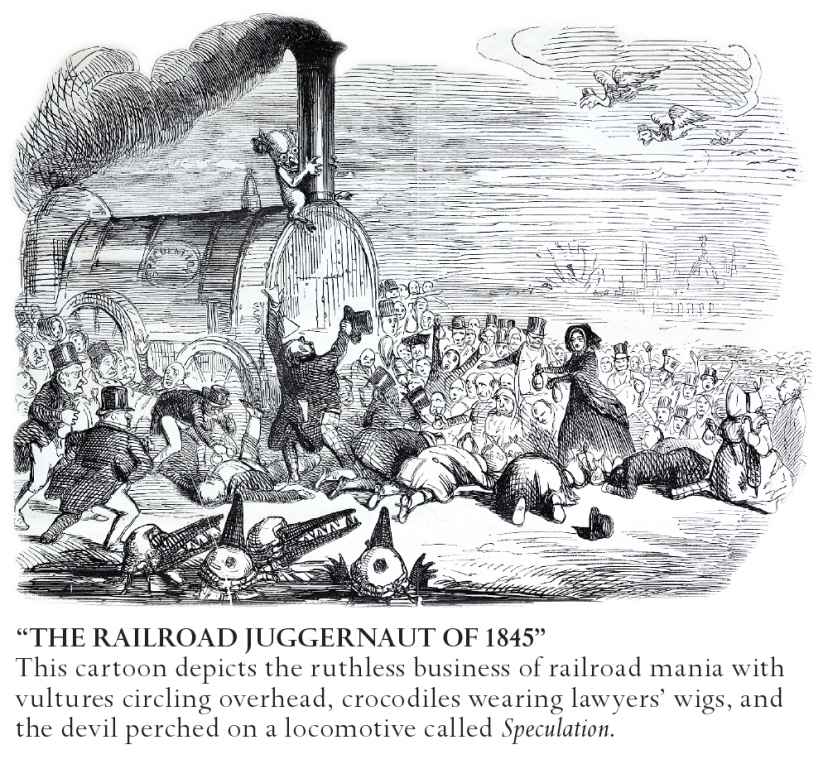
The rapidity with which the mania took hold was astonishing. In 1843, only 100 miles (160km) of new line were approved by the British Parliament, but over the following three years the figures were respectively around 800 miles (1,200km), nearly 3,000 miles (4,800km) and an astonishing 4,500 miles (7,200km), as 272 acts were granted. The scale of this boom can be judged by the fact that it represented a theoretical amount of £700m worth of capital investment—ten times Britain’s annual exports at the time. However, the boom collapsed even faster than it grew. The economy slumped again in 1847, and as a result, only 17 miles (27km) of new line were approved by 1849, but an astonishing two thirds of the mileage approved thus far was eventually completed within a few years, and even some of the failed projects were revived in the smaller booms of 1852–53 and the 1860s.
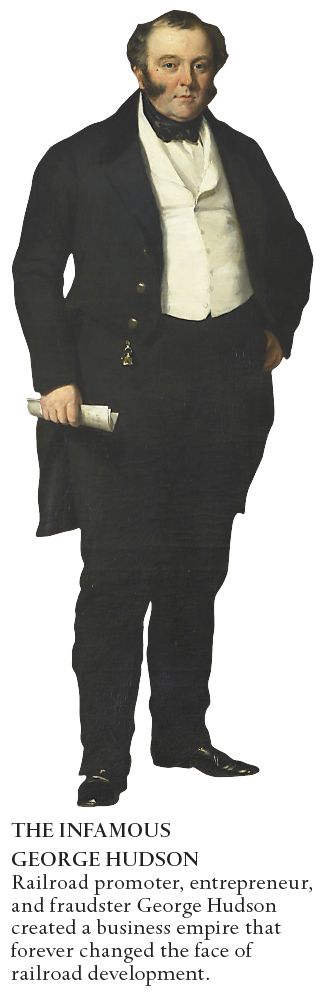
Although most of the projects, even the failed ones, were genuine attempts at building a railroad, some of them were blatantly fraudulent, while others were based on the belief that the expansion would last forever. This was the how the biggest fraudster of the period, George Hudson, created a massive empire, which inevitably collapsed when the bubble burst. A strange-looking fellow, who one biographer describes as having “a cannon-ball of a head set upon his bulky shoulders, the formality of a neck having been disposed of,” Hudson was full of energy and had a fondness for the good life—perhaps the typical profile of a fraudster. He did, in fact, succeed in building several railroads, including the core of the Midland Railway, which was one of the most extensive lines in Britain. He had some other good ideas, too, such as establishing a ticket clearing house through which railroad companies reimbursed each other for running trains on each other’s tracks. As he grew in confidence, however, he used the money he raised for new schemes to pay dividends on previous projects—what is now called a Ponzi scheme. His accounting practices had, in fact, been so dubious that on his demise it was impossible to find out where all the money had gone. He had become rich, as one wag put it, “by keeping everything but his accounts.” His career, so glittering that he was elected Lord Mayor of York and later an MP, came to an abrupt end in 1849 when his dishonesty was exposed, after which he vanished into obscurity.
Switzerland underwent a period of railroad mania in the 1850s, helped by Alfred Escher, a powerful Swiss businessman and politician, and a keen supporter of the railroads. He had observed the growth of railroads in other countries, and feared that Switzerland was missing out on the economic prosperity offered by a rail network and would become “the sad face of Europe’s backwater.” In 1852, he helped push through a law allowing private companies to build and run railroads. This launched a frenzy of construction by competing companies—joined by Escher himself, who founded Swiss Northeastern Railway and enjoyed great success. Over the following decades, the Swiss rail network extended across the country, including the ambitious Gotthard Railway in the 1870s (see Gotthard Tunnel).
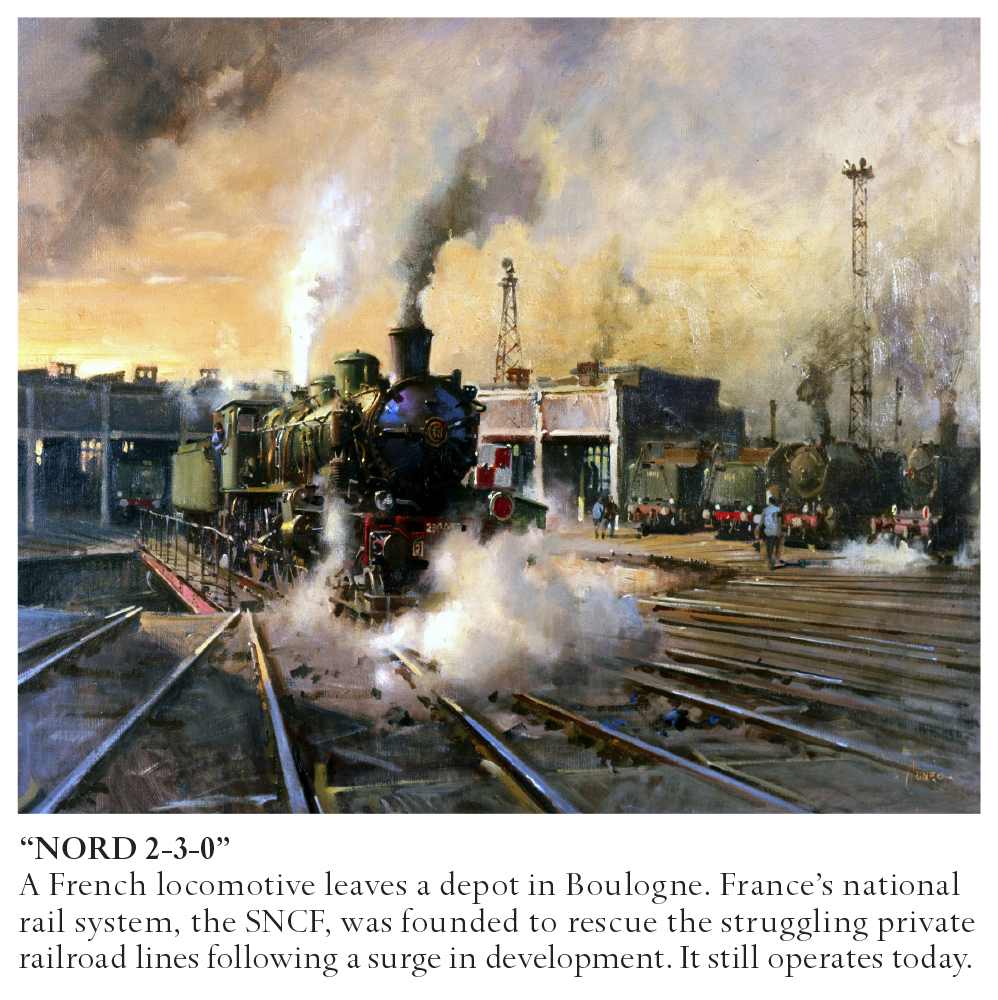
In France, a law passed in 1865 to encourage railroad construction in remote areas led to a period of rapid railroad expansion. At the time, France’s railroads were controlled by six large companies, and the idea was to encourage new entrants on to the network to ensure better coverage of rural areas where the six were reluctant to go. The law allowed local authorities to sponsor these lines, and speculators piled in, seeing the possibility of making money out of the grants being offered, despite the fact that most of these lines would never be viable. Within ten years, nearly 3,000 miles (4,800km) of remote lines had been built, many with a narrow gauge to reduce costs. However, few of them made money and they soon had to be rescued by the state, forming the core of what later became the French nationalized railroad system, SNCF.
In Italy, too, it was the government that stimulated a period of rapid expansion. Creating a national rail network was seen as essential after the unification of Italy in 1861, and the state sponsored a rapid expansion through a concession system. However, most of the companies that built the lines had insufficient capital and got into financial difficulties when the lines, which were poorly constructed, failed to attract enough passengers. The state inevitably took over and nationalized the railroads, which resulted in many investors losing money.
Perhaps unsurprisingly, it was the US that suffered the biggest bout of “railroad fever,” as they called it. There were, in fact, sporadic boom periods of railroad construction throughout the latter part of the 19th century, as humorously described by the historian Stewart H. Holbrook, who related the story of a fictional town called Brownsville:
First some up and coming individual, or simply a fanatical dreamer, said forcibly that his home town Brownsville needed a steam railroad… the idea grew and blossomed and burgeoned and even soared meanwhile taking on all of the beautiful hues of the sky in the Land of Opportunity. It also dripped with gold, gold for all of Brownsville, soon to be a mighty metropolis, teeming with commerce.
… and so on, until an application was made to the state for permission to build the Brownsville Railroad. This type of scene was enacted many times over across the US during every bout of railroad fever.
The US has more than its share of crooks in its railroad history. A group of “robber barons” emerged from the early railroad companies, often using dishonest methods of speculation to gain control of profitable lines. It was a time of wild risks and gambles. In one famous incident – a takeover battle for the Erie Railroad – three railroad barons, led by Jay Gould, holed up in a hotel in New Jersey with several million dollars in cash, protected by armed guards to evade the jurisdiction of the New York courts, which had found in favor of their rival, Cornelius Vanderbilt. (Gould and his associates did eventually win the battle for the Erie Railroad – see Erie Railroad). Such events, while not commonplace, were part and parcel of the colorful period of railroad speculation in the US.
The final bout of speculative building in the US was in the early 20th century, and involved a series of tramways called “electric interurbans.” These were a hybrid of trains and trams that connected towns up to 50 miles (80km) apart with cheaply built single lines sited next to existing highways. There was a remarkable period of expansion of these lines from just 2,000 miles (3,200km) at the turn of the century—by 1906 there were 9,000 miles (14,400km), and by the outbreak of World War I, 15,000 miles (24,000km). By then, it was possible to travel all the way from Wisconsin to New York using a series of interurbans. It was a cheap ride, costing 10 cents for the journey, but it was slow, for the interurbans averaged around 20mph (32kph) at best. Sadly, according to one historian, “the interurbans were a rare example of an industry that never enjoyed a prolonged period of prosperity,” and most investors lost all their money. The demise of the interurbans was swift because they were inherently unprofitable, serving sparsely populated areas and facing competition from the growing use of motor vehicles. Already at the start of World War I, systems were closing and they were all but wiped out by the 1930s, when their vehicles and tracks needed renewing and there was no money for such investment.
All the manias across the world left their mark. Many investors lost their shirts, but many of the lines were built and a good proportion of those survive today. As with other industries, the manias had their roots in genuine need, and many of today’s lines worldwide owe their existence to these excesses.