
THE CHIEF EXCELLENCY
In India as elsewhere economic indicators for the pre-modern period are hard to come by. But thanks to Abu’l-Fazl’s Ain-i-Akbari, to the numerous accounts of the Mughal empire written by foreign visitors, and to the painstaking analysis recently undertaken by scholars like Irfan Habib,1 some basic statistics are available from the late sixteenth century onwards. By combining different methods of calculation, the population of the Indian subcontinent in the year 1600 has been estimated at about 140 million, of whom about 100 million lived within the great band of territory between the Himalayas and the Deccan sultanates which comprised Akbar’s empire. At a time when the population of the British Isles can have been barely five million, and that of all western Europe less than forty million, India was not short of manpower. Travellers, Asian as well as European, marvelled at the frequency of villages and at the dense crowds which thronged the cities. Even Babur, though unimpressed by the inventiveness of India’s craftsmen, had been taken aback by their numbers. Timur had employed two hundred stone-cutters in Samarkand; Babur on the other hand employed nearly fifteen hundred, mostly at Agra. ‘Men of every trade and occupation are numberless and without stint in Hindustan,’ he reported.2
Nor was the country in any sense impoverished by having to support such a large population. Quite the contrary; it was this abundant labour force which generated the surplus on which the Great Mughals grew so great. Compared to central Asia, ‘the chief excellency of Hindustan is that it is a large country and has abundance of gold and silver,’ reckoned Babur. But neither gold nor silver were mined in very significant quantities anywhere in India: such wealth could be accumulated only from foreign trade. The largeness of the country, rather than the abundance of precious metals, represented its true ‘excellency’. For a large country meant plenty of land and, given an average monsoon, plenty of land meant bounteous crops.
Land and labour generated the wealth of India; and on the success with which these resources could be commanded, and their surplus mobilised and distributed, depended the stability of every dynastic regime. It would be wrong, though, to conclude that land and labour were therefore considered the basic units of the economy. Possibly because they had always been comparatively abundant, ownership and input were usually subsumed in a calculation of their joint yield. In India, ever since the earliest evidence of a share of the crop being donated for ritual purposes, produce – not people, not property – was what mattered. On what a field, village, district or province could be expected to produce, or on the value placed on this product, were based all grants, taxes and other revenue rights.
These rights were the means by which the surplus was creamed off from the cultivator, and they varied enormously from one part of the country to another, from one period to another, and from one crop to another. Even in a single village at any given time there might be cultivators subject to three of four different kinds of surplus extraction; thus the yield of some lands might constitute the jagir (revenue assignment) of a great amir (noble), that of others might have been granted as income to some religious establishment, and that of yet others might have been reserved to the crown (khalsa). In addition to such grand and usually absent beneficiaries there were also various lesser and usually local intermediaries with a tenacious claim on the yield. These included those who facilitated or enforced its actual collection, amongst them powerful individuals and interests ranging from the village headman to the zamindar (literally ‘landholder’ but more generally a blanket term for any rural superior).
Although the theory was that all these beneficiaries were entitled to a certain percentage of the yield, leaving the remainder to the cultivator, the reality was that the entire yield, minus only what was deemed necessary for the cultivator’s survival, was liable to appropriation. ‘Amidst the complexity of the arrangements for assessment and collection [of the revenue], one major aim of the Mughal administration still stands out: the attempt at securing the bulk of the peasant’s surplus.’3
In consequence the peasant’s lot was not, even in good times, a happy one. François Bernier, a doctor who travelled widely in India in the 1660s and then reported his findings to Louis XIV’s chief minister, described the lot of the Indian peasant as ‘a debasing state of slavery’.Jagirdars,zamindars and the like exercised ‘a tyranny often so excessive as to deprive the peasant and the artisan of the necessaries of life, and leave them to die of misery and exhaustion’. It was, moreover, ‘a tyranny that drives the cultivator of the soil from his wretched home to some neighbouring state in hopes of milder treatment, or to the army where he becomes the servant of some trooper’.
As the ground is seldom tilled otherwise than by compulsion, and as no person is found willing and able to repair the ditches and canals for the conveyance of water, it happens that the whole country is badly cultivated and a great part rendered unproductive for want of irrigation.4
Bernier thought the problem lay in the absence of individual property rights. Like most Europeans he mistook revenue rights for outright ownership and so considered the king, as the bestower of these rights, to be ‘the sole proprietor of the land’. Since such rights, or in Bernier’s estimation such land grants, were not heritable and could be resumed or swapped by the sovereign at will, the jagirdars who held them had no long-term interest in improving the yield by investing in wells and irrigation. ‘“Why should we spend time and money making [the land] fruitful,’” they asked, “when we may be deprived of it at any moment and our exertions will benefit neither ourselves nor our children?”’ Likewise, according to Bernier, ‘the peasant cannot avoid asking himself the question: “Why should I toil for a tyrant who may come tomorrow and lay his rapacious hands on all I possess without leaving me, if such be his humour, the means to drag on my miserable existence?”’
No doubt Bernier generalised. His India of the 1660s would be still recovering from a succession crisis which amounted to civil war. Large parts of the Deccan, through which he travelled, were in turmoil. An honest observer, he saw India as a parable in mismanagement which might be useful to France’s chief minister, Jean-Baptiste Colbert, as he undertook the radical reform of Louis XIV’s finances. Bernier also overlooked the fact that during the latter part of Akbar’s reign and during those of his immediate successors, Jahangir (1605–27) and Shah Jahan (1627–58), many parts of northern and central India had been enjoying a period of unprecedented political stability. Crop seizures and the requisitioning of transport and labour for military purposes had practically ceased. Markets functioned well, weights and measures were standardised, and cash circulated easily. The population was gradually increasing and so was productivity. Even the derelict villages noticed by the doctor may have been deserted simply because the cultivators had decamped to develop new lands on which the revenue assessment was lighter. Under such incentives much wasteland is thought to have been reclaimed for cultivation during the seventeenth century.
Industry and trade also boomed thanks to the settled conditions and safer communications. Roads, some still today with their Mughal kos minar (brick or stone watchtowers at regular intervals, like mile-posts), linked provincial capitals and trading centres to the imperial axis of Agra–Delhi–Lahore. Around the imperial court at all three of these cities grew up extensive service complexes housing costumiers, perfumiers, gold and silversmiths, jewellers, ivory-carvers, gunsmiths, saddlers, joiners and the army of architects, civil engineers, stonemasons and polishers needed for India’s most ambitious building programme. Similar establishments catered for the nobility in the provincial capitals which, like Ahmadabad, rapidly grew into major cities under Islamic patronage. In the field a moveable bazaar of farriers, armourers, elephant-keepers, tent-makers and provisioners accompanied the imperial forces.
The advent of new European trading companies also stimulated industrial demand, especially for the cotton textiles – muslins, taffetas, brocades, batiks, ginghams – of Gujarat, Bengal, Golconda and the Tamil country. Founded respectively in 1600 and 1602, the East India Companies of London and the Netherlands had been intended to contest the Portuguese monopoly of the mainly Indonesian spice trade. They soon became equally interested in India’s manufactures. During the reign of Jahangir, Akbar’s immediate successor, both companies set up trading houses in Surat, which was by now the main port in Gujarat. They also began to tap into the ancient trade between India’s east coast ports and south-east Asia. Politically the companies were an irrelevance and would long remain so. But by 1640 they had ended Portugal’s monopoly of the eastern sea-routes; Europe’s domestic markets were discovering the joys of cheaper soft-furnishings and more washable cotton apparel; and sailings, whether regulated by the companies or unregulated, were boosting demand in India and, since payment was usually made in bullion, providing a welcome influx of silver.
None of this alleviated the plight of the cultivator. In fact his situation may have been worsened by the prevailing pax Mughala . Unlike the nayaks of the Vijayanagar empire, office-holders and jagirdars under the Mughal dispensation were seldom left long enough in possession of their grants either to become acquainted with rural conditions or to attract local allegiance. Defiance of imperial directives was therefore rarer and, with the important exception of imperial claimants, the nobility were less inclined to revolt. The reforms undertaken by Akbar would indeed go a long way towards integrating most of the subcontinent into a strong, centralised political structure. But it was an integration from above which ignored the plight of the producer and sought increased productivity through increased exploitation. ‘The Mughal state was an insatiable Leviathan,’ writes Tapan Raychaudhuri in The Cambridge Economic History of India, ‘its impact on the economy was defined above all by its unlimited appetite for resources.’5
Akbar’s reforms focused on two distinct control mechanisms: the creation of a centralised bureaucracy, and the elaboration of a standard system of military grading. Each resulted in a separate hierarchy which overlapped only at the top. The bureaucracy sprang from his abolition of the office of chief minister. Instead there were to be four departments and four department heads, one for finance and revenue, one for the military and intelligence, one for religious affairs and the judiciary, and one for the royal household and public works. The same arrangement was duplicated in the provincial capitals of each of the main provinces (Lahore for the Panjab, Ajmer for Rajasthan, etc.), and was extended to other regions as they were incorporated into the empire. All departments were subject to audit; and most staff were salaried although the more senior office-holders were awarded jagirs (revenue assignments) and a ranking within the military hierarchy.
The system of military ranking, Akbar’s other control mechanism, assigned to every senior military commander and office-holder a numerical rank which governed his status and remuneration. Additionally a second system was introduced to denote the number of armed cavalrymen, or sowars, which each had to maintain for service in the imperial army; extra horses, transport and elephants were stipulated for the most senior ranks. Thus all amirs (nobles) and many lesser mansabdars (rank-holders) had both a zat(personal) ranking and a sowar (trooper) ranking. All such rankings were in the emperor’s gift, as were promotion, demotion and dismissal. The system was laden with incentives and duly produced some exceptionally able commanders and administrators. It also encouraged personal loyalty to the emperor while integrating into a single power-structure the assorted Turks, Persians, Afghans, rajputs and Indian Muslims who comprised the nobility.
Although the emperor maintained his own household troops, the recruitment and maintenance of most of his vast forces were thus in effect contracted out. Similarly, since all senior mansabdars were awarded jagirs by way of salaries, the responsibility for most revenue collection was also contracted out. Rates of remuneration, which included both the mansabdar’s salary and so much per sowar, were matched by jagirs affording a similar aggregate yield. If their specified yield came to more, the surplus was due to the imperial treasury; if the jagirdar extracted more than the specified yield, he kept it.
‘Towards the end of [Akbar’s] reign mansabdars and their followers consumed 82 percent of the total annual budget of the empire for their pay allowances.’6 There were around two thousand mansabdars at the time and between them they commanded 150,000–200,000 cavalrymen. The emperor personally commanded a further seven thousand crack sowars plus eighty thousand infantry and gunners who together accounted for another 9 percent of the budget. In addition, according to Abu’l-Fazl, the locally-basedzamindars could muster a colossal 4.5 million retainers, mostly infantrymen. These last, who were poorly paid if at all by their zamindars, did not feature in the imperial budget. But by aggregating all these troop numbers and then adding to them the likely horde of non-combatant military dependants – suppliers, servants, family members – it has been suggested that the figure for those who relied on the military for a living could have been as high as twenty-six million. That would be a quarter of the entire population. The Mughal empire, whether bearing the character of ‘a patrimonial bureaucracy’ as per the administrative hierarchy, or of ‘a centralised autocracy’ as per the ranking system, was essentially a coercive military machine.
Much of this coercive potential was deployed in campaigns against obdurate neighbours like the Deccan sultanates. But, excluding those units on active service or in attendance at the royal court, many sowar contingents were stationed in different parts of the empire where they could be called upon to maintain order and enforce the collection of revenue. In effect many regular troops, as well as all those zamindari retainers, were being used to extract the agricultural surplus which financed them. It was, as Raychaudhuri puts it, ‘a vicious circle of coercion helping to maintain a machinery of coercion’.7
Such heavy-handed intervention on the part of the central government was necessary to overcome the resistance traditionally offered by local zamindari interests and so maximise the revenue yield due to the emperor or his jagirdars . Another way of maximising the revenue yield was to improve the means by which crops were assessed and the revenue calculated. During his brief reign Sher Shah had shown the way with new land surveys, new calculations of estimated yields, and collection in cash instead of kind. But it was Raja Todar Mal, a Colbert to Akbar’s Louis XIV, who from 1560 onwards overhauled the whole revenue system. Standard weights and measurements were introduced, new revenue districts with similar soils and climate were formed, revenue officers were appointed for each such unit, more surveys were undertaken, more data on yields and prices collected, new assessments worked out for each crop and each area, written demands issued and accepted by the village headmen, and copious records kept and filed.
The introduction of these reforms necessitated a five-year period of direct administration during which all jagirs were cancelled. When they were reintroduced in 1585 the results were highly satisfactory. Revenue receipts were vastly increased and the state enjoyed a massive share of rural productivity amounting to ‘one-third of all foodgrain production and perhaps one-fifth of other crops’, much of it achieved ‘at the expense of the older claims and perquisites of the zamindars’.8
NO MAN HIS RELATION
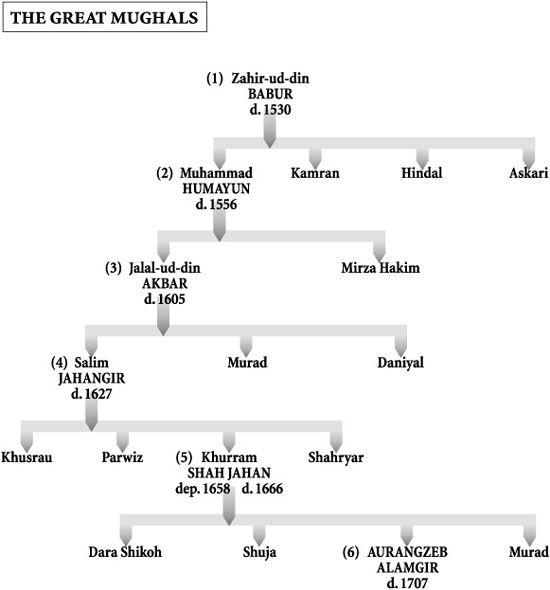
Drawing heavily on Bernier’s account, in 1675 John Dryden’s Aureng-Zebe, a highly romanticised verse epic, received its first performance in London. Through such works the ‘Grand Mogul’ became synonymous in English with autocratic rule and unimaginable opulence. All foreign visitors to the India of the six Great Mughals – Babur, Humayun, Akbar, Jahangir, Shah Jahan and Aurangzeb – found ample evidence of an awesome authority and were stunned by the magnificence of the imperial setting. This last was most obviously architectural, but not exclusively. The eye-catching profusion of solid gold and chased silver, precious silks and brocades, massive jewels, priceless carpets and inlaid marbles was probably without parallel in history. Sir Thomas Roe, an emissary from James I of England and a man usually more obsessed with his own dignity, was frankly amazed when he saw Jahangir in ceremonial attire. The emperor’s belt was of gold, his buckler and sword ‘sett all over with great diamonds and rubyes’.
On his head he wore a rich turbant with a plume of herne tops, not many but long; on one syde hung a ruby unsett, as big as a walnutt; on the other syde a diamond as greate; in the middle an emeralld like a hart, [but] much bigger. His shash was wreathed about with a chaine of great pearles, rubyes and diamonds, drilld. About his neck he carried a chaine of most excellent pearle, three double (so great I never saw); at his elbowes, armletts set with diamonds; and on his wrists three rowes of several sorts.9
Bernier was equally impressed. ‘I doubt whether any other monarch possesses more of this species of wealth [i.e. gold, silver and jewels] …, and the enormous consumption of fine cloths of gold, and brocades, silks, embroideries, pearls, musk, amber and sweet essences is greater than can be conceived.’
Yet, despite all this show, there remained some doubt about the real prosperity of the Mughal emperors. Aurangzeb’s income, reported Bernier in the 1660s, ‘probably exceeds the joint revenues of the Grand Seignior [i.e. the Ottoman sultan] and of the King of Persia’. But so, continued the Frenchman, did his expenses. And although revenue receipts had doubled since Akbar’s day (partly thanks to Todar Mal’s reforms, partly as a result of the acquisition of new territories), so too had expenditure. The emperor was therefore to be considered wealthy ‘only in the sense that a treasurer is to be considered wealthy who pays with one hand the large sums which he receives with the other’.10 As for all the gems and gold, these represented not revenue but gifts, tribute and booty, ‘the spoils of ancient princes’. Though valuable enough, they were not productive. India had long been ‘an abyss for gold and silver’, drawing to itself the world’s bullion and then nullifying its economic potential by melting and spinning the precious metals into bracelets, brocades and other ostentatious heirlooms.
There was also doubt about the size of the imperial army. Jean de Thevenot, another French visitor to Aurangzeb’s empire, had read that the emperor and his mansabdars could field 300,000 horse. This was what the records showed, and ‘they say indeed that he pays so many’. But, mansabdars being notoriously lax in providing their full complement of troopers, ‘it is certain that they hardly keep on foot one half of the men they are appointed to have; so that when the Great Mogol marches upon any expedition of war, his army exceeds not a hundred and fifty thousand horse, with very few foot, though he have betwixt 300,000 and 400,000 mouths in the army.’11
Worse still, the army, like the wealth, was not always being deployed to productive effect. Akbar’s long reign (1556–1605) had been punctuated by a succession of brilliant and rewarding conquests, but as it drew to a close these were overshadowed by rivalry and rebellion. In 1600 Prince Salim, the future Jahangir, attempted to seize Agra during Akbar’s absence in the Deccan; in 1602 he actually proclaimed himself emperor; and in 1605, a few weeks before Akbar’s death, he re-erected that Ashoka pillar at Allahabad and, in a blatant assumption of Indian sovereignty, had his own genealogy inscribed alongside the Maurya’s edicts and Samudra-Gupta’s encomium. Abu’l-Fazl, by now a senior commander as well as Akbar’s memorialist, was sent to deal with the prince but was coolly murdered on the latter’s orders. Even when, after reconciliation with his father, Salim/Jahangir’s succession seemed settled, he was opposed by sections of the nobility who preferred Prince Khusrau, his (Salim’s) eldest son. When his father was duly installed as the Emperor Jahangir (‘World-Conqueror’), Khusrau fled north, laid siege to Lahore, and had to be subdued in battle. Captured, he was eventually blinded on his father’s instructions.
‘Sovereignty does not regard the relation of father and son,’ explained Jahangir in his enlightening but decidedly naive memoir. ‘A king, it is said, should deem no man his relation.’12 Distrust between father and son, as also between brothers, would be a recurring theme of the Mughal period, generating internal crises more serious and more costly than any external threat. Of another trouble-maker Jahangir quoted a Persian verse: ‘The wolf’s whelp will grow up a wolf, even though reared with man himself.’ This proved unintentionally apposite. In 1622 Prince Khurram, Jahangir’s second and best-loved son, on whom he had just bestowed the title ‘Shah Jahan’ (‘King of the World’), would dispose of his elder brother (the blind Khusrau) and then himself rebel against his father. The whelp was indeed worthy of the wolf. In the field or on the run, Shah Jahan led the imperial forces a merry dance for four years. Father and son were only reconciled eighteen months before Jahangir’s death in 1627. There then followed more blood-letting as Shah Jahan made good his claim to the throne by ordering the death of his one remaining brother, plus sundry cousins.
And so it went on. ‘Deeming no man their relation’, least of all their father, in due course each of Shah Jahan’s four sons would mobilise separately against him as also against one another. When Aurangzeb won this contest and in 1658 deposed his father Shah Jahan and imprisoned him in Agra’s fort for the rest of his days, he not unreasonably justified his conduct on the grounds that he was merely treating Shah Jahan as Shah Jahan had sought to treat Jahangir and as Jahangir had sought to treat Akbar. Unsurprisingly Aurangzeb would himself in turn be challenged by his progeny.
Such was the intensity of this internal strife that during much of the seventeenth century it obscured and even confounded attempts to expand Mughal rule. Jahangir’s one notable success was achieved early in his reign when Prince Khurram (Shah Jahan), at that time still ‘my dearest son’ rather than ‘the wretch’ he later became, secured the submission of the Mewar rajputs. Since Rana Udai Singh’s desertion of Chitor and its capture by Akbar, the Mewar Sesodias had recouped their forces and under Rana Amar Singh had successfully seen off several Mughal attempts to induce their submission. Khurram–Shah Jahan at the head of a vast army now concentrated on containment and attrition rather than epic sieges. There was no great battle; indeed Roe, the English ambassador, snidely remarked that the Rana had ‘rather been bought than conquered’, or ‘won to own a superior by gifts and not by arms’.13
Nevertheless the arrival at court of the son of Rana Amar Singh was proof enough of Mewar’s shame. Jahangir, content to have succeeded where Babur and Akbar had both failed, proved magnanimous in victory, while the young Mewar prince sought to save face by excusing himself from making personal submission; no reigning Rana ever would. Amar Singh’s successors would remain on good terms with Khurram–Shah Jahan who received from them sanctuary when in revolt and support when in power. It was during Shah Jahan’s reign as emperor and Jagat Singh’s as rana that the latter embellished his lake at Udaipur with the island, clad in white marble, which was later rebuilt as the famous Jagnivas or ‘Lake Palace’.
But in the next Mughal succession crisis the rana was wrong-footed. A victorious Aurangzeb had no time for his father’s allies nor for the half-loyalties of a Hindu princeling. Every rajput must now be a subservient Mughal amir (noble); either that or be outlawed as one of those ‘Rashboots’ (i.e. rajputs) whom, in the 1690s, the German traveller de Mandelso took to be ‘Highway men or Tories’. Mughal–Mewar hostilities had yet to run their course.
Meanwhile on the frontiers of their empire Jahangir and Shah Jahan endeavoured to emulate Akbar. They rarely succeeded. In the east, although nearly all of what is now Bangladesh was by this time under Mughal rule, a Shan people from upper Burma, the Ahoms, pre-empted Mughal expansion in Assam and repeatedly rolled back Mughal incursions. In the north, along the foothills of the Himalaya, much was made of the capture by Khurram–Shah Jahan in 1618 of the great fort of Kangra (now in Himachal Pradesh). Again Jahangir, who was still emperor at the time, claimed the victory for himself; ‘since the day when the sword of Islam and the glory of the Mohamedan religion have reigned in Hindustan’ no sovereign, he boasted, had been able to reduce the place.14 He was evidently unaware that, as Nagerkot, the fort had been ransacked by Mahmud of Ghazni six hundred years before. There followed minor conquests on the frontiers of Kashmir, whose willow-fringed lakes and cooler climate so enchanted Jahangir, plus another triumph for Khurram–Shah Jahan when at the very end of his father’s reign he finally secured the submission of the raja of Garhwal, a minor hill state in Uttar Pradesh.
None of these places can have rewarded the expense of taking them, nor were they of any great strategic or prestige value. In a very different class, though, were the empire’s two other land frontiers, that in the north-west and that in the Deccan. Invasion was possible from either, both were in the habit of welcoming and assisting Mughal dissidents, and both were arenas in which the Mughals had long-standing ancestral designs. A sovereign self-billed as a ‘World-Conqueror’ like Jahan-gir, or as a ‘King of the World’ like Shah Jahan, could ill afford to ignore either. But here again little real headway was made. In fact Kandahar, the commercially and strategically important capital of southern Afghanistan which Humayun had ceded to Persia and which Akbar had then won back, was again lost. As Persia’s great Shah Abbas advanced on the city in 1622, Jahangir commanded Khurram–Shah Jahan to rush his troops to its defence. This was the order which tipped the latter’s suspicions of his being sidelined for the succession into an open defiance. Jahangir had to switch his attention to the more immediate challenge posed by his son, and Kandahar fell to the shah. Although, as emperor, Shah Jahan launched numerous expeditions to reclaim the city, all proved dismal and increasingly embarrassing failures. So were Shah Jahan’s two forays into northern Afghanistan. Neither of their targets, Balkh and Badakshan, was secured and the dream of reinstating a Timurid in Samarkand receded still further.
The Deccan should have offered a softer and more rewarding target. In the early seventeenth century it was still divided amongst those successor states of the Bahmanid sultanate – now principally Ahmadnagar (in Maharashtra), Golconda (later Hyderabad) and Bijapur (in Karnataka) – which had briefly united for the conquest of Vijayanagar. Akbar, towards the end of his reign, had made the first move by mounting several attacks on Ahmadnagar which culminated with the capture of the city itself in 1600. It also destabilised the Ahmadnagar sultanate, already shaken by rivalry with Bijapur. In the confusion an unlikely but immensely able king-maker emerged. Malik Ambar was an African hubshi (Negro) who had been sold in Baghdad as a slave, brought to the Deccan and, after speedy advancement as a result of numerous military exploits, now undertook the restoration of the Ahmadnagar sultanate with himself as commander and policy-maker. As an administrator he is said to have shown a fine impartiality as between Hindus and Muslims and to have adopted most of the revenue reforms pioneered in Mughal territory by Raja Todar Mal. As a commander he had neither master nor equal and proved the most resourceful and resilient campaigner of his day. Often obliged to use guerrilla tactics, he relied heavily on highly mobile cavalry units which, raised from the martial Hindu aristocracy of upland Maharashtra, were now known as Marathas. Other Marathas served in the Bijapur and Golconda forces. In the increasingly chaotic affairs of the Deccan these Maratha leaders, taking their cue from Malik Ambar, would soon strike out on their own.
Throughout Jahangir’s reign, ‘the black-faced Ambar’ harassed and occasionally routed most of the many Mughal expeditions launched against him. At one point he led his forces north as far as Mandu in Malwa, at another he lay siege to Bijapur. Defeats were quickly reversed, losses recovered, submissions withdrawn. In 1624, at Bhatvadi near Ahmadnagar, Malik Ambar inflicted such a crushing defeat on a combined Mughal–Bijapuri force that he was able to recover virtually the whole of the erstwhile Ahmadnagar sultanate. Then in a final irony Khurram–Shah Jahan, a commander at whose hands he had previously suffered, sought his alliance. This was in 1625 when Khurram–Shah Jahan was in rebellion against his father. The African ex-slave welcomed the ‘King of the World’ and together their forces laid siege to the Mughal’s Deccan headquarters at Burhanpur.
For Malik Ambar there was no such thing as defeat; only his death in 1626 proved irreversible. Thereafter the Ahmadnagar succession faltered and, despite the efforts of Shahji, a Maratha leader of some future consequence, the state barely survived until Shah Jahan, as emperor, formally incorporated it into the Mughal dominions in the mid-1630s. He followed this success by demanding, at the head of an army fifty thousand strong, the submission of Golconda and Bijapur as vassal states. Both eventually complied, the latter after a hard-fought resistance. This was undoubtedly Shah Jahan’s greatest triumph and on paper it extended Mughal suzerainty deep into the peninsula.
But ironically it was also the making of the sultanates. Acceptance of Mughal overlordship scarcely limited their freedom of action and, with their northern frontiers now secure, both Bijapur and Golconda embarked on extensive conquests to the south in the domains of the Vijayanagar nayaks. Much of what is now northern Tamil Nadu – including a Portuguese settlement at San Thome plus a neighbouring stretch of deserted beach at Madras(patnam) where Francis Day of the English East India Company was about to petition the local nayak for building permission – passed under Golconda’s rule. Bijapur secured southern Karnataka (the modern Mysore/Bangalore area) and a fat wedge of southern Tamil Nadu which included the Chola heartland.
In extending Muslim rule to the mouth of the Kaveri river, the Deccan sultanates had revived the successes of the Khalji and Tughluq sultans. Like these predecessors, they too were greatly enriched thereby and, together with the Marathas, they and their wealth would become a preoccupation of the redoubtable Aurangzeb. As Shah Jahan’s governor in the Mughal Deccan and then as emperor, Aurangzeb would for long periods make the Deccan his home. Indeed Deccan policy would be a vital ingredient in his bid for power. Once again the interests of the empire would be subordinated to those of the succession.
It has to be said in defence of the chaotic Mughal successions that only the fittest could hope to survive. From the filial free-for-alls there emerged some of the ablest, most charismatic and most long-lived rulers India has ever known. Even Humayun and Jahangir, the one addicted to opium, the other to alcohol, yet had the sense to select extremely capable consorts and advisers. In 1611 Jahangir had married the thirty-year-old widow of one of his Afghan amirs. Her father, the Persian-born Itimad-ud-Daula, became his closest adviser-cum-minister; her brother Asaf Khan was one of his most successful generals; and the lady herself, eventually known as Nur Jahan (‘Light of the World’), acted as co-ruler and, during periods of imperial incapacity, as the supreme sovereign. Public business ‘sleepes’, reported ambassador Roe, unless it was referred to her; she ‘governs him [Jahangir] and wynds him up at her pleasure’.15 In an unheard-of division of Islamic sovereignty, coins were even struck in her name. Were there any evidence that Jahangir could read the Gupta inscription on the pillar which he had so deliberately re-erected at Allahabad, one might infer that he derived the precedent from Chandra-Gupta I, whose Licchavi queen seems to have been the last consort to feature on north India’s coinage.
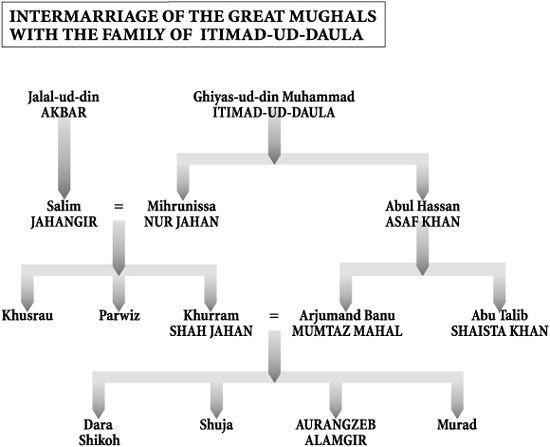
Nur Jahan’s influence should have extended into the next reign. Her brother Asaf Khan stood by Shah Jahan during his rebellion and duly became his closest adviser when he succeeded. Moreover Asaf Khan’s daughter, the famous Mumtaz Mahal, was Shah Jahan’s beloved consort. However Nur Jahan, nothing if not ambitious, came to doubt her chances of controlling her niece’s wilful husband and preferred the idea of a less wilful son-in-law. This was Prince Shariyar, one of Shah Jahan’s brothers and rivals, who was duly married to Nur Jahan’s daughter by her first marriage. On Jahangir’s death, Shariyar, aided by Nur Jahan, made his bid for power. He was outwitted by Asaf Khan, then defeated and murdered. Nur Jahan’s days as the power behind the throne were over. Instead she concentrated on erecting a tomb for her father Itimad-ud-Daula, who had died just before Jahangir.
Itimad-ud-Daula’s stately Agra tomb of white marble inlaid with semi-precious stones ushers in the classic period of Mughal architecture. Jahangir, though best remembered as an ardent and knowledgeable patron of Mughal painting, had not been uninterested in monuments, and under his direction Akbar’s five-tiered but domeless tomb at Sikandra (near Agra) had been erected. Like Sher Shah’s at Sassaram, its terraces and chattris seem to owe more to Indo-Muslim palace architecture than to the funerary conventions of Islam. Only the minarets which flank its gateway are determinedly Islamic; thirty years later they would be gloriously translated into the white marble sentinels which flank Shah Jahan’s Taj Mahal.
Jahangir also built in Lahore, Allahabad and Agra itself, and endowed a variety of less obvious sites in Kashmir and the Panjab with gardens, towers and watercourses. But it is to his son Shah Jahan, to his lavish patronage, his grand imagination and his inspired example, that north India owes its most splendid monuments. Of the magnificence and the might of the Mughals, as also of their extravagance and oppression, there could be no more eloquent testimony.
Shah Jahan built both the black marble pavilion of his now forlorn Shalimar gardens in Kashmir and the white marble pavilions of his now unrecognisable palace in Ajmer. There and in Lahore he also built mosques and, although it is scarcely mentioned in memoirs of his reign, he was presumably responsible for Jahangir’s tomb in Lahore. But it was in Agra and then Delhi that he most famously left his mark. Each in turn became the setting for the formal and increasingly rigid rituals of a self-conscious sovereignty which bordered on the divine. The informality of Babur’s roving entourage and the outspoken animation of Akbar’s symposia had given way to a more awesome ceremonial and a more exalted symbolism. Now the ‘King of the World’ ethereally presided from sun-drenched verandahs of the whitest marble; he was glimpsed through apertures of the richest inlay or framed by cusp-pecked arches; painted profiles showed his impeccable features within a glowing halo, a device adopted from Christian iconography; like the moon in the firmament he shone from the high-carat backdrop of his Peacock Throne wherein jewels to a value of ten million rupees humbly twinkled. The rituals of court and council and the conventions of costume and address were also set, as it were, in stone. Like the architecture, they were formulated to elevate and magnify the impossible grandeur of the greatest ‘Grand Mogul’.
Shah Jahan’s most ambitious creation was another new Delhi. Designed to supersede Agra as the imperial capital, it was not just a fort like Tughlaqabad and not just a sandstone fantasy like Fatehpur Sikri, but a whole new city with processional thoroughfares, bazaars, caravanserais, shaded waterways, spacious squares and massive stone walls. ‘The new walls were punctuated with twenty-seven towers and eleven gates enclosing some 6,400 acres; about 400,000 people lived within them.’16 Constructed in 1639–48 and called Shahjahanabad, this new Delhi was built to the north of the Khalji–Tughluq city and is now known as Old Delhi. Its rigid geometry has long since been blurred and its stately avenues obliterated, but some of the walls and gates remain as do the imperial complex known as the Red Fort and, hard by, the great Jama Masjid. The latter was then the largest mosque in India. From its slight eminence it still contrives to preside over the crowded chaos of one of India’s most densely peopled inner cities. Likewise the Fort, though ravaged by subsequent occupants, including the British, remains an impressive ensemble and is still a focus for state occasions and political pronouncements.
Another Red Fort, that in Agra, retains more of the flavour of the age. Most of it is as Shah Jahan rebuilt it, including the great pillared hall of the Diwan-i-Am and the whole sequence of white marble chambers and pavilions which encrust the fort’s upper storey. There, immured in his own creation and increasingly decrepit, the emperor would shuffle away his final years as Aurangzeb’s prisoner. And thence, squinting into the morning sun, he would famously gaze down the Jamuna river to the great white cloud which, moored in marble on the riverbank, housed the remains of his beloved consort and wherein he would himself be laid to rest by her side.
The Taj Mahal was commissioned, and named, for Mumtaz (Mumtaj) Mahal (literally ‘the Palace favourite’), who was the daughter of Asaf Khan and niece of Nur Jahan. She had shared the emperor’s troubled years on the run and become his dearest associate in power. When she died in 1631 while giving birth to their fourteenth child, the emperor was distraught. Her tomb was begun in the following year. ‘He intends it shall excell all other,’ reported Peter Mundy, an employee of the English East India Company who passed through Agra in the 1630s. ‘The building goes on with excessive labour and cost, prosecuted with extraordinary diligence, gold and silver [being] esteemed common metall, and marble but as ordinarie stone.’17 Completed in 1643, it was instantly acknowledged as a masterpiece. Bernier thought it one of the wonders of the world, James Fergusson, the pioneer of architectural study in India, rated its combination of beauties ‘unsurpassable’, and both Kipling and Tagore ventured a stab at its profound emotional appeal; to the first it was ‘the ivory gate through which all dreams pass’, to the second ‘a tear on the face of eternity’. Combining the bulb-like dome of Humayun’s tomb and the marble and inlay of Itimad-ud-Daula’s with the theatrical staging of Akbar’s and the landscaping of Jahangir’s gardens, it represented a triumphant summation of Mughal taste. Its symbolism, with a setting evocative of paradise and the great white tomb as an image of the Throne of God, is purely Islamic. But in its sculptural conception and in its execution many have recognised an essentially Indian aesthetic and ancient Indian skills.
The site on which the Taj stands was provided, at a price, by Raja Jai Singh, the Kacchwaha successor of that loyal rajput amir, Man Singh of Amber. From the Kacchwaha quarries at Makrana in Rajasthan also came its acres of white marble. The genius of the Mughals, in empire-building as in architecture, is often said to have lain in their synthesis of Indian and Islamic traditions and their eagerness to enlist the support of Hindu subjects, like the rajput princes, as well as that of fellow Muslims. Similarly, although the official language of the Mughal court was still Persian,urdu (literally ‘camp’), a hybrid tongue which had developed in the military encampments of the empire, was winning a wider currency. Written in the Perso-Arabic script, much of its syntax and vocabulary was borrowed from the Sanskritic derivatives of northern India. Poetry, painting and music benefited from the same synthesis and flourished under the same catholic patronage.
Aurangzeb would not conform in this respect. Discrimination against Hindus and the active promotion of Islamic values were about to be revived. Simultaneously the great tradition of Mughal building virtually ceased. Aurangzeb would have little use for the worldly ostentation of his predecessors. Shah Jahan’s expenditure on architecture is thought to have run to twenty-nine million rupees. Compared to the costs of war and the alienation of revenue to support the army, it was probably not significant.18 But having inherited an empire crippled by the crisis of his own succession and beset by still greater military priorities, Aurangzeb would be reluctant to squander even the smallest portion of his colossal revenues on monumental extravagances.
CONQUEROR OF THE UNIVERSE
The popularity of the dome as an architectural feature in the sixteenth and seventeenth centuries extended beyond Mughal India. Far outspanning the Taj Mahal or Sir Christopher Wren’s slightly later St Paul’s, indeed second only to Michelangelo’s somewhat earlier St Peter’s, is an unsung edifice of still impressive integrity known as the Gol Gumbaz of Bijapur.
As if to match the Mughals mosque for mosque and tomb for tomb, the Deccani sultans of Bijapur – and to a slightly lesser extent their neighbours in Golconda – had been busy building since the 1570s; and just as Agra’s architecture climaxed with the Taj so did Bijapur’s with the Gol Gumbaz. Four-square with pagoda-like towers, seven storeys high, at each corner, the Gol Gumbaz (‘Round Dome’) displays a refreshing simplicity combined with extraordinary technical expertise. A finish of pale stucco imparts a certain warmth, but the emphasis is on strength, with the great dome in no way disparaging the sturdy castellate structure on which it sits. If the Taj, as befits the tomb of a queen, has a feminine delicacy, the Gol Gumbaz, the tomb of a sultan, is all masculine virility.
It was completed in 1659 for Sultan Muhammad Adil Shah who had died two years earlier after a reign of thirty years. His father, Ibrahim Adil Shah II, had reigned for forty-seven years (1580–1627) in the nearest thing to a golden age which strife-torn Bijapur would ever know. As a patron of the arts and a tolerant Sunni who allowed both his Shia and Hindu subjects to worship as they pleased, Ibrahim boosted the reputation of the Deccan sultanates for enlightened rule. ‘Nor was he fond of unnecessary war,’ says Ferishta, who under Ibrahim’s protection wrote his great History of the Rise of Mohammedan Power . The History ends rather abruptly with Akbar’s invasion of Ahmadnagar in 1600. Ibrahim had been drawn into this struggle, and wars, necessary and otherwise, now intensified. Under Muhammad Adil Shah, Bijapur had been obliged to acknowledge Mughal supremacy but found compensation in conquests in Mysore and Tamil Nadu. Bijapur’s rule eventually spanned the peninsula from the Konkan and Malabar coasts in the west to the southern Coromandel coast in the east. There the triple fort of Jinji (Gingee, near Pondicherry) was taken and the nayaks of both Madurai and Tanjore acknowledged Muhammad Adil Shah.
It was, though, a fragile empire. The southern conquests had been achieved thanks to the tactical skills of Maratha units like that of Shahji Bhonsle, the latter-day champion of the Ahmadnagar sultanate who had since transferred his loyalties to Bijapur. Shahji, despite securing an extensive fief in the south, would remain loyal to Bijapur. But not so his son, the great Shivaji, the founder of the Maratha kingdom. As early as 1647 the seventeen-year-old Shivaji had begun subverting Bijapur’s authority in the north-west of the state. With ingenuity and a cut-throat nonchalance he first stormed and tricked his way into the forts of neighbouring deshmukhs (landed nobles) in the Maratha homeland of the Western Ghats to carve out an independent Maratha zone around Pune (Poona). This was difficult terrain and with a status to match. It had previously been part of Ahmadnagar but was then transferred to Bijapur when the latter accepted Mughal suzerainty. It was also adjacent to the now directly-administered Mughal province of the Deccan. Maratha activities were therefore of as much concern to the Mughal emperor as to the Bijapur sultan. Equally, the ambiguity of the situation meant that the ever-plausible Shivaji could play off these Islamic superiors and rivals one against the other.
In 1652 Shah Jahan, still the reigning emperor, had reappointed his third son, Aurangzeb, to the governorship of the Deccan province. Aurangzeb, an able administrator and experienced commander who was already in his mid-thirties, quickly adopted a forward policy in respect of the Deccan sultanates. Twenty years of Mughal suzerainty over the sultanates had brought only disturbance and defiance. Additionally, their large Shi’ite communities and Hinduised ceremonial were deeply unacceptable to an orthodox Sunni as devout as Aurangzeb. Annexation rather than overlordship was the only solution, and to this end Aurangzeb began intriguing with Mir Jumla, a Persian adventurer in the service of the Golconda sultanate who had risen to a position of immense power as the conqueror of the northern Tamil country. Becoming in the process something of a merchant-prince, Mir Jumla had latterly attracted the suspicions of the Golconda sultan. The mir therefore took little persuading that his wealth and authority would be better protected by Mughal recognition. In return for a guarantee of his territorial possessions and a top ranking in the Mughal military hierarchy he agreed to join Prince Aurangzeb in a two-pronged attack on Golconda.
This took place in 1656. Hyderabad was taken and the sultan was besieged behind the great walls of Golconda fort. Then orders arrived from Shah Jahan for a Mughal withdrawal. Apparently the Golconda sultan had appealed to Delhi where Dara Shikoh, Aurangzeb’s eldest brother and deadly rival, had persuaded Shah Jahan to abort the campaign. Deeply disappointed, Aurangzeb extracted only territory and a hefty indemnity.
Next year almost exactly the same situation developed when Aurangzeb invaded Bijapur. Taking advantage of the death of Muhammad Adil Shah – he who was laid to rest in the mighty Gol Gumbaz – the Mughal–Mir Jumla forces ravaged Bijapur’s northern cities and were poised to tackle Bijapur itself when once more came the order to desist. Again Dara Shikoh, anxious to thwart his brother’s chances of succeeding, had intervened; again a frustrated Aurangzeb had to be content with an indemnity plus territory. The latter in this case included the Maratha homeland and part of the Konkan coast. Shivaji was now very definitely a Mughal problem.
But it was a problem that would have to wait. Back in Delhi, in September 1657, Shah Jahan was suddenly taken ill with acute constipation. His limbs swelled, his palate dried, and fever developed.19 Although he would partially recover, rumours of his death or incapacity spread, and the scare was enough to send potential successors rushing to arms. Aurangzeb bided his time. But as governor of Bengal Prince Shuja, another brother, was quickly in the field after a hasty coronation. And in Gujarat the fourth brother, Murad Baksh, followed suit. These two, Shuja and Murad, would prove to be the outsiders. Shuja’s advance up the Ganga was halted by defeat near Varanasi at the hands of an imperial army under Jai Singh, the Kacchwaha rajput. Meanwhile Murad, the youngest and least effectual brother, rested his hopes on joint action with Aurangzeb. Garnering troops and plundering the port of Surat for funds, he waited impatiently for Aurangzeb to move north from the Deccan.
At this stage the front-runner was undoubtedly Dara Shikoh. As the eldest brother, Shah Jahan’s favourite, his designated mouthpiece and heir, and the only Delhi-based contender with the reins of imperial patronage and power at his disposal, Dara looked unbeatable. His one fault was that, like Akbar, he inspired deep suspicion amongst orthodox Muslims and especially the religious ulema. A scholar of some repute, he consorted with Sufis, Hindus and Christians; he had translated the Upanisads into Persian; he even advanced the idea ‘that the essential nature of Hinduism was identical with that of Islam’.20 This was heresy by any orthodox standard. Aurangzeb’s contention that in resorting to arms he was aiming to save the empire from idolatry and apostasy was no sanctimonious affectation. To a devout Muslim of simple habits, blameless lifestyle and sincere conviction Dara’s free-thinking was anathema. The contest was therefore as much about ideology as power. Many saw Aurangzeb’s cause as the more righteous and so his claim as the more legitimate.
In February 1658, having commandeered Mir Jumla’s troops including a strong detachment of artillery under European direction, and having partially realised the cash indemnities outstanding from Golconda and Bijapur, Aurangzeb moved north into Malwa with a force of thirty thousand. There he met up with Murad and near Ujjain defeated an army sent south to intercept him by Shah Jahan. Heavy rajput casualties in Shah Jahan’s army, but comparatively few amongst its Muslim component, suggest that Aurangzeb’s cause already commanded sympathy across the filial divide. The victors continued north. They were within eight miles of Agra before they encountered Dara.
At the head of an impressive army somewhat larger than that of his brothers, Dara still looked to hold the advantage. But the best Mughal units had been sent east to oppose Shuja; Dara’s dazzling array, in which rajput contingents were again prominent, also included slippered courtiers and bazaar recruits who quickly wilted in the furnace temperatures of late May. They were no more a match for the dust-smothered veterans from the Deccan than was the dilettante Dara for the resolute Aurangzeb. In battle, despite more rajput heroics, Aurangzeb’s Deccan army stood its ground while the gunners did their work. Victory turned to rout when Dara chose premature flight. Like Khusrau fleeing from Jahangir in 1605, he paused in Agra only to gather funds and family, then took the loser’s well-worn road north through Delhi to Lahore. Aurangzeb occupied Agra. The contest, if not the empire, was won. Dropping all pretence of rescuing Shah Jahan from the infidel influence of Dara, he besieged and then confined the ailing emperor amongst the marble terraces of his Agra fort. There he would remain, a semi-senile spectre of his former glory, until he died eight years later.
Aurangzeb’s victory would be complete only with the elimination of his rivals. Each was now hunted down in turn. The feckless Murad, his ally thus far, was easily dealt with. At Mathura, while heading north in pursuit of Dara, Aurangzeb inveigled Murad into his camp and took him prisoner; he would later be beheaded. Shuja, re-emerging from Bengal, was a second time defeated and sent fleeing back to the east. But Dara continued to elude capture as he flitted from the Panjab to Sind and from Sind to Gujarat. At the head of a new army marching north from Gujarat, he was eventually engaged near Ajmer. Again he escaped, but only to be betrayed and turned over to Aurangzeb. Still a popular figure especially with Delhi’s non-Muslims, Dara’s public humiliation was mercifully brief. After being carried through the streets in chains, he was condemned and cut to pieces. Some say that his body was then again paraded through the streets. ‘So once alive and once dead he was exposed to the eyes of all men, and many wept over his fate.’21
Shuja, meanwhile, was fleeing east through Bengal with the redoubtable Mir Jumla, Aurangzeb’s ally from Golconda, hot in pursuit. In 1660 Shuja took ship from Dacca (Dhaka) for the Arakan coast (now in northern Burma). He was never heard of again, although rumours that the king of Arakan had done Aurangzeb’s killing for him sound plausible.
As the new governor of Bengal (which province included Bihar and Orissa), Mir Jumla moved the capital east to Dacca and is said to have revived the economic life of the region. He also continued in arms. His target was now Assam, whose Ahom rulers had taken advantage of the recent confusion to push down the Brahmaputra into Mughal territory. Mir Jumla pushed them back and in 1662, working upriver with a fleet of three hundred vessels, pressed on into the green unknown of the upper Brahmaputra until he reached the Ahom capital. This was situated at Garhgaon, between the modern Jorhat and Dibrugarh and just beneath the cloud-swept hills of Nagaland. Mir Jumla had added more than five hundred kilometres of the Brahmaputra valley to the Mughal possessions. But here Assam’s torrential monsoon overtook him. Disease and starvation claimed even more victims than the Ahoms as the plight of the Mughal army came to resemble that of Mohammed Bakhtiyar’s Khalji forces when Muslim arms first reached Assam in 1205. The remains of the army, plus boatloads of treasure, were eventually extracted, but Mir Jumla himself shared the Khaljis’ fate. On the way back to Dacca he died of consumption. Four years later the Ahoms recovered most of their watery kingdom; they would retain it till an age when Mughal rule in Bengal was long since history.
Meanwhile Aurangzeb had had himself crowned emperor twice – once in a perfunctory ceremony in 1658 while chasing Dara, and then at a grand assembly in the Delhi Diwan-i-Am in 1659. On both occasions he adopted the title Alamgir, a name by which Muslim historians generally refer to him. It means ‘Universe-Conqueror’, and was obviously an improvement on mere jehangir (‘world-conqueror’), although rather more onerous in terms of anticipated conquests. In addition to the Assam affair and several galling but eventually satisfactory campaigns against the tribes of the north-west frontier, in 1666 it was announced that the ‘Universe-Conqueror’ had secured the submission of ‘Tibet’. To the Mughal agents who were sent there from Kashmir it may indeed have seemed like another planet, although it was probably only Ladakh, the western extremity of the Tibetan plateau. A contemporary chronicler well describes it as ‘mostly a waste land’ which, though bigger than any other subah (province) in the empire except Bijapur, produced a revenue yield no better than the average pargana (sub-district). ‘No other useless place can be compared with it.’ It was gratifying to know that its chief had been bullied into minting coins bearing the name of Alamgir and into building a mosque where the khutba would be read in the emperor’s name, but it was no major triumph. ‘Other kings, unwilling to incur expenditure, had not cared about the introduction of currency and khutba in such a place.’22 Aurangzeb would have to do better in the way of meaningful conquests; and where else but in the rich and troubled peninsula? The Deccan beckoned.
Before personally intervening there, he had important reforms to put in hand. The war of succession had interrupted the work of government. Imperial authority needed to be reimposed in many areas, the vital flow of revenue restored, loyal servants rewarded, and reliable supporters enlisted. Many of the latter would be drawn from the ranks of the ulema, the religious and juridical establishment. Restoring the Muslim credentials of Mughal rule and so reinstating India in the world community of Islam remained Aurangzeb’s priority. This was the God-given cause which had brought him success as a contender for the throne, and this alone could guarantee his further success as its incumbent.
An innovation at his second enthronement had been the appointment of a muhtasib, a ‘censor’ or guardian of public morality, whose duties included the supervision of bazaars and the suppression of such un-Islamic behaviour as gambling, blasphemy and the consumption of alcohol. Opium as well as liquor was totally forbidden, a prohibition which hit the convivial habits of the court as hard as it did the bazaars. In the same spirit, dancers, musicians and artists were dismissed from imperial employ. Their places were taken by bearded jurists and Quranic divines who laboured to produce a standard compilation of Hanafi jurisprudence. The emperor also discontinued his predecessors’ practice of appearing on a palace balcony at sunrise, thus affording the public an apotheosised glimpse of their ruler. In the tenth year of his reign even the official chroniclers were ordered to lay down their simpering pens. Vanity, too, was un-Islamic. From such earnest endeavours to remodel his court in conformity with the precepts of his faith Aurangzeb emerges as a sincere believer untainted by hypocrisy.
Accusations of bigotry, on the other hand, are hard to counter. Although they invariably come from non-Muslim writers, they focus on a whole range of measures, introduced over a period of twenty years, which were indeed blatantly discriminatory. The tax on Hindu pilgrims, lifted by Akbar, was reimposed; revenue endowments enjoyed by temples and brahmans were rescinded; Hindu merchants were penalised by heavier duties; the provincial administrations were instructed to replace Hindu employees with Muslims; and most notoriously of all, newly built, or rebuilt, temples were to be destroyed. Amongst those temples razed and replaced with mosques were such high-profile and heavily patronised shrines as the great Vishvanatha temple in Varanasi – where now still stands (Hindu zealots permitting) the Great Mosque of Aurangzeb – and the new Keshava Deo temple at Mathura – where now still stands (ditto) another great Aurangzeb mosque. Finally, in 1679, came the heaviest blow of all with the reimposition of the detested jizya on non-Muslims.
One man’s bigot may, however, be another man’s saint. Aurangzeb’s apologists argue that Shah Jahan had also discriminated against non-Muslims and targeted temples, that Aurangzeb in fact destroyed comparatively few temples, and that to others he even granted jagirs .23 Moreover the sites which were indeed desecrated were chosen because they posed a direct political or ideological challenge. Hence Varanasi, ‘the Athens of India’ according to Bernier, was a prime target because it was ‘the general school for Hindus’24 as well as a major centre for what Muslims regarded as that most abominable form of idolatry,lingam worship. Even the jizya was not an unreasonable imposition. Although usually described as a poll tax, it was more like a commutation tax in that it applied only to male adults who, had they been Muslims, would have been liable to military service in a jihad ; as non-Muslims they were excused this duty but must instead contribute to the protection they supposedly enjoyed by paying the jizya. The rate varied with the taxpayer’s ability to pay. But the poorest were exempt and it seems unlikely that the tax was collected at all in the remoter regions of the empire.
Those hardest hit were those from whom it was easiest to collect, notably the commercial and artisanal classes in the cities. They were also the most vocal. When the order was first published, Shajahanabad–Delhi erupted in protest. Hordes of Hindus – ‘money-changers and drapers, all kinds of shopkeepers from the Urdu bazaar, mechanics and workmen of all kinds’ – jammed the roadway and barred the emperor’s short progress from the Red Fort to the Jama Masjid.
Every moment the crowd increased, and the emperor’s equipage was brought to a standstill. At length an order was given to bring out the elephants and direct them against the mob. Many fell trodden to death … For some days the Hindus continued to assemble in great numbers and complain, but at length they submitted to the jizya .25
Other protests are recorded and subsequent opponents of Mughal rule would cite the jizya as a major grievance. But the idea that Aurangzeb intentionally set about the persecution and forced conversion of his non-Muslim subjects is absurd. He was too shrewd; they too numerous. More reasonably he wanted to create a moral climate in which Muslims could live in accordance with the tenets of Islam and in which non-Muslims would be aware both of their subordinate status and of how they might improve it by conversion.
This general trend towards Islamic exclusivity was nevertheless a radical departure from the tolerant policies of Akbar and held potentially disastrous consequences for the Hindu–Muslim collaboration on which the empire depended. As a triumph for the ulemait alienated the brahmans and other literate castes who were the mainstay of the administration. It lent a religious dimension to the agrarian dissent of Hindu communities like the Jats of the Agra region who in the 1680s would virtually sever the vital supply-line between Delhi and the Deccan. And to non-Muslim groupings of a more martial disposition, like the Sikhs, rajputs and Marathas, it furnished both pretext and support for outright defiance.
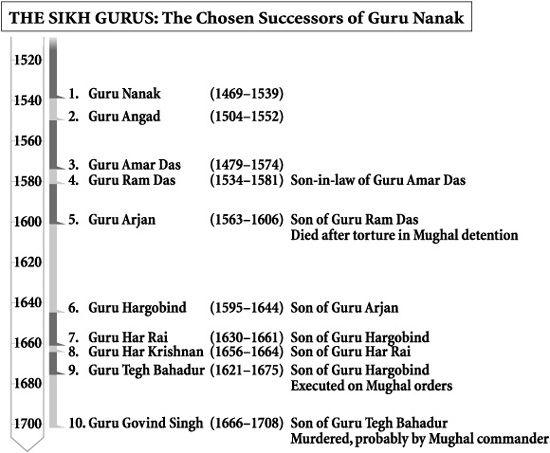
In the Panjab the Sikh followers of Guru Nanak’s successors now constituted a significant but still pacific and often divided minority. Arjan Singh, the fifth Guru, added his own compositions to the collected hymns and teachings of his predecessors, which also included compositions by non-Sikh sufis and sants like Kabir, and the whole became known as the Adi Granth (‘Original Granth’). Revised and expanded by the tenth and last Guru, this would become the sacred Granth Sahib, itself enjoying the authority and respect of a Guru and so precluding any further human Gurus. But at about the same time as the Adi Granth was being compiled, the Sikh community fell foul of Jahangir when they supported Prince Khusrau in the 1605 succession crisis. Guru Arjan Singh is believed to have been martyred by Jahangir as a result. In the 1658 succession crisis Sikh hospitality to Prince Dara similarly angered Aurangzeb. The eighth Guru was summoned to court and his son and presumed heir was inducted into the Mughal hierarchy. This was not acceptable to most Sikhs who instead chose as their ninth Guru Tegh Bahadur, the brother of the seventh. He travelled throughout northern India, preaching to large crowds of followers and proselytising amongst Muslims as well as Hindus. Sikhgurdwarasbecame as much a target of imperial iconoclasm as Hindu temples. But it seems to have been the news of Muslim converts to Sikhism which most outraged Aurangzeb. Tegh Bahadur was brought to Delhi to defend himself and, failing either to convince the emperor or to apostasise, was condemned for blasphemy and executed (1675). ‘At one stroke Aurangzeb earned the bitter hatred of thousands of Jat and Khatri Sikhs living in the north Indian plain.’26 Under Guru Govind, the tenth and last Guru, Sikhism would retire to the fringes of Mughal rule in the Panjab hill states. There, not without ample provocation, it would transform itself from what had hitherto been a movement for religious and social reform into an embryonic political and military formation.
‘Akbar [had] disrupted the Muslim community by recognising that India was not an Islamic country: Aurangzeb disrupted India by behaving as if it were.’27 But it was one thing to antagonise a new sectarian group, like the Sikhs, of which even Hindu princes andjagirdars were suspicious, quite another to stir up the great rajput houses of Rajasthan. The trouble started when in 1678 the Rathor Maharaja of Marwar (Jodhpur) died without heir. Pending the selection of a successor, Aurangzeb’s resumption of the Marwar jagirswas normal practice. The sequel, however, was highly provocative. The troops sent to oversee the takeover indulged in the gratuitous iconoclasm of Marwar’s temples; and in the meantime, two of the deceased maharaja’s widows gave birth to male heirs. One of these infants died but the other, Ajit Singh, immediately became a focus of anti-Mughal sentiment. When, therefore, Aurangzeb eventually conferred Marwar on an unpopular nephew of the deceased maharaja, revolt flared. In an episode beloved of the rajput bards, the infant was smuggled out of Delhi from under the emperor’s nose and whisked away into the desert fastnesses of Rajasthan. There his mother, who happened to be a Sesodia princess of mighty Mewar, ‘threw herself upon the Rana [of Mewar] as the natural guardian of [Ajit’s] rights’.28
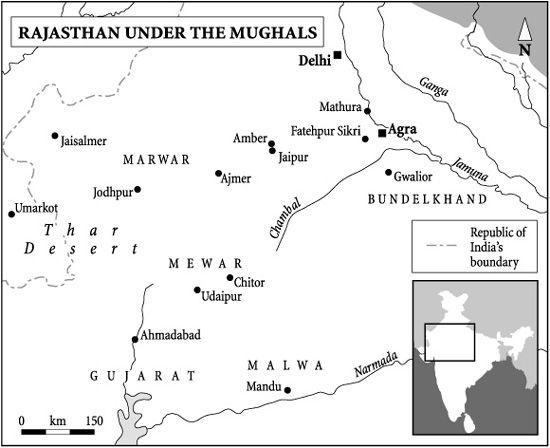
To her appeal Mewar’s rana responded favourably. Welcoming the opportunity to voice Hindu opposition to the reimposed jizya and fearful of the iconoclasm in Marwar, he duly mobilised with strikes into Malwa and elsewhere. To resistance in Marwar (Jodhpur), Aurangzeb had thus added revolt in Mewar (Udaipur), a much more serious challenge. In 1680 a large Mughal army invaded Mewar, duly sacked the city of Udaipur and vandalised its temples. The rana, however, remained free; his forces scored some notable victories; and though peace without dishonour was eventually concluded, he maintained Mewar’s proud record of never making personal submission to the emperor.
Mughal discomfiture can be judged from the reaction of Prince Akbar, one of Aurangzeb’s sons. Akbar had commanded the Mewar campaign in its later phase but was now demoted to the Marwar command. It was not a good idea to humble an imperial contender. Inclined to the liberal views of his illustrious namesake, Prince Akbar had long been contemplating a challenge to his father. History sanctioned, indeed demanded, such conduct and rajput overtures and promises of support now emboldened him still further. In 1681 he therefore proclaimed himself emperor and marched against Aurangzeb. The latter was at Ajmer with very few troops. It was a contest which the prince should have won handsomely. But the emperor’s adept intriguing roused the suspicions of Akbar’s rajput allies and his own dilatoriness allowed for imperial reinforcement. Without his rajput allies, and then minus most of his own troops, Akbar fled south without giving battle. Narrowly escaping capture, he reached the Deccan, there to be warmly welcomed by an even more implacable Mughal foe. Prince Akbar became a protégé of the Marathas.
Aurangzeb soon followed him. Affairs in the Deccan had been crying out for his personal intervention for the past twenty years; now into his sixties, he may reasonably have supposed that time was running out. Moreover it was from the Deccan that he himself had challenged for the throne; Prince Akbar might do the same, possibly in alliance with both Marathas and rajputs. On the other hand a final solution in the Deccan could be the crowning glory of Aurangzeb’s reign. New lands affording new sources of revenue in the form of jagirs were badly needed to meet the expectations of the ever-growing legion of mansabdars . Success in the Deccan would bring conquests to rival those of the great Akbar plus the resources to restore and sustain the imperial system which he had established.
Where the emperor went, the entire imperial court also went, plus, in this case, much of the army. The move to the south in 1681–2 meant that Shahjahanabad–Delhi was partially vacated. Like Sultan Muhammad bin Tughluq, Aurangzeb was shifting the whole apparatus of government to the Deccan. But this was not a move to a new capital, rather the launch of a campaign. For the purposes of travel, all moved into a tented city which was reconstituted with the same topography of bazaars, cantonments, administrative offices and imperial apartments at every halt. Once in the Deccan, they remained in camp. There they stayed, thus they lived, and thence the empire was ruled for the duration of the campaign. Akbar and Shah Jahan had campaigned in much the same style; no doubt it accorded with the semi-nomadic traditions of their Timurid-Mongol predecessors.
But what none realised was that this was a campaign without end. Many of those who went south in 1682 would never see Delhi again, including the emperor; and this was despite his having another twenty-six years to live. An active commander into his late eighties and for the most part a successful one, Aurangzeb would push Mughal rule to its greatest limits. Indeed the empire which he finally claimed exceeded that of any previous Indian ruler. But the price would far outweigh the prize. The emperor’s dogged longevity, no doubt the reward of frugal habits and pious living, would prove to be a substantial contributor to his empire’s undoing.