
SIKH TRANSIT GLORIA
IN MARKED CONTRAST to, say, Napoleon’s adventure in Egypt, the British conquest of India was supposed to be self-financing. Although subject to increasing regulation and direction by the British government after 1776, the East India Company remained a business concern, run from stately offices in Leadenhall Street in the City of London, whose directors were primarily answerable to their stockholders. As with ships and cargoes, the recruitment and maintenance of troops had to be accounted for, and budgets had to be balanced. Before 1760 profits from trade had usually taken care of expenses. But as troop numbers and military overheads soared in the last decades of the eighteenth century, commercial receipts dwindled in significance. Now it was revenue in the form of indemnities, tribute and subventions from Indian states and of tax yields from directly administered territories which became the principal source of the Company’s income and so the mainstay of the Pax Britannica.
Conquests and annexations could be justified in terms of the additional revenue which they would in time undoubtedly yield; but they were expensive in themselves. The banquet of British victories was thus interspersed with periods of retrenchment during which the diners, pulling back from the table, savoured their latest acquisitions and insisted they would eat no more. Central to such digestive interludes was the assessment and forceful imposition in newly acquired territories of revised and usually harsher fiscal demands, or ‘revenue settlements’. The effect of these revenue settlements on India’s rural economy would prove significant. Here it may simply be noted that the order and stability which British rule undeniably brought did not come cheap. In the experience of most IndiansPax Britannica meant mainly ‘Tax Britannica’.
Nor, by any reasonable construction, could Pax Britannica be taken to mean actual peace, either in India or in the wider British empire. To maximise land revenue, frontiers had to be defended, marauding forest-and hill-peoples had to be excluded from taxable zones of settled cultivation, and these taxable zones had themselves to be extended into marginal areas of hill, forest and wetland. In that ‘the century beginning 1780 saw the beginnings of extensive deforestation in the subcontinent’,1 the ‘Axe Britannica’ may bear as much responsibility as the ‘Tax Britannica’ for the desolated aspect of India’s post-colonial rural economy. Armed conflict with those outside this economy, whether along external political frontiers or internal ecological frontiers, was a concomitant of empire. By one reckoning there was not a single year between the Napoleonic Wars and the First World War – the accepted duration of the Pax Britannica – when British-led forces were not engaged in hostilities somewhere in the world.
To this dismal record British India contributed substantially. Just before what the then governor-general was pleased to call ‘the pacification of 1818’ (that is the Pindari and Third Maratha Wars), British expeditions from India had invaded the East Indies (Indonesia) and Nepal. In the Indies a sharp little war (1811–12) involving twelve thousand Company troops relieved the Netherlands, then under Napoleonic control, of the island of Java and rewarded ‘the insolence’ of the island’s senior sultan with the desecration of his far-flung ‘Ayodhya’, otherwise Jogjakarta. Thomas Stamford Raffles, appointed lieutenant-governor of the island, reckoned Java ‘the Bengal of the East Indies’ and, greatly encouraged by the discovery of those inscriptions and monuments advertising the island’s ancient Indic associations, saw Java as the bridgehead for another British India. But it was not to be. Java was returned to the Dutch after Waterloo, and Raffles had to be content with a bridgehead on the south-east Asian mainland, namely Singapore.
The Gurkha War (1814–16) with Nepal went less smoothly but ultimately yielded some bracing Alpine territory in what are now Himachal Pradesh and Uttaranchal Pradesh. Unlike Java, these districts would be retained by the British; and although revenue yields would be disappointing, the amenity appeal of the outer Himalayas was quickly appreciated. Here in the 1820s and thirties were founded the choicest of hill-stations, including Naini Tal, Mussoorie, Dehra Dun and, above all, Simla, imminently to become what one of British India’s greatest military historians candidly calls ‘the cradle of more political insanity than any place within the limits of Hindustan’.2
Continuing the catalogue of conflict, six years after the ‘pacification’ of 1818, the First Burmese War was declared against Burman incursions into Assam. By way of diversion an expedition was also sent to Rangoon. Assam itself was annexed in sections between 1826 and 1838, throughout which period troops were kept busy dealing with a succession of minor revolts in the Brahmaputra valley and a campaign in the Khasi hills. Meanwhile, in 1825–6, the Jat stronghold of Bharatpur, near Agra, had to be besieged for a second time, then stormed; in 1830–3 the hill peoples of Orissa were in constant revolt; and further military intervention was required in Mysore in 1830 to wrest the government from the perceived incompetence of its restored Wodeyar maharaja and in Coorg in 1834 to end by annexation the ambiguous status of this hilly enclave in the south-west corner of Karnataka. And all this, be it noted, during a twenty-year period of vigorous British retrenchment which is usually accounted one of peace and consolidation.
It would indeed seem so in retrospect. The campaigns of the 1830s were mere spats compared to the major wars of the 1840s, not to mention the near-meltdown of the 1850s. Of the wars in the 1840s all would be waged in the north-west of the subcontinent. With most of what today comprises the Republic of India already subject to direct or indirect British rule, it was now the turn of those lands which have since come to comprise Pakistan.
When Ranjit Singh, the Sikh Raja of Lahore, had been deprived of the ‘Cis-Satlej’ states after the Second Maratha War, British expansion for the first time crossed the watershed between the Ganga and the Indus to touch the present-day Indo–Pakistan frontier. That was in 1809, and it was not until a generation later that the banquet of conquest in the north-west was resumed. By then, the 1840s, Bengal had been dominated by the British for ninety years, Mysore for fifty. The Panjab, Sind, Kashmir and the Frontier can scarcely be called afterthoughts, since Wellesley had had his eye on the Panjab at the turn of the century. But their experience of colonial rule would be very much briefer and perhaps less traumatic. Spared the early years of British ‘rapacity’ as in Clive’s Bengal, spared the heady decades when the Company and its sepoy army competed with other Mughal successor states like the Marathas, and spared the deepening sense of military and religious betrayal which was about to flare into the conflagration of 1857, the peoples of the north-west would have a different perspective on British supremacy.
It was not more indulgent or collaborative, perhaps less so. But attitudes in the north-west were tempered by a historical experience in which alien conquest and migration had featured all too frequently. And amongst peoples, mostly Muslim, with a greater awareness of nineteenth-century European supremacy elsewhere in the Islamic world, these attitudes may have been more pragmatic. In the north-west, Sikhs as well as Muslims would find it easier to come to terms with colonial rule. By the mainly Hindu peoples of the rest of India they would even be thought to enjoy preferential treatment from the British. This, however, was not apparent in the 1840s. While substantial parts of what is now India had passed to the British by treaty and annexation, most of what is now Pakistan had to be physically conquered. The battles were more closely contested and the casualties proportionately heavier. This north-western addendum to British conquest would be both the most bloody and the most controversial.
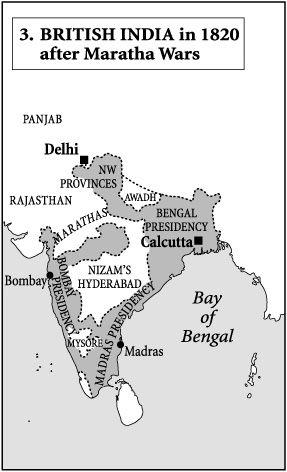
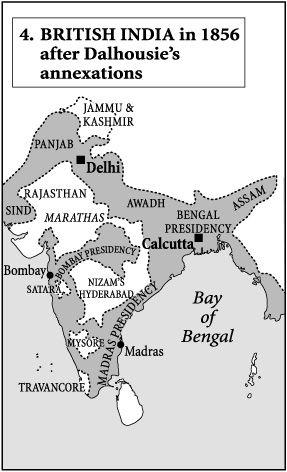
In a provocative mix of commercial ambition and strategic paranoia, the British government had in 1830 urged on Lord William Bentinck, the then governor-general, the desirability of opening the river Indus for steam navigation and of simultaneously assessing the danger to British India of Tsarist Russian expansion into central Asia. There followed various missions upriver and overland into the Panjab, Afghanistan and the great beyond of the central Asian Khanates. Copious reports were written, colourful narratives published, and new geographical ‘discoveries’ bagged. Cooler heads insisted that the Indus, in so far as its erratic flow and shifting mudbanks allowed, was already ‘open’, that the idea of a Russian invasion of India was preposterous, and that such exploratory forays would only generate the hostility which they were supposed to pre-empt. But closer acquaintance with Afghan affairs obligingly fuelled the fantasies of alarmist bureaucrats and excited the ambitions of map-mad generals.
At the time Afghanistan’s existence as a viable and independent polity, rather than just a turbulent Indo–Persian frontier zone, lacked conviction. Kabul had indeed been a Mughal frontier province, but much of what subsequently became Afghanistan was usually under Uzbek and Persian rule. More recently Ahmad Shah Abdali’s fluctuating kingdom had relied heavily on its Indian conquests and anyway proved transitory; by 1814 his grandsons, one of them already blinded, had been ejected from Afghanistan. They repaired first to the Sikh kingdom of Lahore. There, from amongst the effects of Shah Shuja (the still-sighted grandson), Ranjit Singh extracted the Koh-i-Nur diamond as the price of his protection. Far from being a harbinger of misfortune, the gem was proving its worth as a life-saving talisman. In 1833 Ranjit Singh along with the British also assisted Shah Shuja in raising a force to reclaim his kingdom. It failed to do so and in the aftermath Dost Muhammad, the chief of a rival Pathan clan, established himself in Kabul.
Another British mission to Kabul in 1837 reported favourably of Dost Muhammad. British support of his claim to Peshawar, lately taken from Afghan rule by Ranjit Singh, was strongly urged; and in return Dost Muhammad was expected to prove a staunch ally against either Persian or Russian designs on India. To support this contention, the mission made much of the arrival in Kabul of a supposed Russian envoy who, if the British declined to take up Dost Muhammad’s case against Ranjit Singh, might himself do so on behalf of his Tsarist master.
This and other such reports were turned on their head by the ‘politically insane’ coterie of advisers who surrounded Lord Auckland, the most vacillating of governors-general, during his 1838 summer sojourn in Simla. The mere suggestion of Dost Muhammad receiving Russian encouragement now became proof of ‘his most unreasonable pretensions’, indeed of ‘schemes of aggrandisement and ambition injurious to the security and peace of the frontiers of India’. In great haste a tripartite alliance was arranged with Ranjit Singh and the exiled Shah Shuja. Dost Muhammad was to be ousted by force; Shah Shuja was to be installed in his place; the force itself was to be provided jointly by Ranjit Singh and Shah Shuja. But then, lest they prove half-hearted, a British expedition was organised to augment and, in the event, dwarf the Sikh and Afghan contributions. This was ‘the Army of the Indus’, some twenty thousand strong with perhaps double that number of camp-followers, which in early 1839 marched circuitously across 1500 kilometres of patchy desert and instantly denuded cultivation to climb through the Bolan Pass into Afghanistan and thence, for the most part, never to return.
The First Afghan War is usually ranked as the worst disaster to overtake the British in the East prior to Japan’s World War II invasion of Malaya and capture of Singapore exactly a century later. In that in both campaigns most of the troops, and so most of the casualties, were Indian rather than British, this verdict conceals India’s human tragedy beneath a mound of imperial hubris. Even sepoys who were lucky enough to survive the rout in Kabul often found themselves outcastes when they returned to India. ‘This greatly mortified me,’ recalled Sita Ram, a captured brahman sepoy who escaped back to India and may be regarded as ‘a credible witness’.3 In Afghanistan Sita Ram had been enslaved, some of his comrades had been forcibly converted to Islam, and all were deemed to have lost status by serving beyond the Indus, so contravening a high-caste taboo against travel outside India. The ostracism experienced by the survivors was so severe that ‘I almost wished I had remained in Cabool where at any rate I was not treated unkindly.’4This same prejudice against ‘overseas’ service had led to a small mutiny at the time of the Burmese war. But in Afghanistan troubled caste consciences went unsoothed by the balm of victory, and the later expense of caste reinstatement went unpaid by the spoils of conquest. Suddenly employment in the Company’s forces lost some of its popularity. Men thought less of unswerving loyalty to the Company and looked more closely at their terms of service.
Worse still, from the corpse-strewn gorges of the Kabul river, red-coated myths about the Company’s invincibility, its armies’ discipline and its officers’ courage emerged in tatters. A quick reinvasion and heavy reprisals would to some extent restore British pride; but, since the country was ultimately evacuated, questions arose about the political wisdom, indeed sanity, of the ‘tin gods’ who from Simla or Calcutta ordained these affairs.
The conquest and annexation of Sind in 1843, a spin-off of the reinvasion of Afghanistan, did nothing to quell such doubts. Major-General Sir Charles Napier frankly admitted that ‘we have no right to seize Scinde’; yet he actively ‘bullied’ (his own word) the Sindis into hostilities and then conducted what he called this ‘very advantageous, useful, humane piece of rascality’ with maximum brutality. It contravened a sheaf of treaties, themselves signed under duress, which had previously been concluded with the variousrulers, or ‘amirs’, of Sind, and it incurred almost universal condemnation in Britain. The story that Napier, in one of the shortest telegraphs ever sent, announced his victory with a single Latin verb is apparently apocryphal. ‘Peccavi’ (meaning ‘I have sinned [i.e. Sind]’), was not unworthy of Napier’s wit, but it was in fact the caption given him by the magazine Punch; ‘and Punch represented him as confessing that he had sinned because the deposition of the Amirs and the seizure of their territories raised such a storm of criticism in England’.5 Subsequently Sind, despite the development of Karachi as a major sea-port, failed to provide the revenue returns projected by Napier. Worse still, to the likes of sepoy Sita Ram it constituted another source of grievance in that, being for the most part beyond the pale of the Indus, garrison duty there carried the stigma of caste-loss without, since it was now British territory, the compensation of an ‘overseas’ allowance. Not unreasonably, Bengal troops posted to Sind were soon staging a succession of minor mutinies.
Mountstuart Elphinstone, who had led the first British diplomatic mission to Afghanistan in 1809, then been the last British Resident at the court of the peshwa in 1816 and later wrote that eminent history of India, likened Britain’s post-Afghanistan conduct in Sind to that of ‘a bully who had been kicked in the streets and went home to beat his wife’. But if the British were the bully, if Sind was the unfortunate wife and Afghanistan the lawless streets, it was Lahore which was the precinct boss. To avoid friction with Ranjit Singh, Dost Muhammad had been demonised; to avoid crossing his Sikh kingdom in the Panjab, the ‘Army of the Indus’ had marched to Afghanistan so circuitously; and to pre-empt a Sind–Sikh alliance, the amirs had been deposed. Novel though it was, the British were tiptoeing round the sensibilities of an Indian ruler. In Ranjit Singh it seemed as though the tide of British conquest had rolled up against a cliff of Panjabi granite.
Following his non-aggression Treaty of Amritsar with the British in 1809, Ranjit had by 1830 created a kingdom, nay an ‘empire’, rated by one visitor ‘the most wonderful object in the whole world’.6 In addition to uniting the Panjab, a phenomenal achievement in itself given the rivalries of its Muslim, Hindu and Sikh factions, and then reclaiming Multan and Peshawar, the ‘Raja of Lahore’ had also conquered most of the Panjab hill states and occupied Kashmir. In 1836 one of his Dogra vassals then overran neighbouring Ladakh at the western extremity of the Tibetan plateau; and from there in 1840, in one of those rare examples of Indian military aggression beyond its natural frontiers, Zorawar Singh, a Dogra general, actually invaded Tibet itself. Like the ‘Army of the Indus’ – and at almost exactly the same time (1840–1) – this expedition enjoyed initial success and then sensational disaster. In mid-winter at five thousand metres above sea-level Zorawar’s six thousand frostbitten Dogras were confronted by a Chinese host twice as numerous and infinitely better clad. ‘On the last fatal day not half of his men could handle their arms.’ Those who could, fled; the Chinese scarcely bothered to follow, ‘knowing full well that the unrelenting frost would spare no one’.7
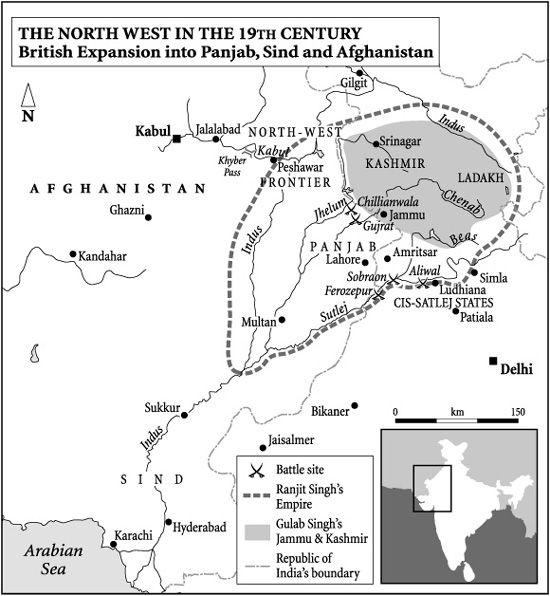
This, however, was a minor reverse and, bar the temperatures, not otherwise comparable to Napoleon’s débâcle in Russia thirty years earlier. Defeat in central Tibet barely registered on the morale of the Lahore army; and like the long-forgotten empire of Kanishka, the Sikh realm still straddled the Himalayas. As contemporaries and, to the British, formidable opponents, Ranjit and Bonaparte invited more obvious comparisons. A French traveller declared the misshapen Sikh ‘a miniature Napoleon’; and the British agreed that both were ‘men of military genius’. Moreover ‘the Sikh monarchy was Napoleonic in the suddenness of its rise, the brilliancy of its success, and the completeness of its overthrow.’8 The comparisons were particularly apposite because of Ranjit’s enthusiasm for employing distinguished ex-Napoleonic officers. Under his direction Generals Avitabile and Ventura, Colonels Court and Allard and a host of others converted his infantry and artillery into a sepoy army as effective as that of the Company. ‘In training, weapons, organisation, tactics, clothing, system of pay, layout of camps, order of march, regular units of the Sikh army resembled their [British] opponents as closely as they could; indeed in battle it was possible to tell the scarlet-coated sepoy of the Bengal army from the scarlet-coated Sikh only by the colour of his belt.’9 Including Muslims and Hindus of Dogra, Jat and rajput origin, the ‘Sikh army’ was a pan-Panjabi army, but with a Sikh core. ‘It may be safe to suggest that more than half of the men … were Sikh, which would mean about fifty thousand.’10 In the councils of state and the rewards of office Sikhs similarly predominated. To Ranjit’s rule, and especially to his army, Sikhism lent something of that distinctive identity and unity of purpose which characterised the command structure of the Company and made the British so formidable.
With a healthy regard for one another’s capabilities, both Calcutta and Lahore did their utmost to avoid a head-on clash. To humour the British Ranjit professed himself a sincere admirer of their rule, and to humour Ranjit successive governors-general trailed up to Lahore to pay their respects and solicit his assistance in the ‘defence’ of their frontier. But in 1839, just as the joint Afghan enterprise was getting underway, Ranjit died. A philanderer of many wives and more women, he was not without potential successors. Yet so personal had been his rule and so absolute his authority that the institutions of sovereignty and government through which a successor might establish himself scarcely existed. As rival court factions sought support for their preferred candidates, authority drained back to its source, the army.
When in 1843 the second maharaja since Ranjit’s death was assassinated, a veritable bloodbath ensued. It was no secret that the British were tempted to intervene, and it is quite probable that they were already actively fomenting the chaos. Certainly the massing of thirty-two thousand troops, with boats, along the Satlej frontier, allegedly to prevent the trouble spreading to the British ‘Cis-Satlej’ states, was highly provocative. With the Sikh army a law unto itself and the contenders for the throne competing for outside support, including that of the British, the mere proximity of this force was enough to ensure its involvement. The inevitable collision took place when in late 1845 word came that another British army was approaching from the east. To forestall it, the Sikh army crossed the Satlej.
The First Sikh War began with two ferocious battles in the vicinity of Ferozepur. From the jaws of defeat, the British edged towards a costly victory which, greatly assisted by the treacherous conduct of Sikh courtier-commanders at odds with their own army, was consummated at Aliwal and Sobraon in early 1846. In the latter battle Sikh losses were believed to total ten thousand and British 2400. A conclusive but expensive bid for Lahore itself was then ruled out as the British opted for the usual peace package consisting of an indemnity, partial annexation, a reduction in the Sikh army and other assorted safeguards.
The annexations included another tranche of the Panjab, which advanced the British frontier from the Satlej river to the Beas. Additionally, in lieu of part of the indemnity, Kashmir with all the hill country between the Beas and the Indus was ceded to the British. Though retaining suzerainty over this vast tract, the British then sold it on to Gulab Singh, the Dogra Raja of Jammu who had been one of Ranjit’s feudatories. Having distanced himself from his nominal overlords in Lahore during the recent troubles and acted as intermediary in the peace negotiations, Gulab Singh now finally transferred from Sikh to British vassalage.
Thus was formed the princely state of Jammu and Kashmir, which would descend through Gulab Singh’s successors as maharajas until 1947. The sale, for three-quarters of a million pounds, of an entire Indian state was criticised, particularly when its strategic importance at the apex of British India became more apparent. But the anomaly of a Hindu from the Panjab ruling a predominantly Muslim Himalayan kingdom was barely noted. Muslims ruled predominantly Hindu populations in Awadh, Hyderabad and elsewhere. There was no reason to assume that a Hindu ruling Muslims had explosive potential. Nor would it for nearly a century, during which time Kashmir enjoyed a peace and prosperity which had seldom been its lot under either Sikh or Afghan rule.
Rather as Cornwallis’s triumph over Tipu in the Third Mysore War had proved to be but a prelude to Wellesley’s ‘tiger-shoot’ in the Fourth, so the First Sikh War was quickly followed by the more conclusive Second. The circumstances were, however, very different. After the First Sikh War, some British troops, a British Resident and a very active staff had been left in the Panjab to uphold and direct the Regency Council operating in the name of the new Maharaja Dhalip Singh, another minor. Only thus, it was argued, could the Sikh court and Council hope to hold its own against still restless elements in the Sikh army, not to mention the even more disgruntled troops who had been laid off as per the treaty.
In the event the British presence proved sufficiently interventionist to provoke alarm but insufficiently supported to contain it. In 1848 the maharaja’s garrison in the southern city of Multan mutinied and killed two Englishmen who happened to be there at the time. The speedy despatch of more British troops would no doubt have taken care of this situation; but in 1848 India had a new governor-general. This was Lord Dalhousie, a modernising and imperious workaholic who made no secret of his conviction that India’s best interests would be served by the extension of British rule wherever opportunity offered. The Multan affair was just such an opportunity. Quickly quashed it would simply entrench the existing regime but, ignored, it would spread to the rest of the Panjab. In the meantime sufficient troops could be mobilised along the Sikh frontier for the full-scale invasion that would assuredly become necessary. Annexation would then follow as a matter of course.
And so it did. Within four months the mutiny had spread through much of the Panjab; the mutineers were calling in Afghan assistance; and the plight of the British staff and troops already in the Panjab was perilous enough to awaken fears of another Kabul. Once again from Ferozepur a large British army crossed the Satlaj, then the Ravi and the Chenab. In early 1849 a major engagement at Chillianwala on the Jhelum was hailed by the Sikhs as a victory. Although the British pretended otherwise, they had lost three thousand men in a battle which now superseded Polilur as the worst defeat suffered by the Company’s forces in the Indian subcontinent. Amends were made a month later at the battle of Gujrat. British victory led to the surrender of the Sikh army and, with almost indecent haste, to the arrival of Dalhousie’s envoy with the instrument of annexation. ‘On 29 March 1849, Maharaja Dhalip Singh held his court for the last time in his life to sign the document of annexation in Roman letters and to become a pensioner of the British. The “majestic fabric” raised by Maharaja Ranjit Singh was a thing of the past.’11
Amongst the terms of this Treaty of Lahore was one to the effect that ‘the gem called the Koh-i-noor which was taken from Shah Shuja-ul-Mulk by Maharaja Ranjit Singh shall be surrendered by the Maharaja of Lahore to the Queen of England.’ Mislaid by John Lawrence, a member of the triumvirate of British officials who now took over the administration of the Panjab, but rediscovered by his valet, the diamond was entrusted to Dalhousie, who personally conveyed it from Lahore to Bombay. ‘It was sewn and double sewn into a belt secured round my waist, one end of the belt fastened to a chain round my neck. It never left me day or night…’12 An unamused Queen Victoria took delivery at Buckingham Palace in 1850.
REFORM AND REACTION
Ahalyabhai Holkar, the ‘philosopher-queen’ of Malwa, had evidently been an acute observer of the wider political scene. In a letter to the peshwa in 1772 she had warned against association with the British, and likened their embrace to a bear-hug:
Other beasts, like tigers, can be killed by might or contrivance, but to kill a bear it is very difficult. It will die only if you kill it straight in the face. Or else, once caught in its powerful hold, the bear will kill its prey by tickling. Such is the way of the English. And in view of this, it is difficult to triumph over them.13
Other foes made their intentions clear by denunciations of one’s family or religion, and by ravaging the countryside and plundering the towns. The British, generally so restrained in their language and so disciplined in the field, were very different. They could make hostility look like friendship and conquest like a favour. It was difficult to rally support against such tactics.
Ahalyabhai’s ‘other beasts’ would no doubt have included Afghans and Muslims in general. Muslim conquerors had been more open in their intentions than the British. In the context of Islam’s triumphalism, dislodging infidels and demolishing shrines of idolatry were divinely-ordained activities. And if, for reasons of policy or compassion, these duties were neglected, Muslim historians could be relied on to invent them. Such things were expected of an Islamic ruler and were therefore conventions of Muslim history-writing.
The British, on the other hand, had been wont to disclaim aggression. Of religious zeal and dynastic ambition they had seemed refreshingly free. Indeed their respect for the traditions of Hindu and Muslim was laudable, and their regard for existing institutions of sovereignty positively gratifying. ‘Tickled’ into clientage, Indian rulers sustained a devastating loss of authority yet might also gain an increment in prestige. From the somewhat chaotic nomenclature of Indian potentates the British began distilling a competitive hierarchy of princely titles and perquisites. ‘Rais’ and ‘rajas’ were gratified to find their rank receiving official recognition way beyond its local parameters; some rajas, like the main Maratha and rajput lineages, became ‘maharajas’. Amongst Muslims, an Indo-Afghan family was officially recognised as Nawabs – or more often Begums (lady nawabs) – of Bhopal, while the most notorious of the Pindari leaders was ‘settled’ as the Nawab of Tonk. In Mysore the young Wodeyar had been allowed to take as his regnant name that of ‘Krishna-deva-raya III’, thereby securing a cherished linkage with the first Krishna-deva-raya who from Vijayanagar had proudly ruled most of the peninsula.
Although sound political calculations underpinned such indulgence, it was not cynical. Company men had often displayed a genuine regard for India’s institutions and were intrigued by what they could learn of their antiquity. Inquisitive minds and acquisitive habits had not unnaturally turned from trade-goods and revenue to other gainful pursuits like the mastery of India’s languages and literature, the reconstruction of its history, the mapping of its geography, and the classification of its flora and fauna. Formidable dedication and a real sense of wonder made these ‘Orientalist’ researches more than just satisfying exercises in the intellectual appropriation of India. Informants, mostly brahmans and Jains, were flattered by the foreigners’ interest and patronage; and from the ‘discoveries’ of people like Sir William Jones and James Prinsep, a wider class of educated Indians would imbibe a new awareness of their particularity and new pride in their past. Nehru would be one of several nationalists to concede ‘to Jones and to many other European scholars … a deep debt of gratitude’.14 Not the least of Warren Hastings’ achievements had been the foundation in 1784 of the Bengal Asiatic Society which, under the presidency of Jones, became a veritable clearing-house for intellectual data about India. Hastings, like Jones, was intrigued by India’s antiquity and impressed by what he knew of its sacred literature and its legal codes. He hoped that, armed with such information, his fellow-countrymen might govern India in accordance with its own customs and so win the approbation of the governed.
Such idealism outlasted Hastings’ era and influenced a generation of turn-of-the-century scholar-administrators. Men like Colin Mackenzie and Thomas Munro in the south, John Malcolm in central India, Mountstuart Elphinstone and his assistant James Grant Duff in Maharashtra, and James Tod in Rajasthan combined senior political or military office with outstanding contributions to the history and geography of their particular areas. As is the way, their scholarship sometimes slipped into active championship of the peoples and dynasts whom they studied, and their histories naturally made a strong case for British intervention. In fact the supposed acquiescence of all but a few Indians in their own conquest became as much a convention of early British history-writing as had the wholesale slaughter of Indians by Islamic conquerors in the chronicles of Muslim writers.
Thus Malcolm, from his experience of central India in the 1820s, insisted on ‘the general opinion of the natives of our comparative superiority in good faith, wisdom and strength, to their own rulers’. True or false, this assumption had, in the case of Malcolm and others, something of a self-fulfilling effect. When challenged by a new and less cosy orthodoxy, he spelled out the beau ideal on which the good opinion of Indians rested.
This important impression will be improved by the consideration we show to their habits, institutions and religions – by the moderation, temper and kindness, with which we conduct ourselves towards them; and [it will be] injured by every act which offends their belief or superstition, that shows disregard or neglect of individuals or communities, or evinces our having, with the arrogance of conquerors, forgotten those maxims by which this great empire has been established, and by which alone it can be preserved.15
Thomas Munro, more familiar with the realities of British rule in the long-settled districts around Madras, demurred from such self-satisfied paternalism. It was true that other foreign conquerors had treated Indians with greater violence and cruelty, ‘but none has treated them with so much scorn as we, none has stigmatised the whole people as unworthy of trust, as incapable of honesty, and as fit to be employed only where we cannot do without them’. Justice and government should be dispensed ‘through the natives themselves’ for, as he told the Company’s directors:
Your rule is alien and it can never be popular. You have much to give your subjects but you cannot look for more than passive gratitude … Work through, not in spite of, native systems and native ways with a prejudice in their favour rather than against them; and when in the fulness of time your subjects can frame and maintain a worthy Government for themselves, get out and take the glory of the achievement and the sense of having done your duty as the chief reward for your exertions.16
Whether patronising or pessimistic, such early-nineteenth-century attitudes had, however, become anathema by mid-century. A sea-change had come over British perceptions of responsible government. ‘The general opinion of the natives’ was no longer worthy of mention. The chance of any ‘prejudice in their favour’ had faded forever. And the ‘Orientalist’ ideal of a government conforming to Indian traditions, already tarnished by the rapacious nabobs, had been obliterated by a compound of cold utilitarian logic, cloying Christian ideology, and molten free-trade evangelism.
The free-trade lobby insisted that India’s economy be opened to British investment and enterprise, and thus challenged the monopoly of eastern trade on which the East India Company had been founded. Subject to increasing supervision by the British government from the late 1770s and to direct management by a government Board of Control from 1785, the Company had already lost its political independence and much of its patronage. Its commercial assets were now stripped in the name of free trade. Backed by manufacturing interests in Britain anxious to obtain access to India’s markets, and by British business houses in Asia keen to compete in the out-and-back carrying trade and exploit Indian production, the government made the periodic renewals of the Company’s royal charter contingent on the surrender of its commercial privileges. In a wasting process not unlike that experienced by Mysore or the Maratha states, the Company was thus forced to make concessions in 1793, to surrender its monopoly of trade with India in 1813, and its monopoly of the even more valuable trade with China in 1833.
Stripped of its commercial assets, the Company’s surviving function was mainly as a political front and a military scapegoat. London’s ignorance and India’s distance might commend the Company’s continuance, but so did the fiction of its being less accountable than a government department; ‘Company mismanagement’, after all, sounded a lot less damaging than ‘official maladministration’. Even, therefore, as its armies streamed triumphantly across the subcontinent, the Honourable Company’s power and direction had drained away. The Afghan, Sind and Sikh campaigns were either prompted by the British government or provoked by its appointees. The Company acquiesced because it had, in effect, been nationalised. Like the Nawabs of Awadh living their extravagant pageant under British ‘protection’ at Lucknow, or like the ex-peshwa on his pension at Kanpur, or the Mughal himself rattling about the airless chambers of his Delhi fort, the Honourable Company had become just another of India’s waxwork despots, dripping beneath the trappings of a defunct sovereignty.
Amongst other conditions of the Company’s charter renewal in 1813 had been its reluctantly-given agreement to allow Christian missions to operate in India. The danger of Hindus and Muslims perceiving British rule as a threat to their religions had long been appreciated. But with the evangelical Clapham Sect in London making converts of a governor-general (Sir John Shore) and a leading Company director, as well as exercising a powerful influence in Westminster, the pressure from missionary enterprises became irresistible. William Wilberforce, the anti-slavery champion who was also a member of the Clapham Sect, declared missionary access to India to be ‘that greatest of all causes, for I really place it before Abolition [of the slave trade]’.17 It was so very important, he told the House of Commons in 1813, because ‘our religion is sublime, pure and beneficent [while] theirs is mean, licentious and cruel.’ Echoing the Muslim horror of idolatry, he declared the Hindu deities ‘absolute monsters of lust, injustice, wickedness and cruelty’, a sentiment with which James Mill, author of The History of British India (published in 1820), readily agreed. Since Hinduism was ‘the most enormous and tormenting superstition that ever harassed and degraded any portion of mankind’, Hindus were indeed ‘the most enslaved portion of the human race’.18 Emancipating them from this ‘grand abomination’ was as much the sacred duty of every Christian as emancipating Africans from slavery.
With Lord William Bentinck, an Evangelical sympathiser, as governor-general (1828–35) a start was made on India’s ‘reformation’ with legislation to outlaw practices like widow-burning (sati, suttee) and ritualised highway killing (thagi, thuggee). Neither was particularly common, nor were they in any sense central or peculiar to Hindu orthodoxy. The effect of legislating against them, whilst it probably saved some lives, was principally to stigmatise Hinduism as indeed abominable to Christian consciences. Although Indian converts to Christianity were few and although Indians were shielded from the worst tirades of Evangelicalism, its assertive new ideology gained a degree of acceptance amongst the British in India. Their rule itself became increasingly imbued with a sense of divine mission, their earlier toleration and even support of Indian religions evaporated, their conviction of Christianity’s moral superiority grew, and their solicitude for the taboos of their subjects was eroded by carelessness and ignorance. When an ambitious army chaplain or a well-meaning subaltern favoured the sepoys under his command with a homily on ‘Christian values’, they might once have indulged him. Now, apprised of a rumoured conversion or smarting under a caste affront, they fidgeted with apprehension.
Wilberforce had never been to India. Nor had James Mill who, as a historian and then as an influential employee of the Company in London, subjected the theory and practice of government in India to the scientific analysis of Utilitarian political thought. Inexperience of India’s beguiling humanity and its bewildering diversity lent great clarity to such exercises. To Mill and his associates, including his son and successor in the employ of the Company, John Stuart Mill, it was axiomatic that ‘the greatest happiness of the greatest number’ depended on the formulation of laws whose ‘utility’ and morality were to be judged by simple, quantifiable criteria of maximum benefit. In Britain the Industrial Revolution had sparked expectations of a steady steam-driven progress towards ever greater prosperity and betterment, in which all would be entitled to participate through social and electoral reform. Although a pre-industrial society such as India’s was clearly no candidate for enfranchisement, there too reform and modernisation were deemed the order of the day.
‘Light taxes and good laws – nothing more is wanting for national and individual prosperity all over the globe,’ declared the elder Mill. Bentinck concurred, and during his long governor-generalship he pruned expenditure, legislated furiously, and pushed through a variety of modernising reforms. But pruning expenditure was not without effect on the army, where allowances were reduced; nor did it lead to lighter taxes. Taxes being principally land revenue, a voluminous controversy was underway between advocates of the ‘Permanent’ revenue settlement introduced in Bengal by Cornwallis and those of the ryotwari system favoured by Munro in the south. The former, influenced by existing Bengali practice and by British ideas of a propertied aristocracy, made the major zamindarsresponsible for collection and payment; recognised as lords of the land, they became in effect landlords. The Munro system, influenced by the more self-sufficient traditions of south Indian villages, depended on direct collection from individual ‘ryots’, or peasant farmers, and regarded all superior intermediaries as parasites. Utilitarian thought naturally favoured the latter which, with considerable modification, was eventually applied in the Maratha lands and then in what the British called the ‘North-West Provinces’ around Delhi and Agra.
But in heated argument over the respective merits of the two systems, it was often overlooked that both rested on some novel assumptions of disturbing potential: revenue responsibility was taken to indicate actual ownership of the lands in question; default in payment was taken as grounds for dispossession by legal process; and enthusiasm for all such settlements presumed a maximum of assessment and a minimum of exception. The cultivator, unless he was also the revenue payer, thus became a mere tenant; and, by both tenant and landlord, security of tenure could no longer be taken for granted. Heavy assessments were no novelty, although they had usually been interspersed with periods of respite or relaxation. Under the British the demand was inelastic and inexorable. If debts incurred to meet the demand went unpaid, creditors foreclosed, and ‘properties’ were distrained by the courts, then sold on the open market. Although the accusation that the British Collector in alliance with the Indian moneylender undermined the country’s rural economy may be an oversimplification, government intervention on a continuous and disruptive basis could not but attract such criticism and occasion deep hostility.
This was heightened by a flurry of legislation in the name of Mill’s ‘good laws’. To assist Bentinck in their formulation, Thomas Babington Macaulay, the son of an eminent Evangelical leader, was sent to India as Law Member on the Governor-General’s Council. His model Penal Code was not introduced until two decades later, and his most telling contribution to the cause of reform proved to be in the field of education. The missionaries had identified literacy and education as essential to their promotion of Christianity. Macaulay, with a Utilitarian’s belief in European science and culture as the epitome of modernity and enlightenment, insisted that it be English literacy and a Western curriculum. His object was, as he put it, to create ‘a class of persons Indian in colour and blood, but English in tastes, in opinions, in morals, and in intellect … who may be interpreters between us and the millions we govern’.19 The available funds were paltry but the principle was accepted and, as of 1835, for government as for education, English became the officially recognised language. Instead of the British essaying a slender command of Indian languages and then venturing across the cultural chasm to accommodate India’s institutions and traditions, Indians were to be encouraged onto the rungs of Anglicisation and thence into the realms of Western thought and science.
It was a momentous decision which Indian opinion would eventually applaud. Demands for independence, when they materialised, would be couched in the language, and based on the principles, of Western liberal thought; the British would thus be hoist on their own petard. Arguably it also spared India the revolutions which would eventually overtake China and Russia. But it was not made without severing support for the study of Sanskrit and Persian, alienating those brahmans and maulvis (Muslim educators) who taught and cherished these languages, and savagely disparaging the arts, literature and traditions of ancient India. In arguing his case on the grounds that ‘a single shelf of a good European library was worth the whole native literature of India and Arabia’, Macaulay was betraying even the scholarship of his fellow-countrymen. His notorious tirade against ‘medical doctrines which would disgrace an English farrier, astronomy which would move laughter in girls at an English boarding school, history abounding with kings thirty feet high and reigns thirty thousand years long, and geography made up of seas of treacle and seas of butter’, though meant as ridicule, now reads as merely ridiculous.
Just as with the Evangelical condemnation of India’s religions, so this assault on India’s literary heritage affected the rulers as much as the ruled. For the British the cultural chasm was no longer a challenge. Secure in the conviction that their own intellectual achievements, artistic tastes and moral precepts were infinitely superior and would, if assiduously practised, soon be emulated, they increasingly withdrew into a way of life that owed as little as possible to India. As communications improved, wives and daughters opted to join their menfolk not just in the cities but also in the garrison towns of the upcountry ‘mofussil’ (the hinterland, as opposed to the ‘presidency’, cities). Here gardens bloomed brightly behind thickets of prickly pear, amateur dramatics flourished, and the tailor turned dressmaker. But with memsahibs about, the servants had perforce to be removed to an outhouse; the club closed its doors to Indians; and the vicar often came to tea. The British were drawing apart, losing touch, becoming less approachable.
Although after Bentinck the cause of reform faltered as the Afghan, Sind and Sikh wars consumed the attentions of government, the conviction remained that British rule was indisputably the best on offer. That its benefits should therefore, in accordance with Christian duty and Utilitarian logic, be extended to as many Indians as possible seemed self-evident to Governor-General Lord Dalhousie. Under his vigorous direction, reform and modernisation were resumed in the 1850s. New laws protecting the rights of Hindu widows to remarry and of lapsed Hindus (mostly Christian converts) to retain their inheritance rights were eminently reasonable, but again ventured into the contentious domain of established practice. Meanwhile public works of undoubted utility, like surveys, roads, railways, telegraph lines and irrigation schemes, were bringing government into direct contact with the rural masses and dramatically demonstrating its power as an agency for change. On the new maps it looked as if India was about to be ensnared in a steel tangle of wires and railway tracks.
Caste taboos were not allowed to impede the march of progress, and there was much fuss over railway carriages not offering caste seclusion. To Dalhousie and his advisers it was equally obvious that the native states, or ‘those petty intervening principalities’ as he called them, should not interrupt the advance of the train and telegraph. Nor was there any reason why those who had had the misfortune to be born under a native dispensation should be excluded from the benefits of such progress and modernity. Hence Dalhousie’s insistence on ‘consolidating the territories which already belong to us by taking possession of States that may lapse in the midst of them’.
The doctrine of ‘the right of lapse’ held that the paramount power might assume the sovereignty of a state whose ruler was either manifestly incompetent or who died without a direct heir. Since the latter ignored the long-established right of an Indian sovereign to adopt an heir of his own choosing, and since the former was obviously a matter of opinion, the doctrine had hitherto been invoked rarely and with great caution. Now it abruptly became an obligation; the government, in Dalhousie’s words, was ‘bound to take that which is justly and rightly its due’. In fact he annexed seven states in as many years. They included Satara in the Maratha heartland, where Shivaji’s direct descendants had long reigned; the Bhonsles’ Nagpur, where insult was added to injury with a callous dispersal sale of the maharaja’s effects; and Jhansi, another albeit minor Maratha raj whose youthful rani exhibited something of the character of Ahalyabhai Holkar but to whom widowhood now merely brought the added pain of deposition and dispossession.
Other rulers were greatly alarmed. The Mughal emperor had already been demoted to ‘King of Delhi’ and his image had been removed from the coinage. Now it was being suggested by Dalhousie that his successor be recognised as no more than a prince and that the Delhi Red Fort in which he held court be handed over to the British. Similarly Nana Sahib, the heir adopted by the Peshwa Baji Rao II while in exile near Kanpur, found himself not only stateless but pensionless and title-less. Like other disappointed princes and pensioners, he appealed to London but received no satisfaction. Several senior British political officers, including the Residents at Satara and Nagpur, also raised strong objections and insisted that the deposed dynasties enjoyed the affection of their subjects. But Dalhousie, never a man to welcome advice from subordinates, was unimpressed. In 1856, on the eve of his departure from India, he delivered his masterstroke by annexing Awadh – or Oudh as the British insistently spelled it.
Nearly the largest, probably the richest, and certainly the most senior and the most loyal of all the native states, Awadh’s extinction seemed to call into question that good faith on which the British so prided themselves. Since the days of Clive, its rulers had been the Company’s allies, graciously accepting a succession of territorial and financial demands and providing much of the manpower for the Company’s Bengal army. It was true that latterly the nawabs – or ‘kings’ as the British now preferred, in a further blow to the Mughals’ pride – had set something of a record in irresponsible government. Lucknow (Laknau), Awadh’s adopted capital as of the turn of the century, had come to combine the monumental magnificence of Shah Jahan’s Delhi with the scented allure of Scheherazade’s Baghdad. In a final outburst of what used to be called ‘Indo-Saracenic’ architecture, the nawabs endowed their city with palaces, gateways, halls and mosques of riotous profile. The Great Imambara, fifty metres long and fifteen high, may be the largest vaulted hall in the world and is certainly ‘one of the most impressive buildings in India’.20 But if it dates from 1780, it is old by Lucknow standards; most of the city’s monuments are nineteenth-century and owe their distressed aspect simply to the intensity of the bombardment which Awadh was about to undergo, plus the chronic neglect which followed.
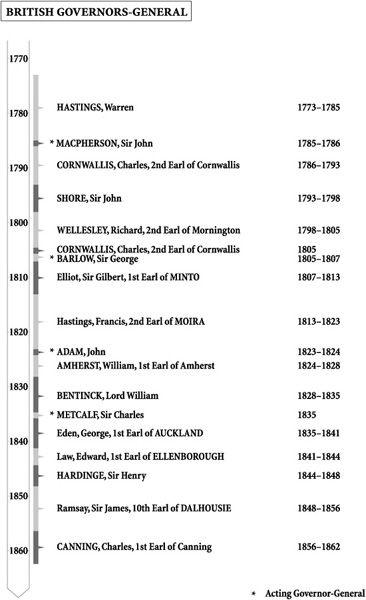
No less sensational was Lucknow’s lavish lifestyle. As connoisseurs of the exquisite and the exotic, the nawabs supported the most celebrated Urdu poets, Persian calligraphers and Shi’ite divines. In the royal employ Hindu minstrels, dancers and impersonators mingled with English barbers, Scottish bagpipers and European clockmakers. Closer still to the royal person moved a swarm of eunuchs, courtesans, concubines and catamites. In short, to the best of their limited abilities the last nawabs fulfilled to the bejewelled hilt their role as the dissipated Oriental despots of European imagining.
But as the Company’s own directors had admitted in 1828, it was the British government which was largely responsible; for ‘such a state of disorganisation can nowhere attain permanence except where the short-sightedness and rapacity of such a barbarous government is armed with the military strength of a civilised one.’21 British troops not only guaranteed Awadh’s security; they also helped enforce the state’s revenue demands. Its nawabs therefore had little to do but spend the proceeds. Nor was their extravagance always objectionable. Loans extracted from the Awadh government had part-financed several of the Company’s wars, and in the case of the Gurkha War of 1814–16 had paid for the entire affair.
Under the terms of an 1801 treaty the nawabs were also bound to rule in the interests of their subjects and to accept British advice when tendered. In fact they did neither. Dalhousie’s decision to annex followed repeated warnings and was prompted by genuine outrage over ‘this disgrace to our empire’. Whether his decision was also ‘just, practicable and right’ as he contended is another matter. Legally it was doubtful, and the doubts were compounded first by the nawab’s refusal to sign the instrument of accession and secondly by Dalhousie’s decision to use limited force. There was also the question of Awadh’s very desirable revenue. Had this played no part in British calculations, and had the spendthrift habits of the nawabs been the main reason for annexation, some of this revenue might reasonably have been earmarked for investment in Awadh. In fact it simply disappeared into the Company’s coffers.
To the people of Awadh the whole affair was inexplicable, indeed indefensible.
Few could really understand why their weak, harmless prince, who had done the British no injury, but like his ancestors, had ever been faithful to them, should be thrust aside. He was not a cruel tyrant and his self-indulgence and careless neglect of his subjects’ welfare were not, in their eyes, such heinous offences as they were to the British.22
In place of ‘careless neglect’ and paternal exploitation the British signalled their arrival by introducing a radical hands-on reformation of the revenue collection. Based on experience gained in the neighbouring North-West Provinces of British India and informed by the principle of dealing direct with the cultivator, it instantly alienated Awadh’s influential aristocracy of rich hereditary revenue farmers, or taluqdars, while seemingly alarming the cultivating classes whom it was supposed to benefit.
Annexation also had the effect, as in the Panjab, of demobilising part of the Awadh army and, worse still, of undermining the privileges enjoyed by the forty thousand men of the Company’s Bengal army who had been recruited in Awadh. With their homeland reduced to the status of a British province, these men lost rights of appeal and redress, previously exercised through British influence with the nawab’s government, which had guaranteed to their families and kinsmen a certain security and immunity. Now they differed from all the other brahman and rajput sepoys recruited in the neighbouring British districts of Bihar, Varanasi and Allahabad only in the depth of their suspicions. They shared grievances over such matters as serving outside India; they shared fears about the intent of alien rulers who seemed increasingly indifferent to their religious beliefs; and they added something very like a national grievance resulting from the faithless treatment meted out to their hereditary ruler in Lucknow. Any of these might have provoked mutinous protests; some already had. Together they became grounds for rebellion.
1857 AND ALL THAT
‘The events of 1857 … have provoked more impassioned literature than any other single event in Indian history.’23 They generated much contemporary documentation and they have since often been taken to mark a watershed in both British rule and the Indian response to it. But the interpretation of these events remains controversial, and so does their title. Known to the British as ‘the Sepoy’, ‘Bengal’ or ‘Indian Mutiny’, to Indians as ‘the National Uprising’ or ‘the First War of Independence’, and to the less partisan of both nations simply as ‘the Great Rebellion’, what happened in 1857 defies simplistic analysis.
For example, equating the rebellion with a traditional, even ‘feudal’, form of reaction whose failure would usher in the new age of nationalism and politically organised protest is no longer completely acceptable. Many different groups with as many different grievances became aligned with either side in the Great Rebellion. The rights and wrongs of British rule were not always a decisive factor and the frontier between the two sides sliced through both agrarian and urban communities, both settled and nomadic peoples, both high caste and low, landlord and tenant, Muslim and Hindu. Paradoxically there was thus something of a national character in the composition of those who opposed the rebellion as well as in that of those who supported it.
Of the insurgents’ various grievances, many were long-standing and had provoked earlier protests and mutinies. Some of these grievances had been, and continued to be, articulated in nationalist terms. But they lacked a pan-Indian dimension, and this mirrored the lack of overall cohesion in the British government of India itself, with each presidency (Calcutta/Bengal, Madras, Bombay) still having its own army and its own administration. Thus, although the Rebellion commanded support amongst most communities in much of northern India, and although recognisably nationalist rhetoric contributed to it, large parts of the future nation, together with the most important centres of British rule, were quite unaffected. Moreover, if ‘historians of the future will begin to define the content of nationalism much more widely and to date its origins much earlier’,24 no less surely will traditional forms of resistance based on hereditary leaders and local grievances be discerned long after 1857. The great ‘watershed’ of British–Indian relations, in other words, proves to be a broad plateau where the run of the rivulets is often contradictory.
But at least there is agreement that the Great Rebellion began as a rising within the Company’s Bengal army. It was not the first. On the eve of Baksar, nearly a century earlier, the Company’s Indian sepoys had refused orders and been horribly executed by Hector Munro. In 1806 at Vellore in Tamil Nadu new regulations about uniforms and the wearing of a cap-badge of leather (always repugnant to Hindus) had prompted a violent mutiny in the Madras army. And, as noted, during the Burmese, Sind and Panjab wars sepoys had staged several mutinies when denied compensation for the loss of caste involved in serving ‘overseas’.
In 1857, soon after Dalhousie had fanned this still simmering discontent about ‘overseas’ service, the Bengal sepoys became aware of another development which would compromise their beliefs. A new rifle was being issued for which the cartridges, which had to be rammed down the barrel, were being greased with a tallow probably containing both pigs’ fat and cows’ fat. Moreover, the cartridges had first to be bitten open with the teeth. To cow-reverencing Hindus as to pig-paranoid Muslims the new ammunition could not have been more disgusting had it been smeared with excrement; nor, had it been dipped in hemlock, could it have been more deadly to their religious prospects.
Although the offending cartridges were quickly withdrawn, all existing cartridges immediately became suspect. So did other official issues like those of flour and cooking oil. Detected in such an underhand attempt, the British were deemed capable of adulterating anything whereby they might compromise the sepoy’s religion and so advance his conversion to Christianity. In Bengal itself a serious mutiny over the cartridges was easily suppressed in February 1857, but as the rumours and the rancour spread upcountry they multiplied and were magnified.
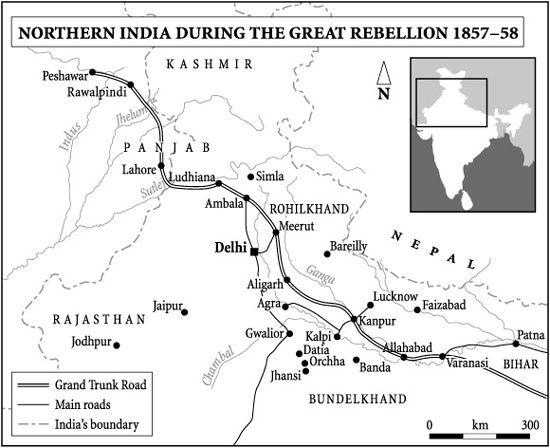
The evidence for any organised incitement is unconvincing. Shared distrust was sufficient to concert action, British arrogance sufficient to incite it. At Meerut (Mirat), an important garrison town about sixty kilometres from Delhi, a particularly insensitive British command court-martialled eighty-five troopers for refusing suspect cartridges and then publicly humiliated them in front of the entire garrison. Next day their comrades-in-arms at Meerut rose as one to free them. They also broke into the armoury and began massacring the local European community. It was early May, a hot month in a parched province. Tinder-dry, the wattle huts of the garrison and the thatched roofs of the officers’ lines ignited at the kiss of a torch.
As a metaphor, spark and tinder would feature widely in contemporary British accounts. Meerut lit the ‘conflagration’ which then ‘spread like wildfire’ across the parched Gangetic plain and deep into the forest scrub of central India. There was no knowing where or when the ‘flames of rebellion’ would break out next; even when extinguished, they often ‘flared up’ again. By perceiving the mutiny as a natural disaster the British tried to come to terms with it. How else to explain an indiscriminate ferocity, their own as well as the enemy’s, whereby innocents and onlookers, women and children, were routinely killed to no obvious purpose?
To the mutineers, however, the conflagration was not without purpose. From Meerut, the first insurgents headed immediately for Delhi, there to seek out the higher authority of the Mughal emperor. Bahadur Shah Zafar (or Bahadur Shah II) was eighty-two and had reigned from Shah Jahan’s Red Fort for the past twenty years, a king with neither subjects nor troops. The sudden accession of both scarcely improved his position. With his local British sponsors outwitted, outnumbered and quickly evicted from the city, and with their sepoys joining the men from Meerut, he had little choice but to endorse the insurgents’ cause. But if the insurgents did the Mughal no favours, the Mughal’s co-option transformed the insurgency. Within hours of its outbreak, a regimental mutiny had acquired the character of a political revolt whose legitimacy arguably transcended that of the regime it challenged. ‘For there is not the slightest doubt that the rebels wanted to get rid of the alien government and restore the old order of which the King of Delhi was the rightful representative.’25
If the example of Meerut prompted a host of other military mutinies, the sanction of the Mughal invited a swarm of civilian adherents. To all who sought redress for past grievances or reassurance over future fears the rebellion now provided a lawful focus. It was the British and their local allies, principally Sikhs, Gurkhas and others from beyond the margins of arya-varta (the Aryan homeland), who were regarded as the subversives. The Sikhs in particular, long hostile to Mughal rule and lately worsted by the now mutinous Bengal army, rallied to the British cause. Meanwhile in the Panjab and elsewhere hasty British disarmament and disbandment of suspect Bengal units contributed to the sense of a faith that had been broken and an authority transferred. The enemy was no longer the British government but the entire British presence plus all those who, unless they proved otherwise, had supported it or benefited by it. The old order was being restored, the clock set back; Bahadur Shah was appointing a governing council; Awadh had erupted; Kanpur had fallen; Agra, Allahabad, Varanasi and Gwalior seethed with dissent. Instead of a dry-season conflagration, to the insurgents their uprising partook of the green renewal heralded by the god-given monsoon which in late June duly blessed their struggle.
By then a force comprised of British, Sikh and Gurkha units had returned to the Ridge just north of Delhi. Although neither the British on the Ridge nor the insurgents in the city were actually besieged, for two months both sides engaged in the sallies, bombardments and reinforcements typical of a siege situation. Within the city, attempts to set up an administration floundered on the unruliness of the sepoys and the incompetence of the Mughal court. Many of the insurgents had dispersed elsewhere when in September the city finally fell to a British assault. The British, nevertheless, suffered heavy casualties which left them thirsting for revenge. Another indiscriminate massacre, another orgy of looting was added to Delhi’s record of woe. Two of Bahadur Shah’s sons and a grandson were shot while in custody, supposedly to thwart an escape. The emperor himself traded trial and ignominy for a few more months of an already wretched existence. Exiled to Rangoon, the last Mughal died ‘a plaything of fortune, in a foreign land, far from the country of his ancestors, unhonoured and unsung, but maybe not altogether unwept’.26
Delhi, like the Mughal, had served its purpose. To the insurgents its loss was less disastrous than it had been to the British. Poorly armed compared to the British forces, lacking a command structure and hampered by weak communications, the rebels were ill-equipped to hold prestigious strongpoints or defend strategic frontiers. Their capabilities and their composition, now heavily diluted by irregular local militias, unruly bands of aggrieved cultivators and the firebrands of various religious and agrarian movements, were better suited to wide-ranging tactics of mobility, concentration and dispersal.
By September 1857 it was clear that south of the Narmada river the rebellion enjoyed little support; the Madras and Bombay armies remained loyal to the British. To the north-west Sind was indifferent, Kashmir’s new maharaja supported the British, and the Panjab provided a steady stream of Sikh and Pathan recruits. In the east, Bengal itself and most of Bihar were neutralised by the prompt arrival of British troops redirected from imperial duties in China and the Persian Gulf. The rebellion thus became largely confined to the vast mid-Gangetic region which now comprises the states of Uttar Pradesh and Madhya Pradesh together with adjacent areas of Rajasthan and Bihar.
In the midst of this region Awadh – the recruiting ground whence a third of the mutinous Bengal army had traditionally been drawn, the erstwhile kingdom whose free-spending nawab had so recently been dispossessed, and the now-British province whose revenue system had just been so disastrously reorganised – became the main arena of revolt. Indeed in Awadh the rebellion transcended both its origin as an army mutiny and its transformation into a political revolt. It became, indeed, a genuinely populist uprising rooted in rural support. Amongst the Awadh insurgents armed retainers and rural militias outnumbered the Bengal mutineers. Lucknow now eclipsed Delhi as the military focus of the rising; and the Nana Sahib, the adopted heir of the last peshwa, emerged to replace the Mughal as its figurehead.
Amongst the British community in Kanpur the portly Nana Sahib had once been a popular figure. Although the loss of the peshwa’s pension gave him a grudge against the British government, his support for the insurgents seems, like that of the Mughal, to have been given with some reluctance, and his authority over the mutineers remains doubtful. He nevertheless assumed the defunct peshwa-ship and took the surrender, after a three-week siege, of the four hundred British in Kanpur. For their massacre as they boarded boats to take them downriver to Allahabad, he was technically guilty as the guarantor of their safe-conduct. But at the time passions were running high. Reports of draconian British reprisals at Varanasi were followed by news of an avenue of gibbets along the road thence to Allahabad. Retribution was advancing up the Ganga; on the riverbank at Kanpur mercy must have seemed out of place. The first shots were probably mischievous. The Nana Sahib, far from ordering the massacre, organised the rescue of some British women who were abducted during the ensuing chaos.
They, along with other surviving women and children, perhaps two hundred in all, were then lodged under the Nana Sahib’s protection. With the avenging British forces now fast approaching from Allahabad, the intention seems to have been to use these captives as hostages. But if that was indeed the plan, it was never put into operation. Instead, as the insurgent commanders debated escape, orders were issued for the captives’ extermination. The task, so objectionable to trained soldiers, was eventually undertaken by five bazaar recruits. Two were actually butchers by trade. Their slaughterhouse methods, clumsy rather than sadistic, constituted an atrocity which would haunt the British till the end of their Indian days. For sheer barbarity this ‘massacre of the innocents’ was rivalled only by the disgusting deaths devised for dozens of equally innocent Indians by way of British reprisal.
The Nana Sahib claimed to have been as ignorant of the second massacre as he was of the first. Along with his ablest commander, a fellow Maratha known as Tatya Topi (Tantia Topi), he escaped from Kanpur, was later reported at Lucknow, and would continue with the insurgents until he disappeared in Nepal. But, noted mainly for a louche lifestyle, he owed his celebrity less to his exploits and more to the British need for scapegoats plus Indian nationalism’s later need for heroes. Like the emperor Bahadur Shah, his importance was largely symbolic.
Meanwhile the recapture of Kanpur had given the British a forward base from which to attempt the relief of their fellow-countrymen in Luck-now. Awadh’s spectacularly endowed capital had fallen to the insurgents at the end of June (1857), at which time about 750 European combatants, as many British Indian sepoys, and about 1400 servants, women and children had taken refuge in a fortified area around the British Residency on the outskirts of the city. Here they made a defiant stand which developed into a remarkable siege. With the first relief effort in late September serving merely to reinforce the defence, the siege lasted nearly five months. It captured the imagination of India’s entire British community, for whom Lucknow became a microcosm of the ‘mutiny’, and its saga of brave deeds, shattered hopes and ultimate redemption an enduring reminder.
The little band in the Residency did more than make history. In a sense they made scripture, for their refuge became one of the holy places of British Imperialism and their struggle, reiterated in verse and prose, re-enacted on the stage and refought in spirit, summarised the Imperial ethos and furnished the Imperial dogma with all the apparatus of miracles and martyrs.27
The massacre at Kanpur, or rather ‘Cawnpore’ as it was known to the British, was too shocking for polite English mention; it was banished to the sweat-soaked realm of nightmares and high fevers. But Lucknow was a soaring triumph of the spirit, eminently worth mythologising, and defiantly as many British Indian sepoys, and about 1400 servants, women and children commemorated by the Union Jack which would fly, night and day, above the ravaged Residency for the remaining ninety years of British rule.
To the insurgents too, Lucknow was important. The siege of the Residency provided a sustained focus for the revolt in Awadh. The longer it lasted, the more committed became both Hindu and Muslim participants and the more persuaded became the great ruraltaluqdars. Lucknow flourished again as a source of power and authority. A supposed son of the last nawab was enthroned, and a skeleton administration set up in his name. It lasted until March 1858 when the city finally fell to the largest British army, as opposed to Sepoy army, ever mustered in India. Suppressing the insurgency in the rest of Awadh took another year, plus a complete reversal of the 1856 land settlement. But with the fall of Lucknow and the ruthless sacking of this ‘Babylon of India’ the Great Rebellion lost all momentum.
The final scenes of defiance occurred to the south of the Jamuna in the wilder territory, mostly under princely rule, between the Chambal and Betwa rivers. This was Bundelkhand and amongst its states was that of Jhansi, a small Maratha principality south of Scindhia’s Gwalior which had been annexed under Dalhousie’s ‘doctrine of lapse’. Lakshmi Bai, the last raja’s widow, made a strong impression on those British who took over her state. She was ‘of high character [and] much respected by everyone’; she was also comparatively young and possessed of ‘many charms’ and ‘a remarkably fine figure’. Although, like the Mughal and the Nana Sahib, she had a strong grievance against the British, she too seems to have played no part in the mutiny of the Bengal troops stationed in Jhansi. There, in a carbon copy of events in Kanpur, the small British community had sought refuge in the local fort but soon accepted proposals for its evacuation. They then straggled out under what they thought was a safe-conduct and were promptly massacred. Again Lakshmi Bai may have been innocent. She blamed the mutinous troops and insisted that she too had been their victim, having been forced to part with funds and her few guns. The mutineers then marched off to Agra and Delhi leaving her implicated and defenceless.
No British troops were available to deal with this comparatively minor affair, but the rani soon found herself challenged both by a rival claimant to her husband’s defunct title and by the neighbouring rajput rajas of Datia and Orchha. When the latter invaded Jhansi, supposedly on behalf of the British, she began raising troops and herself led them in repulsing the assault. This was in September and October 1857. It is notable that the rani’s considerable military reputation was first acquired fighting not the British but local rivals and that, though her forces were drawn largely from elements who had aligned themselves with the Rebellion, in her correspondence she continued to protest her fidelity to the British. In effect old dynastic scores were being settled and new opportunities exploited under cover of the Rebellion.
The situation changed in early 1858 with the northward advance of a section of the British Bombay army. Having received no encouragement from her various letters to the British, the rani and her advisers rightly assumed that her reassertion of Jhansi’s sovereignty was threatened and her own safety in danger. Now, if not earlier, she definitely became reconciled to rebellion and established contact with Tatya Topi, the Nana Sahib’s protégé who had established himself at Kalpi on the Jamuna. When the British laid siege to Jhansi in March, Tatya came to her aid but was repulsed. After a ferocious resistance led by Lakshmi Bai herself, Jhansi fell; but of its fearless commander, ‘the Jezebel of India’ as a fanciful British writer called her,28 there was no sign. In one of those hair’s-breadth escapes so dear to Maratha folklore, she slipped out in disguise with a trusty band of followers and rode hard for Kalpi.
Thereabouts the combined insurgents were again worsted, but on 1 June 1858 they responded with the boldest move of the whole Rebellion. Just when the British thought they had finally dislodged them from Bundelkhand, Lakshmi Bai and Tatya Topi seized Gwalior. As Scindia’s capital and still the greatest natural stronghold in India, Gwalior was well-chosen for a final stand. Scindia himself, while remaining loyal to the British, had been pretending sympathy for the insurgents as a way of detaining the large body of mutinous troops based in Gwalior. An appeal in the name of the peshwa, Scindia’s one-time superior in the Maratha hierarchy, failed to sway him; but it did serve to disabuse his troops. With their collaboration, Tatya Topi and the rani entered the city, paid their forces from its accumulated riches, and duly ensconced themselves on central India’s ‘Heights of Abraham’.
This tableau, so dear to nationalist lore, lasted barely three weeks. It ended when Lakshmi Bai died the death of the heroine she undoubtedly was. While riding round the ramparts, she was hit by a spray of bullets as the British launched their first assault. She was cremated nearby, ‘the only man among the rebels’ according to one of her British adversaries. Three days later the citadel fell and with it the last attempt at concerted action by the insurgents. Tatya and his followers would roam through Rajasthan and Madhya Pradesh for another year of improbable and much-embellished escapades before he was betrayed, captured and executed. Meanwhile the Nana Sahib and the rump of the Awadh insurgents were penned ever closer to the Nepalese border. By 1860 even these ‘embers’ had been doused or dispersed. Their cause was anyway hopeless, not least because many of the grievances on which it rested had by then been addressed.
Measured in terms of concessions the Great Rebellion was far from being a disaster for the insurgents. Obviously the British made sure that military vulnerability would never again be the undoing of the Raj. By 1863 the Indian component in the Bengal, Bombay and Madras armies had been reduced by about 40 per cent and the British component increased by nearly 50 per cent. This gave an Indian–British ratio of less than 3:1, which was henceforth considered the bare minimum; in 1857 it had been more like 9:1. No Indian troops were now given artillery training; recruitment was increasingly switched from Awadh and Bihar to the Panjab and marginal hill regions whose supposedly ‘martial peoples’ were deemed more reliable and less paranoid about caste-loss; at the same time deployment was so organised as to avoid a concentration anywhere of units with the same composition. Rapid expansion of the railway system and of the telegraph further precluded the danger of mutiny. The 250 kilometres of track laid by 1856 had become 6400 by 1870 and sixteen thousand by 1880. Moreover in 1869 the opening of the Suez Canal slashed journey times between Europe and India, while the 1870 completion of an overland telegraph link brought closer co-ordination of imperial policies and more supervision from London.
The issue of the offending cartridges had, of course, long since been resolved. The troops now greased them themselves with whatever lubricant they preferred; moreover in 1867 the whole procedure became unnecessary when the breech-loading rifle made its Indian debut. Other concessions which addressed the underlying causes of the ‘mutiny’ were much more significant. In recognition of the fact that the mutineers had genuinely feared conversion to Christianity, missionary activity was curtailed and the public funding of mission schools reduced. Queen Victoria’s proclamation of 1858 specifically disclaimed any ‘desire to impose Our convictions on any of Our subjects’ and ordered British officials to abstain from interfering with Indian beliefs and rituals ‘on the pain of Our highest displeasure’.
The reforming zeal of the Bentinck era was also repudiated. Already out of fashion in Britain, the presumed omniscience of Utilitarians and Benthamites was recognised as particularly inappropriate in India and the attempt to legislate away discriminatory traditions and eccentric practices was largely abandoned. An exception was made in respect of education; more schools were part-funded by government and the English language continued to be promoted. But the idea that extending the benefits of British rule to all Indians was a moral imperative lost favour. In particular the process of absorbing the Indian states and of eliminating hereditary revenue farmers was reversed. The taluqdars of Awadh, stigmatised as parasites in 1856 and rebels in 1857, had only to clear themselves of shedding British blood to emerge as faithful allies in 1858. Recognised as having a genuine hold on the loyalties as well as the remittances of their cultivating subordinates, they were confirmed in the hereditary possession of their rights and also co-opted into the British administration as local magistrates. Like Bengal’s zamindars and other rural aristocracies they joined the British Indian hierarchy as rajas and rais and became some of its most stalwart supporters.
Likewise their princely brethren of the Indian states. Although annexed states like Awadh were not restored, there were to be no further annexations. Existing treaties with India’s five hundred princes were now to be ‘scrupulously maintained’ while the detested ‘doctrine of lapse’ did just that; it lapsed. With few exceptions, the princes had remained loyal during the rebellion; in British eyes such loyalty now commanded a higher premium than enlightened rule.
The status of the princes was further enhanced by a new constitutional relationship between Britain and India. The royal proclamation of 1858 announced a decision of the British Parliament that all rights previously enjoyed by the East India Company in India were being resumed by the British Crown. Victoria thereby became Queen of India as well as of the United Kingdom, and India’s governor-general became her viceroy as well as the British government’s chief executive in India. The fiction of Company rule thus finally ended. Long as irrelevant as the Mughal, the Company now shared his fate as a casualty of the Rebellion. Instead of pining away in Rangoon, it would linger on for a few more years in a London office ‘unhonoured and unsung, but maybe not altogether unwept’.
So India had a new sovereign; and just as in Britain the monarch’s position was buttressed by a hierarchy of hereditary nobles and by the award of honours, so in India similar structures were created. The Star of India, a royal order of Indian knights, was introduced in 1861, and the first tour by a member of the British royal family took place in 1869. Meanwhile India’s aristocracy of ‘feudatory’ princes, chiefs, rajas, nawabs and so on was being further stratified and grouped to conform to British ideas of hierarchy. The grading of gun salutes and other minutiae of protocol provided a ready reckoner of status, status itself being assessed on the basis of historical and territorial credentials, good governance, charitable activities and, of course, demonstrations of loyalty.
Only when this structuring was complete was the keystone installed. In 1876, on the advice of Disraeli, the Queen announced to the British Parliament that, satisfied that her Indian subjects were ‘happy under My rule and loyal to My throne’, she deemed the moment appropriate for her to assume a new ‘Royal Style and Titles’. The style, it was later revealed, was to be imperial and the titles, in English, ‘Empress of India’ and, for the benefit of her Indian subjects, the rather unfortunate ‘Kaiser-i-Hind’.
In January 1877, in a vast tented city around the Ridge whence British forces had recaptured Delhi twenty years earlier, the new imperium was solemnised at an Imperial Assemblage. The official attendance of eighty-four thousand included nearly all of India’s ‘sixty-three ruling princes’ and ‘three hundred titular chiefs and native gentlemen’. Lord Lytton, the presiding viceroy whose arrangements would provide a blueprint for all future imperial durbars, took some delight in listing those present. Here were the princes of Arcot and Tanjore from the deep south, the principal ‘Talukdars of Oudh’, ‘Alor Chiefs of Sindh’, Sikh Sardars, rajputs and Marathas, ‘the semi-independent Chief of Amb’, ‘Arabs from Peshawar’, ‘Biluch Tommduis from Dera Ghazi Khan’, and envoys from Chitral and Yassin in the high Hindu Kush ‘who attended in the train of the Maharajah of Cashmere and Jammu’. Also included in Lytton’s litany were quite a few ex-princes like the grandson of Tipu Sultan, the son of the last Nawab of Awadh and ‘members of the ex-Royal family of Delhi’.
The presence of these descendants of the former great ruling houses of India imparted some of the flavour of a Roman triumph to the assemblage. The British conception of Indian history thereby was realised as a kind of ‘living museum’, with the descendants of both the allies and the enemies of the English displaying the period of the conquest of India.29
Conservation was now the order of the day. The riot of privilege and particularism, once seen as an indictment of British rule, was to be preserved as imperial pageantry. And with the British apparently disclaiming plans for the rapid transformation of Indian society, the initiative now slowly passed from these hereditary representatives of the old dynastic order to a new elite, English-educated and city-based.