
EBB OF EMPIRE, FLOW OF IDEAS
BETWEEN THE DEATH of Ashoka in 231 BC and the advent of Gupta power in 320 AD, India’s ancient history plummets again to a murky obscurity. ‘Certainties are not many,’ bemoans a writer on the period.1 Prior to the Mauryas our vision is blurred by the ambiguity of mainly literary sources whose purpose is suspect and whose dates are vague. After the Mauryas the source materials are more varied: coins furnish the names of a host of otherwise forgotten kings; other archaeological finds, plus inscriptions, provide additional information about guilds and religious establishments; and texts – Indian, Graeco-Roman and Chinese – hint at a wider historical context and testify to the importance of trade. Yet the sum total of these sources remains inadequate and, in respect of the successor states of the Mauryan empire, certainties are indeed ‘not many’. How far the writ of these states ran, whence came their rulers and when they reigned, even the order in which their dynasties succeeded one another, are matters of dispute. The Puranascontinue to prove tantalisingly unreliable; and the greater variety of sources often serves only to introduce contradictions. A long period of political confusion is deduced and, pre-modern history necessarily being a reflection of such sources, this confusion is taken to indicate instability, fragmentation and turbulence. The five hundred years between the Mauryas and the Guptas become, in fact, ‘India’s Dark Age’.2
While Rome beamed its civilisation into three continents, handsomely documenting its conquests in the process, Pataliputra retreated into insignificance and silence. In India no king or dynasty would either scale the heights of Ashoka’s lofty universalism or cast such long imperial shadows across the subcontinent. Inscriptions claiming otherwise are usually couched in bombastic phrases which should be treated with caution. Ideals of legitimacy and empire would remain: Ayodhya’s utopian Ram-raj (the rule of Lord Rama) would continue to exercise a fascination; so would inclusive concepts of a ‘one umbrella’ sovereignty as claimed by the Nandas and of a world-ruling Cakravartin (literally ‘wheel-turner’) as featured in Buddhist teaching. But the reality was of many jostling umbrellas, of no consensus on legitimacy, and of no universal sovereignty.
Worse still from the viewpoint of latter-day nationalists, many of the dynasties credited with contributing to this turbulence would be of non-Indian origin. In some histories this ‘Dark Age’ thus also becomes an ‘Age of Invasions’ characterised by foreign hordes from Bactria, Parthia, and the wilds of Turkestan pouring across the north-west frontier. They would overrun all of what is now Pakistan and strike deep into the Gangetic heartland and central India. To orthodox minds such disasters were no worse than was to be expected of the dreaded Kali Yug. Vedic values and brahmanic authority had been undermined by the pushy teachings of the Buddha and his rivals. An earlier spirit of metaphysical enquiry had given way to an unnatural and populist egalitarianism. Fickle sources of royal patronage had been diverted; the neglect of ritual obligations had necessarily prejudiced political legitimacy. A disrespectful age got the discredited history it deserved.
Yet, politics apart, the half-millennium which straddles the birth of Christ was not all petty doom and patriotic gloom. On closer inspection the ‘Dark Age’ proves to be softly illuminated by the steady glow of cultural integration, especially in peninsular India. There and elsewhere the gloom was also fitfully dispelled by dazzling shafts of artistic, scientific and commercial innovation. Indeed, if an age be judged in terms of art and literature, the tag of ‘classical’ belongs less to the much-studied decades of the great Mauryas and more to the quickly dismissed centuries of their less distinguished and often non-Indian successors.
The Mauryas, for instance, had done little for India’s artistic heritage. If one excludes his pillars and their Achaemenid-style capitals, Ashoka’s numerous endowments, principally stupas and viharas, seem to have been modest affairs of brick and timber. It was only under his successors that stone became established as the supreme medium of artistic expression. To the first two centuries BC and AD may be attributed the magnificent sculptural reliefs of the Bharhut, Sanchi and Amaravati stupas. Typically crammed with scenes of popular devotion and, judging by their inscriptions, often paid for by commercial and religious benefactors, these were not manifestations of royal prestige nor products of courtly largesse. Ascribing them to a particular dynasty is thus misleading. Rather should they be attributed to a pious merchant class, proud of its skills and increasingly interested in the security and patronage afforded by religious centres in an age of political uncertainty.
Much the same applies to the first of a long succession of ‘rock-cut cathedrals’, now more prosaically known as ‘cave temples’, which date from the last century BC onward. They are found principally in western India, inland from Bombay, where sudden folds and gashes at the edge of the Deccan plateau expose long, snaking strata of sheer rock. No doubt here were already natural caves which, affording secluded shelter and yielding readily to the sculptor’s chisel, inspired the idea of more elaborate excavations. There followed entire monastic establishments with prayer chambers, deep pillared halls, lofty stupas, finely fretted façades, and airy meditation cells, all connected by galleries and staircases and all cut and carved into the solid rock.
The skills involved appear to have derived from a contemporary tradition of working in the hard timbers of India. In the north, in the first centuries AD, similar skills and similar mainly Buddhist patronage gave birth to two distinctive schools of more portable sculpture. One, deeply indebted to the aesthetic of the Graeco-Roman world, depicts figures from Indian tradition as Apollo Belvederes attended by a ‘classical’ repertoire of cherubs and acanthus leaves. Fashioned in stucco or carved from a hard grey-black schist, these figures and motifs are particularly associated with Taxila and the north-west frontier region (hence the ‘Gandhara school’). The other school is very different. A gloriously voluptuous celebration of nature’s mainly female charms, it uses a fleshy pink sandstone flecked with white spots from the region around the city of Mathura where, on the tourist highway from Delhi to Agra, a fine collection of both Gandhara and Mathura figures now languishes largely unseen in the city’s museum.
As for literature, in the second century BC Patanjali, a Sanskrit grammarian who wrote a commentary on Panini, compiled the standard text on yoga. Mighty compendia of other important human activities followed, with the Manusmriti (‘Manu’s code’ of law), theKamasutra of Vatsyana, and Kautilya’s Arthasastra all datable in their final form to the second century AD. Meanwhile a Buddhist writer, Asvaghosha of Magadha, may be credited with the first Indian drama; he was a contemporary and protégé of King Kanishka, who would be the age’s nearest equivalent to an Ashoka. Subsequently the great tradition of Sanskrit drama got off to a more certain start with Bhasa, whose prolific output of plays probably dates from the third century AD. A debt to his work would be acknowledged by Kalidasa, the Sanskrit Shakespeare, who may have been a near-contemporary although he is usually assigned to the cultural efflorescence that awaited the Guptas after 320. Perhaps the ‘dark’ centuries on either side of the year zero should be seen more as a sprightly preface to this ‘golden age of the Guptas’ than as a dire postscript to that of the Mauryas.
The ‘Dark Age’ looks to have been one of enlightenment and, even more paradoxically, the ‘Age of Invasions’ looks to have been one of expansion. For every incursion by non-Indians from central Asia, there is good evidence for an excursion by Indians into south-east Asia – or even back into central Asia. Hellenised kingdoms on the upper Indus are matched by Indianised kingdoms on the lower Mekong, Roman trading stations on the Indian coast by Indian trading stations on the Malay peninsula. Just as the archaeology of northern India is being invaded by uncompromising images of Greek adventurers and booted warlords from beyond the Oxus, so that of Sumatra and Sinkiang is invaded by serene Buddhas and handsome stupas. That first Indian drama by Asvaghosa came to light not in some Magadhan archive but in a horde of manuscripts found in the oasis city of Turfan, between the Takla Makan and the Gobi desert on China’s silk route. For every inscription in Greek or Sogdian script that is chiselled into India’s rocks another in Brahmi or Kharosthi is etched in the cliffs of Afghanistan or echoed in a stele on the coast of Vietnam.
In short, the diaspora of India’s culture began just as India itself apparently buckled before a succession of intruders. Both processes would continue, with intermissions, for the next two thousand years. Indeed the great paradox of political vulnerability in the midst of commercial and cultural dynamism may be considered one of Indian history’s distinctive features. If for no other reason than to explore the genesis of such a phenomenon, the underrated interlude between the glorious Mauryas and the golden Guptas merits attention.
IN THE DYNASTIC WILDERNESS
Of Ashoka’s Mauryan successors in the third to second centuries BC we know practically nothing except that they lost most of their inheritance. There were at least six of them, and they continued to rule, mostly from Pataliputra, for another fifty years. One, Dasaratha, may have been Ashoka’s grandson and immediate successor. In the only inscription certainly attributable to the later Mauryas, he dedicated some caves to the Ajivikas. Another, Brhadratha, was by common consent the last of the dynasty; a half-wit, hewas murdered by his commander-in-chief. There is nothing to suggest that any of them ever exercised authority in the Deccan or in Orissa, and there is reason to suppose that many other Mauryan provinces, including those in Afghanistan, Gandhara, Kashmir, the Panjab and perhaps Malwa, all broke away at an early stage. Reasons suggested for this rapid decline include the economic crisis implied by an adulteration of the coinage, the reluctance to use force which was supposedly inherent in dhamma, and the vulnerability of Ashoka’s personalised authority to the presumed failings of his successors.
It is perhaps also worth reflecting on the nature of an empire which could so rapidly disintegrate. For instance, the scatter of Ashokan inscriptions in Karnataka (Mysore) and Andhra Pradesh (Hyderabad) should probably not be interpreted as evidence that Mauryan authority was ever effective throughout the Deccan. Instead, the empire should be seen as consisting of corridors of authority connecting pockets of agricultural, mineral (many of the southern inscriptions are in a gold-mining area), commercial or strategic importance. Beyond this carefully administered root-structure of nodes and conduits lay wild tracts of hill, forest and desert whose peoples produced no surplus of taxable significance. Here the Mauryan policy of containment, if they proved disruptive, or of neglect, if peaceable, may have been an early casualty of retrenchment. For all the evidence of an elaborate fiscal and judicial system under the Mauryas, we know remarkably little about the sanctions which enforced it. Along the highways, as well as rest houses and shade trees, one might expect some mention of garrisons, forts and escorts; but there is none. Mauryan authority, theoretically so extensive and invasive, may, in practice and beyond the confines of Magadha itself, have always been localised and vulnerable.
The last Maurya was murdered and supplanted by his commander-in-chief in about 180 BC. Pushyamitra, the assassin, was a brahman; his family came from Ujjain, where they had once served in the Mauryan administration. An inscription testifies to his performing two horse-sacrifices, and he is portrayed in Buddhist texts as no friend to the sangha (the monastic community). Perhaps, after a century of Mauryan patronage of the heterodox sects, Pushyamitra headed an orthodox brahmanical backlash. The dynasty he founded is known as the Shunga and his successors presided over a still disintegrating kingdom for about 110 years. The last Shunga, being reportedly ‘overfond of women’s company’,3 was assassinated by the daughter of one of his female companions. Vasudeva, his brahman minister, is said to have instigated the crime and it was he who duly founded a new dynasty. This was the Kanva, which lasted barely fifty years and of which almost nothing is known. Thereafter the kingdom of Magadha virtually disappears from the record for three centuries.
The Shungas and the Kanvas, like the later Mauryas, had been challenged on many fronts. An inscription in Orissa tells of the great king Kharavela of Kalinga who, though apparently a devout Jain, led his forces deep into the Deccan as well as invading Magadha and taking Pataliputra. Immense booty was accumulated, Kharavela’s horses and elephants were watered in the Ganga, and the king was styled a cakravartin, or world-ruler. Perhaps it was by way of a Kalingan revenge for Ashoka’s triumph of 260 BC. But Kharavela’s dates remain a mystery and his inscription is in ‘a rather flowery and pompous style and doubtless much of it was royal panegyric’.4 The only obvious inference is that Kalinga had long since broken away from Magadhan rule and now held its neighbour in contempt.
Amongst other adversaries over whom Kharavela was supposedly victorious, the inscription mentions the Shatavahana kings of the Deccan and a confederation of Tamil rulers in the extreme south, plus the Yavanas, or Greeks. As will be seen, the Deccan and the south begin to feature prominently in Indian history from about the last century BC. Slightly earlier the Yavanas had led the procession of intruders who now descended on India from the north-west. They originated in Bactria, or northern Afghanistan, where the Achaemenids had established a Greek colony. Alexander had augmented it, and over it Seleucus had briefly reasserted Macedonian authority before, some time during the reign of Ashoka, one Euthydemus had declared an independent kingdom. His successors, who were not necessarily his descendants, extended Bactrian rule to much of Afghanistan. Then, taking further advantage of the break-up of the Mauryan empire, some of them passed on down the Kabul river to the Indus and the Panjab.
Almost everything that is known of these Bactrian Greeks has been surmised from their splendid coins. Minted and die-cast in imitation of Greek practice, they are mostly circular, of silver, often large, and altogether a great advance on the punch-marked lumps of the Mauryas. Considerable hoards as well as individual examples have been found over a vast area; and coinage design being extraordinarily conservative, they provide somewhat the same information as a modern coin. Thus, we learn of the names of these kings, of their preferred titles, and often of the Greek deity with whom they wished to be associated. From the obverse, or ‘heads’ side of the coins, we also know what they looked like and what headgear they sported. Such personal insights are rare; knowing nothing of, for instance, Ashoka’s mien (other than that it was ‘gracious’), we feel personally aquainted with the bull-necked Eucratides and the big-nosed Heliocles. Some wear a curious cap, modelled on an elephant’s skull, with the trunk serving as a peak; others favoured the kausia, like a shallow upturned bowl, of faintly ecclesiastical look; the chinless Amyntas, whose long nose quests from beneath a sun helmet indistinguishable from the British solar topi, must surely have had knobbly knees and worn knee-length white socks. From such portraits information has been drawn about the likely age of a king when he ascended the throne; and blood relationships, indeed the succession, are sometimes premised on resemblances in their physiognomy and headgear. Lacking much in the way of corroborative sources, scholars have pored over every iota of numismatic detail to ingenious but seldom conclusive effect.
A fundamental problem seems to be that of there being rather too many kings for the, at most, 130 years of their involvement in India. It is as if all these Platos and Stratos, Demetriuses and Diodotuses had got wise to the idea that immortality was theirs provided they could but strike their own coins. Scholars meet this problem by proposing that there was usually more than one king and more than one kingdom. The Yavanas had a reputation for quarrelling amongst themselves, and their territories must therefore have frequently been divided and subdivided. As well as rival kings, it seems that sub-kings, joint-kings, expectant-kings and satraps or governors may all have minted their own coins. Where their various territories lay can be vaguely inferred from the find sites of a particular coin-type.
Many clearly never crossed the north-west frontier from Afghanistan, and those who did may not have come as invaders. Perhaps, like other Greeks in Asia, they came bearing gifts. Bactria had grown rich as a corridor of east–west trade and was also an important source of bloodstock. Indians, ever anxious for horses (but blissfully ignorant of the one gifted to Troy), may have welcomed them as both traders and mercenaries. It could be significant that three centuries later, when the Gandhara school of sculpture popularised Greek themes, the Trojan horse seems to have been a favourite.
First of these Indo-Greeks into India was a Demetrius, probably Demetrius II, who seems to have achieved success in the Panjab and to have established himself at Taxila. He may also have continued down the Indus to its mouth. This is thought to have happened some time soon after 180 BC and, from the fact that the legends on his coins are in Prakrit or Kharosthi as well as in Greek, it is clear that he acquired Indian subjects. A successor, Menander, fared even better with mid-century acquisitions to the north in Swat and possibly Kashmir, as well as to the east. How far east is uncertain. He probably extended his territory to the river Ravi, but may have raided much further afield. In Indian sources a Yavana force that was probably Menander’s is said to have joined the kings of Panchala and Mathura (both in the Ganga-Jamuna Doab) for a raid down the Ganga. Perhaps it was this combination of Greeks and Indians that the all-conquering Kharavela of Kalinga encountered. If so, he failed to stop them since, realising Alexander’s dream, they stormed Pataliputra and routed its presumably Shunga incumbent. Then, typically, they quarrelled; maybe Menander, like Alexander, faced a mutiny. ‘They came, they saw, but India conquered,’ writes one of their biographers.5
On his coins Menander does not have the look of a conqueror. His topi-style helmet appears much too big; protruding curls and delicate features suggest effeminacy; and he calls himself ‘Basileos’ and ‘Soter’, ‘King’ and ‘Saviour’, rather then ‘Conqueror’ or ‘Patriot’. With this gentler image his other legacy is more in keeping; for in Buddhist tradition he is remembered as ‘Milinda’, the great king who in a celebrated question-and-answer session with the philosopher Nagasena became the vehicle for an exposition of Buddhist doctrine; he may even himself have adopted Buddhism. The meeting took place in Menander’s capital of Sagala, whose whereabouts are uncertain but which may have been in the boulder-strewn valley of Swat. If this surmise is correct, it must be thanks to Menander that the gentle terraces beside the racing river Swat came to accommodate the pre-eminent centre of Buddhist teaching in the north-west.
Of Menander’s successors we know little. One, Antialcidas, is thought to have briefly reunited the Greeks’ territories on either side of the Hindu Kush in around 110 BC. He is mentioned in an inscription on a pillar erected by one Heliodorus in a village in central India hundreds of miles away to the south-east but just fields from Vidisha and the stupas of Sanchi. Heliodorus was Antialcidas’ emissary to a King Bhagabhadra who is otherwise unknown but who may have been one of the Shungas. Perhaps Antialcidas was seeking some kind of alliance against his ever quarrelsome rivals. The memorial is more revealing about ambassador Heliodorus who, though decidedly a Greek and the son of a certain Dion of Taxila, nevertheless describes himself as a devotee of the god Vasudeva. Accordingly he crowned his pillar with an image of the winged Garuda, Vasudeva’s ‘vehicle’. Already associated with both the Greek Heracles and the Yadavas’ Lord Krishna, the heroic Vasudeva was about to become absorbed into the multiple persona of the great Lord Vishnu. Heliodorus thus provides an early example of the adoption by a non-Indian, not of the generally more accessible and proselytising doctrines of the Buddha, but of an orthodox cult within the so-called ‘Great Tradition’ of what we now call Hinduism.
Such cross-cultural adoptions, for which the word ‘conversion’ is still too strong, become commonplace amongst those who in the first century BC supplanted the Bactrian Greeks. On their coins, modelled on those of the Bactrian Greeks, Greek gods are jumbled up with unmistakably Indian deities, amongst whom Lord Shiva and his consort Uma have been identified. Elephants also appear, and kings are often depicted mounted on horseback. The newcomers have unfamiliar names – Maues, Azes, Spalirises; each is typically designated a ‘king of kings’ and, less proud of their profiles, they eschew the close-up portraits so beloved of the Greeks.
Who these people were, when they reigned and where, is still debated. Most authorities believe that Maues, who first displaced the Greeks in the Taxila region, was a Shaka, others that he was a Pahlava. The Pahlavas, it appears, may or may not be the same as the Parthians of northern Iran, just as the Shakas may or may not be the same as the Scythians of the Caucasus. But if Maues and his immediate successors in the first century BC were Shakas, their immediate successors in the first century AD were probably Parthians.
Of one of these Parthians we know from a source other than his coins and the odd inscription. His name was ‘Gondophares’, which, as the French scholar M. Reinaud noticed in the 1860s, bears a more than coincidental resemblance to ‘Gudnaphar’, an Indian king mentioned in an early Christian text. This text was the Acts of St Thomas, wherein the self-same apostle is said to have actually attended the court of King Gudnaphar. Thomas, it seems, had reached the Panjab under protest. After the death of Christ, when the apostles drew lots as to their respective missions, Thomas had drawn India and, ever the ‘doubting Thomas’, immediately knew that the task was beyond him. ‘Whithersoever thou wilt, O Lord, send me,’ he prayed, ‘only to India I will not go.’ But the prayer was of no avail. Thomas, apparently a skilled carpenter, found himself indentured to a passing Indian merchant who took him back to work on Gondophares’ new palace. In the Panjab he was eventually rewarded with honours and converts. Later, he would undertake a second mission to peninsular India, where his misgivings would prove tragically well-founded.
Whether this Thomas was really Thomas the apostle, and whether he really reached the Panjab, is suitably open to doubt; likewise the ‘converts’ he is supposed to have made there. But at least the tradition implies that Gondophares must have ruled after the death of Christ. This may not seem a great point. It deserves, though, to be greeted as something of a milestone in what is otherwise a trackless wilderness of dynastic uncertainty.
Both Shakas and Parthians had originated beyond the Hindu Kush. There, along the desert routes from China and across the steppes of Turkestan, a major upheaval had been taking place. Chinese sources tell of the construction of the Great Wall in the third century BC and the repulse of various marauding tribes. Forced to head west and eventually south, these tribes displaced others in an ethnic knock-on effect which lasted many decades and spread right across central Asia. The Parthians from Iran and the Bactrian Greeks from Bactria had both been dislodged by the Shakas coming down from somewhere near the Aral Sea. But the Shakas had in turn been dislodged by the Yueh-chi who had themselves been driven west to Sinkiang by the Hiung-nu. The last, otherwise the Huns, would happily not reach India for a long time. But the Yueh-chi continued to press on the Shakas and, having forced them out of Bactria, it was sections or clans of these Yueh-chi who next began to move down into India in the second half of the first centuryAD.
Once again the ready assumption that the Yueh-chi, or Kushana as they are known in Indian history, actually invaded India should be treated with caution. Little is known either of the circumstances which accounted for the movements of these peoples or of the reception they received in India. They may have come as allies or mercenaries, invited by disaffected Indians like Alexander’s Ambhi; or they may have come as refugees fleeing invasion just like the Tibetans, Afghans and Bangladeshis of the twentieth century. India’s ancient history was first reconstructed largely by British scholars in the nineteenth century who, schooled on the invasions of Aryans, Macedonians and Muslims, readily detected a pattern of incursions. Their own presence conformed to it; indeed this pattern of constant invasion conveniently excused their presence.
The coins and inscriptions of the first few centuries BC/ad certainly testify to alien rulers, but of battles we know nothing, let alone who won them. Marital alliances, economic crises, coups and assassinations have probably triggered more dynastic changes than have successful invasions. Given the crisis of political legitimacy, given too the obscure origins of most indigenous dynasties of the period, plus the absence of anything like a national consciousness, there may have been no fundamental objection to accepting as kings men with strange names, remote origins and unusual headgear.
The Pahlavans/Parthians quickly disappeared from the Indian scene. They would be resurrected only once, and much later, as the doubtful antecedents of the Pallavas of Kanchipuram, a distinguished dynasty but one separated from the Parthians by three centuries and the breadth of the entire subcontinent. The Shakas/Scythians, segmenting into a variety of junior kingdoms, or satrapies, and readily assimilating to Indian society, made a more lasting impression. At one time they penetrated to Mathura and Ujjain but would latterly be penned into Saurashtra (in Gujarat); thence, as the ‘Western Satraps’, they would resurface briefly in the first and second centuries AD. Only the Yueh-chi or Kushanas, and in particular their great king Kanishka, would establish anything like an Indian empire.
Coins, plus an inscription found at Taxila, bear early testimony to the pretensions of the Kushana. ‘Maharajah’, ‘King of Kings’, ‘Son of God’, ‘Saviour’, ‘Great One’, ‘Lord of all Lands’, ‘Caesar’ and other such titles are reeled off as if the incumbent wished to lay claim to every source of sovereignty going. ‘Son of God’ is thought to be a legacy of the Yueh-chi’s familiarity with China and its celestial rulers; ‘King of Kings’ was borrowed from the Shakas, who had imitated the Achaemenids of Iran; ‘Saviour’ came from the Greeks; ‘Caesar’ from the Romans. The coins are of the highest quality and show a switch to Roman weight standards; possibly they were actually recast Roman aurei. But to accommodate such fanfares of majesty in the limited space available, the name of the king in question was often left out. The succession of the Kushana kings is therefore far from certain. It is thought that there was a Kujula Kadphises and then a Wima Kadphises, evidently another devotee of Lord Shiva, who between them added to their Afghan territories those of Gandhara, the Panjab, and the Ganga-Jamuna Doab at least as far south as Mathura.
After these Kadphiseses came, probably, Kanishka. Inscriptions referring to him (or to the era which supposedly began with his accession) are found over a vast area extending from the Oxus frontier of Afghanistan to Varanasi and Sanchi. Tradition further testifies to his conquest of Magadha and to vast responsibilities in and beyond the western Himalayas, including Kashmir and Khotan in Sinkiang. Buddhist sources, to which we are indebted for much of this information, hail him as another Menander or Ashoka; he showered the sangha (the monastic community) with patronage, presided over the fourth Buddhist council and encouraged a new wave of missionary activity. At Purushpura, or Peshawar, his capital still boasts the foundations of a truly colossal stupa. Nearly a hundred metres in diameter and reliably reported to have been two hundred metres high, it must have ranked as one of the then wonders of the world.
Mathura on the Jamuna seems to have served as a subsidiary capital, and nearby have been found suitably massive statues of Wima Kadphises and of Kanishka himself. Unfortunately both have been decapitated. While for the Greeks, thanks to their coins, we have notable heads but few torsos, for the Kushanas we have notable torsos but few heads. Kanishka stands in challenging pose, his outsize feet encased in quilted felt boots and splayed outwards. The full-frontal presentation reveals a belted tunic beneath a stiff ankle-length coat that looks as if it could have been of leather. One hand rests on a grounded sword of skull-splitting potential, the other clutches an elaborate contraption sometimes described as a mace but which could equally be some kind of crossbow. Hopelessly overdressed for the Indian plains and most un-Indian in its angular and uncompromising posture, this statue evokes the harsh landscapes whence the Kushana came and where, while campaigning in Sinkiang, Kanishka is said to have died. Although surely not ‘one of the finest works of art produced on Indian soil’, his statue is indeed ‘unique as the only Indian work of art to show a foreign stylistic influence that has not come from Iran or the Hellenistic or Roman world’.6
Kanishka’s successors, many with names also ending in ‘-ishka’, continued Kushana rule for another century or more. As with other august dynasties, their territories are assumed to have shrunk as their memorials became fewer and nearer between; in the course of time the Kushanas dwindled to being just one of many petty kingdoms in the north-west. Unfortunately it is impossible to be precise about their chronology since all inscriptions are dated from the accession of Kanishka, itself a subject of yawning complexity which numerous international gatherings on several continents have failed to resolve. Today’s Republic of India, as well as having two names for the country (India and Bharat), has two systems of dating, one the familiar Gregorian calendar of BC/ad and the other based on the Shaka era which is reckoned to have begun in 78 AD. Although called ‘Shaka’ (rather than ‘Kushana’), this era is supposed by many to correspond with the Kanishka era. Others have tried to match Kanishka with another Indian era, the Vikrama, which began in 58 BC. This seems much too early. On the other hand the latest scholarship, based on numismatic correlations between Kushana and Roman coins, pushes Kanishka’s accession way forward to about 128 AD.
Clearly these variations are significant. Were Kanishka’s dates certain, it might be possible to be a little more dogmatic about his achievements, although the same can hardly be said of his elusive successors. If there has to be a blind summit somewhere along north India’s chronological highway, the second to third centuries AD would seem as good a place as any. Should, however, the controversy be resolved, it could mean whole-scale revision of our understanding of the preceding centuries; upgrading even chronological highways can have dramatic results.
ACROSS THE ROOF OF THE WORLD
When Pakistani and Chinese engineers began construction of a road link between their two countries in the late 1970s, eyebrows were raised in Delhi and elsewhere. The planned ‘Karakoram Highway’ was seen as evidence of a menacing alignment between Mao-tse Tung’s China and Zulfiqar Ali Bhutto’s Pakistan. As well as being politically sinister and strategically unprecedented, it was thought geographically perverse. For if ever there was a frontier decreed by nature it was the Himalayan chain. This, after all, was India’s Great Wall; behind it the peoples of the subcontinent had traditionally sheltered from the whirlwinds of migration and conquest which ceaselessly swept the arid pastures beyond. Moreover, nowhere was this wall more formidable than at its western bastion where, in the far north of Pakistan, the Great Himalaya becomes entangled in the pinnacles of the Hindu Kush and the glaciers of the mighty Karakoram. Extremes of temperature, colossal natural erosion, frequent seismic activity and recent glacial acceleration also make this the most unstable region on earth. Breaching the rampart with the viaducts, tunnels and easy gradients of an all-weather, two-lane highway looked to be short-sighted, provocative and exceedingly challenging.
Nevertheless, at fearful cost in lives and plant, the road was built. ‘The eighth wonder of the world’ was duly hailed, and convoys of battered trucks and buses began occasionally to emerge at its either end after eventful days of motoring across ‘the roof of the world’. The benefits have been mixed. At five thousand metres above sea-level, the Sino–Pakistan border on the blizzard-swept Khunjerab Pass has witnessed a modest flow of trade but little other intercourse. The road has been more of a boon to the isolated mountain communities of Pakistan’s ‘Northern Areas’, although the discreet charms of their valleys have been prejudiced in the process. Only to archaeologists and historians has the road opened a wholly welcome perspective.
That from India the teachings of the Buddha had originally spread to China via central Asia had long been known. The Han dynasty had opened trade with the West via the so-called Silk Route in the second century BC; the Route ran north of Tibet, on through Sinkiang and then down the Oxus through Bactria to Bukhara, Iran and the Mediterranean. The Han dynasty had also been in diplomatic contact with the Yueh-chi long before the latter, as Kushanas, entered India. Later, when Kushana dominion spread in a great arc from Sinkiang through Afghanistan and across the Indus into India, an obvious India–China conduit was created. Additionally Kanishka had clearly revived Ashoka’s policy of patronising the Buddhist sangha and promoting the spread of Buddhist doctrine. From Chinese sources it was even known that the first Buddhist missionaries to China had set out from India in 65 AD. It was therefore probably under the Parthians or the Kushanas that the monks Dharmaraksa and Kasyapa Matanga had made their way to China, there to found the first monastery and begin their work of preaching and translating the sacred doctrines. In their footsteps would follow the procession of teachers and artists, of icons, texts and relics which over the next three hundred years would nurture the new faith and diffuse new art forms in China and beyond.
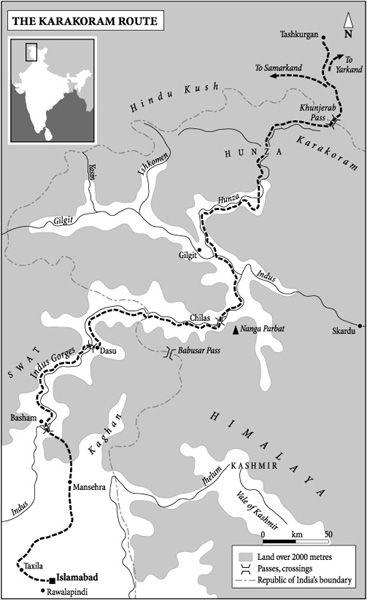
Traditionally their route is supposed to have proceeded from Peshawar to Kabul and over the Hindu Kush via Bamiyan, a tight valley above which two gigantic statues of the Buddha were carved high in the vertical cliffs. There they stood for 1500 years until in March 2001 Taliban zealots tested them with antitank mines, targeted them with artillery and finally toppled them with dynamite. (Exactly six months later Bamiyan’s twin Buddhas were followed to extinction by New York’s ‘twin towers’; the first outrage inspired the second and has often been attributed to the same agency.) Other remains in Bactria itself still attest the Buddhist presence, and thence north and east across the Pamirs, round the desert of Takla Makan and across Lop Nor a succession of Buddhist sites marks the trail to China. ‘The road is long,’ reported a later Chinese pilgrim who had made the return journey to India; looping laboriously right round that mountain bastion of India’s ‘Great Wall’ it is all of three thousand kilometres. There is no doubt that it was indeed an important route for the traffic of both ideas and commodities; but what the road-builders in the 1970s discovered was that there had been as horter and better signposted route by way of the upper Indus and Hunza rivers along the line of their Karakoram Highway.
As reconstructed by Dr Ahmad Hasan Dani, Pakistan’s leading archaeologist, the historical trail begins north of Taxila, where the modern highway strikes off into the hills. Suitably enough the first ‘signpost’ is a Kharosthi version of Ashoka’s Major Rock Edict engraved on two badly weathered boulders at Mansehra. The road runs between them and, in view of the incidence of other Ashokan inscriptions at major route intersections, it seems safe to infer that the Indus route into the mountains was in use in the third centuryBC and here linked with feeder routes from Taxila, Peshawar and Swat. Thence the new road traverses the switchback hills of Kohistan, where innumerable caves and rock drawings continue the Buddhist theme; one drawing is identified by an inscription as being of ‘the monastery of Maharajah Kanishka’. As the roadway wriggles above, and then through, the awesome Indus gorges, more such graffiti on cliffs and rocks – ‘beside the tunnel’, ‘above the petrol station’ – record the passage of individual monks and the presence of stupas and viharas.
West of Chilas, beneath the snowy massif of Nanga Parbat, the Indus valley opens out into a scorching lunar wasteland, devoid of vegetation but garish with rocks of every hue. Here one of many inscriptions mentions the Kushana king Wima Kadphises. Nearer the windswept little town a scene etched on a boulder by the river clearly identifies the Shaka king Maues; it is ‘the first proof of the conquest of this region by the Scythian ruler’8 who seems to have actually ‘invaded’ the Panjab by this route. On the other side of Chilas one of many illustrated boulders is known as the Rock of Gondophares; its inscription lauds the Parthian king who was ‘doubting Thomas’s’ patron.
A sculpted Buddha and more stupas lie in the valleys round Gilgit. Thence both highway and Buddhist trail funnel into the Hunza valley for the spectacular climb up to the glaciers. K2 and associated peaks lie to the east with the Khunjerab Pass and the Chinese border dead ahead. The highway terminates at Tashkurgan, an ancient staging post on the main Silk Route. As a final reminder that this vital trail and all the territory through which it passed lay within the Kushana empire, there is a veritable data-bank of ancient kings, cults and passing strangers, including notices of both the first Kadphises and again of Kusana Devaputra [‘son of God’] Maharajah Kaniska, on the so-called Sacred Rock of Hunza.
The new Karakoram Highway which runs along its southern face … led to the discovery of this monument of world importance that had remained hidden for centuries. The Sacred Rock has stood adamantly through the ravages of time and maintained the carvings and writing of men to tell us about the long-forgotten history of the place and of the pathway along which man travelled from Gandhara to China.9
So the Karakoram Highway, though defying geography, can scarcely be said to have confounded history. In fact it faithfully follows what is now recognised as the preferred route of Buddhist missionaries carrying their teachings to Sinkiang and China.
It is also clear that the teachings in question were increasingly those of Mahayana Buddhism. At the Fourth Buddhist Council held under Kanishka’s auspices a long-simmering dispute within the sangha had led to schism. Those purists who adhered to the essentially ethical content of the Buddha’s teachings became the Hinayana school, while those who would elevate the Buddha and other potentially ‘enlightened ones’ to the status of deities deserving of worship, and so make of his teachings a conventional religion, became the Mahayana. The former persisted in not representing the Buddha as a human figure; in Hinayana art his presence is traditionally indicated merely by a footprint, a throne, a tree, an umbrella. But the Mahayana introduced the Buddha as icon, depicting the ‘enlightened one’ and a host of other Boddhisatvas, together with their female counterparts, in human form. The idea may have come from the imagery of Graeco-Roman gods introduced by the Bactrian Greeks and from the mainly Roman statuary which was evidently much treasured and traded thereafter. Certainly from this coincidence of Mahayanist demand and Mediterranean supply arose the distinctive style and motifs of Gandhara art.
The Kushana, controlling east–west trade in Bactria as well as vast territories in India, had wealth to lavish on both the new faith and the new art; they may even, like Gondophares, have imported western craftsmen like St Thomas. The style developed rapidly, influencing architecture and painting, and inspiring a narrative art based on Buddhist legend but using Graeco-Roman compositions and mannerisms. Exceptionally, the figure of the Buddha himself proved less susceptible to this ‘forum’ decorum; though draped in classical folds and endowed with a serene Grecian countenance, his posture, gestures and physical features conformed strictly to Indo-Buddhist iconography. Such was the Gandhara tradition, a curious synthesis of Kushana patronage, Graeco-Roman forms and Indian inspiration. In sculpture, stucco, engraving and painting, it was this synthesis which passed on up the Karakoram route, or round via Bamiyan and Bactria, to fill the monasteries along the Silk Route and provide the inspiration for later Buddhist art in China and beyond.
The Karakoram trail would be little trodden after the fourth century, when Buddhism in north-west India would be eclipsed by more intruders from central Asia, this time the Huns. Despite those ravages of time and nature, the Karakoram records have therefore remained comparatively undisturbed. Significantly, they reveal little about the route being used for trade. Chinese silks, in particular, were imported into India for re-export from India’s west coast ports to Egypt and Rome. If such caravans avoided the Karakoram route it was presumably because they found the gradients and the grazing of the Bactrian route more agreeable than the cliff-face ladders of Hunza and the landsliding slopes of the Indus gorges. Lacking commercial potential, the Karakoram route was quietly abandoned.
LOOKING OUTWARDS TO THE SEA
Elsewhere the exchange of ideas matched that of commodities stride for stride, stage for stage. In peninsular India – the region south of the Narmada river comprising the Deccan and the extreme south – the last centuries BC and the first ad witnessed those processes of urbanisation and state-formation which had taken place three centuries earlier in the Gangetic region. But here it was trade which stimulated the transition and trade routes which defined it, especially in the western Deccan (Maharashtra and adjacent regions) and in the extreme south (Tamil Nadu and Kerala). Something of that slow metamorphosis from pastoralism and subsistence agriculture to wet rice-cultivation and an agricultural surplus is also discernible. The construction of irrigation works in the south goes back to the second century BC and was accompanied by a demographic shift from upland settlements to the alluvial and easily watered soils of the deltas. ‘In the Chola country, watered by the Kaveri, it was said that the space in which an elephant could lie down produced enough rice to feed seven’ (people, presumably, rather than elephants).10 But here a surplus laboriously realised from agriculture, and then partially squandered on oblations designed to ensure its repetition, was second-best to the surplus on offer from the export of marine and forest produce (especially pearls and pepper) and the re-export of luxury items from further afield. Such options, not open to the Gangetic states, propelled the peninsula from Stone Age to statehood in record time.
Before the first century BC the southern extremity of the subcontinent scarcely features in India’s history. Today’s southern states – Karnataka, Andhra Pradesh, Tamil Nadu and Kerala – correspond to the languages spoken in each, respectively Kannada, Telugu, Tamil and Malayalam. All belong to the Dravidian family, which is quite distinct from the Indo-Aryan whence Sanskrit and most of north India’s contemporary languages derive.
Dravidian-speakers are thought to have preceded Indo-Aryan-speakers in the subcontinent. It has yet to be proved that the Harappans’ language was some form of Dravidian, but the survival of a pocket of proto-Dravidian-speakers in Baluchistan, the Pakistan province which borders with Iran, does suggest that the language was in use west of the Indus and could have emanated from there. It also once enjoyed a wide currency in Gujarat and Maharashtra, though whether in the course of a ‘descent’ to the south, or an ‘ascent’ from it, is uncertain. By the mid-first millennium BC, it was certainly well established in the south, perhaps as a result of dissemination by Dravidian-speakers possessed of the horses and iron weaponry usually associated with the Sanskritic arya, or possibly very much earlier as the language of those responsible for the megalithic sites found in upland regions of the peninsular interior.
The four Dravidian languages must have developed from proto-Dravidian at an early stage since they were already distinct from one another in prehistoric times. Each, too, was already confined to the region represented by today’s states. In fact the continuity of such geo-linguistic entities is the outstanding feature of south Indian history. Here, unusually, definable linguistic units seem to predate the states into which they would become integrated.
Megasthenes in around 300 BC knew of the Pandya kingdom; then, as subsequently, it occupied ‘the portion of India which lies southward and extends to the sea’; and it had 365 villages, a not incidental number in that each was expected to supply the needs of the royal household for one day in the year. Ashoka was even better informed. In the Major Rock Edicts he lists his southern neighbours as the Cholas and Pandyas (respectively the northern and southern Tamil-speaking peoples), the Satiyaputras (whose identity is disputed), the Keralaputras (or the Malayalam-speakers of Kerala), and the people of Sri Lanka. Although none formed part of the Mauryan empire, all, according to the Beloved of the Gods, acknowledged the superiority of dhamma and had imitated the Ashokan provision of roadside shade trees and of medical care for men and animals.
Later the all-conquering Kharavela, king of Kalinga (Orissa), also noticed the southern kingdoms. In his one extant inscription he typically pretends to have defeated a confederacy of Tamil states and to have acquired a large quantity of pearls from the Pandyas. Pearls and shells, along with the fine cottons of Madurai, the Pandya capital, are also mentioned in the Arthasastra. There, in a discussion on how to maximise the state’s revenue, Kautilya’s mentor rashly suggests that north India’s most valuable trade is that with central Asia. The know-all brahman puts him right in no uncertain terms: the trade via the Daksinapatha (the ‘Southern Route’) is the more valuable and, besides, the route is very much safer. Thus trade with the south, albeit in prestige goods, was well-established in Mauryan times; and by way of the secure – and, no doubt, well-shaded –Daksinapatha prestigious ideas also travelled down the peninsula.
Of these and much else about the south we know from anthologies of Tamil poetry and from an early Tamil grammar. The poems, of which the oldest date from about the time of Christ, were composed and first recited at marathon arts festivals, or assemblages (sangam), organised by the Pandyan court. They were collected into the ‘Sangam’ anthologies and committed to writing only very much later. Like the Sanskrit classics, they may therefore contain additions and revisions. On the other hand, unlike the Sanskrit classics, they were not the property of a particular caste and served no obvious ritual purpose. Moreover, they provide much reliable detail about social conditions. ‘It would be difficult to make too much of this fact,’ writes an American authority on Sangam literature. ‘Not only does ancient Tamil literature furnish an accurate picture of widely disparate classes; it also describes the social conditions of Tamil Nadu much as it was before the Aryans arrived in the south.’11
This verdict suggests some future Aryan mass-migration, for which the evidence is scant. Besides, Sangam literature was already aware of Aryan and Sanskritic ideals. The Tamil poets – and poetesses – knew the epics well and were keen to associate their patrons with the heroes of the Mahabharata. Place-names like Madurai, a variant of ‘Mathura’, reflect the early adoption of the sacred geography of the epics; and just as ‘Ayodhya’ travelled on to Thailand and central Java, so ‘Mathura/Madurai’ would make a further landfall in the crowded island of Madura off eastern Java. The Sangam poets also knew of the fabled wealth of the Nandas and of the one-time presence of the Mauryas in Karnataka. Brahmans were already well-established in the south and were the recipients of land grants; Buddhism and Jainism were also familiar; and the script used in the Tamil dedications of their caves was a form of north Indian Brahmi.
Caste distinctions were also observed in the south, but may well predate contact with the Sanskritic north. Certainly they did not conform to the hierarchical fourtier varna system; native ksatriya and vaisya are practically unknown in the south to this day. In caste functions, in hero-worship of the dead, and in the taboos and importance attached to relations between the sexes, there is indeed much that is non-Aryan. Equally unprecedented is the Sangam’s spirit of joyous celebration, which pervades both the endless wars between Cheras (Keralans), Pandyas and Cholas as well as the scenes of peaceful plenty and royal munificence which intervene. The impression given by these poems is not that of a society defying the rigid orthodoxies of inevitable Aryanisation, more of one voluntarily adjusting to prestigious new values and selectively adopting from them.
Patterns of Aryanisation were typically spontaneous and here, as outside India, Sanskritic innovations did not necessarily spread through direct contact with the Gangetic heartland. Thus it seems that the southern kingdoms derived as much from their seaward contacts as from landward intercourse. Literacy, for instance, ‘and indeed incipient civilisation in general’12 look to have originally spread not southward from the Gangetic valley but northward, from Sri Lanka. Heavily indebted to Ashoka’s missionising, Sri Lanka had stolen a march on the mainland. Its Buddhist chronicles provide the only cross-dating yet established for any of the kings mentioned in the Sangam poems. And from Sri Lanka the Brahmi script is thought to have crossed the straits to neighbouring parts of the Pandya country and thence on to Kerala and the Chola country. By this roundabout route other Aryanising traits may have followed.
The maritime dimension would continue to be crucial; in fact it is from their detailed descriptions of commercial life and foreign trade that the Sangam poems derive much of their authenticity. For in references to busy markets, bulging warehouses, ships from many lands, elaborate import/export procedures, and the Yavanas (not only the Bactrian Greeks, but foreigners in general) ‘whose prosperity never wanes’, there is an impressive convergence of Tamil testimony with what we know of south India in the first centuryAD from other sources, principally archaeology and copious references in the literature of the Roman empire.
This was the age of Rome’s commercial expansion. The new empire’s demand for exotica was insatiable, and the acquisition of Egypt in 30 BC had opened the maritime route to the East to Roman investors. A text written by a Greek of the first century AD, thePeriplus of the Erythraean Sea, contains detailed navigational, commercial and even political information on the ports of the Indian Ocean, many of which have been reliably identified with maritime outlets on India’s coast. Ptolemy’s second-century ‘Geography’ adds further details; and the Elder Pliny was already rehearsing an argument, which would become something of a European refrain in the seventeenth century, about Roman bullion being drained away by the purchase of frivolous luxuries from the East. The emperor Augustus claims to have received ‘frequent’ Indian embassies which look to have come from as far afield as Gandhara and the Pandya kingdom; and it was during his reign (31 BC–14 AD) that Europe’s first concerted bid for the exotic produce of the East saw fleets making annual sailings from the Red Sea. Crewed by Greeks and Egyptians, they were familiar with the monsoon trade winds and headed straight for the steamy ports of India’s Konkan and Malabar coasts.
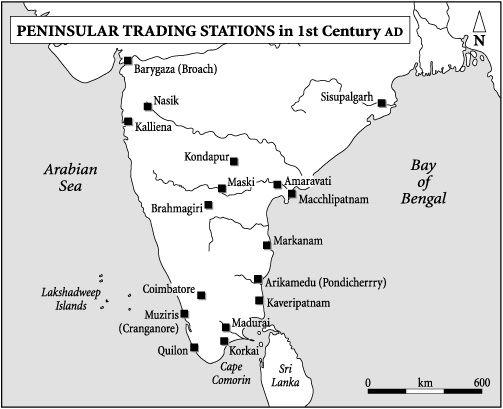
There numerous examples of Roman pottery, including wine-impregnated amphorae, have been found in both the south and along the west coast; and hoards of Roman coins have been unearthed in Tamil Nadu, Kerala and elsewhere. On the east coast near Pondicherry (south of Madras) what has been described as ‘one of a series of Indo-Roman trading stations’ has been excavated at Arikamedu. ‘To Arikamedu suddenly, from unthought-of lands five thousand miles away, came strange wines, tablewares far beyond the local skill, lamps of a strange sort, glass, cut gems.’13
To a neighbouring port at about the same time, there also came the still ‘doubting’ Thomas. Traditionally on this, his second Indian mission, Thomas made more converts but ultimately paid the price of martyrdom. He was killed in Mylapore, now a suburb of Madras where the cave in which he lived, the hill on which he died, and the grave in which he was laid are named after him and still venerated.
Thomas had landed at one of the palm-fringed ports of Kerala’s coconut coast. From converts made there, some sections of Kerala’s still thriving Syrian Christian community claim descent. Thence the apostle had proceeded overland to the east coast. A trail of Roman finds extends across the peninsula from Cranganore, otherwise the Roman port of ‘Musiris’ (near Cochin), to Arikamedu and the mouth of the Kaveri. It would seem, therefore, that Roman shipping did not usually round Cape Comorin. Kerala’s pepper and malabathrum (a kind of cinnamon) were the principal Roman imports, and for these it was unnecessary to risk the contrary winds of the Cape. But clearly some of those amphorae of Tuscan wine, some of that glass and tableware and some Yavana traders must have trundled in oxcarts through the Coimbatore gap (in the Western Ghats) and down the Kaveri. At Arikamedu and elsewhere on the east coast they were needed to sustain a no less important trade – that in the cloves and nutmeg of the Moluccan spice islands and in the gems and resins of Malaya, Burma and the eastern Himalayas.
TRAFFIC AND SETTLEMENTS
A pattern of east–west trade thus emerges. It is one in which the Indian ports served as entrepôts as well as termini and in which the voyage across the Arabian Sea was only one sector of a much more extensive network. Further information on this first global exchange, and on the vital role played in it by Indian shipping and Indian merchants, emerges from two very different sources: inscriptions in the great cave temples of the western Deccan, and scattered archaeological finds in south-east Asia.
Unfortunately neither is as geographically explicit as the data available for the Bactrian and Karakoram routes to China. The archaeological finds in south-east Asia are particularly unimpressive when compared with the region’s later heritage of Indic monuments. In central Burma a town with palace and stupas based on Indian Buddhist models has been excavated and dated to the first centuries AD. In Thailand and Vietnam the odd Roman coin has been found as well as beads, gems, pottery, intaglios and metalwork of Indian provenance. Shards of Indo-Roman ceramics similar to those found at Arikamedu have also turned up in Javanese burial sites. More emphatically, bronze vessels and a carnelian lion found at Don Ta Phet in west-central Thailand are said to be Buddhist and to ‘strongly suggest that Buddhist missionaries were already active, indeed were established, in south-east Asia before the Christian era’. If account also be taken of Indian references to ocean-going ships and missionary and trading ventures to ‘Suvarnabhumi’, and of Roman notices of ‘Chryse’ and ‘Chersonese’ (all three words meaning ‘the land of gold’ and variously identified with Burma, Sumatra, or the Malay peninsula), then ‘enough evidence is now at hand … to show that south-east Asia was already part of a world trading system linking the civilisations of the Mediterranean Basin and Han China.’14
Thanks to this trade and missionary activity, there are also the first signs of Indianised cultures in south-east Asia. Early Chinese texts have been taken to indicate the existence on the Malay peninsula of ‘petty Indian states from the second century AD’.15 One such, called Tun-Sun by the Chinese, had five hundred families from India plus a thousand brahmans to whom the native population gave their daughters in marriage. ‘Consequently many of the brahmans do not go away. They do nothing but study the sacred canon, bathe themselves with scents and flowers, and practise piety ceaselessly by day and by night.’16
It seems that traders, rather than head down to the Malacca Strait, took a short-cut across the Malay peninsula, just as they did the Indian peninsula. Indian settlements in Malaya were presumably engaged in this transshipment activity, and it may well have been from one of these communities that Kaundinya, a brahman, continued east across the Gulf of Thailand to the mouth of the Mekong. There, again according to Chinese sources, he is said to have encountered hostility. The local queen, Liu-ye (‘Willow-Leaf’), wanted to seize his ship. But when Kaundinya fired an arrow which holed her own ship, Willow Leaf changed her mind.
Frightened, she gave herself up, and Kaundinya took her for his wife. But, unhappy to see her naked, he folded a piece of material to make a garment through which he had her pass her head. Then he governed the country and passed power on to his descendants.17
Thus, according to the Chinese, was founded in about 100 AD the Indic kingdom known as Funan. It would survive for five centuries, providing the impetus for other Hindu-Buddhist trading kingdoms on the Vietnamese coast (Champa, Lin-i), before becoming incorporated into the more famously ‘Hinduised’ kingdom of the Khmers of Angkor.
For the period prior to 300 AD Funan has left few relics. A portcity excavated at Oc-eo in Long-xuyen province in the Mekong delta may date back to the second century AD and has yielded a stone statuette of Vishnu and other Hindu cult objects as well as what may have been a temple. Up the coast at Vo-canh in the Nha Trang region a stele bearing an inscription in Sanskrit may be of the third century. It refers to a ruler who has not been certainly identified; more importantly, it strongly supports the idea that writing was introduced into south-east Asia from India. These are, however, no more than clues to an Aryanising process which, though begun in the first centuries AD, would only assume the character of a cultural diaspora after India’s culture had itself become more clearly defined under the ‘golden’ Guptas.
As for the information to be gleaned from the cave temples of the western Deccan, it not only corroborates Yavana (principally Roman) trading activities but also suggests an important link between religious foundations and commercial pioneering. Excavated and sculpted between about 100 BC and 170 AD, the earliest caves in the western Deccan number nearly a thousand. They include those of Bhaja, Karle, Nasik and some of the Ajanta and Ellora caves. Many incorporate the pillars, stupas, chaitya arches and magnificent façades which triumphantly belie their designation as ‘caves’; and most are Buddhist.
From their numerous inscriptions, plus coins, we learn of Maharashtra’s first dynasty and, by correlation with the listings in the Puranas, a rough order of succession has been constructed for its kings. These were the Shatavahanas, or Andhras. They are said to have deprived Magadha’s Kanva dynasty of its residual authority; and more certainly, they established an extensive if loosely-knit hegemony throughout central India and the Deccan. Its prosperity may be judged not only by the cave temples but also by the magnificent Amaravati stupa, structurally and sculpturally the most elaborate in India. Commissioned mainly by mercantile interests living under the Shatavahana dispensation, it was originally located in Andhra Pradesh but was dismantled in the nineteenth century and is now divided between several museums, including the British where it rightly ranks with the Rosetta Stone and the Elgin Marbles as a most cherished possession.
Like the reliefs on the Sanchi and Bharhut stupas, those of Amaravati depict incidents drawn from the mythology which had grown up around the life of the Buddha. Incidentally all these reliefs also provide insights into the busy social life of the period. In scenes crammed with vitality, turbaned crowds fill every panel. Musicians crouch intently over their instruments and wasp-waisted dancers sway provocatively. Above them ladies ajangle with necklaces and bangles lean from a first-floor balcony beneath the fanciful gable of a barrel-vaulted roof. Horses prance in the street, bullocks patiently haul an elaborately decorated carriage, and an elephant goes berserk. One can almost hear the hubbub, smell the dust. Laden ox-carts, and ships with sails and oars, attest the importance of trade. Masons and labourers are seen constructing the very stupa on which their work is depicted. Indeed the ubiquitous standards and fly whisks carried by those who attend on the Buddha may well belong to particular trade and craft guilds (sreni). From literary sources we know of the social, financial and even political weight exercised by guild organisations. We also know that each had its own banner and, from the inscriptions, that these guilds were major patrons of Buddhist institutions.
Similar organisations operated throughout the Shatavahana kingdom and it is no coincidence that Shatavahana ascendancy coincided with the boom in overseas trade with both south-east Asia and the Roman empire. The anonymous author of the Periplusactually mentions some of the Shatavahana kings, and clearly knew their portcities well: Broach (Bharukaccha, ‘Barygaza’), he reports, had a system of pilot boats to escort oceangoing vessels into its tricky anchorage at the mouth of the Narmada, ‘where nothing can be observed with certainty’; Sopara and Kalyan (Kalliena), both near Bombay, were also major ports although the latter had lately been grabbed by the Shatavahanas’ rivals, the Shaka satraps of Gujarat; its trade was therefore ‘much hindered’. After 170 AD recession throughout the Roman world much hindered the entire Indian Ocean trade, and once again this development was faithfully reflected in the western Deccan; the excavation of cave temples abruptly ceased, not to be resumed for another two hundred years, as the Shatavahanas withdrew to the east.
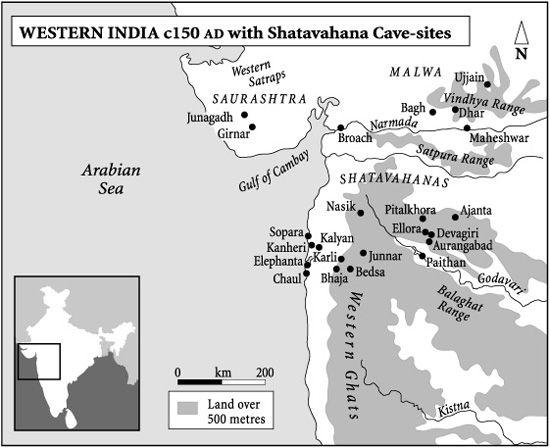
Moreover, the link between trade and dominion was not just one of timing. ‘The prosperity ushered in by trade and the need to control the trade routes is apparent in the sites chosen by the Shatavahanas for their earliest inscriptions.’18 Inland trade routes converged on the Shatavahanas’ west coast ports from Ujjain and the Gangetic states as well as from the Shatavahanas’ capital at Paithan in the Deccan. In both cases they had to thread their way down the rocky defiles of the Western Ghats. The Shatavahanas’ earliest inscriptions are at cave sites clearly related to these passes and defiles. Not without reason did one of the earliest Shatavahana kings describe himself as daksinapatha-pati, ‘the lord of the daksinapatha (the “southern route”)’.
The Periplus describes vast wagon trains heading down from Ujjain with the exotic produce of the Kushana domains and beyond – spikenard, saffron and costus (a medicinal root) from the Himalayas, ivory and bdellium (a resin), muslins and silks, agate and carnelian, ebony and teak. The trade may go back to Mauryan times since a fragment of an Ashokan Rock Edict has been found at the port of Sopara. But it was the Shatavahanas who were responsible for developing it. They not only controlled the trade routes but also encouraged the settlement of lands which would supply both the ports and the staging posts. It was to further this programme of settlement and strategic control that the Shatavahana dynasty, though orthodox in its adherence to Vedic sacrifice and deities, patronised and encouraged Buddhist establishments as well as making land grants to brahmans.
Buddhism, as noted, had become identified with commerce and manufacturing. Not only did Buddhist doctrine encourage the investment of resources which would otherwise be wasted on sacrifices; it also denied caste taboos on food and travel which made trade so hazardous for the orthodox. Monastic establishments thus became foci of inland trade. Beside and below the extant cave temples it is thought that there stretched bazaars and lodging houses, stables, holding pens and joinery shops, all of course built in long-since-perished timber. The monasteries thus served the functions of caravanserais. And, though initially recipients of royal grants, they soon attracted private donations and mercantile endowments. As guild-members or as individuals, weavers, grain merchants, basket makers, leather workers, shipping agents, ivory carvers, smiths, salt merchants and a host of other craftsmen and dealers are recorded as donors in the cave temple inscriptions. Many hailed from distant parts of India; some even described themselves as Yavanas ; all clearly had a vested interest in the booming commerce and so in the religious establishments which made it possible.
The nature of Aryanisation within the subcontinent is still debated; so is that of India’s growing influence outside the subcontinent. Were Funan and all the later Indianised states in south-east Asia the result of trading links, of missionary activities, of migration, or of conquest? Should they be called ‘colonies’? Or were their Indian credentials simply the result of local elites espousing imported ideas of kingship, cultural sophistication and social differentiation? Conquests like Rome’s contemporary triumphs in Gaul and Britain can be discounted. It is much more likely that the processes responsible for the diaspora of Indian ideas in south-east Asia mirrored those at work in the western Deccan where trade, religious institutions and royal authority operated in consort to promote security, extend agrarian settlement and stimulate state-formation.