

The bureau has direct connotations of the white-collar workplace - that is, the professional non-manual world of the executive office. Bureau has evolved from the physical desk that the letter writer may sit at while constructing correspondence, through the space or office within which clerical work is conducted, to a unit of administrative organisation. The advent of digital technology combined with the rapid change in working practices means that office work has developed from a static occupation with a fixed hierarchy to a highly dynamic activity that encourages physical movement, interaction and a complete lack of disconnection. Bureau also forms the beginning of bureaucracy; the design of most interiors entails an entanglement with the machinations of the public authorities.
Key words Bureaucracy, Building Reuse, Cabinet, Furniture, History, Office, The New Office, Working from Home

Fig 11.1 The Underwriting Room, Lloyd’s, City of London, 1964.
Work
It wasn’t really until the industrial period that the practice of ‘going to work’ became prevalent. Until this time most work, especially bureaucratic endeavour, was conducted from home. The house would contain degrees of privacy, so official business would be situated at the front of the building, while more homely activities would take place in the rear and on the upper levels. Francis Spufford, in his wonderful evocation of mid 18th-century New York, describes the counting-house of the firm of Lovell & Company on Golden Hill Street, and in particular the contrast between the formality of the office and the seemingly magical spaces occupied by the banker's family beyond. After some late-night, important and notuncontroversial business is conducted, to show hospitable expectation, the banker invites the young protagonist beyond the confines of the office into his home:
... it ran perpendicular to another street-door, whence fell the faint remaining light of the day; and where the counting office had smelled of ink, smoke, charcoal and the sweat of men, this had a different savour of waxed wood, food, rosewater and tea-leaves, with a suggestion of (what is common to both sexes) the necessary-house.78
Spufford’s book is set in 1746, just on the cusp of the modern era and the Industrial Revolution. This began, suggests Kenneth Frampton, with the extraordinary technical and cultural changes to society in the 18th century, and it was these that encouraged architects to question the classical canons of Vitruvius.79 However, in Home: A Short History of an Idea, Witold Rybczynski80 argues for a slightly earlier turning point, proposing that the 17th century represented the moment of change. Undisputed are the astonishing societal transformations wrought by this that caused a complete adjustment to the way people lived; from smaller, relatively self-sufficient groups in mostly small to medium-sized villages and towns, to great urban conurbations that housed thousands of people, all of whom depended on the import of goods from other places. This transformation greatly affected where people worked. It was no longer possible to work from home, and so the general population went out to work. The white- and blue-collar worker left the family home in the morning and returned in the evening after a full day of labour. These workers were of course mostly men and unmarried women. However, although office work was not conducted in the family home, most of it was still completed in what were family houses. There were very few purposely constructed office buildings until the second half of the 18th century. Charles Dickens’s 1843 description of the working conditions of the Scrooge and Marley office offers what to our eyes seems an extreme account of the organisation of the Victorian workplace:
The door of Scrooge’s counting-house was open, that he might keep an eye upon his clerk, who in a dismal little cell beyond, a sort of tank, was copying letters. Scrooge had a small fire, but the clerk’s fire was so very much smaller that it looked like one coal.81
The office interior
The interiors of the first purpose-built offices quickly adopted the Taylorism principle - a scientific approach that emphasised efficiency for maximum productivity of the workforce. The openplan office was organised with regimentally arranged desks that accommodated as many workers as possible with little attention paid to the physical or mental health of the staff - just like a factory. So strict was the hierarchy that sometimes the boss or line manager would sit in a slightly elevated position to keep watch over their underlings, very much like Jeremy Bentham’s all-seeing principle of the panopticon. This is perfectly illustrated by the Underwriting Room at Lloyd’s (Figure 11.1), which contained a great bustle of trade and industry conducted by men in black suits.
A seemingly more compassionate development was one which appreciated that the corporate image of the firm was epitomised by the visual impact of the office. The understanding that workers normally worked harder in more benevolent conditions combined with a general concern for the health and wellbeing of the population was epitomised by the opening of the Johnson Wax Company building designed by Frank Lloyd Wright in 1939. The visually arresting interior included radical design values such as bright lights, warm spaces and sound-absorbing surfaces. Despite these seemingly altruistic resolutions, the office was primarily designed to increase productivity, and as such over 200 sales staff were situated on one floor.
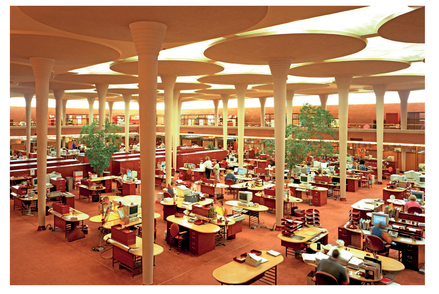
Fig 11.2 The top-lit interior of the Johnson Wax Company building designed by Frank Lloyd Wright, 1939.
Bürolandschaft
A significant evolution of the office was the more socially democratic layout of the Bürolandschaft. This was a German concept that loosely translates as ‘office landscape’, and it encouraged interaction and engagement. The organisation of the office was much less severe, with nested tables, breakout spaces and group meeting areas divided not by rigid partitions but organic boundaries made from plants. This coincided with the influx of female workers. They were rarely in a position of power, but their continued presence in the office ensured subtle changes, for example modesty panels on the tables and more generous lavatories.

Fig 11.3 The organic Bürofandschaft organisation of the BDP offices in Preston, England is based on the needs and relationships of the workers.
With the advent of digital technologies, the noise created by telephone interaction and the need for some small degree of separateness, the altruistic principles of Bürolandschaft evolved into the Cubicle Farm. This is frequently portrayed as the most depressing of all white-collar environments, a situation epitomised by the permanently dejected cartoon character Dilbert, continually frustrated by the futility of his job.82

Fig 11.4 Call centre -Cubicle Farm.
The New Office
Around the time the Cubicle Farm was developing, another more significant advance in the office environment was conceived: the New Office. This was instigated by the breakdown of the traditional office hierarchy, the understanding that working practices had evolved, and the realisation that to accommodate these it was not the mechanics of the material office that needed to change, but the physical position of those working there. Frank Duffy was one of the first commentators to articulate this change. Beginning in the late 1970s he wrote a series of texts including the seminal 1997 The New Office, which describes the physical differences between the old and the new working cultures, before suggesting a type of design logic for a new and radical way for the office to be used.83 Work, he argued, had become more varied, with different types of activities occurring at different times of the day, week or even year. Therefore, offices could be organised according to the processes that occurred within them, rather than by the hierarchy of the personnel. As the environment of the office became less solitary and more plural, so the balance between space given over to individual workstations and that allocated to group activities shifted. This would mean that workers would no longer necessarily occupy a dedicated space, but would use the space most suitable for the task they were completing.
The New Office proposed that work could be broken down into four different organisational types, and each of these needed a distinct type of space for that work to be conducted in. These Duffy classified as ‘group processing’, ‘transactional knowledge’, ‘individual processes’ and ‘concentrated study’. Duffy then used analogy to conveniently describe the quality of the space. Group processing - that is, short-term, highly interactive and often noisy work, such as a team brainstorming, would occupy the Den. Transactional knowledge needs a quiet and often private space that accommodates intimate interaction, like a confidential meeting, and would occur in the Club. Individual processes are the distinct and routine process activity that has low levels of interaction and autonomy, such as callcentre work, and this would take place in the Hive. Meanwhile concentrated study is work that needs little or no interruption, and this Duffy suggests should take place in the Cell.
The Cell is a space that need not even be situated within the office environment. At the end of the 20th century, Frank Duffy identified this space as possibly being at home. By the third decade of the 21st century, this is a viable option. The home provides all of the conditions necessary for Cell-working; digital technology has ensured that all office workers have access to all of the information they need while still within the privacy of their own house.
Duffy didn’t foresee the massive advances in digital technology that allow much office work to be conducted away from the office.84 All of the different environments described by Duffy are now freely available within a normal home. The digital revolution has facilitated the move away from the strict office environment towards other places of work, and it has liberated (if that is what it can be called) the worker from the commute to the office to allow work to be conducted from home. The Covid-19 pandemic exacerbated this situation in the 2Q20's. The move away from the office may have been a gradual acceptance of the possibilities that virtual interaction offers, and it could have taken 30 years to become common practice but instead it took just a matter of days. (cf. Room)

Fig 11.5 Creative start-up freedom in the New Office.
Interior design bureaucracy
Expectations of what work could and couldn’t be completed away from the office have far exceeded what could possibly have been imagined. Processes that before the upheavals of the pandemic would definitely have needed physical interaction have been made possible through, among other facilitating mediums, video-conferencing software. This includes the bureaucracy demanded by authorities to ensure that interiors are safe, compliant with certain standards and appropriate to the local area - although this can at times be quite a controversial judgement. Building regulations govern the performance expectations of materials and building work within any project, and as such are both complex and necessary. They safeguard basics such as ensuring that the building and interior is fully accessible, will not fall down and is not flammable, but they also expect the architect and designer to demonstrate that the building is sustainable, has ambitions to be carbon neutral and is environmentally careful. Planning permission is much more connected with the strategic ambitions of the local area, and includes aesthetic matters, urban growth and the control of the built environment. For example, many conurbations in the UK no longer support uncontrolled horizontal development, so encourage the use of brownfield sites and building reuse.
And so, as with many aspects of interior history, a cyclical process has occurred; the home has once again become the venue for bureaucratic endeavour. This is sometimes conducted at the kitchen table, or sprawled on the living room sofa, but many workers have a small, dedicated area for this work; this is a bureau or workstation - a piece of furniture specifically designed to accommodate the digital needs of the remote worker.