
6
Propositional logic studies arguments whose validity depends on “if-then,” “and,” “or,” “not,” and similar notions. This chapter covers the basics and the next covers proofs. Our later logical systems build on what we learn here.
6.1 Easier translations
We’ll now create a “propositional language,” with precise rules for constructing arguments and testing validity. Our language uses capital letters for true-or-false statements, parentheses for grouping, and five special logical connectives (“∼” squiggle, “•” dot, “∨” vee, “⊃” horseshoe, and “≡” threebar):
∼P = Not-P
(P • Q) = Both P and Q
(P ∨ Q) = Either P or Q
(P ⊃ Q) = If P then Q
(P ≡ Q) = P if and only if Q
A grammatically correct formula of our language is called a wff, or well-formed formula. Wffs are sequences that we can construct using these rules:1
1 Pronounce “wff” as “woof” (as in “wood”). We’ll take letters with primes (like A′ and A″) to be additional letters.
1. Any capital letter is a wff.
2. The result of prefixing any wff with “∼” is a wff.
3. The result of joining any two wffs by “•” or “∨” or “⊃” or “≡” and enclosing the result in parentheses is a wff.
These rules let us build wffs like the following:
· P
· = I live in Paris.
· ∼Q
· = I don’t live in Quebec.
· (P • ∼Q)
· = I live in Paris and I don’t live in Quebec.
· (N ⊃ (P • ∼Q))
· = If I’m Napoleon, then I live in Paris and not Quebec. 0113
“∼P” doesn’t need or use parentheses. A wff requires a pair of parentheses for each “•,” “∨,” “⊃,” or “≡.” So “∼P • Q” is malformed and not a wff; this ambiguous formula could be given parentheses in two ways:
· (∼P • Q) = Both not-P and Q
· ∼(P • Q) = Not both P and Q
The first says definitely that P is false and Q is true. The second just says that not both are true (at least one is false). Don’t read both the same way, as “not P and Q.” Read “both” for the left-hand parenthesis, or use pauses:
· (∼P • Q) = Not-P (pause) and (pause) Q
· ∼(P • Q) = Not (pause) P and Q
Logic is easier if you read the formulas correctly. These two also differ:
· (P • (Q ⊃ R)) = P, and if Q then R
· ((P • Q) ⊃ R) = If P-and-Q, then R
The first says P is definitely true, but the second leaves us in doubt about this.
Here’s a useful rule for translating from English into logic, with examples:
Put “(” wherever you see “both,” “either,” or “if.”
· Either not A or B = (∼A ∨ B)
· Not either A or B = ∼(A ∨ B)
· If both A and B, then C = ((A • B) ⊃ C)
· Not both not A and B = ∼(∼A • B)
Our translation rules have exceptions and need to be applied with common sense. So don’t translate “I saw them both” as “S(” – which isn’t a wff.
Here’s another rule:
Group together parts on either side of a comma.
· If A, then B and C = (A ⊃ (B • C))
· If A then B, and C = ((A ⊃ B) • C)
If you’re confused on where to divide a sentence without a comma, ask yourself where a comma would naturally go, and then translate accordingly:
· If it snows then I’ll go outside and I’ll ski
· = (S ⊃ (G • K))
· If it snows, then I’ll go outside and I’ll ski
Be sure that your capital letters stand for whole statements. “Gensler is happy” is just “G”; don’t use “(G • H)” (“Gensler and happy”?). Similarly, “Bob and Lauren got married to each other” is just “M”; “(B • L)” would be wrong, since the English sentence doesn’t mean “Bob got married and Lauren got married” (which omits “to each other”). However, it would be correct to translate 0114 “Bob and Lauren were sick” as “(B • L)”; here “and” connects whole statements since the English means “Bob was sick and Lauren was sick.”
It doesn’t matter what letters you use, as long as you’re consistent. Use the same letter for the same idea and different letters for different ideas. If you use “P” for “I went to Paris,” then use “∼P” for “I didn’t go to Paris.”
Order and grouping don’t matter in wffs using “•,” “∨,” or “≡” as the only connective:1
1 Order matters in English when “and” means “and then”; “Suzy got married and had a baby” differs from “Suzy had a baby and got married.” Our “•” is simpler and more abstract, and ignores temporal sequence. §§7.5 and 15.2 have additional equivalences.
· (A • B) = (B • A)
· ((A • B) • C) = (A • (B • C))
Order matters with “⊃”; these two make different claims:
· If it’s a dog, then it’s an animal = (D ⊃ A)
· If it’s an animal, then it’s a dog = (A ⊃ D)
We can switch the parts of an if-then if we negate them; so “If it’s a dog, then it’s an animal” “(D ⊃ A)” is equivalent to the contrapositive “If it’s not an animal, then it’s not a dog” “(∼A ⊃ ∼D).”
6.1a Exercise: LogiCola C (EM & ET)1
1 Exercise sections have a boxed sample problem that’s worked out. They also refer to LogiCola computer exercises (see Preface), which give a fun and effective way to master the material. Problems 1, 3, 5, 10, 15, and so on are worked out in the answer section at the back of the book.
Translate these English sentences into wffs.
Both not A and B.
(∼A • B)
1. Not both A and B.
2. Both A and either B or C.
3. Either both A and B or C.
4. If A, then B or C.
5. If A then B, or C.
6. If not A, then not either B or C.
7. If not A, then either not B or C.
8. Either A or B, and C.
9. Either A, or B and C.
10.If A then not both not B and not C.
11.If you get an error message, then the disk is bad or it’s a Macintosh disk.
12.If I bring my digital camera, then if my batteries don’t die then I’ll take pictures of my backpack trip and put the pictures on my Web site.
13.If you both don’t exercise and eat too much, then you’ll gain weight. 0115
14.The statue isn’t by either Cellini or Michelangelo.
15.If I don’t have either $2 in exact change or a bus pass, I won’t ride the bus.
16.If Michigan and Ohio State play each other, then Michigan will win.
17.Either you went through both Dayton and Cinci, or you went through Louisville.
18.If she had hamburgers then she ate junk food, and she ate French fries.
19.I’m going to Rome or Florence and you’re going to London.
20.Everyone is male or female.
6.2 Basic truth tables
Let “P” stand for “I went to Paris” and “Q” for “I went to Quebec.” Each could be true or false (the two truth values) – represented by “1” and “0” (or sometimes “T” and “F”). There are four possible combinations:
|
P Q |
|
|
0 0 |
Both are false |
|
0 1 |
Just Q is true |
|
1 0 |
Just P is true |
|
1 1 |
Both are true |
· I went to neither Paris nor Quebec
· I went to Quebec but not Paris
· I went to Paris but not Quebec
· I went to both Paris and Quebec
A truth table gives a logical diagram for a wff. It lists all possible truth-value combinations for the letters and says whether the wff is true or false in each case. The truth table for “•” (“and”) is very simple:
|
P Q |
(P • Q) |
|
0 0 |
0 |
|
0 1 |
0 |
|
1 0 |
0 |
|
1 1 |
1 |
“I went to Paris and I went to Quebec.”
“(P • Q)” is a conjunction; P and Q are its conjuncts.
“(P • Q)” claims that both parts are true. So “I went to Paris and I went to Quebec” is false in the first three cases (where one or both parts are false) – and true only in the last case. These truth equivalences give the same information:
|
(0 • 0) = 0 |
(false • false) = false |
|
(0 • 1) = 0 |
(false • true) = false |
|
(1 • 0) = 0 |
(true • false) = false |
|
(1 • 1) = 1 |
(true • true) = true |
“(0 • 0) = 0” says that an AND statement is false if both parts are false. The next two say that an AND is false if one part is false and the other part is true. And “(1 • 1) = 1” says that an AND is true if both parts are true.
Here are the truth table and equivalences for “∨” (“or”): 0116
|
P Q |
(P ∨ Q) |
|
0 0 |
0 |
|
0 1 |
1 |
|
1 0 |
1 |
|
1 1 |
1 |
(0 ∨ 0) = 0
(0 ∨ 1) = 1
(1 ∨ 0) = 1
(1 ∨ 1) = 1
“I went to Paris or I went to Quebec.”
“(P ∨ Q)” is a disjunction; P and Q are its disjuncts.
“(P ∨ Q)” claims that at least one part is true. So “I went to Paris or I went to Quebec” is true just if I went to one or both places. Our “∨” symbolizes the inclusive sense of “or”; English also can use “or” in an exclusive sense, which claims that at least one part is true but not both:
· Inclusive “or”: A or B or both = (A ∨ B)
· Exclusive “or”: A or B but not both = ((A ∨ B) • ∼(A • B))
So the exclusive sense requires a longer symbolization.1
1 People sometimes use “Either A or B” for the exclusive “or.” We won’t do this; instead, we’ll use “either” to indicate grouping and we’ll translate it as a left-hand parenthesis.
Here are the truth table and equivalences for “⊃” (“if-then”):
|
P Q |
(P ⊃ Q) |
|
0 0 |
1 |
|
0 1 |
1 |
|
1 0 |
0 |
|
1 1 |
1 |
(0 ⊃ 0) = 1
(0 ⊃ 1) = 1
(1 ⊃ 0) = 0
(1 ⊃ 1) = 1
“If I went to Paris, then I went to Quebec.”
“(P ⊃ Q)” is a conditional; P is the antecedent and Q the consequent.
“(P ⊃ Q)” claims that what we don’t have is the first part true and the second false. Suppose you say this:
“If I went to Paris, then I went to Quebec.”
By our table, you speak truly if you went to neither place, or to both places, or to Quebec but not Paris. You speak falsely if you went to Paris but not Quebec. Does that seem right to you? Most people think so, but some have doubts.
Our truth table can produce strange results. Take this example:
· If I had eggs for breakfast, then the world will end at noon = (E ⊃ W)
Suppose I didn’t have eggs, and so E is false. By our table, the conditional is then true – since if E is false then “(E ⊃ W)” is true. This is strange. We’d normally take the conditional to be false – since we’d take it to claim that my having eggs would cause the world to end. So translating “if-then” as “⊃” seem fishy.
Our “⊃” symbolizes a simplified “if-then” that ignores causal connections and temporal sequence. “(P ⊃ Q)” has a very simple meaning; it just denies that we have P-true-and-Q-false: 0117
· (P ⊃ Q) = ∼(P • ∼Q)
· If P is true, then Q is true = We don’t have P true and Q false
Translating “if-then” this way is a useful simplification, since it captures the part of “if-then” that normally determines validity. The simplification usually works; in the few cases where it doesn’t, we can use a more complex translation (as we’ll sometimes do in the chapters on modal logic).
The truth conditions for “⊃” are hard to remember. These slogans may help:
Falsity implies anything.
(0 ⊃ ) = 1
Anything implies truth.
(0 ⊃ 1) = 1
Truth doesn’t imply falsity.
(1 ⊃ 0) = 0
“Falsity implies anything,” for example, means that the whole if-then is true if the first part is false; so “If I’m a billionaire, then …” is true, regardless of what replaces “…,” since I’m not a billionaire.
Here are the table and equivalences for “≡” (“if-and-only-if”):
|
P Q |
(P ≡ Q) |
|
0 0 |
1 |
|
0 1 |
0 |
|
1 0 |
0 |
|
1 1 |
1 |
(0 ≡ 0) = 1
(0 ≡ 1) = 0
(1 ≡ 0) = 0
(1 ≡ 1) = 1
“I went to Paris if and only if I went to Quebec.”
“(P ≡ Q)” is a biconditional.
“(P ≡ Q)” claims that both parts have the same truth value: both are true or both are false. So “≡” is much like “equals.”
Here are the table and equivalences for “∼” (“not”):
|
P |
∼P |
|
0 |
1 |
|
1 |
0 |
∼0 = 1
∼1 = 0
“I didn’t go to Paris.”
“∼P” is a negation.
“∼P” has the opposite value of “P.” If “P” is true then “∼P” is false, and if “P” is false then “∼P” is true.
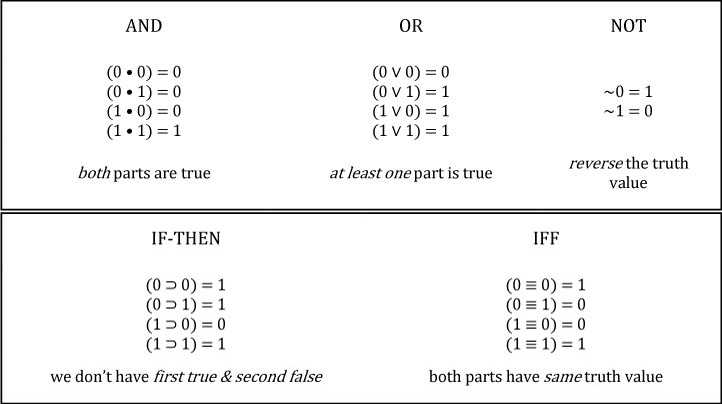
This double-box sums up these basic truth equivalences (learn them well!):
0118
6.2a Exercise: LogiCola D (TE & FE)
Calculate each truth value.
(0 • 1)
(0 • 1) = 0
1. (0 ∨ 1)
2. (0 • 0)
3. (0 ⊃ 0)
4. ∼0
5. (0 ≡ 1)
6. (1 • 0)
7. (1 ⊃ 1)
8. (1 ≡ 1)
9. (0 ∨ 0)
10.(0 ⊃ 1)
11.(0 ≡ 0)
12.(1 ∨ 1)
13.(1 • 1)
14.(1 ⊃ 0)
15.∼1
16.(1 ∨ 0)
17.(1 ≡ 0)
6.3 Truth evaluations
We can calculate a wff’s truth value if we know the truth value of its letters:
Suppose that P = 1, Q = 0, and R = 0. What’s the truth value of “((P ⊃ Q) ≡ ∼R)”?
First replace “P” with “1” and the other letters with “0,” to get “((1 ⊃ 0) ≡ ∼0).” Then simplify from the inside out, using our basic truth equivalences, until we get “1” or “0.” Here we get “0,” so the formula is false:
· Formula: ((1 ⊃ 0) ≡ ∼0)
· Replace “(1 ⊃ 0)” with “0” and “∼0” with “1,” to get “(0 ≡ 1)”
· Replace “(0 ≡ 1)” with “0,” to get “0”
In evaluating “((1 ⊃ 0) ≡ ∼0),” we keep looking for parts, here highlighted as “((1 ⊃ 0) ≡ ∼0),” that match the left side of our basic truth equivalences (see previous page), and then replace these parts with their equivalents.
On this strategy, with formulas like “∼(1 ∨ 0),” first work out the truth value of the part in parentheses. Then apply “∼” to the result:
· Formula: ∼(1 ∨ 0)
· Replace “(1 ∨ 0)” with “1,” to get “∼1”
· Replace “∼1” with “0,” to get “0”
Beginners often do this wrong. They distribute the NOT, going from “∼(1 ∨ 0)” to “(∼1 ∨ ∼0)” (wrong!); this evaluates to “(0 ∨ 1)” and then “1” (wrong!). Don’t distribute “NOT”! With “∼(…),” first simplify the part in parentheses and then apply “∼” to the result.1
1 NOT (“∼”) doesn’t distribute in logic, since, for example, “∼(P • Q)” (which says that not both are true) differs from “(∼P • ∼Q)” (which says that both are false). Likewise MINUS (“−”) doesn’t distribute in math, since “−(2 • 2)” (which equals −4) differs from “(−2 • −2)” (which equals +4).
0119
6.3a Exercise: LogiCola D (TM & TH)
Assume that A = 1 and B = 1 (A and B are both true) while X = 0 and Y = 0 (X and Y are both false). Calculate the truth value of each wff below.
((A ∨ X) ⊃ ∼B)
((1 ∨ 0) ⊃ ∼1)
(1 ⊃ 0)
0
1. ∼(A • X)
2. (∼A • ∼X)
3. ∼(∼A • ∼X)
4. (A ⊃ X)
5. (∼X ≡ Y)
6. (∼B ⊃ A)
7. ∼(A ⊃ X)
8. (B • (X ∨ A))
9. (∼(X • A) ∨ ∼B)
10.(∼A ∨ ∼(X ⊃ Y))
11.((A • ∼X) ⊃ ∼B)
12.∼(A ⊃ (X ∨ ∼B))
13.(∼X ∨ ∼(∼A ≡ B))
14.(∼Y ⊃ (A • X))
15.∼((A ⊃ B) ⊃ (B ⊃ Y))
6.4 Unknown evaluations
We can often figure out a formula’s truth value without knowing the value of some letters:
Suppose that P = 1 and Q = ? (unknown). What’s the truth value of “(P ∨ Q)”?
We might just see that “(1 ∨ ?)” is true, since an OR is true if at least one part is true. Or we can try it both ways; “(1 ∨ ?)” is true because it’s true either way:
(1 ∨ 1) = 1
(1 ∨ 0) = 1
Here’s another example:
Suppose that P = 1 and Q = ? What is the truth value of “(P • Q)”?
We might just see that “(1 • ?)” is unknown, since its truth value depends on the unknown letter. Or we can try it both ways; “(1 • ?)” is unknown because it could turn out true and it could turn out false:
(1 • 1) = 1
(1 • 0) = 0
6.4a Exercise: LogiCola D (UE, UM, & UH)
Assume that T = 1 (T is true), F = 0 (F is false), and U = ? (U is unknown). Calculate the truth value of each wff below. 0120
(∼T • U)
(∼1 • ?) = (0 • ?) = 0
1. (U • F)
2. (U ⊃ ∼T)
3. (U ∨ ∼F)
4. (∼F • U)
5. (F ⊃ U)
6. (∼T ∨ U)
7. (U ⊃ ∼T)
8. (∼F ∨ U)
9. (T • U)
10.(U ⊃ ∼F)
11.(U • ∼T)
12.(U ∨ F)
6.5 Complex truth tables
A truth table for a wff is a diagram listing all possible truth-value combinations for the wff’s letters and saying whether the wff would be true or false in each case. We’ve done simple tables already; now we’ll do complex ones.
With n distinct letters we have 2n possible truth-value combinations. And so one letter gives 2 (21) combinations:
|
A |
|
0 |
|
1 |
Two letters give 4 (22) combinations:
|
A |
B |
|
0 |
0 |
|
0 |
1 |
|
1 |
0 |
|
1 |
1 |
Three letters give 8 (23) combinations:

And n letters give 2n combinations. To get every combination, alternate 0’s and 1’s for the last letter the required number of times. Then alternate 0’s and 1’s for each earlier letter at half the previous rate: by twos, fours, and so on. This numbers the rows in base 2.
Begin a truth table for “∼(A ∨ ∼B)” like this:
|
A B |
∼(A ∨ ∼B) |
|
0 0 |
|
|
0 1 |
|
|
1 0 |
|
|
1 1 |
The right side has the wff. The left side has each letter used in the wff; write each letter just once, regardless of how often it occurs. Below the letters, write all possible truth-value combinations. Then figure out the wff’s truth value for each line. The first line has A and B both false – which makes the whole wff false:
· Formula: ∼(A ∨ ∼B)
· Replace each letter with “0,” to get “∼(0 ∨ ∼0)”
· Replace “∼0” with “1,” to get “∼(0 ∨ 1)”
· Replace “(0 ∨ 1)” with “1,” to get “∼1”
· Replace “∼1” with “0,” to get “0” 0121
The wff comes out “1,” “0,” and “0” for the next three lines; so we get:
|
A B |
∼(A ∨ ∼B) |
|
0 0 |
0 |
|
0 1 |
1 |
|
1 0 |
0 |
|
1 1 |
0 |
“∼(A ∨ ∼B)” is true if and only if A is false and B is true. The simpler wff “(∼A • B)” is equivalent, in that it’s true in the same cases. Both wffs are true in some cases and false in others – making them contingent statements.
“(P ∨ ∼P)” is a tautology, since it comes out true in all cases:
|
P |
(P ∨ ∼P) |
|
0 |
1 |
|
1 |
1 |
“I went to Paris or I didn’t go to Paris.”
This formula, the law of the excluded middle, says that every statement is true or false. This holds in propositional logic, since we stipulated that capital letters stand for true-or-false statements. The law doesn’t always hold in English, since English allows statements that are too vague to be true or false, like “It’s raining” when there’s a slight drizzle or “My shirt is white” when it’s a light cream color. So the law is an idealization when applied to English.
“(P • ∼P)” is a self-contradiction, since it comes out false in all cases:
|
P |
(P • ∼P) |
|
0 |
0 |
|
1 |
0 |
“I went to Paris and I didn’t go to Paris.”
“P and not-P” is always false in propositional logic, which presupposes that “P” stands for the same statement throughout. English is looser and lets us shift the meaning of a phrase in the middle of a sentence. “I went to Paris and I didn’t go to Paris” may express a truth if it means “I went to Paris (in that I landed once at the Paris airport) – but I didn’t really go there (in that I saw almost nothing of the city).” Because of the shift in meaning, this better translates as “(P • ∼Q).”
6.5a Exercise: LogiCola D (FM & FH)
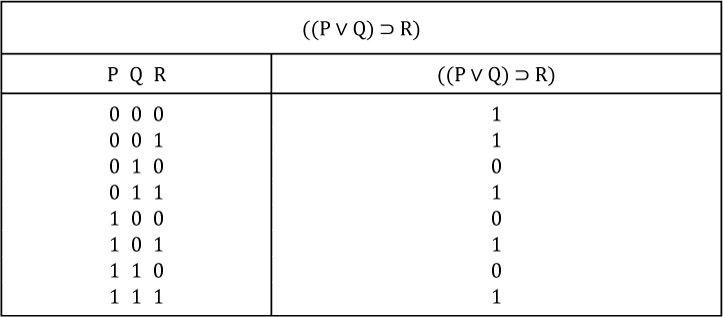
Do a truth table for each wff. 0122
1. (P ≡ ∼Q)
2. (∼P • Q)
3. (P ∨ (Q • ∼R))
4. ((P • ∼Q) ⊃ R)
5. ((P ≡ Q) ⊃ Q)
6. ((P ∨ ∼Q) ⊃ R)
7. (∼Q ⊃ ∼P)
8. (P ≡ (P • P))
9. ∼(P • (Q ∨ ∼R))
6.6 The truth-table test
Recall how we defined VALID and INVALID for arguments:
VALID = No possible case has premises all true and conclusion false.
This can’t happen: 1, 1 ∴ 0
INVALID = Some possible case has premises all true and conclusion false.
This can happen: 1, 1 ∴ 0
To use the truth-table test on a propositional argument:
Construct a truth table showing the truth value of the premises and conclusion for all possible cases. The argument is valid if and only if no possible case has premises all true and conclusion false.
Suppose we want to test this invalid argument; first do a truth table for premises and conclusion, starting as follows:
· If you’re a dog, then you’re an animal.
· You’re not a dog.
· ∴ You’re not an animal.
· (D ⊃ A)
· ∼D
· ∴ ∼A
|
D A |
(D ⊃ A), |
∼D |
∴ |
∼A |
|
0 0 |
||||
|
0 1 |
||||
|
1 0 |
||||
|
1 1 |
Then evaluate the three wffs on each truth combination. The first combination 0123 has D = 0 and A = 0, which makes all three wffs true:
· (D ⊃ A) = (0 ⊃ 0) = 1
· ∼D = ∼0 = 1
· ∼A = ∼0 = 1
So the first line of our truth table looks like this:
|
D A |
(D ⊃ A), |
∼D |
∴ |
∼A |
|
0 0 |
1 |
1 |
1 |
Work out the other three lines:
|
D A |
(D ⊃ A), |
∼D |
∴ |
∼A |
|
0 0 |
1 |
1 |
1 |
|
|
0 1 |
1 |
1 |
0 |
|
|
1 0 |
0 |
0 |
1 |
|
|
1 1 |
1 |
0 |
0 |
Invalid - we can get true premises and a false conclusion (second line).
The argument is invalid, since some possible case has premises all true and conclusion false. Perhaps you’re an animal but not a dog (but maybe a cat).
With this next argument, again do a truth table for premises and conclusion:
· If you’re a dog, then you’re an animal.
· You’re a dog.
· ∴ You’re an animal.
· (D ⊃ A)
· D
· ∴ A
|
D A |
(D ⊃ A), |
D |
∴ |
A |
|
0 0 |
1 |
0 |
0 |
|
|
0 1 |
1 |
0 |
1 |
|
|
1 0 |
0 |
1 |
0 |
|
|
1 1 |
1 |
1 |
1 |
Valid - we never get true premises and a false conclusion.
There’s a short-cut test. Recall that we’re looking for 110 (premises all true and conclusion false). The argument is invalid if 110 sometimes occurs; otherwise, it’s valid. To save time, first evaluate an easy wff and cross out lines that can’t be 110. In our last example, we might work out “D” first:
|
D A |
(D ⊃ A), |
D |
∴ |
A |
|
0 0 |
----- |
0 |
--- |
|
|
0 1 |
----- |
0 |
--- |
|
|
1 0 |
1 |
|||
|
1 1 |
1 |
The first two lines can’t be 110 (since the second digit is 0); so we cross them out and ignore them. Next we might evaluate “A”: 0124
|
D A |
(D ⊃ A), |
D |
∴ |
A |
|
0 0 |
----- |
0 |
--- |
|
|
0 1 |
----- |
0 |
--- |
|
|
1 0 |
1 |
0 |
||
|
1 1 |
----- |
1 |
1 |
The bottom line can’t be 110 (since the last digit is 1); so we cross it out. Then we evaluate “(D ⊃ A)” for only one case – for which it comes out false. Since we never get 110, the argument is valid:
|
D A |
(D ⊃ A), |
D |
∴ |
A |
|
0 0 |
----- |
0 |
--- |
|
|
0 1 |
----- |
0 |
--- |
|
|
1 0 |
0 |
1 |
0 |
|
|
1 1 |
----- |
1 |
1 |
Valid – we never get true premises and a false conclusion.
The short-cut method can save much time if otherwise we’d have to evaluate a long formula for eight or more cases.
With a two-premise argument, look for 110. With three premises, look for 1110. In general, look for a case having premises all true and conclusion false. The argument is valid if and only if this never occurs.
The truth-table test can get tedious for long arguments. Arguments with 6 letters need 64 lines – and ones with 10 letters need 1024 lines. So we’ll use the truth-table test only on fairly simple arguments.1
1 An argument that tests out “invalid” may be valid on grounds that go beyond the system in question. For example, “This is green, therefore something is green” translates into propositional logic as “T ∴ S” and tests out invalid; but it’s valid as “Gt ∴ (∃x)Gx” in quantificational logic.
6.6a Exercise: LogiCola D (AE, AM, & AH)
First appraise intuitively. Then translate into logic (using the letters given) and use the truth-table test to determine validity.
It’s in my left hand or my right hand.
It’s not in my left hand.
∴ It’s in my right hand.
|
L R |
(L ⋁ R), |
∼L |
∴ |
R |
|
0 0 |
0 |
1 |
0 |
|
|
0 1 |
1 |
1 |
1 |
|
|
1 0 |
1 |
0 |
0 |
|
|
1 1 |
1 |
0 |
1 |
Valid - we never get true premises & false conclusion.
1. If you’re a collie, then you’re a dog.
You’re a dog.
∴ You’re a collie. [Use C and D.]
2. If you’re a collie, then you’re a dog.
You’re not a dog.
∴ You’re not a collie. [Use C and D.] 0125
3. If television is always right, then Anacin is better than Bayer.
If television is always right, then Anacin isn’t better than Bayer.
∴ Television isn’t always right. [Use T and B.]
4. If it rains and your tent leaks, then your down sleeping bag will get wet.
Your tent won’t leak.
∴ Your down sleeping bag won’t get wet. [R, L, W]
5. If I get Grand Canyon reservations and get a group together, then I’ll explore canyons during spring break.
I’ve got a group together.
I can’t get Grand Canyon reservations.
∴ I won’t explore canyons during spring break. [R, T, E]
6. There’s an objective moral law.
If there’s an objective moral law, then there’s a source of the moral law.
If there’s a source of the moral law, then there’s a God. (Other possible sources, like society or the individual, are claimed not to work.)
∴ There’s a God. [Use M, S, and G; from C. S. Lewis.]
7. If ethics depends on God’s will, then something is good because God desires it.
Something isn’t good because God desires it. (Instead, God desires something because it’s already good.)
∴ Ethics doesn’t depend on God’s will. [Use D and B; from Plato’s Euthyphro.]
8. It’s an empirical fact that the basic physical constants are precisely in the narrow range of what is required for life to be possible. (This “fine-tuning principle” has considerable evidence behind it.)
The best explanation for this fact is that the basic physical constants were caused by a great mind intending to produce life. (The main alternatives are the “chance coincidence” and “parallel universe” explanations.)
If these two things are true, then it’s reasonable to believe that the basic structure of the world was set up by a great mind (God) intending to produce life.
∴ It’s reasonable to believe that the basic structure of the world was set up by a great mind (God) intending to produce life. [Use E, B, and R; see §5.9.]
9. I’ll go to Paris during spring break if and only if I’ll win the lottery.
I won’t win the lottery.
∴ I won’t go to Paris during spring break. [P, W]
10.If we have a simple concept proper to God, then we’ve directly experienced God and we can’t rationally doubt God’s existence.
We haven’t directly experienced God.
∴ We can rationally doubt God’s existence. [S, E, R]
11.If there is a God, then God created the universe.
If God created the universe, then matter didn’t always exist.
Matter always existed.
∴ There is no God. [G, C, M] 0126
12.If this creek is flowing, then either the spring upstream has water or this creek has some other water source.
This creek has no other water source.
This creek isn’t flowing.
∴ The spring upstream has no water. [F, S, O]
6.7 The truth-assignment test
Recall how we defined VALID and INVALID for arguments:
VALID = No possible case has premises all true and conclusion false.
This can’t happen: 1, 1 ∴ 0
INVALID = Some possible case has premises all true and conclusion false.
This can happen: 1, 1 ∴ 0
To use the truth-assignment test on a propositional argument:
Set each premise to 1 and the conclusion to 0. Figure out the truth value of as many letters as possible. The argument is valid if and only if no possible way to assign 1 and 0 to the letters will keep the premises all 1 and conclusion 0.
Suppose we want to test this valid argument:
· It’s in my left hand or my right hand.
· It’s not in my left hand.
· ∴ It’s in my right hand.
· (L ∨ R)
· ∼L
· ∴ R
Here’s how we work it out. First set each premise to 1 and the conclusion to 0:
· (L ∨ R) = 1
· ∼L = 1
· ∴ R = 0
Since premise 2 has ∼L = 1, making L = 0, write 0 above each L. A 0 superscript above a letter, as in “∼L0,” says that that letter is false:
· (L0 ∨ R) = 1
· ∼L0 = 1
· ∴ R = 0
Since the conclusion has R = 0, write 0 above each R: 0127
· (L0 ∨ R0) = 1
· ∼L0 = 1
· ∴ R0 = 0
But then premise 1 can’t be true. So we can’t have true premises and a false conclusion. So it’s valid:
· (L0 ∨ R0) ≠ 1 Valid
· ∼L0 = 1
· ∴ R0 = 0
So first assign 1 to the premises and 0 to the conclusion (just to see if this could work). Then figure out the truth values for the letters, and then for the longer formulas. If we have to cross something out, then the initial assignment isn’t possible, and so the argument is valid.
This next example shows how to work out an invalid argument:
· It’s in my left hand or my right hand.
· It’s not in my left hand.
· ∴ It’s not in my right hand.
· (L ∨ R)
· ∼L
· ∴ ∼R
First set each premise to 1 and the conclusion to 0:
· (L ∨ R) = 1
· ∼L = 1
· ∴ ∼R = 0
Since premise 2 has ∼L = 1, making L = 0, write 0 above each L:
· (L0 ∨ R) = 1
· ∼L0 = 1
· ∴ ∼R = 0
Since the conclusion has ∼R = 0, making R = 1, write 1 above each R:
· (L0 ∨ R1) = 1
· ∼L0 = 1
· ∴ ∼R1 = 0
So we can have true premises and a false conclusion. So it’s invalid:
· (L0 ∨ R1) = 1 Invalid
· ∼L0 = 1
· ∴ ∼R1 = 0
A truth table gives the same result when L = 0 and R = 1:
|
L R |
(L ⋁ R), |
∼L |
∴ |
∼R |
|
0 1 |
1 |
1 |
0 |
Invalid
The truth-assignment test gives this result more quickly.
Here’s another invalid argument:
· It’s in my left hand or my right hand.
· ∴ It’s in my right hand.
· (L ∨ R)
· ∴ R
If we work this out, we get R false, but we get no value for L; so we give L a value that makes all premises true and conclusion false. Again, first set the premise to 1 and the conclusion to 0: 0128
· (L ∨ R) = 1
· ∴ R = 0
Since the conclusion has R = 0, write 0 above each R:
· (L ∨ R0) = 1
· ∴ R0 = 0
To make the premise true, make L true:
· (L1 ∨ R0) = 1
· ∴ R0 = 0
So we can have true premises and a false conclusion. So it’s INVALID:
· (L1 ∨ R0) = 1 Invalid
· ∴ R0 = 0
If you don’t get a value for a letter, try it both ways (as 1 and as 0); if either gives true premises and a false conclusion, then the argument is invalid.
In working out the truth values for the letters, try to make premises all true and conclusion false. The argument is invalid if there’s some way to do this.
6.7a Exercise: LogiCola ES
Test for validity using the truth-assignment test.
· (K ⊃ (I ∨ S))
· ∼ I
· K
· ∴ S
· (K1 ⊃ (I0 ∨ S0)) ≠ 1 Valid
· ∼ I0 = 1
· K1 = 1
· ∴ S0 = 0
(we can’t have 1110)
1. ∼(N ≡ H)
N
∴ ∼H
2. ((J • ∼D) ⊃ Z)
∼Z
D
∴ ∼J
3. ((T ∨ M) ⊃ Q)
M
∴ Q
4. P
∴ (P • Q)
5. ((L • F) ⊃ S)
S
F
∴ L
6. ((A • U) ⊃ ∼B)
B
A
∴ ∼U
7. ((W • C) ⊃ Z)
∼Z
∴ ∼C
8. Q
∴ (P ⊃ Q)
9. (E ∨ (Y • X))
∼E
∴ X
10.(∼T ⊃ (P ⊃ J))
P
∼J
∴ T
11.∼P
∴ ∼(Q ⊃ P)
12.((∼M • G) ⊃ R)
∼R
G
∴ M
13.∼(Q ≡ I)
∼Q
∴ I
14.((Q • R) ≡ S)
Q
∴ S
15.A
∼A
∴ B 0129
6.7b Exercise: LogiCola EE
First appraise intuitively. Then translate into logic and use the truth-assignment test to determine validity.
If our country will be weak, then there will be war.
Our country will not be weak.
∴ There will not be war.
· (K0 ⊃ R1) = 1 Invalid
· ∼K0 = 1
· ∴ ∼R1 = 0
(we can have 110)
1. Some things are caused (brought into existence).
Anything caused is caused by another.
If some things are caused and anything caused is caused by another, then either there’s a first cause or there’s an infinite series of past causes.
There’s no infinite series of past causes.
∴ There’s a first cause. [A “first cause” (often identified with God) is a cause that isn’t itself caused by another; from St Thomas Aquinas.]
2. If you pass and it’s intercepted, then the other side gets the ball.
You pass.
It’s not intercepted.
∴ The other side doesn’t get the ball.
3. If God exists in the understanding and not in reality, then there can be conceived a being greater than God (namely, a similar being that also exists in reality).
“There can be conceived a being greater than God” is false (since “God” is defined as “a being than which no greater can be conceived”).
God exists in the understanding.
∴ God exists in reality. [This is St Anselm’s famous ontological argument.]
4. If existence is a perfection and God by definition has all perfections, then God by definition must exist.
Existence is a perfection.
God by definition has all perfections.
∴ God by definition must exist. [From René Descartes.]
5. If we have sensations of alleged material objects and yet no material objects exist, then God is a deceiver.
God isn’t a deceiver.
We have sensations of alleged material objects.
∴ Material objects exist. [From René Descartes, who thus based our knowledge of the external material world on our knowledge of God.]
6. If “good” is definable in experimental terms, then ethical judgments are scientifically provable and ethics has a rational basis.
Ethical judgments aren’t scientifically provable.
∴ Ethics doesn’t have a rational basis. 0130
7. If it’s right for me to lie and not right for you, then there’s a relevant difference between our cases.
There’s no relevant difference between our cases.
It’s not right for you to lie.
∴ It’s not right for me to lie.
8. If Newton’s gravitational theory is correct and there’s no undiscovered planet near Uranus, then the orbit of Uranus would be such-and-such.
Newton’s gravitational theory is correct.
The orbit of Uranus isn’t such-and-such.
∴ There’s an undiscovered planet near Uranus. [This reasoning led to the discovery of the planet Neptune.]
9. If attempts to prove “God exists” fail in the same way as our best arguments for “There are other conscious beings besides myself,” then belief in God is reasonable if and only if belief in other conscious beings is reasonable.
Attempts to prove “God exists” fail in the same way as our best arguments for “There are other conscious beings besides myself.”
Belief in other conscious beings is reasonable.
∴ Belief in God is reasonable. [From Alvin Plantinga.]
10.If you pack intelligently, then either this teddy bear will be useful on the hiking trip or you won’t pack it.
This teddy bear won’t be useful on the hiking trip.
You won’t pack it.
∴ You pack intelligently.
11.If knowledge is sensation, then pigs have knowledge.
Pigs don’t have knowledge.
∴ Knowledge isn’t sensation. [From Plato.]
12.If capital punishment is justified and justice doesn’t demand a vindication for past wrongs, then capital punishment reforms the offender or effectively deters crime.
Capital punishment doesn’t reform the offender.
Capital punishment doesn’t effectively deter crime.
∴ Capital punishment isn’t justified.
13.If belief in God were a purely intellectual matter, then either all smart people would be believers or all smart people would be non-believers.
Not all smart people are believers.
Not all smart people are non-believers.
∴ Belief in God isn’t a purely intellectual matter.
14.If you’re lost, then you should call for help or head downstream.
You’re lost.
∴ You should call for help. 0131
15.If maximizing human enjoyment is always good and the sadist’s dog-torturing maximizes human enjoyment, then the sadist’s act is good.
The sadist’s dog-torturing maximizes human enjoyment.
The sadist’s act isn’t good.
∴ Maximizing human enjoyment isn’t always good.
16.If there’s knowledge, then either some things are known without proof or we can prove every premise by previous arguments infinitely.
We can’t prove every premise by previous arguments infinitely.
There’s knowledge.
∴ Some things are known without proof. [From Aristotle.]
17.If you modified your computer or didn’t send in the registration card, then the warranty is void.
You didn’t modify your computer.
You sent in the registration card.
∴ The warranty isn’t void.
18.If “X is good” means “Hurrah for X!” and it makes sense to say “If X is good,” then it makes sense to say “If hurrah for X!”
It makes sense to say “If X is good.”
It doesn’t make sense to say “If hurrah for X!”
∴ “X is good” doesn’t mean “Hurrah for X!” [From Hector-Neri Castañeda.]
19.If we have an idea of substance, then “substance” refers either to a simple sensation or to a complex constructed out of simple sensations.
“Substance” doesn’t refer to a simple sensation.
∴ We don’t have an idea of substance. [From David Hume.]
20.If we have an idea of “substance” and we don’t derive the idea of “substance” from sensations, then “substance” is a thought category of pure reason.
We don’t derive the idea of “substance” from sensations.
We have an idea of “substance.”
∴ “Substance” is a thought category of pure reason. [From Immanuel Kant.]
21.If “good” means “socially approved,” then what is socially approved is necessarily good.
What is socially approved isn’t necessarily good.
∴ “Good” doesn’t mean “socially approved.”
22.[Generalizing the last argument, G. E. Moore argued that we can’t define “good” in terms of any empirical term “F” – like “desired” or “socially approved.”]
If “good” means “F,” then what is F is necessarily good.
What is F isn’t necessarily good. (We can consistently say “Some F things may not be good” without thereby violating the meaning of “good.”)
∴ “Good” doesn’t mean “F.”
23.If moral realism (the belief in objective moral truths) were true, then it could explain the moral diversity in the world.
Moral realism can’t explain the moral diversity in the world.
∴ Moral realism isn’t true. 0132
6.8 Harder translations
As you symbolize idiomatic English, keep following our earlier rules: (1) put “(” wherever you see “both,” “either,” or “if”; and (2) group together parts on either side of a comma. Here we’ll add additional rules, with examples:
Translate “but” (“yet,” “however,” “although,” and so on) as “and.”
· Michigan played but it lost
· = (P • L)
The translation loses the contrast (or surprise), but this doesn’t affect validity.
Translate “unless” as “or.”
· You’ll die unless you breathe
· = (D ∨ B) = (B ∨ D)
· Unless you breathe you’ll die
· = (D ∨ B) = (B ∨ D)
“Unless” is also equivalent to “if not”; so we also could use “(∼B ⊃ D)” (“If you don’t breathe, then you’ll die”).
Translate “just if” and “iff” (a logician word) as “if and only if.”
· I’ll agree just if you pay me $1,000
· = (A ≡ P)
· I’ll agree iff you pay me $1,000
· = (A ≡ P)
The order of the letters doesn’t matter with “•” or “∨” or “≡.”
Our next two rules are tricky. The first governs most conditional words:
The part after “if” (“provided that,” “assuming that,” and so on) is the if-part (the antecedent, the part before the horseshoe).
· If A, then B
· = (A ⊃ B)
· Provided that A, B
· = (A ⊃ B)
· A, if B
· = (B ⊃ A)
· A, provided that B
· = (B ⊃ A)
· You’re an animal, if you’re a dog
· = (D ⊃ A)
· Provided that you’re a dog, you’re an animal
· = (D ⊃ A)
“Only if” is different and follows its own rule:
The part after “only if” is the then-part (the consequent, the part after the horseshoe). (Or just write “⊃” for “only if.”)
· A only if B
· = (A ⊃ B)
· Only if A, B
· = (B ⊃ A) 0133
· You’re alive only if you have oxygen
· = (A ⊃ O)
· Only if you have oxygen, are you alive
· = (A ⊃ O)
The contrapositive translation “(∼O ⊃ ∼A)” (“If you don’t have oxygen, then you aren’t alive”) is equivalent and often sounds more intuitive.
Here’s the rule for “sufficient” and “necessary”:
“A is sufficient for B” means “If A then B.”
“A is necessary for B” means “If not A then not B.”
“A is necessary and sufficient for B” means “A if and only if B.”
· Water is sufficient for life
· = (W ⊃ L)
· Water is necessary for life
· = (∼W ⊃ ∼L)
· Water is necessary and sufficient for life
· = (W ≡ L)
The order of the letters matters with “⊃” but not with “≡.”
Sometimes none of these rules applies and you just have to puzzle out the meaning on your own.
6.8a Exercise: LogiCola C (HM & HT)
Translate these English sentences into wffs.
A, assuming that B.
(B ⊃ A)
1. If she goes, then you’ll be alone but I’ll be here.
2. Your car will start only if you have fuel.
3. I will quit unless you give me a raise.
4. Taking the final is a sufficient condition for passing.
5. Taking the final is necessary for you to pass.
6. You’re a man just if you’re a rational animal.
7. Unless you have faith, you’ll die.
8. She neither asserted it nor hinted at it.
9. Getting at least 96 is a necessary and sufficient condition for getting an A.
10.Only if you exercise are you fully alive.
11.I’ll go, assuming that you go.
12.Assuming that your belief is false, you don’t know.
13.Having a true belief is a necessary condition for having knowledge.
14.You get mashed potatoes or French fries, but not both.
15.You’re wrong if you say that. 0134
6.9 Idiomatic arguments
Our arguments so far have been phrased in a clear premise–conclusion format. Unfortunately, real-life arguments are seldom so neat and clean. Instead we often find convoluted wording or extraneous material. Important parts of the argument may be omitted or only hinted at. And it may be hard to pick out the premises and conclusion. It often takes hard work to reconstruct a clearly stated argument from a passage.
Logicians like to put the conclusion (here italicized) last:
“Socrates is human. If he’s human, then he’s mortal. So Socrates is mortal
· H
· (H ⊃ M)
· ∴ M
But people sometimes put the conclusion first, or in the middle:
“Socrates must be mortal. After all, he’s human. And if he’s human, he’s mortal.”
“Socrates is human. So he must be mortal – since if he’s human, he’s mortal.”
Here “must” and “so” indicate the conclusion (which always goes last when we translate into logic). Here are some typical words that help us pick out premises and conclusion:
These often indicate premises:
· Because, for, since, after all …
· I assume that, as we know …
· For these reasons …
These often indicate conclusions:
· Hence, thus, so, therefore …
· It must be, it can’t be …
· This proves (or shows) that …
When you don’t have this help, ask yourself what is argued from (these are the premises) and what is argued to (this is the conclusion).
In reconstructing an argument, first pick out the conclusion. Then symbolize the premises and conclusion; this may involve untangling idioms like “A unless B” (which translates as “A or B”). If you don’t get a valid argument, try adding unstated but implicit premises (you may need to add a premise that uses letters that only occur once); using the “principle of charity,” interpret unclear reasoning in the way that gives the best argument.
Here’s a twisted argument – and how it goes into premises and a conclusion:
The gun must have been shot recently! It’s still hot.
· The gun is still hot.
· ∴ The gun was shot recently.
· H
· ∴ S 0135
Since this seems to presume an implicit premise, we add a plausible one that makes the argument valid. Then we translate into logic and test for validity:
· If the gun is still hot, then it was shot recently. (implicit)
· The gun is still hot.
· ∴ The gun was shot recently.
· (H ⊃ S) Valid
· H
· ∴ S
6.9a Exercise: LogiCola E (F & I)
First appraise intuitively. Then pick out the conclusion, translate into logic, and determine validity using the truth-assignment test. Supply implicit premises if needed.
Knowledge is good in itself only if it’s desired for its own sake. So knowledge is good in itself, since it’s desired for its own sake.
· (G0 ⊃ D1) = 1 Invalid
· D1 = 1
· ∴ G0 = 0
The conclusion is “So knowledge is good in itself”: “G.”
1. Knowledge can’t be sensation. If it were, then we couldn’t know something that we aren’t presently sensing. [From Plato.]
2. Presuming that we followed the map, then unless the map is wrong there’s a pair of lakes just over the pass. We followed the map. There’s no pair of lakes just over the pass. Hence the map is wrong.
3. If they blitz but don’t get to our quarterback, then our wide receiver will be open. So our wide receiver won’t be open, as shown by the fact that they won’t blitz.
4. My true love will marry me only if I buy her a Rolls–Royce. It follows that she’ll marry me, since I’ll buy her a Rolls–Royce.
5. The basic principles of ethics can’t be self-evident truths, since if they were then they’d largely be agreed upon by intelligent people who have studied ethics.
6. That your views are logically consistent is a necessary condition for your views to be sensible. Your views are logically consistent. So your views are sensible.
7. If Ohio State wins but Nebraska doesn’t, then the Ohio Buckeyes will be national champions. So it looks like the Ohio Buckeyes won’t be national champs, since Nebraska clearly is going to win.
8. The filter capacitor can’t be blown. This is indicated by the following facts. You’d hear a hum, presuming that the silicon diodes work but the filter capacitor is blown. But you don’t hear a hum. And the silicon diodes work.
9. There’s oxygen present. And so there will be a fire! My reason for saying this is that only if there’s oxygen present will there be a fire.
10.We have no moral knowledge. This is proved by the fact that if we did have moral knowledge then basic moral principles would be either provable or self-evident. But they aren’t provable. And they aren’t self-evident either.
11.It must be a touchdown! We know that it’s a touchdown if the ball broke the plane of the end zone. 0136
12.Assuming that it wasn’t an inside job, then the lock was forced unless the thief stole the key. The thief didn’t steal the key. We may infer that the robbery was an inside job, inasmuch as the lock wasn’t forced.
13.It must be the case that we don’t have any tea bags. After all, we’d have tea bags if your sister Carol drinks tea. Of course, Carol doesn’t drink tea.
14.We can’t still be on the right trail. We’d see the white Appalachian Trail blazes on the trees if we were still on the right trail.
15.If God is omnipotent, then he could make hatred inherently good – unless there’s a contradiction in hatred being inherently good. But there’s no contradiction in this. And God is omnipotent. I conclude that God could make hatred inherently good. [From William of Ockham, who saw morality as depending on God’s will.]
16.Taking the exam is a sufficient condition for getting an A. You didn’t take the exam. This means you don’t get an A.
17.If Texas or Arkansas wins, then I win my $10 bet. I guess I win $10. Texas just beat Oklahoma 17–14!
18.Unless you give me a raise, I’ll quit. Therefore I’m quitting!
19.Empirical knowledge must be impossible. My reason for saying this is that there’s no independent way to prove that our senses are reliable. Empirical knowledge would be possible, of course, only if there were an independent way to prove that our senses are reliable.
20.It’s virtuous to try to do what’s good. On the other hand, it’s not virtuous to try to do what’s socially approved. I conclude that, contrary to cultural relativism, “good” doesn’t mean “socially approved.” I assume, of course, that if “good” meant “socially approved” and it was virtuous to try to do what’s good, then it would be virtuous to try to do what’s socially approved.
21.Moral conclusions can be deduced from non-moral premises only if “good” is definable using non-moral predicates. But “good” isn’t so definable. So moral conclusions can’t be deduced from non-moral premises.
22.The world can’t need a cause. If the world needed a cause, then so would God.
6.10 S-rules
Inference rules are rules of valid reasoning that provide the building blocks for formal proofs (which we begin in the next chapter). We’ll name our inference rules after the type of wff that they operate on, like AND or IF-THEN.
S-rules simplify statements. Our first S-rule simplifies AND statements and is itself called “AND”:
|
AND |
(P • Q) – – –––– P, Q |
AND statement, so both parts are true.
From an AND statement, we can infer each part: “It’s cold and windy; therefore it’s cold, therefore it’s windy.” Negative parts work the same way: 0137
· It’s not cold and it’s not windy.
· ∴ It’s not cold.
· ∴ It’s not windy.
· (∼C • ∼W)
· –––––––––
· ∼C, ∼W
But from a NOT-BOTH statement (where “∼” is outside the parentheses), we can infer nothing about the truth or falsity of the parts:
· You’re not both in Paris and in Quebec.
· ∴ No conclusion.
· ∼(P • Q)
· –––––––
· nil
From “∼(P • Q)” we can’t tell the truth value for “P” or for “Q”; we only know that not both are true (at least one is false). Use the AND rule only on AND forms, like these three:
(A • B)
(∼C • D)
((E ≡ F) • (G ∨ H))
Never use the AND rule on a formula that starts with a NOT, like “∼(J • K)”; this formula has the NOT-BOTH form, not the AND form. ANDs always start with “(” and then have a wff and “•” and a wff and “)”; ANDs never start with a squiggle (“∼”).
Our second S-rule operates on NOR (NOT-EITHER) statements and is itself called “NOR”:
|
NOR |
~(P ∨ Q) –––––– ~P, ~Q |
NOT-EITHER is true, so both parts are false.
From a NOR, we can infer the opposite of each part: “It’s not either cold or windy, therefore it’s not cold, therefore it’s not windy.” Negative parts work the same way: infer the opposite of each part (the opposite of “∼A” being “A”):
· Not either not-A or not-B.
· ∴ A
· ∴ B
· ∼(∼A ∨ ∼B)
· –––––––––––
· A, B
· ∼(part-1 ∨ part-2)
· –––––––––––––––––––––
· op of part-1, op of part-2
But a positive OR tells us nothing about the truth or falsity of each part:
· You’re in either Paris or Quebec.
· ∴ No conclusion.
· (P ∨ Q)
· –––––––
· nil
Here we can’t tell the truth or falsity of each part; we only know that at least one part is true. Use the NOR rule only on NOR forms, like these three below:
∼(A ∨ B)
∼(∼C ∨ D)
∼((E ≡ F) ∨ (G • H))
0138 NORs always start with a squiggle. Never use the NOR rule on an OR, like “(J ∨ K).”
Our final S-rule operates on NIF (FALSE IF-THEN) statements:
|
NIF |
~(P ⊃ Q) –––––– P, ~Q |
FALSE IF-THEN, so first part true, second part false.
Since “(P ⊃ Q)” means “We don’t have P-true-and-Q-false,” so also “∼(P ⊃ Q)” means “We do have P-true-and-Q-false.” NIF isn’t very intuitive; memorize it instead of appealing to intuitions or examples. You’ll use this rule so much in doing proofs that it’ll become second nature.
If a NIF has negative parts, again infer part-1 and the opposite of part-2:
· ∼(∼A ⊃ B)
· ––––––––––
· ∼A, ∼B
· ∼(A ⊃ ∼B)
· ––––––––––
· A, B
· ∼(∼A ⊃ ∼B)
· –––––––––––
· ∼A, B
· ∼(part-1 ⊃ part-2)
· ––––––––––––––––
· part-1, op of part-2
A positive IF-THEN “(A ⊃ B)” says nothing about each part’s truth or falsity. Use the NIF rule only on NIF (FALSE IF-THEN) forms, like these:
∼(A ⊃ B)
∼(∼C ⊃ D)
∼((E ≡ F) ⊃ (G • H))
NIFs always start with a squiggle. Never use the NIF rule on an IF-THEN, like “(J ⊃ K).”
And so you can simplify AND, NOR, and NIF:
|
AND |
NOR |
NIF |
|
(P • Q) –––––– P, Q |
~(P ∨ Q) ––––––– ~P, ~Q |
~(P ⊃ Q) ––––––– P, ~Q |
|
“AND statement, so both parts are true.” |
“NOT-EITHER is true, so both parts are false.” |
“FALSE IF-THEN, so first part true, second part false.” |
I suggest that, as you apply these rules, you mumble the little saying at the bottom – like “AND statement, so both parts are true.” To understand why our rules work, recall our basic truth tables:
· A true AND must have both parts true.
· A false OR must have both parts false.
· A false IF-THEN must have the first part true and the second part false.
Try to learn the inference rules so well that they become automatic. You’ll use these rules a lot when you do formal proofs; and learning formal proofs will be so much easier if you’ve already mastered the inference rules. 0139
6.10a Exercise: LogiCola F (SE & SH)
Draw any simple conclusions (a letter or its negation) that follow from these premises. If nothing follows, leave blank.
(C • ∼R)
–––––––
(C • ∼R)
–––––––
C, ∼R
“AND statement, so both parts are true.”
1. (P • U)
––––––
2. (L ∨ C)
––––––
3. (∼N ⊃ S)
–––––––––
4. ∼(F ⊃ M)
––––––––
5. ∼(R ∨ S)
––––––––
6. ∼(J • ∼N)
–––––––––
7. ∼(I ∨ ∼V)
–––––––––
8. (F ⊃ ∼G)
––––––––
9. (∼Q • B)
––––––––
10.∼(H ⊃ ∼I)
–––––––––
11.(∼O ∨ ∼X)
–––––––––
12.(∼T ⊃ ∼H)
––––––––––
13.∼(∼N ∨ ∼E)
––––––––––
14.∼(Q • T)
––––––––
15.(M ∨ ∼W)
–––––––––
16.(∼D • ∼Z)
–––––––––
17.∼(∼Y ⊃ G)
––––––––––
18.∼(∼A • ∼J)
––––––––––
19.∼(∼U ⊃ ∼L)
–––––––––––
20.(∼K ∨ B)
––––––––
6.11 I-rules
I-rules infer a conclusion from two premises. Our first I-rule is called “NOT-BOTH,” since the larger wff has to have this form:
|
NOT-BOTH |
||
|
~(P • Q) P –––––– ~Q |
~(P • Q) Q –––––– ~P |
|
|
affirm one part |
||
NOT-BOTH are true, this one is, so the other one isn’t.
To infer with NOT-BOTH, we must affirm one part:
· You’re not both in Paris and also in Quebec.
You’re in Paris.
∴ You’re not in Quebec.
· You’re not both in Paris and also in Quebec.
You’re in Quebec.
∴ You’re not in Paris.
Negative parts work the same way; if we affirm one, we can deny the other: 0140
· ∼(∼A • ∼B)
∼A
––––––––––
B
· ∼(A • ∼B)
A
–––––––––
B
· ∼(A • ∼B)
∼B
–––––––––
∼A
In each case, the second premise affirms (says the same as) one part. And the conclusion denies (says the opposite of) the other part.
If we deny one part, we can’t draw a conclusion about the other part:
· Not both are true.
The first is false.
–––––––––––––––
No conclusion.
· ∼(P • Q)
∼P
–––––––
nil
· You’re not both in Paris and also in Quebec.
You’re not in Paris.
∴ No conclusion.
You may want to conclude “Q”; but maybe “Q” is false too (maybe both parts are false, maybe you’re in neither place). To infer with NOT-BOTH, we must affirm one part.
Our second I-rule is called “OR,” since the larger wff has to have this form:
|
OR |
||
|
(P ∨ Q) ~P –––––– Q |
(P ∨ Q) ~Q –––––– P |
|
|
deny one part |
||
At least one is true, this one isn’t, so the other one is.
To infer with OR, we must deny one part:
· At least one hand (left or right) has candy.
The left hand doesn’t.
∴ The right hand does.
· At least one hand (left or right) has candy.
The right hand doesn’t.
∴ The left hand does.
Negative parts work the same; if we deny one part, we can affirm the other:
· (∼A ∨ ∼B)
A
–––––––––
∼B
· (A ∨ ∼B)
∼A
––––––––
∼B
· (A ∨ ∼B)
B
––––––––
A
In each case, the second premise denies (says the opposite of) one part. And the conclusion affirms (says the same as) the other part.
If we affirm one part, we can’t draw a conclusion about the other part:
· At least one is true.
The first is true.
––––––––––––––––
No conclusion.
· (L ∨ R)
L
––––––
nil
· At least one hand (left or right) has candy.
The left hand has candy.
∴ No conclusion. 0141
You may want to conclude “∼R”; but maybe “R” is true (maybe both parts are true, maybe both hands have candy). To infer with OR, we must deny one part.
Our final I-rule is called “IF-THEN.” The first form here is modus ponens (Latin for “affirming mode”) and the second is modus tollens (“denying mode”):
|
IF-THEN |
||
|
(P ⊃ Q) P –––––– Q |
(P ⊃ Q) Q –––––– P |
|
|
affirm 1st or deny 2nd |
||
“IF-THEN, affirm the first, so affirm the second.”
“IF-THEN, deny the second, so deny the first.”
To infer with IF-THEN, we must affirm the first part or deny the second part:
· If you’re a dog, then you’re an animal.
You’re a dog.
∴ You’re an animal.
· (D ⊃ A)
D
––––––
A
· If you’re a dog, then you’re an animal.
You’re not an animal.
∴ You’re not a dog.
· (D ⊃ A)
∼A
––––––
∼D
Negative parts work the same. If we affirm the first, we can affirm the second:
· (∼A ⊃ ∼B)
∼A
–––––––––
∼B
· (A ⊃ ∼B)
A
––––––––
∼B
· (∼A ⊃ B)
∼A
––––––––
B
And if we deny the second, we can deny the first:
· (∼A ⊃ ∼B)
B
–––––––––
A
· (A ⊃ ∼B)
B
––––––––
∼A
· (∼A ⊃ B)
∼B
––––––––
A
If we deny the first part or affirm the second, we can’t conclude anything about the other part:
· If you’re a dog, then you’re an animal.
You’re not a dog.
∴ No conclusion.
· (D ⊃ A)
∼D
––––––
nil
· If you’re a dog, then you’re an animal.
You’re an animal.
∴ No conclusion.
· (D ⊃ A)
A
––––––
nil
“You’re not an animal” doesn’t follow in the first case, since you could be a cat. “You’re a dog” doesn’t follow in the second case, since again you could be a cat. To infer with an if-then, we need the first part true or the second part false.
In using I-rules, determine the larger wff’s form and apply its rule: 0142
|
NOT-BOTH ~(P • Q) P –––––– ~Q ~(P • Q) Q –––––– ~P affirm one part |
OR (P ∨ Q) ~P –––––– Q (P ∨ Q) ~Q –––––– P deny one part |
IF-THEN (P ⊃ Q) P –––––– Q (P ⊃ Q) ~Q –––––– ~P affirm 1st or deny 2nd |
|
“NOT-BOTH are true, this one is, so the other one isn’t.” |
“At least one is true, this one isn’t, so the other one is.” |
“IF-THEN, affirm the first, so affirm the second.” “IF-THEN, deny the second, so deny the first.” |
Again, say the little slogan to yourself as you derive the conclusion. (This is much less confusing than saying the individual formulas.)
6.11a Exercise: LogiCola F (IE & IH)
Draw any simple conclusions (a letter or its negation) that follow from these premises. If nothing follows, leave blank.
(∼Q ∨ ∼M)
Q
–––––––––
(∼Q ∨ ∼M)
Q
–––––––––
∼M
“At least one is true, this one isn’t, so the other one is.” (OR)
1. ∼(W • T)
W
––––––––
2. (S ∨ L)
S
––––––
3. (H ⊃ ∼B)
H
––––––––
4. (X ⊃ E)
E
––––––
5. ∼(B • S)
∼S
–––––––
6. (∼Y ⊃ K)
Y
––––––––
7. (K ∨ ∼R)
R
––––––––
8. ∼(∼S • W)
∼W
–––––––––
9. (U ⊃ G)
U
–––––––
10.(∼I ∨ K)
K
–––––––
11.(C ⊃ ∼V)
∼C
––––––––
12.(∼N ∨ ∼A)
A
––––––––––
13.∼(V • H)
∼V
–––––––
14.(∼A ⊃ ∼E)
∼E
–––––––––
15.∼(∼F • ∼O)
∼O
––––––––––
16.(Y ∨ ∼C)
∼C
––––––––
17.(∼L ⊃ M)
∼M
––––––––
18.(∼M ∨ ∼B)
∼M
––––––––––
19.∼(∼F • ∼Q)
F
––––––––––
20.∼(A • ∼Y)
A
–––––––––
0143
6.12 Mixing S- and I-rules
Our next exercise mixes S- and I-rule inferences. Use S-rules (the first group below) to simplify one premise and I-rules (the second group) to infer from two premises:
|
AND |
(P • Q) –––––– P, Q |
|
NOR |
~(P ∨ Q) –––––– ~P, ~Q |
|
NIF |
~(P ⊃ Q) –––––– P, ~Q |
||
|
NOT-BOTH |
|||
|
~(P • Q) P –––––– ~Q |
~(P • Q) Q –––––– ~P |
||
|
affirm one part |
|||
|
OR |
||
|
(P ∨ Q) ~P –––––– Q |
(P ∨ Q) ~Q –––––– P |
|
|
deny one part |
||
|
IF-THEN |
||
|
(P ⊃ Q) P –––––– Q |
(P ⊃ Q) ~Q –––––– ~P |
|
|
affirm 1st or deny 2nd |
In using these rules, focus on the (larger) wff’s form. Simplify AND, NOR, and NIF. Infer from NOT-BOTH (with one part true), OR (with one part false), or IF-THEN (with the first part true or the second part false).
6.12a Exercise: LogiCola F (CE & CH)
Draw any simple conclusions (a letter or its negation) that follow from these premises. If nothing follows, leave blank.
(A ⊃ ∼B)
∼A
––––––––
(no conclusion)
“IF-THEN, need first part true or second part false.”
1. ∼(U • T)
T
–––––––
2. ∼(∼B ∨ C)
–––––––––
3. (X ⊃ F)
∼X
––––––
4. (∼S ∨ T)
––––––––
5. (P • ∼Q)
–––––––
6. (∼I ⊃ ∼N)
N
–––––––––
7. (D ∨ ∼J)
D
––––––––
8. ∼(L • M)
––––––––
9. ∼(∼C ⊃ D)
–––––––––
10.∼(∼R • A)
∼R
–––––––––
11.∼(M ∨ ∼I)
–––––––––
12.∼(R • ∼G)
∼G
–––––––––
13.(∼L • S)
–––––––
14.(∼L ∨ ∼T)
L
–––––––––
15.(A ⊃ ∼B)
––––––––
16.∼(W • ∼X)
∼W
–––––––––
0144
6.13 Extended inferences
S- and I-rules can work on larger formulas too. Suppose you meet a big AND, “((C ≡ D) • (E ⊃ F)).” Visualize it as having two parts – and derive both:
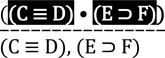
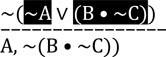
Say to yourself “AND statement, so both parts are true.” Or suppose you meet a big NOR, “∼(∼A ∨ (B • ∼C)).” Visualize it as having two parts – and derive the opposite of each:
Say to yourself “NOT-EITHER is true, so both parts are false.” Or suppose you meet a big NIF, “∼((C • D) ⊃ (E ⊃ F)).” Again, visualize it as having two parts and say “FALSE IF-THEN, so first part true, second part false”:

· (C • D), ∼(E ⊃ F)
Focus on a complex wff’s FORM; we can simplify an AND, NOR, or NIF.
I-rules require two wffs; the larger wff’s FORM tells us what further wff we need to complete the inference. Suppose you meet a big NOT-BOTH statement, “∼((A ≡ B) • (C • (D ∨ F))).” You can infer with it if you have one part true:
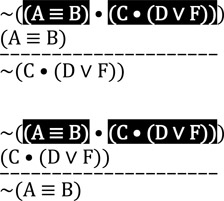
Say to yourself, “NOT-BOTH are true, this one is, so the other one isn’t.” Or suppose you meet a big OR, “(∼A ∨ (B • ∼C)).” You can infer with it if you have one part false:
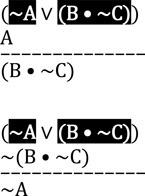
Say to yourself “At least one is true, this one isn’t, so the other one is.” Or suppose you meet a big IF-THEN, “((C • D) ⊃ (E ⊃ F)).” You can infer with it if you have the first part true or the second part false: 0145

Say to yourself “IF-THEN, affirm the first, so affirm the second” or “IF-THEN, deny the second, so deny the first.”
6.14 Logic and computers
Digital computers were developed using ideas from propositional logic. The key insight is that electrical devices can simulate logic formulas.
Computers represent “1” and “0” by different physical states; “1” might be a positive voltage and “0” a zero voltage. An and-gate would then be a physical device with two inputs and one output, where the output has a positive voltage if and only if both inputs have positive voltages:

An or-gate would be similar, except that the output has a positive voltage if and only if at least one input has a positive voltage. For any formula, we can construct an input-output device (a logic gate) that mimics that formula.
A computer basically converts input information into 1’s and 0’s, manipulates these by logic gates and memory devices, and converts the resulting 1’s and 0’s back into a useful output. So propositional logic is central to computers. One of my logic teachers at the University of Michigan, Art Burks, was part of the team in the 1940s that produced the ENIAC, the first large-scale electronic computer. So propositional logic had a key role in moving us into the computer age.