
13
Thus the growing process of intellectualization and rationalization does not imply a growing understanding of the conditions under which we live. It means something quite different. It is the knowledge or the conviction that if only we wished to understand them we could do so at any time. It means that in principle, then, we are not ruled by mysterious, unpredictable forces, but that, on the contrary, we can in principle control everything by means of calculation. That in turns means the disenchantment of the world.
– Max Weber, ‘Science as a Vocation’ (1918)1
§ 1
In March of 1661 a gentleman called John Mompesson, of Tedworth in Wiltshire, had a busker who was drumming arrested (beggars had to have a licence, and this beggar’s licence was forged) and his drum taken from him. For the next two years or so Mompesson’s house was haunted by a poltergeist.2 There were drumming noises but also strange levitations of objects and alarming noises. Here is a typical report:
On the Fifth of Novemb. 1662. it kept a mighty noise, and a servant observing two Boards in the Childrens Room seeming to move, he bid it give him one of them. Upon which the Board came (nothing moving it that he saw) within a yard of him. The Man added, Nay let me have it in my Hand; upon which it was shov’d quite home to him. He thrust it back, and it was driven to him again, and so up and down, to and fro, at least twenty times together, till Mr Mompesson forbad his Servant such familiarities. This was in the day-time, and seen by a whole Room full of People. That morning it left a sulphurous smell behind it, which was very offensive. At night the Minister one Mr Cragg, and divers of the Neighbours came to the House on a visit. The Minister went to Prayers with them, Kneeling at the Childrens Bed-side, where it was then very troublesome and loud. During Prayertime it withdrew into the Cock-loft, but returned as soon as Prayers were done, and then in sight of the Company, the Chairs walkt about the Room of themselves, the Childrens shooes were hurled over their Heads, and every loose thing moved about the Chamber. At the same time a Bedstaff was thrown at the Minister, which hit him on the Leg, but so favourably that a Lock of Wool could not have fallen more softly, and it was observed, that it stopt just where it lighted, without rolling or moving from the place.3
There have always been plenty of stories of the weird and the wonderful. This story comes from Saduscismus triumphatus, written by a clergyman, Joseph Glanvill, one of the chief propagandists for the new science, and a fellow of the Royal Society from 1664. Glanvill began publishing in defence of the reality of witchcraft in 1666, and his first version of the Mompesson story appeared the next year, in A Blow at Modern Sadducism, Sadducism being understood to be the denial of the reality of spirits. (The version just quoted comes from the posthumous work Saducismus triumphatus, or The Saducee Triumphed Over (1681), seen through the press by Glanvill’s friend the Platonist philosopher Henry More, which went through a further five editions.) The purpose of Saducismus triumphatus was simple: Glanvill sought to produce unimpeachable testimony (including his own), what he called ‘a choice Collection of modern Relations’, which would establish witches, poltergeists and demons as matters of fact (the use of the language of contemporary science was deliberate); thus he would prove the reality of a spirit world, and thereby refute atheistical materialism.4 A physician, John Webster, wrote The Displaying of Supposed Witchcraft against him in 1677: Webster had trouble getting a licence to publish, but finally obtained one from the vice-president of the Royal Society. In the conflict between Glanvill and Webster the Society hedged its bets; Webster, however, was never elected a fellow. For Glanvill, and others like him, the new science was intended to serve as a bulwark against materialism and atheism; being modern and believing in witchcraft went hand in hand.5
§ 2
The word ‘modern’ (modernus) dates to the sixth century.i It postdates the sack of Rome by the Visigoths (410) and the establishment of a new, Christian order under Theodoric (493–526). Then, the modern age was an age of restoration, after a lengthy period of catastrophe, crisis and collapse. What ‘modern’ means has shifted century by century, and discipline by discipline. For a millenium or so there were ancients and moderns, which corresponded roughly to pagans and Christians. As early as 1382 the Florentine chronicler Filippo Villani refers to ‘ancient, middle, and modern times’; in 1604 the term medium aevum (the forerunner of ‘medieval’) was introduced, setting up the distinction between ancient, medieval and modern history which is still standard.6 Other terms come and go: ‘the Renaissance’ and ‘the Enlightenment’ (with the definite article) are nineteenth-century terms, which for the last fifty years have been giving ground to ‘early modern’; all three reflect a reluctance to think of all history since 1453 (the fall of Constantinople) as ‘modern’.7 A nineteenth-century traveller, Baedeker in hand, embarking on a train at one of the great railway stations of Europe, no longer felt much in common with Erasmus, who had crossed Europe on horseback in the early sixteenth century; in the Enlightenment the only advance since Erasmus’s day was the introduction of the coach. ‘Modernity’ (an eighteenth-century word), for the late-nineteenth-century historian, began not with the fall of Rome or the fall of Constantinople but with the railway timetable.ii And there it seems it has (at least for now) stuck, for we have invented the term ‘postmodern’ to mark out the differences between our world (the world of the last fifty years or so) and that of our parents, grandparents and great-grandparents.
Shakespeare used the word ‘modern’ to mean both ‘ordinary’ and ‘contemporary’. He did not have a strong enough sense of historical change to want to emphasize the peculiar features of the modern world, and the peculiar feature he was most acutely aware of – the Reformation – he was obliged to refer to only obliquely, for fear of being accused of Catholicism. So when Lafeu in All’s Well that Ends Well says, ‘They say miracles are past; and we have our philosophical persons, to make modern and familiar, things supernatural and causeless. Hence is it that we make trifles of terrors, ensconcing ourselves into seeming knowledge, when we should submit ourselves to an unknown fear’ (II.iii.891), he is attacking the new, Protestant doctrine that miracles are past; but his use of ‘modern’ as a synonym for ‘ordinary’ obscures, rather than clarifies, his purpose. In the fifth century the sack of Rome marked the end of one world and the beginning of another; so did the railway in the nineteenth century. Shakespeare is not aware of living in a distinctly ‘modern’ world, despite the compass, the printing press, gunpowder and the discovery of America. He was keen to elide the differences between ancient Rome and his own London, as well as those between Verona and Canterbury.
In some distinct disciplines a sense of the modern exists in the Renaissance: in painting, in music, in warfare, in literature (where modern literature, Dante being the supreme example, is written in the vernacular, not in Latin).iii But the idea that there was something that might be called the ‘modern age’, or the ‘modern world’, or ‘modern times’ established itself only after Shakespeare’s death (1616).iv Take, for example, the lengthy comparison between the achievements of the ancients and moderns published by Alessandro Tassoni in 1620. Tassoni is well aware of all sorts of things that the ancients did not have: falconry, for example, or silk, or perspective painting. He thinks certain modern technologies – the clock, the compass, gunpowder, the telescope – represent a real advance over anything achieved by the ancients. But his view of history is fundamentally cyclical: the gains of one age can all too easily be lost by the next. Above all, he has no conception of a decisive transition in the natural sciences. In his discussion of natural philosophy he praises the moderns for not accepting anything on Aristotle’s mere authority and for making numerous discoveries (mainly as a by-product of the discovery of the New World), but he regards the superiority of the Greeks over the moderns as indisputable. In his discussion of astronomy he shows himself well aware of Brahe’s demonstration that comets are in the supralunary world and of Galileo’s discoveries with the telescope, but he classifies Sacrobosco, along with Copernicus, as a modern (just as he classifies the clock, along with the telescope, as modern). And he praises Cremonini, who had refused to look through Galileo’s telescope. It has been claimed that Tassoni expresses a sense of liberation from the schoolroom of antiquity, but his claim is merely that the moderns must find a place in the schoolroom alongside the ancients. It does not occur to him that they might supplant them.8
This chapter is about the birth of the modern in two senses: first, there is the emergence of a new sense of the word ‘modern’ in the 1660s to refer to post-Galilean science. Thus in Glanvill’s Plus ultra (1668) the first section is entitled ‘Modern Improvements of Useful Knowledge’, and he uses the word ‘modern’ frequently (‘the modern world’, ‘modern times’, ‘the modern way of Philosophy’, ‘modern Experimenters’, ‘the modern Discoveries’) to refer to the post-Columbus age.v This is the same sense of ‘modern’ which underlies Butterfield’s title The Origins of Modern Science, and reflects a usage established by the contemporaries of Newton. Our understanding of the word ‘modern’, when talking about science, thus still corresponds to theirs, and their use of the term ‘the modern’ is their way of acknowledging what we call the Scientific Revolution.
Second, there is the decline of belief in magic and witchcraft, already hinted at in Lafeu’s speech, if we take ‘modern’ to mean something more than just ‘ordinary’. At the time this was seen as something new and unparallelled; this, too, was modern. Early-eighteenth-century England represents a key moment in Weber’s ‘disenchantment of the world’. It is Weber’s conception of modernity which particularly draws our attention to this aspect of the Scientific Revolution.9
§ 3
In 1704 Jonathan Swift, later the author of Gulliver’s Travels, published a little satire entitled The Battle of the Books. It described a war between books in a library, a war between the Ancients and the Moderns. Swift had written this squib by 1697, and by the time it appeared the conflict it satirized appeared to be over. Swift’s text was teasingly incomplete, so that it was impossible to tell who had emerged victorious. The conflict, in its English version, had broken out in 1690 when the distinguished politician and diplomat Sir William Temple (who employed Swift as his secretary on and off from 1688 until his death in 1699) published an essay defending the ancients against the moderns.10 Temple was responding to a dispute which had begun a few years earlier in France, where it had been claimed that the writings of French authors of the seventeenth century (which the French now call l’âge classique; the usage is apparently new in the twentieth century) were superior to anything the Greeks or Romans had to offer. In England this debate turned on the relative merits of authors such as Milton and Dryden on the one hand and Vergil and Homer on the other (Shakespeare had not yet established a claim to be the greatest of all poets). The ‘moderns’ had acquired a new self-confidence.
In this dispute the question of the relative merits of ancient and modern science was at first entirely secondary. Temple touched on it only tangentially in his essay; it recedes into the background again in Swift’s Battle of the Books.11 But it was a central topic when Fontenelle took up the defence of the moderns against the ancients in France (1686),12 and it again played a central role in the major reply to Temple, Reflections upon Ancient and Modern Learning (1694; with an expanded second edition in 1698), by a young clergyman, William Wotton, who had managed to get himself elected a Fellow of the Royal Society, though science was far from being his primary interest. (Wotton was commissioned to write the first life of Robert Boyle; he began work but never finished as he fell, for a time, into a life of drunkenness and debauchery.)13 Temple knew very little about science, much less than Wotton, and lacked any inclination to make good this deficiency. He left an unfinished reply to Wotton when he died in 1699–missing was the discussion of science which needed to be the crux of his argument. He had evidently hoped that someone else, perhaps Swift, would draft this section for him.
Swift published this incomplete text posthumously in 1701.14 According to Swift, the following passage was in Temple’s handwriting, but the information in it, which implies a good knowledge of the work of Godwin, Wilkins and others, was surely supplied by Swift, who was well informed on questions of science, and indeed on almost every subject under the sun:15
What has been produced for the Use, Benefit, or Pleasure of Mankind, by all the airy Speculations of those, who have passed for the great Advancers of Knowledge and Learning these last fifty Years, (which is the date of our modern Pretenders) I confess I am yet to seek, and should be very glad to find. I have indeed heard of wondrous Pretensions and Visions of Men, possess’d with Notions of the strange Advancement of Learning and Sciences, on foot in this Age, and the Progress they are like to make in the next: As, The Universal Medicine, which will certainly cure all that have it: The Philosopher’s Stone, which will be found out by Men that care not for Riches: The Transfusion of young Blood into old Men’s Veins, which will make them as gamesom as the Lambs, from which, ’tis to be derived: An Universal Language, which may serve all Mens Turn, when they have forgot their own: The Knowledge of one anothers Thoughts, without the grievous Trouble of Speaking: the Art of Flying, till a Man happens to fall down and break his Neck: Double-bottom’d Ships, whereof none can ever be cast away, besides the first that was made: The admirable Virtues of that noble and necessary Juice call’d Spittle, which will come to be sold, and very cheap in the Apothecarys Shops: Discoveries of new Worlds in the Planets, and Voyages between this and that in the Moon, to be made as frequently as between York and London: Which, such poor Mortals as I am, think as wild as those of Ariosto, but without half so much Wit, or so much Instruction; for there, these modern Sages may know, where they may hope in Time to find their lost Senses, preserved in Vials, with those of Orlando.16
All this (the transfusions, the double-bottomed ships, the communication without speaking, even the cure by spittle) is accurate enough. The knowledge is Swift’s, not Temple’s.
The publication of Temple’s Defence in 1701 had not provoked Wotton into a reply, for his adversary was dead, and in any case his essay confessedly lacked the lengthy discussion of the new science which could alone have enabled it to sustain its argument. But he did not take the publication of Swift’s Battle of the Books, which made mocking references to his own work, so stoically, particularly, perhaps, as he may now have suspected that Swift had had more of a role in the Defence than had at first been apparent. So in 1705 he published his own Defense, along with a savage attack on Swift’s Tale of a Tub (which had been published alongside The Battle of the Books), an allegory which he interpreted as an attack upon the core beliefs of Christianity.
Temple was a man of noble family, who treated the upstart Wotton with barely concealed disdain.17 Even Swift, whose background was modest indeed, dismissed Wotton as someone of unknown parentage.18 It would have astonished Temple to think that one day his name would be remembered principally because he had been for a while Swift’s employer, and that he and Wotton would be remembered only for having given occasion to Swift’s Battle of the Books.vi For Wotton has sunk into an obscurity even deeper than Temple’s. No one now reads his scholarly disquisitions on the Tower of Babel, or on the Scribes and the Pharisees. But, unlike Temple, he deserves to be better remembered. He had an excellent grasp of the Scientific Revolution; indeed, he was the first to survey the field. He saw that he had to give an account of the differences between ancient and modern sciences; that he had to analyse the contribution of the printing press, and of the telescope and the microscope, to the new sciences; and that he had to describe the way in which a new critical attitude combined with better dissemination of information had led to greater reliability in both facts and theories.vii His enquiry into the pre history of the idea of the circulation of the blood was the beginning of the history of science as a learned enterprise.19 It used to be thought that his judgement was clearly defective, in that he makes no mention of Copernicus; now that Tycho Brahe has come to be seen as the true founder of the new astronomy, this looks less culpable.viii 20 And it is Wotton who was the first to articulate the view that the founding of the Royal Society marks the true beginning of modern science, for he held that the achievements of the sixteenth century had been primarily destructive (‘It was the Work of one Age to remove the Rubbish’), while it was only in the last forty or fifty years that ‘the new Philosophy had gotten Ground in the World’.21
Nowadays, Wotton says, in his final summary:
(1.) No Arguments are received as cogent, no Principles are allowed as current, among the celebrated Philosophers of the present Age, but what are in themselves intelligible . . . Matter and Motion, with their several Qualities, are only considered in Modern Solutions of Physical Problems. Substantial Forms, Occult Qualities, Intentional Species, Idiosyncrasies, Sympathies and Antipathies of Things, are exploded . . . because they are only empty Sounds, Words whereof no Man can form a certain and determinate Idea.
(2.) Forming of Sects and Parties in Philosophy . . . is, in a manner, wholly laid aside. Des Cartes is not more believed upon his own Word, than Aristotle: Matter of Fact is the only Thing appealed to . . .
(3.) Mathematicks are joyned along with Physiology [i.e. natural science], not only as Helps to Men’s Understandings, and Quickners of their Parts; but as absolutely necessary to the comprehending of the Oeconomy of Nature, in all her Works.
(4.) The new Philosophers, as they are commonly called, avoid making general Conclusions, till they have collected a great Number of Experiments or Observations upon the Thing in hand; and, as new Light comes in the old Hypotheses, fall without any Noise or Stir.22
Thus Wotton had a sophisticated analysis of the Scientific Revolution, although he did not use the term. It had been made possible by the printing press and the invention of the telescope; it depended on mathematics and the mechanical philosophy; and it relied on a new experimental method and the establishment of matters of fact. The new science was different in kind from anything that had gone before because it was based on experiment and observation, not on empty theorizing, and because it recognized that scientific understanding would continue to change over time. By 1694 Newton’s Principia had been published, and Wotton had some grasp of its significance; by 1705 he was able to present Newton’s Opticks as the exemplary text of the new science. It was already possible to look back over the Scientific Revolution, to identify its leading protagonists and sketch out its main characteristics. This present book stands squarely in a tradition established by my namesake, William Wotton.
That last sentence is not a whimsical one, as it might appear, for by 1700 a conception of science had developed which has remained largely unchanged ever since, and with it came a fundamentally reliable account of what had changed over the previous two hundred years. In 1650 nobody quite knew how to study the physical world. By 1700 the idea that the study of the physical world is all about facts, experiments, evidence, theories and laws of nature had become well established. Later scientific revolutions have transformed our knowledge, but they have not melted down and recast our idea of science.
§ 4
The idea of modern science also raises, however, a set of further questions which are tied together in Weber’s phrase ‘the disenchantment of the world’. As Wotton interpreted Swift, it was Swift, the critic of the moderns, who was the sceptical unbeliever, while Wotton presented himself as an orthodox Protestant.23 He shows no anxiety that science might be associated with unbelief. Reading Wotton, we may gather that there is no conflict between the new philosophy and Christian faith, but we obtain no insight into the nature of their relationship to each other, or of the relationship between science and a range of beliefs which we have now rejected as incompatible with science, particularly magic and witchcraft. The one topic Wotton does touch on is alchemy, where he makes his own scepticism clear, although he expresses himself very cautiously, perhaps because he was aware that Boyle and Newton were adepts; Temple is thus given an opportunity to attack Wotton for being far too sympathetic to the alchemists.24 One might be forgiven for thinking that it is Temple and Swift, the critics of modern science, who live in a disenchanted world, not Wotton, its advocate.
On the important subject of science and the decline of magic the work done by the last generation of historians is curiously unhelpful. In many respects the key text remains Keith Thomas’s Religion and the Decline of Magic (1971).25 Thomas believed that there was a double foundation to magic. On the one hand, magic represented an attempt to gain control over nature, an attempt which was inevitable in societies which were incapable of protecting their members from bad harvests, fires, disease, pain and sudden death. Thus, in principle, belief in magic ought to decline with improvements in technology, particularly medicine, and the beginnings of insurance policies and other methods of reducing the impact of unforeseen disasters. On this account belief in magic ought not to have declined until the nineteenth century, or even later. (It is true that Nicholas Barbon’s Fire Office insurance company was founded in 1680, but few benefitted from its services; similarly, friendly societies, such as the Freemasons, go back to the beginning of the eighteenth century, but they had relatively few members until the nineteenth.)
Secondly, Thomas held that individuals were identified as practising witchcraft and demonic magic as a result of social tensions, particularly with regard to the distribution of charity. By this argument, belief in demonic magic ought not to have declined until there was a general improvement in living standards, and perhaps not until the development of the welfare state. Certainly, both the beliefs and the tensions remained prevalent in early-eighteenth-century society. Joseph Addison, in the Spectator (1711), insists that in every village there are people believed to be witches, and this belief straightforwardly reflects social tensions:
When an old Woman begins to doat, and grow chargeable to a Parish, she is generally turned into a Witch, and fills the whole Country with extravagant Fancies, imaginary Distempers, and terrifying Dreams. In the mean time the poor Wretch that is the innocent Occasion of so many Evils begins to be frighted her self, and sometimes confesses secret Commerces and Familiarities that her Imagination forms in a delirious old Age. This frequently cuts off Charity from the greatest Objects of Compassion, and inspires People with a Malevolence towards those poor decrepid Parts of our Species, in whom Human Nature is defaced by Infirmity and Dotage.26
Yet it is clear that belief in witchcraft among the educated elite diminished rapidly in the early eighteenth century. Addison himself claimed to be neutral on the subject: he believed in witchcraft in principle, but not in the validity of any particular accusation of witchcraft. Neatly reflecting this ambivalence, Jane Wenham was convicted of witchcraft in 1712, but pardoned and set free. She was not, however, the last to face a capital charge: Mary Hickes and her nine-year-old daughter were executed in 1716 for raising a storm. The anti-witchcraft legislation was, however, abolished in 1736.27 Somewhat surprisingly, contemporaries (including Addison) insisted that the clergy were at the forefront of the new scepticism with regard to witchcraft accusations.28
There would appear to be a straightforward solution to this puzzle. There may be no technological or sociological explanation for the decline in belief in witchcraft in the early eighteenth century, but there is an alternative explanation ready to hand. The new science must be responsible. Thomas, who generally avoids intellectualist explanations, falls back on this. He has been criticized for doing so, on the grounds that this is not really an explanation at all, since the new science and scepticism towards witchcraft represent merely two sides of the same coin.29 I cannot see that this criticism holds. Think of the boats on a tidal river; at low tide they are stuck in the mud. One can certainly explain the lifting of the boats by the tide, even if the lifting of the boats is itself the best evidence that the tide is rising.
However, if the new science is responsible, the mechanism is far from straightforward.30 In the years after the founding of the Royal Society in 1660 it was very important to a significant group of leading members, and to Boyle above all, to establish that the new philosophy was favourable to Christianity, not hostile to it. This was one of the central tasks assigned to Sprat’s so-called History (which appeared only seven years after the Society was founded; Sprat was a clergyman and future bishop, and he wrote under the supervision of Wilkins, who was promoted to a bishopric the year after the History appeared), just as it was the key objective of Glanvill’s Philosophia pia (1671, which, despite the Latin title, was written in English) and of Boyle’s Christian virtuoso (1690).31 It is not difficult to understand the reasons for this. As we have seen, the ‘corpuscularian philosophy’, as Boyle called it, was based on the teachings of Epicurus and Lucretius, opponents of all religion. Thomas Hobbes, although he was not an atomist, had developed a materialist, Epicurean philosophy which was universally understood to be hostile to religion. Irreligious thinking was apparently widespread in the coffee houses of London (which rapidly increased in number after the Restoration in 1660), although it had little expression in print. There were evidently unbelievers even among the members of the Royal Society: it was said of Halley ‘that he would not so much as pretend to believe the Christian religion’, and it was for this reason that he was denied the chair of astronomy at Oxford in 1691; he was somewhat irritated, consequently, to see that Nicholas Saunderson’s reputation for unbelief (he later became the model for the blind atheist in Diderot’s Letter on the Blind) was no bar to his obtaining the Lucasian chair of mathematics at Cambridge in 1710.32
Moreover, since the founding of the universities in the twelfth century, Christian theology had been taught within a framework established by the philosophy of Aristotle; it was natural for defenders of Aristotelian natural philosophy to accuse the new philosophy of being contrary to good theology as well as good philosophy. Thus members of the Royal Society were bound to think it was of strategic importance that the new philosophy should demonstrate that it was favourable to Christian faith; but, of course, for many of them this was not merely a matter of calculation. Boyle was a deeply religious man who gave money to pious causes and by the terms of his will founded the Boyle Lectures for the conversion of unbelievers. His insistence on the compatibility of the new science and Christian faith was an expression of his deepest convictions.33
In the years immediately before the founding of the Royal Society two new sets of arguments for Christian faith were pioneered. First, there were the Cartesian arguments that the mind must be immaterial, that rational beings must therefore have an immortal soul, and that our knowledge of God as a being superior to ourselves must come from outside ourselves. In other respects, Cartesianism sat uncomfortably with traditional belief, since Descartes was prepared to imagine a universe which was completely unplanned, once the fundamental laws of nature had been established, and various forms of irreligious argument were developed out of Cartesianism, above all by Spinoza. But at the core of Descartes’ philosophy there was this set of arguments in favour of belief. Second, there was the argument from design: the mechanical philosophers, by describing the universe as like a clock (see Chapter 12), were able to argue that it was incomprehensible except as the production of an omnipotent clockmaker. Boyle laid great stress on this argument, which ran counter to the Epicurean and Lucretian insistence that the universe was the result of a random swerve which had brought two atoms into contact and set off a chain reaction.
Both these arguments were fundamentally new. In traditional medicine ‘spirits’ did the work in the body that we would attribute to electrical impulses travelling along the nerves; these spirits were, we might say, barely material. And in theology, angels and demons occupied space, even if they did not have bodies in the conventional sense. The spirit world was thus a blurred zone between the material and the immaterial.34 This is how John Webster describes it in 1677:
[A]s we know not the intrinsick nature of body, so also we are ignorant of the highest degree of the purity and spiritualness of bodies, nor do we know where they end, and therefore cannot tell where to fix the beginning of a meer spiritual and immaterial being. For there are of Created bodies in the Universe, so great a diversity, and of so many sorts and degrees of purity and fineness, one exceeding another, that we cannot assign which of them cometh nearest to incorporeity, or the nature of spirit . . . So the vital part in the bodies of men are by Physicians called Spirits in relation to the bones, ligaments, musculous flesh and the like . . . and yet still are contained within the limits of body, and are as really Corporeal as any of the rest, and so are the air and aether. And those visible species of other bodies that are carried in the air and represented unto our Eyes, by which we distinguish the shape, colour, site and similitude of one body from another, though by the Schools passed over with that sleight title of qualities, as though they were either simply nothing, or incorporeal things, are notwithstanding really Corporeal . . . So that if we have bodies of so great purity, and near approach unto the nature of spirit, we cannot tell where spirit must begin, because we know not where the purest bodies end.35
Cartesianism, by making an unambiguous divide between the material and the immaterial, left it unclear how angels and demons might be present in the world. Long before Descartes, Reginald Scot had drawn the conclusion that there could be no place (except within the mind) for an immaterial being in a material world. But Webster, who saw himself as following Descartes, was happy to argue that angels and demons were material entities, capable of appearing to the sight and of communicating, but, like air, too spiritual to be touched or held.36 Even human beings had not only an immaterial mind but a material sensitive soul, capable of a physical presence after death. Moreover, a severe blow was dealt to Descartes’ argument for an immaterial mind when John Locke, in his Essay Concerning Humane Understanding (1690), acknowledged that there was no logical impossibility in the idea of thinking matter.37 Thus the Cartesian distinction between mind and matter turned out to be less sharp and decisive than at first it had seemed.
As for the argument from design, it was fundamentally different from the traditional Thomistic argument, which held that the universe was imbued with purpose, and that the ultimate purpose was to be found in God. The new philosophers regarded matter as the passive recipient of a divine shaping and denied the existence of Aristotelian forms. For them, as we saw in Chapter 9, the argument from design depended on envisaging the universe as manufactured, rather than on showing nature itself to be purposive. This argument was much more robust than the mind/matter distinction, and came under systematic attack only in Hume’s posthumous Dialogues. Both these arguments thus depended on prior acceptance of the mechanistic or corpuscular philosophy, according to which matter is passive and always acted on from outside.
Alongside them, in the years between 1653 and 1691, a third argument developed, an argument which was based on the new language of ‘matter of fact’.38 The idea was simple: Christianity depended on belief in a spiritual world beyond the material world. To deny the existence of spirits in the form of angels and demons was a key step towards denying the existence of the immortal soul; to demonstrate the existence of spirits would prove the reality of the spiritual world. Although battle was to be engaged on the question of the existence of spirits, the assumption was that it was really the existence of God that was at stake. As Glanvill put it, ‘[T]hose that dare not bluntly say, There is NO GOD, content themselves (for a fair step, and Introduction) to deny there are SPIRITS or WITCHES.’39 This emphasis on grounding faith in indisputable matter of fact was not peculiar to the Protestant world, and has its origins before the new language of facts had established itself. In Rome the advocatus diaboli, or devil’s advocate, had been established as early as 1587 to test the evidence adduced in support of the miracles claimed for those proposed for canonization.
The new strategy for the refutation of unbelief begins with Henry More’s Antidote against Atheism (1653), which includes an extensive study of witchcraft cases. More’s disciple Glanvill became its chief exponent. Glanvill made certain cases famous, above all ‘The Drummer of Tedworth’.40 It was as a contribution to this literature that Boyle arranged for the translation from French of The Devil of Mascon (1658) and Méric Casaubon published the record of John Dee’s conversations with angels, or, as Casaubon would have it, with devils (1659). Boyle went on to carry out extensive research into the phenomenon of second sight, which one might describe as the beginnings of parapsychology.41 The last significant work to be published in this tradition is Richard Baxter’s The Certainty of the World of Spirits (1691).
There was a simple problem with this strategy of establishing the existence of the spirit world by accumulating testimonies from reliable witnesses. It assumed that the sort of evidence which would be persuasive in the report of a laboratory experiment or in a court of law when dealing with a murder or a theft could be convincing when dealing with cases of demonic possession or levitation. This view was shared by Glanvill’s chief opponent, John Webster. Indeed, it is striking (given that we rarely find the word ‘evidence’ in Boyle’s texts) how frequently they use the word ‘evidence’: thirty-two times in Webster, sixty-six in the 1681 edition of Glanvill. Webster wanted to deny that there was reliable evidence for pacts with the devil, copulation with the devil, familiars such as black cats who sucked on protuberances on the witch’s skin, witches flying through the air or being turned into wolves or hares. He defined reliable evidence as one would in a court of law: more than one witness, and the witnesses must be of sound mind, not partial or prejudiced. Relying on these criteria, he accepted the reliability of evidence for apparitions, for the body of the murdered bleeding in the presence of the murderer, for alchemy, and so forth. Thus the debate between Glanvill and Webster was not over the reality of demons, but only over the limits of their actions in the world; and Webster believed many things that seem ridiculous to us on the basis of evidence that, in the eyes of Boyle and Glanvill, was no stronger than the evidence for witchcraft.42
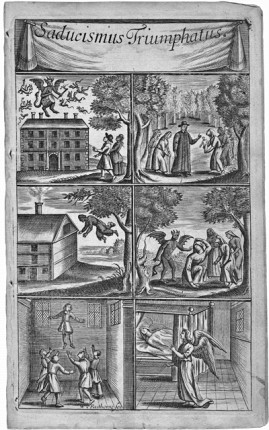
The frontispiece to the second part of Joseph Glanvill’s Saducismus triumphatus (1681). Clockwise from top left, the following are represented: the drummer of Tedworth (see pp. 449–50); the Somerset witch Julian Cox; a rendezvous of witches at Trister Gate; a celestial apparition in Amsterdam; the Scottish witch Margaret Jackson; and the levitation of Richard Jones at Shepton Mallet.
However, the Logic of Port-Royal (1662) had acknowledged that the more unlikely an event the stronger the evidence in favour of it would have to be in order to ensure that it was more unlikely that the evidence should be false than that the event should not have occurred. This obviously presented a problem for evidence for miracles, one which was rapidly glossed over by the Logic and by Locke; indeed, it is presumably for this reason that the argument was slow to be taken up. But in the early years of the eighteenth century this argument from probability was applied with devastating force. It was at the heart of Francis Hutchinson’s Historical Essay Concerning Witchcraft (1718) (though Hutchinson, a future bishop, carefully affirmed his belief in angels), from where it was adopted, in 1722, by Trenchard and Gordon in Cato’s Letters.43 And it was put to work in one of the pamphlets generated by the famous case of Mary Toft, who claimed in 1726 to have given birth to seventeen rabbits:
Suppose one were to see a Letter from Battersea, importing that a Woman there had been delivered of five Cucumbers, or indeed a hundred Letters, would that lead a man of Sense to believe any Thing, but, either that the People who wrote those Letters had been grossly impos’d upon themselves, or intended to impose upon him. Either of these two Things may, and do happen every Day; but it was never known, that ever any Creature brought forth any one Creature of a Species in all Respects different from it self, much less five or seventeen such Creatures; for which therefore, a Man of common Sense, much more a penetrating and quicksighted Anatomist, should look upon all such Letters with the utmost Contempt.44
In a more sophisticated form it became the argument of David Hume’s essay ‘Of Miracles’ in An Enquiry Concerning Human Understanding (1748).45
The Christian churches could not abandon their belief in miracles and angels, but Christians could certainly retreat from their insistence on the reality of witchcraft, demonic possession, poltergeists, levitation and second sight. Indeed, as we have seen, the clergy, who had been in the vanguard of the army of those advocating belief in spirits, were among the leaders in this retreat, which was well under way by the trial of Jane Wenham in 1712. What made this retreat possible was the development of a new and powerful argument for religious faith.
§ 5
In 1687 Newton published his Principia, which established his theory of gravity. Gravity involved action over a distance, something impossible according to the mechanical philosophy. On the Continent resistance to Newtonianism continued into the 1740s and involved key intellectual figures such as Huygens, Leibniz and Fontenelle.46 In England the importance of the Principia was slow to establish itself simply because the book was so technical: it is said that only ten people could properly understand it in the period between its first publication and Newton’s death in 1727.47
The key moment for the popular transmission of Newton’s discovery came in 1692, when Richard Bentley delivered the first set of Boyle Lectures. Bentley was the greatest classical scholar of his age, but he would also become a Fellow of the Royal Society.48 He had joined the battle of the ancients versus the moderns on his friend Wotton’s side by providing for the second edition of Wotton’s Reflections a lengthy demonstration that the letters of Phalaris, which Temple had singled out as one of the jewels of classical literature, were a later forgery. He had not started out on a clerical career, but he had been ordained deacon in 1690 and was later ordained as a priest. In preparation for his lectures, he wrote to Newton, who replied, ‘When I wrote my treatise about our systeme, I had an eye upon such principles as might work with considering men for the beliefe of a Deity; and nothing can rejoyce me more than to find it useful for that purpose.’49
Bentley’s eight lectures were published under the title The Folly and Unreasonableness of Atheism Demonstrated from the Advantage and Pleasure of a Religious Life, the Faculties of Human Souls, the Structure of Animate Bodies, & the Origin and Frame of the World (1693). The first lecture dealt with the social and psychological benefits of religion; the second with the Cartesian argument against thinking matter; the third, fourth and fifth with the design of the human body; and the last three with the Newtonian account of the universe. Bentley, following Newton, made a simple case: gravity required that God constantly ‘inform and actuate’ the universe; gravity was ‘the immediate Fiat and Finger of God, and the Execution of the Divine Law . . . which at once, if it be proved, will undermine and ruine all the Towers and Batteries that the Atheists have raised against Heaven’. This was ‘a New and Invincible Argument for the Being of God’.50 Moreover, our solar system could not have come into existence by chance but required the deliberate organization of its component parts in order to create a stable system. A benevolent deity could thus be shown to have created both the universe and humankind.
It is these new arguments which made possible a profound shift in the culture of both scientists and theologians in the years after 1692. The old arguments from the spirit world were discarded (in all the published Boyle Lectures from the eighteenth century I can find only one passing reference to witchcraft) and a new rationalized (as we would see it) theology put in their place. Bentley’s Newtonian Christianity was presented as an alternative not only (implicitly, if not explicitly) to belief in demonic activity but also to the excessive rationalism of the Cartesians. Bentley’s target here was Thomas Burnet, who, in his Sacred Theory of the Earth (Latin, 1681–9; English, 1684–90) had sought to give a scientific account of Noah’s Flood.
As we have seen, Aristotelian philosophers believed the sphere of water was ten times larger than the sphere of Earth, so that for them the puzzle was not why did the waters cover the land during the Flood, but why did they not always do so. Once the sphere of waters and the sphere of land had been merged into one, it seemed evident that there was not enough water to cover the whole surface of the globe. Moreover, Cartesians held that the universe was a plenum: it was full. So if God chose temporarily to create more water he would have simultaneously to destroy the matter that currently occupied the space into which he was going to place the water. Burnet found this implausible. Instead, he hypothesized that the Earth was once a perfectly smooth shell completely surrounding the water; a crisis provoked the shell to crack and large parts of it then fell beneath the waves, thus creating the Earth as we know it today. Burnet’s argument was met with widespread horror; as Herbert Croft, the bishop of Hereford, put it, ‘This way of philosophizing all from natural causes, I fear, will make the whole world turn scoffers.’51 Bentley, drawing on works such as John Ray’s The Wisdom of God Manifested in His Works of Creation (1691), insisted that the Earth had been made from the start with oceans and harbours for the benefit of mankind. Consequently, the Flood had to be seen as a true miracle, not a mere natural event which happened to coincide with an excess of human depravity.52
So, from one point of view, Bentley’s argument was a restatement of traditional Christianity, much more conservative, for example, than William Whiston’s A New Theory of the Earth (1696), which developed Newton’s account of the cosmos to argue that the Flood was the result of a close pass by a comet. But in arguments about devils and witches Bentley was on the side of the radicals, as is apparent from his later attack on one of the great irreligious texts of the early eighteenth century, Anthony Collins’s Discourse of Freethinking (1713). In his Remarks upon a Late Discourse of Freethinking (1713), Bentley, hiding behind the pseudonym of Phileleutherus (lover of freedom), makes clear that he no more believes in witchcraft than does Collins, referring with approval to Balthasar Bekker’s The Enchanted World (1691), an influential attack on belief in witchcraft and demonic possession originally published in Dutch, and to a work by Samuel Harsnett, probably the Declaration of Egregious Popish Impostures of 1605. Harsnett had been much influenced by Reginald Scot, and had set out to prove that cases of supposed demonic possession were in fact deliberate frauds. Bentley is thus, as his choice of name indicates, prepared to meet the freethinkers on common ground at least when it comes to witchcraft, while defending the established Church.
The chief importance of Bentley’s Remarks for present purposes lies in the explanation he offers for the decline of belief in witchcraft:
In the dark times before the Reformation, not because they were Popish, but because Unlearn’d, any extraordinary Disease attended with odd Symptoms, strange Ravings or Convulsions, absurd Eating or Egestion, was out of ignorance of natural Powers ascrib’d to Diabolical. This Superstition was universal, from the Cottages to the very Courts; nor was it ingrafted by Priestcraft, but is implanted in Human Nature: no Nation is exempted from it; not our Author’s Paradise of New Jersey, where no Priests have yet footing: and if the next Ages become unlearn’d, That Superstition will, I will not say return, but spring up anew. What then has lessen’d in England your stories of Sorceries? Not the Growing Sect [of Freethinkers], but the Growth of Philosophy and Medicine. No thanks to Atheists, but to the Royal Society and College of Physicians; to the Boyle’s and Newton’s, the Sydenham’s and Ratcliff’s. When the People saw the Diseases they had imputed to Witchcraft, quite cur’d by a course of Physic, they too were cur’d of their former Error: they learn’d Truth, by the Event; not by a false Position a priori, That there was neither Witch, Devil, nor God.53
Note the care with which Bentley formulates his view: systematic denial of belief in witch, devil and God is the false position of the atheist; rejection of the superstitious belief that witchcraft causes diseases is the correct position of the philosopher. The atheist argues ‘a priori’; the philosopher argues ‘by the Event’, in other words from experience. Bentley surely did not think that Boyle, Newton, Sydenham and Ratcliffe had directly attacked belief in witchcraft; and he probably knew that Boyle had been all in favour of such belief. Rather he meant that, whatever their intentions, the new sciences had undermined credulous belief. The new attitude to evidence, which Sprat had praised as ‘this Inquiring, this scrupulous, this incredulous Temper’, had encouraged a general scepticism of miracles, providences and witchcraft. As God was increasingly assumed to work by his ‘known, and standing Laws’, not by miracles, so, too, the Devil was held to operate through the ordinary temptations of vice, not the extraordinary means of possession and incantation.54 Bentley is thus an advocate of the Thomas thesis: an improved technology for dealing with disease, combined with better scientific knowledge, undermined belief in magic and witchcraft. On the one hand he places learning, and on the other superstition. (Of course, there was no improved technology for treating disease, but Bentley evidently thought that medicine was making great strides, even though this belief now seems unjustified.)
He was not alone in assuming that the progress of science destroyed superstitious beliefs. Indeed, the erosion of traditional beliefs had been going on for quite some time. First under attack had been belief in fairies and hobgoblins (which, according to Reginald Scot, had largely disappeared among the educated by the 1580s); then had come the doctrine of sympathies;ix and this had been followed by the belief in prodigies – strange shapes in the clouds, double and triple suns, comets, monstrous births – which were held, as in ancient Rome, to herald catastrophe. In A Discourse Concerning Prodigies of 1663 John Spencer had argued that natural philosophy was the proper cure for superstition:
Its the nature of all knowledge to give a kinde of strength and presence of minde to a man, but especially of Philosophy: this will secure us, as from the rocks of Atheism because leading us into a notice of some First cause, into which all the second doe gradually ascend and finally resolve; so also from the shelves of superstition, because acquainting us with the second causes: for fancy is apt to suggest very monstrous and superstitious notions of those things of whose causes and natures we are unresolv’d; all which flie (like the shadows of the twilight) before the approaching beams of knowledge. Philosophy leads us (as men doe horses) close up to the things we start at, and gives us a distinct and through view of what frighted us before, and so shames the follies and weakness of our former fears.55
The attack on prodigies was part of a larger post-Restoration programme to undermine ‘Enthusiasm’ (particularly the belief in immediate inspiration by the Holy Spirit), in the conviction that it could only lead to civil conflict.56 Thus Sprat had wanted to emphasize the tendency of the new science to moderate the ‘extravagances’ of those who believed in providences and wonders:
Let us then imagin our Philosopher, to have all slowness of belief, and rigor of Trial, which by some is miscall’d a blindness of mind, and hardness of heart. Let us suppose that he is most unwilling to grant that any thing exceeds the force of Nature, but where a full evidence convinces him. Let it be allow’d, that he is alwayes alarm’d, and ready on his guard, at the noise of any Miraculous Event; lest his judgment should be surpriz’d by the disguises of Faith.57
Enthusiasm, in Sprat’s view, by making false claims of divine intervention in the world, simply offered hostages to unbelief. It was necessary to pare down faith to a set of core beliefs in order to make it defensible.
The key value that took the place of credulous piety was politeness, which was the great preoccupation of writers in the late seventeenth and early eighteenth centuries. Spencer already reflects this new concern when he redescribes Christianity as follows:
But they which talk of and look for any such vehement expressions of Divinity now [as occurred in the Old Testament], mistake the temper & condition of that Oeconomy which the appearance of our Saviour hath now put us under; wherein all things are to be managed in a more sedate, cool, and silent manner, in a way suited to, and expressive of the temper our Saviour discover’d in the world, Who caused not his voice to be heard in the streets; and to the condition of a Reasonable Being made to be manag’d by steady and calm arguments, and the words of Wisdom heard in quiet; the mysteries of the Gospel come forth cloth’d in sedate and intelligible forms of speech; the minds of men are not now drawn into ecstasie by any such vehement and great examples of Divine Power and Justice as attended the lower and more servile state of the World. The miracles our Saviour wrought were of a calm and gentle nature [curing the blinde, restoring the sicke and lame, not causing of thunder and storms, as Samuel, but appeasing them].58
It would be easy to think of witchcraft, too, as belonging to a more primitive dispensation, inappropriate in this new sedate, cool, quiet and reasonable age. Spencer’s argument is of course ambiguous – has to be ambiguous – as to just when the ‘lower and more servile state of the World’ came to an end. Was it really with the birth of our Saviour? Or was it perhaps with the Reformation, or even with the Restoration?
Between 1653 and 1692 many of the new philosophers were concerned to assert their orthodoxy by demonstrating their belief in angels and demons, even though these arguments fitted uncomfortably with the sedate, polite world which, in other respects, they aspired to occupy. After 1692 Newtonianism offered a viable alternative argument for faith, the argument from the balance of probabilities, which was set loose, first against witchcraft and then eventually against miracles (with Middleton’s Free Enquiry of 1747 and Hume’s essay of 1748). Arguments for belief in magic and witchcraft were largely abandoned. But, over time, the middle ground that people like Sprat and Bentley had sought to occupy between superstition and rationalism became increasingly embattled, and the pendulum began to swing the other way. As the gospel miracles came (at least implicitly) under attack, what had recently been regarded as superstition became respectable again. Hogarth represents this new world in Credulity, Superstition and Fanaticism (1762), which, as well as satirizing contemporary events, looks back to the beginning of the century, when such views had last been voiced: Mary Toft is giving birth to rabbits; a copy of Glanvill is piled with Wesley’s sermons under the thermometer of fanaticism, and on the top of the thermometer stands the drummer of Tedworth. An era of scepticism was giving way to a new species of Enthusiasm.
§ 6
Thus, in simple terms, Bentley was right: the new science did undermine belief in magic and witchcraft, just as it undermined belief in astrology and alchemy. But this process was not straightforward. Between 1653 and 1692 belief in witchcraft and the practice of alchemy often went hand in hand with the new science and, if the new science eventually proved incompatible with both, this was for many an unintended, not an intended, consequence of the new philosophy. Only after 1692 did a new rationalism begin to take a secure hold; and when that rationalism later came under sustained attack from John Wesley, the result was not its defeat but the emergence, for the first time, of two cultures, of science on the one hand and faith on the other.
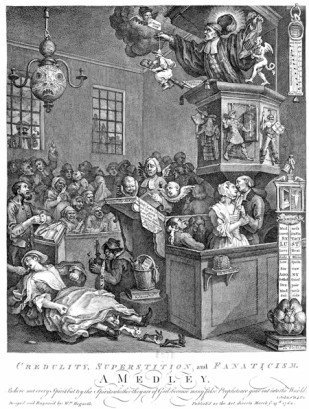
Hogarth’s Credulity, Superstition and Fanaticism. A Medley (1762). Around a dozen cases of witchcraft and superstition are represented: among them, the drummer of Tedworth stands on top of the thermometer on the right (the thermometer itself stands on a copy of Glanvill), while Mary Toft gives birth to rabbits in the foreground.
For the remarkable thing about Wotton and Bentley is that they were simultaneously theologians and advocates of the new science, while Swift, who mocked them both in The Battle of the Books, was a clergyman who knew as much science as they did. In England scientists and clergymen still inhabited a common culture, and there was no division between them when it came to belief or disbelief in magic and witchcraft. In being clergymen with an interest in science, Wotton and Bentley were typical among the early supporters of Newtonianism. Many of the leaders of the Newtonian party were clergymen: John Flamsteed, the first astronomer royal; Samuel Clarke, Boyle Lecturer and Newton’s champion against Leibniz; James Bradley, Savilian professor of astronomy at Oxford and astronomer royal; William Derham, author of Physico-Theology (1713), which went through numerous editions and translations; William Whiston, Newton’s successor as Lucasian professor of mathematics at Cambridge; and so on. Unbelievers – and there were plenty of them – were usually more interested in classical learning than in contemporary science; they published works with titles such as The Two First Books of Philostratus, Concerning the Life of Apollonius Tyaneus: Written Originally in Greek, and now Published in English: Together with Philological Notes upon each Chapter (Charles Blount, 1680); the bulk of Bentley’s attack on Collins is given over to a dispute over the interpretation of a passage in Cicero. The battle lines of the nineteenth century were yet to be drawn.
Making and remaking the common culture that bound together clergymen, mathematicians, instrument makers and aristocrats such as James Brydges, Duke of Chandos, and George Parker, second Earl of Macclesfield, required constant effort.59 We can distinguish four components to the project. First, there was the need to provide a Newtonian education at the universities: the first Newtonian textbook in physics was John Keill’s Introductio ad veram physicam (1701), which competed with Samuel Clarke’s adaptation of Rohault’s Physica (1697), in which Rohault’s Cartesianism was steadily swamped by Clarke’s Newtonian commentary as one edition succeeded another. Newton himself was simplified by Willem’s Gravesande, first in English (1720) and then in Latin (1723); and made even simpler by John Pemberton in his A View of Sir Isaac Newton’s Philosophy (1728). Second, Newtonian Christianity had to be defended against its critics, with works such as James Jurin’s Geometry No Friend to Infidelity (1734). Then, Newtonianism had to be made popularly accessible. Whiston’s New Theory (1696) was the first detailed popular account of the arguments of the Principia, but it was rapidly followed by works such as Nehemiah Grew’s Cosmologia sacra (1701), Edward Wells’s The Young Gentleman’s Astronomy (1718), John Harris’s Astronomical Dialogues between a Gentleman and a Lady (1729), Voltaire’s The Elements of Sir Isaac Newton’s Philosophy (1738) and Francesco Algarotti’s Sir Isaac Newton’s Philosophy Explain’d for the Use of the Ladies (1739; the book went through thirty editions in six languages).
The seeming obsession with the education of ladies derives partly from the imitation of Fontenelle’s Dialogues (in France women had a central place in the culture of the salon) and partly through the example of Émilie du Châtelet, Voltaire’s companion, who was a competent mathematician and translated the Principia into French (1756).60 Even Voltaire, who avoided the dialogue between a philosopher and a lady, a form popularized by Fontenelle, liked to imagine his book being read by a sophisticated woman at her dressing table. And surely he had some readers of this sort; Voltaire corresponded with Laura Bassi, the first woman to obtain a degree from the University of Bologna (1732), and the first to teach there. Bassi held a chair in physics, and naturally taught the physics of Newton.61 In England, it was the playwright Aphra Behn who translated Fontenelle and the poet Elizabeth Carter who translated Algarotti, so the female audience was more than fictional.62
These three components of the campaign on behalf of Newtonianism developed momentum over time. A simple measure of this is to count books in which Newton’s name appears in the title: the peak period clearly runs from 1715 to 1745. When Samuel Johnson, in his essay on ‘The Vanity of Authors’ (1751), wrote, ‘Every new system of nature gives birth to a swarm of expositors, whose business is to explain and illustrate it, and who can hope to exist no longer than the founder of their sect preserves his reputation,’ he was taking for granted a state of affairs that was entirely new.63No one had popularized systems of nature before Fontenelle’s Dialogues on the Plurality of Worlds (1686); the Newtonians adopted and adapted the techniques of the Cartesians in order to make a much more abstruse and complex intellectual system available to a mass audience. In the process they sought not only to preserve the idea of a common culture shared by all the educated but also to adapt that idea to a new era of cheap books, mass communication and nearly universal literacy.
This was not all. The best way of communicating the experimental philosophy was through making it possible for people to see experiments performed. John Harris gave public lectures, accompanied by experiments, in London from 1698 to 1707, teaching ‘the principles of true Mechanick Philosophy’. He was soon competing with James Hodgson, Francis Hauksbee the elder and Humphrey Ditton. In 1713 William Whiston (who had been expelled from Cambridge in 1710 for his heretical views) began lecturing and demonstrating in London. In January he was lecturing from his home, and also with the elder Francis Hauksbee; in the spring he was lecturing and demonstrating with the younger Francis Hauksbee (nephew to Francis Hauksbee the elder) in Crane Court, on mathematics at Douglas’s Coffee House, and at the Marine Coffee House. The greatest of the popular lecturers was John Theophilus Desaguliers (another Newtonian clergyman, although he paid little attention to his clerical duties and showed few signs of religious conviction), who began lecturing and demonstrating in London in the spring of 1713, publishing his Physico-Mechanical Lectures in 1717. By 1734 he had delivered 121 courses, not only in London but also on provincial tours and in the Low Countries, and could boast that, of the dozen or so professional lecturers on the circuit, eight had been educated by him. Indeed, courses of lectures were available far and wide: in Newcastle, in Spalding, in Scarborough, in Bath.64
It would be easy to imagine that Newton, because of the intellectual level at which he operated, brought about a new professionalisation of science, so that it became an esoteric activity in which only an elite could participate.65 But the reverse is the case. From the end of the seventeenth century, through sermons and lectures, through popular textbooks and dramatic dialogues, the new science was disseminated to a wider audience than ever before. If it played a role in disenchanting the world, it did so precisely because it was effectively inculcated among the educated, clerical and lay, male and female. The real historical puzzle, we might think, is not this eighteenth-century loss of belief in witches and demons, but the progressive re-enchantment of the world in the nineteenth century.