
PART THREE
No theory of knowledge should attempt to explain why we are successful in our attempts to explain things . . . there are many worlds, possible and actual worlds, in which a search for knowledge and for regularities would fail.
– Karl Popper, Objective Knowledge (1972)1
Part Three contains the central chapters of this book. All of them are concerned with the development of a new language for thinking about, talking about and writing about science. In each chapter questions of language are intertwined with direct engagements with nature on the one hand, and with broader conceptual and philosophical questions on the other. The argument is simple: the language we use when thinking about scientific questions is almost entirely a construction of the seventeenth century. This language reflected the revolution that science was undergoing, but it also made that revolution possible.
7
Facts alone are what are wanted in life.
– Thomas Gradgrind in Dickens, Hard Times (1854)
The fact can only have a linguistic existence, as a term in a discourse, and yet it is exactly as if this existence were merely the ‘copy’, purely and simply, of another existence situated in the extra-structural domain of the ‘real’.
– Roland Barthes, ‘The Discourse of History’ (1967)1
. . . the so-called facts proved never to be mere facts, independent of existing belief and theory.
– Thomas Kuhn, The Trouble with the Historical Philosophy of Science (1992)2
§ 1
We have seen that Renaissance science went beyond Greek science. Archimedes cried ‘Eureka!’, but the Renaissance invented discovery, priority disputes and eponymy. Vitruvius described something like perspective painting, but the Renaissance invented a new combination of subjectivity and objectivity, the situated viewer and the vanishing point. Cicero thought cartography was a branch of geometry, but the Renaissance developed a whole range of new mathematical disciplines and demonstrated their power to make sense of the world. Above all, the Renaissance acknowledged the existence of killer facts: facts which required the abandonment of well-established theories. Clearly, there were some fundamental changes before 1608, but in many respects Renaissance science was essentially an extension of classical science. Regiomontanus and Galileo saw themselves as disciples of Archimedes. They would have been puzzled by the claim that they had something he did not (accurate though that claim would be for Galileo, and perhaps for Regiomontanus, too). In 1621 Kepler published the second part of his Epitome of Copernican Astronomy. He described it as ‘a supplement to Aristotle’s On the Heavens’ because he assumed it would be part of a programme of education still based on Aristotle.3 By 1700 this sense of continuity had been destroyed: the moderns knew that they were different from the ancients. If one thing marks out that difference, it is ‘the fact’.
We take facts so much for granted that there have been few attempts to write their history, and none of them satisfactory.4 Yet our culture is as dependent on facts as it is on gasoline. It is almost impossible to imagine doing without facts, and yet there was a time when facts did not exist. What did the map of knowledge look like before the invention of the fact? On the one hand there was truth, on the other opinion; on the one hand there was knowledge, on the other experience; on the one hand there was proof, on the other persuasion. Opinion, experience and persuasion were necessarily unreliable and unsatisfactory; knowledge had to be built on firmer foundations. The story of the fact is a story in which the lowest and most unreliable form of knowledge was magically transformed into the highest and most reliable.
What we are concerned with in this chapter is what the OED lists as ‘fact’ sense 8a: ‘A thing that has really occurred or is actually the case’ – although dictionaries don’t distinguish clearly enough between an agency idea of a fact (something that has occurred because someone has done it) and an impersonal idea of a fact (something that has occurred in the course of nature).5 How did you refer to this something before facts were invented? In Greek there was the phenomenon, but the phenomena were malleable – they could be ‘saved’ or ‘salved’; while facts are stubborn. In Latin there was the thing: res.6 The Romans said ‘res ipsa loquitur’; we say, ‘the facts speak for themselves.’7 Wittgenstein wrote in the Tractatus that ‘The world is the totality of facts, not of things.’ There is no translation for this in classical Latin or Elizabethan English.i In English, before the fact, there were particulars.ii Phenomena are too subjective: they are appearances, not realities; things and particulars are too much in the real world: none of them corresponds to that peculiar blend of reality and thought which is the fact. This peculiar blend is what Barthes was referring to when he described facts as linguistic yet claiming to be copies of the real.
What is a fact? Naturally, philosophers disagree. My subject is what the philosophers call Humean facts. According to Hume, ‘All the Objects of human Reason or Enquiry may naturally be divided into two Kinds, viz. Relations of Ideas and Matters of Fact. Of the first kind are the sciences of Geometry, Algebra, and Arithmetic . . . [which are] discoverable by the mere operation of thought . . . Matters of fact, which are the second object of human reason, are not ascertained in the same manner; nor is our evidence of their truth, however great, of a like nature with the foregoing.’8Relations of ideas deal with matters that are definition-ally or necessarily true, such as 2 + 2 = 4 or all bachelors are unmarried. Matters of fact deal with matters that are contingently true, that is to say matters that could be otherwise (such as that the Earth has only one moon, or that I was born in January). Relations of ideas are purely logical; our knowledge of contingent matters, of matters of fact, depends on evidence: testimony, experience, documents.
In ordinary language, in our culture, we often ignore this distinction between relations of ideas and matters of fact, so I might say that it is a fact that the square on the hypotenuse is equal to the sum of the squares of the other two sides. Indeed, because all facts are by definition true we tend to think all truths are facts. But, for Hume, and for anyone writing about facts in the seventeenth century, the relationship is not reciprocal; Pythagoras’s theorem is not a fact but a deduction (unless I have been measuring the squares on one particular triangle). It should immediately be apparent that in a culture in which experience was taking on a new significance, the term ‘fact’ was invaluable because it identified that type of knowledge which is grounded in experience. And it should also be apparent that the distinction between the two types of knowledge had a quite different significance in a world where there were two conflicting approaches to knowledge – Aristotelianism, on the one hand, relying primarily on relations of ideas; and experimental science on the other, relying primarily on matters of fact – and intellectuals were under pressure to choose between them. Hume, in distinguishing relations of ideas from matters of fact, is recapitulating the fundamental intellectual conflict which gave rise to the Scientific Revolution.
What is a fact? It is a sort of trump card in an intellectual game. If you are playing Rock, Paper, Scissors, you can never be sure who will win. Intellectual life was a bit like that when the fact was invented – some thought reason should win; some authority (particularly where questions of faith were concerned); and still others wanted to rely on experience or experiment. But when facts entered the game everything changed because there is no arguing with the facts: they always win. Facts are a linguistic device which ensures that experience always trumps authority and reason. As Hume acknowledged, ‘there is no reasoning . . . against matter of fact.’9 The quotations chosen by the OED to illustrate the meaning of the word tell their own story: ‘Facts are stubborn things’ (1749); ‘Facts are more powerful than arguments’ (1782); ‘One fact destroys this fiction’ (1836).
We get an insight into the world before the fact by reading a book which tries to talk about facts without having the word or indeed the concept: Thomas Browne’s Pseudodoxia epidemica, or Vulgar Errors, of 1646. Browne’s aspiration is to rid the world of false beliefs (such as the notion that elephants have no knees, or the claim that beavers when fleeing from the hunt bite off their own testicles), but in doing so he compares himself to David taking on Goliath: ‘[W]ee are often constrained to stand alone against the strength of opinion; and to meet the Goliah and Gyant of Authority, with contemptible pibbles [pebbles], and feeble arguments, drawne from the scrip and slender stocke of our selves.’10 Browne lived in a world in which what we would call facts seemed impotent when faced with authority. He thought reason, opinion and authority should all give ground before experience, but he lacked the language in which to express this simple idea. He couldn’t say, as Hume did and we do, that there’s no arguing with the facts.
We take facts so much for granted that it comes as a shock to learn that they are a modern invention. There is no word in classical Greek or Latin for a fact, and no way of translating the sentences above from the OED into these languages. The Greeks wrote of to hoti, ‘that which is’, and scholastic philosophers asked an sit, ‘whether it is’. But there is plenty of scope for arguing with ‘is’ statements, and one could hardly describe them as stubborn or powerful. Of course, words and things are not always identical: one could have the idea of a fact, or a procedure for establishing facts, without the word ‘fact’; indeed, I will shortly argue that there is an important distinction between fact-establishing and the language of the fact. I have already said that Vespucci’s voyages produced killer facts – but there is no word corresponding to ‘fact’ in Vespucci’s texts, either in the original languages (The New World was published in Latin in 1503; The Letter in Italian in 1505), or in the numerous early translations.
In Latin the word that is most frequently translated as ‘fact’ by modern translators is res (thing). But things and facts are not the same. A thing exists without words, but a fact is a statement, a term in a discourse. Things are not true, but facts are. Things and facts are not the same. Nevertheless, we treat facts as if they are equivalent to things, and dictionary definitions of ‘fact’ slide between defining facts as things and defining them as true beliefs. Thus, according to the American College Dictionary, a fact is ‘something that actually exists; reality’ and also, or alternatively, ‘a truth known by actual experience or observation; something known to be true’.11 Our understanding of facts is thus Janus-faced: at one moment we regard them as things, reality itself; at the next they are true beliefs, statements about reality. The result is that the grammar of the fact is profoundly problematic. In so far as facts are real, they are not true or false; in so far as they are statements, they are. It would be a mistake to think that one can resolve this contradiction: the whole point of the fact is that it inhabits two worlds and claims the best of both. It is precisely this quality that makes facts the raw material of science, for science, too, is a peculiar amalgam of the real and the cultural. Facts and science are made for each other.12
Facts are not just true or false; they can be confirmed by an appeal to evidence. The statement ‘I believe in God’ is either true or false, but only I can know for sure which, because it refers to a purely internal state of mind; it is inherently subjective. If I practise certain religious observances, then there are grounds for thinking the statement is true, but it is difficult to see how one could ever prove it. There are people who carry on practising religious observances although their faith has (temporarily, they hope) deserted them. But I can prove that I have been baptized or married: these are documented facts. They are objective states of affairs.
A contemporary philosopher has distinguished between three sorts of facts: brute facts, language-dependent facts and institutional facts. Let us look at some of his examples:
1. ‘Mt Everest has snow and ice near its summit.’ This is objectively true or false, and does not depend on my language or my subjective experience (although I need an appropriate vocabulary, of course, to communicate this truth to someone else). It is a brute fact.
2. Today is Thursday 6 June 2013. This is true, but it depends on a convention for numbering years and numbering and naming months and days. It is a language-dependent fact.
3. This is a ten-pound note. This is only true because this piece of paper has been issued by the Bank of England and is of the approved form. It is an institutional fact. Much of social reality consists of institutional facts: property, for example, or marriage.13
These categories imply that we find Everest to be covered in snow; we make today Thursday; and the bank decrees that this is legal tender. So some facts are found, some made and some decreed. Nothing could be more straightforward – except we never talk about finding, making or decreeing facts; instead, we ‘establish facts’.iii I have been able to trace the phrase back to 1725 and, of course, its great advantage is that ‘establish’ shares the ambivalence of the concept of a fact: we may establish that such and such is the case, establish a base camp and establish a business – it applies to words, deeds and things.
That’s not the only problem with this classification. European knowledge of Mount Everest depends on a long history of discovery, exploration, surveying and cartography. In 1855 a British trigonometric survey of India measured a mountain labelled Peak XV as being 29,002 feet high (‘high’ here means higher than sea level, although two hundred years earlier it was possible to believe that the oceans were higher than the highest mountains). In 1865 this mountain was officially named by the Royal Geographical Society. So when I say that there is snow at the top of Mount Everest I am relying on a shared knowledge that there is a place we have agreed to call Mount Everest, that that place is a very high mountain, and that therefore it is not at all surprising that there is snow and ice near its summit. This ‘brute’ fact has become a brute fact for us; but that is because the process by which the mountain was discovered, measured, named and made famous has become invisible to us. In fact, Mount Everest is itself a language-dependent and institutionally defined entity. Making statements about Mount Everest shareable involves more than just finding a snow-covered mountain; it involves creating a shared language.iv ‘Peak XV has snow and ice near its summit’ would have been an equally true statement, but one that would only ever have made sense to a small group of surveyors and cartographers; to anyone else it would have been meaningless.
Or take today’s date. This isn’t just a linguistic convention. It is an institutional fact because contracts depend on the interpretation of dates. In Britain and the British Empire the Gregorian calendar, the calendar we use now, was introduced by law in 1752. The day after Wednesday 2 September 1752 was Thursday 14 September. Over most of Continental Europe, Wednesday 2 September (British-style) was already 13 September. At the same time as the date was changed, the start of the year was moved from 25 March to 1 January, so 1 January to 24 March 1752 never existed. Dates are not just named, they are also, like money, decreed.
The social and technological process by which we establish facts becomes invisible to us because we naturalize it. Language-dependent and institutional facts come to seem like brute facts to us: this is true for social institutions, like money, but even more so for claims about the natural world which are, in truth, theory dependent: we have naturalized the idea that the heights of mountains should be measured from sea level, an idea that would have made no sense in the Middle Ages. A couple more examples should make this clear. I know my date of birth: my parents told me, it is recorded on my birth certificate, my driving licence, my passport, and in all sorts of official records. It is a true objective fact, and if I had a stroke and forgot my date of birth I could establish it without any difficulty. However, I don’t know Shakespeare’s date of birth. He probably never knew his date of birth. The only official record tells us the date on which he was baptized.
You may think that of course Shakespeare must have known his own date of birth, even if we do not. You would be wrong. In 1608 Galileo was in correspondence with Christina of Lorraine, the wife of Ferdinand I, Grand Duke of Tuscany. Christina wanted Ferdinand’s horoscope to be cast, but she was not sure when he had been born and offered two alternative dates more than a year apart: 19 July 1548 and 30 July 1549.14 Galileo had to cast two horoscopes, work out which seemed better to fit the life of Ferdinand so far, thus decide his date of birth and so predict his future. Here was a great prince (originally a younger son, it is true, and so not expected to inherit) about whose year, let alone day, of birth there was genuine doubt. We all know the day on which we were born not because there is anything natural or even normal about such knowledge but simply because we live in a world in which such knowledge has been institutionalized.
When Marin Mersenne, a friar and mathematician in Paris, read Galileo’s Dialogue Concerning the Two Chief World Systems (1632), he came across measurements of the relative speed of falling bodies expressed in braccia, arm’s lengths or ells, the standard Italian unit of measurement.vBut how long was Galileo’s braccio ? Mersenne wrote to him, asking, but never got a reply. A few years later when he was in Rome, he sought out a shop which sold measuring sticks and acquired a Florentine braccio. He then checked Galileo’s measurements and decided they were wrong.15But did Galileo make his measurements in Florence, or earlier in his life in Venice? The Venetian braccio was longer than the Florentine, which would have made Galileo’s measurements much more nearly accurate. In all probability Galileo did not worry about producing absolutely precise measurements, simply because he knew that in Rome, in Venice, in Florence and in Paris different units of measurement were used: precision was pointless when units of measurement were local. Indeed, in Florence and Venice two different braccia were used for different purposes. Thus it is true to say that Galileo made measurements relating to falling bodies; but he did not manage to turn those measurements into facts, as far as Mersenne was concerned, because the measurements were language dependent, and behind the linguistic differences lay institutional decrees: the length of a Florentine braccio was determined by the Florentine state to ensure that merchants did not cheat their customers. What looks like a brute fact – the distance a body falls in a certain period of time – turns out to be in part dependent on language and institutions. Mersenne wanted to assess Galileo’s claims by getting the facts straight; this turned out to be very far from straightforward because establishing facts depends upon instruments, even instruments as simple as measuring sticks, which have to be standardized.16
We live in societies that mass-produce facts: packages are marked with weights, road signs tell you distances and, in some countries, the populations of the towns you are passing through. We not only mass-produce them, we distribute them as efficiently as we distribute the post: my utility statements, for example, tell me how much electricity I have used; my bank statements tell me how much money I have to spend. Before the Scientific Revolution facts were few and far between: they were handmade, bespoke rather than mass produced, they were poorly distributed, they were often unreliable. Nobody, for example, knew what the population of Great Britain was until the first census in 1801; the first serious attempt at an estimate was made by Gregory King in 1696; before him, John Graunt had estimated the population of London in 1662. Before that numbers were hopelessly unreliable, and no one bothered to produce population figures for whole countries. In 1752 David Hume published an essay, ‘Of the Populousness of Ancient Nations’, pointing out that the figures we find in classical texts are meaningless.17 Thus, according to Diodorus Siculus, writing in the first century BCE, the city of Sybaris in 510 BCE could field an army of 300,000 free men; add in women, children, old men and slaves, and Sybaris was apparently much, much bigger than London at the time Hume was writing (a total population of approximately 700,000, according to modern estimates). So was Agrigentum, which, according to Diogenes Laertius, in the third century had a population of 800,000. Yet these were only minor cities in their day, whereas London was the greatest commercial capital the world had ever seen. Hume’s essay marks an intellectual shift because he expects numbers to be accurate; no one before 1650 or so complained that Diodorus Siculus’s or Diogenes Laertius’s numbers were untrustworthy, because they expected nothing else and their own numbers were equally unreliable.
It was not just science that made this new world, it was also the state, which was busy taxing citizens, borrowing money and putting armies in the field. The stock market required figures for profits and loss, capital and turnover. But states had been doing all these things for thousands of years without getting the numbers right. Merchants had been making and losing money since time immemorial. The idea that accurate figures could make a fundamental difference started with double-entry bookkeeping in the thirteenth century; it then spread to the sciences, and outwards from both accountancy and science to government.
In 1662, for example, John Graunt published the numbers dying in London, the cause of death and his estimate of their age at death. From these he produced the first calculations of life expectancy for different age groups, and so the first reliable figures which could provide a basis for pricing life insurance. He lived in a new world of statistical accuracy. It was from the scientists, from men like William Petty, a first-generation fellow of the Royal Society, who surveyed Ireland, that Gregory King, a government administrator, effectively an accountant, acquired the conceptual tools that enabled him to calculate (very approximately) what we would call the Gross National Product of Britain and France in 1696 in order to work out which had the greater resources for winning the war they were fighting. (King’s enterprise involved calculating not just the number of human beings and their taxable income but also the populations of cows, sheep and rabbits.)18 We have something the Greeks and Romans did not, which is reliable facts and accurate statistics, and, in so far as they relate to more than the affairs of a particular business enterprise, these date back to the Scientific Revolution of the seventeenth century.
In stressing that facts are ‘established’, and that you have to learn how to establish them, I do not want to imply that they are subjective or culturally relative. Everest was just as covered in snow and just as tall before it was named in 1865 as it was after it was named, but finding and sharing facts about Everest required a naming process, a measuring process, a mapping process. Everest was there before 1865, but there were no facts about Everest before 1865. The facts about Everest were established, and this involved a triple process of finding, making and decreeing.
§ 2
Let us get down to business, then, with a particular example of fact-establishing (and let’s for the moment set aside the anachronism implicit in using the word ‘fact’ when describing the activities of people who did not yet have the word). On the night of 19 February 1604, in Prague, Johannes Kepler was out measuring the position of Mars in the sky with a metal instrument called a quadrant.19 The type of measurement he was trying to make was perfectly familiar to astronomers: such measurements had been made since Ptolemy. But in Kepler’s view Ptolemy’s measurements were not accurate enough, nor were any of those made since, except for Tycho Brahe’s. On this particular night it was bitterly cold with a biting wind. Kepler found that if he removed his gloves his hands were soon too numb to manage his instrument; if he kept them on he could barely make the fine adjustments necessary. The wind was too strong to keep a candle alight, so he had to read his measurements and write them down by the light of a glowing coal. The results, he felt sure, were unsatisfactory – he was out, he thought, by 10 minutes of a degree (a minute being one sixtieth of a degree). On a modern school protractor you cannot distinguish ten minutes of a degree, and only one astronomer before Kepler would have thought such a measurement unsatisfactory. Ptolemy and Copernicus had regarded 10 minutes as precisely the acceptable margin of error. But Kepler had worked with Tycho Brahe, who had devised new instruments capable of measuring with astonishing accuracy to a single minute.
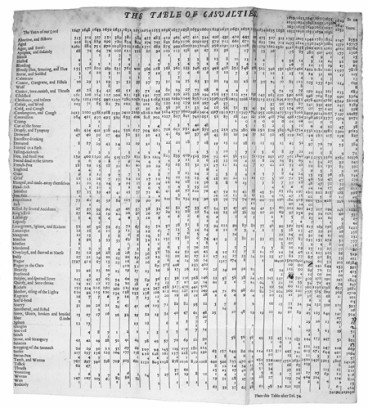
Graunt’s table of mortality from his Natural and Political Observations (1662). Graunt compiled statistics for the number born and dying each year, and the causes of death, from the annual bills of mortality that were published in London. He used these to calculate life expectancies for each age group, and to estimate the population of London, which he concluded was 460,000 – not, as had been claimed, 7 million or so.
Kepler was worried about such tiny numbers because he had a quite different understanding of astronomy from anyone before him. The goal of previous astronomers had been to construct mathematical models that would successfully predict the location of the planets in the heavens. They had all shared the assumption that such models must involve various combinations of circular movement, because the philosophers had instructed them that all movements in the heavens was required to be circular. The problem for Kepler was that circles, eccentrics and epicycles were geometrical constructions; there was no evidence that any such gearing existed in the heavens. Moreover, his predecessors had been quite happy to use two distinct models for each planet: one to calculate its movement from east to west, and the other its movement from north to south.
Kepler knew there were no crystalline spheres in the heavens, and so he understood that the planets were moving through empty space on what he called an ‘orbit’. Kepler replaced orbs with orbits because his ambition was to replace geometry with physics. (‘Orbit’ used in this sense was a marker of Kepler’s key innovation; previously, an orbit was the track left by a wheel in the ground, or the socket into which the eye is set. An orbit is physical, while an orb is a geometrical abstraction.)20 In order to understand the movements of the planets, Kepler thought about ferrymen trying to row across a fast-flowing river. If you were steering a planet through space, he wondered (for Kepler was prepared to imagine intelligences guiding the planets), how would you locate yourself, and how would you keep on course? An eccentric, which involved a perfect circle around an unmarked point in featureless space, seemed to him an impossibility. Kepler was convinced one had to think of forces flowing through space – his inspiration was provided by Gilbert’s recently published study of the magnet – and ask oneself how a celestial helmsman would take his bearings.21 Consequently, he insisted on using one single mathematical model to account for a planet’s movement across the heavens. When he tried to employ this method for Mars using Brahe’s combination of circles, he could get satisfactory results for the longitudes (2 minutes of error), but then the latitudes failed. When he readjusted the geometry to get the latitudes right, the error in the longitudes climbed to a value that would once have been dismissed as insignificant but which Kepler now thought intolerable: a full 8 minutes.22
The truth is that, if Kepler had been determined to find a system of circles that would fit, he could have done so, as he later recognized. But instead he began to play around with other mathematical models, and he discovered that he could produce results to a satisfactory standard of accuracy (better than 2 minutes) if he modelled the orbit as an ellipse with the sun as its focus. Previous astronomers would have rejected this solution because it did not involve circular movement. Kepler, however, was delighted with it, because he could imagine that there was some sort of physical force involved which caused the planet to swing through space, speeding up as it approached the sun – the source of the force – and slowing down as it moved away from it: and he was right, of course, for that force is gravity.23
Kepler did not have the word ‘fact’ (he wrote of phenomena, observations, effects, experiments, of to hoti), but he certainly had the idea and knew that facts were what he was after. He chose to place on the title page of his New Star (1606) the image of a hen pecking around in a farmyard, with the motto grana dat e fimo scrutans (‘hunting about in the dung, she finds grain’). He presented himself not as a great philosopher but as someone prepared to grub around for facts. And because he had to make his facts credible he was obliged to adopt many of the rhetorical techniques that were, according to the literature, invented much later: the apparently prolix recounting of irrelevant details (the glowing coal by which he read his instruments on the night of 19 February 1604); the determination to report failures (he presents what he calls his war on Mars as an almost endless series of defeats) with the same care as successes; the insistence on involving the reader as if they were really present.24 In the New Star he even introduces us to his wife, as though we were visiting them at home, explaining that he had found it difficult to refute the arguments of the Epicureans, who thought the universe was the product of chance. But his wife is a more redoubtable adversary than he is:
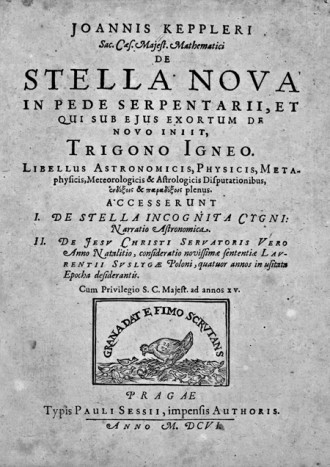
Title page of Kepler’s New Star of 1606.
Yesterday, when I had grown tired of writing and my mind was full of dust motes from thinking about atoms, she called me to dinner and served me a salad. Whereupon I said to her, ‘If one were to throw into the air the pewter plates, lettuce leaves, grains of salt, drops of oil, vinegar and water and the glorious eggs, and all these things were to remain there for eternity, then would one day this salad just fall together by chance?’ My beauty replied, ‘But not in this presentation, nor in this order.’25
The purpose of such irrelevant details – the pewter plates, the glorious eggs – is to create what Roland Barthes called ‘the reality effect’.26 We can trust Kepler, we are to understand, because he tells us what really happened. In the nineteenth century this sort of narrative became the ideal of the historian (wie es eigentlich gewesen, ‘just as it actually happened’, as Ranke put it), but in the seventeenth century it was not the historians but the scientists who aspired to realism as a literary style. (There are exceptions, however, Newton and Descartes being the most striking.) Since the new science had yet to establish its claim to authority, that claim had to be asserted by appealing to reality. In a world without peer review, texts, in order to convey trustworthiness, reliability and accuracy, had to employ literary devices. In the case of Kepler’s New Astronomy (1609) the quest for realism took what seems to the modern reader a most peculiar form: instead of outlining his new astronomy, Kepler presents an historical narrative of his quest for a new astronomy, with all his false turns and mistakes carefully recorded. In order to make facts, Kepler not only had to freeze his fingers on February nights, he also had to devise literary forms that would convince the reader that he had gone to extreme lengths to get his facts (and his theories) right; even the title page declares that his new astronomy was ‘worked out at Prague in a tenacious study lasting many years’.27
Of course, not everyone found these strategies helpful: Galileo complained that he found Kepler unreadable. For him, drama rather than historical narrative was the way of constructing the appearance of reality. Galileo’s Dialogue Concerning the Two Chief World Systems has as its frontispiece the image of Aristotle, Ptolemy and Copernicus in front of the sort of curtain that would be raised at the start of a theatrical performance. Galileo, by presenting a dialogue in which he himself never appears on stage, was able (in principle, at least) to avoid taking responsibility for any of the arguments proposed. But he also wanted to give the reader the sense of being present at a real argument, one from which Copernicanism emerged as indisputably victorious. Unfortunately, these two objectives were directly at odds with each other, and Galileo’s success at the second undermined his rather half-hearted efforts at the first. There is a paradox here. Galileo’s Dialogue, although apparently set in a real place (Venice), is transparently fictional: one of his characters, Simplicio, was imaginary, and the two others were dead (Salviati in 1614; Sagredo in 1620). But the purpose of the fiction is to create a sense of reality which will convince the reader that the information in the dialogue is perfectly genuine. The facts are true, even if the protagonists are fictions.
I started with Kepler on the night of 19 February 1604 because every fact has a local history: Kepler had an interest in telling that history in order to convince his reader that his measurements were accurate, and the historian has an interest in telling it in order to catch facts in the process of being both established and narrated. One reason that Kepler had to go to such lengths was that he could not simply baldly state the facts, because there was no tradition of taking facts at face value. The key term in philosophy, even in Kepler’s and Galileo’s time, was ‘phenomena’. As far as Aristotle was concerned, phenomena included everything which was generally accepted to be the case.28 So if people generally believe that mice are spontaneously generated in straw, then the task of the philosopher is to explain why this is so, not to question whether it is so.29 Moreover, phenomena were malleable. Ptolemy had based his astronomy on measurements, just as Kepler did. But Ptolemy and his followers had assumed that measurements could be regarded as approximations: in practice, there were bound to be minor discrepancies between theoretical predictions and actual measurements. Furthermore, they were under no obligation to be consistent. It was perfectly acceptable to use one hypothesis (or model) to account for a planet’s movement along the plane of the ecliptic, and another, conflicting model to account for its deviation above and below this plane;30 thus saving, or salving, the phenomena.31 Kepler, by contrast, was looking for a perfect match. He may have been making measurements very like the ones Ptolemy had made, using instruments very like the ones Ptolemy had used, but in his enterprise the measurements (what we call the facts) had a new status, a new authority.
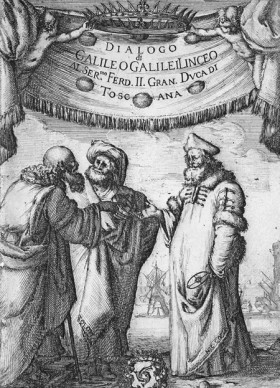
The frontispiece to Galileo’s Dialogue (1632). Aristotle (left), shown as a feeble old man; Ptolemy (centre), wearing a turban because he comes from Egypt; and Copernicus, wearing the clothes of a Polish priest, stand on the shore of the Florentine port of Livorno debating questions of physics and astronomy. But Copernicus looks nothing like the image of Copernicus that appears in other sources, where he is always portrayed as young and clean-shaven. Indeed, the Latin translation by Bernegger soon corrected this ‘error’, providing a more accurate representation of Copernicus. It seems Galileo has decided to present himself in the role of Copernicus. Over the heads of the three philosophers hangs the curtain which rises at the beginning of a theatrical performance – a device that was used by Galileo’s engraver, Stefano della Bella, for the frontispieces of plays. Thus Galileo implies that the arguments presented in the book are not to be regarded as true, for Copernicanism had been condemned by the Church.
§ 3
Facts are not only established, they are ‘disestablished’. Of course, we do not say that: facts are by definition true, so when they are discovered to be false they simply cease to be, like Tinkerbell, who can live only if the children believe in her. Facts are based in experience and they are refuted by experience. The ancient Greeks and Romans believed that if you rubbed a magnet with garlic it ceased to work.32 Plutarch, Ptolemy and all sorts of other authors believed this implicitly. It was, for them, in the words of Daryn Lehoux, an example of ‘unproblematic facticity’.33 You could get the magnet to start working again by smearing it with goat’s blood. Sophisticated thinkers (what Thomas Browne in 1646 called ‘grave and worthy Writers’) went on believing this well into the seventeenth century.34 In 1589 Giambattista della Porta (a Neapolitan aristocrat whose Natural Magick was one of the great best-sellers in the century between 1560 and 1660) protested:
But when I tried all these things, I found them to be false: for not onely breathing and belching upon the Loadstone after eating of Garlick, did not stop its vertues: but when it was all anointed over with the juice of Garlick, it did perform its office as well as if it had never been touched with it.35
This appeal to experience, however, was not new. Plutarch had claimed ‘palpable experience’ of the disempowering effect of garlic upon the magnet.36 Something in the nature of experience had, it would seem, changed between Plutarch and della Porta.
But there was nothing new (we are told) in della Porta’s approach to evidence: he was every bit as credulous about many matters as all those who had believed in the power of garlic. For example, he believed in spontaneous generation: not only that there were barnacles that could hatch into geese (hence the barnacle goose; even Kepler believed geese came from barnacles) but that putrefying sage generated a bird ‘like a blackbird’. And he believed that bears love honey because in their quest for it they are stung, and the bee stings on a bear’s mouth draw down the thick humour that normally clouds its vision, thus bears love honey because it improves their eyesight. If della Porta happens to hold the same view as we do on the subject of garlic and magnets, it is not because he is better at handling evidence than Plutarch or Ptolemy. All he has done is isolate the question of garlic and magnets from the larger context in which it was normally placed, that of sympathy and antipathy. This has made it possible for him to come up with a new answer to the question: ‘What happens when garlic meets a magnet?’ His answer happens to be our answer.37
But the claim that della Porta had isolated the study of magnets from the question of sympathy and antipathy is rather odd, because right at the beginning of his book, when he discusses these powerful forces through which so much can be accomplished, his examples are the standard ones, such as the antipathy between man and the wolf, which ensures that if a man sees a wolf he is rendered speechless. Included, almost inevitably, is the case of garlic and the magnet (I quote from the 1658 English translation):
Hither belongeth that notable Disagreement that is betwixt Garlick and the Load-stone: for being smeared about with Garlike, it will not draw iron to it; as Plutark hath noted, and after him Ptolomaeus: the Load-stone hath in it a poisonous vertue, and Garlick is good against poison: but if no man had written of the power of Garlick against the Load-stone, yet we might conjecture it to be so, because it is good against vipers, and mad dogs, and poisonous waters. So likewise those living creatures that are enemies to poisonous things, and swallow them up without danger, may shew us that such poisons will cure the bitings and blows of those creatures.38
We should not to be too critical of della Porta’s acceptance of the doctrine of sympathy and antipathy. Even Descartes, who would soon set out to reject all received opinions, believed in 1618 (probably on the authority of della Porta) that a drum covered in lamb’s skin would fall silent if it sensed the vibrations from one covered in wolf’s skin. Not death – not even tanning – could undo the antipathy between lamb and wolf.39 And yet only a few decades later Walter Charleton poured scorn on those who held this view:
[I]t hath been affirmed by many of the Ancients, and questioned by very few of the Moderns, that a Drum bottomed with a Woolfs skin, and headed with a Sheeps, will yeeld scarce any sound at all; nay more, that a Wolfs skin will in short time prey upon and consume a Sheeps skin, if they be layed neer together. And against this we need no other Defense than a downright appeal to Experience, whether both those Traditions deserve not to be listed among Popular Errors; and as well the Promoters, as Authors of them to be exiled the society of Philosophers: these as Traitors to truth by the plotting of manifest falsehoods; those as Ideots, for beleiving [sic] and admiring such fopperies, as smell of nothing but the Fable; and lye open to the contradiction of an easy and cheap Experiment.40
In the middle years of the seventeenth century experience stopped being something that accorded naturally with the statements of previous authorities and became a caustic solvent of fabulous beliefs.
How, though, are we to explain the peculiar fact that della Porta both believes in and rejects the garlic/magnet antipathy?vi A first step is to recognize that Of Natural Magic is a book written over a period of more than thirty years. Indeed, it is two books. The first edition, divided into four ‘books’ or sections, was published in 1558 (and went through sixty editions in five languages over the course of seventy years).41 The second, consisting of twenty books, was published in 1589. The relationship between the two editions is a complex one. A good deal of material that had been in the 1558 edition disappeared in 1589. The main reason for this is straightforward. Della Porta had been put on trial by the Inquisition in 1577–8 accused of black magic. (His arrest probably dates back to 1574, when he was ordered to close the academy he had founded to enquire into the secrets of nature.)42 He had continuing problems with Catholic censorship, for a time being banned from publishing.
The second edition of Of Natural Magic had been worked through carefully to remove possible causes of offence. Introduced was a careful sentence to bring della Porta’s discussion of the soul in line with Christian teaching, and all references to the world soul, the anima mundi, were now carefully turned into quotations.vii Gone, inevitably, is a chapter in which della Porta described an experiment with an unguent supposedly used by witches to enable them to fly to the sabbat: he had conveniently made the acquaintance of a witch who agreed to provide a demonstration of her powers. Having rubbed herself all over with an ointment (della Porta provided two recipes, one based on the fat of young children, the other on bat’s blood), she had simply fallen into a deep sleep, but her body had never left the room in which she was locked, although when she awoke she described flying over seas and mountains. The clear implication was that the sabbat was an hallucination, not a reality.viii Gone, too, were various procedures which might be suspected of being magical, including a lengthy discussion of amulets. Or at least anyone looking for them with the first edition in hand would think they were gone. But a recipe for finding out if your wife is faithful or not (put a magnet, engraved with an image of Venus, under her pillow: if she is faithful, she will make amorous advances to you in her sleep; if not, she will kick you out of the bed) is simply moved into the expanded section on magnets, and rendered relatively innocuous by being transformed into a bit of scholarly learning. Also displaced into a relatively safe position, to the last book, a collection of miscellaneous remarks entitled ‘Chaos’, was a recipe guaranteed to make women tear their clothes off and dance wildly: heat hare’s fat over a lamp until it smokes. The recipe is incomplete, since the lamp ought to be inscribed with mysterious characters and there is an incantation to be mumbled. Even so, della Porta was obviously relying on the censors being too careless to pay close attention right to the very end, for these mysterious characters and mumbled incantations would surely have implied black magic to any suspicious reader.
Religious censorship was not the only pressure upon della Porta’s text. We know he was engaged in a lengthy search for the secret of how to turn base metal into gold; indeed, briefly in the 1580s, he thought he had found it.43 Such a secret could not be widely disseminated, as there would be no point in making gold if everyone was at it. In both editions of Of Natural Magic he assured the reader that he was not going to promise mountains of gold, but in both he pointed out that he had sometimes expressed himself obscurely, hiding the truth from the unsophisticated reader, and he provided recipes for enterprises which amounted to making both fake and real silver and gold: increasing the weight of a bar of gold, for example.44
Despite acknowledging that most alchemists are con artists, della Porta assures us that he is different and offers only reliable information. Both editions of Of Natural Magic open with a promise that della Porta will speak only from personal experience:
Many men have written what they never saw, nor did they know the Simples that were the Ingredients, but they set them down from other mens traditions, by an inbred and importunate desire to adde something, so Errors are propagated by succession, and at last grow infinite, that not so much as the Prints of the former [i.e. the original ingredients] remain. That not onely the Experiment will be difficult, but a man can hardly reade them without laughter.45
The first edition provides two examples of such errors. Cato and Pliny had said that a bottle made of ivy could be used to establish whether wine had been adulterated with water, as the wine would be expelled, leaving the water behind. And Galen had said that it was false to claim that crushed basil spontaneously generated scorpions: della Porta had tested this by putting crushed (crushed, but not torn!) basil outdoors on earthenware tiles, and not only had scorpions been generated, but other scorpions, attracted by the smell of the basil, had come flocking. (Della Porta does not bother to explain how he could distinguish the freshly generated scorpions from those who were simply passing by.)
Della Porta is thus a puzzling case. He has the notion that much information is unreliable and needs to be tested, and yet he seems incapable of performing sensible tests. Part of the problem is that he is incorrigibly dishonest, insisting he has seen and done things he cannot possibly have. This dishonesty has recently been shown to lie at the heart of his discussion of magnetism in the second edition, which is largely plagiarized from an anonymous manuscript written by a Jesuit philosopher, a Venetian nobleman teaching at the Jesuit college in Padua, Leonardo Garzoni (1543–92).46The evidence is clear: not only does della Porta echo Garzoni’s words, but he misunderstands some of the experiments he claims to have performed, and so misreports them. Ironically, della Porta was soon complaining that his own discussion of magnetism had been plagiarized by William Gilbert.47
Only one incomplete copy of Garzoni’s text survives. It had formed part of the Paduan library of Giovanni Vincenzo Pinelli, a library in which Galileo read hard-to-find books, and the whole library had been sold on Pinelli’s death and loaded on to ships for transport from Venice to Naples. One ship, carrying part of the library, was seized by pirates, who were dismayed to discover the cargo consisted of nothing but old books; they tossed some boxes overboard out of sheer frustration, and, having seized the crew (who, unlike the cargo, could easily be sold), left the ship to drift until it was wrecked. Many of the books and manuscripts that survived the waves were burnt by fishermen as if they were driftwood. Pages were torn out to plug holes in boats, or to stretch across windows (window glass was still a luxury).48 By the time the owner’s representatives arrived to lay claim to what remained, much damage had been done. This particular manuscript escaped the waves and the flames, but evidently fell into the hands of the fishermen, for part of it has disappeared.49
But there must once have been other copies, for it is not only a crucial unacknowledged source for della Porta but also an acknowledged one for The Magnetical Philosophy of the Jesuit Niccolò Cabeo (1629). William Gilbert, whose On the Magnet (1600) is generally held to mark the beginning of modern experimental science, is heavily dependent on Garzoni, although probably only as transmitted by della Porta.50 Garzoni devised over a hundred experiments, many of which were copied by Gilbert. There is a good case for regarding him, not Gilbert, as the founder of modern experimental science (we’ll come back to this problem in the next chapter). How did della Porta get hold of Garzoni’s text? It is possible he read it when he was in Venice in 1580/81 – but of course only if it had been written by then, of which we cannot be confident. The great Venetian historian and scientist Paolo Sarpi was in Naples from 1582 to 1585, and della Porta tells his readers that he has learnt most of what he knows about magnetism from him; Sarpi may have supplied him with a copy of Garzoni’s text. Della Porta was also a lay brother of the Society of Jesus: this seems to have been part of his efforts to prove his religious orthodoxy after his trial for heresy; so he may have had other ways of gaining access to Jesuit philosophy.
A further problem is presented by della Porta’s fulsome thanks to Sarpi. He writes:
I knew at Venice R. M. Paulus the Venetian, that was busied in the same study: he was Provincial of the Order of servants, but now a most worthy Advocate, from whom I not onely confess, that I gained something, but I glory in it, because of all the men I ever saw, I never knew any man more learned, or more ingenious, having obtained the whole body of learning; and is not onely the Splendor and Ornament of Venice or Italy, but of the whole world.51
This is the only occasion on which della Porta thanks a named individual. Sarpi, at some point, wrote a brief treatise on magnetism, which no longer survives. Perhaps della Porta had read it. But one reason for introducing Sarpi is evidently to provide cover in case della Porta’s plagiarism is exposed; by acknowledging a debt to Sarpi della Porta can deny having ever read Garzoni, for he can claim that any similarity between their texts is the result of what he has learnt from Sarpi.
Garzoni is not very interested in garlic and magnets; but his tract begins by stating that there is much nonsense written about magnets, and that reliable knowledge has to be based on experiments. He explains the basic equipment you need: a couple of magnets, some small iron bars, some iron pointers. And he remarks that with this equipment you will find it easy to establish that garlic and diamonds do not disempower magnets; you can do the experiment whenever you like. Della Porta was clearly intrigued, and if he did not actually perform a number of the experiments described by Garzoni which he claimed to have, it seems he did perform these particular experiments. Having insisted repeatedly (twice in the first edition, once in the second) that garlic dis-empowers magnets, he now reports that ‘when I tried all these things, I found them to be false: for not only breathing and belching upon the Loadstone after eating of Garlic, did not stop its vertues: but when it was all anoynted over with the juice of Garlic, it did perform its office as well as if it had never been touched with it.’52
Having disproved the supposed capacity of garlic to disempower the magnet (sailors themselves, we are told, had no time for this story, for ‘Sea-men would sooner lose their lives, then abstain from eating Onyons and Garlick’), della Porta goes on to show that the popular belief (which he had happily accepted in the first edition) that a diamond also disempowers the lodestone is false:
I tried this often, and found it false; and that there is no Truth in it. But there are many Smatterers and ignorant Fellows, that would fain reconcile the ancient Writers, and excuse these lyes; not seeing what damage they bring to the Common-wealth of Learning. For the new Writers, building on their ground, thinking them true, add to them, and invent, and draw other Experiments from them, that are falser then the Principles they insisted on. The blinde leads the blinde, and both fall into the pit. Truth must be searched, loved and professed by all men; nor must any mens authority, old or new, hold us from it.53
Indeed, della Porta’s experiments led him to adopt the opposite view: that you can use a diamond to make, rather than unmake, a magnet.
False, too, is the claim (again made in the first edition, and a commonplace in the literature from Pliny onwards) that goat’s blood re-empowers it:
Since therefore there is an Antipathy between the Diamond and the Loadstone; and there is as great Antipathy between the Diamond and Goats blood, as there is sympathy between Goats blood and the Loadstone; We are from this Argument proceeded thus far, that when the vertue of the Loadstone is grown dull, either by the presence of the Diamond, or stink of Garlick, if it be washed in Goats blood it will then recover its former force, and be made more strong: but I have tried that all the reports are false. For the Diamond is not so hard as men say it is: for it will yield to steel, and to a moderate fire: nor doth it grow soft in Goats blood, or Camels blood, or Asses blood: and our Jewellers count all these Relations false and ridiculous. Nor is the vertue of the Loadstone, being lost, recovered by Goats blood. I have said so much, to let men see what false Conclusions are drawn from false Principles.54
When he is writing about garlic and magnets della Porta reads just like a modern, and yet only a few pages earlier (before the passages stolen from Garzoni) he had been as addlepated as ever: it would surely be possible, he suggests, to communicate with someone at a distance (even with someone held fast in prison) if you are each equipped with a compass with the alphabet engraved around the dial. If one person points the needle of their compass at a letter, the other compass needle will swing and point at the same letter. Yet again, ‘false conclusions are drawn from false principles,’ though at least he does not claim to have tried the method and proved that it works.ix
So it is impossible to turn della Porta into a cautious empiricist concerned to get his facts right, for all his own repeated assertions to the contrary, or to lay claim to him as a modern thinker, for all his insistence that he intends to show ‘how exceedingly this later Age hath surpassed Antiquity’.55And yet this assessment is also obviously wrong: when it comes to magnets and their supposed interactions with garlic, diamonds and goat’s blood, della Porta is a modern empiricist, determined to get the facts straight, even if it involves sacrificing a cherished theory. There appear to be two della Portas. One just talks the talk; the other, surprisingly, walks the walk.
There is a simple explanation for this. Della Porta reads like a modern when Garzoni is doing his thinking for him, and like Pliny when he is thinking for himself. So these little nuggets of problematic facticity – the inability of garlic to disempower a magnet or of goat’s blood to re-empower it – found their way into della Porta’s text. And of course he was delighted to include them. What better proof could there be, after all, of his oft-repeated claim that he relied on experience not authority?
And yet della Porta could not bring himself to rethink his world in the light of this simple discovery. And so garlic and the lodestone still found their traditional place in his crucial chapter on sympathy and antipathy, in which we learn that a wild bull tied to a fig tree becomes tame, that basilisks are frightened by the crowing of cocks, that a well-washed snail cures drunkenness, that the sight of a wolf renders a man speechless, and that garlic disempowers magnets. The refutation of the supposed antipathy between garlic and magnets was like a loose thread on a sweater: pull on it and the whole thing would unravel. So della Porta simply tucked the thread back into place and pretended there was nothing wrong.56
It is easy to eliminate an obvious alternative. One could suggest that the new section on magnetism was added at the last minute, and that della Porta simply failed to revise his introduction in the light of his new conclusions. This will not do, for the new section on magnetism contains material that della Porta had moved out of its original position as he sought to make his book inoffensive to the censors; it would seem evident, then, that he wrote or revised the section on magnetism at the same time as he revised the opening chapters. In any event, the whole work must have been carefully reviewed before publication to ensure that it would satisfy both the Congregation of the Index (who were in charge of ecclesiastical censorship) and the Inquisition (who prosecuted heresy). Della Porta must have realized that he was contradicting himself.
So, willy-nilly, a little fragment of problematic facticity was let loose in the world. Anyone with access to a compass and a clove of garlic could perform their own test, which is why the unmaking of the old ‘fact’ was so important. Much harder to lay one’s hands on a wild bull, a basilisk or a wolf. As della Porta’s book went through edition after edition, translation after translation, it carried (for those who read far enough; some hardly read beyond the chapter on sympathy and antipathy) a powerful antidote to the old beliefs. Della Porta had paid no more than lip service to the idea that all intellectual authority must be regarded with suspicion and all claims to experience put to the test, but even he had a part to play in rendering the old certainities problematic. Thus Bernardo Cesi in his Mineralogia of 1636 reports the old story that garlic disempowers the magnet but is sufficiently impressed by della Porta’s vehement denials to be (almost) persuaded by him. He finds it harder to abandon the belief that diamonds disempower the magnet because it is unanimously supported by the most distinguished authors; nevertheless, he faithfully reports della Porta’s insistence that he has direct experience to the contrary. In the end, though, Cesi was prepared to carry on, as della Porta was, as if nothing had really happened, as if one could both believe the old stories and disbelieve them at the very same time. After all, had Cesi not said earlier in his book that ‘[w]e know by daily experiments that the power of the lodestone is weakened by garlic’?57
At this point it looks as though we have solved the problem with which Lehoux presents us. Lehoux wants to argue that there is no real difference between Plutarch and della Porta, which is fair enough; he could not have made the same argument if he had compared Plutarch and Garzoni. But there is a further issue we need to explore. Plutarch, Garzoni and della Porta all appeal to experience. But let us look at what Plutarch says. It is that ‘[w]e have palpable experience of these things.’ Cesi writes, ‘We know by daily experiments that the power of the lodestone is weakened by garlic.’ Arnold de Boate wrote in 1653 that the lodestone ‘hath an admirable vertue not onely to draw Iron to it self, but also to make any iron upon which it is rubbed to draw iron also. It is written notwithstanding, that being rubbed with the juyce of Garlick, it loseth that vertue, and cannot then draw iron, as likewise if a Diamond be layed close upon it.’ Compare Plutarch’s ‘We have palpable experience’, Cesi’s ‘We know’ and de Boate’s ‘It is written’ with della Porta’s ‘when I tried all these things’ or Garzoni’s invitation to us to get our own equipment and make our own tests. Garzoni’s and della Porta’s facts are based not on a collective knowledge, on a shared understanding, but on direct, personal experience. Lehoux tells us that an anonymous referee, reading his text, ‘correctly pointed out that there is logically another possibility [than that Plutarch’s ‘experience’ and della Porta’s are the same sort of thing]: that Plutarch may mean something significantly different by “experience” than we do’.58
The referee was right: Plutarch’s experience was an indirect experience, just as Aristotle’s phenomena were based on other people’s experiences; Garzoni’s and della Porta’s experiences were based on real, personally performed tests.59 A good example is provided by Pietro Passi, writing in 1614, who denies that diamonds disempower magnets: ‘for I have carried out tests here in Venice, in order to clarify the question, in the presence of Padre Don Severo Sernesi . . . and I used twenty diamonds . . .’ supplied by a jeweller of the highest repute.60 Or take Thomas Browne, who dismissed the garlic/magnet antipathy as ‘certainly false’ in 1646. How did he know? ‘For an Iron wire heated red hot and quenched in the juice of Garlick, doth notwithstanding contract a verticity from the Earth, and attracteth the Southern point of the Needle. If also the tooth of a Loadstone be covered or stuck in Garlick, it will notwithstanding attract; and Needles excited and fixed in Garlick until they begin to rust, do yet retain their attractive and polary respects.’61 Browne does not use the first person singular, but his careful use of detail (the red-hot iron, the rusting needles) suggests direct experience, not conventional presumption. Jacques Rohault in 1671 certainly does use the first person singular: ‘[T]hese are stories [about magnets and garlic] which are refuted by a thousand experiments that I have performed.’62
We can see an early example of the new standard of evidence at work in Anselmus Boëtius de Boodt’s study of minerals published in 1609. De Boodt, who came from Bruges, was educated at Padua, and became the personal physician to the Emperor Rudolph II. He accepted that modern scholars must be right when they claim that garlic has no effect on magnets, since the sailors agree with them; as for the capacity of diamonds to disempower a magnet, he reported both the traditional view and the experiments (or supposed experiments) of della Porta, and then cautiously added that he had not conducted a test of his own.63 He was suspicious of the claim made by Pliny and others that there is a sort of magnet which repels iron instead of attracting it; he had never been able to see this for himself or find a reliable first-hand report of it. He also doubted the often-repeated claim that there is a stone (the pantarbe) which attracts gold as the magnet attracts iron, and that there is another type of magnet which attracts silver: he could find no direct eyewitness testimony in either case.64 And he rejected the claim that diamonds cannot be smashed with a hammer: in recent times, every diamond tested had proved to be frangible. There could be no need to resort to goat’s blood to soften the diamond.65
Of course, the new opponents of the claim that garlic destroyed the power of the magnet – della Porta, William Barlowe (1597),66 Gilbert, Browne – were not immediately victorious. The old views were upheld by Jan Baptista van Helmont (1621), Athanasius Kircher (1631) and Alexander de Vicentinis (1634).67 The last attempt to give them a serious scientific formulation appears to be Robert Midgeley’s New Treatise of Natural Philosophy (1687).68 How was this possible? The best answer is provided by Alexander Ross’s reply (1652) to Browne:
I know what I said but now (Book 2. c. 3.) of the Garlick in hindring the Load-stones attraction, is contradicted by Doctor Brown, and before him by Baptista Porta; yet I cannot believe that so many famous Writers who have affirmed this property of the garlick, could be deceived; therefore I think that they had some other kinde of Load-stone, then that which we have now. For Pliny and others make divers sorts of them, the best whereof is the Ethiopian. Though then in some Load-stones the attraction is not hindred by garlick, it follows not that it is hindred in none; and perhaps our garlick is not so vigorous, as that of the Ancients in hotter Countries.69
In other words, Ross knew perfectly well that he would not be able to confirm the story by testing it, yet he continued to believe it nevertheless. ‘Grave and worthy Writers’ trumped his own experience and that of his contemporaries.
The correct response to this is to be found in one of Aesop’s fables, ‘The Braggart’. An athlete boasts that in Rhodes he performed the most astonishing jump and claims he can produce eyewitnesses to testify to it. Which meets with the reply: ‘Imagine this is Rhodes. Jump here.’ (In Latin, hic Rhodus, hic saltus).x Thus the alchemist George Starkey insisted that he did not just rely on testimonials but was prepared to be put to the test whenever his critics chose to name a time and place: hic Rhodus, hic saltus.70
I don’t mean to suggest that we moderns are unlike Ross in that we believe only things we have experienced for ourselves. But, like de Boodt, we believe things (at least where science is concerned) only if we are confident that they can be traced back to a direct experience, or a series of direct experiences, and can survive retesting.71 If I wanted to persuade you of continental drift, for example, I would point you to the classic papers on paleomagnetism and we could then go and make our measurements in the field. Boyle laid out the rules for the new knowledge in the methodological preface to his Physiological Essays of 1661 (revised in 1669). There, he distinguishes, as I have done, between writers who insist on their direct experience of matters of fact, or at least their reliance on identifiable witnesses who have had direct experience, and those who uncritically report established traditions. His policy, he says, is not to quote the second sort (naming Pliny and della Porta as examples):
[T]he occasions I have had of looking into divers matters of fact deliver’d in their Writings, with a bold and an impartial Curiosity; have made me conclude so many of those Traditions to be either certainly false, or not certainly true, that except what they deliver upon their own particular Knowledge, or with peculiar Circumstances that may recommend them to my belief, I am very shy of building any thing of moment upon foundations that I esteem so unsure.
For, he insists, he does not appeal ‘to other Writers as to Judges, but as to Witnesses, nor employing what I have found already publish’d by them barely as Ornaments to imbellish my Writings, and much less as Oracles by their Authority to demonstrate my Opinions, but as Certificates to attest Matters of fact’.
Having chosen to trust only a few, reliable writers, Boyle expressed contempt for the rest, the Plinys and della Portas:
[W]hen vain Writers, to get themselves a name, have presum’d to obtrude upon the credulous World such things, under the Notion of Experimental Truths, or even great Mysteries, as neither themselves ever took the pains to make tryal of, nor receiv’d from any credible Persons that profess’d themselves to have try’d them; in such cases, I see not how we are oblig’d to treat Writers that took no pains to keep themselves from mistaking or deceiving, nay, that car’d not how they abuse us to win themselves a name, with the same respect that we owe to those, who though they have miss’d of the Truth, believ’d they had found it . . .
Honest mistakes must be clearly distinguished from a failure to take pains. What Boyle was advocating was a disciplined, organized distrust of other authors; this was the logical consequence of trying to find out not what books say but what ‘[t]hings themselves would incline me to think’.72
Boyle never discussed garlic and magnets, but he did address the old belief that it was impossible to crush a diamond unless it had first been softened in goat’s blood. Too frugal to experiment with one of his own diamonds, he sought advice from someone with first-hand experience:
Notwithstanding the (lately mention’d) wonderful Hardness of Diamonds, there is no Truth in the Tradition, as generally as ’tis receiv’d, that represents Diamonds as uncapable of being broken by any External force, unless they be soften’d by being steep’d in the Blood of a Goat. For this odd Assertion, I find to be contradicted by frequent practice of Diamond Cutters: And particularly having enquir’d of one of them, to whom abundance of those Gems are brought to be fitted for the Jeweller and Goldsmith, he assur’d me, That he makes much of his Powder to Polish Diamonds with, only, by beating board Diamonds (as they call them) in a Steel or Iron Morter, and that he has that way made with ease, some hundreds of Carrats of Diamond Dust.73
The assertion that goat’s blood softens diamonds seemed odd to Boyle, because he had escaped from the old conceptual framework of sympathy and antipathy, according to which there was a natural sympathy between the lodestone and goat’s blood and a natural antipathy between the diamond and goat’s blood. But all that was required to abolish this conceptual scheme was an insistence on direct as opposed to indirect experience.xi
The result of such an approach, which looks to us just like common sense but was revolutionary at the time, was a transformation in the reliability of knowledge.74 William Wotton, in his Reflections upon Ancient and Modern Learning (1694), put it like this:
Nullius in verba [‘Take no man’s word for it’, i.e. defer to no authority]xii is not only the motto of the ROYAL SOCIETY, but a received Principle among all the Philosophers of the present Age. And therefore, when once any new Discoveries have been examined, and received, we have more Reason to acquiesce in them than there was formerly . . . So that, whatsoever it might be formerly, yet in this Age general Consent . . . especially after a long Canvass of the Things consented to, is an almost infallible Sign of Truth.75
Here again, we are coming up against one of the conditions of possibility of the new science. I can trace the unmaking of the garlic-disempowers-magnets pseudo-fact to della Porta’s direct experience; I can do this because I have a number of key books to hand. I know about Garzoni because his tract has, at long last, made its way into print. In a manuscript culture claims to experience cannot be traced back in this way. Plutarch could not go back beyond the ‘we’ that seemed to him secure enough; he could not point to any direct experience. Printed books, by improving access to information, make it far easier to establish and refute facts. In the course of a few years della Porta’s personal experience came to be shared with the whole of educated Europe. As Wotton put it in 1694, ‘Printing has made Learning cheap and easie.’76 It may at first seem strange, but it is the printing press that made it possible to privilege the eyewitness account over all others, simply by making available a much greater range of accounts from which to choose.77
What we are seeing when we read della Porta is a moment of transition, not only between ancient beliefs and modern ones but also between a manuscript culture, in which experience is unspecific, indirect and amorphous (and in which a conman like della Porta can hope to get away with all sorts of wild claims; when he died he left behind a manuscript in which he claimed to have invented the telescope),78 and a print culture, in which experience is specific, direct, documented and retrievable. In a print culture it becomes possible to apply the peculiarly high standards of a court of law (Roman or common law) to anything and everything. In comparison to the world of print, manuscript culture is one of rumour and gossip. The printing press represents an information revolution, and secure facts are its consequence.
Garzoni’s text, with its invitation to test garlic and magnets, existed, until 2005, only in manuscript. However, it seems to have been written with a view to publication. It is this that underlies his decision to declare war on ‘false rumour and the opinions of some, based on unreliable and untrustworthy foundations’.79 Unfortunately, his success in demolishing the supposed antipathy between garlic and magnets remained hidden from history until very recently; it is della Porta who established the new fact within the world of learning, not Garzoni.
Yet the printing press alone does not explain the unique authority now given to eyewitness testimony. In the post-Columbus, post-Galilean world no one could dispute that important discoveries depended solely on the corroboration of eyewitnesses.80 As we saw in Chapter 3, the very concept of discovery depended on the conviction that there could be new experiences, unlike any that had gone before. Moreover, many discoveries were made by men of low social status, men like Columbus himself, or Cabot, who had discovered the variation of the compass. Thus we suddenly find sailors and jewellers being asked to resolve disputes between philosophers and gentlemen. Bacon had seen clearly that this was the direction the new philosophy must take. But the revolution was long and slow: if Garzoni marks its beginning in the 1570s or 1580s, neither Browne in the 1640s nor Boyle in the 1660s marks its end. For us, to whom the privileged status of eyewitnesses seems obvious, this great revolution has ceased to be visible, and it is almost impossible to conceive of ourselves living in a world – a world that was never real, but always imaginary – in which garlic disempowers lodestones and goat’s blood softens diamonds.
§ 4
Kepler had lots of facts, and della Porta had one or two, but neither had the word ‘fact’ in the modern sense. Where does that word come from? In 1778 Gotthold Lessing wrote a little essay on the German word for ‘fact’, Tatsache: ‘The word is still youthful,’ he said. ‘I remember perfectly the time before anyone used it.’81 But the word itself, at least in English, French and Italian, is not new. It’s source is the Latin verb facio, ‘I do’. Factum, the neuter past participle, means ‘that which has been done’. Throughout Europe, wherever the influence of Roman law was felt, the law concerned itself with the factum – the deed, or crime. Thus ‘the fact of Cain’ was the killing of Abel.82 In Shakespeare’s All’s Well that Ends Well, Helena says:
Let us assay our plot; which, if it speed,
Is wicked meaning in a lawful deed
And lawful meaning in a lawful act,
Where both not sin, and yet a sinful fact:83
The play on words here depends on ‘fact’ being both a synonym for ‘deed’ and ‘act’ but also a word used specifically for unlawful deeds and acts. We still use this (now somewhat archaic) language when we talk of ‘an accessory after the fact’ – someone who helps a criminal after the crime has been committed.
In England the jury was the judge of fact (Did Joe kill Tom? The jury determined whether Joe did the deed); the judge was the authority on questions of law (Under what circumstances can someone kill someone else in self-defence? Is this document correctly drawn up?) One could appeal against the judge’s interpretation of the law and his guidance to the jury, but not against the jury’s determination of the fact.84 It should be stressed that there was nothing natural about this legal conception of the fact; it was a construction of the thirteenth century, when the jury was introduced as a substitute for trial by ordeal.85 But it meant that the fact had a peculiar status in English law: once determined, it could never be disputed. Hence the peculiar feature of the word ‘fact’ in its modern usage that a fact (unlike a theory) is always true: facts are infallible because juries determined facts and they were held to be infallible (or at least incorrigible and indisputable, which amounts to the same thing).
Between the Latin factum and the modern English ‘fact’ there was a barrier that had to be crossed: a factum requires an agent, a fact does not. The barrier is clear in principle, although there are inevitable ambiguities in practice. Bacon (d.1626), when writing in a posthumously published text about the capacity of the imagination to act on bodies, insists it is wrong ‘to mistake the Fact or Effect; And rashly to take that for done, which is not done’.86 Thus witches often claim to be responsible for events that would have happened anyway. A ‘fact’ here is still an action or deed (although Dr Johnson’s Dictionary of 1755, quoting Bacon, says otherwise).87 When Noah Biggs describes, in 1651, how sunflowers turn to follow the sun he calls it a ‘matter of fact’ but he also calls it a ‘thing done’; he is treating sunflowers as agents, with what he calls instincts.88 He is stretching but certainly not breaking the convention that old-fashioned facts have agents. The same thing happens a year later when Alexander Ross, previously chaplain to Charles I, discusses an ancient story, one told by Averroes and rejected by Thomas Browne, of a woman who got pregnant from bathing in water in which men had bathed before her; Ross thinks an instinctive attraction between womb and semen may be at work.89 A second ambiguity occurs, as here, in discussing historical events which don’t quite count as actions. History was held to be concerned with facts – with things people had done. In his diary entry of 1 September 1641 John Evelyn, then in the Netherlands, records a visit ‘to see the monument of the woman pretended [claimed] to have been a Countess of Holland [and] reported to have had as many children at one birth as there are days in the year. The basins were hung up in which they were baptized together with a large description of the matter of fact in a frame of carved work in the church of Lysdun, a desolate place.’ Although births are not exactly actions, they easily slip into the realm of historical facts.90
When and where was the language of the fact invented? Only quite recently historians thought there was a straightforward answer to this question. Francis Bacon invented the fact; from Bacon the fact entered the English language and was adopted by the Royal Society. So historians began to write about ‘Baconian facts’.91 English philosophy has always been thought to be peculiarly empiricist; on this account, it seemed that England had created and invented the culture of the fact.xiii
Unfortunately, this story just won’t do. Crucially, the fact isn’t English. Galileo and his correspondents happily discuss facts, but there are Italian usages from much earlier, from the 1570s.92 According to the established scholarship, the French discovered the new word only in the 1660s93 – and yet Montaigne uses faict to mean fact no less than five times, one of which dates from 1580 (before his journey to Italy), and the rest from 1588 (they occur in three crucial essays, ‘On Regret’, ‘On Experience’ and ‘On the Lame’). It is worth remarking that in three of these five cases Florio, who was the first to translate Montaigne into English, felt that he could stretch the English word ‘fact’ to cover the meaning of Montaigne’s faict, but in two he could not.xiv Similarly, Montaigne’s disciple Charron in De la sagesse twice uses faict to mean fact – but in neither case does Samson Lennard’s English translation of 1608 feel it can use the English word ‘fact’.94 We can be sure that Montaigne and Charron were not alone: Jean Nicot’s Thresor de la langue françoyse, tant ancienne que moderne of 1606 contains a couple of examples of the noun fait being used in the modern sense: articuler faits nouveaux can refer to new deeds or new things; ‘the facts’ can be those things, quite generally, which underpin an argument.95
Nor is the word ‘fact’ Baconian. Bacon never uses the word in its modern meaning in English in print, and he uses factum three or perhaps four times in print, but the crucial text, the Novum organum of 1620, was not translated into English in time to have any influence.96 The failure of Bacon (or, for that matter, Florio) to introduce the word ‘fact’ into everyday English is plain as a pikestaff from Browne’s failure to use the word in its impersonal sense despite his familiarity with Montaigne and Bacon, his love of Latinate language and his evident need for a word (other than ‘pibbles’) to describe his weapons of war. As far as Browne was concerned, the word he needed did not exist.
§ 5
The man with a far stronger claim than Bacon to have introduced the word ‘fact’ into English is Thomas Hobbes, who discusses facts in the first part of his Elements of Law, Natural and Politic, written in 1640 (but not published until 1650, under the title Humanexv Nature).xvi Hobbes had been a secretary to Bacon, but he had also (according to Aubrey) met Galileo, whom he undoubtedly admired; either or both may have been behind his use of the word ‘fact’. Hobbes circulated the Elements among his friends, and so the word first appears in print in English in its modern sense in a text written by one of Hobbes’s friends: that bundle of contradictions – for he was a Protestant and a Catholic, an Aristotelian and an atomist, a faithful royalist and a friend of Cromwell – Sir Kenelm Digby. In his book on the immortality of the soul, published in Paris in 1644, Digby argues that the fantasies women have while having intercourse can affect the appearance of their children; so if you think of your lover as a bear you may have a furry baby. We can establish ‘the verity of the fact’, he says, without having knowledge of the cause.97
Next, in 1649, comes a translation of a book by Jan Baptist van Helmont on the weapon salve (an ointment which cures wounds by being applied not to the body but to the weapon), a book first published in Latin in 1621 and now translated with a lengthy introduction by Digby’s friend Walter Charleton. Charleton is well aware that his usage of the word ‘fact’ is unusual: the first time he introduces it (in the preface), he paraphrases it with a Latin phrase, de facto; the second, with a Greek word, hoti.xvii 98
After these works by Hobbes’s friends came Hobbes’s Humane Nature (the first part of the Elements) in 1650. Here Hobbes distinguishes between two types of knowledge: science, which is, as Hume would later say, about the relationship between ideas; and what he calls prudence, which is about facts. And Hobbes sticks in other respects (apart from his innovatory use of the word ‘facts’) to an old-fashioned vocabulary: knowledge of facts is derived from testimony and from signs (which we would call evidence; we have seen the English translation of della Porta calling them ‘prints’, as in paw prints), while knowledge of concepts is accompanied by what he calls evidence (which we would call understanding). Next comes a book written in Paris but published in England, Hobbes’s Leviathan (1651), a text widely read and deeply influential, but one to which few thinkers wanted to acknowledge their debt because it was generally held to be wickedly atheistical. There, for the first time in English, we are told that there are historical facts (the actions of men and women), the subject of civil history, and natural facts, the subject of natural history.xviii And, for Hobbes is nothing if not consistent, the same vocabulary appears in his Of Libertie and Necessitie of 1654.99
I have been able to find only one unambiguous use of the word ‘fact’ in print in English before 1658 outside these three authors; this is in a work called The Modern States-Man by G. W., published in 1653. Unfortunately, we cannot identify G. W. with any confidence, but the likelihood is that he had been reading Hobbes.100 The ambiguous usages of Noah Biggs and Alexander Ross, discussed earlier, also follow the publication of Hobbes’s Humane Nature. So where did the three friends Hobbes, Digby and Charleton get the idea of the fact from? The right answer, I suspect, is from several places. Hobbes, as we have seen, knew both Bacon and Galileo. Digby was writing in France, but he also spoke Italian like a native – though this alone cannot have been a sufficient condition for using the new word, or we would find it in William Harvey and Thomas Browne, both of whom were educated in Padua. All three – Hobbes, Digby and Charleton – had a great deal of reading in common, reading which surely included Montaigne, Galileo and Bacon. But there is one source which we cannot doubt: Charleton’s Latin source, van Helmont, used factum to mean ‘fact’ (although Charleton used ‘fact’ when speaking in his own voice and not simply when translating van Helmont’s Latin).
So far, what we have learnt is this: there were facts in Italian, French and Latin before there were facts in English; and the key role in the introduction of the word ‘fact’ into the English language was played not by Bacon but by Hobbes. There is a delicious irony in this because Hobbes believed factual knowledge was a truly inferior kind of knowledge, science consisting solely of deductive knowledge. Hobbes’s thinking is straightforward: we may define facts as necessarily true, and say that something mistaken for a fact is not a fact at all, but mistakes are frequent; the supposed facts are often not facts. And when we try to draw conclusions from the facts we often go astray because we have misunderstood their significance. Hobbes even sketched out what would later become the classic problems of induction: Hume’s, that just because the sun has risen every morning until now, it does not follow that it will rise tomorrow; and Popper’s, that just because all the swans you have seen are white, it does not follow that there are no black swans (indeed, there are, in Australia) – in order to show the limitations of arguments from facts.101 Hobbes was the first serious philosopher of the fact because he understood facts, but he did not trust them.
The next important contribution to the philosophy of the fact came in 1662, with the publication of The Logic of Port-Royal. The four final chapters of that work, apparently composed after 1660, and probably written by Antoine Arnauld, are famous for outlining modern probability theory for the first time; they are also the first extended discussion in French of the concept of the fact, for facts are here defined as contingent events, and contingent events are more or less probable. Thus ‘it snowed on Christmas Day’ is perfectly credible if it is a statement about Sydney, Nova Scotia, but suspect if it is a statement about Sydney, New South Wales. Where did Arnauld get his idea of the fact from? Not from Hobbes, whose key discussions of the subject were at this point available only in English. Arnauld’s preoccupation with the fact developed out of the great dispute over whether Jansenism, of which Arnauld was the leading light, was heretical. After 1653 this dispute turned on the question of whether the five Jansenist propositions condemned by the pope as heretical were or were not to be found in Jansen’s Augustinus. The pope, Arnauld argued, had authority in matters de jure but not in matters de facto. On the crucial matter of fact, whether the propositions were contained in the book (and it was a matter of fact rather than of act, because Jansen could hardly have intended to place in his work propositions that had yet to be formulated), the pope was simply wrong, and one could still defend the teaching of the Augustinus properly interpreted, while accepting the pope’s authority to condemn the five propositions. In the course of this dispute, and with the example of Montaigne to hand, Arnauld reinvented the idea of the fact.xix
Following Arnauld’s example, Blaise Pascal published his own defence of Jansenism in 1657. Written while he was in hiding from the authorities and published under the pseudonym Louis de Montalte, the Provincial Letters, which came out at first one by one, on illegal presses, contained frequent usages of the word for ‘fact’ in its modern sense.xx They were also brilliantly funny, and devastating for the Jesuits, against whom they were directed. Quickly, the text was translated into English, and published first in 1657 and then in an expanded edition in 1658.102 The translation was organized by Henry Hammond, a royalist clergyman, but the book did not go unnoticed among members of the Royal Society: John Evelyn translated a sequel, Another Part of the Mystery of Jesuitism, which appeared in 1664.103 In the Provincial Letters the word ‘fact’, and particularly the phrase ‘matter(s) of fact’, occurs over and over again, dozens of times. ‘Matters of fact’, as opposed to matters of law and of faith, becomes an intellectual slogan and a powerful political weapon. Pascal had never used the word ‘fact’ in its modern sense in his scientific writings, but now (even though it is most unlikely that any of his English readers knew the true identity of Louis de Montalte) he had given it respectability as the indispensable word required in any attack upon received opinion or in any dispute with established authority.
§ 6
This complicates our main story, the dissemination of the idea of the fact in England. So far my argument has been that – in the language of epidemiologists – the index case is the circulation in manuscript of Hobbes’s Elements, and that the word ‘fact’ spreads from there, first among the friends of Hobbes, and then a little more generally. But if we look at England in 1658, the year Cromwell dies, facts are now newly established in the language, thanks not to the friends of Hobbes, but to Pascal. It was also in 1658, in a text first published in French but then immediately translated into English, that Sir Kenelm Digby, returning to the question of the weapon salve, gave a clear definition of the new usage:
In matter of fact, the determination of existence, and truth of a thing, depends upon the report which our senses make us. This businesse is of that nature, for they who have seen the effects, and had experience thereof, and have been carefull to examine all necessary circumstances, and satisfied themselves afterwards, that there is no imposture in the thing, do nothing doubt but that it is real, and true. But they who have not seen such experiences, ought to refer themselves to the Narrations, and authority of such, who have seen such things.104
Was Digby here echoing Hobbes or Pascal? We cannot tell.
Originally, the weapon salve is an unguent applied to the weapon which has caused a wound and thus cures the wound. One recipe involves bear grease, boar fat, powdered mummy (as in Egyptian mummy) and moss that has grown on a skull. Della Porta gives this recipe: ‘Take of the moss growing upon a dead man his scull, which hath laid unburied, two ounces, as much of the fat of a man, half an ounce of Mummy, and man his blood: of linseed oyl, turpentine, and bole-armenick, an ounce; bray them all together in a mortar, and keep them in a long streight glass.’105Van Helmont, it is worth remarking, provoked the fury of the Jesuits, his co-religionists, by suggesting that the skull of a Jesuit would be ideal – he was hostile to the Jesuits because they had little difficulty persuading people to believe in their miracles, while his own scientific facts were met with scepticism. Digby was advocating a much simpler chemical powder which could be dissolved in water and easily carried with one into battle.
Because the weapon salve involved action over a distance, it defied a fundamental principle of Aristotelian physics, that action requires contact. Van Helmont, Charleton and Digby argued that this was no bar to an effective cure; they wanted to redescribe the weapon salve as ‘magnetical’ because the magnet provides a paradigm case of action over a distance. Their fundamental claim is that, although some argue that such cases are miraculous or demonic, they are in fact perfectly easy to reproduce. As Charleton wrote in 1649, he had no choice but to believe:
until my Scepticity may be allowed to be so insolent, as to affront the evidence of my own sense, and question the verity of some Relations, whose Authors are persons of such confessed integrity, that their single Attestations oblige my faith, aequall with the strongest demonstration. Among many other Experiments, made by my self, I shall select and relate onely one: and that most ample and pertinent . . .106
And he goes on to report a test where the unguent was applied by a sceptical clergyman, so that there could be no suspicion of either cheating or demonic involvement. The weapon salve was thus to be brought within the sphere of experimental science, and strange facts were to be naturalized. There is a deep irony in the fact that the idea of factual knowledge was first promoted not, as some have thought, to help interpret Boyle’s vacuum-pump experiments but to convince sceptics of the real efficacy of the weapon salve.xxi
By 1654 Charleton, whom we earlier met translating van Helmont, had become one of the insolent sceptics. He announced that he had changed his mind about the weapon salve. He had three objections to it: the theory underpinning it was incoherent (why could the unguent not cure any wound in its vicinity?); the claim that it worked needed to be tested by comparing a group treated with the weapon salve with a control group who had not been in order to establish that it worked better than no treatment at all; and, in any case, its supposed efficacy was, he now suspected, an illusion because the occasions on which it had appeared to succeed were widely reported, while its failures were lost in oblivion:
[M]any of those stories [of its success] may be Fabulous; and were the several Instances or Experiments of their Unsuccessfulness summed up and alledged to the contrary, they would, doubtless, by incomparable excesses overweigh those of their successfulness, and soon counter-incline the minds of men to a suspicion at least of Error, if not of Imposture in their Inventors and Patrons.107
The facts which had previously convinced him now seemed mere chance occurrences. The principle at issue was straightforward: natural facts must be replicable and reproducible if they are to count as facts at all. We can see here in miniature how the idea of the fact was inseparable from questions of evidence and probability. And, of course, as replication became the test, historical facts, which had once seemed so solid and reliable, came to seem increasingly fragile and tenuous.
Quite suddenly, in the five years after the publication of Pascal’s Mystery of Jesuitisme (1657) and Digby’s Late Discourse (1658) on what he called the powder of sympathy, the word ‘fact’, in its new sense, was naturalized in the English language. This is the analogous moment in English to the revolution Lessing lived through a hundred years later in German; and the extraordinary success of Digby’s Discourse – it went through twenty-nine editions – may have had a good deal to do with it. But Pascal’s Provincial Letters surely had an even greater influence. Before 1658 instances of the use of the word are so few and far between that one can reasonably doubt that it exists in English except in a metaphorical or stretched sense or as a private idiolect. After 1663 facts are everywhere. In Germany the culture of the fact was created in the 1770s; in England and France it happened in the early 1660s.
In England the fact not only became linguistically commonplace; it also became institutionally entrenched, for the Royal Society’s official aim was to establish new facts. According to their statutes of 1663:
In all Reports of Experiments to be brought into the Society, the matter of fact shall be barely stated, without any prefaces, apologies, or rhetorical flourishes; and entered so in the Register-book, by order of the Society. And if any Fellow shall think fit to suggest any conjecture, concerning the causes of the phaenomena in such Experiments, the same shall be done apart; and so entered into the Register-book, if the Society shall order the entry thereof.108
Here the fundamental distinction between facts and explanations, which goes back to Montaigne and beyond, is restated. When the Royal Society adopted as its motto nullius in verba it was committing itself not to scepticism about facts (experience distilled into words) but about the conjectures concerning the causes of inherently malleable phenomena which had been the central enterprise of scholastic natural philosophy. The society was to defer to the word of no authority but stick to the facts. Nullius in verba implied that facts are not words but things caught up in the net of language, like fish in a keep-net. And so when Sprat wrote what was somewhat misleadingly called The History of the Royal-Society – a work he began writing in 1663, when the society was three years old, and published in 1667 – facts were given a central role. Matters of fact, he insisted, must always trump authority, no matter how ancient; and facts were the sole concern of the Society: ‘[T]hey only deal in matters of Fact.’109
How did the fact enter the mainstream of English-language intellectual life? The first thing to note is that not everyone was quick to adopt it: there are no facts, for example, in Hooke’s Micrographia or in Newton’s Optics (both rely on the word ‘observations’).110 More surprisingly perhaps, there are no facts in Robert Boyle’s New Experiments of 1660, his first account of the air-pump experiments, only phenomena. In Leviathan and the Air-pump Steven Shapin and Simon Schaffer have argued that the production of facts is at the heart of Boyle’s experimental method: the air pump is a machine for creating matters of fact. But this is not the case in the New Experiments. Boyle was already familiar with the English word ‘fact’ in its modern usage; he had used it in 1659 in a prefatory letter to a short work on the preservation of anatomical specimens (and his sister used it in a letter later that year).111 He went on to use it three times in the Sceptical Chymist of 1661, eight times in the Physiological Essays of the same year (both texts were written some time before they were published), and it finally appears in the context of his vacuum experiments in his Defence of his New Experiments in 1662. This suggests that it took a while for Boyle to think of the word ‘fact’ as a respectable term to be used in natural philosophy when engaging with scholastics and Cartesians. It wasn’t, for example, a word that his great predecessor Pascal had used when writing about his vacuum experiments (which we will come to in the next chapter). The Sceptical Chymist and the Physiological Essays were works heavily influenced by van Helmont; it took a while for this new terminology to cross over from the topics discussed by the followers of Paracelsus, the iatrochemists, into those discussed by the mathematicians. It looks as though at first Boyle wanted to keep these two sides of his intellectual life, with their different vocabularies, separate. But the word rapidly became fashionable, and by 1662 he could no longer resist it.
§ 7
What made the word ‘fact’ respectable in philosophical English? The standard argument is that the fact became important in the 1660s because it represented a way of ending (or sidestepping) debates; in a society which had been torn apart by Civil War, natural philosophers were keen to identify a route to agreement, an end to dispute.112 I am sure this is true; certainly, Joseph Glanvill insists in The Vanity of Dogmatizing (1661) that a key merit of the new philosophy is that it will put an end to disputation, although, in France, as we have seen, the word ‘fact’, far from ending the dispute over Jansenism, was poured as petrol on the flames. Facts can provoke disputes as well as settling them.113 In any case, my story so far invites a more local history. Hobbes was left out of the Royal Society – there is an extended literature on why114 – but Digby, Charleton and Boyle, all readers of van Helmont, were among the first members. A simple explanation would be that the word ‘fact’ acquired its significance as a result of their influence; had the initial membership been very slightly different, scientists might still be discussing ‘phenomena’, not ‘facts’, and the fact might have entered English, as it entered German, only in the eighteenth century.
But if Hobbes was excluded from the Society, might the word ‘fact’ not also have been excluded? Was it not a dangerous word, too closely connected to Hobbes and to dubious stories about sympathetic magic told by Digby – someone whom John Evelyn, another early member, could dismiss as an arrant mountebank?115 Was it not a word, thanks to Pascal, irretrievably associated with religious polemics of the sort that the members of the Royal Society were determined to avoid? The simple answer to this might be that the members of the Royal Society were familiar with Bacon’s use of the word in Latin. There is, however, no sign – not the slightest fragment of evidence – that they had been struck by this, and Sprat went out of his way to criticize Bacon’s in sufficiently critical approach to questions of evidence.116 Bacon was not their model.
There is another possible reason why the word ‘fact’ suddenly became respectable. Late in 1661 Thomas Salusbury, the librarian to the Marquis of Dorchester, published the first volume of his Mathematical Collections and Translations, which contained the first English translations of Galileo’s Dialogue Concerning the Two Chief World Systems, his Two New Sciences and his ‘Letter to Christine of Lorraine’. The book is rare, and presumably had few readers, but those few would have found frequent occurrences of the word ‘fact’ in Salusbury’s translations, particularly in the Letter. Earlier that year Joseph Glanvill published his The Vanity of Dogmatizing, in which he criticized Hobbes but praised Digby, in the process taking over his use of the phrase ‘matter of fact’.117 He also took over from Galileo’s Two New Sciences Galileo’s paradoxes regarding the movement of a wheel, and summarized Galileo’s arguments in favour of a moving Earth, urging interested readers to read the Dialogue for themselves; since copies of the Latin edition of the Dialogue were notoriously difficult to obtain, and the Italian edition was a true collector’s rarity, Glanvill was probably aware that an English translation was about to appear, and he may even have been shown Salusbury’s translations. It may have been Galileo, in Salusbury’s translations, who made Digby’s usage respectable.118
Like Glanvill, the members of the Royal Society were, naturally, interested in Galileo. Charleton had drawn on his work extensively in his defence of Epicurean natural philosophy, the Physiologia Epicuro-Gassendo-Charletoniana of 1654. Boyle was desperate to show that polished marble plates would cease to cohere in a vacuum because Galileo had said as much.119 Evelyn recorded a suggestion that the Society might take as its coat of arms a representation of a pair of crossed telescopes surmounted by the Medicean planets.120 John Wilkins, who, along with Henry Oldenburg, originally shared the role of secretary to the Society, was the author of two works arguing that the moon is like the Earth, and the Earth is a planet. It was Wilkins who supervised Sprat’s History, in which Galileo’s discoveries are reported at length.xxii
Salusbury’s Mathematical Collections may thus have been crucial to the success of the word ‘fact’; they rescued it from Hobbes and van Helmont, from the weapon salve and the powder of sympathy, from furry babies and virgin births. They also rescued it from Pascal and religious dispute. They made it respectable. The answer to the question ‘To whom do we owe the word “fact” in English?’ is therefore perhaps to Montaigne, Galileo, Bacon and van Helmont (although they wrote in French, Italian and Latin); certainly to Hobbes, Digby and Charleton; evidently to Pascal; and finally, perhaps, to Salusbury, as the translator of Galileo. It was this complex and ambiguous inheritance that the Royal Society adopted when it wrote the word into its Statutes. And what was Boyle’s role in all this? Like Digby and Charleton, he was a reader of van Helmont, so the word ‘fact’ came naturally to him. Unlike them, he was not a pioneer in the use of the new word, and he waited until it had become respectable before extending its use to new fields. In this area he was, it would seem, a follower, not a leader.
So the word ‘fact’ in its modern sense becomes respectable in English only after 1661, while in French it was at first a word particularly associated with Jansenism. But for Digby and Charleton, who happened to be in the right place at the right time, but for the rapid translation of Pascal, and but for Salusbury’s translation of Galileo, there might have been no culture of the fact in England for another hundred years–there was no guarantee the English would become obsessed with facts a century before the Germans. So, too, but for the dispute over the Augustinus, the French might have remained in the old world of proof and persuasion, deduction and experience, truth and opinion. And without the fact, the new notion that knowledge is grounded in evidence, not authority, might have received only the sort of inconsistent and un reliable endorsement that we have seen it receiving from della Porta.
But the words are one thing, the concepts are another. The word ‘fact’ tells us very little about the establishing and refuting of facts. In astronomy this is true; but in all the other fields of scientific enquiry the word consolidates a conceptual revolution.121
According to the standard principles of Renaissance education, there were fundamentally two types of argument: arguments from reason, and arguments from authority. There were various sorts of arguments collected under the general heading of ‘authority’: arguments from ‘custom, public opinion, antiquity, the testimony of the skilled in their own art, the judgement of the wise, or the many, or the best’.122 So when, in 1651, Pascal drafted an introduction to his unfinished treatise on the vacuum he started by distinguishing two sources of knowledge: reason and authority. How do we know the names of the kings of France through history? From authority: documentary testimony is classified under authority. Then, suddenly, and out of nowhere, he introduces sense experience as an adjunct of reason (though some writers had classified the senses under authority). So, decisions about the existence of a vacuum should be made not by appeal to authority but on the basis of sense experience and reason. Where does Pascal’s own testimony to the outcome of his experiments fit? He does not say. We find exactly the same confusion in Browne. He wants to attack authority, and so he naturally appeals against authority to reason; but as a consequence he feels an obligation to insist that testimony, as a form of authority, is relevant only in very restricted circumstances. The fact that almost all his arguments are in the end arguments from testimony never seems to occur to him.123
In Hobbes this traditional schema was revolutionized. As far as he was concerned, there were only two sources of knowledge: reason on the one hand, and on the other sense experience, memory and testimony, all of which established matters of fact. Within this schema there was no scope for custom, public opinion, antiquity or the judgement of the wise, but the place of testimony was clear: it, like memory, represented a surrogate form of immediate sense experience. Hobbes would not have said that we derive our knowledge of the kings of France from authority; he would have said we derive it immediately from testimony and, ultimately, from sense experience.
The word ‘fact’ symbolized this new status given to testimony. Everybody understood that it was a word imported from the law courts, and with it came an established set of standards for judging the reliability of testimony. These standards were not peculiar to any one system of law but were generally acknowledged throughout Europe. Browne, even while dismissing testimony as relevant only to morality, rhetoric, law and history, and irrelevant to natural philosophy, summed up the basic principle: ‘in Law both Civill and Divine, that is only esteemed legitimum testimonium, or a legall testimony, which receives comprobation from the mouths of at least two witnesses; and that not onely for prevention of calumny, but assurance against mistake.’124 His problem with admitting testimony to natural philosophy was that it would then be necessary to accept what he called ‘aggregated testimony’ – in other words, the indirect experience of people who simply voice what everyone believes to be the case. He could not imagine turning the republic of letters into a vast law court.
Thus, before the invention of the fact an appeal to testimony was seen as an appeal to authority (even Digby, writing in 1658, had thought of eyewitnesses as authorities): witnesses, we might say, were thought of as character witnesses, not as eyewitnesses. After the fact, eyewitness testimony became a form of virtual witnessing, hence Boyle’s insistence that he did not appeal ‘to other Writers as to Judges, but as to Witnesses’. With testimony distinguished from authority, what was previously authority became, in Glanvill’s words, simply ‘old and useless luggage’. Sprat was even blunter: getting rid of the tyranny of the ancients simply involved throwing out what he called ‘the rubbish’.125
After the invention of the fact, testimony could be approached with a form of systematized distrust. In the end, all systems of knowledge require one to put one’s trust in someone, something or some procedure.126 But to emphasize the undoubted role of trust in the new science is to run the risk of missing the large part of the iceberg which is hidden under the water: Boyle claimed to be trustworthy because he had learnt to distrust the della Portas of this world, and he hoped to teach others to read his own work in the same sceptical spirit as that in which he read the work of della Porta. The new science was, compared to what had gone before, based on distrust, not trust.
§ 8
It should be evident that many of the supposed facts we have been looking at – the weapon salve, for example – are rather odd, and always have seemed odd. There are cases of ‘problematic facticity’ and others of ‘unproblematic facticity’, and the language of the fact seems to be employed first of all to deal with cases of problematic facticity. Lorraine Daston has distinguished what she calls ‘strange facts’ from ‘plain facts’.127 She argues that strange facts came first and plain facts came later; first, there were Siamese twins, hermaphrodites, furry babies and virgin births, then there was Boyle’s air pump. In England, she claims, plain facts replaced strange facts much earlier than in France; in other words, facts became regularized and routinized.
Let me suggest another story: strange facts are always aspirant plain facts. As Isaac Beeckman (who is best known for having introduced Descartes to the corpuscular philosophy) put it in 1626, referring to Simon Stevin’s motto ‘Wonder is no wonder’:
In philosophy, one must always proceed from wonder to no wonder, that is, one should continue one’s investigation until that which we thought strange no longer seems strange to us; but in theology, one must proceed from no wonder to wonder, that is, one must study the Scriptures until that which does not seem strange to us, does seem strange, and that all is wonderful.128
This binary distinction between the natural and the supernatural seems straightforward to us, but it was in fact revolutionary, since it implied the abolition of the realm that had previously been held to lie between the natural and the supernatural, the realm of the preternatural, of ghosts and witches, marvels and monsters.129
The difficulty, of course, lay in knowing how and when to distinguish between philosophy and theology. The Logic of Port-Royal sketches what could go wrong when it describes people who are too credulous when it comes to miracles. They gulp down (abreuver), it says, a strange fact (ce commencement d’étrangeté), and when they encounter objections to it they change their story to meet them; the strange fact can survive only if it is turned into a plainer fact, which, in this case, involves moving it further and further from whatever truth there may have been in it to begin with. Almost imperceptibly, the supposedly supernatural is transformed into the natural.130
It was with the intention of turning strange facts into plain facts that Charleton and Digby insisted that the weapon salve could be reliably reproduced; it might be strange, but it was no stranger than magnetism. Galileo insisted that the mountains on the moon were just like mountains on Earth; the moons of Jupiter rather like our moon; the phases of Venus just like the phases of our moon; the spots on the sun rather like clouds. At every step he took the strangest facts and made them as plain as possible. Even Boyle’s vacuum pump produced ‘strange facts’ in the eyes of Aristotelians and Cartesians.xxiii For them, a vacuum was an impossibility, so all the experiments that appeared to establish the existence of such a thing were strange indeed.
The simplest way of making strange facts plainer was to replicate them. In the Reports of the Society for Experiments, the society formed in Florence to carry forward a Galilean programme of experimentation after the great man’s death, which took as its motto provando e riprovando (‘test and test again’), there is a paradigmatic example: faced with a plausible but problematic result, they repeated their experiments using a different methodology. Thus they assured themselves that they had not been taken in by a spurious result.131 If the strangeness of the fact could not be undone, at least the evidence for it could be reinforced so that it was turned into a stubborn fact; this was how, Arnauld argued, we could be confident in the miracles reported by St Augustine, for, strange as they might be, who could doubt his veracity? So, from the beginning, strange facts and plain facts existed in an uncomfortable struggle in which the strange facts were constantly trying to promote themselves into being acknowledged as plain facts, or at the very least as stubborn facts. As Arnauld recognized, the question of where to draw the line between facts that were too strange to be credible and facts that were strange but stubborn was far from straightforward.
A good example is provided by meteorites. Eighteenth-century English and French scientists rejected the ample testimony as to the reality of meteorites, as we reject stories of alien abduction. On 13 September 1768 a large meteorite, weighing seven and a half pounds, fell at Lucé, Pays de la Loire. Numerous people (all of them peasants) saw it fall. Three members of the Royal Academy of Sciences (including the young Lavoisier) were sent to investigate. They concluded that lightning had struck a lump of sandstone on the ground; the idea of rocks falling from outer space was simply ridiculous. There are other similar cases.132 On 16 June 1794 a large meteorite exploded over Siena. The shower of rocks that fell on the city was seen by large numbers of academics and by English noblemen. Abbot Ambrogio Soldani published a whole illustrated book of testimonies. This was the first meteorite fall to be accepted as being (in some sense) genuine. It helped that there were lots of witnesses, and that they were educated and wealthy. It helped that the testimonies were published. But it also helped that the event could be made to seem less strange. Eighteen hours before the meteorites fell, Vesuvius, 320 kilometres away, had erupted; so it was possible to imagine that the rocks had been fired out of Vesuvius, even though they fell out of the northern sky, not the southern. This was clearly preferable to imagining that they had fallen from outer space.133 The meteorite that fell on Lucé was too strange; the ones that fell on Siena were not so strange. As Arnauld had argued in The Logic of Port-Royal, plain facts beat strange facts every time.
§ 9
In this chapter we have looked at a series of local histories: Kepler’s efforts to make accurate meaurements of Mars; the introduction of the word ‘fact’ into English; the weapon salve. If we look too closely at the details we are in danger of missing the big picture – for facts only became stubborn when experience became public and the printing press played a crucial role in turning private experience into a public resource, undermining established authority as it did so. The first new science grounded in what we would now call facts was the anatomy of Vesalius (1543), which depended on the public space of the anatomy theatre and the public space of the printed book to rebut the previously uncontested authority of Galen. Even Browne (1646) was not drawing his ‘pibbles’ from the ‘scrip and slender stocke’ of himself but from his ample library. Thus printed books brought with them a new freedom to contest authority. The epigraph to Rheticus’s First Narration (1540) is a quotation from the second-century Platonist Alcinous: ‘Free in mind must be he who desires to have understanding.’ It was echoed by Kepler in his Conversation with Galileo’s Sidereal Messenger (1610); by Galileo in his Discourse on Floating Bodies (1612); and the Elseviers made it the epigraph to the Latin translation of Galileo’s Dialogue Concerning the Two Chief World Systems (1635).134 In 1581 the exiled Hungarian bishop Andreas Dudith found himself playing host in Breslau to two astronomers, the Englishman Henry Savile and the Silesian Paul Wittich. ‘I do not always grasp their ideas,’ he wrote, ‘but I marvel at their freedom [libertas] in judging the writings of the ancients and the moderns.’135 In 1608 Thomas Harriot complained to Kepler that he could not yet philosophize freely: at the time he was suspected of atheism, and his two patrons, Sir Walter Raleigh and the Earl of Northumberland, were locked up in the Tower of London, the one convicted and the other suspected of treason.136 In 1621 Nathanael Carpenter published his Philosophia libera, or free philosophy. Pascal in 1651 insisted that scientists should have ‘complete liberty’.137 The epigraph to Salusbury’s Mathematical Collections (1661) is ‘inter nullos magis quam inter PHILOSOPHOS esse debet aequa LIBERTAS’ (‘between none more than philosophers ought there to be an equal liberty’). There is something inherently egalitarian and liberating about the new inter-related worlds of the book and of the fact. Indeed, we may say that the new science aspired to the creation of that social sphere which was idealized in the seventeenth century as ‘the republic of letters’ and which the eighteenth century was to label ‘civil society’.138
Bruno Latour, in an important essay entitled ‘Visualization and Cognition: Drawing Things Together’, which originally appeared in 1986, claimed that the printing press made facts ‘harder’; before printing, facts were too soft to be reliable.139 What made the Scientific Revolution, Latour argues, is not the experimental method, or commercial society – both had been around for centuries – but the printing press, which turned private information into public knowledge, private experience into communal experience. Bruno Latour is a bold – even sometimes a rash – thinker, never afraid to push an argument too far; but in this case I think he does not push his argument far enough. The printing press did not make facts harder, it made them – outside a few narrowly specialized fields, such as astronomy – possible. Latour rightly thinks that books represent a special class of objects. Many objects exist to be exchanged and consumed: sacks of grain, for example, are turned into bread. They are, in Latour’s language, mutable mobiles. Gold and silver coins, which one might think of as immutable mobiles, are always being melted down and recycled – they are hard but mutable mobiles; books, on the other hand, are good for nothing other than reading (except, ocasionally, burning). They are the first true immutable mobiles.
This phrase, ‘immutable mobiles’, sums up neatly the epistemological paradox of the fact: facts can be moved around, transferred from one person to another, without being degraded, or so at least the story goes. In this they are quite unlike testimonies, which degrade as they pass from ear to ear in an endless game of Chinese whispers; eighteenth-century probability theorists actually devised formulae for calculating this rate of degradation. It was argued that such formulae could be used to date the Second Coming: the last trump would blow before the testimony for the resurrection of Christ would degrade to the point that belief in it would cease to be rational.140 Testimonies degrade, facts do not, and yet both are grounded in the very same sensory experience. Facts are made in the image not of people, who misremember, misquote and misrepresent, but of books, immutable but mobile. The fact, you might say, is an epistemological shadow originally cast by a material reality: the printed book.
Gutenberg’s Bible was published in 1454/5. But the printing revolution took a long while to get going. The comet of 1577 provoked more than 180 publications discussing its significance; Brahe’s book on the subject provided not only his own measurements of the comet’s parallax, which placed it firmly in the heavens, but an extended review of the measurements and arguments of others. Thus the printing press took scattered astronomers and astrologers belonging to different cultures and holding varied intellectual commitments and allowed the widespread exchange and comparison of ideas. This new community had a physical manifestation in the catalogues of the Frankfurt book fair, which, as we have seen, began in 1564.xxiv
The book fair accelerated the growth of an international trade in books, what the Jacobean poet Samuel Daniel called ‘the intertraffique of the mind.’141 By 1600 William Gilbert could complain that intellectuals were expected to navigate ‘so vast an Ocean of Books by which the minds of studious men are troubled and fatigued’.142 In 1608, for example, Galileo came across a book in a catalogue whose title was De motu terrae, On the Movement of the Earth, and naturally tried to get hold of a copy; two years later he was still trying to track one down, appealing to Kepler for help. It is not surprising the Venetian booksellers had been unable to help Galileo, as I cannot find De motu terrae in the Frankfurt catalogues either; but the book exists, so Galileo must have seen it listed in some other catalogue. Had he obtained a copy, he would have been disappointed, as its subject is earthquakes, not Copernicanism.143 At the end of his life the same international trade meant that Galileo could find a publisher, Elsevier, for his Two New Sciences, the manuscript of which had been smuggled out of Italy, and which was published in Leiden, not in Latin or Dutch but in Italian, just as the illustrated edition (1590) of Thomas Harriot’s Brief and True Report of the New-found Land of Virginia was published in Frankfurt, with simultaneous editions in English, Latin, French and German.
Markets do not always work for the best; according to Gresham’s law (first formulated by Copernicus, as it happens), bad money drives out good:144 but at the Frankfurt book fair, year by year, slowly but surely, good facts drove out bad. As scholars became aware of this process they began to publish books which were compilations of errors which had once been learned errors but could now be dismissed as nonsense. The doctors led the way, with Laurent Joubert’s Popular Errors (first printed in French in 1578, it was reprinted ten times in six months and frequently thereafter, and also translated into Italian and Latin); Girolamo Mercurii’s Of the Popular Errors of Italy (in Italian, 1603, 1645, 1658); and James Primerose’s Errors of the Crowd (seven editions in Latin from 1638, with translations into English and French). Thomas Browne’s Vulgar Errorstook all error as its subject, though he, too, was a doctor (five English editions from 1646, with translations into French, Dutch, German and Latin). And what was in many ways the founding text of the Enlightenment, Pierre Bayle’s vast Critical Dictionary (1696, with eight French editions in fifty years, plus two translations into English and one into German) was originally intended to be simply a compendium of errors.145 This struggle against error brought into being the footnote: the mechanism for ensuring that every fact could be traced to an authorizing statement.146
Thus the printing press strengthened the hand of the innovators by making it possible for them to pool information and work together. It replaced the professorial lecture, the voice of authority, by a text in whose margin you could scribble your dissent. It replaced the manuscript, read more or less in isolation from other texts, with a book which could be consulted in a library, surrounded by competing authorities. It introduced the index as a ready route to the location of information on specific texts, to make it easier to set one authority against another.xxv And, by fostering a constant clash of arguments and ideas (Riccioli against Copernicus; Hobbes against Boyle), it forced each side in an argument to adapt and change. What the printing press did, quite simply, was undermine ‘the dishonourable tyranny of that Usurper, Authority’ and strengthen evidence.147 It was the perfect tool for the Scientific Revolution.
The printing press also fostered a sort of intellectual arms race, where new weapons (the astronomical sextant, invented by Brahe; the telescope, improved by Galileo; the pendulum clock, invented by Huygens (1656) – sastronomers had long sought an accurate way of measuring time) were constantly being brought up to the front line. It’s not surprising that Kepler’s New Astronomy (1609) is full of military metaphors; indeed, he presents the whole book as a war over the motions of Mars. Riccioli’s New Almagest (1651) puts vast arrays of evidence and argument to the test, evidence and argument largely generated within Riccioli’s lifetime, and assembled from Paris and Prague, Venice and Vienna, from books with nothing in common other than that they had all passed at some point through the Frankfurt fair. Such a book is simply inconceivable within a manuscript culture.
I am presenting here a version of what is called the Eisenstein thesis, first propounded by Elizabeth Eisenstein in The Printing Press as an Agent of Change (1979). The Eisenstein thesis has never been popular with historians.148 Historians like microhistories, not macrohistories. They like to be able to point to specific evidence that clinches an argument: but in the case of the printing revolution we are talking about a long, slow transformation. Quite properly, historians have insisted that manuscript culture ran alongside print culture right through the sixteenth and seventeenth centuries; thus, there survive some sixty manuscript copies of Leonardo’s Treatise on Painting, all apparently produced between 1570 and 1651 (when it was first printed).149 Knowledge was often spread as much through the correspondence of figures such as Nicolas-Claude Fabri de Peiresc (1580–1637), an astronomer and collector, Mersenne and Samuel Hartlib (c.1600–62), a Baconian reformer who sought to promote useful knowledge, as through the printing press. Even books, once annotated, were valuable for their unique contents: Brahe who was himself at the centre of an extended network of correspondence, tracked down individual copies of On the Revolutions because he wanted to read the annotations written in them by their previous owners.150 But he also had his own printing press, and he was fortunate that, after he died, Kepler saw his unpublished works into print. Indeed, Kepler gave the printing press a prominent place in the frontispiece to the Rudolphine tables, which celebrated the progress of astronomy from the ancient world to the modern era. We can point to such contemporary witnesses, but in the end we are dealing with a question of scale: 5 million manuscripts produced in fifteenth-century Europe; 200 million books produced in sixteenth-century Europe; 500 million in the seventeenth century.151 Even if the book did not have significant advantages over the manuscript, when it comes to illustrations, for example, the increase in the sheer quantity of available information would have been sufficient to generate a major cultural revolution.
Once the printing press had been invented, the concept of the fact (and with it the extension of the process of establishing reliable facts from astronomy to other disciplines) became inevitable, just as it was inevitable that the telescope would eventually be used to discover the phases of Venus, and that, once maritime compasses became widely available, someone would test the supposed antipathy between garlic and magnets. The question was not whether, but when, where and by whom.
The frontispiece to Kepler’s Rudolphine tables (1627). The figures, from left to right, are the astronomers Hipparchus, Copernicus, an anonymous ancient observer, Brahe and Ptolemy, each surrounded by symbols of his work. The pillars in the background are made of wood; those in the foreground of brick and marble, symbolizing the progress of astronomy. Astronomical instruments designed by Tycho Brahe serve as decorations. The figures on the cornice symbolize the mathematical sciences, with Urania, the muse of astronomy, in the centre. Kepler’s patron, the Holy Roman emperor Rudolph II, is represented by the eagle. On the base, from left to right, are Kepler in his study, a map of Brahe’s island of Hven and a printing press.
How is one to understand this peculiar characteristic of the fact which I have labelled its ‘hardness’? The unidentified G. W., who had, I believe, been reading Hobbes but who went far beyond Hobbes in embracing the fact, tried to describe it in 1653. Even the world of contingency, he insisted, was subject to what he called ‘a determinate cognoscibility’:
For matters in fact are as certain in being and reality, as demonstrations . . . indeed all such effects as lurk in probable causes, that seem to promise very fairly, may be known also in an answerable, and proportionable manner, by strong, and shrewd conjectures: thus the Physician knows the disease, the Mariner forsees a storm, & the Shepherd provides for the security of his flock.152
Matters of fact are as certain as demonstrations (i.e. deductions, or logical proofs); the claim seems to us hard to dispute, since facts are by definition true. This whole passage in G. W., which I have abbreviated here, is almost entirely stitched together out of phrases lifted, without acknowledgement, from Nathaniel Culverwell’s posthumous An Elegant and Learned Discourse of the Light of Nature, which had appeared only the year before. Nowadays, we would call this plagiarism, but that would be entirely to miss the point. Culverwell, for example, had said, ‘Matters of fact are as certain in being and reality, as demonstrations,’ but he wrote of matters of fact that were historical and legal events, and were only a small part of the larger class of contingent events. Culverwel was writing about old-fashioned facts (facts = deeds), not modern facts (facts = events), while G. W. made all contingent events matters of fact; unlike Culverwell, he was writing about Humean or, rather, Hobbesian facts. Moreover, Culverwell insisted that, in general, our knowledge of contingent matters is deeply imperfect, being based either on ‘meer testimony’ (if they are matters of old-fashioned fact) or on ‘crackt and broken’ empirical generalizations (if they are matters of experience).153 G. W., by contrast, is happy to entrust himself to ‘strong, and shrewd conjectures’.
Although the writers use almost exactly the same words, Culverwell’s Elegant and Learned Discourse is on one side of the line which divides pre-modern from modern thought, and G. W.’s Modern States-Man is (as its title would suggest) on the other. G. W. borrowed from Culverwell precisely because there was no danger that anyone would think he was saying what Culverwell had said. Over the course of the next fifty years or so the fact, which had previously existed in a sort of intellectual limbo where it could have only a ghostly existence as a ‘phenomenon’, came to be the very foundation of all knowledge. In 1694 William Wotton summarized the new science in a phrase: ‘Matter of Fact is the only Thing appealed to.’154 In 1717 J. T. Desaguliers began his A Course of Experimental Philosophy with the words: ‘All the knowledge we have of Nature depends upon Facts.’155 In 1721 Count Marsigli of Bologna visited the Royal Society and reported: ‘[A]ll speculation unsupported by observation or experiment is utterly rejected. In England all study and teaching is based on fact.’156 It is easy to read past sentences like these, because we now swim in a sea of facts and think that they are merely a recitation of the obvious. But in early-eighteenth-century Italy, where scholasticism still dominated university teaching, there was nothing self-evident about these new English values, just as the Declaration of Independence’s claim that all men are created equal had once been anything but self-evident.
What is the significance of the fact? The postmodernists were not the first to challenge the claim that knowledge of matters of fact is true knowledge. It had already been disputed by Hobbes; it would soon be contested by Hume; in any case, every pre-modern thinker up to and including Culverwell was familiar with the arguments that established the unreliability of empirical knowledge. Still, despite all the arguments, we moderns – and, indeed, we postmoderns – place our faith in facts. Without facts there can be no reliable knowledge. It is not books as physical objects that are required to underwrite the fact; it is sources that don’t alter and change from one day to the next, of which books remain the clearest manifestation. If you cite a book (or a photographic reproduction of a book on the Web), there is no need to write ‘Accessed on . . .’ because the text remains the same no matter when you access it. It is the fixity of its text that makes it an immutable mobile, and it is immutable mobiles that are needed if facts are to endure into the post-print age.