


The Tools of Witchcraft
10

Many people have noticed the resemblance of the witches' tools to the armor and weapons of a Knight. There is a definite connection, and any true `Witch must (to some degree) be a Spiritual `Warrior. This is equally true of anyone who walks a magickal path in life.
from the text
Humans have always used tools, from the days of throwing stones and swinging clubs to the current age of push-button destruction. In this chapter, we will examine the purpose, and the evolution, of Witchcraft's ceremonial/Magickal tools in humankind's quest to gain a balance with Nature. The earliest of Strega's tools was the wand, which was closely followed by the shell or gourd (depending upon the region). Over the centuries, other tools appeared, and today we have the Wand, Cup (chalice or grail), Sword (Spirit Blade), and Pentacle. The earliest appearance of these four tools displayed together in a magickal context originated with the fifteenth-century Italian Tarot now knows as the Cary-Yale Visconti deck. In some magickal lodges, these tools are given the following correspondences: Wand of Intuition, Cup of Sympathy, Blade of Reason, and Pentacle of Valor. Considered of equal importance, the Strega also include the ritual bowl and the Nanta Bag among their primary tools.
Many people have noticed the resemblance of the Witches' tools to the armor and weapons of a Knight. There is a definite connection, and any true Witch must (to some degree) be a Spiritual Warrior. This is equally true of anyone who walks a magickal path in life. In a metaphysical sense, the sword is necessary to maintain a stable mind, and to "cut through" deception and delusion. The chalice or cup serves as a reminder of compassion as one grows in personal power. The wand focuses the intuitive mind so that one can discern and realize what one perceives. The shield (pentacle) of valor is often left out in most texts of this nature, but it should be stated that one must carry their valor before them to serve as a protection against fear (the great enemy). A person of magick must hold true to their own set of values and codes of conduct, for one can only be as strong as their most vulnerable weakness.
As we continue with this chapter, we will take a look at each tool, its history, and its preparation as a magickal tool. Let us begin now with the primary tools.
THE PRIMARY TOOLS
The Wand
In early times, humankind observed that the branches of trees brought forth life. From season to season, the trees issued leaves, flowers, and fruits. Trees were held to be Sacred Beings, who gave life and provided food and shelter. These Beings were rooted in the Earth and reached upward into the sky. They were bridges between the Underworld and the Overworld. It is not surprising, then, that the ancients chose to "borrow" some of the tree's power by incorporating a part of it into a tool. Thus was born the wand (or staff) which became a magickal tool as well as a symbol of power (usually carried by the tribal shaman).
In reverence to the tree, strict procedures were adopted for the taking of a branch. First, offerings had to be made to the spirit (or Numen) of the tree. These were usually "first fruits" of the harvest or "nectar" which was made up of wine, honey, and milk. The wood was taken from the bend in the branch, out to the fork. This represented the human arm from the elbow to the tip of the middle finger, because the extending branch of a tree resembles a human arm and hand. Over the course of time, a measure was established. Wands were to measure from the inside of the elbow to the tip of the middle finger. Staffs were to measure to the height of the person, plus the measure of his or her wand (so that the staff was taller than the person; i.e., more powerful).

Figure 12a The Wand

Figure 12b The Spirit Bowl
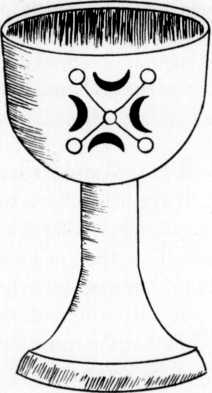
Figure 12c The Chalice (Cup or Grail)
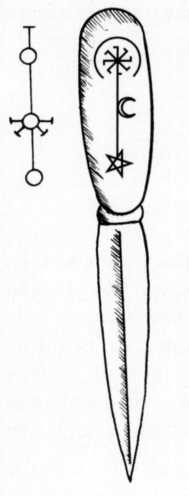
Figure 12d The Spirit Blade

Figure 12e The Pentacle Symbol
Once formed and prepared, the wand became a tool of Nature's inner magick. The wand is a tool which is used to request rather than demand, and it is gentle with power. This request possesses great influence, for its source is the Divine itself. It is used for calling upon the gods and nature spirits. It is a symbol of the element of air, and is associated with the east. Magickally it is often used for healing, divination, and astral workings.
The Ritual Wand Procedure-Choose a tree of the fruit-bearing variety, as these are best. If you wish, however, you may use oak or willow (even rose wood is fine). These woods have magickal associations to ancient cults, and many people prefer them for that reason. The wood of a tree that bears fruit is actually superior for a wand of general use.
Before sunrise, go before the tree and pour (or place) an offering. Tell the spirit within the tree what you wish to do, and why. Wait a few moments, and then proceed, unless you feel that the spirit has rejected your request. If you are going to take the branch, do so quickly. Wrap it up in cloth and return home. Trim the wood smooth, removing the bark, and shape the tip so that it resembles a phallus. Allow the wood to dry for nine days before carving or painting symbols upon it.
On the night of the Full Moon, place the symbols of the art upon it. Present it to the east quarter and declare it to be a wand of magick, and a power over the element of air. At midnight (or 9 P.M. if necessary) go out beneath the Full Moon, hold the wand up toward it, and say:
My Lady, Mistress of Night and of Magick, You who rule the star-filled heavens, bless and empower this Wand, that all may see, and know Thy Greatness. Wherefore, do I consecrate and dedicate this Wand to you, Great Mistress of Magick.
After completing this, set a bowl out beneath the Moon. Place equal portions of the following herbs into the bowl: pennyroyal, rosemary, hyssop, and acacia. Pour boiling water into the bowl, and steep for three minutes. Strain the mixture through cheesecloth, and then add this liquid potion to a half-filled bowl of fresh spring water. To the spring water add nine drops of almond extract. Then drop three moonflowers (or white jasmine flowers) into the bowl. Pause a moment, and look up at the Moon. Raise the wand up to Her, and then lower it into the bowl. Bathe the wand in the liquid briefly, and then remove and dry it. It is now ready to use.
The Spirit Bowl (Shell)
One of the oldest ritual tools in Witchcraft is the shell or bowl. Originally, large shells were used to contain seawater for blessings, and various works of magick. The Moon has long been associated with the tides of the ocean, and for this reason seawater was considered to contain the essence of the Moon's power.
These shells were placed upon stone altars (or sometimes upon fallen trees) with the open end up. Normally these shells were the size of a common bowl. Seawater was then poured into the bowl, and a small white shell was placed in the center of the bowl. In this manner, the worship of the Moon could be carried out, even when the Moon was not visible in the night sky (or even indoors, if necessary).
The shell also symbolized the womb of the Great Goddess, and the shell within symbolized the "Child of Promise." The Child was the promise of prophecy, and the mediator between humans and gods. With the shell in place, the priestesses were assured of the divinatory powers of the Moon bowl. A series of small white shells were also placed around the bowl, forming a crescent shape just below the bowl. As the stones were placed, left to right, the name of the goddess being invoked was chanted. At the conclusion of the rite, the shells were removed, one at a time, from right to left.
In time, in the interior parts of Italy, this shell was replaced by a gourd or wooden bowl, and later still by a ceramic bowl. By the time the Temple of Diana stood on the shore of Lake Nemi, the use of the Moon bowl had changed. Instead of seawater, an alcohol-like fluid was placed in the bowl. The shell was no longer set in the bowl, but was replaced by a flame, burning on the liquid's surface. The flame represented the presence of Deity, and so the shell fell out of usage, at least in the temple setting. The Moon itself reflected off the waters of Lake Nemi, where the Temple of Diana stood. This seemed a natural replica of the old Moon bowl. The use of the flame was a step in the evolution of the Cult.
Today, in the Triad Clan's System, the bowl is called the Spirit Bowl and is set in the center of the altar. An alcohol-based liquid (such as Strega Liquore) is poured into it, and lighted. This is done with a series of gestures and verbal incantations that aid to empower the flame. Once established, the flame is considered to be the presence of Deity, within the ritual setting. Traditionally, a woman will tend the altar and renew the liquid, so that the flame will not die out.
The Chalice (Cup) or Grail
Having studied in other Traditions/Systems, I think it possible that the common Chalice may have originated from the shell or gourd. In the Aridian Tradition, we also use a chalice and it does have the same "womb" associations as does the bowl. In effect, the chalice serves as a type of Grail. Ancient lore addresses the legend of the Grail, which was a vessel of transformation.
In time, this Grail legend was adopted by Christianity, and the Grail itself became the chalice from which Christ drank at the Last Supper. Here he said that the wine was his blood (contained within the cup), and bid everyone to drink of it. The cup then becomes the vessel of transformation, and carries with it the very essence of the Divine (from which nourishment is drawn).
The Grail legend originates with the Moon bowl, which serves as a meeting place for humankind and Deity. The liquid within the bowl symbolized a state of existence between matter and Spirit (physical and yet not physical). It is here that we connect to the source of our existence upon the Earth. Traditionally, seawater was the fluid within the bowl. Since many people believe that we evolved from life within the ocean, perhaps this practice stemmed from an ancient memory of our own beginnings.
Today, in the old system, the shell (as a moon bowl) is used only in private devotional rites. This is not to say that it can no longer be used in group celebrations, for indeed it can, but a metal bowl has taken its place, because of the use of fire. Some Strega, however, have taken a large abalone shell and filled it with sand, and then placed a small metal bowl upon the sand. In this manner, the spirit flame can still be kindled within the shell/Moon bowl with no damage to the shell or risk of fire spreading, should the shell crack. Technically, there is no real preparation of the bowl other than a simple blessing and a dedication of its service to the God and Goddess.
The Spirit Blade (Sword)
One of the most common tools associated with the practice of the Craft today is the athame, or dagger (in the Aridian Tradition it is called a Spirit Blade). This section will cover the ritual preparation for the dagger as performed in the Nemaic System of Witchcraft. I created the Nemaic System myself as an "outer-court" system in 1980, and it is based upon the Old Italian Tradition. Please bear in mind that this particular technique is an eclectic modern work based upon an old tradition.
Preparation of the Blade-Three nights before the Moon is full (the third night being the Full Moon), dig a small hole in the earth which is as deep as your hand is long. Then take equal portions (about a handful) of the ground herbs: rue, vervain, and fennel.
Add them to the soil from the hole which you dug, and mix this all together. Then replace the soil in the hole. Leave this until the night of the Full Moon. On the night of the Full Moon, boil some water (about eight ounces), to which you will add three pinches of salt. Then go outdoors and pour the boiled water out (slowly) on the area where you dug the hole. Next mark out a triangle around the hole. Then place nine drops of liquid camphor (Campo-Phenique will do, in a pinch) directly upon the center of the hole. At this point grasp the dagger in both hands, with the blade pointing down, and raise your arms up to the Moon, saying:
0 Great Tana, bless me with Power.
Then push the blade down into the soil (directly centered in the hole) up to the handle base. Next, draw power down from the Moon as follows. Kneel before the Moon, hands upon your thighs, and say:
At will, I make swift streams retire To their fountains, whilst their banks admire; Sea toss and smooth; clear clouds with clouds deform. With spells and charms I break the viper's jaw, Cleave solid rocks, oaks from their seizures draw, Whole woods remove, the lofty mountains shake, Earth for to groan, and ghosts from graves awake, And Thee, 0 Moon, I draw....
(As you begin the last verse, raise your left hand and "cup" the Moon.) Then quickly close your hand in a grasping manner, seemingly closing the Moon within your hand. Do not look up at this point, but bring your closed hand down (as if drawing or pulling) and grasp the knife handle. Next place your right hand firmly over your left and concentrate upon the knife, and imagine it glowing with power. After a few minutes, remove the knife from the soil, and clean it off with a white cloth. The knife is then ready for the symbols to be placed upon the handle. All that remains is to charge the knife with the four elements, and to dedicate it to the service of Tana.
The Pentacle
The original ritual pentacles were flat rocks employed to mark the center of the "sacred space" in a ritual setting. Later the rock was engraved with etchings to denote the four cardinal points comprising this space. The ancients believed that the rock itself contained a spirit, and so the marked pentacle represented the four elements of creation held in balance by the spirit of Nature. When humans became more proficient at using tools, pentacles were often made from sacred woods associated with the Deities of the cult artisans.
Today, the pentacle can be made from any natural substance, and bears a pentagram image on its surface. This five-pointed star represents the four elements, overseen by the fifth element of spirit. We see in this symbolism that the original concepts were retained up into modern times. Generally speaking, the pentacle does not require any special preparation after the pentagram is set upon it. This is because it is a natural substance, and as such is filled with the spirit force of Nature. A general blessing and anointing with the names of the God and Goddess will serve quite nicely.
The Nanta Bag
The Nanta Bag is a very old tool, appearing in various forms as it is traced back through the Ages. The form in which we have it today comes to us from fifteenth-century Italy. The purpose of the Nanta Bag is two-fold. First, it is designed to keep its wearer in harmony with the forces of Nature. Second, it serves as a carrier for the tools of the Craft, so that a Witch can perform his or her magick anywhere or any time. The original followers of Aradia carried them as they traveled from village to village, and soon they became a symbol of being a Priest or Priestess of the Old Religion.
Within these bags were miniature representations of the ritual tools, along with elemental symbols and objects of personal power. Typically the bag would contain a thimble (chalice), a needle or pin (ritual blade), a coin (pentacle), and a twig (wand). Also included would be a stone (earth), a feather (air), a flint stone (fire) or a match today, and a shell (water) or vial of liquid. Finally, the bag would contain a symbol for the God and Goddess, along with objects of personal meaning. If someone was given a small token by one whose power they respected, then this also would be added to the Nanta Bag.
The principle of "contagion" magick was the foundation for empowering the bag. Basically, this means that objects absorb power and have an energy field around them. When one object is placed in contact with another, then these objects are joined and influence one another. The Nanta Bag, in turn, has a contagion influence upon the person who carries it (in direct proportion to the items it contains). The following list is a basic example of the items that might be contained within a functional Nanta Bag:
A small stone, smooth and rounded
A small feather, blue or very light in color
A small portion of ash (wood or coal)
A small vessel of pure water
A small coin, with a five-pointed star etched upon it
A small twig (fruit or nutwood)
A pin with a black head (or needle)
A thimble
A portion of incense
2 small white candles
A piece of marking chalk
A measure of cord (nine feet)
A small finger-sized bowl (cup or dish)
A symbol of the God: (an acorn, small pine cone, piece of horn, etc.)
A symbol of the Goddess: (a seashell, string of beads, nutshell)
A personal power object (a lucky piece, a crystal, etc.)
A portion of salt
A small vessel of anointing oil
Collect these items and make a bag of leather or cloth large enough to contain them. You may wish to add some healing herbs or other desired items. For example, use a stone for earth, a feather for air, etc. The first four items are to be gathered in a manner that brings you into contact with the element represented.
Finally, take the completed bag and consecrate it in the manner of the altar tools, charging by the Elements and Gesture of Power (see "The Gesture of Power," Figure 14). Then say over the completed bag:
O Great Nanta bag, be thou a natural focus and a bridge to Power. I am linked to thee and thou art linked to Nature. We are One from Three. We are the Triangle manifest. In the names of Tana and Tanus, so be it.
THE SECONDARY TOOLS
The secondary tools of Stregheria are all Folk Magick tools, and are associated with the hearth and home. They are, therefore, tools of the Matriarch and symbolize her power. It must be remembered that Italian women were (and still are) very powerful forces in the family. The association of domestic tools with women, in the Strega tradition, is not an insult but rather a remembrance of when women ruled.
The Broom
The broom was not publicly associated with Italian Witches, as a symbol, until around the later part of the eighteenth century. Strega were always portrayed as riding to the Treguenda (Sabbat) on the backs of goats, unlike Witches of northern Europe, who were portrayed as flying on broomsticks. There is a similarity in this mythos, in as much as the goats provided flight in the same manner as did the broomsticks.
As a ritual tool, the broom can be used for protection and banishment, and it also serves as a symbol of the Goddess when turned brush-side up. As a tool of protection, the broom is laid across a doorway or entry way of any sort. When a ritual "doorway" is opened in a ceremonial circle, the broom can be set across the opening, while members exit and re-enter the circle. Ritual blades can also be used for this same purpose.
In banishment, the broom can be used to sweep salt (scattered around the affected area) out through the front door or entry area. The sprinkling of salt to remove negative energy is a very ancient practice. It can also be used to "thrash the air" in any setting to purify the area. Typically this involved censing the place with incense smoke, and then swinging the broom through the smoke.
The broom can also be set, brush-side up, near a ritual gathering site to represent the presence of the Goddess. This symbolizes the fertile and sexual power of the Goddess. Traditionally, a new broom was given to a bride on her wedding day as a symbol of her own power within the home and family. In ancient times, this was meant to honor her for nurturing and supporting the family structure. The entire family was dependent upon her, and through this she was given a great deal of respect and authority.
The Scissors
Another domestic tool wielded by the women of the home was a simple pair of scissors. In the Folk Magick of the Strega, scissors are used to break spells and sever magickal or astral connections. This is accomplished by acts of either cutting, slashing, or actually dropping the scissors. Cutting up a picture can sever the connection with that person, as can cutting up a piece of their clothing.
Olive oil drops can be placed upon the surface of a bowl of water, to represent whatever needs banishment. The scissors can then be jabbed into the drops while visualizing the problem. A person believed to be under a spell can be freed by sneaking up behind them and dropping the scissors to the floor. I suppose that this is similar to curing "hiccups" by scaring the person.
A charm in the image of a pair of scissors can also be worn for protection, or hung in a window, or over a doorway. The same is also true of a horseshoe, key, or a piece of horn. These, of course, are Folk Magick beliefs.
The Cauldron
The cauldron is used primarily for offerings with a ritual setting. This can be either an offering to deities or spirits. Typically the cauldron is set at the appropriate directional quarter of the ritual circle, which symbolizes the powers or forces whose influence is sought.
Offerings to the spirits of earth would be performed at the north quarter. Spirits of air receive offerings at the east quarter, spirits of fire to the south, and spirits of water to the west. Most deities are given offerings at the north, but occasionally this may be performed at either the east or west. In such a case it would involve aspects of Deity associated with either the Sun or Moon, since those are the quarters of rising and setting.
The Lare House (or Lasa Shrine)
Although not truly a tool per se, the Lare house is so integral a part of Stregheria that all Strega must possess one. Each one resembles a temple roof supported by two columns set upon a landing. Typically, this landing section extends out to form a ledge upon which offerings can be placed. This shrine is a focal point for the old spirits to commune with the Strega. The Lare are associated with ancestor worship in classical Roman religion, but this is quite different from the Strega practice.
In northern Italy, the Strega view the Lasa as beings who have already lived as humans and are now moving up the scale to demi-god status. Tuscan Witches call upon them for help in all matters and work very closely with the Lasa. In central and southern Italy, these entities are called Lare and are viewed more as the "collective consciousness" of former Strega. They can be called upon for assistance in the same manner as are the Lasa.
During important family occasions, offerings are made at the Lare house, which typically is set in the east or west of the home. Originally Lasa shrines were set in the west and Lare houses set in the east. Celebrations of birthdays, marriages, and other events call for the lighting of votive candles upon the shrine, as well as an offering of nectar.
When the Lare house is first established in the home, it is blessed in the names of the God and Goddess. A figure is usually added to the shrine depicting the Lare. Some Strega use a small figure of an angel in the Lare house, and, since Lasa were always depicted with wings, this is quite appropriate. To complete the shrine, a small offering bowl is set in place, along with a fava bean. The fava is symbolic of the "Otherworld" and was considered a plant sacred to the Underworld by ancient Greeks and Romans.
The Symbols
Before humans had invented an alphabet, as we understand one, they used symbols to communicate. Hunters used animal tracks as symbols of their prey and later as sigils of their power. The difference between a symbol and a sigil is that a symbol represents something else, but a sigil is the thing itself (or at least the essence of the thing). This is why sigils are used for invocations, and symbols are used to mark tools and equipment, but not to actually call upon an entity.
The following are the most common symbols and sigils used in Italian Witchcraft (Figures 13a-c, pages 106-108):

Figure 13a Symbols and Sigils Used in Italian Witchcraft

Figure 13b Symbols and Sigils Used in Italian Witchcraft

Figure 13c Symbols and Sigils Used in Italian Witchcraft