

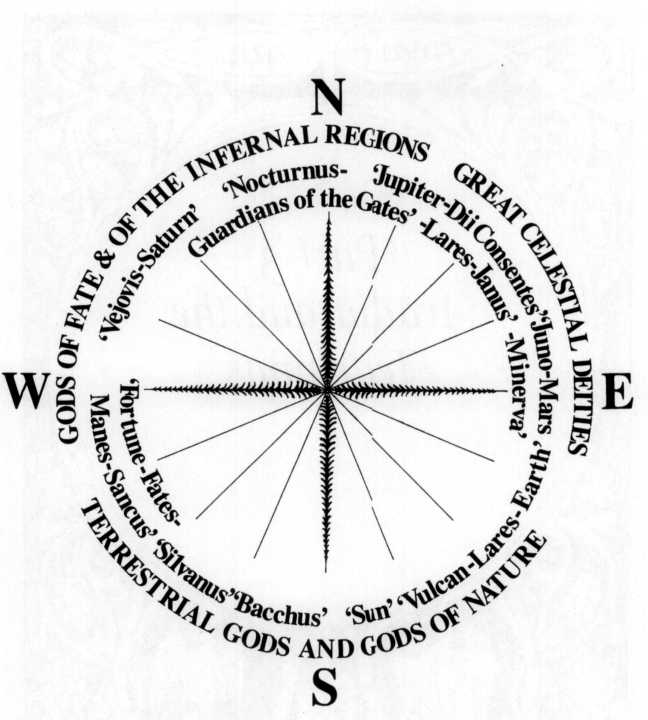
The Wheel of the Gods
20

'Then having obtained a pilgrim's dress, she traveled far and wide, teaching and preaching the religion of old times, the religion of `Diana, the Queen of the `Fairies and of the Moon, the goddess of the poor and the oppressed. And the fame of her wisdom and beauty went forth over all the land, and people worshipped her, calling her La Bella'Pellegrina (the beautiful pilgrim).
Charles Leland
Aradia; Gospel of the Witches
Long ago, in the Alban hills of Italy, a disheveled group of outcasts gathered by the fireside one Summer's eve to hear the tales of a forgotten age. In their midst sat a woman whom they called La Bella Pellegrina: the beautiful pilgrim. Her name was Aradia de Toscano, and in time she came to be known as the Holy Strega. Here in these ancient hills, she brought about the revival of the Old Religion of Italy (La Vecchia Religione), after centuries of Christianity and feudal lords had robbed the people of their heritage and their hope.
The Old Gods of Nature lay silent, carved in the mute stones that supported the ceilings of Christian temples. The cult of saint worship arose, and arrogated the offerings once sanctified by Pagan deities. It was a time of enslavement and abuse of power. Aradia came to deliver these peasants from slavery and to return their ancient Pagan heritage.
Many people are already familiar with the Legend of Aradia, as told by Charles Leland in his book, Aradia; Gospel of the Witches. Unlike his other works, Leland sought out what he thought was a pre-existing "gospel," instead of researching it on his own (as was his custom). He paid a local fortuneteller to obtain the text for him once she claimed to have knowledge of its existence.
The legend that was eventually given to Leland is a distortion of the original Italian legend. It was unlike anything that Leland had previously published, and contradicted his general theme of the "good witches" of Italy. Some people say that Leland created the text himself, and others say that he was deceived by the fortuneteller, whose only motive was a quick profit. If Leland had indeed created it himself, then it would certainly have supported his basic stand on Italian Witchcraft, but clearly it does not.
In this chapter, we will look at both portrayals of Aradia, through the eyes of Leland, and through the eyes of the Tradition that actually evolved out of her original teachings. To begin, we turn to the gospel of Aradia that was presented to Leland.
Leland's Aradia; Gospel of the Witches has been read and quoted by many Witches over the years. Yet how many have understood the potential danger hiding within its words? A close look at the published "Gospel" itself quickly reveals many of the flaws in its alleged "validity." These we will examine as the chapter continues, along with several fragments of actual Strega material woven into the deceptive fabric of the text.
Telling the Strega's Story
Charles Leland began his search for material pertaining to Italian Witchcraft in the late 1800s. In Italy he met a woman named Maddalena, who claimed to be a Witch. It was through her that Leland obtained the material that resulted in his book (published in 1899). I'm sure that anyone who has had to seek out the Craft in America is aware of all the obstacles and pitfalls, even with the many excellent Pagan organizations available today. You can imagine what it must have been like for Leland in Italy during the latter part of the nineteenth century. Despite his good intentions, Leland ended up with a mixture of folklore and fabrication (with a dash of authentic witch lore thrown in).
In chapter one, the text describes medieval Italy, and then quotes the Goddess Diana as saying (to Aradia):
Thou must go to Earth below to be a teacher unto women and men who fain would study Witchcraft in Thy school ...
and Thou shalt be the first of Witches known; and Thou shalt be the first in all the World ...
What this is trying to tell us is that Aradia was the first Witch in the world, and that she appeared in medieval Italy. This would mean that there was no Old Religion of the Craft predating Christianity. This would then support the Christian claim that Witchcraft is a perversion of Christian belief. No true Witch of the Old Religion would ever write such nonsense, nor ever desire to see it be published as representative of the Old Religion. If Maddalena were actually a Witch, then why would she pass on such nonsense? Chapter one also links Diana to Lucifer, a theme that plays right into the hands of Christian propaganda. The matter is somewhat resolved by the fact that Leland's Gospel of Aradia does not reflect the Witchcraft tradition actually practiced by Maddelena. It is likely that Maddelena was simply passing on to Leland the material he requested, and she may not have known he was going to publish it as a book. By Leland's own account he never again had any contact with her after receiving the Witches' Gospel from Maddelena.
In chapter two, we find a very disturbing invocation to Diana for the charging of ceremonial cakes:
I bake the body and blood, and the Soul of great Diana, that She shall know neither rest nor peace, and ever be in cruel suffering till She will grant what I request ...2
This is another thing that no true Witch would advocate, and therefore it was not a practitioner of the Old Religion who incorporated these words. I know of nothing like this in the Old Religion of Italy, but aspects of such practices by Catholic peasants in Italy do exist relating to saint worship. In a practice originating in the Middle Ages, statues of saints are sometimes bound with cords and placed in darkness. This is a punishment designed to extract favors from the saint in some type of sympathetic magick.
Leland's Aradia text is clearly a Christianized mutation of the actual writings of Aradia's followers. Again, in chapter one, we find another disturbing verse:
And when the Priests of the Nobility shall say to you that you should put your faith in the Father, Son, and Mary. then reply: "Your God, the Father and Maria are three devils!'
This would certainly bring disaster to anyone who spoke these words in medieval Italy. So, why would a Witch advocate such a stand? Unfortunately, Leland fell victim to what some Italian Witches call the Malandanti. The Malandanti are people who practice black magick and disregard the true path of Stregheria, but claim to be Witches, just as many Satanists call themselves Witches, even though they are not. Is there anything positive to say about Leland's book? Yes, there are actually a few fragments of genuine Strega material.
In chapter one, we find part of the now well-known "Charge of the Goddess":
Whenever ye have need of anything, once in the month, and when the Moon is Full ...
This is part of what Aradia told her followers before she departed. The actual Strega text, as it appears today, can be found in the Full Moon ritual appearing in this book. In chapter two of Leland's Aradia, we find a writing that reflects one of the ancient symbolical mystery teachings. Here Leland associates the grain for the cakes of celebration with the seed that was planted in the ground "where all deep secrets hide," and the firefly (whose shape is like a wheat grain) with the forces which aid plant growth (pollination and sunlight). They also represent the Sun God, who is the harvest grain.
In chapter eleven, we find the term La bella pellegrina (the beautiful pilgrim) connected to a story about a woman born in Volterra. This was a phrase actually used by followers of Aradia, and it is curious to find it here in Leland's book. Finally, in chapter thirteen, Leland gives an excellent description of the offering to, and invocation of, Diana.
Even though there are a few almost redeemable segments in Leland's book, the material itself cannot be taken seriously by anyone knowledgeable in the Old Religion as an indication of Italian Witchcraft beliefs and practices. It is certainly a far cry from his excellent book, Etruscan Roman Remains, which also addresses Italian Witchcraft. Why he chose to publish the Aradia material, clearly contradicting his life's work, remains an unsolved mystery.
Despite the many errors in Leland's book, the portrait of Aradia as a rebellious leader is quite accurate. To better understand this, we shall now turn our attention to the original legend of Aradia.
According to the teachings, Aradia was born in Volterra, Italy during the early part of the fourteenth century. Legend states that she was born on August 13, 1313. Many people dismiss this date as a fabrication, feeling that it is a bit too "witchy." Others see it as symbolism, for August 13 was the sacred Festival day of the Goddess Diana, and thirteen was the mystical number of the Moon (Aradia and Diana being thirteen twice). This may not be so far off, however, when we consider that there is some evidence that Aradia did exist, and was alive during the fourteenth century.
According to the original legend, Aradia brought about a revival of the Witch Cult in Italy during the mid-fourteenth century. She was taught the Old Ways by her aunt, and she later returned this ancient Pagan heritage to the oppressed peasants of Italy.
The Italian Inquisitor, Bernardo Rategno, documented in his Tractatus de Strigibus (written in A.D. 1508) that a "rapid expansion" of the "witches sect" had begun 150 years prior to his time. Rategno had studied many transcripts concerning Witchcraft from the trials of the Inquisition. Tracing back, he discovered the time at which the trials had first begun, and noted how they have increased over the years.
After a thorough study of these records (kept in the Archives of the Inquisition at Como, Italy), Rategno fixed the time the persecution began at somewhere in the mid to late 1300s. If Aradia had been born in 1313, she would certainly have been old enough to teach and influence others, and for groups to form to carry on her teachings.
There are no public records concerning Aradia by name, and no references to her in any published literature (that I can find) until Leland's account of her in 1890. In 1962, T C. Lethbridge (former Director for Cambridge University Museum of Archaeology and Ethnology) published a book called Witches, which does refer to Aradia in several chapters. In chapter two, he writes:
We can then, I think, assume that Leland's Vangelo and Dr. Murray 'c trial evidence are more or less contemporary and that it is reasonable to use the two together to form a picture of the witch cult at about A. D. 1400... Aradia was sent to earth to teach this art to Mankind. That is, she was, in the opinion of her devotees, a personage, known in Hindu Religion as an Avatar, who taught them how to harness Magick power. Aradia, at some far-off time, may have been as much an historical person as Christ, Krishna or Buddha . . .4
This is one of the few references to Aradia having possibly been a real person in history, written by someone not personally connected with Witchcraft. It is also interesting to note that Ecstascies: Deciphering the Witches' Sabbath, by Carlo Ginzburg, contains a passage that may also be a historical reference to Aradia. On page 189, he speaks of a medieval pagan sect known as the Calusari, who (as late as the sixteenth and seventeenth centuries) worshipped a mythical Empress. The Calusari called her "Arada" or "Irodeasa," and also used the term "mistress of the fairies" for her. Could this sect have still been practicing a form of worship initiated by Aradia over 100 years earlier?
According to the original legend of Aradia, she left Italy at some point in her quest, and traveled out of the country. Serbia, the home of the Calusari, lies a short distance across the Adriatic from central Italy, and travel by ship was not uncommon in that era. Aradia would not have traveled west to France because the Papacy was still established in France, and the Church was still hunting her. It would have been too dangerous to go to northern Europe, because Witches were being burned or hanged in that region (Italy did not begin the burning of Witches until after the time of Aradia). So, in fact, an eastern exodus would have been the only logical action that Aradia could have taken. At the very least, there is a striking coincidence between Aradia's Witches and the Calusari of Arada.
Many people will refute this circumstantial evidence and demand some solid historical documentation. Unfortunately, such evidence is not available to the public, so the truth of her existence may never be made known. However, there are no historical records of there ever having been a Jesus Christ either, except for references to the persecution of his followers, and the existence of his gospel. The same can be said for Aradia. As we know, all myths have their basis in fact (and the most effective lies are based upon the truth).
Leland's public account of Aradia includes a legend about the "Beautiful Pilgrim," and we believe this to be a remembrance of Aradia, preserved for generations by Tuscan peasants. In part, this legend says:
Then having obtained a pilgrim's dress, she traveled far and wide, teaching and preaching the religion of old times, the religion of Diana, the Queen of the Fairies and of the Moon, the goddess of the poor and the oppressed. And the fame of her wisdom and beauty went forth over all the land, and people worshipped her, calling her La Bella Pellegrina (the beautiful pilgrim).'
An interesting connection can be found in classical Roman mythology. The Roman deities Faunus and Fauna had offspring known as Fatui, who were considered to be prophetic deities of the fields. These resemble the later beings known in Celtic folklore as Fays, or fairies.
In Italian Witchcraft, the name Fauna (or Fana) is another name for Diana, just as Faunus is another name for Dianus. Leland names Diana as the Queen of all Fairies (Fays) and Roman mythology names Fatua/Fauna as the mother of Fays. Leland's Aradia contains several stories connecting fairies to Diana, Aradia, and to Witchcraft in general. He also mentions that La Bella Pellegrina was converted to Moon Worship and taught others the Old Religion of Diana.
In the original story of Aradia, we find a woman who was rebelling against her parents and their religion. In the fourteenth century, this was not met with much understanding (not that it is today, by any stretch of the imagination). According to the legend, Aradia would often go for long walks through the Alban Hill region near Lake Nemi. It was here that she one day experienced a vision that shaped the course of her life. In a manner not uncommon among mystics, Aradia encountered a moment of spiritual enlightenment.
It is said that she heard a "voice" that told her that she was chosen to fulfill a quest, and that she must challenge the established order of things, and provide hope to those who were enslaved by the wealthy nobility. Whether this was an inner voice, or some other phenomenon, we do know that it was significant enough for her to set out on a course of which few women of that era would ever dare dream.
Aradia came to be known as the Holy Strega, a spiritual teacher and wise woman. Her natural healing abilities and her knowledge of herbal potions was legendary during her time. She collected a small band of followers from the outlaw camps in the Alban Hills, and traveled the countryside, teaching the Old Religion of pre-Christian Europe. During her brief time as a holy woman among the peasant people, Aradia came to be regarded as the daughter of the Goddess Diana, and after her disappearance many people worshipped her as a goddess herself. But Aradia had come as the avatar of a forgotten age, and not as a goddess. It was never her intention to be worshipped.
In the final instruction to her followers, she asked them to remember her through a sacred meal of wine and cakes, and to always keep to the Old Ways. She told them to gather together when the Moon was full, and to worship the Great Goddess. She told them that they must be free when they came together, and that as a sign of their freedom they were to be naked in their rites, to celebrate in joy, and to make love with one another.
The freedom of which she spoke was the freedom of the mind, body, and spirit. She urged her followers to reject the Judaic-Christian "morality" that served to control them, and to practice the Old Ways. Today, many people have personal issues with these old Pagan ways, and cling to the moral values of Judaic-Christian culture.
Many involved in the Craft today come from this kind of background, and it is difficult for them to shed the beliefs of their parents and teachers. They do not strive to embrace the Old Ways which lead to liberation, but allow their own inhibitions and fears to stunt their Pagan spiritual growth. Sadly, this attitude, which is better suited to Christianity than to Paganism, quite often causes the initiate to remain in the Outerworld, outside of the abilities of the Old Ways to bring them the peace and harmony which so many seek, but cannot sustain.
Throughout the original legend of Aradia, we find a woman who was capable of both great spiritual peace and great social anger. In one particular event, she is confronted by Christian priests being escorted by a group of soldiers. When she is told that they have come to arrest her, Aradia unleashes her anger upon them, saying:
I rebuke you and I cast you out because you teach punishment and shame to those who would free themselves from the slavery of the Church. These symbols and apparel of authority that you bear serve only to hide the nakedness which we are all equal. You say that you serve your God, but you serve only your own fears and restriction.
This is quite a contrast to some of the gentle spiritual teachings that she so eloquently delivered in other parts of the original text.
Above all things, Aradia stressed the seeking and obtaining of an inner and outer balance. She spoke of the equality of the masculine and feminine in an age where this was most unwelcome. Aradia challenged the authority of the Church and the "right" of the wealthy nobility to oppress the peasants. This behavior brought her many enemies and eventually resulted in her arrest for heresy and treason.
She suffered humiliation and torture at the hands of her captors, but never lost sight of her spiritual quest. In prison, she used her sexual power over men to secure her escape. She did not allow herself to become a victim of their power over her, but instead used hers against them.
Today, many people have bought into the Judaic-Christian myth concerning a woman's sexuality. Even many modern Pagans hold to the myth that a woman who is free with her sexuality, according to her own needs and desires, is somehow cheap or used, and is a "slut." Somehow men do not seem to fall into this same category, and at worst are considered "animalistic," which to a Pagan does not necessarily carry the same demeaning connotations (even to non-Pagans, it's still not quite the same meaning).
Aradia used her entire being as a tool for self-empowerment. She employed her intellect and spiritual nature when she spoke with friends and enemies alike. She used her feminine instincts and sexuality as a resource upon which to establish power over those who sought to control her. Aradia employed magick as a tool for self-empowerment, to reach beyond to her full potential.
To her, the totality of a person, both experientially and potentially, had to be nurtured and brought into fullness. This was what the Church feared most, and was the real reason for the persecution of Witches. Men basically fear a woman's sexual power over them and seek to control it, harnessing it for their own use. If she denies it to him, she is called a bitch. If she shares it with anyone but him, she is called a slut.
Aradia is the image of the powerful female Witch. She is bold, independent, sexual, confident, and self-empowered. Even in the distorted version provided by Charles Leland, Aradia appears as a woman who draws people together into the Society of Diana, displaying leadership abilities and personal charisma. Overlooked for far too long by modern Witches, Aradia should be a symbol of women in the Craft today, for in Aradia is the Amazon Warrior, the Enchantress, the Healer, and the Matriarch.
In fourteenth-century Italy, Aradia taught hope and personal empowerment to an oppressed peasant population. She taught them freedom and openness in a time when the Church taught them shame and guilt. She gave peasants hope and self-worth, in an age that offered them only slavery and servitude. She taught them how to discover their roots, and to remember who they were, so they could start to live the lives of the people they truly were. She returned their heritage and pride to them, teaching them that they did not simply labor for the fancy of the wealthy.
The message of Aradia is much the same today, and her teachings offer the same path to freedom and personal empowerment. Every woman who has ever stood her ground, faced her fears, or met her death defending her beliefs, knew the spirit of Aradia. She still lives on today inside of all women. Sometimes she whispers her message, sometimes she sets it on fire, but it is always there for those who have the courage to listen. All women are Daughters of Aradia, and she asks only these few things of those who will follow her ways.
THE COVENANT OF ARADIA
Observe the times of the Treguenda, for therein is the foundation of the powers of Stregheria.
When good is done to you, then do good to another. If someone wishes to repay you for a kindness, then bind them to go out of their way to help three others; then this shall clear the debt.
Do not use the arts of Stregheria to appear powerful among others. Do not lower the standards of the Art and thereby bring contempt upon the Old Ways.
Do not take the life of anything unless it is to preserve life, yours or another's.
Do not give your word of honor lightly, for you are bound by your words and by your oaths.
Do not bow before any authority over you unless it is of the gods. Instead, cooperate with others but do not be a slave and always preserve your honor. Give respect to others and expect respect in return.
Teach all who appear worthy and aid the continuance of the Old Religion.
Do not belittle another's religious beliefs, but simply state your own truths. Strive to be at peace with those who differ.
Do not purposely cause harm to another, unless it is to prevent true harm to yourself or another.
Strive to be compassionate to others, and to be aware of the hearts and minds of those around you.
Be true to your own understanding and turn away from those things which oppose the good in you, or are harmful to you.
Hold reverence to all within Nature. Destroy nothing, scar nothing, and waste nothing; live in harmony with Nature, for the ways of Nature are our own ways.
Remain open in your heart and in your mind to the Great Ones who created all that is, and to your brothers and sisters alike.
ENDNOTES
1. Leland, Charles. Aradia; Gospel of the Witches (1890). Phoenix Publishing, Inc. (1990 reprint), page 4.
2. Leland, Charles. Aradia; Gospel of the Witches, pages 13-14.
3. Leland, Charles. Aradia; Gospel of the Witches, page 5.
4. Lethbridge, T. C., Witches. The Citadel Press (1962), pages 13-14.
5. Leland, Charles. Aradia; Gospel of the Witches, page 69.