
2
I forsee that a day will come, and that perhaps not so very far distant, that the world of scholars will be amazed to consider to what a late period an immense body of antique tradition survived in Northern Italy, and how indifferent the learned were regarding it; there having been in truth only one man, and he a foreigner, who earnestly occupied himself with collecting and preserving it.
Charles Leland
Aradia; Gospel of the Witches, 1899
It has become currently popular in the Neo-Wiccan community to dismiss "The Old Religion" as a reconstructed system, a contemporary creation based upon ancient concepts. Some modern writers insist that there is no evidence of a Wiccan tie to any ancient and authentic way of worship. Others say that Witches have always been portrayed as evil in ancient times and that there can be no similarity between ancient references to Witches and the image of Witches portrayed by Wicca today.
In this chapter we will look at all of these issues and present some compelling evidence that Witchcraft was indeed an ancient religion, and that Witches were not inherently evil, but simply maligned by a "solar" patriarchal society which was opposed to the "lunar" matriarchal society. We shall see that the Christian image of Witchcraft is one that grew out of fear and ignorance, giving way to prejudice and discrimination.
I have made liberal use of various quotations within this chapter, and I ask the reader to please indulge me. It is important here to introduce the conclusions of others who came before me, in order to present a convincing argument for my case. Time-proven techniques of magick and esoteric religious belief are integral parts of the Old Religion in Italy. They have carried and maintained the Old Ways for centuries, allowing them to survive the persecution during the Middle Ages. A little patience with this chapter will be well worth your time.
HISTORICAL SUPPORT FOR ANTIQUITY AND SURVIVAL
In the book Etruscan Magic & Occult Remedies' (published in 1892), author and folklorist Charles Leland writes of his investigation into Italian Witchcraft:
But I was much more astonished to find that in Tuscany, the most enlightened portion of Italy under all Roman rule, an old pagan faith, or something like it, has existed to a most extraordinary degree. For it is really not a mere chance survival of superstitions here and there, as in England or France, but a complete system, as this work will abundantly prove.'
Leland later implies that he was taken into the Witches' community in his book Legend of Florence (1895), in which he states:
The witches of Italy form a class who are the repositories of all the folklore; what is not at all generally known, they also keep as strict secrets an immense number of legends of their own, which have nothing in common with the nursery or popular tales, such as are commonly collected and published ... Lady Vere de Vere, who has investigated witchcraft as it exists in the Italian Tyrol, in an admirable article in La Rivista of Rome (f une 1894) tells us that "the Community of Italian Witches is regulated by laws, traditions, and customs of the most secret kind, possessing special recipes for sorcery" which is perfectly true. Having been free of the community for years, I can speak from experience. The more occult and singular of their secrets are naturally not of a nature to be published ....I
What should be of particular interest here to modern Wiccans is Leland's (and Lady Vere de Vere's) use of the present tense when speaking of Witchcraft in their time. For those who believe that the Craft was invented by Gerald Gardner, bear in mind that this was written over half a century before any of Gardner's books. Indeed, many aspects of the Old Religion found in Gardnerian Wicca can also be seen in the earlier writings of Charles Leland and James Frazer. Despite this fact, many people insist on attributing such origins to Gardnerian Wicca.
After consulting with Lady Vere de Vere (Italian Folklorist) and Professor Milani (Director of the Archaeological Museum in Florence), Leland wrote of Italian Witchlore in Legends of Florence:
That this is of great antiquity is clear, for out of this enchanted forest of Italian Witchcraft and mystical sorcery, there never came anything great or small which was not at least of the Bronze Age, if not the Neolithic Age.4
In Aradia; Gospel of the Witches (1899) Leland writes of the popular Christian image of the Witch, but goes on to say:
But the Italian Strega or sorceress is in certain respects a different character from these. In most cases she comes of a family in which her calling or art has been practiced for many generations.... S
Again we find Leland's use of the present tense when describing Witches in Italy, circa 1880.
Worthy of mention also, in Leland's book, is the story about the walnut Witches. Manuscripts from old witch trials in Italy speak of this walnut tree, which (it is said) had always been there and was in leaf all year long. For centuries, legends were told of the great Witch gatherings in the town of Benevento, at the site of an ancient walnut tree. In the year A.D. 662, Saint Barbato converted the Duke of Benevento (a pagan) to Christianity and had the tree cut down. The Witches replanted the walnut tree from seed, and legend says it still stands in Benevento. Bottles of Strega Liquore, manufactured in Benevento today, bear labels upon which appears the old walnut tree with a group of Witches and satyrs dancing around it.
There are several chapters in Etruscan Magic & Occult Remedies that contain some very interesting statements supporting the existence of the Witch Cult in Italy during the nineteenth century, and implications of its existence dating back to the days of antiquity. In chapter 10, we find a section titled "Witches and Witchcraft," with these words:
... and it is interesting to know that in the city of Florence in the month ofjanu- ary, 1891, there were people who believe in a prehistoric Shamanism which is stronger and mightier than that of the Church. Ages have lapped over ages, the Etruscans and Sabine-Latin and Roman and Christian cults have succeeded one to the other, but through it all the witch and wizard, humble and unnoted, have held their own.6
In chapter 8 we find a section titled "Diana and Herodias" which contains the following words:
It is remarkable that while witchcraft was regarded in later times among Northern races as a creation of Satan, it never lost in Italy a classic character. In this country the witch is only a sorceress, and she is often a beneficent fairy. Her ruler is not the devil, but Diana ... it is true enough that the monks imported and forced into popular Italian superstition strong infusions of the devil. Yet with all this, in the main, the real Italian witch has nothing to do with Satan or a Christian hell, and remains as of yore a daughter of Diana. There is something almost reviving or refreshing in the thought that there is one place in the world-and that in papal Italy itselfwhere the poison of diabolism did not utterly prevail.'
So what was the basis of the evil Witch image? There are several ways to understand this distorted image, and we turn to the writings of the Roman poet Horace to begin our quest. In the Epodes of Horace, written around 30 s.c., he tells the tale of an Italian Witch named Canidia. Horace describes her as an old toothless hag with wild unkempt hair, who casts evil spells upon those who offend her.
Horace goes on to say that Proserpine and Diana grant power to Witches who worship them, and that Witches gather in secret to perform the mysteries associated with their worship. He speaks of the Witches' book of incantations (Libros Carminum) through which the Moon may be "called down" from the sky. Other ancient Roman writers such as Lucan and Ovid produced works that clearly support the same theme. This would seem to indicate that during this era such beliefs about Witches and Witchcraft were somewhat common knowledge. In Epode 5 we read:
... Night and Diana, who command silence when secret mysteries are performed, now aid me; now turn your vengeance and influence against my enemies' house ...
In Epode 17 we find these words (addressed to Canidia):
Now already I yield to your mighty art, and suppliant beseech you by the realms of Proserpine, and by the powers of Diana, not to be provoked, and by your books of enchantments that are able to call down the fixed stars from heaven, Canidia, at length spare your magic words, and turn backward your swift wheel ... (Canidia replies) ... must I, who can move waxen images and draw down the moon from the sky by my spells, who can raise the vaporous dead, and mix a draught of love lament the effect of my art, availing nothing upon you?8
We know from the writings of Roman times that Proserpine and Diana were worshipped at night in secret ceremonies. Their worshippers gathered at night beneath the Full Moon and shunned the cities where the solar gods ruled. It is only logical that the city dwellers would fear them because they met in secret when "decent" people were asleep in bed. Out of their fear came the imaginings common to ignorance and prejudice. All unexplained ailments and disasters were in turn believed to come from these Witches who met in secret (for surely they were plotting against the "good folk"). From generation to generation, prejudicial beliefs were passed on, in time becoming common knowledge. In this same way prejudicial beliefs about various minorities are kept alive today. One generation teaches another through comments and attitudes, and soon distortion becomes "fact."
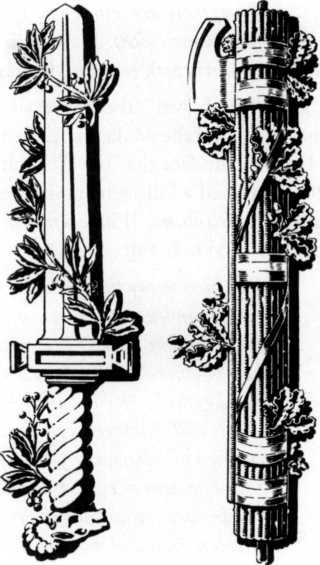
Roman Sword and Fasces
It is not surprising that the unsophisticated, country-dwelling Pagan bore the image of the toothless evil hag, cursing the cattle and fields of her "good" neighbors. Since Witchcraft was predominantly matriarchal, the men who ruled the cities (and wrote the history) looked down upon Witches as rebellious and dangerous to the established order. In a patriarchal society, a woman who uses magick and worships in secret, having no need of patriarchal society or religion, can only be seen as an evil, crazed woman. In the traditional Halloween witch image, perhaps we are seeing the worst fears of a patriarchal society: a woman turned loose without the constraints of patriarchal rules or religious dogma. Add to this, in later times, the arrival of Christianity and its passion to convert pagans, and its need to discredit Pagan ways in order to firmly establish Church doctrine, and what other image of a Witch could there be but an evil one?
The fact that some Witches went "renegade" in order to fight the Church, employing Satan, who the Church itself viewed as a powerful enemy, in the end served only to verify the evil nature that Christianity attributed to Witches. The majority of Witches chose not to denigrate the Old Ways in such a manner, and went "underground," almost completely disappearing from history.
It is interesting to note, however, that in Italy there were both "good" and "evil" Witches. In chapter 10 of Etruscan Magic & Occult Remedies, Leland writes :
True, there are witches good and bad, but all whom I ever met belonged entirely to the buone (good). It was their rivals and enemies who were maladette streghe (evil witches), et cetera, but the latter I never met. We were all good.9
This "witch war" theme between good and bad Witches is similar to that of the Benandand and the Malandanti,10 of whom I have written in other chapters.
Despite the fact that the Church taught that all Witches were evil, their ancient cult still maintained a following and continued on through the centuries. Mircea Eliade wrote in his book Occultism, Witchcraft, and Cultural Fashions, concerning the existence and modem study of Witchcraft:
It suffices to say that, as work progressed, the phenomenon of witchcraft appeared more complex and consequently more difficult to explain by a single factor. Gradually it became evident that witchcraft cannot be satisfactorily understood without the help of other disciplines, such as folklore, ethnology, sociology, psychology, and history of religions ... for instance, even a rapid perusal of the Indian and Tibetan documents will convince an unprejudiced reader that European witchcraft cannot be the creation of religious or political persecution or be a demonic sect devoted to Satan and the promotion of evil. As a matter of fact, all the features associated with European witches are-with the exception of Satan and the Sabbath-claimed also by Indo- Tibetan yogis and magicians."
Clearly there is a common thread running through many ancient practices and beliefs. It is through our look back into time that we find the roots of Witchcraft. In his book The World of Witches, Julio Baroja writes of southern Europe:
There seems to have been a flourishing cult of Diana among European country people in the 5th and 6th Centuries A.D., and she was generally looked upon as a Goddess of the woods and fields, except by those trying to root out the cult, who thought she was a devil. 12
In the author's notes for chapter 4, Baroja adds that the cult also worshipped a male deity called Dianum. This may be of interest to modern writers on Wicca who claim that witches never worshipped Diana, or a God and Goddess consort, in ancient times.
In A.D. 906, Regino of Prum wrote in his instructions to the bishops of the Kingdoms concerning Witches:
They ride at night on certain beasts with Diana, goddess of the pagans, and a great multitude of women, that they cover great distances in the silence of the deepest night, that they obey the orders of the goddess ... by speaking of their visions (they) gain new followers for the Society of Diana...."
It is interesting to note that the label "Society of Diana" mentioned by Regino continues to be associated with Witches throughout the centuries in Italy, as recorded in witch trials by the Italian Inquisition. It appears with greater frequency in trial transcripts during the later part of the fourteenth century and into the late fifteenth century. A brief chronology14 follows to summarize this unbroken chain of European Witchcraft through the centuries:
700 B.C.: Hesiod, in his Theogony, speaks of the Witch, Circe.
30 B.C.: Roman poet Horace in his Epodes of Horace associated Witches with the goddess Diana in a mystery cult.
A.D. 314: Council of Ancyra labeled as heretics witches who believed that they belonged to a "Society of Diana." Council concluded that they were deceived by Satan.
A.D. 662: Saint Barbato converted Romuald (Duke of Benevento) to Christianity. On Saint Barbato's bidding, Romuald had the "witches' walnut tree" cut down. This walnut tree was the gathering place of Witches who worshipped Diana, well known in the region. In A.D. 680, Saint Barbato attended the Council of Constantinople, where he spoke out against the "witches of Benevento."
A.D. 906: Regino of Prum, in his instructions to the bishops, claimed that pagans worshiped Diana in a cult called the Society of Diana.
A.D. 1006: 19th book of the Decretum (entitled Corrector) associated the worship of Diana with the common Pagan folk.
A.D. 1280: Diocesan Council of Conserans associates the "Witch Cult" with the worship of a Pagan Goddess.
A.D. 1310: Council of Trier associated Witches with the Goddess Diana (and Herodias).
A.D. 1313: Giovanni de Matociis wrote in his Historiae Imperiales that many lay people believed in a nocturnal society headed by a queen they call Diana.
A.D. 1390: A woman tried by the Milanese Inquisition for belonging to the "Society of Diana" confessed to worshipping the "Goddess of Night" and stated that "Diana" bestowed blessings upon her.
A.D. 1457: Three women tried in Bressanone confessed that they belonged to the "Society of Diana" (as recorded by Nicholas of Cusa).
A.D. 1508: Italian Inquisitor Bernardo Rategno wrote in his Tracatus de Stigibus that a rapid expansion of the Witch Cult had begun 150 years earlier. He concluded this from his study of trial transcripts from the Archives of the Inquisition at Como, Italy. A.D. 1519: Girolamo Folengo (Italian poet) associated a "Mistress" known as Gulfora with Witches who gathered to worship at her court, in his Maccaronea.
A.D. 1526: Judge Paulus Grillandus wrote of Witches in the town of Benevento who worshiped a goddess at the site of an old walnut tree.
A.D. 1576: Bartolo Spina wrote in his Quaestrico de Strigibus, listing information gathered from confessions, that "witches" gathered at night to worship "Diana," and had dealings with night spirits.
A.D. 1647: Peter Pipernus wrote, in his De Nuce Maga Beneventana and De Effectibus Magicis, of a woman named Violanta, who confessed to worshipping Diana at the site of an old walnut tree in the town of Benevento.
A.D. 1749: Girlamo Tartarotti associated the Witch Cult with the ancient cult of Diana, in his book Del Congresso Nottorno Delle Lammie. In his A Study of the Midnight Sabbats of Witches he wrote: "The identity of the Dianic Cult with modern witchcraft is demonstrated and proven."
A.D. 1890: Author Charles Leland associated the Witch Cult with the goddess Diana, as a survival of the ancient ways, in his books: Etruscan Magic & Occult Remedies, Legends of Florence, and Aradia; Gospel of the Witches.
Professor Carlo Ginzburg, author of Night Battles: Witchcraft & Agrarian Cults in the 16th & 17th Centuries, and Ecstasies: Deciphering the Witches' Sabbath, presents compelling evidence of Witchcraft as the survival of a hidden shamanistic culture that flourished across the European continent (and in England) for thousands of years. Ginzburg was formerly a history professor in the Instituto di Storia Medioevale e Moderna at the University of Bologna. He is currently professor of Italian Renaissance studies at the University of California at Los Angeles. In Ecstasies, Ginzburg presents important information supporting the antiquity of the Witch Cult. Although burdened with the Christian image of evil Witches, but armed with the knowledge of pre-Christian European religion, Ginzburg links those accused of practicing Witchcraft to an ancient fertility cult which he believes was once widespread throughout central Europe.
Ginzburg has an interesting approach to the study of Witchcraft. Most scholars who study Witchcraft look at the trial transcripts, dismiss the statements as "too fantastic," and therefore conclude that such a cult never existed, but was due to some kind of hysteria. Ginzburg looks at the material as though the statements indicate what the people themselves actually believed, and then goes on to try to understand why they would have believed themselves to have participated in such fantastic events. A great deal of Witchlore can be discerned by such an approach, and allows us to view the material contained in various transcripts as a peek into the folklore of the Middle Ages.
Through this line of investigation emerges an ancient shamanistic practice involving organic hallucinogens, employed to send the practitioners off into other realms of consciousness. This, of course, resulted in fantastic stories of flight, mythical creatures, orgies, and wild Sabbats (not to mention whatever may have been contributed to the trial transcripts for its own agenda by the Inquisition).
THE CULTURAL ASPECTS BEHIND SURVIVAL
The roots of Witchcraft clearly do go back to the shaman priests and priestesses of our forefathers. From their attempts to understand the world around them arose the beliefs and practices of what came to be Witchcraft. Women were viewed as magickal because of their ability to reproduce, and because they could bleed for days and not grow weak or perish. Men were in awe of women, and supported them in a matriarchal society. In time, as men began to go off hunting and warring, masculine images took on more importance. An inner patriarchal cult arose and demanded a place in the clan. Sadly, the matriarchal and patriarchal systems would not share equally in the clan life, and the former power began to collapse.
The concept of Deity in the Old Religion has its origin in the early stages of human development. When humankind began to wonder about the forces around them, personifying for simplification, the "gods" arose. This stage in human development was the origin of what eventually became the Nature religion of Witchcraft.
Our ancestors perceived a "consciousness" or "spirit" within all things. This, they called the Numen. It was the Numen that gave power to the forms in Nature. Power objects, stones, and charms were all valued for the power of their Numen. These indwelling spirits could be minor entities, or very powerful ones, depending upon the object possessed. Rare objects were believed to contain powerful Numen, while the more common objects contained the lesser ones. One major exception was the tree. Trees were always considered to contain very potent Numen.
In addition to the Numen, our ancestors perceived the Nature spirits, or Elementals. These are spirits who channel the life force into Nature. In the occult tradition they are called Gnomes, Sylphs, Salamanders, and Undines. Gnomes are linked to the Earth energies, Sylphs to Air, Salamanders to Fire, and Undines to Water. These are the physical and nonphysical elements that constitute created materials.
The rituals of Witchcraft indicate a concern for growth and sustenance, and clearly mark the peak of the cult at a time of agricultural development. The rites were designed to increase fertility of both plant and animal. Traces of the well-known "Slain God" mythos are still evident. In the modern rites of Aridian Witchcraft, layer upon layer of these ancient beliefs can be found, having been built upon each prior foundation (much as ancient ruins lay deeper beneath cities of antiquity). With the growing power of the new religion of Christianity, the Witch Cult began to retreat. Where once entire villages had gathered in celebration, now only handfuls of people came to worship. By A.D. 314 it had become a crime of heresy to believe in anything that was contrary to Christianity.
Trial transcripts and various treatise from the fourth century A.D. through the eighteenth century clearly document a continuing Witch Cult in Christian Europe. Some contemporary authors would have us believe that none of this was really going on during this era. I can only assume that they perceive these peasants to have been simply bored, and that the peasants therefore decided to commit suicide by fabricating involvement in a nonexistent cult.
However, consistent documented statements recorded by Italian Inquisitors clearly demonstrate that these peasants were worshipping Diana, in a cult whose practices can be traced back historically to at least the time of Horace. It is interesting to note that peasants on trial in the fifteenth and sixteenth century A.D. were being accused of the very same magickal practices that Horace, in the first century B.C., ascribes to Canidia, the Witch.
The Italian Inquisitor Bernardo Rategno wrote, in his Tractatus de Strigibus, of a rapid expansion of the "witches' sect" around 1375. He had studied trial transcripts of the past, and concluded that what he was dealing with in 1508 had begun to spawn sometime around 1375. Something had taken place in fourteenth century Italy from which arose an increase in the practice of Witchcraft.
In the book Folklore by the Fireside; Text and Context of the Tuscan Veglia, author Alessandro Falassi (professor of anthropology and director of the University of Colorado in Siena) relates the Italian custom known as the veglia (pronounced vay-yah). The word "veglia" is roughly translatable as "wake" and is similar to the Latin word vigilia, meaning to stay awake during the usual hours of sleep (a vigil). The veglia has always been a social occasion in which social rules and values have been discussed and transmitted in rural Tuscany; folklore has provided for centuries the means and messages of such crucial communicative events.
Falassi describes the scene in which Italian peasants once returned from the fields at sunset and gathered before the fireplace. Here, they would first tell fairy tales to the youngest children that contained various messages and morals intended to merge the child into the Tuscan community as he or she grew up. Next, the older children were told stories of their family members and ancestors, in order to establish a sense of who they were and who they had been. Lastly, they spoke of their religious beliefs and customs in order to preserve their traditions. It is because of traditions like the veglia that so much of hereditary Italian Witchcraft has survived and been passed on. Falassi writes of the veglia:
La veglia; the word and the custom that surrounds it have an old-fashioned ring to Tuscans today. Yet these fireside evenings and their homespun performances are not so far removed from contemporary people's experience, for it is only in the last decade or so that the occasion has lost its vitality ... The veglia has lasted over 500 years without losing its function or meaning."
Traditionally, to attend a veglia one had to be a member of the family; "of the blood" as they would say. Other participants in the veglia could be relatives "of the same blood," or those acquired through marriage.
Throughout the Middle Ages, the veglia was held during the period of the year between the fall and winter sowing of the crops and Lent, even though the common rituals extended to cover the complete cycle of the year and all four seasons.
The fireside hearth was the center of the Italian Pagan's home, a place it has maintained for centuries. The family and the fireplace belonged to the mother of the home and it was she who tended the fire. In the center of the fireplace sat the "fire stone," a fireproof slab over which the fire burned. The umbilical cords of children born into the family were placed beneath the stone, a custom based on the folklore belief that this would keep the family together. This is an indication that the fire stone was an important element in the veglia family gatherings.
The main substance of the fire at the veglia was the ceppo (log) which was burned. This log always came from the part of the tree closest to the roots, connecting the log symbolically to the family roots. Ceppo is the Italian word for log, but can also mean "a group of houses" or "a family." A pregnant woman is sometimes called ceppa inceppita, which means a log ready to sprout a branch. The log was the symbol of marriage in Roman times, and the woman symbolized the tree of life, so it is easy to see that the symbolism of the veglia is quite ancient.
The fireplace was the center of the house, providing heat and light and the means by which food was prepared. It was the point at which Nature merged with human culture. Here also hung the items common to domestic family life, which were also symbols of the generative act of life and of the family. The female symbols were the kettle, the chimney, and the chain, symbolizing the womb, the vaginal passage, and the unifying principle of family. The male symbols were the fire poker and tongs (phallic representations), and the fire itself.
It was here in this setting that the family gathered to hear the old stories told and retold. The fire which back-lighted the narrator was the explanatory principle and signifier of both magickal transformation and the metaphysics of the family. It only made sense that this would be the place where family values and world views would be shared among those of the same blood. It was here that hereditary witches were kept bound together from one generation to the next through the family tales of bloodlines and religious beliefs, mixed together with folklore and legend.
The earliest references to the veglia in literature date from the fifteenth century, although certainly this was a much older practice. In the Strega Tradition, gatherings at the time of the Full Moon are referred to as the Veglione (pronounced vay-yoe-nay), although the slang term Tregua (tray-gwah), meaning "respite," is more commonly used. The root word of Veglione is clearly Veglia. Veglione means "to dance all night"; today that word is the name of a traditional Italian dance.
The ritual gathering at the time of a Full Moon was a respite from the burdens of daily work and drudgery for the Pagan peasants of old Italy, hence the slang word Tregua. This was also true of the yearly celebrations of the great festivals, many of which were adopted and altered by the Church, making it easier for the Pagans to celebrate in the open under the guise of Christian worship. Open worship of the saints became a useful cover for the worship of the old gods, as witches adapted to the ruling class of the period.
Many modern witches see Catholics simply as Pagans who accept Jesus as divine, and certainly many aspects of Italian Paganism have survived in Roman Catholicism. Clearly Mary is the goddess image, the "mother of god," and Jesus is the slain god born at the Winter Solstice, linked to themes of resurrection maintaining the ancient cycle of the Green Man.
The fire of the veglia is still kindled today by Italian Witches in the form of the "Spirit Flame," which burns upon the altar. Placed directly in the center of the altar is a bowl that holds the blue flame symbolizing the presence of the ancient spirit of the Old Ways. In a real sense, however, this is more than a symbol, as the Strega invoke the ancient ones directly within the flame and draw their power from divine fire. Fire is one of the most ancient forms of divinity and appears to have been a common focus in most ancient cultures.
In the book The Golden Bough, by James Frazer, there is a chapter dealing with the sanctuary of the Goddess Diana at Lake Nemi in Italy. In this chapter Frazer makes reference to the divine fire:
For the perpetual holy fires of the Aryans in Europe appear to have been commonly kindled and fed with oak-wood, and in Rome itself, not many miles from Nemi, the fuel of the vestal fire consisted of oaken sticks or logs as has been proven by a microscopic analysis of the charred embers of the Vestal fire ... if Diana was a queen of the woods in general, she was at Nemi a goddess of the oak in particular. In the first place, she bore the title of Vesta, and as such presided over a perpetual fire, which we have seen reason to believe was fed with oak-wood. But a goddess of fire is not far removed from a goddess of the fuel which burns in the fire; primitive thought perhaps drew no sharp line of distinction between the blaze and the wood that blazes. 16
Here again we see the ancient connection between the log, fire, and the female spirit (which is the setting for the veglia). Literally it was "folklore by the fireplace" which preserved so much of the Strega's ways.
Fortunately, the persecution of Witches in Italy began almost 100 years later than it did in northern Europe, and even then the local village witch was generally tolerated as the Church searched mainly for organized groups. The persecution of Witches was not as fierce in Italy, although indeed many Witches (and non-Witches) were burned by the Inquisition in its war against religious freedom. However, more often than not, the majority of Witches in Italy were either flogged or imprisoned for short term. This more tolerant attitude, along with the tradition of the veglia, helped many family traditions survive the centuries of persecution that destroyed or severely fragmented so many of the Witch traditions of northern Europe.
RUSTIC BELIEFS BEHIND SURVIVAL
As previously mentioned, in the Old Religion of Italy there are certain spirits called the Lare, who are both protectors and preservers. In Roman mythology, the Lare were ancestral spirits and guarded the family. A small Lare "house" was placed upon the hearth. Each Lare house had a receptacle for offerings that consisted of wine, honey, milk, and flowers.
The focal point of a family is their home, and in ancient times the focal point of a house was the hearth (the Latin word focus means hearth); the hearth held the fire, which provided heat and upon which the meals were prepared. A prayer was said to the Lare every morning, and special offerings were made at family festivals. These spirits were originally gods of the cultivated fields, worshipped by each household at the crossroads where its allotment joined those of others. Later Lare were worshipped in houses, and the household Lar (singular of Lare) was conceived of as the center of the family, and of the family cult. The image of the Lar was usually a youthful figure dressed in a short tunic, holding in one hand a drinking horn and in the other a cup.
In early Etruscan times, these spirits were called the Lasa. In Tuscany, the name Lasa still applies to various spirits. Aradia, who lived in Tuscany during the fourteenth century, taught mortals about the Lasa and about fire. The flame became a symbol of the Spirit of the Old Religion. Aradia associated the light of fire with personal enlightenment. She taught that we all bear a spark or flame of Divine Consciousness within us. This was our Spirit or Soul. Fire is an ancient symbol of Deity and of worship (Moses and the burning bush, etc.). To early humankind it provided warmth and protection, as well as a method of food preparation. The possession of fire was essential to long-term survival. Today it appears on the Aridian altar as the Spirit Flame, which represents the presence of Deity.
In La Vecchia, the Lare represent not only ancient family ties, but also the spirits who protect and preserve the Old Religion (and its followers). It is also largely because of the Lare belief that the Old Religion was never totally destroyed during the violent Witch persecutions of the Middle Ages. The Lare Cult maintains a strong family connection, and it is for this reason that the hereditary Witches of Italy retained a cohesive Family Tradition down through the centuries.
Generation after generation has remembered and honored their predecessors, passing on the ancient traditions of the Old Religion. Even today among the mainstream populace many elements of the ancient cult still exist. The tradition of the Good Witch Befana filling stockings hung on the hearth is a living remnant of the Old Religion. It is interesting to note that children write their wishes upon bits of paper that they place in the hearth to be carried up the chimney (connecting fire, Lare, and Befana). For more information on Befana, see the appendix.
ENDNOTES
1. Originally titled Etruscan Roman Remains, when first published in 1892. Renamed in 1963 reprint by University books.
2. Charles Leland was an American folklorist who spent his final years in Italy researching Italian Witchcraft and Tuscan folklore. Author of many books and articles on this subject, Leland's works were clearly the foundation for much of Gerald Gardner's reconstructive material on Wicca.
3. Introduction, page 9. Reprint by University Books, 1963.
4. Preface, pages 8-9.
5. Page 252, Legends of Florence, Macmillan & Co., 1895.
6. Preface, page 5, Aradia; Gospel of the Witches. Reprint Phoenix Publishing, Inc., 1990.
7. Etruscan Magic & Occult Remedies, page 196. Reprint University Books, 1963.
8. Etruscan Magic & Occult Remedies, pages 150 and 152.
9. The Works of Horace, pages 177-178. Reprint, David McKay Publisher, 1884.
10. Etruscan Magic & Occult Remedies, page 197.
11. The Benandanti and Malandanti were two different factions of witches who fought against each other in ritual combat.
12. The World of Witches, page 65. English translation, University of Chicago Press, 1964.
13. The World of Witches, page 60.
14. Compiled from the collective works of Carlo Ginzburg, Julio Baroja, Alfredo Cat- tabiani, and Charles Leland. Although some of the references address events outside of Italy, it must be remembered that the Church directed them from Rome, and that the Councils and individuals mentioned here were accountable to the Pope in Italy (and also for a time at Avignon).
15. Folklore by the Fireside, page 2, University of Texas Press, Austin, 1980.
16. The Golden Bough, page 190. Reprint 1 volume abridged edition, Macmillan Co., 1972.
17. See chapter 21, "Teachings of the Holy Strega," for additional information.