
8

In the fighting that we do, one time we fight over the wheat and all the other grains, another time over the livestock, and at other times over the vineyards. And so, on four occasions we fight over all the fruits of the earth and for those things won by the 'Benandanti that year there is abundance.
Carlo Ginzburg
The Night Battles
In the Old Religion, each Tradition has as its foundation a mythos concerning the seasons. In most Traditions of northern Europe the foundation is the Oak King and the Holly King, but there is another mythos in southern Europe which reflects the roles of Divinity within the dance of Winter and Summer. In the Aridian Tradition, the aspects of the waxing year and the waning year are symbolized by the Stag God and the Wolf God, respectively. The Wolf God is called Lupercus and the Stag God is called Kern. Unlike the mythos of the Oak King and the Holly King, the Stag and Wolf gods do not slay each other "at the appointed time," but instead are slain by another.
In the Old Religion of Italy there are three aspects to the God. In these aspects we find the connections of Deity within the Physical World. The three titles by which the God is known are The Hooded One, The Horned One, and The Old One. The Hooded One is commonly referred to, in many Traditions, as the Green Man or Jack-in-the-Green. He is covered with vegetation, or hooded in the green. The Horned One is a Stag-horned Deity and is the God of the Forests, or of the Wild. The Old One is the Sage, or Elder.
It is interesting to note that the earliest known representation of the Stag-horned God appears on a rock carving in Val Camonica (Italy) dating back to the fourth century B.C. (according to Miranda Green, Tutor in Celtic studies at the University of Wales College of Cardiff, and Honorary Research Fellow at the center of advanced Welsh and Celtic studies at Aberystwyth). In this carving the Stag-horned God is shown wearing a long robe; he is standing with his arms uplifted and a pair of antlers appears upon his head, which is human in appearance.
In Miranda Green's book Symbol and Image in Celtic Religious All, a picture of the rock carving is reproduced (on her page 87). Engravings from the prehistoric period at Trois- Freres depict humans dressed in animal skins (including a stag disguise), engaged in hunting and ceremonial acts. Joseph Campbell, in his book Primitive Mythology, describes them as shaman dancers in animal disguise, involved in a hunting ritual. While these prehistoric carvings picture a human disguised as a stag, the carving in Italy portrays the stag itself as a deity.
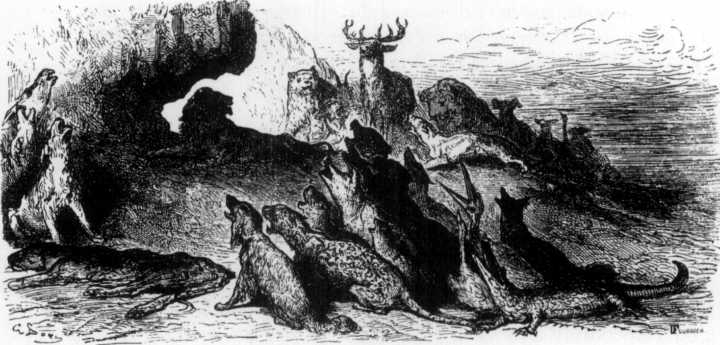
The Powers of Light and Darkness
The three aspects of the God evolved out of the merging of the Hunter/Gatherer society into the agricultural community. The Hooded One was connected with the crops, and came after the time of the Stag God. He was the son of the Stag God. The Hunter/Gatherer came long before the agricultural community, and therefore the Animal Spirit was valued before the Plant Spirit. As humankind grew in spiritual maturity, the concept of the Old One was born. This was the human representation of Deity: the God man.
Other aspects of the God are simply variations of these three basic concepts. The Trickster aspect, for example, is associated with the Hooded One. We see this in the Celtic Legend of the Green Knight who tricked Gawaine, and again in the Roman Lord of Misrule who was sacrificed during the Saturnalia. In the Italian Tradition, the Raven (a renowned trickster) is associated with the Hooded One in his role as the Guardian of the Grove.
The common image of the Goat-foot God, or Pan-like God, is merely a domesticated version of the Stag God of the Forest. As humankind began farming, domesticated animals became more important than once-hunted animals, and thus the symbolism began to change. Pan, or Faunus, is simply the Stag God of the Forest as seen by an agricultural community which valued domesticated animals more than the wild animals of the forest.
The Winter months brought on the wolves that preyed upon both domesticated and wild animals. Wolves easily became symbols of the power of Winter, aiding in the decline of the other creatures during the harsh Winter months. Their connection with the Stag of the Forest (the Hunted and the Hunter) lies deep in the memories of early humankind. Thus the Stag God came to symbolize the waxing year, and the Wolf God came to represent the waning year.
THE STAG AND THE WOLF
The Stag and the Wolf God go back to the days of antiquity in the Witch Cult. An early Etruscan image, found on a vase from the sixth century B.C., shows the Goddess holding up a wolf and a stag. This is no surprise, for Italian Witchcraft originates from Tuscany, which is where the Etruscan civilization once flourished. The wolf, the "Howler of the Night," was the Goddess' principal cult animal. Its importance in the religion of Old Europe can be found in the numerous figurines and vessels that depict the Goddess with the wolf and stag.
Wolves were sacred to the Moon Goddess. Their lunar nature is indicated by the crescents that appear along with their images on ancient artifacts. More common today is the portrayal of the Goddess Diana with her hunting dogs (domesticated wolves), but the earliest statues of Diana show her with a stag. It is in Diana that we discover the seasons of the stag, and of the wolf.
The season of the waxing year is symbolized by the phenomenon of the cycle of regeneration and growth of the stag's antlers. Marija Gimbutas, Professor of European Archaeology at the University of California, Los Angeles, in her book The Goddesses and Gods of Old Europe, states:
The role of a deer in Old European Myth was not a creation of Neolithic agriculturists. The importance of a pregnant doe must have been inherited from a pre-agricultural era. [In this book she also states]: In some portrayals deer antlers and crescent moons merge together as they spin around a cross with knobbed extremities showing the four cardinal points of the world. Two pairs of opposed crescents and the goddess' dog can also be seen.'
Again we see lunar connections, the Goddess, and also her dog (which is a wolf).
In the Strasbourg Museum of Archaeology there is an icon of a god which illustrates the ancient connection of the Old Religion with the stag and the wolf (a picture of this statue appears in the book Symbol and Image in Celtic Religious Art by Miranda Green, on page 102). It was discovered at the site of the mountain sanctuary of Le Donon (near a Celtic shrine to Mercury). The icon depicts a woodland god carrying the first fruits of the forest-a pine cone, acorns, and nuts-in an open bag underneath his left arm. He is shown wearing a wolf-skin, and a long hunting knife hangs on his left side. His boots are decorated with a small animal head at the top of each boot.
The god's ambiguity as a hunter/protector is shown, on the one hand, by the wolf-skin cloak and weapons he bears, and on the other hand by his close relationship with a stag who stands next to him as he gently rests his hand upon its antlers. It is in this icon that we see the connection of the God of the Old Religion with images of the stag and the wolf. He is shown as both the hunter and protector of all forest animals, the Guardian of the Grove, the Lord of the Trees, the Old One.
The image of the stag and the wolf also appears in icons of the Celtic god known as Cernunnos. The famous Gundestrup bowl contains a panel showing Cernunnos with a wolf standing to his left and a stag to his right. This seems to be a common theme in many different parts of Europe, and it seems likely that they all come from a common source.
In an early Roman mosaic, an interesting image actually captures the history of the transition from hunter/gatherer to agricultural community. In the book Roman Life (page 56, 1957 edition, published by Scott, Foresman, and Co.), this mosaic is divided into three sections, displaying the evolution of the ancient Italian society. The bottom portion shows a human hunter wearing a cloak made of a stag's skin, with a stag's head upon his own. He is pictured sneaking up on his prey, and herding them into a trap that he has prepared.
Above this scene, in the center of the mosaic, is a crude encampment where people are tilling the soil with primitive tools, employing various animals for some of the labor. In the upper portion of the mosaic, we find a classic Roman structure; the people are dressed in classical Roman attire and the animals are all of the domesticated variety. Of particular interest in this last section is the portrayal of a stag and a wolf, which are fleeing the more modern part of the human community. Captured here in this mosaic is the story of our ancestors, and the story of the stag and the wolf, who were gradually driven out of our communities and out of our religion.
It is interesting to note, in this same book, a picture of a Lare shrine in which two Lare hold up drinking vessels which are adorned with a stag head. Lare were originally deities of cultivated fields and later came to represent the spirits of Roman ancestors. In any agricultural society, the presence of deer pose a threat to the crops, and it would be unlikely that agricultural cultures would hold the stag in reverence (at least on the surface it would seem unlikely).
Why would the ancients have depicted the Lare holding drinking cups symbolizing a stag? The answer is contained within the imagery itself. A drinking cup is used to contain the essence that it receives, and serves to pass this essence on to whoever drinks from it. The stag cups represent the original connection with the Horned God of the forest, who later became the Slain God of the harvest, a remembrance of the origin of the "essence" of the Old Religion.
As stated earlier, the Goddess Diana is often depicted in art accompanied by either a stag or a hound. In some art forms we also find her with the God Pan. Here again we see the domesticated version of her earlier consort, the stag. In one of the legends concerning Diana we find the story of Actaeon. In the public Greek myth, Actaeon comes upon Artemis while she is bathing in the woods and stops to admire her beauty. He is noticed by one of her followers, and, in her anger at being seen nude by a mere mortal, Artemis turns him into a stag. His hunting dogs then turn upon him and kill him.
It is interesting to note that Actaeon was said to be the son of Artisaeus (who was the Horned God of Thessaly, being very much like Pan) and Autonoe, the daughter of Cad- musn. According to legend, Aristaeus was the son of Uranus and Gaea (or Apollo and Cyrene). He was brought up by the centaur Chiron and instructed in the arts of medicine and soothsaying. He was considered the protector of flocks and agriculture.
There is another Mythos concerning Diana and Actaeon that is much older, and more closely related to the Mystery Tradition of the Old Religion. In this myth, Diana fell in love with the god Actaeon, but because of her reputation as a chaste goddess she sorrowed for a love she felt she could never experience. An adversary of the god Actaeon discovered Diana's secret and plotted against the god. In the guise of a friend, the adversary went to Diana and told her to change Actaeon into a stag when he entered the forest, saying that she could then proclaim her love to him and no one would take notice.
Diana agreed with the plan and set out to seduce Actaeon. Knowing his usual hunting places, Diana decided to bathe nude in a forest stream so that Actaeon would encounter her. When Actaeon finally saw Diana, she transformed him into a stag and left her bath to go to him. In the course of the Mythos they became lovers, and Actaeon remained in the forest as a Stag God.
Unfortunately, one day as Actaeon intended to surprise Diana during her bath, he encountered a pack of wolves and fled to escape them. He was overrun by them and perished, having been brought down by the leader of the wolf pack (which is what his adversary had planned all along).
In The Goddesses and Gods of Old Europe, Dr. Marija Gimbutas writes:
The Lady of free and untamed nature and the Mother, protectress of weaklings, a divinity in whom the contrasting principles of virginity and motherhood are fused into the concept of a single goddess, was venerated in Greece, Lydia, Crete and Italy. She appears as Artemis and under many local names: Diktynna, Pasiphae, Europa ("the wide-glancing one'), Britomartis ("the sweet virgin') in Crete, Laphria in Aetolia, Kallisto ("the beautiful') in Arkadia, orAgrotera ("the wild'), and Diana in Rome ... The stag is her standing attribute in plastic art; she is called "staghuntress" in the Homeric Hymns.'
In her conclusions, Dr. Gimbutas writes:
The teaching of Western Civilization starts with the Greeks and rarely do people ask themselves what forces lay behind these beginnings. But European civilization was not created in the space of a few centuries; the roots are deeper-by six thousand years. That is to say, vestiges of the myths and artistic concepts of Old Europe, which endured from the seventh to the fourth millennium b.c. were transmitted to the modern Western world and became part of its cultural heritage.3
When we research the mythos of the stag and the wolf, we find a widespread legend connecting people from Eurasia, through Italy, and up into France and the British Isles. It seems quite reasonable to conclude that there was a common origin to this ancient totem concept, and that we can all trace our Traditions back to one common belief system.
An altar set with stag horns awakens a common spiritual mentality in all Pagans, Witches, and Wiccans. It is there in our very Being; it is part of us. The wolf also speaks to us, and the memory of its place in our mysteries is now hidden in the association of werewolves and the occult.
The werewolf legend, though altered by Christian revisions (as is common with most Pagan images), still contains elements of the Wolf Cult that was once a part of the Old Religion. This cult was the early warrior society in which men first came to understand their own mysteries. They were fearful and dangerous, but were controlled by the matriarchal priestesses before the male cults rose to power.
It is curious that only a silver sword or bullet could slay a werewolf (silver being a lunar symbol), and that a full moon transformed a person into a werewolf. Curious also that a pentagram appeared on the body of one who was a werewolf (a tattoo to symbolize membership in the ancient cult?). All of these ancient symbols are still associated with Witchcraft, and are ingrained in the human psyche. These ancient memories call to us, beckon us, and bid us awaken to the Old Ways.
THE LORD OF MISRULE
The Winter rites of the Old Religion, in Italy, are connected to the ancient rites of the Roman Saturnalia and Lupercalia. The "Lord of Misrule" found in the Saturnalia, and the "Wolf Cultists" present in the Lupercalia, are still aspects of Italian Witchcraft today. These characters are mainly visible in the daytime festivals and celebrations of the Old Ways, but glimpses of them can be found in the "Night Rituals" which make up the majority of ritual material in the Aridian Tradition. The Lord of Misrule and the Wolf Priest of Lupercus are responsible for the antics that follow their respective rites.
Even in public festivals of the common people today, there are remnants of these ancient practices. In Italy one can still observe the Carnevale, or Carnival. With the old season dying, and a new one being born, the Carnevale is the last party of the year. The Carnevale is an occasion for masked balls, processions, feasts, and ancient rituals to assure an abundant harvest in the time ahead.
During the Middle Ages, the Carnevale was marked with obscene songs and erotic dances. Games of chance and outrageous acts were performed, all under the protection of masks worn by those who joined in the festivities. The celebrations often ended in an orgy brought on by the sexual themes of the songs and dances. The intent was magickal in nature, and was designed to "impregnate" the earth, where the seeds were waiting for the season of growth. Pregnant women joined in the celebrations as well, in hopes of stimulating the growing "seed" within their wombs.
Today, the Carnevale begins with a fife and drum procession on the morning of Epiphany, January 6 (also the festival time of Befana). The Carnevale festival continues on for a week, consisting of street dances, parades, pageants, and feasts. People join in the celebrations as much as possible, napping for an hour or two whenever possible. A fava bean is baked into one of many pastries, which are placed before those who wish to partake in the "choosing."
Whoever finds the fava bean is proclaimed the King of the Carnevale, and may then choose anyone as his Queen. The couple will then "rule" over the festival for the entire week. The Carnevale ends with a candlelight procession in which an effigy of the King is carried. Behind the effigy, the man who portrayed the King carries a sword, the tip of which he allows to "scrape" along the walkway. The procession is silent, except for this sound.
It is dark by this time, and a bonfire is lit. The effigy is then "sacrificed" upon the bonfire, and the celebration concludes with a great deal of wine drinking and merrymaking. Later on, with the sounds of revelry fading in the night, and the flickering of thousands of candles, Carnevale ebbs away. With the rising of the Sun, Carnevale is dead.
This is an ancient theme, recounting the days when human sacrifice was offered in Pagan worship. This theme is well documented in such books as The Golden Bough by Frazer, and Western Inner Workings by William Gray.
THE CULTS OF THE CAVALLINO AND LUPERCI
During the parade of the Carnevale comes the appearance of the Cavallino. The origin of this brotherhood goes back to the days of antiquity, and there are striking similarities between the group and the ancient cult of the Calusari (addressed in Ecstasies; Deciphering the Witches Sabbath, by Ginzburg). In the Middle Ages, the Cavallino's public ceremonies consisted of dances, pantomimes, healings, and processions bearing swords and flags.
The Cavallino assembled under the banner of a queen who they called Erodiade, and sometimes gave her the title of "Mistress of the Fairies." Before they were eradicated by the Plague, the Church hunted them down as heretics who worshipped Diana, goddess of the Pagans.
The Society of the Cavallino has an interesting history. It was exclusively a society of men; women were not allowed at any of their private meetings/celebrations. It is believed that they were a homosexual Tradition, in very much the same manner as were the female worshippers of Bona Dea. The Cavallino always gathered in odd numbers, usually in groups of seven, nine, or eleven.
They dressed in women's clothing, feigned female voices, and painted their faces white. They were organized in a paramilitary fashion, and had various offices of authority, including a chief. The Cavallino bore flags in their procession, and carried ritual "vegetable weapons," such as fennel stalks and sidearms of garlic and absinthe. In their ritual practices they wore animal disguises and took on the characteristics of the animals that they portrayed.
Their animal disguises featured a horse's head on a pole, with a long flowing mane. These they "rode" about on during the processions. In pre-Christian times, the Cavallino were accompanied by a dancer masked as a stag (and still earlier as a wolf). The Cavallino cult can be traced back to the days of the Lupercalia, when they were priests called Luperci. The Luperci were priests of the Wolf God and Goddess, whom they secretly called Martius and Lycisca (Faunus was officially worshipped at the Lupercalia, and, under the name Lupercus, he had a temple on the Palatine).
Their cult was associated with the constellation called Lupus (named the "wild beast" by early Romans), in the Stellar Mysteries. Although very ancient, Lupus is inconspicuous, lying partly in the Milky Way-south of Libra and Scorpio, and east of the Centaur. The wolf, Lupus, was said to be placed in the heavens as a reminder of the religious nature of Chiron, the Centaur, who is depicted as spearing the wolf in order to offer it as a sacrifice. It is interesting to note that the word "Cavallino" means "little horses," and that in their processions we can envision them as "centaurs"-part human, part horse.
In the constellation myth, we can see the connection between the wolf and horse as religious symbols. In star magick/astrology, Lupus has an acquisitive nature: grasping, aggressive, prudent, and treacherous, with a keen desire for knowledge, and strong "illregulated" passions.
The Luperci were present during the ancient Lupercalia, at which time they formed into two groups. One was called the Quinctiales and the other the Fabiani. As part of the ritual, they would run naked through the streets, carrying straps of hide.
Roman tradition says that these were straps of goat hide, but in their earlier form they were most likely wolf or stag. Women who desired fertility would gather in the streets, to be flogged by the Luperci as they ran past. Three strokes of the strap were believed to make a women fertile. When the spirit of the Lord of Misrule came upon the Luperci, they were known to chase women of various ages (innocent bystanders) around the town, much to the delight of the crowds that gathered for the spectacle.
During the height of the Roman worship of Olympic-class gods (usually within the cities), a parallel worship was taking place among Pagans who lived in the less-developed areas. The "sophisticated" city dwellers looked down upon the "uneducated" country dwellers. It was from this attitude that the term "Pagan" actually arose. The word pagan comes from the Latin words paganus, meaning someone who lives on uncultivated land (i.e., the heath, a heathen) and pagus, meaning country dweller (a peasant or rustic).
It was there, among the rustics, that the worship of the oldest gods and goddesses was being preserved, even at a time that we now think of as ancient. Many of these deities were unknown to the classic writers, and their names have never been recorded in the popular tales of Roman mythology. It is from these rustics that the Witch Clans are descended.
In the Aridian Tradition, the name of Lupercus has been preserved along with the mythos of the God. The festival of Lupercus takes place on February 2, in contrast to the Lupercalia, which was observed in ancient Rome on February 15. The priests of the Wolf God held their secret ceremonies on the second day of February, and the public rites on the fifteenth. This is why the dates seemingly do not coincide. February was the month of purification, and was sacred to Februus, the God of the Dead (also known as Dis, among the Etruscans). This is a time of personal renewal and purification. It is a time in which the primal nature is awakened, and the ritual participants draw from their most ancient roots. It is an atavistic experience. It is the Time of the Wolf.
The ritual, itself, is a drama play concerning the birth of Lupercus and the quest placed before him. He is the Golden Wolf who banishes the Wolves' Night. He is the new Sun God of the year and must prove his worthiness to rule in the heavens. At the conclusion of the ritual everyone is released from the circle and all join in the rite of "shape-shifting."
It is through this atavistic resurgence that one is transformed, and merges with these forces of Nature. It is in the "becoming" that a person is purified of the stain of domestication, and is "one" with the Time of the Wolf. This is the seed of freedom which dwells in the heart of all true Witches. It is what governments, rulers, and organized religions all fear. It is personal power, personal empowerment, and personal freedom. It is one of the reasons why Witches were hunted down by the Inquisition as a threat to Christianity. It is one of the reasons why men have suppressed the sexuality of women, while keeping the empowerment for themselves.
The wolf stalks its prey in Winter, a time which offers little sustenance. Decline is everywhere, and the world waits for renewal. In our own lives, perhaps, we find that it is through the loss of "things" or "situations" that we are truly freed. It is our fears that imprison us, and hold us hostage to the desires and demands of others.
The Holy Strega says that Witches must be "free," and it is in the message of Lupercus that one comes to understand her words. For when a person "tames" us, or "domesticates" us, then this person loses that part of us which attracted them to us to begin with (and we lose ourselves in the process). When one keeps company with wolves, one must run with wolves.
A wolf is a beautiful creature, worthy of admiration, but a wolf makes a poor dog, and neither the wolf nor the owner can be very proud of the situation. Wolves were meant to be free, and it was this type of freedom of which Aradia spoke when she said "and you must be free . . . " It was also this type of freedom which caused the Church to focus its attention upon the Witches of the Old Religion.
THE BENANDANTI AND MALANDANTI
In the latter part of the sixteenth century in Italy, the Church first encountered an ancient society that called itself the Benandanti. From the records of the Inquisition concerning the Benandanti (covering 1575-1647) we can draw a profile of the Benandanti and their beliefs. Professor Carlo Ginzburg recorded much of the story of the Benandanti in his book The Night Battles; Witchcraft &Agrarian Cults in the 16th & 17th Centuries. Although interpreted mainly through the eyes of the Christian Church, the "confessions" of the Benandanti contain a great deal of information which confirms the existence (and theology) of the Witch Cult as a surviving Tradition from pre-Christian European roots. In the opening of the foreword to Ginzburg's book we find these statements:
Some time in the late 16th Century the attention of a perplexed Church was drawn to the prevalence of a curious practice in the region of the Friuli, where German, Italian and Slav customs meet ... Carlo Ginzburg argues that theirs was a fertility ritual once widespread throughout central Europe, but by this period perhaps flourishing only in marginal regions such as the Friuli (and Lithuania, whence a strictly similar institution of benevolent werewolves is recorded from the late 17th century), and suggests Slav or even Ural-Altaic influences, which must be left to the judgment of experts in popular religion.
On March 21, 1575, a priest named Don Bartolomeo Sgabarizza appeared before Monsignor Jacopo Maracco at the Monastery of San Francisco di Cividale with an amazing account of a local practice in the village of lassico. He related the story of a man named Paolo Gasparutto who had a reputation as a magickal healer. Upon questioning, Paolo admitted that he belonged to a society called the Benandanti (good-doers). He then revealed that the Benandanti would fall into trances on certain nights of the year (called the "ember days"), and that their souls would leave their bodies. Then they would engage in ritual combat with the Malandanti (evil-doers) over the fate of the harvest.
The Malandanti fought with sorghum stalks and the Benandanti fought with stalks of fennel in a ritual joust. In a recorded "confession" by a man named Battista Moduco we find these words:
In the fighting that we do, one time we fight over the wheat and all the other grains, another time over the livestock, and at other times over the vineyards. And so, on four occasions we fight over all the fruits of the earth and for those things won by the Benandanti that year there is abundance.4
That the Benandanti did exist is quite clear from the continued discoveries of their society and trial transcripts, which span almost 100 years as recorded in the archives of the Inquisition. The information is consistent and does not seem to be designed by the Inquisitors, as it rarely plays into the hands of the Christian Church in its attack upon the Old Religion. In fact, the Benandanti at first deny that they are Witches but insist that they are an army for Christ in the war against evil. Obviously it would have been extremely dangerous and quite foolish for them to have professed to be "good Witches" at that particular time in Italian history. They give accounts of the banners which they carry into battle: their banner being white and bearing a gilded lion, and the Malandanti banner being red and bearing four dark angels. In time, the confessions begin to contain contradictions, and eventually the Benandanti confessions are seen as evidence that they are indeed Witches, but that they fight on the side of good against evil.
Of particular interest to Witches today is the background information which the trial transcripts contain. This information unintentionally gives support to the long-claimed practices of Wicca/Witchcraft. We have already mentioned that the Benandanti address the issue of "leaving the body" (astral projection), but there are other aspects to their practices which connect to the Old Religion as well.
In the confessions of Paolo Gasparutto and Battista Maduco, we find that the Benandanti and the Malandanti (referred to as witches in their confessions) gathered for seasonal rites associated with the fertility of crops and animals, and held feasts and played games, and performed marriages and dances. These are all things that speak of a community and a structured set of practices and customs. Since marriages were performed at these gatherings, we can assume that the society had priests and/or priestesses to perform the rites, and that a marriage rite would seemingly imply the existence of a religious or spiritual tradition behind it all.
Professor Ginzburg relates the rites of the Benandanti to an older tradition which be believes was once widespread throughout most of Europe. In chapter one (page 24), Ginzburg writes:
It may be supposed that this combat re-enacted, and to a certain extent rationalized, an older fertility rite in which two groups of youths, respectively impersonating demons favorable to fertility and the maleficent ones of destruction, symbolically flayed their loins with stalks of fennel and sorghum to stimulate their own reproductive capacity, and by analogy, the fertility of the fields of the community. Gradually the rite may have come to be represented as an actual combat, and from the uncertain outcome of the struggler between the two opposed bands would magically defend the fertility of the land and the fate of the harvests. At a later state these rites would cease to be practiced openly ... S
Ginzburg goes on to associate the struggle between the Benandanti and the Malandanti as an analogy of the rites of contest between the waxing and waning year. The use of fennel and sorghum represent the plants of winter and summer which are seen as the symbols of conflict and resolution. Here we see not only the ancient passing of power in a seasonal sense, but also the classic struggle of good against evil. Stories abound of villages during the Middle Ages whose people burned effigies of evil incarnate, and symbolically drove off evil-doers with rods and staffs out beyond the village's boundaries. Many of these accounts can be found in The Golden Bough by James Frazer and many other works.
Today, Witches may face a very similar situation to that of the Benandanti. Satanism is on the rise, and appears to be spreading quite rapidly across the United States. Many subcults of Satanism are forming, whose actions toward other people and animals can certainly be defined as evil. Once these subcults become skilled in magickal practices, then all hell is likely to break loose (so to speak). The social and political reasons for this are too intricate to be covered here, but suffice it to say that the reasons are many and varied.
Modern Witches continually have to deal with the erroneous label of "Satanists" attributed to them by Christian fundamentalists. The danger to Witches comes not only from Christians, but also from "spin-offs" of the actual Satanic groups themselves. This is not readily apparent on the surface, and many Witches and Satanists would probably not agree. However, "evil" is a thing which seeks to banish "good," and in the final analysis has no friends or allies.
I think it is not at all unlikely that Witches in the near future will be faced with protecting their communities from the destructive energies of an evil which is surely coming. Nor is it unlikely that Witches will take the blame for these misdeeds, as we have since the Middle Ages.
The Benandanti fought against negative and destructive thought-forms and cleansed the collective consciousness of their communities. Theirs was a battle against evil forces personified in a war between the armies of Light and Darkness. The Benandanti Tradition was a shamanistic society working behind the forces of Nature, reaching directly into the supernatural fibers that animate and direct physical Nature. It might be wise for Witches today to clear some garden space for a bit of fennel.
ENDNOTES
1. The Goddesses and Gods of Old Europe, by Marija Gimbutas, pages 171 and 174. University of California Press, reprint 1990.
2. The Goddesses and Gods of Old Europe, by Marija Gimbutas, page 198.
3. The Goddesses and Gods of Old Europe, by Marija Gimbutas, page 238.
4. The Night Battles; Witchcraft & Agrarian Cults in the 16th & 17th Centuries, by Carlo Ginzburg, page 6. Penguin Books 1985.
5. The Night Battles; Witchcraft & Agrarian Cults in the 16th & 17th Centuries, by Carlo Ginzburg, page 24.