
There is no one true path to wealth
THOUGH YOU HAVE probably never heard of Wally Jay, he is considered one of the greatest judo instructors of all time. Despite never once competing in judo (only in jiujitsu), Jay consistently produced champions in judo and other martial arts.
One of Jay’s key insights was that not everyone learned like he did:
“The biggest mistake is for an instructor to teach exactly the way he was taught. Once a teacher said to me, ‘All of my boys fight like me.’ Then when we got on the mat, not one of his students could beat one of mine. Not one. So I told him that he had to individualize his instruction.”63
Jay’s realization—what works for some people won’t necessarily work for others—is as true in judo as it is in investing.
However, investment advice is rarely presented this way. Instead you typically get a supposed guru who claims to know the one true path to wealth. But, in reality, there are many such paths. There are many ways to win.
As a result, the proper approach to building wealth is to explore all of these paths in order to find what will best fit your needs. This is why I say that if you want to get rich, then you need to continually buy a diverse set of income-producing assets. You’ll remember this from the book’s introduction. It’s the core ethos of Just Keep Buying.
The hard part is deciding what kind of income-producing assets to own. Most investors rarely venture past stocks and bonds when creating an investment portfolio. And I don’t blame them. These two asset classes are great candidates for building wealth.
However, stocks and bonds are just the tip of the investment iceberg. If you are really serious about growing your wealth, you should consider everything that the investing world has to offer.
To this end, I have compiled a list of the best income-producing assets that you can use to grow your wealth. For each asset class discussed, I will define what it is, examine the pros and cons of investing in it, and finally tell you how you can actually invest in it as well.
The list that follows isn’t a recommendation, but a starting point for further research. Because I don’t know your current circumstances, I can’t say which, if any, of the following assets would be a good fit for you.
In fact, I have only ever owned four of the asset classes listed below because some of them don’t make sense for me. I advise that you evaluate each asset class fully before adding or removing anything from your portfolio.
With that being said, let’s begin with my personal favorite.
Stocks
If I had to pick one asset class to rule them all, stocks would definitely be it. Stocks, which represent ownership (i.e., equity) in a business, are great because they are one of the most reliable ways to create wealth over the long run.
Why You Should/Shouldn’t Invest in Stocks
As Jeremy Seigel stated in Stocks for the Long Run, “The real return on [U.S.] equities has averaged 6.8 percent per year over the last 204 years.”64
Of course, the U.S. has been one of the best performing equity markets over the past few centuries. However, the data suggests that many other global equity markets have provided positive inflation-adjusted returns (aka real returns) over time as well.
For example, when Elroy Dimson, Paul Marsh, and Mike Staunton analyzed the equity returns of 16 different countries from 1900–2006, they found that all of them had long-term positive real returns. The lowest of the group was Belgium with 2.7% annualized real returns while the highest was Sweden with almost an 8% annualized real return over this time period.
Where did the U.S. fall in this group?
The top 25% (75th percentile). While returns in the U.S. were above the world average, they still trailed behind those of South Africa, Australia, and Sweden.65 This illustrates that though U.S. equity returns are exceptional, they aren’t a complete outlier on the global stage.
More importantly, the analysis conducted by Dimson, Marsh, and Staunton was on the 20th century, one of the most destructive in human history. Despite having two World Wars and the Great Depression, global equities (as a whole) provided positive long-term real returns.
Barton Biggs, the author of Wealth, War, & Wisdom, came to a similar conclusion when examining which asset classes were most likely to preserve wealth over the centuries. He stated, “considering their liquidity, you have to conclude equities are the best place to be with the bulk of your wealth.”66
Of course, the upward trend of global stocks that occurred in the 20th century may not continue into the future, but I bet it will.
One of the other benefits of owning stocks is that they require no ongoing maintenance. You own the business and reap the rewards while someone else (the management) runs the business for you.
Despite all the praise that I have just given to stocks, they are not for the faint of heart. In fact, you should expect to see a 50%+ price decline a couple times a century, a 30% decline once every four to five years, and a 10% price decline at least every other year.
It is this highly volatile nature of stocks that makes them difficult to hold during turbulent times. Seeing a decade’s worth of growth disappear in a matter of days can be gut-wrenching even for the most seasoned investors.
The best way to combat such emotional volatility is to focus on the long term. While this does not guarantee returns, the evidence of history suggests that, with enough time, stocks tend to make up for their periodic losses. Time is an equity investor’s friend.
How Do You Buy Stocks?
You can purchase individual stocks, or an index fund or exchange-traded fund (ETF) that will get you broader stock exposure. For example, an S&P 500 index fund will get you U.S. equity exposure while a Total World Stock Index Fund will get you worldwide equity exposure.
I prefer owning index funds and ETFs over individual stocks for a host of reasons (many of which will be discussed in the following chapter), but mainly because index funds are an easy way to get cheap diversification.
Even if you decide to only own stocks through index funds, opinions differ on which kinds of stocks you should own. Some argue that you should focus on size (smaller stocks), some argue that you should focus on valuations (value stocks), and some argue that you should focus on price trends (momentum stocks).
There are even others that suggest that owning stocks that pay frequent dividends is the sure-fire way to wealth. As a reminder, dividends are just profits from a business that are paid out to its shareholders (i.e., you). So, if you own 5% of a company’s shares and it pays out a total of $1 million in dividends, you would receive $50,000. Pretty nice, huh?
Regardless of what stock strategy you choose, having some exposure to this asset class is what matters. Personally, I own U.S. stocks, developed market stocks, and emerging market stocks across three different equity ETFs. I also have some additional exposure to small value stocks as well.
Is this the optimal way to invest in stocks? Who knows? But it works for me and it should do well over the long run.
Stocks Summary
· Average compounded annual return: 8%–10%.
· Pros: High historic returns. Easy to own and trade. Low maintenance (someone else runs the business).
· Cons: High volatility. Valuations can change quickly based on sentiment rather than fundamentals.
Bonds
Now that we have discussed the high-flying world of stocks, let’s discuss the much calmer world of bonds.
Bonds are loans made from investors to borrowers, to be paid back over a certain period of time. This period of time is called the term, tenor, or maturity. Many bonds require periodic payments (known as coupons) to be paid to the investor over the term of the loan before the full principal balance is paid back at end of the term. The annual coupon payments divided by the price of the bond is its yield. So if you bought a bond for $1,000 and it paid you $100 a year, it would have a 10% yield [$100/$1,000].
The borrower can either be an individual, a business, or a government. Most of the time when investors discuss bonds they are referring to U.S. Treasury bonds—these are bonds where the U.S. government is the borrower.
U.S. Treasury bonds come in various maturities and have different names based on the length of those maturities:
· Treasury bills mature in 1–12 months.
· Treasury notes mature in 2–10 years.
· Treasury bonds mature in 10–30 years.
You can find the interest rates paid on U.S. Treasury bonds for each of these maturities online at treasury.gov.67
In addition to U.S. Treasury bonds, you can also purchase foreign government bonds, corporate bonds (loans to businesses), and municipal bonds (loans to local/state governments). Though these kinds of bonds generally pay more interest than U.S. Treasury bonds, they also tend to be riskier.
Why are they riskier than U.S. Treasury bonds? Because the U.S. Treasury is the most creditworthy borrower on the planet.
Since the U.S. government can just print any dollars they owe at will, anyone who lends to them is virtually guaranteed to get their money back. This is not necessarily true when it comes to foreign governments, local governments, or corporations, all of which may default on their obligations.
This is why I tend to only invest in U.S. Treasury bonds and some tax-free municipal bonds in my state of residence. If I wanted to take more risk, I wouldn’t take it in the bond portion of my portfolio by buying riskier bonds. Bonds should act as a diversifying asset, not a risk asset.
I understand that there is a case to be made for owning higher-yielding, riskier bonds, especially considering how low yields on U.S. Treasuries have been since 2008. However, yield isn’t the only thing that matters—bonds have other properties that are useful for investors.
Why You Should/Shouldn’t Invest in Bonds
I recommend bonds because of these characteristics:
1. Bonds tend to rise when stocks (and other risky assets) fall.
2. Bonds have a more consistent income stream than other assets.
3. Bonds can provide liquidity to rebalance your portfolio or cover liabilities.
During market sell-offs, bonds are one of the only assets that tend to rise while everything else is falling. This happens as investors sell their riskier assets to buy bonds in what is commonly known as a “flight to safety.” Because of this tendency, bonds can act as a behavioral crutch within your portfolio during the worst of times.
Similarly, bonds also tend to provide more consistent income over time due to their stability. Since the U.S. government can print money (and pay back bondholders) at will, you don’t have to worry about your income changing after you buy a bond.
Lastly, because bonds are more stable during market crashes, they also tend to be good at providing liquidity in case you need extra cash to rebalance your portfolio or cover your liabilities. For example, if you lose your job because of a financial panic, you will be pleased to know that you should be able to rely on the bond portion of your portfolio to get you through these tough times; in other words, you can sell some bonds to generate cash.
You can visualize how much bonds help to stabilize a portfolio by examining what happened to various portfolios during the Covid-19 related crash in early 2020. As the following chart illustrates, portfolios with more bonds (U.S. Treasuries) declined less than those with fewer bonds.
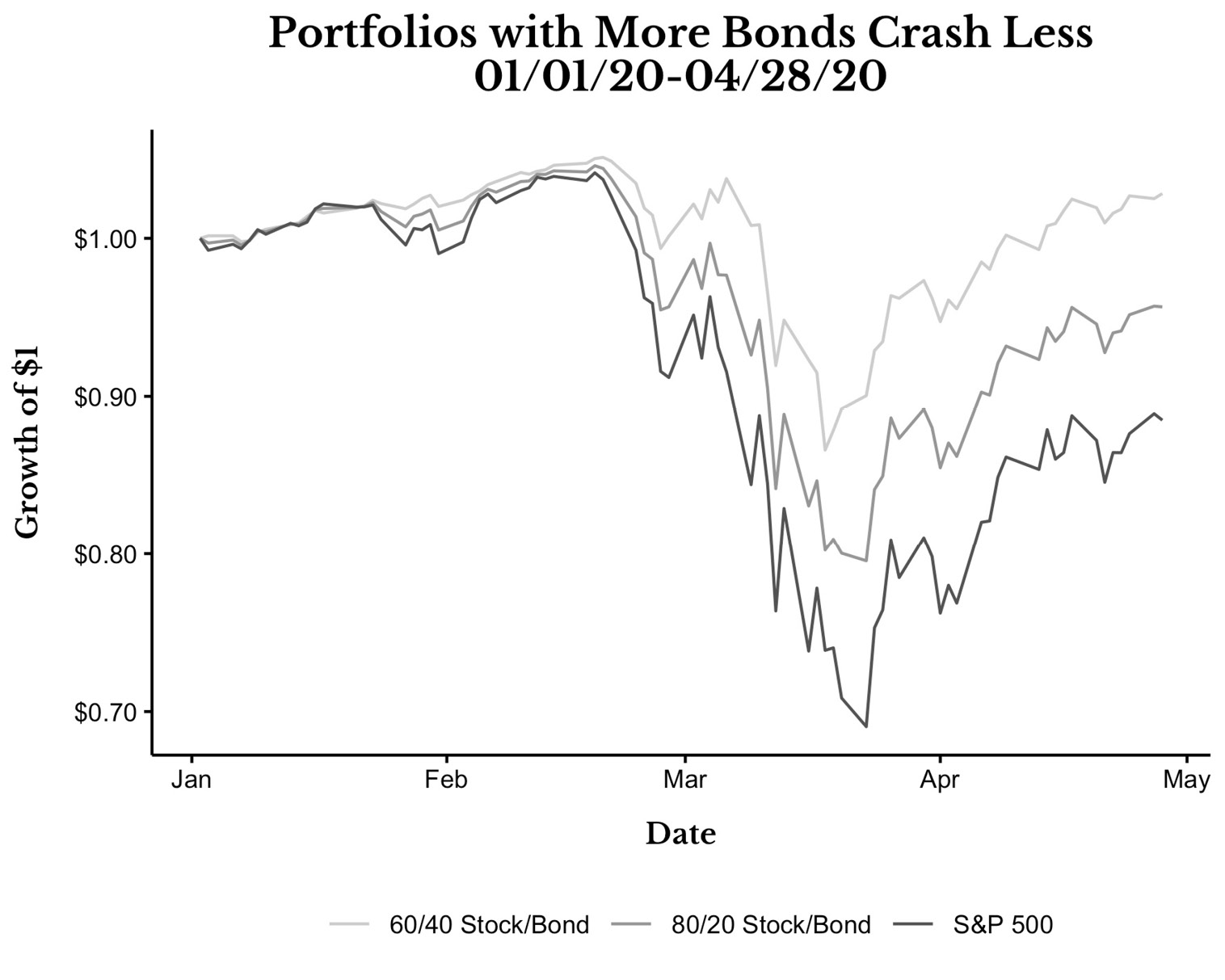
In this instance, the 60/40 and 80/20 portfolios both declined less than the S&P 500 only portfolio during March 2020.
More importantly, those investors that had bond exposure and rebalanced during the crash saw an even bigger benefit during the recovery that followed. For example, I was lucky enough to rebalance my portfolio—I sold some bonds and bought stocks—on March 23, 2020, the exact day the market bottomed. Yes, this timing was complete luck, but the fact that I owned bonds and was able to sell some of them to rebalance into stocks was not luck.
The one major downside to owning bonds is that their returns tend to be much lower than stocks and most other risk assets. This is especially true when yields are low, as they were from 2008–2020. In this kind of environment bond returns may be near zero or negative going forward after taking into account inflation.
How Can You Buy Bonds?
You can choose to buy individual bonds directly, but I recommend buying them through bond index funds or ETFs because it’s much easier.
Though there has been a debate in the past about whether there is a material difference in performance between individual bonds and bond funds, there isn’t. Cliff Asness, founder of AQR Capital Management, thoroughly debunked this notion in the Financial Analysts Journal in 2014.68
Regardless of how you buy your bonds, they can play an important role in your portfolio beyond providing growth. As the old saying goes:
“We buy stocks so we can eat well, but we buy bonds so we can sleep well.”
Bonds Summary
· Average compounded annual return: 2%–4% (can approach 0% in a low-rate environment).
· Pros: Lower volatility. Good for rebalancing. Safety of principal.
· Cons: Low returns, especially after inflation. Not great for income in a low-yield environment.
Investment Property
Outside of the realm of stocks and bonds, one of the next most popular income-producing assets is an investment in property. Owning an investment property can be great because you can use it yourself, and it can also earn you extra income if you rent it out to others when you are not using it.
Why You Should/Shouldn’t Buy Investment Property
If you manage your property correctly, you will have other people (rent-paying guests) helping you to pay off the mortgage while you enjoy the long-term price appreciation on the property. Additionally, if you were able to borrow money when acquiring the property, your return can be a bit magnified due to the leverage. When borrowing to buy investment property, leverage boosts your exposure to the price changes of your property.
For example, if you put down $100,000 for a $500,000 property, that means that you would have borrowed the remaining $400,000. Now let’s assume that the property increases in value to $600,000 after a year. If you sell the property and pay off the loan you will have about $200,000 left instead of your original $100,000. Because of the leverage, the 20% increase in the price of the home allows you to earn a 100% return ($100,000 became $200,000).
If this sounds too good to be true, it’s because it is. You have to remember that leverage can also work against you if prices fall. For example, if the price of your home fell from $500,000 to $400,000 and you sold the house, your equity would be completely wiped out. A 20% decline in the value of the property led to a 100% decline in your investment.
Since major price crashes in real estate tend to be rare, leverage usually provides a positive financial benefit to real estate investors.
Despite the many financial upsides to owning an investment property, it also requires far more work than many other assets that you can set and forget.
A property investment requires the ability to deal with people (the renters), list the property on a rental site and make it look appealing to prospective guests, provide ongoing maintenance, and much more. While doing all of this, you also have to deal with the added stress of having another liability on your balance sheet.
When this goes right, owning an investment property can be wonderful, especially when you have borrowed most of the money to finance the purchase. However, when things go wrong, like they did in 2020 with pandemic-induced travel restrictions, they can go really wrong. As many Airbnb entrepreneurs learned the hard way, investment properties aren’t always so easy.
While the returns on investment properties can be much higher than stocks or bonds, these returns also require far more work to earn them.
Lastly, buying individual investment properties is similar to buying individual stocks in that they aren’t diversified. When you buy an investment property you take on all the specific risks to that property. The real estate market can be booming yet you could get a bad result if your property has too many underlying issues and costs.
Given that most investors are not likely to own enough investment properties to be diversified, single property risk is an issue.
Nevertheless, if you are someone that wants to have more control over their investments and like the tangibility of real estate, then you should consider an investment in property as a part of your portfolio.
How Do You Buy Investment Properties?
The best way to buy investment properties is through a real estate agent or by negotiating directly with the sellers themselves. The process can be rather involved, so I recommend doing thorough research before going down this route.
Investment Property Summary
· Average compounded annual return: 12%–15% (dependent on local rental conditions).
· Pros: Higher returns than other more traditional asset classes, especially when using leverage.
· Cons: Managing the property and tenants can be a headache. Hard to diversify.
Real Estate Investment Trusts (REITs)
If you like the idea of owning real estate, but hate the idea of managing it yourself, then the real estate investment trust (REIT) might be right for you. A REIT is a business that owns and manages real estate properties and pays out the income from those properties to its owners.
In fact, REITs are legally required to pay out a minimum of 90% of their taxable income as dividends to their shareholders. This requirement makes REITs one of the most reliable income-producing assets.
However, not all REITs are the same. There are residential REITs that can own apartment buildings, student housing, manufactured homes, and single-family homes; and commercial REITs that can own office buildings, warehouses, retail spaces, and other commercial properties.
In addition, REITs can be offered as publicly traded, private, or publicly non-traded.
· Publicly traded REITs: Trade on a stock exchange like any other public company and are available to all investors.
1. Anyone who owns a broad stock index fund already has some exposure to publicly traded REITs, so buying additional REITs is only necessary if you want to increase your exposure to real estate.
2. Instead of buying individual publicly traded REITs, there are publicly traded REIT index funds – which invest across a basket of REITs – that you can buy instead.
· Private REITs: Not traded on a stock exchange and only available to accredited investors (people with a net worth >$1 million or annual income >$200,000 for the last three years).
1. Requires a broker, which may result in high fees.
2. Less regulatory oversight.
3. Less liquid due to longer required holding period.
4. May generate higher returns than public market offerings.
· Publicly non-traded REITs: Not traded on a stock exchange, but available to all public investors through crowdsourcing.
1. More regulatory oversight than private REITs.
2. Minimum investment requirements.
3. Less liquid due to longer required holding period.
4. May generate higher returns than public market offerings.
Though I have only ever invested in publicly traded REIT ETFs, real estate crowdsourcing firms are a non-traded alternative that could offer higher long-term returns.
Why You Should/Shouldn’t Invest in REITs
No matter how you decide to invest in REITs, they generally have stock-like returns (or better) with a somewhat low correlation (0.5–0.7) to stocks during good times. This means that REITs can do well when stocks aren’t doing well.
However, like most other risky assets, publicly traded REITs tend to sell off during stock market crashes. Therefore, don’t expect diversification benefits from REITs on the downside.
How Do You Invest in REITs?
As mentioned above, you can either invest in publicly traded REITs available through any brokerage platform, or go to a crowdsourced site to buy publicly non-traded or private REITs. I personally lean towards publicly traded REITs simply because they are more liquid (i.e., easier to buy/sell), but there can be benefits to looking at publicly non-traded or private options where you get to pick which specific properties you invest in.
REITs Summary
· Average compounded annual return: 10%–12%.
· Pros: Real estate exposure that you don’t have to manage. Less correlated with stocks during good times.
· Cons: Volatility greater than or equal to stocks. Less liquidity for non-traded REITs. Highly correlated with stocks and other risk assets during stock market crashes.
Farmland
Outside of real estate, farmland is another great income-producing asset that has been a major source of wealth throughout history.
Why You Should/Shouldn’t Invest in Farmland
Today, one of the best reasons to invest in farmland is its low correlation with stock and bond returns. After all, farm income tends to be uncorrelated with what is happening in financial markets.
In addition, farmland has lower volatility than stocks because the value of land doesn’t change much over time. Since the productivity of land is more stable than the productivity of businesses from year to year, you can see why farmland has lower overall volatility when compared to stocks.
In addition, farmland also provides inflation protection because it tends to rise in value alongside broader price trends. Because of its specific risk profile (i.e., low volatility with decent returns), farmland is unlikely to go to zero, unlike an individual stock or bond. Of course, the effects of climate change may alter this in the future.
What kind of returns can you expect from farmland? According to Jay Girotto in an interview with Ted Seides, farmland is modeled to return in the “high single digits” with roughly half of the return coming from farm yields and half coming from land appreciation.69
How Do You Invest in Farmland?
While buying individual farmland is no small undertaking, the most common way for investors to own farmland is through a publicly traded REIT or a crowdsourced solution. The crowdsourced solution can be nice because you have more control over which farmland properties you specifically invest in.
The downside of crowdsourced solutions is that they are only typically available to accredited investors (people with a net worth >$1 million or annual income >$200,000 for the last three years). In addition, the fees for these crowdsourced platforms can be higher than with other public investments.
I don’t think these fees are predatory given the amount of work that goes into structuring these deals, but if you hate the idea of fees, this is something to keep in mind.
Farmland Summary
· Average compounded annual return: 7%–9%.
· Pros: Lower correlation with stocks and other financial assets. Good inflation hedge. Lower downside potential (land less likely to “go to zero” than other assets).
· Cons: Less liquidity (harder to buy and sell). Higher fees. Requires “accredited investor” status to participate in crowdsourced solution.
Small Businesses/Franchise/Angel Investing
If farmland isn’t for you, maybe you should consider owning a small business or part of a small business. This is where angel investing and small business investing come in.
However, before you embark on this journey you have to decide whether you will operate the business or just provide investment capital and expertise.
Owner + Operator
If you want to be an owner + operator of a small business or franchise, just remember that as much work as you think it will take, it will likely take more.
Brent Beshore, an expert on small business investing, once tweeted that the operator’s manual to run a Subway restaurant is 800 pages long. Imagine trying to run a $50m manufacturer.70
I don’t mention Brent’s comments to discourage you from starting a small business, only to provide a realistic expectation for how much work they require. Owning and operating a small business can generate much higher returns than many of the other income-producing assets on this list, but you have to work for them.
Owner Only
Assuming you don’t want to go down the operator route, being an angel investor or passive owner of a small business can earn you very outsized returns. In fact, according to multiple studies, the expected annual return on angel investments is in the 20%–25% range.71
However, these returns aren’t without a very large skew. An Angel Capital Association study found that just one in nine angel investments (11%) yielded a positive return.72 This goes to show that though some small businesses may become the next Apple, most never make it too far out of the garage.
As Sam Altman, famed investor and President of YCombinator, once wrote:
“It’s common to make more money from your single best angel investment than all the rest put together. The consequence of this is that the real risk is missing out on that outstanding investment, and not failing to get your money back (or, as some people ask for, a guaranteed 2x) on all of your other companies.”73
This is why small business investing can be so tough, yet also so rewarding.
However, before you decide to go all-in, you should know that small business investing can be a huge time commitment. This is why Tucker Max gave up on angel investing and why he thinks most people shouldn’t even start. Max’s argument is quite clear—if you want access to the best angel investments with big, outsized returns, then you have to be deeply embedded in that community.74
Research on this topic supports Max’s claim, finding that time spent on due diligence, experience, and participation were all positively correlated with an angel investor’s long-term returns.75
How Do You Invest in Small Businesses?
You can’t do angel/small business investing as a side hustle and expect big results. While some crowdsourcing platforms allow retail investors to invest in small businesses (with other opportunities for accredited investors), it is highly unlikely they are going to have early access to the next big thing.
I don’t say this to discourage you, but to reiterate that the most successful small business investors commit more than just capital to this pursuit. If you want to be a small business investor, keep in mind that a larger lifestyle change may be warranted in order to see significant results.
Small Business Summary
· Average compounded annual return: 20%–25%, but expect lots of losers.
· Pros: Can have extremely outsized returns. The more involved you are, the more future opportunities you will see.
· Cons: Huge time commitment. Lots of failures can be discouraging.
Royalties
If you aren’t a fan of small business, maybe you need to invest in something with a bit more… culture. This is where royalties come in. Royalties are payments made for the ongoing use of a particular asset, usually a copyrighted work. There are websites where you can buy and sell the royalties to music, film, and trademarks and earn income from their use.
Why You Should/Shouldn’t Invest in Royalties
Royalties can be a good investment because they generate steady income that is uncorrelated with financial markets.
For example, Jay-Z and Alicia Keys’ “Empire State of Mind” earned $32,733 in royalties over a 12-month period. On RoyaltyExchange.com, 10 years’ worth of this song’s royalties were sold for $190,500.
If we assume that the annual royalties ($32,733) remain unchanged going forward, then the owner of those royalties will earn 11.2% per year on their $190,500 purchase over the next decade.
Of course, no one knows whether the royalties for this song will increase, stay the same, or decrease over the next 10 years. That is a matter of musical tastes and how they will change year to year.
This is one of the risks (and benefits) of royalty investing. Culture changes and things that were once in fashion can go out of fashion and vice versa.
However, RoyaltyExchange has a metric called Dollar Age that they use to try and quantify how long something might stay in fashion.
For example, if two different songs both earned $10,000 in royalties last year, but one of the songs was released in 1950 and the other was released in 2019, then the song released in 1950 has the higher (older) Dollar Age and will probably be a better long-term investment.
Why?
The song from 1950 has 70 years of demonstrated earnings compared to only one year of demonstrated earnings for the song from 2019. Though the song from 2019 may be a passing fad, the song from 1950 is an undeniable classic.
This concept, more formally known as the Lindy Effect, states that something’s popularity in the future is proportional to how long it has been around in the past.
The Lindy Effect explains why people in the year 2220 are more likely to listen to Mozart than to Metallica. Though Metallica probably has more worldwide listeners today than Mozart, I am not sure this will be true in two centuries.
Lastly, the other downside to investing in royalties is the potentially high fees charged to sellers. Typically sellers have to pay a percentage of the final sale price after an auction closes and this percentage fee can be a sizeable chunk. So, unless you plan on investing only in royalties (and doing it at scale), then royalty investing might not be right for you.
How Do You Invest in Royalties?
The most common way for your typical investor to purchase royalties is to use an online platform that matches buyers and sellers. Though you can also buy royalties through private deals, online is probably the easier way to go.
Royalties Summary
· Average compounded annual return: 5%–20%76
· Pros: Uncorrelated to traditional financial assets. Generally steady income.
· Cons: High seller fees. Tastes can change unexpectedly and impact income.
Your Own Products
Last, but not least, one of the best income-producing assets you can invest in is your own products. Unlike all of the other assets on this list, creating products (digital or otherwise) allows for far more control than most other asset classes.
Since you are the 100% owner of your products, you can set the price, and, thus, determine their returns (at least in theory). Products include things like books, information guides, online courses, and many others.
Why You Should/Shouldn’t Invest in Your Own Products
I know quite a few people who have managed to earn five to six figures from selling their products online. More importantly, if you already have an audience via social media, an email list, or website, selling products is one way to monetize that audience.
And even if you don’t have one of these distribution channels, it’s never been easier to sell products online thanks to platforms like Shopify and Gumroad, and online payment processors.
The hard part about products as investments is that they require lots of work upfront with no guarantee of a payout. There is a long road to monetization.
However, once you get one successful product under your belt, it is much easier to expand your branding and sell other things as well.
For example, I have seen my income on my blog, OfDollarsAndData.com, grow beyond small affiliate partnerships to include ad sales along with more freelancing opportunities. It took years of blogging before I started earning any significant amount of money, but now new opportunities are always popping up.
How to Invest in Your Own Products
If you want to invest in your own products, you have to build them. Whether that means starting a website for a blog or creating your own Shopify store, creating a product takes lots of time and effort.
Your Own Product(s) Summary
· Average compounded annual return: Highly variable. Distribution is fat-tailed (i.e., most products return little, but some go big).
· Pros: Full ownership. Personal satisfaction. Can create a valuable brand.
· Cons: Very labor intensive. No guarantee of payoff.
What About Gold, Crypto, Art, Etc?
A handful of asset classes did not make the above list for the simple reason that they don’t produce income. Gold, cryptocurrency, commodities, art, and wine have no reliable income stream associated with their ownership, so I have not included them in my list of income-producing assets.
Of course, this does not mean that you can’t make money with these assets. What it does mean is that their valuations are based solely on perception—what someone else is willing to pay for them. Without underlying cash flows, perception is everything.
It’s different for income-producing assets, though. While perception does play a role in how these assets are priced, cash flows should anchor their valuations, at least in theory.
For this reason, the bulk of my investments (90%) are in income-producing assets, with the remaining 10% spread out among non-income-producing assets such as art and various cryptocurrencies.
Final Summary
Here is a summary table of the information covered in this chapter, for better comparison purposes.
|
Asset Class |
Annual Compounded Return |
Pros |
Cons |
|
Stocks |
8%–10% |
High historic returns. Easy to own and trade. Low maintenance. |
High volatility. Valuations can change quickly. |
|
Bonds |
2%–4% |
Low volatility. Good for rebalancing. Safety of principal. |
Low returns, especially after inflation. Low income in low-yield environment. |
|
Investment Property |
12%–15% |
Higher returns (especially when you include leverage). |
Managing the property can be a headache. Hard to diversify. |
|
REITs |
10%–12% |
Real estate exposure that you don't have to manage. |
Volatility greater than or equal to stocks. Crashes when other risk assets do. |
|
Farmland |
7%–9% |
Lower correlation with traditional financial assets. Good inflation hedge. |
Less liquid + higher fees. Requires “accredited” status to participate. |
|
Small Businesses |
20%–25% |
Extremely outsized returns. More involvement creates more opportunity. |
Huge time commitment. Lots of failures can be discouraging. |
|
Royalties |
5%–20% |
Uncorrelated with traditional financial assets. Generally steady income. |
High seller fees. Tastes can change suddenly and impact income. |
|
Your Own Product(s) |
Variable |
Full ownership. Personal satisfaction. Can create a valuable brand. |
Very labor intensive. No guarantee of payoff. |
No matter what mix of income-producing assets you end up choosing, the optimal asset allocation is the one that will work best for you and your situation. Remember that two people can have very different investment strategies and they can both be right.
Now that we have talked about what you should invest in, we will spend some time discussing why you shouldn’t invest in individual stocks.
63 Colberg, Fran, “The Making of a Champion,” Black Belt (April 1975).
64 Seigel, Jeremy J., Stocks for the Long Run (New York, NY: McGraw-Hill, 2020).
65 Dimson, Elroy, Paul Marsh, and Mike Staunton, Triumph of the Optimists: 101 Years of Global Investment Returns (Princeton, NJ: Princeton University Press, 2009).
66 Biggs, Barton, Wealth, War and Wisdom (Oxford: John Wiley & Sons, 2009).
67 U.S. Department of the Treasury, Daily Treasury Yield Curve Rates (February 12, 2021).
68 Asness, Clifford S., “My Top 10 Peeves,” Financial Analysts Journal 70:1 (2014), 22–30.
69 Jay Girotto, interview with Ted Seides, Capital Allocators, podcast audio (October 13, 2019).
70 Beshore, Brent (@brentbeshore). 12 Dec 2018, 3:52 PM. Tweet.
71 Wiltbank, Robert, and Warren Boeker, “Returns To Angel Investors In Groups,” SSRN.com (November 1, 2007); and “Review of Research on the Historical Returns of the US Angel Market,” Right Side Capital Management, LLC (2010).
72 “Who are American Angels? Wharton and Angel Capital Association Study Changes Perceptions About the Investors Behind U.S. Startup Economy,” Angel Capital Association (November 27, 2017).
73 Altman, Sam, “Upside Risk,” SamAltman.com (March 25, 2013).
74 Max, Tucker, “Why I Stopped Angel Investing (and You Should Never Start),” Observer.com (August 11, 2015).
75 Wiltbank, Robert, and Warren Boeker, “Returns To Angel Investors in Groups,” SSRN.com (November 1, 2007).
76 Frankl-Duval, Mischa, and Lucy Harley-McKeown, “Investors in Search of Yield Turn to Music-Royalty Funds,” The Wall Street Journal (September 22, 2019).