
And why you’ll never get any more of it
PETER ATTIA, A physician and longevity expert, did a talk in 2017 on how to increase your lifespan where he proposed the following thought experiment to his audience:
“I would be willing to bet that not one of you, if you were offered every dollar of Warren Buffett’s fortune, would trade places with him right now… And I would also bet, by the way, that Buffett would be willing to be 20 years old again if he was broke.”104
Consider Attia’s trade for a moment. Imagine having Buffett’s wealth, fame, and status as the greatest investor on earth. You can go anywhere you please, meet anyone you want, and buy anything that can be sold. However, you’re now 87 years old (Buffett’s age at the time). Would you make the trade?
I know it sounds cryptic, but I bet you wouldn’t. You intuitively understand that, in some circumstances, time is worth far more than money. Because you can do some things with time that you could never do with money. In fact, with enough time you could even move mountains.
The Mountain Man
One of the most remarkable tales of perseverance in human history is one that you probably have never heard before.
The story starts in 1960 in the town of Gehlaur in the north-eastern part of India. Back then Gehlaur was isolated. In fact, it was so isolated that villagers would have to walk a treacherous 30-mile (50km) path around a mountain ridge if they ever needed supplies or medical treatment.
One such villager was walking along the ridge one day when she fell and injured herself. Her husband, Dashrath Manjhi, learned of her injuries and decided that the villagers of Gehlaur had walked around that mountain ridge for long enough. That same night Manjhi made a vow that he would carve a path through the mountain.
The next day, using only a hammer and chisel, Manjhi started cutting away at the ridge. When the local villagers heard about Manjhi’s mission they mocked him saying that it was impossible. However, he never gave up.
Over the course of the next 22 years Manjhi chipped away at the mountain by himself. Day by day and night by night. He eventually carved a path that was 360 feet long (110m), 30 feet wide (9.1 m), and 25 feet deep (7.6m).
In total he moved over 270,000 cubic feet of rock by the time he finished the path in the early 1980s, earning himself the nickname “Mountain Man.”
In creating this path, Manjhi was able to reduce the travel distance between the neighboring villages from 34 miles (55km) to 9 miles (15km). If you search “Dashrath Manjhi Passthrough” on Google Maps and go to Street View you can find the final product of his two decades of work. Sadly, Manjhi’s wife, who was the inspiration for his mission, died a few years before his work was complete.
Manjhi’s story illustrates the incredible unseen value that time has. Though Manjhi didn’t have the money to pay a construction crew to carve a path through that mountain, he did have the time.
This is why time is, and always will be, your most important asset. How you use that time in your 20s, 30s, and 40s will have huge impacts on your life in your 50s, 60s, and 70s. Unfortunately, it can take a while to learn this lesson. I know from personal experience.
I started this book by discussing my money worries as a young college graduate and I will end it by telling you about a goal I set for myself at around the same age. It wasn’t the goal that was important, but what pursuing that goal taught me about the value of time and how we judge our lives.
We Begin Our Lives as Growth Stocks and End Our Lives as Value Stocks
When I was 23 years old I told myself that I wanted to have half a million dollars by the age of 30. At that point in time I had less than $2,000 to my name. I chose $500,000 as my end goal after reading that Warren Buffett had $1 million by the time he was 30.
Note that Buffett had his $1 million back in 1960, which would be over $9 million today. Since I’m no Warren Buffett, I cut the goal in half and didn’t adjust it for inflation either.
When I turned 31 in November 2020 my net worth still hadn’t hit half a million dollars. I came up short. How short? Far more than I would have wanted.
But that’s not really important. As Dominic Toretto, Vin Diesel’s character in The Fast and the Furious, once said, “It don’t matter if you win by an inch or a mile. Winning’s winning.”
Well, losing is losing too, whether by one figure or six figures. But what makes this loss particularly unfortunate is that it occurred during a raging bull market. I can’t blame the S&P 500 for my shortcoming, only my own behavior.
Where did I slip up? Well, it wasn’t for a lack of trying. I had been working full-time for over eight years and had put in 10 hours a week on my blog for almost four years. Though I didn’t really monetize my blog until 2020, even if I had monetized it earlier I still would have come up short.
I also don’t think I can blame my spending either. Though I could have traveled and dined out less often (experiences I thoroughly enjoyed), those purchases wouldn’t have moved the needle enough to make a difference.
But you know what would have made a difference? Making better decisions earlier in my career. It wasn’t my money I should have optimized, but my time.
While many of my friends went off to big tech firms (Facebook, Amazon, Uber, etc.) and got that sweet, sweet equity compensation, I worked at the same consulting firm for six years where I was paid generously, but had no such upside. I didn’t realize how much I was missing out until it was a bit too late.
Now many of those friends are millionaires (or at least half millionaires) after exercising their stock options following the massive growth in tech valuations. Yes, it’s easy to write my friends off as lucky, which is partially true, but I also know that’s just an excuse. Because I had many opportunities to board the big tech boat as it passed by, but I declined them all.
And it’s not that I wanted to work in big tech specifically (I didn’t). It’s that I didn’t spend any significant time thinking about my career until I was 27 years old. Researchers at the Federal Reserve Bank of New York have shown that an individual’s income grows most rapidly in their first decade of work (ages 25–35).105 Given this information, you can see why my focus at age 23 should’ve been on my career and not my investment portfolio.
The reason for my mistake is that I incorrectly believed that money was a more important asset than time. I only later realized why this was false.
Though you can always earn more money, nothing can buy you more time.
As harsh as this sounds, I promise that I am not as hard on myself as it might seem. I know that I currently have a much better life than what I would’ve expected given my upbringing. In addition, I doubt I would have had the opportunity to write this book had I joined a big tech company. So there’s that.
But more importantly, I know that even if I had reached my $500,000 goal, it likely wouldn’t have changed my life in any meaningful way. I know this because affluence increases in steps, roughly by factors of 10. This is why someone who increases their wealth from $10,000 to $100,000 will probably see a bigger life impact than someone going from $200,000 to $300,000. So even if I had been a half millionaire at age 30, it wouldn’t have made a difference.
I understand how tone deaf it sounds when I complain about not reaching an exorbitant financial goal while many U.S. households struggle to make ends meet. But, as I explained in the prior chapter, wealth isn’t an absolute game, it’s a relative game.
For better or for worse, I will compare myself relative to my own aspirations and my own peer group just like you will. I wish it wasn’t like this, but it is. You can argue with me all you want—however, overwhelming research suggests otherwise.
For example, in the book The Happiness Curve, Jonathan Rauch describes how happiness in most people starts declining in the late 20s, bottoms at age 50, and then increases after that. When plotted, lifetime happiness ends up looking like a U-curve (or a little smile).
Visually, you can see this in empirical research from Hannes Schwandt, an economist and assistant professor at Northwestern University, when he plots the expected life satisfaction five years in the future by age and the actual life satisfaction at that same age.106
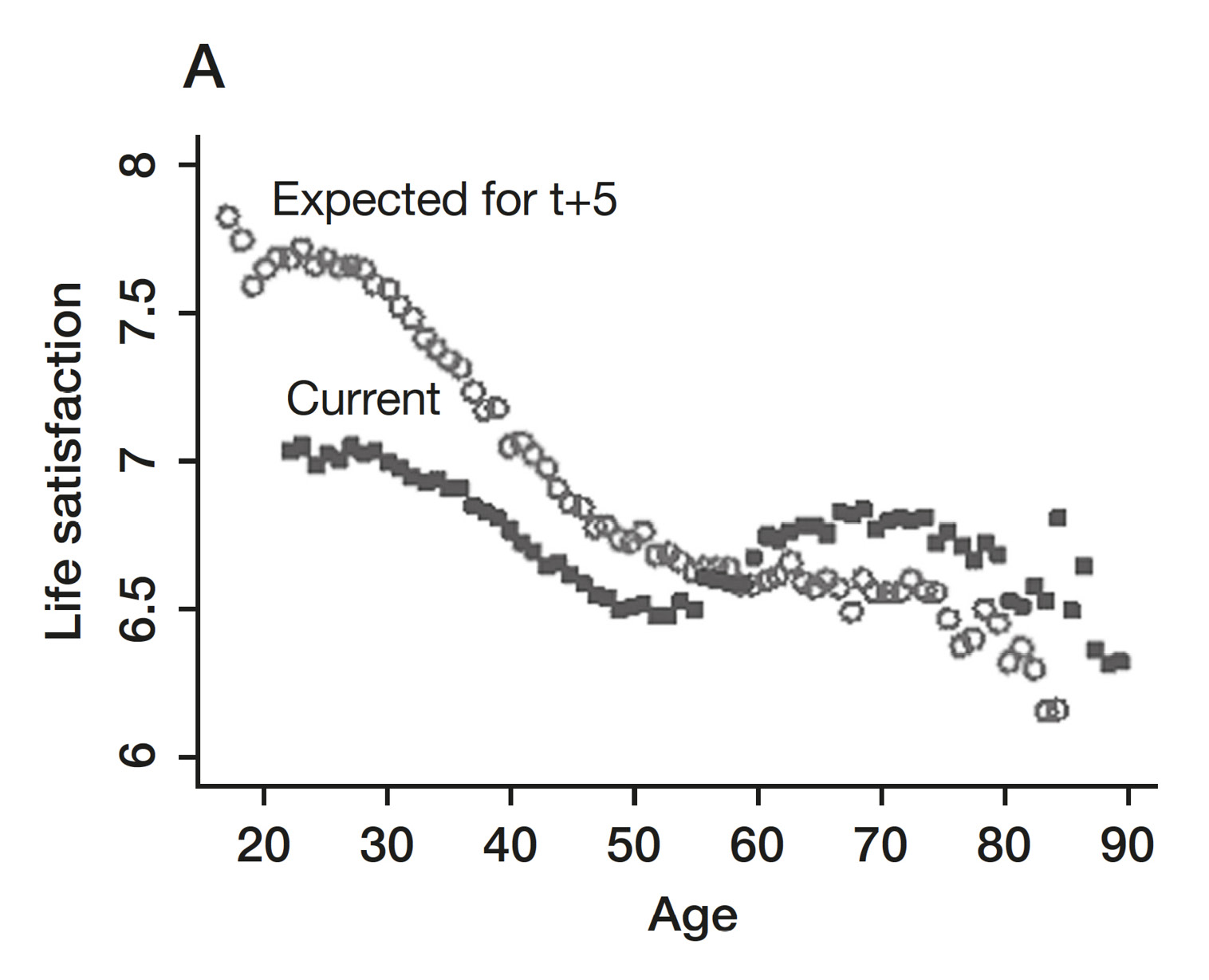
For example, 30-year-olds have a current life satisfaction of 7 (out of 10). And they expect their life satisfaction to be 7.7 (out of 10) five years from now, when they reach age 35. However, looking at the chart you can see that 35-year-olds have lower life satisfaction than 30-year-olds—their actual life satisfaction at age 35 is 6.8, rather than the 7.7 they predicted at age 30. On average, 30-year-olds expect a 0.7 point increase in their life satisfaction but are actually likely to experience a 0.2 point decrease over the next five years.
If you look just at the dots representing current life satisfaction, it forms the famous happiness U-curve from ages 25–70.
But why does happiness start to decline in the late 20s? Because, as people age, their lives usually fail to meet their high expectations. As Rauch states in The Happiness Curve:
“Young people consistently overestimate their future life satisfaction. They make a whopping forecasting error, as nonrandom as it could be—as if you lived in Seattle and expected sunshine every day… Young adults in their twenties overestimate their future life satisfaction by about 10 percent on average. Over time, however, excessive optimism diminishes… People are not becoming depressed. They are becoming, well, realistic.”107
This research explains why I was a bit bummed about not reaching the audacious financial goal I set for myself when I was 23 years old. However, it also explains why I was unlikely to reach that goal in the first place (i.e., it was probably too optimistic).
You may find this same pattern in your life too. You may have set your expectations rather high while you were young, only to be let down later. However, as the research suggests, this is completely normal.
What’s also normal is lowering your expectations over time, probably too much, to the point where, as you head into old age, pleasant surprises will provide you with additional happiness. We begin our lives as growth stocks, but end our lives as value stocks.
Growth stocks are priced similarly to how we think of ourselves when we are young. There are high expectations and high hopes for the future. However, many of us, like many growth stocks, eventually fail to meet these high expectations.
Over time we lower our expectations so much that we doubt that things could be better in the future. This is similar to how investors price value stocks. However, things usually go better than expected and we, like value stock investors, can experience pleasant upside surprises.
Of course, this is only on average. Everyone’s life is different with its own twists and turns. We all must make decisions based on what we know at the time. That’s all we can ever do.
Now that we have discussed the most important asset in your portfolio, let’s wrap up by bringing everything together with a game.
104 Petter Attia, “Reverse Engineered Approach to Human Longevity,” YouTube video, 1:15:37 (November 25, 2017).
105 Guvenen, Fatih, Fatih Karahan, Serdar Ozkan, and Jae Song, “What Do Data on Millions of US Workers Reveal About Life-cycle Earnings Dynamics?” FRB of New York Staff Report 710 (2015).
106 Schwandt, Hannes, “Human Wellbeing Follows a U-Shape over Age, and Unmet Aspirations Are the Cause,” British Politics and Policy at LSE (August 7, 2013).
107 Rauch, Jonathan, The Happiness Curve: Why Life Gets Better After 50 (New York, NY: Thomas Dunne Books, 2018).