
SMITHSONIAN NATIONAL MUSEUM OF NATURAL HISTORY
WASHINGTON, DC
JANUARY 20, 1981
11:47 P.M.
Ronald Reagan stares at the elephant in the room. It stands thirteen feet tall and measures twenty-seven feet from trunk to tail. It took thirteen four-inch bullets to kill him. The Fénykövi elephant, as the regal animal is known, is poised for battle in the center of this festive rotunda. Its flanks are draped in patriotic red, white, and blue bunting, making it the very symbol of the Republican Party.1
The other symbol of the party stands at a lectern bearing the official seal of the president of the United States of America. Ronald Wilson Reagan gazes out over the hundreds of supporters dressed in formal wear who have come to celebrate his inauguration. He wears white tie and tails. Nancy Reagan, on his right, is draped in a white satin sheath that took a team of dressmakers four weeks to embroider. Her full-length Maximilian mink coat and alligator handbag are backstage, watched over by the Secret Service. Unbeknownst to the crowd, Nancy’s outfit for the evening costs close to twenty-five thousand dollars.2
This is the Reagans’ ninth inaugural ball of the evening. And with midnight just moments away, they still have one more to go. The festivities began the previous night, at the inaugural gala organized by Frank Sinatra. Johnny Carson was the emcee, introducing performances by Sinatra and comedian Bob Hope, who poked fun at Reagan’s Hollywood days by joking that the new president “doesn’t know how to lie, exaggerate or cheat—he’s always had an agent for that!”
Tonight is even more glamorous. Priced at a steep five hundred dollars a ticket, seats are in such demand that the press will compare these formally dressed men and women to “drunken soccer fans” as they battle for their places at the table, where swordfish and chateaubriand are washed down with California wine and Kentucky bourbon. Hundreds of corporate titans have flown in from all over the country—so many, in fact, that their private jets have disrupted normal flight patterns at Washington’s National Airport this morning. As limousines clog the city streets, California socialite and longtime Nancy Reagan confidante Betsy Bloomingdale actually gets out of her stretch limo to direct traffic at Dupont Circle. A mink stole draped around her shoulders, the fifty-eight-year-old Bloomingdale doesn’t have time for gridlock.
Indeed, so many women have worn expensive furs to these inaugural balls that the press will report coatracks looking like “giant furry beasts.” The Washington caterer Ridgewells will serve four hundred thousand hors d’oeuvres at the various parties tonight. Lavish consumption is on display, something Jimmy and Rosalynn Carter would never have allowed.
Throughout the night, Ronald Reagan remains unfazed. “I want to thank all of you,” he tells the crowd at the Smithsonian. His voice is growing hoarse after hours of speeches, but though he is just weeks away from turning seventy years old, the new president shows no signs of fatigue. “Without you there wouldn’t be this successful inaugural.”
Four years ago, Jimmy Carter did not feel it appropriate to celebrate his inauguration with even one formal ball, let alone ten. No partying for the man from Plains. Instead, Carter’s 1977 inaugural address was somber, pointing out America’s limitations as a nation. The tone of pessimism and defeat that marked Carter’s first day in office came to define his entire presidency.
If Ronald Reagan’s first day in office is any indication of what is to come, the United States of America is in for a far more upbeat presidency. He and Nancy spent last night at Blair House, the official state residence where presidents-elect sleep the night before their inauguration.3 The first couple is rested and ready to take full advantage of the celebration.
The Reagans have been in Washington for a week, adapting to the capital’s routine after more than a year living out of suitcases on the campaign trail. With their new life comes intense public scrutiny. A litany of personal facts is finding their way into the media. Given his age, many wonder about Reagan’s health. Despite a medical history that includes a shattered femur suffered in a celebrity baseball game thirty years ago, the worst of his maladies right now is minor arthritis in his right thumb and chronic hay fever. He continues to work out each night, using a small exercise wheel before taking an evening shower. To some doctors, for a man about to enter his eighth decade, Reagan is an amazing physical specimen.
In fact, the biggest physical problem Reagan has right now might be his hair color. It has become a national mystery. The president says he does not dye his dark hair, but many are skeptical.4
There is no question that Ronald Reagan is a vain man. He is almost deaf in his right ear, thanks to standing too close to gunfire while filming a series of movies about the Secret Service in the late 1940s. But Reagan refuses to wear a hearing aid. Also, he can get testy at times. Some of his campaign staff whisper about Irish rages. In one case, candidate Reagan became so annoyed with his speechwriters that he took off his glasses and threw them against the wall. Such outbursts are rare, but Reagan’s closest confidants know that when they see his jaw tighten, it is time to back off.
The Reagans are often pedestrian in their tastes. Reagan’s favorite Christmas carol is “Silent Night,” and his favorite song is the “Battle Hymn of the Republic.” He enjoys lasagna and hamburgers for dinner, followed by a dessert of brownies or carrot cake. When watching television, the Reagans prefer The Waltons and Little House on the Prairie, shows built around wholesome values.
Ronald Reagan’s political hero is no longer Franklin Delano Roosevelt; he’s been replaced by former Republican president Calvin Coolidge. “He [Coolidge] wasn’t a man with flamboyant looks or style, but he got things done in a quiet way,” Reagan will write of the man whose picture he will hang in the White House Cabinet Room. “He came into office after World War I facing a mountain of war debt, but instead of raising taxes, he cut the tax rate and government revenues increased, permitting him to eliminate the wartime debt.”
This kind of analysis surprises observers in Washington, many of whom don’t think that Ronald Reagan has a first-rate intellect. He has long studied the nuances of domestic and foreign policy and possesses a stunning ability to recollect the most minute facts for the purposes of a speech or debate. But Reagan often hides his knowledge in order to present himself as a simple man of humble opinions, an image he believes makes him more appealing to regular voters.
Yet Reagan does not pander. While many politicians use religion as a campaign theme, the Reagans rarely go to church, and the new president does not make an issue out of his belief in God. However, his spirituality does influence him. On October 11, 1979, Reagan sends a letter to a writer for a pro-life Catholic magazine, in response to an article about Reagan’s views on abortion. “To answer your questions; I have a very deep belief that interrupting a pregnancy means the taking of a human life. In our Judeo-Christian tradition, this can only be justified as a matter of self-defense.”
But expressions like that for Ronald Reagan are rare. His experience in the secular state of California imbued him with a practical political strategy, so he mostly avoids the emotional issue of religion.
Nancy Reagan, on the other hand, avoids very little. She is known to blurt out her personal thoughts. When her son, Ron, attacks Jimmy Carter as having “the morals of a snake,” Nancy publicly defends her boy.5 In December, just one month after the election, she stands up against gun control by admitting to owning a “tiny little gun.” Coming shortly after the assassination of singer John Lennon, the comment strikes many as callous, and there is public outrage over the incident in liberal circles. Reacting to the heat, Nancy fires her newly appointed press secretary for not “protecting” her from the media backlash.
Sensing blood, the press descends on Nancy Reagan. Soon, she is being described as being cheap and self-absorbed. Tonight Show host Johnny Carson refers to her as the “Evita of Bel-Air,” comparing her to the imperious wife of Argentinian dictator Juan Perón, Eva, who longed for her own unlimited power.
In truth, Nancy Reagan is much more interested in high fashion and copies the dress and look of two icons: Jackie Kennedy and England’s Duchess of Windsor. To cover the cost of such extravagance, the incoming First Lady expects designers to give her clothing and handbags gratis—under the pretense that they are merely being “borrowed.”
* * *
Nancy Reagan wears one of those outfits now, a three-thousand-dollar dress, coat, and hat by the Cuban-born designer Adolfo, as she and Ronald Reagan are driven from Blair House to the White House shortly before noon on Inauguration Day. There they are met by a somber Jimmy Carter and his wife. Per tradition, the two men ride together in a limousine for the short two-mile journey to the Capitol building for Reagan’s swearing-in. They sit side by side in the backseat but do not speak. Instead, each man looks out the window, waving to the crowds on his side of the limo. “He was polite,” Reagan will later write of that stony ride. “He hardly said a word to me as we moved slowly toward the Capitol, and I think he hesitated to look me in the face.”
Nancy Reagan and Rosalynn Carter are driven in a separate limousine, directly behind their husbands. Rosalynn Carter wears a dull brown skirt and coat with a matching scarf knotted at her throat, making her look somewhat dowdy next to Nancy in her fire-engine red outfit. Today is the end of a dream for Rosalynn, who grew up poor, with a widowed mother who took in sewing to make ends meet. The differences between her and Nancy Reagan, with her debutante past and wealthy stepfather, are many. Rosalynn has attempted to be kind to Nancy throughout the transition, as her husband has been to Ronald Reagan, for the Carters well remember the courtesies extended to them by the Ford family as they were leaving office four years ago.
However, Nancy Reagan has managed to annoy Rosalynn. She has visited the White House several times, intent most of all on gauging the amount of closet space so that her enormous wardrobe will have a home. Mrs. Carter tolerated having Nancy snoop around, even though the White House was still very much the Carter home. But when Nancy requested that the Carter family move out a week before the inauguration, Rosalynn drew the line. Her answer was a firm no. The Carters remained the White House’s official residents until just a few minutes before noon on Inauguration Day.
Nevertheless, the transition of presidential power is well under way. The recorders who tally every moment of a president’s day stopped recording Carter’s activities one week ago. The Carters’ furniture is being removed from the White House, replaced by that of the Reagans. Leaving office is hard on Jimmy Carter, for he is exhausted from staying up all night in a last-minute attempt to free the hostages in Iran. It is an act for which he will receive little credit. The Iranian militants would not set the Americans free until Reagan was sworn in, due to Carter’s support for the shah of Iran.6
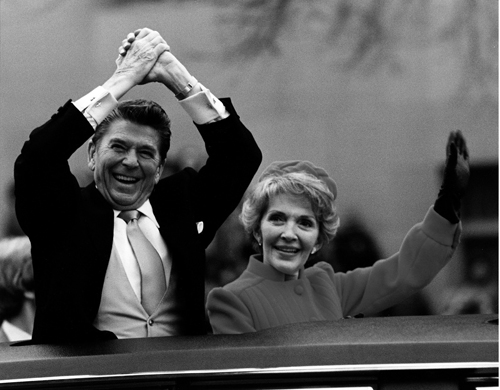
Ronald and Nancy wave from the presidential limousine on Inauguration Day, 1981.
The Reagans have brought California’s weather with them. Tens of thousands of people stand in shirtsleeves and light jackets on this fifty-six-degree day. The crowds stretch from the Capitol Building all the way down to the National Mall to the Lincoln Memorial. American flags and red, white, and blue bunting seem to be everywhere, imbuing this day with a jubilant sense of patriotism. Later on, once word gets out about the newly freed American hostages, yellow ribbons will be tied around every available tree, only heightening the festive atmosphere.7
But not everyone is joyful. There are many in the media who despise Ronald Reagan. Terms such as lightweight, B-movie actor, and even dangerous are sometimes used to denigrate him, both privately and in print. Ever since the failed Nixon administration, it has become commonplace in the media to disrespect Republican politicians.
Despite many preconceived notions and his familiar television persona, the press and most of the American people do not really know Ronald Reagan. He reveals himself to very few people. He is wary of the media and easily guided by the strong personality of Nancy, who has more influence than any of his advisers—though even she is often frustrated by his unwillingness to share his feelings. Ronald Reagan is passive in many ways. He can be stubborn when he chooses to put his foot down but often allows others to make decisions for him. He craves approval and applause, thanks to growing up the son of an alcoholic father who gave him little of either. He often appears disengaged, preferring the company of his own thoughts to time with family and friends. He is a loyal man but has put little effort into fatherhood, often ignoring his children when they need him most. Reagan’s world revolves around his conservative ideals and Nancy, with whom he has been known to get annoyed but rarely angry.
This is the real Ronald Reagan. But the public man is a far different story. To millions of his supporters, the new president is a benign father figure, a man who makes them proud to be Americans. And Reagan himself is proud of that image.
* * *
Vice President George H. W. Bush is sworn in first. The choice of running mate was a savvy move on Reagan’s part, as it was Bush who proved the toughest opponent during the 1980 Republican presidential primaries. A longtime party workhorse, the World War II bomber pilot has served as a congressman from Texas, envoy to China, director of Central Intelligence, and chairman of the Republican National Committee. At six foot two, he stands an inch taller than Reagan and shares a similar athletic background. His eyes are blue, and he adds styling mousse to his gray-brown hair to keep it in place. “Poppy,” as he was nicknamed in his youth, is known for being a gentle yet tough man.
Bush now steps into the thankless role of vice president with the same aplomb he brought to each of his previous jobs. Reagan has plans to make great use of George Bush and his many skills, in a manner normally unseen between a president and a vice president. Unlike Reagan, who can be privately aloof, Bush makes friends easily. He still keeps in touch with schoolmates and navy buddies he met decades ago. The same holds true in Washington, where Bush is deeply connected inside the Beltway. Reagan’s practical side will not allow him to let such qualities go to waste.
At the stroke of noon, the new vice president steps away from the lectern. It is now Ronald Wilson Reagan’s turn to take the oath of office. He wears a gray vest and tie under his black suit as he places his hand on a Bible that once belonged to his mother. A poised Nancy Reagan is at his side, resplendent in her matching red dress, coat, and hat. In what is a political first for Reagan, all four of his grown children are in attendance, standing with the other invited guests just behind him. And in what is a harbinger of things to come, none of the children is smiling.
A burst of sunshine plays on Reagan’s face as Chief Justice Warren Burger reads him the oath. “I, Ronald Wilson Reagan, do solemnly swear…”
The oath takes just forty seconds. Reagan relishes each phrase, repeating words for dramatic impact and adding a pause here and there for emphasis.
“May I congratulate you, sir,” the chief justice says, reaching over to shake Reagan’s hand. As a twenty-one-gun salute echoes throughout Washington, DC, Reagan kisses his wife on the cheek. They turn together and look out on the thousands of Americans who have traveled to Washington to be here with them in person to witness this historic moment. Tonight there will be fireworks in the nation’s capital. In New York, the Statue of Liberty will be bathed in spotlights. For the next twelve hours, Ronald and Nancy Reagan will be celebrated with a dazzling succession of parades, parties, and speeches. Then, finally, will come the humbling moment when Ronald Reagan steps into the Oval Office for the first time.8
As the most powerful man in the world, Ronald Reagan is preparing himself for the job by bringing in many political veterans. His chief of staff will be James Baker III, a fellow former Democrat who ran the presidential campaigns of Gerald Ford and then George H. W. Bush four years later. Reagan is willing to overlook that indiscretion for the sake of an organized and efficient White House. He likes that Baker is a no-nonsense manager known for his crisp analysis.
Reagan’s deputy chief of staff, and the second man in what will become known as the Troika, will be Michael Deaver, a member of his California gubernatorial staff and a man whom both Ronald and Nancy Reagan prize for his loyalty.
And the third man upon whom Reagan will rely for advice in times of doubt is Edwin Meese, an attorney who served as chief of staff during the California governorship. His official title is counselor to the president, but the forty-nine-year-old Meese’s actual job description goes much deeper than merely giving legal advice. He and Reagan know each other so well that Meese is often considered the president’s alter ego. However, knowing that such a role can carry too much clout in the White House, Meese has made it a point to meet with Baker in order to sharply define their roles. It is a balance of power that will be tested much sooner than either man is anticipating.
Thanks to his capable team, Reagan is confident that he can run the country. He is so eager to begin changing America that this afternoon he will sign his first executive order. With the swipe of a pen, he will order a federal hiring freeze. Within a week he will also lift price controls on oil and gasoline, simultaneously setting in motion his personal idea of a free-market economy and making his many donors from the gas and oil industry billions of dollars richer.9
“It is time for us to realize that we are too great a nation to limit ourselves to small dreams,” he preaches in his inaugural address. “We’re not, as some would have us believe, doomed to inevitable decline. I do not believe in a fate that will fall on us no matter what we do.
“I believe in a fate that will fall on us if we do nothing.”
* * *
The last inaugural ball winds down well past midnight, but at nine o’clock the same morning, Ronald Reagan sits down at the Resolute desk in the Oval Office and scans his list of scheduled meetings. He wears a coat and tie, as he will each and every time he sets foot in this legendary work space.
Reagan is firmly in command. Or so it seems to those around him.
Little does he know the violence that lies ahead.