
NATIONAL CATHEDRAL
WASHINGTON, DC
JUNE 11, 2004
NOON
The whole world is watching.
“We have lost a great president, a great American, and a great man, and I have lost a dear friend,” says Margaret Thatcher, her face appearing on the big-screen monitors arrayed throughout the cathedral. “In his lifetime, Ronald Reagan was such a cheerful and invigorating presence that it was easy to forget what daunting historic tasks he set himself.”
Nearly four thousand mourners fill this century-old Episcopal church, watching as Thatcher praises her dear friend on videotape. Among the crowd are the Reagan family, President George W. Bush, and former presidents Ford, Carter, Bush, and Clinton. Thatcher herself is in attendance, dressed all in black with an enormous hat, seated up front next to Mikhail Gorbachev. She is frail and hunched, her doctors having ordered her not to travel. Thatcher has ignored them out of respect for her longtime friend. However, fearing that she might embarrass herself by speaking live at the service, Baroness Thatcher videotaped her anticipated eulogy for Reagan months ago in London.
* * *
But not everyone is giving tribute. In Communist Cuba, the government greets Reagan’s death with a proclamation attacking his conservative policies, stating, “He should never have been born.”
And in America, the far left’s opinion of Reagan’s passing is summarized in Slate magazine: “He was as dumb as a stump,” writes Christopher Hitchens. “I could not believe that such a man had even been a poor governor of California in a bad year, let alone that such a smart country would put up with such an obvious phony and loon.”
* * *
Reagan’s funeral is the largest in America since that of President John F. Kennedy more than forty years ago. Security is extremely tight, as this is the first major national event since the September 11, 2001, terrorist attacks on New York City and Washington, DC. But once Reagan’s body rests inside the Capitol Rotunda and the doors are opened to the public on the evening of June 9, a wave of humanity arrives to pay their respects. Many have been waiting two days for this opportunity. All through the night and the next day, five thousand visitors per hour walk past the casket of Ronald Reagan.
On the morning of June 11, which President George W. Bush has declared a national day of mourning, the body of Ronald Reagan is delivered to the National Cathedral for the first state funeral since that of Lyndon Johnson in 1973.
With a global television audience looking on, and 3,700 mourners in the pews, Margaret Thatcher’s taped eulogy concludes.
“Ronald Reagan’s life was rich not only in public achievement, but also in private happiness. Indeed, his public achievements were rooted in his private happiness.
“The great turning point of his life was his meeting and marriage with Nancy. On that, we have the plain testimony of a loving and grateful husband. ‘Nancy came along and saved my soul.’”
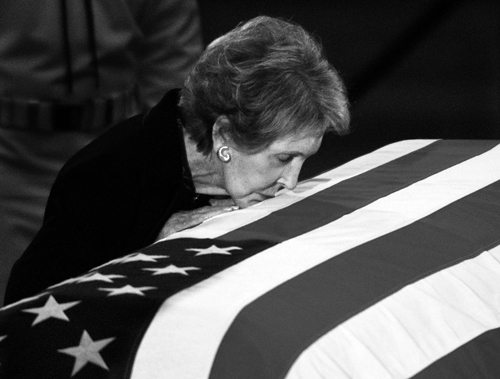
Nancy Reagan kisses her husband’s coffin.
Television cameras and all within view turn to Nancy. Despite the ten long years of Reagan’s decline, and the ample time she has had to prepare for this moment, she is consumed by grief.
“We share her grief today,” Thatcher continues. “For the final years of his life, Ronnie’s mind was clouded by illness.
“That cloud has now lifted. He is himself again, more himself than at any time on this Earth, for we may be sure that the Big Fellow upstairs never forgets those who remember him. And as the last journey of this faithful pilgrim took him beyond the sunset, and as heaven’s morning broke, I like to think, in the words of John Bunyan, that ‘all the trumpets sounded on the other side.’”
A subtle smile creases Thatcher’s lips on the screen as she ends her eulogy. As she does so, it is possible to see the slight facial paralysis from her recent series of strokes, and yet her voice is clear and deliberate.
“We here still move in twilight, but we have one beacon to guide us that Ronald Reagan never had.
“We have his example.”
* * *
That evening, the body of Ronald Reagan is buried in California. Margaret Thatcher is there. So is Jane Wyman. Nancy Reagan kisses the coffin and whispers, “I love you,” before stepping away for good. Nancy, clutching the American flag that once draped her husband’s coffin, dissolves in tears. She looks pale, fragile, and frightened.
Four F-18 fighter jets thunder overhead while a military band plays “America the Beautiful.” Symbolically, one of the jets suddenly peels away, leaving the other three to fly on in the “missing man” formation.
“I know in my heart that man is good,” the inscription on Reagan’s tombstone reads, “that what is right will always eventually triumph, and there is purpose and worth to each and every life.”