
CHAPTER 8
The great industrial revolution that transformed America after the Civil War triggered an inflationary boom that swamped the country with goods. When this expanded supply led to lower prices and a deflationary bust, it set the pattern for the rest of the nineteenth century, which experienced huge economic advances, punctuated by treacherous slumps. Lured by easy profits, legions of investors rushed into a promising new field and, when big gluts developed from overproduction, they found it impossible to recoup their investment. This was especially true in new industries where people lacked the caution bred by experience and thus expanded with reckless abandon. As a result, many businessmen began to distrust unfettered competition and flirted with newfangled notions of cooperation—pools, monopolies, and other marketing arrangements that might curb production and artificially buoy prices.
While all commodity prices fluctuated, crude-oil prices were especially volatile. Based on locating deep, unseen pools, the industry was an unpredictable, nerve-racking affair. Every time some lucky devil hit a gusher, this bonanza drove prices down. In 1865, producers began to torpedo wells by exploding gunpowder (later nitroglycerine) deep inside them to shake loose more oil, swelling the surplus. Within a year or two after the Civil War, the oil flood caused prices to skid to as low as $2.40 a barrel—they had traded as high as $12 in 1864—leading producers to contemplate forming a cartel to boost prices. The same predicament roiled refining, which had generated astronomical profits at first. As Rockefeller said tartly, the spoiled refiners “were disappointed if they did not make one hundred percent profit in a year—sometimes in six months.”1 With sky-high profits and ridiculously low start-up costs, the field had soon grown overcrowded. “In came the tinkers and the tailors and the boys who followed the plow, all eager for this large profit,” said Rockefeller.2
By the late 1860s, this dynamic produced a pervasive slump in the oil industry, keeping it depressed for the next five years. Low kerosene prices, a boon to consumers, were catastrophic for refiners, who saw the profit margin between crude- and refined-oil prices shrink to a vanishing point. Rampant speculation had so overbuilt the industry that total refining capacity in 1870 was triple the amount of crude oil being pumped. By then, Rockefeller estimated, 90 percent of all refineries were operating in the red. At this bleak impasse, a leading Cleveland rival, John H. Alexander, offered to sell his interest to William Rockefeller at ten cents on the dollar, as the entire industry faced ruin. Worse, the oil market wasn’t correcting itself according to the self-regulating mechanism dear to neoclassical economists. Producers and refiners didn’t shut down operations in the expected numbers, causing Rockefeller to doubt the workings of Adam Smith’s theoretical invisible hand: “So many wells were flowing that the price of oil kept falling, yet they went right on drilling.”3 The industry was trapped in a full-blown crisis of overproduction with no relief in sight.
Thus, in 1869, one year after his stellar railroad coup, Rockefeller feared that his wealth might be snatched away from him. As someone who tended toward optimism, “seeing opportunity in every disaster,” he studied the situation exhaustively instead of bemoaning his bad luck.4 He saw that his individual success as a refiner was now menaced by industrywide failure and that it therefore demanded a systemic solution. This was a momentous insight, pregnant with consequences. Instead of just tending to his own business, he began to conceive of the industry as a gigantic, interrelated mechanism and thought in terms of strategic alliances and long-term planning.
Rockefeller cited the years 1869 and 1870 as the start of his campaign to replace competition with cooperation in the industry. The culprit, he decided, was “the over-development of the refining industry,” which had created “ruinous competition.”5 If this fractious industry was to be made profitable and enduring, he would have to tame and discipline it. A trailblazer who improvised solutions without any guidance from economic texts, he began to envision a giant cartel that would reduce overcapacity, stabilize prices, and rationalize the industry. If Rockefeller first expounded this idea among refiners, he was anticipated by the very drillers who later railed at his machinations. During the Civil War, they had formed an Oil Creek Association to curtail production and lift prices, and on February 1, 1869, they again met in Oil City to create the Petroleum Producers’ Association to protect their interests.
To devise a comprehensive solution for the industry, Rockefeller again needed money: money to create economies of scale, money to build cash reserves to endure downturns, money to heighten efficiency. “And to buy in the many refineries that were a source of overproduction and confusion we needed a great deal of money.”6 The tricky part for Rockefeller and Flagler was how to supplement their capital without relinquishing control; the solution was to incorporate, which would enable them to sell shares to select outside investors. “I wish I’d had the brains to think of it,” said Rockefeller. “It was Henry M. Flagler.”7
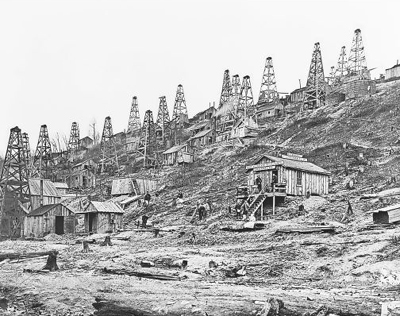
The chaotic, derrick-covered slopes of Oil Creek, Pennsylvania, in 1865. (Courtesy of the Drake Well Museum)
Luckily, many states had now passed laws permitting companies to incorporate. The one hitch—and it was a formidable one for Rockefeller—was that these firms couldn’t own property outside their state of incorporation; to finesse this restriction would require endless legal legerdemain. On January 10, 1870, the partnership of Rockefeller, Andrews and Flagler was abolished and replaced by a joint-stock firm called the Standard Oil Company (Ohio), with John D. Rockefeller as president, William Rockefeller as vice president, and Henry M. Flagler as secretary and treasurer. Besides echoing their Standard Works refinery, the name advertised the uniform quality of their kerosene at a time when consumers feared explosions from impurities. With $1 million in capital—$11 million in contemporary money—the new company became an instant landmark in business history, for “there was no other concern in the country organized with such a capital,” Rockefeller said.8 Already a mini-empire, Standard Oil controlled 10 percent of American petroleum refining, as well as a barrel-making plant, warehouses, shipping facilities, and a fleet of tank cars. From the outset, Rockefeller’s plans had a wide streak of megalomania. As he told Cleveland businessman John Prindle, “The Standard Oil Company will some day refine all the oil and make all the barrels.”9
Despite his lack of legal training, Henry M. Flagler drew up the act of incorporation. Nearly sixty years later, when this document was dredged up in a legal dispute, people were stunned by its simplicity. Instead of a fancy embossed paper, dripping with seals, one reporter described it as “a cheap looking legal paper, faded yellow and of evident poor material, granting the Standard Oil Company the right to engage in business.”10 This economical, no-nonsense approach appealed to investors, as did Rockefeller’s decision that the leading men would receive no salary but would profit solely from the appreciation of their shares and rising dividends—which Rockefeller thought a more potent stimulus to work.
Standard Oil started out in a modest suite of offices in a four-story building known as the Cushing Block on the Public Square. The office shared by Rockefeller and Flagler was somber and austere. Furnished with funereal dignity, it had a black leather couch and four black walnut chairs with elaborately carved backs and arms, plus a fireplace to provide warmth in winter. Rockefeller never allowed his office decor to flaunt the prosperity of his business, lest it arouse unwanted curiosity.
From the start, he owned more shares of Standard Oil than anybody else and exploited every opportunity to augment his stake. Of the original 10,000 shares, he took 2,667, while Flagler, Andrews, and William Rockefeller each took 1,333; Stephen Harkness took 1,334; and the former partners of Rockefeller, Andrews and Flagler divided another 1,000. The final 1,000 shares went to Oliver B. Jennings, William Rockefeller’s brother-in-law and the first outside investor. An adventurous figure, Jennings had gone to California during the gold rush and profited from selling supplies to prospectors.
Rich investors did not line up to invest in Standard Oil, among other reasons because it was an inauspicious time for new ventures. On September 24, 1869—the infamous Black Friday—Jay Gould and Jim Fisk’s scheme to corner the gold market by manipulating President Grant’s monetary policy collapsed, fomenting financial panic and ruining more than a dozen Wall Street houses. Beyond that, the speculative aura of the oil industry still deterred many reputable businessmen. Rockefeller never forgot how his scheme was savagely derided as a “rope of sand” or how sage businessmen told him that similar attempts to create a Great Lakes shipping cartel had misfired. “Either this experiment will result in a great success or a dismal failure,” one aging financier warned him.11 As Rockefeller recalled, it was “a course which older and more conservative business men shrank back from and regarded as reckless, almost to the point of insanity.” 12 Embittered by these skeptics and set to prove them wrong, Rockefeller managed to pay dividends of 105 percent on Standard Oil stock during the first year of operations despite one of the worst financial bloodbaths in the industry’s early history.
The man with the hypertrophied craving for order was about to impose his iron rule on this lawless, godless business. As Ida Tarbell described Rockefeller in 1870, he was “a brooding, cautious, secretive man, seeing all the possible dangers as well as all the possible opportunities in things, and he studied, as a player at chess, all the possible combinations, which might imperil his supremacy.”13 As he scanned the field of battle, the first target of opportunity lay close to home: the twenty-six rival Cleveland refiners. His strategy would be to subjugate one part of the battlefield, consolidate his forces, then move briskly on to the next conquest. His victory over the Cleveland refiners would be the first but also the most controversial campaign of his career.
For his admirers, 1872 was the annus mirabilis of John D. Rockefeller’s life, while for his critics it constituted the darkest chapter. The year revealed both his finest and most problematic qualities as a businessman: his visionary leadership, his courageous persistence, his capacity to think in strategic terms, but also his lust for domination, his messianic self-righteousness, and his contempt for those shortsighted mortals who made the mistake of standing in his way. What rivals saw as a naked power grab, Rockefeller regarded as a heroic act of salvation, nothing less than the rescue of the oil business.
The state of the kerosene trade had further deteriorated in 1871 as prices sagged another 25 percent. As competitors skidded into bankruptcy, Standard Oil declared a 40 percent dividend, with a small surplus to spare. Despite this, John D. Rockefeller sold off a small block of Standard Oil shares—the only time he ever lost heart momentarily—prompting brother William to lament, “Your anxiety to sell makes me feel uneasy.” 14 This discouragement was short-lived. In late 1871, Rockefeller engineered the covert acquisition of Bostwick and Tilford, New York’s premier oil buyers, who owned barges, lighters, and a large refinery at Hunter’s Point on the East River. A former Kentucky banker who had also dealt in cotton and grain and peddled Bibles, Jabez Abel Bostwick was a devout Baptist in the Rockefeller mold: “strict almost to sternness in his business dealings, preferring justice to sentiment,” as one contemporary said.15 The purchase of Bostwick’s firm gave Rockefeller a sophisticated purchasing agency at a critical moment. Oil prices were now being set on exchanges in western Pennsylvania, with powerful syndicates pushing aside the lone speculators who had once dominated trading. The move set a pattern of stealth that shadowed Rockefeller’s career: Renamed J. A. Bostwick and Company, the newly acquired firm brazenly feigned independence of Standard Oil while acting as its cat’s-paw.
On January 1, 1872, the Standard Oil executive committee, bracing for the tumultuous events ahead, boosted the firm’s capital from $1 million to $2.5 million and then to $3.5 million the next day.16 Among the new shareholders were several luminaries of Cleveland banking, including Truman P. Handy, Amasa Stone, and Stillman Witt. An intriguing new investor was Benjamin Brewster, a direct descendant of Elder Brewster of the Plymouth colony, who had made a fortune with Oliver Jennings during the California gold rush. It was a sign of Rockefeller’s exceptional self-confidence that he gathered strong executives and investors at this abysmal time, as if the depressed atmosphere only strengthened his resolve. “We were gathering information which confirmed us in the idea that to enlarge our own Standard Oil of Ohio and actually take into partners with us the refining interest would accomplish the protection of the oil industry as a whole.” 17 On January 1, 1872, the executive committee made its historic decision to purchase “certain refining properties in Cleveland and elsewhere.” 18 This seemingly innocuous resolution was the opening shot of a bloody skirmish that historians came to label the Cleveland Massacre.
The mayhem in Cleveland began when Rockefeller struck a clandestine and richly ironic deal with Tom Scott, the overlord of the Pennsylvania Railroad. As noted, the Pennsylvania had threatened to blot out Cleveland as a refining center, prompting Rockefeller to solidify his ties with the Erie and New York Central systems. Rockefeller had no personal love of Scott and later branded him “perhaps the most dominant, autocratic power that ever existed, before or since, in the railroad business of our country.” 19 Like many railroad executives, Scott had made his reputation during the Civil War by keeping railroad lines open between Washington and the North and winning appointment as an assistant secretary of war. A shrewd, dashing man with long, curling side-whiskers, he wore an enormous felt hat and exuded an aura of power. Of this master political manipulator, Wendell Phillips observed that “as he trailed his garments across the country the members of 20 legislatures rustled like dry leaves in a winter’s wind.”20 Though Andrew Carnegie was a protégé of Scott before going into the iron and steel business, the railroad executive didn’t appeal to the sanctimonious Rockefeller.
In business matters, however, Rockefeller stood ready to strike a deal with the devil himself. Since he dreaded an alliance between the Pennsylvania Railroad and Pittsburgh and Philadelphia refiners, he wanted to drive a wedge between them. “They went on their knees to [Scott] for rates,” Rockefeller said disparagingly of his rivals. “They reverenced the Pennsylvania Railroad administration; would do anything at their beck; would do anything to get in return help in the transportation of oil.” 21 So Rockefeller was receptive to an overture from Scott, which came unexpectedly from Peter H. Watson, an official of the rival Lake Shore Railroad and an intimate ally of Commodore Vanderbilt. As president of a Lake Shore branch that joined Cleveland to Oil Creek, Watson had a personal stake in advancing the fortunes of his largest customer, Standard Oil. When Standard Oil expanded its capital in January 1872, Watson quietly pocketed five hundred shares in another example of the growing back-scratching between Rockefeller and the railroads. It was probably through Watson that Commodore Vanderbilt discreetly invested $50,000 in Standard Oil that year.
On November 30, 1871, Watson met Rockefeller and Flagler at the Saint Nicholas Hotel in New York and presented an audacious scheme devised by Tom Scott, who proposed an alliance between the three most powerful railroads—the Pennsylvania, the New York Central, and the Erie—and a handful of refiners, notably Standard Oil. To implement this, Scott had obtained a special charter for a shell organization bearing the blandly misleading name of the South Improvement Company (SIC). After the Civil War, the venal Pennsylvania legislature had created dozens of such charters by special enactment. These improvement companies possessed such broad, vague powers— including the right to hold stock in companies outside Pennsylvania—that some economic historians have christened them the first real holding companies. The Pennsylvania Railroad had a special purchase on these instruments of corporate power and sometimes traded them for favors.
Under the terms of the proposed pact, the railroads would sharply raise freight rates for all refiners, but refiners in the SIC would receive such substantial rebates—up to 50 percent off crude- and refined-oil shipments—that their competitive edge over rivals would widen dramatically. In the most deadly innovation, the SIC members would also receive “drawbacks” on shipments made by rival refiners—that is, the railroads would give the SIC members rebates for every barrel shipped by other refiners. On shipments from western Pennsylvania to Cleveland, for instance, Standard Oil would receive a forty-cent rebate on every barrel it shipped, plus another forty cents for every barrel shipped to Cleveland by competitors! One Rockefeller biographer has called the drawback “an instrument of competitive cruelty unparalleled in industry.”22 Through another provision, Standard Oil and other SIC refiners would receive comprehensive information about all oil shipped by their competitors— invaluable in underpricing them. The SIC members were naturally sworn to secrecy about the inner workings of this alarming scheme. All in all, it was an astonishing piece of knavery, grand-scale collusion such as American industry had never witnessed.
Though Rockefeller and his coconspirators contended that all refiners were impartially invited to join the SIC, the group excluded refiners from Oil Creek and New York, and Standard Oil was indisputably the driving force. Of the 2,000 shares issued, over one-fourth were held by John and William Rockefeller and Henry Flagler; counting Jabez Bostwick and Oliver H. Payne (soon to be a leader of Standard Oil), the Rockefeller group controlled 900 of 2,000 shares. The SIC president was Peter H. Watson, who held 100 shares and was also now a Standard Oil shareholder, thus ensuring the supremacy of Cleveland refiners over the Pittsburgh and Philadelphia members of the group.
Why did the nation’s leading railroads offer Rockefeller and his confederates terms so generous as to render them all but omnipotent in oil refining? How did they benefit from this association? First, the railroads had engaged in such fierce, internecine price wars that freight rates had fallen sharply. No less than the oil producers, they needed somebody to arbitrate their disputes and save them from their own cutthroat tactics. The cornerstone of the SIC was a provision that Standard Oil would act as “evener” for the three railroads and ensure that each received a predetermined share of the oil traffic: Forty-five percent of the oil shipped by SIC members would travel over the Pennsylvania Railroad, 27.5 percent on the Erie, and 27.5 percent on the New York Central. Unless the railroads had greater control over the oil business, Rockefeller knew, they “could not make the divisions of business necessary so as to prevent rate-cutting.”23 Rockefeller would become their official umpire and try to govern their pool in a fair, disinterested fashion. As mentioned, the railroads also had an economic interest in greater consolidation among refiners to streamline their own operations. One other factor tempted the railroads to come to terms with Rockefeller: In a farsighted tactical maneuver, he had begun to accumulate hundreds of tank cars, which would be in perpetually short supply.
The SIC—soon exposed as an infamous conspiracy—was a masterful move in Rockefeller’s quest for industrial domination. Both refiners and railroads were struggling with excess capacity and suicidal price wars. Rockefeller’s supreme insight was that he could solve the oil industry’s problems by solving the railroads’ problems at the same time, creating a double cartel in oil and rails. One of Rockefeller’s strengths in bargaining situations was that he figured out what he wanted and what the other party wanted and then crafted mutually advantageous terms. Instead of ruining the railroads, Rockefeller tried to help them prosper, albeit in a way that fortified his own position.
Later on, trying to distance himself from the SIC fiasco, Rockefeller scoffed at charges that he had been the ringleader. All along, he insisted, he knew it would fail and had gone along simply as a tactical maneuver. “We acceded to it because [Tom Scott] and the Philadelphia and Pittsburgh men, we hoped, would be helpful to us ultimately. We were willing to go with them as far as the plan could be used; so that when it failed, we would be in a position to say, ‘Now try our plan.’ ”24 Rockefeller’s plan was to unify the industry under Standard Oil. By his own admission, he had not opposed the SIC on ethical grounds but solely as a practical matter, convinced it wouldn’t apply the needed discipline to member refiners. The scheme never bothered his conscience. “It was right,” an unreconstructed Rockefeller said in later years. “I knew it as a matter of conscience. It was right before me and my God. If I had to do it tomorrow I would do it again the same way—do it a hundred times.”25 Even in hindsight, he couldn’t tolerate doubts about his career but had to present it as one long, triumphal march, sanctified by his religion.
Rockefeller’s assertion that he reluctantly followed the railroads’ lead conveniently distorted the truth. Far from coyly stepping aside and waiting for a misbegotten scheme to founder, he took a leading role and promoted it zealously. We know this because of several remarkable letters he wrote to Cettie from New York, where for several agitated weeks he remained closeted with railroad officials. He knew the negotiations were controversial, since he advised Cettie on November 30, 1871, “A man who succeeds in life must sometimes go against the current.”26 While these letters confirm that he didn’t originate the scheme, they show that he soon warmed to the project, declaring on December 1, “indeed the project grows on me.”27 When Watson secured Commodore Vanderbilt’s blessing, Rockefeller was positively jubilant, and he emerged as natural leader of the group, particularly as others grew skittish. In late January 1872, trapped in New York, he wanted to return to Cleveland but told Cettie that “our men would not hear to it, they are nervous, and lean on me. . . . I feel like a caged lion and would roar if it would do any good.”28 Obviously, had Rockefeller wished the SIC to collapse, he would have renounced a leadership position and returned to Cleveland sooner.
The small batch of letters he wrote to Cettie at this time—among his few early, surviving letters to her—betray a surprisingly romantic sensibility, as if seven years of marriage hadn’t dimmed his ardor. Amid negotiations, he told her, “I dreamed last night of the girl Celestia Spelman and awoke to realize she was my ‘Laura.’ ”29 Repeatedly, Rockefeller complained about how lonely he felt in New York—“like a wandering Jew”—and reiterated his yearning to be at home. Far from being beguiled by the money, fashion, and power of New York, his Baptist soul recoiled from it. “The world is full of Sham, Flattery, and Deceptions,” he wrote, “and home is a haven of rest and freedom.”30 At this stage, Rockefeller still found his wealth wonderful and slightly unreal, telling Cettie that “we have been so prospered and placed in independent circumstances, it seems a fabulous dream but I assure you it is a solid and comforting fact—how different our condition from the multitudes, let us be thankful.”31 Perhaps this financial independence emboldened Rockefeller to undertake the risky SIC scheme, confident that it wouldn’t endanger his family’s security. And lest Cettie worry about his risky new venture, he reminded her, “You know we are independently rich outside investments in oil—but I believe my oil stock the very best.”32
By late January 1872, as the conspirators drew up and signed the last contracts while trying to preserve total secrecy, rumors of an impending jump in freight rates began to filter through western Pennsylvania. On February 22, the Petroleum Centre Recordalluded darkly to a “rumored scheme of gigantic combination among certain railroads and refiners to control the purchase and shipment of crude and refined oil from this region.” 33 Definite word of the plot didn’t leak out until days later, when the local freight agent for the Lake Shore Railroad rushed off to visit a dying son and left in charge a subordinate who didn’t realize that the new freight rates hadn’t yet been enacted. Oblivious to the historic impact he would have, this minor functionary promulgated the staggering rates for outside refiners decreed by the SIC. On February 26, the stunned residents of Oil Creek read in the morning papers that freight rates had doubled overnight for everyone—everyone, that is, except a privileged group of refiners in Cleveland, Pittsburgh, and Philadelphia who belonged to a shadowy entity called the South Improvement Company.
For the horror-struck refiners in Titusville or Oil City, this wasn’t simply a new competitive threat: It was a death warrant, and they stopped work and poured into the streets, denouncing the action in strident tones. “The oil region was afire with all sorts of wild stories,” recalled Rockefeller. “There were meetings of protest, of bitter denunciation.”34 On the night of February 27, three thousand people stormed into the Titusville Opera House, waving banners that stated, “Down with the conspirators,” “No compromise,” and “Don’t give up the ship!” while Rockefeller and his cabal were denounced as “the Monster” and “the Forty Thieves.”35 Perhaps the most impassioned speaker was a short young refiner named John D. Archbold, the hard-drinking, poker-playing son of a circuit preacher. Though Peter Watson had tried to inveigle him into the SIC, Archbold had indignantly refused and now told the crowd, “We have been approached by the great anaconda, but do not desire to yield.”36 The Oil Creek refiners believed they had a God-given right to market the oil drilled in their backyards and Archbold—destined, ironically, to succeed Rockefeller at the Standard Oil helm—endorsed this view. “We believe this is the natural point for the business,” he told the cheering audience. “This is the last desperate struggle of desperate men.”37 After he was elected secretary of a new Petroleum Producers’ Union, the group agreed to retaliate by starving out the SIC conspirators, selling crude oil only to refiners along Oil Creek.
Amid this frenzied hue and cry, the local citizenry created a small army of roving protesters who moved from town to town, organizing torchlight rallies and picking up new adherents. On the night of March 1, refiners and producers jammed another tumultuous meeting at the opera house in Oil City. One featured speaker was a young producer, Lewis Emery, Jr., who supported a proposal by Archbold to cut existing production by 30 percent and suspend new drilling for thirty days. With this speech, the indefatigable Emery launched a crusade against Standard Oil that would persist for decades. By the end of the meeting, a thousand men stood ready to besiege the state capitol in Harrisburg and demand relief from the SIC.
In this warlike atmosphere, the Oil City Derrick printed a daily blacklist of the conspirators—Peter Watson, followed by Rockefeller and six other directors— in a black-bordered box on the front page. Each day, a new inflammatory caption was supplied, such as “Behold ‘The Anaconda’ in all his hideous deformity.”38 It was in the context of such hysterical emotion that the world first learned the name of John D. Rockefeller. As if his foes already intuited his special power, he was singled out for abuse, one newspaper crowning him “the Mephistopheles of Cleveland.”39 As people learned of his central place in the SIC, vandals defaced the blue Standard Oil barrels with skulls and crossbones. Two Standard employees on Oil Creek, Joseph Seep and Daniel O’Day, barricaded themselves in their offices and fended off marauding mobs. “It was a tense situation,” said Seep. “Some of my friends were actually afraid to be seen talking with me in the street. There were threats of violence. Captain John W. Jones, a big producer, wanted the people to burn the Standard Oil Company’s tanks.”40 Saboteurs attacked the railroads, raiding oil cars and spilling their contents on the ground or tearing tracks apart. A local lawyer, Samuel C. T. Dodd, said that if the protests had continued indefinitely, “there would not have been one mile of railroad track left in the County of Venango. The people had come to that pitch of desperation.”41 Few residents of Oil Creek imagined that their dread adversary was a clean-cut, churchgoing young man. This nightmarish period left an especially deep imprint upon a flabbergasted fourteen-year-old schoolgirl named Ida Tarbell. “I remember a night when my father came home with a grim look on his face and told how he with scores of other producers had signed a pledge not to sell to the Cleveland ogre that also had profited from the scheme—a new name, that of the Standard Oil Company, replacing the name South Improvement Company in popular contempt.”42
Far from giving Rockefeller pause, the vandalism only confirmed his view of Oil Creek as a netherworld of rogues and adventurers who needed to be ruled by stronger men. He was always quick to impugn the motives of enemies while regarding his own as somehow beyond reproach. “The Standard Oil Company were a very orderly body, and these producers were a rabble of wild, excitable men, waiting for a war-cry to rush into the arena with a suitable noise.”43 Clad in the armor of self-righteousness, Rockefeller felt no need to explain his actions and turned away reporters at his door. After Flagler told reporters that Standard Oil’s opponents were “a few soreheads,” Rockefeller advised silence, and Flagler desisted from further comment. With threats being made on his life, Rockefeller posted a special detail of policemen outside both office and home and kept a revolver by his bed for good measure.
Only in the twilight of life did Rockefeller realize how poorly his taciturnity had served him in business battles. This was especially true during the SIC furor, which evolved into a political and public-relations battle. By remaining silent in the face of criticism, he thought he would seem confident and secure in his integrity—in fact, he seemed guilty and arrogantly evasive. Throughout his career, Rockefeller endured abuse with so much equanimity that Flagler once shook his head and said, “John, you have a hide like a rhinoceros!”44 He had an early Christian’s fierce defiance of critics, his boyhood with Big Bill having also taught him to disregard the malicious gossip of neighbors. He had a great general’s ability to focus on his goals and brush aside obstacles as petty distractions. “You can abuse me, you can strike me,” Rockefeller said, “so long as you let me have my own way.”45
As always, the greater the tumult, the cooler Rockefeller became, and a strange calm settled over him when his colleagues were most disconcerted. When pushed, he always stood his ground. The SIC episode showed that Rockefeller was now developing exalted faith in his own judgment. Like all revolutionaries, he saw himself as an instrument of higher purpose, endowed with a visionary faith. He knew that his actions would at first be resisted and misunderstood by the myopic crowd, but he believed that the force and truth of his ideas would triumph in the end.
When the petroleum producers embargoed the sale of crude oil to members of the SIC, Rockefeller professed a lack of concern. Yet this impromptu coalition, welded together by the overwhelming threat, responded with impressive unity, creating sixteen districts, each with a separate committee, that blocked oil sales to the cabal. By moonlight, the producers patrolled Oil Creek on horseback to guard against any clandestine drilling that would subvert their cause. Ida Tarbell recalled how her father had proudly spurned a lucrative contract to ship oil to the conspirators for a tempting $4.50 a barrel. In the meantime, the producers busied themselves on the legislative front, lobbying in Harrisburg to annul the SIC charter and submitting to the U.S. Congress a scroll-like, ninety-three-foot petition, demanding an industrywide investigation. While Rockefeller dodged the press, producers handed out thirty thousand copies of a polemical tract about the SIC so that “enemies of freedom of trade may be known and shunned by the honest men.”46
The uproar didn’t weaken Rockefeller’s resolve, yet for all his bravado the boycott exacted a grave toll on his operations. Ninety percent of his employees had to be temporarily laid off, leaving a skeletal staff at his refineries. In letters to Cettie in March 1872, he tried to reconcile his actions with his conscience as he became the bugbear of Oil Creek. As he wrote from New York on March 15,
It is easy to write newspaper articles but we have other business. We will do right and not be troubled about what the papers say. By and by when all are through possibly we may briefly respond (though it is not our policy) and leave future events in the business to demonstrate our intentions and plans were just & warranted—I want to act perfectly conscientiously and fearlessly in the matter and feel confident of good results. . . . I am hopeful [we] can get at least a good fraction of the N.Y. Refiners to join at an early day.47
Further, he wrote on March 21, “I am still persevering and hopeful, remember our side have not yet been in the papers. We know a few things the people generally may not, at all events we know our own intentions, and they are right and only so—but please saynothing only you know your husband will stand by and stick to the right.”48
The conspirators committed a major strategic gaffe by omitting the New York refiners, who therefore sided with the Oil Creek refiners to pressure the railroads. To head their liaison committee, the New York refiners appointed a suave thirty-two-year-old named Henry H. Rogers, who had the flashing eyes and confident air of a young buccaneer. When Rogers met Tom Scott at a Philadelphia hotel on March 18, the railroad chief struck a conciliatory note, admitting that the SIC contract was unfair and offering a similar deal to the excluded New York and Pennsylvania refiners. While Scott was backpedaling and angling for peace, Rockefeller remained uncompromising, telling his wife on March 22, “I assure you it is not my pleasure to remain all this time but a stern sense of duty to this cause—I haven’t any idea giving up ship or letting go my hold.”49
On March 25, the Rogers group held a climactic meeting with wavering railroad officials at the Erie Railroad’s offices in the ornate Grand Opera House in New York. While they conferred, an edgy Rockefeller and Peter Watson tapped at the door and asked to enter. While Watson was admitted, Rockefeller was barred and so anxiously paced the corridor. For the first time, Rockefeller appeared in The New York Times—his name was misspelled as “Rockafellow”— with the reporter noting that, excluded from the talks, Rockefeller had finally gone off looking “pretty blue.”50The meeting dealt a blow to Rockefeller and Watson, for the railroads agreed to abrogate the SIC contract, end rebates and drawbacks, and institute uniform rates for all shippers. The serpent had been killed in the egg.
Far sooner than Rockefeller, the railroads had foreseen the political reaction and inevitable defeat. In this era before railroad regulation and antitrust legislation, the SIC contract didn’t violate any obvious laws, only a universal sense of fair play. In early April, the Pennsylvania legislature canceled the SIC charter, while a congressional committee, a month later, branded the scheme the “most gigantic and daring conspiracy” ever to confront a free nation.51 On April 8, 1872, Rockefeller capitulated and wired the oil producers that all contracts between the SIC and the railroads were now void. In his own defense, he added: “I state unqualifiedly that reports circulated in the Oil Region and elsewhere, that this company, or any member of it, threatened to depress oil, are false.” 52 On this last count, Rockefeller was probably sincere, for what he envisioned was less a conspiracy against producers than against consumers, a united effort to ensure steady prices and adequate returns on investment. Till the very end, he saw the producers’ outrage against him as shot through with envy and hypocrisy. “The producers . . . held to the view that rebates were wrong unless the rebates were given to them.”53
It always mystified Rockefeller that people made such a fuss about a phantom company. “There never was a shipment made or a rebate or drawback collected under the South Improvement plan.”54 Though only a latent threat, the scheme acquired lasting infamy for two reasons. First, Rockefeller’s fiercest critics regarded it as a dress rehearsal for the grand pageant, the place where he first revealed his master plan, to be implemented in a thousand secret, disguised, and indirect ways. The second reason for all the later attention was that during the brief interval while the SIC was alive, Rockefeller engineered his most important coup: the swift, relentless consolidation of Cleveland’s refineries, which gave him irresistible momentum. The threat of the SIC, critics alleged, was the invisible club that he had waved over Cleveland refiners, forcing them to submit to his domination. Between February 17 and March 28, 1872—between the first rumors of the SIC and the time it was scuttled— Rockefeller swallowed up twenty-two of his twenty-six Cleveland competitors. During one forty-eight-hour period alone in early March, he bought six refineries. As one refiner, John H. Alexander, recalled:
There was a pressure brought to bear upon my mind, and upon almost all citizens of Cleveland engaged in the oil business, to the effect that unless we went into the South Improvement Company we were virtually killed as refiners; that if we did not sell out we should be crushed out. . . . It was said that they had a contract with railroads by which they could run us into the ground if they pleased.55
Since petroleum output promised to shatter records in 1872 and keep prices depressed, Rockefeller increasingly sought to own as large a portion of the industry as possible and didn’t think he could afford to wait for the marketplace to prune out weak refiners by attrition. “We had to do it in self-defense,” he said of the Cleveland takeovers. “The oil business was in confusion and daily growing worse.”56
Another businessman might have started with small, vulnerable firms, building on easy victories, but Rockefeller started at the top, believing that if he could crack his strongest competitor first, it would have a tremendous psychological impact. His major rival was Clark, Payne and Company, and conquering it would give Rockefeller special satisfaction, since he had already tangled with one partner, James Clark, early in his career and now coveted his Star Works refinery. The firm also had social cachet in Cleveland: Colonel Oliver H. Payne— a Yale graduate, honored Civil War colonel, and son of politician Henry B. Payne—was extremely wealthy, lived in a Euclid Avenue mansion, and was descended from one of Cleveland’s founding families. (Commodore Matthew Perry, who opened Japan to commerce in 1854, came from a collateral branch of the family.) With an erect, military bearing and coolly formal manner, many people found the young bachelor pompous—Flagler dubbed him the “kin of God”—but Rockefeller always paid tribute to Payne as a stalwart and capable ally.57
One afternoon in December 1871, Rockefeller asked Payne, an old high-school friend, to meet in the parlor of a downtown Cleveland bank, where Rockefeller outlined his plan for a vast, efficient industry under Standard Oil control. Telling Payne about the impending capital increase at Standard Oil, he asked point-blank: “If we can agree upon values and terms do you want to come in?”58 As Clark, Payne’s largest shareholder, Colonel Payne gave his qualified approval, but he first wanted to examine Rockefeller’s books before selling his company. That afternoon, when he surveyed Standard Oil’s ledgers, he was thunderstruck by the profits. Whether he was impressed by the railroad rebates or operating efficiencies is unclear, but he eagerly told Rockefeller, “Let us get the appraisers in and see what the plant is worth.”59 After conferring with his partners, Payne consented to a $400,000 price for his refinery. Rockefeller knew that he was overpaying but couldn’t resist a deal that would certify his position as the world’s largest oil refiner at age thirty-one. Though Rockefeller stipulated that James Clark wasn’t welcome at Standard Oil, he wanted to enlist Payne’s services, and the latter soon shared a private office with Rockefeller and Flagler. James Clark later told Ida Tarbell that he sold out only from fear of the SIC contract. As Tarbell’s assistant reported, “He stated positively that Clark, Payne & Co. did not sell out before the organization of the SIC, and that it never considered selling out to the Standard before the SIC was formed.” 60
According to later lawsuits, whenever Rockefeller suggested that rivals sell out to him, the SIC formed the burden of his appeal. Some old Cleveland refiners told Ida Tarbell that his menacing pitch ran as follows:
You see, this scheme is bound to work. It means an absolute control by us of the oil business. There is no chance for anyone outside. But we are going to give everybody a chance to come in. You are to turn over your refinery to my appraisers, and I will give you Standard Oil Company stock or cash, as you prefer, for the value we put upon it. I advise you to take the stock. It will be for your good.61
Stung by charges that he had used coercion, Rockefeller retorted that he had been unfailingly friendly and courteous and never mentioned the SIC in negotiations. Strictly speaking, this was probably true, yet the timing of his twenty-two takeovers suggests strongly that the SIC was a prime factor and that the deals were done amid an atmosphere of well-timed intimidation. Several rivals alleged that Rockefeller orchestrated a chorus of terrifying rumors about his secret pact with the railroads. Even without direct threats, he knew his opponents’ imaginations would embellish these stories and conjure up a conspiracy of unfathomable scope. “In 1872 reports were purposely circulated to the effect that the Standard Oil Company had entered into agreement with the railroads, whereby no outside refiner could bring crude oil to Cleveland and manufacture it without a loss,” rival refiner J. W. Fawcett of Fawcett and Critchley told Ida Tarbell in the early 1900s.62 “The refiners became prematurely alarmed at the reports of destructive competition and inability to secure crude oil, and they ‘fell over each other’ in their haste to sell out. Had they refused to be coerced, and had they held together, there never would have been a Standard Oil Company.”63 When Fawcett received word that he should see the Standard people and dispose of his refinery, he was told “that they had the railroads in a position where they would control the rates, that Fawcett and Critchley would not ever ship any oil.”64 Like many vanquished refiners, Fawcett surrendered his independence and went to work for Rockefeller, but he never quite overcame his anger at what he perceived as clever manipulation.
Rockefeller dismissed as “an absolute lie” the idea that he had stampeded the Cleveland refiners and added that the vast majority of those refiners “were already crushed by the competition which had been steadily increasing up to this time” and were staring at ruin. For these concerns, he insisted, the opportunity to sell to Standard Oil and receive stock instead “was a godsend to them all.”65 Had Standard Oil not existed, he asserted, these refiners would simply have gone bust—which would have been true for many of them. Even Fawcett conceded that “at that time some of the refineries were not making money, and they were the first to ‘run to cover’ and sell out. Eventually all sold out.”66
Several Cleveland refiners claimed that Rockefeller had directly threatened them. John H. Heisel of Bishop and Heisel remembered telling Rockefeller that he wasn’t afraid of him, to which Rockefeller supposedly replied, “You may not be afraid to have your hand cut off, but your body will suffer.” 67 Yet it seems unlikely that Rockefeller menaced refiners quite so blatantly, for it didn’t serve his purpose. Gifted with persuasive powers, he preferred to talk earnestly to his rivals, tapping them on the knee or gesturing with his hands, reasoning with them in richly cadenced, evangelical tones. As one refiner said of Rockefeller, “He knew that he and his associates had a better knowledge of the business and a better command of the business than anyone else. You never saw anyone so confident as he was.” 68 He liked to make Standard Oil sound like a philanthropic agency or an angel of mercy, come to succor downtrodden refiners. “We will take your burdens,” he remembered telling his weaker brethren in 1872. “We will utilize your ability; we will give you representation; we will unite together and build a substantial structure on the basis of cooperation.” 69 Similarly, he said, “We here at Cleveland are at a disadvantage. Something should be done for our mutual protection. We think this plan of ours is a good scheme. Think it over. We would be glad to consider it with you if you are so inclined.”70 Sure of his mission, Rockefeller castigated those who resisted Standard Oil as foolish and shortsighted. “Take Standard Oil stock,” he urged them, “and your family will never know want.”71
If these refiners had surrendered faith in oil’s future, as Rockefeller insisted, then why did they so bitterly resent him after he bought them out? Why didn’t they regard him as their savior, as he preferred to depict himself? The answer lies partly in the way their plants were appraised. Since so many refiners were losing money, Rockefeller paid them a pittance, typically a quarter of their original construction costs, or what the plants might have fetched if auctioned off for scrap; he paid little or nothing for goodwill—that is, the intangible value in a thriving business, such as its reputation or client list. If this was hard policy, it wasn’t necessarily unscrupulous. “No, the good will of a business which is losing money is not worth much,” said Rockefeller.72 “If there isn’t work for an oil refinery to do, it has less value than ships or railroad property, which can be used on other lines.”73 One must also remember that Rockefeller was in the anomalous position of taking over many plants not to operate them but to shut them down and eliminate excess capacity. He ridiculed many of the refineries he bought as “old junk, fit only for the scrap heap.”74 Rockefeller probably paid a fair price for many antiquated plants, but it was a bitter pill for the ruined owners to swallow. And he operated in a climate of fear that gave his rivals little choice in the matter.
Whether by chance or design, Rockefeller’s 1872 business papers have vanished, and we aren’t privy to his thoughts during these crucial negotiations. But in later years, he was a fair-minded bargainer who often paid too much for properties that served a strategic purpose. Indeed, his papers are chock-full of lamentations about how he overpaid for properties. When it came to mergers, he didn’t fight for the last dollar and tried to conclude matters cordially. Since he aimed to convert competitors into members of his cartel and often retained the original owners, he preferred not to resort to naked intimidation. As Rockefeller said, he and his colleagues weren’t “so short-sighted as to antagonize these very men whom they were eager to have come into a close and profitable relationship with them.”75 He wasn’t a sadistic man, but he had a hard, unyielding sense of purpose that brooked no opposition. If Rockefeller expressed elation, it was behind closed doors. According to one legend, after taking over a new refinery, he would rush into the office, perform a little dance, and shout joyously to Sam Andrews, “We’ve got another refinery, Sam. One more in the fold!”76
During the Cleveland Massacre, Rockefeller savored a feeling of sweet revenge against some of the older men who had patronized him when he started in business. This was especially true of his negotiations with Alexander, Scofield and Company, whose partners included his original boss, Isaac L. Hewitt. After Hewitt came to Rockefeller’s Euclid Avenue home to plead for mercy, they strolled down Euclid Avenue together, and Rockefeller told him his firm would never survive if it didn’t sell out to Standard Oil. He made a cryptic statement to Hewitt that entered into Rockefeller folklore: “I have ways of making money you know nothing about.”77 Disconcerted by such assertions, Hewitt and his partners finally sold out for $65,000, though they believed their business was worth $150,000. Rockefeller felt merciful toward Hewitt and loaned him money to buy Standard stock, but he despised Hewitt’s partner, John H. Alexander, who still viewed him, he thought, as Hewitt’s former clerk. As Rockefeller put it, “How could this conceited Englishman ever conceive it possible that a young man who had been a bookkeeper, and especially at a time when he had been employed in an oil refinery, be qualified to lead in a movement of this kind?” 78
Rockefeller’s most controversial purchase—and one that resulted in a bitter lawsuit—was the takeover of Hanna, Baslington and Company. When Robert Hanna, the uncle of Mark Hanna, was summoned to Standard Oil’s offices, he bluntly told Rockefeller that he wouldn’t sell. In response, Rockefeller sighed and wearily shrugged his shoulders, as if expressing regret that this benighted sinner hadn’t seen the light. “You will stand alone,” he warned Hanna. “Your firm can never make any more money in Cleveland. No use trying to do business in competition with the Standard Oil Company. If you do it will end in your being wiped out.”79 What seemed a barefaced threat to Hanna was later interpreted by Rockefeller as a timely warning and sincere advice.
Irate over the rebates enjoyed by Standard Oil, Hanna pleaded with executives of the Lake Shore Railroad to grant his refinery equal treatment. They defended Standard Oil’s freight rates as the privilege due to a big bulk shipper and promised to give Hanna the same rates if he delivered the same volume of oil— which he couldn’t. The railroads employed this as an all-purpose defensive tactic, since nobody could ever match Standard Oil’s voluminous shipments. In the end, Hanna accepted $45,000 for a refinery that he believed was worth $75,000.
It is interesting to note that Rockefeller perjured himself in an affidavit he submitted for the lawsuit brought jointly by William S. Scofield and Hanna, Baslington. Not only did he state that “but few persons who were stockholders in the Standard Oil Co. of Cleveland, Ohio were subscribers to stock in the South Improvement Company,” but he added that “P. H. Watson, Pres. of the South Improvement Co. . . . was not a stockholder in nor was he in any way connected with the Standard Oil Company.” 80 As mentioned, Standard Oil executives controlled almost 50 percent of the SIC shares and issued five hundred shares of Standard to Watson sub rosa in the January 1872 recapitalization. Although Rockefeller professed that he never lied under oath, the claim doesn’t bear up under close examination.
The oil wars of 1872 turned Cleveland society upside down. Many who had made easy fortunes in oil refining and built splendid mansions on Euclid Avenue found themselves bankrupt and forced to sell. Whether it was Rockefeller or the slumping oil market that forced them to sell their refineries at distress-sale prices, they chose to see Rockefeller as the author of their woes. It is likely that in many cases the marketplace would eventually have closed their unprofitable firms, but Rockefeller certainly speeded up the winnowing. Though several independent refiners held on for a few years, in most cases this merely postponed the day of reckoning. Ella Grant Wilson, a social chronicler of nineteenth-century Cleveland, recalled how her father, a partner in the refinery of Grant, Foote and Company, had befriended Rockefeller in various Baptist causes but refused to join Standard Oil, convinced it would fail. When it became impossible to compete with this leviathan, his refinery went bankrupt, and he surrendered his life savings. “Father went almost insane over this terrible upset to his business. He walked the house night and day. . . . [He] left his church and never entered a church afterward. His whole life was embittered by this experience.” 81 With so many losers in the struggle—and one shrewd, gigantic winner—it comes as no surprise to learn that John D. Rockefeller had made his first group of implacable enemies.
Nowadays, most people imagine that American businessmen have always favored free competition, at least in the abstract. But in the industrial boom after the Civil War, the most significant revolt against free-market capitalism came not from reformers or zealous ideologues but from businessmen who couldn’t control the maddening fluctuations in the marketplace. In an unregulated economy, they had to improvise the rules of the game as they went along. Pestered by overproduction in the early oil industry, Rockefeller tirelessly mocked those “academic enthusiasts” and “sentimentalists” who expected business to conform to their tidy competitive models. Like some of his contemporaries, he didn’t see how they could build vast, enduring industries in a volatile economy disrupted by recessions, deflation, and explosive boom-and-bust cycles, and he decided to subjugate markets instead of responding endlessly to their changing price signals. Thus, Rockefeller and other industrial captains conspired to kill competitive capitalism in favor of a new monopoly capitalism.
Economic historians often cite the exuberance of Gilded Age businessmen, their red-blooded faith in America’s future, without noting the constant uncertainty that lurked underneath. As Rockefeller’s story shows, many of the age’s most controversial business practices were forged in a desperate spirit of self-preservation. “It was forced upon us,” Rockefeller said of Standard Oil’s genesis. “We had to do it in self-defence. The oil business was in confusion and daily growing worse. Someone had to make a stand.” Though he foresaw the triumph of cooperation, its far-ranging ramifications weren’t yet clear to him. “This movement was the origin of the whole system of economic administration. It has revolutionized the way of doing business all over the world. The time was ripe for it. It had to come, though all we saw at the moment was the need to save ourselves from wasteful conditions.” Then he added, as if enunciating his economic credo: “The day of combination is here to stay. Individualism has gone, never to return”82
Of course, companies had colluded to restrain the open play of market forces before. In Europe, guilds and state monopolies were of ancient provenance, and even Adam Smith had noted the alacrity with which businessmen hatched conspiracies against consumers. In 1872, Standard Oil was just one of many companies whose leaders had daydreams of controlling prices and production throughout their industry. When the SIC scheme surfaced, one newspaper observed, “This great monopoly is one of many now forming to control the commercial products of this great nation,” and it referred to the western grain and livestock trades as analogous situations.83 As his own inspiration, Rockefeller cited Western Union, then busily buying up small telegraph lines, and the New York Central Railroad, which had consolidated its trunk line from the Atlantic seaboard to Chicago. During the 1870s, pools and rings flourished among salt, rope, and whiskey concerns.
It was only fitting that someone with Rockefeller’s personality and values should have questioned the canons of free-for-all capitalism. If the most creative and dynamic of economic systems, capitalism can also seem wasteful and inefficient to those who endure its rocky transitions and violent dislocations. By bringing forth superior methods, capitalism renders existing skills and equipment outmoded and thus fosters unceasing turmoil and change. Such a mutable system violated Rockefeller’s need for stability, order, and predictability. Indeed, the sober, thrifty Puritan identified by Max Weber as the prototypical capitalist was almost certain to feel distressed by this unstable economy, which forced him to steer his orderly business through a maelstrom of incessant change.
From the three-year interview he gave privately to William O. Inglis in the late 1910s, it is clear that Rockefeller brooded for many years on a theoretical defense of monopoly. His comments are fragmentary and do not cohere into a full-blown system, yet they show that he gave the subject a great deal of intelligent thought, much more than one might have expected. He knew that he had latched on to a mighty new principle, and arose as the prophet of a new dispensation in economic history. As he said, “It was the battle of the new idea of cooperation against competition, and perhaps in no department of business was there a greater necessity for this cooperation than in the oil business.”84
Rockefeller’s logic deserves some scrutiny. If, as he asserted, Standard Oil was the efficient, low-cost producer in Cleveland, why didn’t he just sit back and wait for competitors to go bankrupt? Why did he resort to the tremendous expense of taking over rivals and dismembering their refineries to slash capacity? According to the standard textbook models of competition, as oil prices fell below production costs, refiners should have retrenched and padlocked plants. But the oil market didn’t correct itself in this manner because refiners carried heavy bank debt and other fixed costs, and they discovered that, by operating at a loss, they could still service some debt. Obviously, they couldn’t lose money indefinitely, but as they soldiered on to postpone bankruptcy, their output dragged oil prices down to unprofitable levels for everybody.
Hence, a perverse effect of the invisible hand: Each refiner, pursuing his own self-interest, generated collective misery. As Rockefeller phrased it, “Every man assumed to struggle hard to get all of the business . . . even though in so doing he brought to himself and the competitors in the business nothing but disaster.”85 In a day of primitive accounting systems, many refiners had only the haziest notion of their profitability or lack thereof. As Rockefeller noted, “often-times the most difficult competition comes, not from the strong, the intelligent, the conservative competitor, but from the man who is holding on by the eyelids and is ignorant of his costs, and anyway he’s got to keep running or bust!”86
What made an expeditious shutdown of outmoded rivals vital to Rockefeller was that he had borrowed heavily to build gigantic plants so that he could drastically slash his unit costs. Even his first partner, Maurice Clark, remembered that “the volume of trade was what he always regarded as of paramount importance.”87 Early on, Rockefeller realized that in the capital-intensive refining business, sheer size mattered greatly because it translated into economies of scale. Once, describing the “foundation principle” of Standard Oil, he said it was the “theory of the originators . . . that the larger the volume the better the opportunities for the economies, and consequently the better the opportunities for giving the public a cheaper product without . . . the dreadful competition of the late ’60’s ruining the business.”88 During his career, Rockefeller cut the unit costs of refined oil almost in half, and he never deviated from this gospel of industrial efficiency.
To service the outsize debt that made this possible, Rockefeller needed to smooth out the inordinate price fluctuations that made the oil business so hazardous. Realizing that the higher the economic peaks the deeper the subsequent troughs, Rockefeller feared booms no less than busts. “Neither the depressions nor the advances were profitable. The depressions gave occasion to the advances; so that the conditions of the depressions had to be offset by the advances. I concede that so far as the oil industry was concerned we were successful in preventing to an extent these extremes so trying and unprofitable.”89 Rockefeller preferred moderate growth purely as a matter of self-interest. His goal was to forestall potential competitors through low prices and thus minimize risk and chance disruptions. By this approach, Rockefeller believed, he could beneficently spare Standard Oil employees the plight of other industrial workers who “find themselves in each period of ten or fifteen years in destitute circumstances, with bankrupt employers, owing to the foolish and universal competitive methods accompanying the excessive production of any and all products.”90
At times, when he railed against cutthroat competition and the vagaries of the business cycle, Rockefeller sounded more like Karl Marx than our classical image of the capitalist. Like the Marxists, he believed that the competitive free-for -all eventually gave way to monopoly and that large industrial-planning units were the most sensible way to manage an economy. But while Rockefeller had faith in such private monopolies, the Marxists saw them as merely halfway houses on the road to socialism.
The most tantalizing question in Rockefeller’s story—and one that allows no final answer—is whether Standard Oil stimulated or retarded the oil industry’s growth. Rockefeller’s foremost academic supporter, Allan Nevins, believed that after the Civil War it was so cheap and easy to enter oil refining that only a monopoly could have curbed surplus capacity and brought order to the industry. Without Standard Oil, he argued, the business would have fragmented into small, antiquated units, and oil gluts, with their accompanying low prices, would have persisted indefinitely. Rockefeller believed that only a firm with the strength of Standard Oil could have attained the necessary economies of scale at that stage of the industry’s development.
Long after Rockefeller had exited the industrial scene, various economists, while espousing the general superiority of competition, conceded the economic wisdom of trusts under certain conditions. The conservative, Austrian-born economist Joseph A. Schumpeter, for example, contended that monopolies might prove beneficial during depressions or in new, rapidly shifting industries. By replacing turmoil with stability, a monopoly “may make fortresses out of what otherwise might be centers of devastation” and “in the end produce not only steadier but also greater expansion of total output than could be secured by an entirely uncontrolled onward rush that cannot fail to be studded with catastrophes.”91 Schumpeter imagined that entrepreneurs wouldn’t commit large sums to risky ventures if the future seemed cloudy and new competitors could easily spoil their plans. “On the one hand, largest-scale plans could in many cases not materialize at all if it were not known from the outset that competition will be discouraged by heavy capital requirements or lack of experience, or that means are available to discourage or checkmate it so as to gain the time and space for further developments.”92 As we shall see, Rockefeller keenly felt a need to freeze the industry’s size, stymie new entrants, and create an island of stability in which expansion and innovation could then occur unimpeded.
When Rockefeller took over competing refiners, he retained plants with up-to-date facilities and shuttered obsolete ones. It would have been impossible to shrink the industry and steady prices, however, if those who sold their outmoded plants took the money only to open new refineries. Unencumbered by antitrust laws, Rockefeller forced these refiners to sign restrictive contracts that prohibited them from sneaking back into the oil business. Rockefeller regarded these agreements—which would today be outlawed as in restraint of trade—as sacred obligations. For the most part, they were faithfully honored, though on several occasions Rockefeller hauled violators into court.
For all the uproar about Rockefeller’s predatory tactics, many refiners continued to defy him, and dozens of small independents survived outside of Standard Oil. Rockefeller lured many of them into his tent with an intermediate step that he called “running arrangements,” in which Standard Oil guaranteed them a certain level of profits if they accepted a ceiling on their output. This allowed Standard Oil to restrict the output of rivals and made Rockefeller, a hundred years before the Organization of Petroleum Exporting Countries (OPEC), the chief administrator of a sweeping oil cartel. Much like OPEC leaders, Rockefeller had to arbitrate demands for increased quotas among restive members and cope with the immemorial problem of cartels: how to prevent cheaters. Whenever refiners with running arrangements exceeded their assigned allotment, Standard Oil, as the swing producer, curtailed its own output to maintain prices—exactly the dilemma faced by Saudi Arabia as the world’s largest oil exporter in the 1970s. This situation steeled Rockefeller in his determination to own his competitors instead of just presiding over a confederation of perennially warring members.
Where Rockefeller differed most from his fellow moguls was that he wanted to be both rich and virtuous and claim divine sanction for his actions. Perhaps no other businessman in American history has felt so firmly on the side of the angels. Critics were quick to spy an oily sanctimony in this servant of God and Mammon and wonder why his religious beliefs didn’t trammel his acquisitive nature. They converted him into a wily Machiavellian or a stock figure from a Balzac novel—the pious, cunning hypocrite who showily attends church on Sunday then spends the rest of the week trampling rivals underfoot. More generous critics argued that he simply led parallel lives, with a complete separation of his public and private selves. Rockefeller himself felt no such discontinuity and always insisted that his private and commercial activities should be judged by the same exacting standards. Many years later, William O. Inglis read to him John Milton’s stern denunciation of King Charles I: “For his private virtues they are beside the question. If he oppress and extort all day, shall he be held blameless because he prayeth night and morn?” In response, Rockefeller exclaimed, “That’s well put! And the oil men have got to stand the test of that.”93 Clearly, he felt that his business conduct could withstand the most rigorous scrutiny.
It is too glib to say that Rockefeller was a hypocrite who used his piety as a cloak for greed. The voice that reverberated in his ears was one of burning zeal, not low, devious cunning. He was a sincere if highly self-serving churchgoer and, however deluded, extremely devout. From an early age, he had learned both to use and to abuse religion, to interpret and to misinterpret Christian doctrine to suit his purposes. The church provided him with a stock of images and ideas that, instead of checking him, enabled him to proceed with a clear conscience. Religion validated his business misdeeds no less than his charitable bequests, buttressing his strongest impulses. If religion made him great, it also armed him with theological justification for his actions and may have blinded him to their brutal consequences.
To reiterate an earlier point, John D. regarded God as an ally, a sort of honorary shareholder of Standard Oil who had richly blessed his fortunes. Consider this impassioned outburst he made to a reporter:
I believe the power to make money is a gift from God—just as are the instincts for art, music, literature, the doctor’s talent, the nurse’s, yours—to be developed and used to the best of our ability for the good of mankind. Having been endowed with the gift I possess, I believe it is my duty to make money and still more money, and to use the money I make for the good of my fellow man according to the dictates of my conscience. 94
For Rockefeller, there was a perfect fusion of Christianity and capitalism and, given his extensive church involvement, it would have been odd if his career hadn’t been saturated with his own version of evangelical Protestantism. Even the business of drilling and refining oil was wrapped for him in religious mystery. “The whole process seems a miracle,” he once said. “What a blessing the oil has been to mankind!” 95 In pleading for his oil monopoly, Rockefeller always exhibited many qualities of the Baptist missionary. He needed to endow his aggressive business tactics with transcendent purpose and elevate his material designs into holy crusades. When faced with the squalid disorder of the oil business in the early 1870s, he converted Standard Oil, in his own mind, into the moral equivalent of the Baptist Church. His career as a trust king would be for him a Christian saga, a pilgrim’s progress, where he was the exemplary man, rescuing sinful refiners from their errant ways.
What’s most striking, both in the extensive Inglis interview and elsewhere, is that every time Rockefeller explained the rationale for Standard Oil, he resorted to patently religious imagery. “The Standard was an angel of mercy, reaching down from the sky, and saying, ‘Get into the ark. Put in your old junk. We’ll take all the risks!’ ”96 He referred to Standard Oil as “the Moses who delivered them [the refiners] from their folly which had wrought such havoc in their fortunes.” 97 Charged with destroying competition, Rockefeller was indignant: “I repeat again, it was not a process of destruction and waste; it was a process of upbuilding and conservation of all the interests . . . in our efforts most heroic, well meant—and I would almost say, reverently, Godlike—to pull this broken-down industry out of the Slough of Despond [for which] we are charged with criminal proceedings.”98 Far from being an outlaw band, Standard Oil had “rendered a missionary service to the whole world. Strong as this statement is, it is the Gospel truth.”99 Further, “Faith and work were the rocks upon which Standard Oil was built.”100 He credited Standard Oil with “the salvation of the oil business and making it a reputable pursuit instead of a disgraceful, gambling, mining scheme.” 101 While he and his partners were “missionaries of light” and tried to treat weaker competitors with compassion, there were limits to their tolerance since they could not “stop the car of salvation in their great enterprise which meant so much to the consuming public the world over.”102 If his stewardship of Standard Oil exposed him to vitriolic persecution, it was exactly the martyrdom he expected.
Rockefeller has often been described as a social Darwinist who viewed the harsh struggle of capitalism as a salutary process that rewarded the industrious and punished the lazy. And it is true that he adamantly opposed any government program or private charity that sapped the frontier spirit of self-reliance. Yet Rockefeller could hold contradictory views on essential matters, and his philosophic justification of cooperation rested heavily upon a direct refutation of social Darwinism:
The struggle for the survival of the fittest, in the sea and on the land the world over, as well as the law of supply and demand, were observed in all the ages past until the Standard Oil Company preached the doctrines of cooperation, and it did cooperate so successfully and so fairly that its most bitter opponents were won over to its views and made to realize that rational, sane, modern, progressive administration was necessary to success. 103
Standard Oil was thus presented as the antidote to social Darwinism, a way to bring universal brotherhood to a fractious industry. Without Standard Oil, said Rockefeller, “there would have been the survival of the fittest—and we had proved ourselves to be the fittest, and we could have picked up the wrecks as the less fortunate brethren went down. This we did not do, but tried to call a halt and avert the impending disaster.”104 Standard Oil would be a cooperative commonwealth, open to refiners who renounced their selfish ways to join the faithful. It would be for Rockefeller a unique case of the strong showing mercy to their weaker brethren by inviting them to participate in a common effort to save the industry.
In a critical distinction, he viewed competitive capitalism—and not capitalism per se—as producing a vulgar materialism and rapacious business practices that dissolved the bonds of human brotherhood. In a state of ungoverned competition, selfish individuals tried to maximize their profits and thereby impoverished the entire industry. What the American economy needed instead were new cooperative forms (trusts, pools, monopolies) that would restrain grasping individuals for the general good. Rockefeller thus tried to reconcile trusts with Christianity, claiming that cooperation would end the egotism and materialism abhorrent to Christian values. It was an ingenious rationalization. While religion did not lead him to the concept of trusts, it did enable him to invest his vision of cooperation with a powerful moral imperative.
From the outset, Standard Oil was permeated by an us-versus-them attitude that emanated from the top. At moments, Rockefeller made it sound as if he and his colleagues were a band of early Christians, misunderstood by the pagans. In this moralistic frame of mind, he was bound to see his opponents as benighted, misguided people, “governed by their narrow jealousies and unwarranted prejudices” and unaware that the old gods were now obsolete.105 Rockefeller developed an inverted worldview, accusing his critics of exactly the same sins of which they accused him. Far from seeing himself as a rascal or bully, the Standard Oil chieftain presented himself as a respectable gentleman who attempted in vain to reason with wicked independents. In his correspondence, Rockefeller betrayed a characteristic manner of referring to his rivals: They were selfish people forever stirring up trouble or creating annoyances, like so many mischievous children who needed a good stiff spanking from father. Never conceding any legitimacy to dissent, Rockefeller denigrated his critics as blackmailers, sharpsters, and crooks. He was now dangerously impervious to criticism.
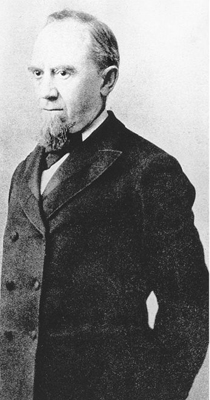
Charles Pratt, Sr., Rockefeller’s colleague and frequent adversary. (Courtesy of the Rockefeller Archive Center)