
CHAPTER 14
Because Standard Oil had long exercised a global monopoly, Rocke-feller’s name was already known abroad. Foreign markets were larger and more lucrative than domestic markets—some 70 percent of American oil went abroad in the mid-1880s—while some feeble competition managed to sputter on at home in the face of daunting odds. In the early 1870s, kerosene penetrated China, Japan, and other far-off spots, and one American traveler in 1874 saw Standard kerosene flickering in the ancient quarters of Babylon and Nineveh. In the early 1880s, 85 percent of world crude-oil production was still extracted from Pennsylvania soil, making it America’s fourth-largest export, and only Russian oil constituted a serious competitive threat. Since it made no sense to clamp down excess capacity at home only to see it expand abroad, Rockefeller could never tolerate foreign rivals, telling one colleague, “We have the capacity to do all the home trade as well as the export, and I hope we can devise ways and means to accomplish it later on; at all events we must continue to strive for it.”1
Standard Oil studied foreign markets and posted a cultivated oil merchant, William Herbert Libby, to the Far East in 1882 to make a two-year survey. Observing that oil had “found its way into more nooks and corners of the civilized and uncivilized countries than any other product in business history emanating from a single source,” Libby proselytized for kerosene in Japan, China, and India.2 After translating into Chinese a pamphlet touting the safety of kerosene lamps, Libby had the satisfaction of seeing sampans laden with Standard Oil products floating up rivers deep in China’s interior. To inflate demand, the combine sold hundreds of thousands of cheap lamps and wicks and sometimes distributed them gratis along with the first kerosene purchase. “In many countries,” said Rockefeller, “we had to teach the people . . . to burn oil by making lamps for them; we packed the oil to be carried by camels or on the backs of runners in the most remote portions of the world; we adapted the trade to the needs of strange folk.”3
For a time, Standard ruled foreign markets no less dictatorially than domestic ones, and with crude oil found in large quantities only in western Pennsylvania, it seemed this idyll might last forever. Then this fool’s paradise was roughly shattered in the early 1870s by a giant scramble for oil at the Russian port of Baku on the Caspian Sea. For more than a century, the natives had scooped up crude oil from huge pits, selling it mostly to Persians to lubricate their cart wheels, grease leather harnesses, and alleviate rheumatic pains. In the early 1870s, this primitive industry was suddenly thrust into the modern world when drillers struck wells of unprecedented force. Amid deafening roars, black geysers shot into the air with such staggering power that some of them couldn’t be capped for months; one raging gusher spouted 2,400 tons of oil within its first twenty-four hours.
In 1873, Robert Nobel, a member of the illustrious Swedish family, arrived in the Caucasus on a mission unrelated to oil. His brother had a contract to produce rifles for the Russian government, and Robert was scouting walnut trees for use as rifle stocks. Instead, he stumbled upon the bedlam of Baku, a frantic scene of such ghastly beauty that Maxim Gorky later limned it as “a dark hell painted by an artist of genius.”4 A crossroads as exotic as it was hellish, a Moslem enclave bristling with minarets, mosques, and palaces, Baku presented two faces to the traveler. In the bazaars, vendors hawked everything from Russian sugar to Persian silks, while outside of town a thick canopy of black smoke enveloped the refineries.
Robert Nobel took his 25,000 rubles of walnut money and plumped it down to buy a refinery. Where local kerosene had hitherto been mocked as Baku sludge, the Nobel refineries produced kerosene equal to that of Standard Oil, which monopolized the Russian marketplace in the early 1870s. Bringing sophisticated management and ample funds to the industry, Nobel and his brothers had created by decade’s end an eight-mile pipeline to the Caspian Sea, where they floated the world’s first oil tanker, the Zoroaster. They pioneered a continuous refining method that was superior to Standard’s batch system for sorting out distillates. In 1879, the Nobels organized the Nobel Brothers Petroleum Producing Company and soon cobbled together an impressive distribution system, complete with flatcars, tank cars, and storage depots, ejecting Standard Oil from Russia. That year, a roving Standard operative, William Brough, sent Rockefeller samples of Russian crude and refined oil along with prophecies that in a few years the Nobels would build a pipeline or railroad from the Caspian to the Black Sea, setting the stage for Russian oil to challenge Standard Oil in European markets.
Rockefeller’s first influential critic, Henry Demarest Lloyd, in Boston in 1903. (Courtesy of the State Historical Society of Wisconsin)
By the early 1880s, two hundred refineries cluttered Baku’s oil-stained slopes, and in 1883—true to Brough’s forecast—a railroad connected Baku on the Caspian Sea to Batumi on the Black Sea. The potent Russian wells flowed with such fierce abundance that it was cheaper to produce oil in Russia than at Titusville, and cut-rate kerosene soon flooded European markets, undercutting Standard’s prices. The American consul in Batumi, J. C. Chambers, who had been dispatched by Standard Oil to harvest intelligence, kept Rockefeller apprised of these developments and sounded an alarm about the Russians’ “quixotic ambition to drive the American oil from the markets of the world.” 5 Whatever the coolness between Rockefeller and American officialdom at home, they cooperated overseas to stop tariffs against American oil. Paying tribute to the State Department, Rockefeller later said, “Our ambassadors and ministers and consuls have aided to push our way into new markets to the utmost corners of the world.”6
Rockefeller seems to have been caught napping by the Russian incursion just as he had snuffed out all his major domestic rivals. When his Hamburg agent, Charles F. L. Meissner, reported in 1885 on extensive Russian penetration of European markets, Rockefeller, taken aback, fired off an indignant blast at his executive committee: “I am at a loss to understand how the bulk transportation could have been carried on to the extent referred to in Switzerland and elsewhere, without our having received more information about it. ” 7 To retaliate, Rockefeller resorted to the usual high-powered weaponry, cutting prices across Europe and starting an insidious whispering campaign to question the safety of Russian kerosene. His files also reveal numberless secret contacts in Paris and London hotels with shadowy, self-appointed intermediaries inquiring whether Standard wished to buy a stake in Nobel Brothers or join with them in slicing up European markets. In 1885, Standard’s peripatetic emissary, W. H. Libby, held talks with the Nobels in Saint Petersburg, but these overtures faltered. The Nobels’ power in Russia hinged on their relationship with the despotic czarist government, and they didn’t intend to admit Standard Oil into their preserve.
By the mid-1880s, another powerful force appeared on the world oil scene. The Paris Rothschilds, led by Baron Alphonse de Rothschild, had built refineries at Rijeka and Trieste on the Adriatic Sea. In organizing the Caspian and Black Sea Petroleum Company—better known by its Russian initials, Bnito— they stood to reap a fortune from inexpensive Russian oil. No sooner had the Rothschilds entered the business than reports filtered back to Rockefeller that the Nobels, who were heavily in debt to the Rothschilds, could not meet their payments and might be forced to make common cause with the French bankers. For many years, the Rothschilds, the Nobels, and Standard Oil circled around each other, each trying to forge links with a second party to isolate the third.
This vigorous competition abroad aroused Rockefeller’s fighting spirit, and he even took to lecturing his colleagues in verse: “We are neither old nor sleepy and must ‘Be up and doing, with a heart for any fate; Still achieving, still pursuing, learn to labor and to wait.’ ” 8 Both Rockefeller and Archbold favored scrapping their former system of operating through European brokers and instead launching their own marketing subsidiaries. For a time, they were held back by Benjamin Brewster, and Rockefeller, unwilling to move without a consensus, yielded against his better judgment. When the Rothschilds set up a British oil-marketing firm in 1888, Brewster’s logic suddenly crumbled, and twenty-four days later Standard Oil set up its first overseas affiliate, the Anglo-American Oil Company, which soon monopolized the British oil trade. Two years later, Standard started the Deutsche-Amerikanische Petroleum Gesellschaft in Bremen to handle the north German market. Neither old nor sleepy, Rockefeller set up an oil terminal at Rotterdam, struck a deal to supply all of France’s crude oil, took stakes in oil firms in Holland, Italy, and Scandinavia, and orchestrated heated price wars in India. Taking a cue from the Nobels, Standard launched its first oil-tank steamer to Europe, a mammoth vessel that transported a million gallons of oil, the first of what would shortly be an entire ocean fleet piloted from 26 Broadway.
Despite the low price of Russian oil, Standard barred it from America and retained nearly 80 percent of world markets in the late 1880s. For all the complaints about adulterated kerosene that Rockefeller heard on his European travels, the Nobels and Rothschilds never matched the quality of Standard’s products or surpassed its integrated operation. For Archbold, it was the Russians’ failure to consolidate their domestic industry—that is, to suppress competition and establish a trust—that consigned them to secondary status. “If there had been as prompt and energetic action on the part of the Russian oil industry as was taken by the Standard Oil Company, the Russians would have dominated many of the world’s markets which have been made to inure so largely to the benefit of the American oil industry.” 9
If the Nobels and the Rothschilds weren’t mortal threats, neither did they capitulate tamely to Standard Oil, as so many American rivals had. These contending forces clashed repeatedly in the oil wars of the 1890s, a protracted battle that saw periods of blistering competition followed by cozy deals to divvy up markets. When competition forced price-cutting in the early 1890s, Rockefeller advocated a tactical rapprochement with his erstwhile foes and induced Baron Alphonse de Rothschild to visit 26 Broadway in secret. Archbold’s report to Rockefeller about the July 1892 meeting revealed that, beneath the competitive veneer, the Rothschilds were eager to come to terms with Standard Oil:
We reached a tentative agreement with them. . . . I need hardly report again that it seems desirable on all sides that this matter be kept exceedingly confidential. It was thought best that we should not see the Nobel people, but that the approach be made to them on the subject by the Rothschilds. We were treated with great courtesy by Baron Rothschild, and we [were] much delighted that he spoke English fluently, which greatly facilitated our intercourse. 10
In the end, Count Sergei Witte, the Russian finance minister, spiked the scheme for a grand alliance of Standard Oil with the Nobels and Rothschilds—to the dismay of countless European newspaper cartoonists who had made sport evoking the clumsy embrace of the octopus and the bear. All the while, Russia kept pumping crude oil and by the late 1890s briefly overtook the United States in oil production, even though Standard Oil handily eclipsed it in refining.
By 1890, it was self-evident that oil existed throughout the earth’s crust and that only a freak accident (plus some timely Yankee ingenuity) had led to the business being founded in Titusville. In 1884, Dutch drillers began prospecting for oil in Sumatra and six years later received a royal charter to exploit Dutch East Indian reserves, christening their company Royal Dutch. Meanwhile, another aggressive contender waited in the wings. In 1891, the enterprising London merchant Marcus Samuel signed a contract with the Rothschilds to market their kerosene in the Far East. Samuel used the Suez Canal to speed the export of Russian kerosene to Asian markets. Oil had taken four months to travel from New York to the Far East but now reached it from Batumi in a month. Even though Samuel designed a custom-made bulk tanker, the Murex, to conform to the canal’s strict requirements, Standard Oil hired London solicitors to sow doubts about the project, spreading nasty rumors about a “powerful group of financiers and merchants” under “Hebrew influence” who planned to take tankers through the canal.11 Rockefeller later ranted against “our Asiatic competitors controlled by Jewish men who cry ‘Wolf ! Wolf! Standard Oil Company!’ and keep moving in and getting control of markets.”12 (He once compared Standard Oil’s supposedly “fair-minded” methods with “the old, old Jew method of treating one customer one way and another in another [way].”)13 Warding off this verbal sabotage, Samuel managed to defeat Standard Oil decisively, and his trademark red oilcans—in contrast to Standard’s blue cans—soon became known throughout Asia.
By 1892, with oil production booming in Burma and Java, Standard Oil belatedly recognized the need for concerted action in Asian markets. It tried in vain to buy the business of both Royal Dutch and Marcus Samuel, who renamed his company Shell Transport and Trading Company in 1897 to honor his family’s old seashell-box business. Standard even stooped to trading for Russian kerosene in order to serve better its Asian customers. It finally set up a series of Asian stations and assigned a small army of agents to Shanghai, Calcutta, Bombay, Yokohama, Kobe, Nagasaki, and Singapore. These operatives sold Standard kerosene in tin cans with wooden frames because Asian customers recycled the tin as roofing and turned the wooden cases into household objects. For all these smart marketing ploys, Standard Oil was forced to coexist with Royal Dutch and Shell, which merged to create a rival empire in the early 1900s. Henceforth, competition was enshrined as a permanent fact of the international oil business—despite a multitude of secret, market-sharing deals— and it was only a matter of time before the deadly contagion of competition infected North America.
Even as it was menaced by new competitors abroad, Standard Oil seemed omnipotent in American oil. Everything about its operation was colossal: Twenty thousand wells poured their output into 4,000 miles of Standard Oil pipelines, carrying the crude to seaboard or to 5,000 Standard Oil tank cars. The combine now employed 100,000 people and superintended the export of 50,000 barrels of oil to Europe daily. Rockefeller’s creation could be discussed only in superlatives: It was the biggest and richest, the most feared and admired business organization in the world. Earning steady, reliable profits, year in and year out, Rockefeller could be forgiven for believing he had outwitted the business cycle. For a man who craved order, he had reached his apogee. No longer at the mercy of unpredictable economic forces, he thrived even in recessions.
Rockefeller was exceedingly pleased by the harmonious workings of his fantastic machinery and the neat, orderly unfolding of his days. When he arrived at work each morning, he sat at his rolltop desk and examined two stacks of paper, one representing decisions made, the other matters to be thought over, and he slowly burrowed his way through both piles. Starting in the 1880s, he adopted a policy of never doing business with strangers or even meeting them, avoiding unwanted solicitations and controversy. If this simplified his life, it also strengthened the unsettling image of an untouchable tycoon, hidden behind the scenes.
Many of Rockefeller’s critics alleged that he divided his life into compartments and kept two separate sets of moral ledger books: one governing his exemplary private life, another sanctioning his reprehensible business behavior. But he saw his entire life guided by the same lofty ideals. In retirement, he wrote to Harvard president Charles Eliot, apropos of Standard Oil, “I can say without hesitation that no business organization with which I have ever been connected has been controlled by higher ideals.” 14 One way that he upheld this belief was to become self-righteous about his opponents, whom he reviled as undisguised rascals. “The other people were up to all sorts of tricks, mixing benzine with the oil, and so forth,” he said of rival refiners.15 Nobody was more vigilant about being cheated than Rockefeller nor quicker to seize the moral high ground. To convince himself that he was a highly ethical businessman, he redefined exactly what that meant. For instance, he always made much of the fact that he honored contracts, paid bills and debt promptly, treated small shareholders fairly, and never watered stock. To confirm his clean, sanctimonious image of himself, he reiterated these ideals with a kind of incantatory relish, and the more naysayers dwelled on his railroad dealings or secret subsidiaries, the more he affirmed his own compensating code of business honor. This was as much to preserve his own self-image as to persuade a skeptical public that he was honorable, for Rockefeller desperately needed to have a good opinion of himself.
What further blinded Rockefeller to his misdeeds was that by the 1880s he always stood at several removes from any mayhem. He was now a master puppeteer, adroitly manipulating his marionettes, with the strings artfully concealed. As Standard Oil’s leading figure, he was the only person who didn’t have any direct operational responsibility. Instead, statesmanlike, he applied himself to general policy and monitored the performance of lieutenants, who sent him copious reports about their activities and often boasted shamelessly of their unsavory deeds. In contrast, Rockefeller replied in brief, opaque letters. He never assumed total confidentiality, even in internal memorandums, and cultivated a spare, elliptical style, devoid of names or specifics, that would have baffled any prosecuting attorney. In creating this self-protective structure, Rockefeller could run Standard Oil while simultaneously sidestepping responsibility, erasing incriminating evidence, and avoiding contact with his victims. It enabled him to distance himself from the dirty work down below and feign ignorance of what was happening. When confronted with well-documented cases of terror tactics used by subordinates, he blandly conceded some few indiscretions by overly zealous employees and cast himself as a helpless spectator. But if one examines the reams of letters sent to him by his associates, his pose of innocence crumbles. He knew everything that was going on and now, for the first time, we can document it. For that reason, we will digress occasionally in this chapter from the linear narrative of Rockefeller’s life to examine reports he received from the field. They leave no doubt that he was the brains of the operation, directing activities he professed to deplore and setting the tone for his subordinates. This, of course, only complicates the mystery of how he integrated the various facets of his life—of how the enlightened patron of Spelman Seminary could also be the brutal overlord of Standard Oil. In the end, we can only explain how he rationalized his behavior to himself and others; given the absence of revelatory letters or diaries, we can say little about the unconscious drives that led him to do this or the mental strains it might have caused.
In his memoirs, Rockefeller implied that Standard took no rebates after 1880, whereas his files disclose that collusion with the railroads became even more brazen after that date. By the early 1880s, the railroads had ceded supremacy in oil transport to the Standard-dominated pipelines, which now carried more than three-fourths of the crude oil from the Pennsylvania wells to coastal cities, charging Standard Oil’s own refineries half the posted price. Not surprisingly, as the railroads weakened, Standard Oil only browbeat them more. The combine owned a subsidiary, the Galena-Signal Oil Company, which monopolized the manufacture of high-grade railroad lubricants. Simply by stalling on shipments of this indispensable grease, it could bring any railroad to a halt. If Standard wished to extract a railroad rebate, it merely tacked on a surcharge to the price of Galena cylinder or engine oils. And Rockefeller continued to play his favorite trump card: the tank-car fleet. By the late 1880s, Standard Oil was leasing its tank cars to 196 railroads, forcing most of them to pay a double-mileage tribute to 26 Broadway—that is, a mileage royalty on outward-bound trips, when the cars were topful of oil, and also on inward-bound trips, when they returned empty.
One reason for Rockefeller’s continuing solicitude toward the roads after the pipeline revolution was that he himself had a significant investment in them. He conceded as much when he stated that Standard Oil stockholders “as the years had gone by were becoming more and more a factor in railway problems and other enterprises.”16 At the time, railroad shares were among the few blue-chip securities available to rich investors, which meant that Rockefeller invested heavily in the Erie, the New York Central, and other oil-carrying roads. In March 1881, Rockefeller wrote A. J. Cassatt of the Pennsylvania Railroad about rumors that his railroad would soon issue $400,000 worth of stock. He suggested they set up a joint private account of Pennsylvania stock—with Rockefeller making the payment.17 Whether this deal was executed is unclear, but it was a blatant bid to connive with a major railroad executive.
In later years, when Ida Tarbell made railroad manipulation the focal point of her Standard Oil indictment, Rockefeller pleaded ignorance of such dealings, claiming they were handled by his colleagues while he magisterially confined himself to broader matters. In fact, his papers document that he either met directly with railroad presidents or else was given graphic, blow-by-blow accounts of negotiations by Flagler, Archbold, O’Day, Payne, Warden, and a formerly little-noticed figure, Colonel W. P. Thompson, who had headed a Virginia cavalry unit for the Confederacy. The secretary of Standard Oil of Ohio and a brother-in-law of Standard power broker Johnson N. Camden, Colonel Thompson shared a Cleveland office with Rockefeller and Payne, and his letters furnish explosive proof of extensive railroad collusion in the 1880s. While Rockefeller made it seem as if such shenanigans occurred far from his sphere, he was fully briefed by Thompson, who liked to boast of his maneuvers.
Rockefeller’s files are chock-full of examples of rebates well into the 1880s. In March 1886, William G. Warden reported from Philadelphia that the Pennsylvania Railroad had agreed to the following discounts: Fifty-two cents per barrel to ship oil from Oil Creek to New York (versus a listed rate of 78 cents) and 39 cents to Philadelphia (versus 65 cents for other refiners). Rockefeller was always insistent that Standard’s competitive advantage had nothing to do with preferential transport rates, but his correspondence reveals that rebates could single-handedly transform an unprofitable plant into a profitable one. In 1886, Colonel Thompson told him that it made sense to proceed with a new naphtha plant at Oil City (naphtha was a crude-oil fraction used to make gas or solvents) only if the Lake Shore hauled the finished product to Cleveland for ten cents instead of seventeen.18 During these negotiations, Colonel Thompson also reported that low freight rates would enable them to rehabilitate an otherwise insolvent Oil City refinery. Wherever possible, Thompson preferred oral agreements, once telling Rockefeller of his talks with two railroads, “I think they will concede the undesirability of a regular written contract.” 19
The backdoor deals with the railroads necessarily generated more speculation than proof at the time. But it was the trust’s marketing operation that ultimately proved its undoing, for it directly touched consumers and tens of thousands of small businessmen located in every congressional district. In the 1870s, Rockefeller began to assemble a marketing organization to eliminate the middlemen, independent agents who had earned three to five cents per gallon of kerosene. Since they handled Standard kerosene andcompeting products—an intolerable situation for Rockefeller—and often cared more about gouging consumers than expanding markets, he decided to get rid of them.
Furthermore, Standard’s refinery flow was now too huge to depend upon this fragmented, obsolete distribution system. Kerosene demand was booming as it illuminated mills, factories, hotels, and office buildings in the growing cities. To exploit economies of scale, Rockefeller noted, “we had to create selling methods far in advance of what then existed; we had to dispose of two, or three, or four gallons of oil where one had been sold before, and we could not rely upon the usual trade channels then existing to accomplish this.”20 To have high-volume, low-cost production, the Standard needed huge guaranteed sales. This forced Rockefeller to integrate vertically the entire industry, controlling everything from the wellhead to the consumer.
Around 1882, in a revolutionary development, the trust began to sweep away the old distribution system, with its horse-drawn carts full of swaying barrels, and disburse millions of dollars to build thousands of tank wagons to service every American town. Rockefeller hailed the efficient new system: “I believe it one of our best means for getting and holding the trade.”21 It worked thus: Standard’s tank cars or pipelines delivered refined oil to storage tanks, where the tank wagons were filled up. From here, the wagons set out for local groceries and hardware stores—the principal retail outlets—where they replenished special canisters that the trust provided. Sometimes, over the furious opposition of storekeepers, tank wagons even went door-to-door, selling directly to households and putting Standard smack in the retail trade. (In some places, the trust manipulated local retailers by saying that they would refrain from this practice if storekeepers dealt exclusively in Standard kerosene.) The combine also sold, almost at cost, heaters, stoves, lamps, and lanterns to widen the market; in the manner of a modern corporation, Standard Oil created demand as well as satisfied it, and its obliging agents helped consumers clean lamps and burners to enhance their use.
Grocers and hardware merchants resented the demand to stock only Standard Oil kerosene or be starved out of the business. Along with wholesalers rendered obsolete by the Standard marketing effort, they emerged as Rockefeller’s most potent enemies. Conveniently, Rockefeller never set eyes on these men, had no sympthy for them, and chided them for standing in the way of progress. “Of course it is natural that the man who drove the stage coach should be antagonistic to the railroad and that the man who used to keep the small inn should look with disfavor upon the big, magnificent hotels.”22
Since jobbers often adulterated Standard Oil kerosene with poor-quality product from independent refiners, Rockefeller hoped that his marketing operation would ensure a uniform quality of Standard Oil products. The 1870s witnessed five thousand to six thousand deaths annually from accidents caused by faulty kerosene.23 Far from being immune to complaints, however, Standard Oil was bedeviled by reports that its kerosene emitted an offensive odor, crusted wicks, and smoked lamps. One day in Cleveland, an angry woman pushed her way into Rockefeller’s office and demanded to know what he planned to do about his poor kerosene. Indignantly, he marched off to the lab and had the woman’s sample analyzed, the results unknown. At 26 Broadway, he tracked the activities of the manufacturing committee, which burned kerosene lamps for six hours at a time to test oil quality. Always touchy about complaints, Rockefeller often blamed poor wicks and developed the Acme wick to eliminate those complaints. To his consternation, customers still grumbled even after they switched to this allegedly foolproof article.
Standard’s marketing subsidiaries were conducted with such controlled ferocity that they became the most hated part of the entire organization. One must recall that Standard Oil was a federation of companies, not a single firm, and held only a partial interest in many affiliated companies. This invited trouble, for Standard often retained the original managers and allowed them a fair degree of autonomy. When the combine absorbed established marketing concerns, it brought into the organization several rogue proprietors who tarnished the Standard Oil name. Later on, Rockefeller feigned ignorance of their actions and disclaimed responsibility when, as we shall see, he received elaborate warnings about their methods.
In 1873, Standard secretly bought half of Chess, Carley and Company, which had a Louisville refinery and a lucrative marketing operation in the Southeast. The owner, F. D. Carley, was a lapsed Methodist minister who set a new standard for pitiless methods in oil marketing. Confidential reports informed Rockefeller that Carley was a charming scoundrel, an inveterate gambler who went straight from board meetings to his bookie’s office; even the circumspect Rockefeller referred euphemistically to Carley’s “want of balance.” 24 Although Rockefeller planned to pack Chess, Carley’s board with a majority of Standard directors, Carley blocked outright control from 26 Broadway until 1881, and another five years elapsed before Standard swallowed the firm whole and renamed it Standard Oil of Kentucky.
By then, Chess, Carley had become a byword for vicious tactics. When F. D. Carley learned that Standard Oil’s nemesis George Rice had shipped a scant seventy barrels of kerosene to a Louisville merchant, he reacted furiously. As a director of the Louisville, Nashville and Great Southern Railroad, which had granted Rice low freight rates, Carley had an underling dash off a peremptory letter to the railroad’s freight agent, telling him exactly how to treat Rice: “Please turn the screw.”25 When this quotation was revealed by investigators years later, it was emblazoned in newspaper headlines across America.
Carley went to extravagant lengths to stop competitors. When he learned that Rice planned to sell kerosene in Columbus, Mississippi, he sent local grocers an unambiguous letter: “If you do not buy our oil we will start a grocery store and sell goods at cost and put you all out of business. ” 26 No bluffer, Carley set up a store that sold Standard Oil kerosene at cut-rate prices, as well as oats, meat, sugar, coffee, and other household items at or below cost. In many localities, grocers gladly took a 5 percent discount offered on foodstuffs by Carley in exchange for an agreement to carry only Standard kerosene, one of many anticompetitive practices perfected by Standard Oil that shaped future antitrust legislation. Notwithstanding the public uproar, Rockefeller claimed to be unaware of Carley’s practices. Yet at one point, Colonel Thompson confidentially told Rockefeller that Carley was a “secret, surreptitious” man with “mysterious, dishonest secrets” who even cheated on his agreements with Standard Oil. 27
In 1878, Standard Oil boldly expanded its marketing territory by acquiring a 40 percent stake in the Waters-Pierce Company, which was based in Saint Louis and dominated a wide swatch of territory from Arkansas to Texas. It was decided that Chess, Carley would monopolize the oil trade east of the Mississippi, while Waters-Pierce would control the area southwest of the river. The Waters-Pierce deal brought another patent scoundrel into the trust, Henry Clay Pierce, who made F. D. Carley look like a cherub in comparison. By age nineteen, this country doctor’s son monopolized the kerosene trade in Saint Louis, and then he mounted a pony and branched out into Arkansas and Texas. Even Standard Oil people never defended Henry Clay Pierce. One executive recalled him as a gifted businessman but added, “He couldn’t do a thing straight if it could be done crooked. He was cordial and polite enough, and it was only when he got into a jam with people that he became nasty. Then they knew they were fighting someone. He was the greatest fighter you ever saw.”28
Once again, Rockefeller self-servingly disclaimed knowledge of the rough-house tactics used by the Waters-Pierce salesmen and portrayed Pierce as a loose cannon who operated on his own initiative. He said that he never gave “a minute in a month to this local trade” and that any marketing excesses, when exposed, were condemned by the executive committee, but his files show that he received a full accounting of Pierce’s high crimes and misdemeanors.29 When Pierce made a highly profitable foray into the Mexican market in 1880, Colonel Thompson reported to Rockefeller that this had been accomplished “largely by evasion of the enormous duty placed upon Refined oil by Mexico.”30 Enriched by this operation, Pierce declared a 100 percent dividend on capital the next year. Thompson repeatedly warned Rockefeller about Pierce, branding him “a man not without designs” and relaying a letter “showing great duplicity on the part of Mr. Pierce.”31 Far from rebuking Pierce, in 1892 Rockefeller extended him a personal loan for $200,000—a king’s ransom—and patiently carried him for eight years. Clearly, he had no qualms about the buccaneering spirit of the Waters-Pierce business.
The Standard Oil marketing subsidiaries fanned out across the remaining sections of the continent. In 1878, the Consolidated Tank Line Company took over the territory north of the Missouri River, spread across Michigan and Minnesota, then expanded westward into the Dakotas. Formed in 1884, the Continental Oil Company covered the Rocky Mountain states. In the mid-1870s, the trust sent a young executive to California, Wesley H. Tilford, who foresaw the state’s potential as both an oil producer and consumer; a decade later, Standard Oil of Iowa developed this West Coast trade. Many frustrated customers of Waters-Pierce turned, in revenge, to Republic Oil, a New York–based company that specialized in cultivating retailers who loathed the trust. Of course, Republic was secretly owned by Standard Oil.
Around 1886, 26 Broadway divided the continent into eleven marketing districts, with boundary disputes to be resolved by a domestic-trade committee. As subsidiaries raided each other’s territories, their clashes were arbitrated by headquarters. Nothing so clearly reveals the trust’s imperial character than its deliberations about marketing territories, where exclusive rights to entire states and countries were dispensed like so many royal charters. At one point, when Chess, Carley; Waters-Pierce; and Consolidated Tank Line tangled over the virgin southwestern territory, Colonel Thompson explained to Rockefeller, “I have, for a long time, waited for the opportunity of defining the western limits of all these connections and take the liberty of saying on behalf of Standard Oil Co. that we had never conceded to any one the right to go and occupy Colorado, New Mexico, Arizona or Mexico.”32 In the end, Standard Oil ceded Mexico to Henry Pierce in a swap for the state of New Mexico.
Once Rockefeller controlled a marketing territory, he protected it fiercely and quickly dispatched troops to fend off the smallest incursion. If Standard Oil spotted even one carload of outside oil entering its territory, it traced its source through railroad agents and moved swiftly to halt it. Standard Oil marketing men were known to trail competitors’ wagons and undersell them if necessary. This unceasing drive, this implacable need to win, emanated from Rockefeller himself. When told that competitors had appeared in Saint Louis, he exhorted Oliver Payne, “Regret to hear that those parties have established an agency in St. Louis. We must not let them get the business. Why not make a good, hard, vigorous fight with the view of taking it all back again and not let them retain a foothold there, and the same in St. Paul.”33
As the capstone of this system, Rockefeller fostered an extensive intelligence network, assembling thick card catalogs with monthly reports from field agents, showing every barrel of oil sold by independent marketers in their territory. From 26 Broadway, the titan could peer into the most distant corners of his realm. Standard Oil spies collected much of this information from grocers and railway-freight agents. One Cleveland refiner discovered that Standard paid his bookkeeper twenty-five dollars a month to provide information on his shipments, mailing these trade secrets to Box 164 at the Cleveland post office. Standard’s reputation as a pervasive, all-seeing presence was richly deserved.
The manic vigor of Standard’s salesmen becomes understandable in light of a secret policy that Archbold enunciated to Rockefeller in an 1891 letter. Station managers were expected to command at least 85 percent—and, if possible, much more—of the oil trade in their district, a punishing standard that goaded them into aggressive tactics.34 Because they had carte blanche to reduce prices and use any other means necessary to hold the trade, they created pitched battles in many cities. One repentant Standard Oil marketer named Charles Woodbury recalled a favorite scare tactic. “Substantial rumors that the few independents surviving might not much longer be able to supply oil at all continually alarmed their customers.”35
Rockefeller found nothing reprehensible about this intelligence network and could never understand the eternal fuss. “The practice of the Standard Oil Company in this regard brings no credit or discredit to the Standard Oil Company,” he later told William O. Inglis. “It was following out a method in universal use by the largest and most intelligent distributors of goods the country over.”36 Some Standard Oil people, however, refused to stoop to these methods. When Charles Woodbury protested eavesdropping on competitors, his superior gruffly insisted, “We do not intend merely to grasp the situation—we must control it.” Woodbury replied, “But this is espionage. I cannot stand over these men and make them go after these details.” 37 After being censured for such squeamishness, he quit in protest. Recounting this in 1911, Woodbury left some tart comments about Rockefeller’s assumed innocence. “Results were what the master asked for,” he explained. “Details [Rockefeller] need not know. He could be left to his own self-effacement. He had selected his staff.”38 In short, Rockefeller posted the sales targets, whipped up the fervor, then foreswore any knowledge of the inevitable consequences.
To square his actions with his conscience—always a necessity for Rockefeller—he needed to invoke an overarching theme: vouchsafing cheap light to humanity. Touring a well drilled on Oil Creek in the early days, he stared at it silently and then intoned, “This is the poor man’s light.”39 Such remarks weren’t just for public consumption but were commonplaces in his correspondence. In 1885, he instructed a young colleague, Henry C. Folger, “Let the good work go on. We must ever remember we are refining oil for the poor man and he must have it cheap and good.”40 Having grown up in secluded farmhouses, reading by candelight, he understood the revolutionary impact of cheap kerosene.
Rockefeller never had a single motive for any action and was surely motivated by more than altruism in championing cheap kerosene. He was obsessed with high-volume, low-cost production to maintain market share, even if he temporarily sacrificed profit margins. As he noted, “This fact the Standard Oil Company always kept in mind: that they must render the best service and be content with a largely increasing volume of business, rather than increase the profit so as to tempt others to compete with them.” 41 When discussing prices with subordinates, he frequently reminded them, “We want to continue, in reason, that policy which will give us the largest percentage of the business.”42
The public tolerated the trust’s brawny tactics for a long time because it believed that it had, over the long run, cheapened kerosene and exercised a relatively benevolent dictatorship. As journalist Henry Demarest Lloyd wrote scornfully to George Rice in 1891, “Thus the public—dear fools—believe, and it entirely reconciles them—knavish fools—to the piracies, treasons and murders by which the fabled cheapness has been brought to them.”43 Befuddled reformers assailed the trust for selling both too high and too low, for fleecing consumers and underselling rivals. As John Archbold summed up the paradox, “It is usually alleged that whenever the Standard, for whatever reason, advances its prices, it is oppressing the consumer, and when if, on the other hand, it lowers its prices, it is then oppressing its competitors.”44 Of course, both things were often true, since Standard Oil kept prices high where it faced no competition and low where it had to keep rivals at bay. On balance, the trust wielded its monopolistic power to keep prices artificially low to forestall competition.
In general, Standard Oil did an excellent job at providing kerosene at affordable prices. It boasted far lower unit costs than competitors and relentlessly drove down costs over the years. Between 1880 and 1885, its average cost of processing a gallon of crude oil went from 2.5 to 1.5 cents. In a rare 1890 newspaper interview, a supremely confident Rockefeller said that since Standard’s birth twenty years before, the retail price of kerosene had plunged from 23.5 to 7.5 cents per gallon. Only half that drop, he contended, had resulted from the steep fall in crude-oil prices, and he credited the tank-wagon system for much of the savings. In the early 1900s, the Bureau of Corporations attributed most of the drop in kerosene prices to a sharp dip in crude-oil prices, not to Standard’s superefficient management. Whatever the truth, the resulting low prices inoculated the public for a long time against the anti-Standard venom.
Many of Rockefeller’s foes contended that routine underselling was his most lethal weapon, even more destructive than railroad rebates. As the industry’s low-cost producer, Standard merely had to dump oil at cost to stamp out competitors. The practice of selling at or below cost, which started in the 1870s, intensified with the tank-wagon system, which permitted the trust to set retail prices. Hesitant to initiate price wars, which smacked of the old, Darwinian competition, Rockefeller said that he cut prices only defensively—that is, when forced to retaliate against price-cutting independents. When he did so, he showed no mercy against these reprobates and said with righteous indignation, “These people did not want cooperation. They wanted competition. And when they got it they didn’t like it.” 45
Allan Nevins cited a federal study of predatory pricing that found that Standard Oil practiced it in only 37 of 37,000 towns serviced by its tank wagons and then only in response to cuts by competitors. Yet Rockefeller’s files are so rife with references to this practice as to refute Nevins’s verdict. In an 1886 letter, Colonel Thompson told Rockefeller that Standard sold at cost wherever competition appeared and compensated for the lost profits by raising prices in less competitive locales: “We find the outsiders mainly from Pittsburgh and the Oil Region had 2,000 barrels of oil in Cincinnati. . . . We have lowered the Cincinnati market an additional half cent temporarily to meet that competition and forced them to sell their oil without a profit.” In contrast, he noted that with independents now banished from Chicago, “we jacked that price up a quarter or so, without multiplying instances, we are doing all around. The system is working well, better than any other we can devise and our feeling is to hold along on this basis—I beg you and the other gentlemen will keep in mind the fact that we are selling ¼ of all the oil we handle without a farthing of profit to this department.” 46
If Standard Oil sold one-quarter of all its oil at cost, as Thompson alleged, that would have meant anticompetitive price cuts in more than 9,000 towns— quite different from the 37 cited by Nevins. The trust used such infinite sleight of hand in setting prices, obscuring the real price through secret discounts, that a definitive accounting is impossible. Though many states had already outlawed predatory pricing, they found such a ban difficult to enforce. On this issue, Rockefeller remained an unreconstructed monopolist, defending Standard Oil’s price-cutting years later by commenting, “If in doing so they were losing money, which they made up on some of the specialties—they made up the difference—would it be a crime?”47 Eventually, a national ban on such predatory pricing formed an integral component of antitrust legislation.
Standard’s policy of differential pricing also proved expedient in the global marketplace. During the 1880s and 1890s, trying to stem the tide of Russian and East Indian oil, the organization charged lower prices in Europe and compensated with higher American prices. Its tight control of the home market enabled it to prosecute savage price wars against the Nobels, Rothschilds, Royal Dutch, and Shell. For this reason, Standard Oil always considered its domestic monopoly a necessary precondition for its overseas conquests.
But Standard Oil never sought a perfect monopoly because Rockefeller realized that it was politically prudent to allow some feeble competition. As he admitted, “We realized that public sentiment would be against us if we actually refined all the oil.”48 The combine ceded about 10 percent of the refining and marketing business to a tiny group of fringe rivals. Even in the mid-1880s, ninety-three mostly marginal refineries were allowed to operate. A very smart monopolist, Rockefeller kept prices low enough to retain control of the market but not so low as to wipe out all lingering competitors.
We must retire one common canard about Rockefeller: He didn’t set crude-oil prices through blanket edicts. In his correspondence, one sees the oil king trying to guess the trend of crude prices and bemoaning speculation. As he told one of his personal financial advisers in 1882, crude oil “is about the worst commodity in the world to speculate in. . . . It is about as uncertain as railroad stocks.”49 Perhaps the chief way that Standard Oil influenced crude prices was by elevating or dropping storage charges at its pipelines, which the firm sometimes used to break speculative raids. By issuing certificates against oil stored by its pipelines, it stimulated a free market in crude oil, and hundreds of thousands of people speculated in or borrowed against these certificates, creating the first oil-futures market and setting the trend for spot prices. After the National Petroleum Exchange opened in Manhattan in late 1882, the speculators far outweighed the trust in importance in pegging prices.
As Rockefeller boasted, Standard Oil was an infallible moneymaker. In the late 1880s, Henry M. Flagler testified it had average earnings of 13 percent a year on net assets, which considerably understated its performance. When Teddy Roosevelt’s Bureau of Corporations later examined the matter, it computed a more handsome 19 percent return from 1882 to 1896. Rockefeller defended these high returns as justified by the fear that the oil might run dry and render the trust’s vast investment worthless. He knew public opinion was inflamed by the exorbitant dividends declared on Standard Oil shares, which sometimes ran as high as 200 percent. These figures were misleading, Rockefeller argued, since Standard Oil’s actual capital was typically ten times its official capitalization. In terms of real capital, the 200 percent dividend declared in January 1885 was more like 20 percent—extremely high but not astronomical. Such a rich but not altogether outrageous return was just what the politic Rockefeller wanted.
Rockefeller knew that if he got greedy, other products could be substituted for kerosene, and this, too, curbed his appetite for excess profits. Oil was just one of many fossil fuels and kerosene one of many potential illuminants. In the fall of 1878, America’s wunderkind, Thomas Alva Edison, boasted to reporters at Menlo Park, New Jersey, that he had dreamed up a practical electric lightbulb; within a year, he had created a miraculous bulb that glowed brightly for one hundred straight hours and directly threatened Rockefeller’s kerosene business. The new Edison Electric Light Company enlisted affluent bankers, including the august Drexel, Morgan and Company. On September 4, 1882, Edison stood in J. P. Morgan’s offices at 23 Wall Street and threw a switch that brightened Morgan’s office with electric lighting, inaugurating a generating plant in lower Manhattan. Luckily for Rockefeller, the lightbulb didn’t instantly drive out kerosene: It took time for Edison to cover the country with power stations, and by 1885 only 250,000 lightbulbs shone across America.
Instead of electric light, the soft, shimmering glow of gaslight began illuminating many American cities in the 1880s. For a long time, natural gas had been discarded by oilmen as a waste product until a business group led by J. N. Pew piped natural gas to Pittsburgh in 1883. Quick to perceive that natural gas complemented the oil business, Rockefeller advised Daniel O’Day that Standard Oil should develop its own strength in this area rather than turning to outsiders. O’Day and his ebullient team assured Rockefeller that they could pipe explosive gas long distances without mishaps. Within two years, they were piping gas from western Pennsylvania to cities in Ohio and New York, and by the late 1890s Rockefeller secretly oversaw natural-gas companies in Titusville, Oil City, Buffalo, and thirteen other localities. As one newspaper said, “Consumers in some of these places would be surprised to learn that they are burning Standard Oil gas.”50
To counter competition from gaslight, Edison based his promotional scheme upon a moral and aesthetic contrast between good electric light and evil gaslight. Of the flickering gaslight that later generations found so enchantingly poetic, he sneered, “It is a nasty, yellow light, too, and far removed from the color of the lovely natural light,” while he touted the “soft radiance” of electric lights as “singularly powerful and even . . . perfectly steady.” 51 With a persistence worthy of Standard Oil’s crusaders, Edison sales agents approached customers using “outmoded” gas jets and urged them to switch to advanced electric lamps.
The promotion of natural gas involved Rockefeller in sanguinary battles, for the major customers were municipalities, and the decisions were always highly political. The natural-gas business fed rampant corruption, a veritable cornucopia of graft, as companies manipulated urban officials to get these franchises. Though Rockefeller regularly denied knowledge of such machinations, his papers tell a different story: He exercised a supervisory role and knew all about the money funneled to politicians. In securing the Detroit franchise, Standard Oil furnished an emissary, G. A. Shelby, with $15,000 in cash and $10,000 in gas stock to sway politicians. When payment came tardily, Shelby groused to Rockefeller: “Will you guarantee the amount stated if Ordinance passes and is approved by the Mayor. . . . I have been to considerable expense and want to be sure of prompt settlement when work is completed.”52
In the natural-gas battles, the porous boundaries between politics and business began to crumble and disappear. In 1886, Daniel O’Day met behind closed doors in Philadelphia with the rival Columbia Natural Gas Company and fairly gasped at the political luminaries who were represented. As he told Rockefeller, “I was astonished to learn the people who are in it. All of the Republican local politicians of Philadelphia are stockholders. They are very much afraid of their investment, and feel now that unless they make some alliance with us that they will in all probability lose all their money, or a great share of it.” From pure expediency, O’Day favored a deal with their rivals, telling Rockefeller, “The feeling generally was to push the co. to the wall, a feeling in which I would fully share, were it not for the fact that the stockholders of the company might be very bad enemies to have in the Penna. legislature next winter.”53 Unconvinced by such pragmatic reasoning, the executive committee overruled Day.
The most bitter natural-gas fracas erupted in Toledo, Ohio, where the former governor, Charles Foster, was an old boyhood friend of Flagler and a recipient of Standard Oil campaign largesse. In July 1886, O’Day reported to Flagler that the ex-governor had agreed to merge his Fostoria Illuminating Gas Company with the Standard’s Toledo gas start-up to form the Northwestern Ohio Natural Gas Company. O’Day relayed the secret terms of this arrangement: “That Gov. Foster be President of the Co. But that we would have full control of management.”54 Toledo citizens were delighted when the Eastern Ohio Natural Gas Company decided to vie with Northwestern for a gas franchise; in a compromise settlement, both companies received franchises. Then it surfaced that both rival companies were controlled by Standard Oil, and in the ensuing brouhaha city officials decided, in retaliation, to erect their own municipal gasworks. Politicians in the Gilded Age tended to dispense with euphemisms, preferring cash on the barrelhead. Having done Standard Oil’s bidding in the gas business, Foster demanded his payoff from Rockefeller in January 1888, saying his campaign committee had a debt of almost $1,200. “My suggestion to you,” he told Rockefeller bluntly, “is that you send me a cheque for this amount. . . . I have refused to ask you or your people for contributions for several years past. In this case I did it because I know that you feel an interest with us, and for the further reason that I thought it would be helpful in warding off the blows made at you, and at our Gas Co.”55 In reply, Rockefeller sent Foster a thousand dollars, though he couldn’t resist appending some barbed comments on his past performance. “Our friends do feel that we have not received fair treatment from the Republican Party, but we expect better things in the future.”56
In 1886, Standard Oil set up the Natural Gas Trust, with Rockefeller as its largest shareholder. As such, he presided over these sordid municipal skirmishes, albeit keeping a sanitary distance. He followed matters closely but never soiled his hands, so that he could profess ignorance of the whole matter.
If Rockefeller tried to deny responsibility for his more deplorable actions, he had legions of critics who loudly proclaimed that he had maliciously ruined them. As Ida Tarbell noted, his foes endowed him with superhuman powers. “Strange as the statement may appear, there is no disputing that by 1884 the Oil Regions as a whole looked on Mr. Rockefeller with superstitious awe.”57 Each day’s mailbag brought more invective from total strangers who cursed him and pleaded for relief. The most bile flowed from western Pennsylvania oilmen who believed that he capriciously decreed crude-oil prices each morning. As one Bradford producer told him, “The situation here is truly alarming and hundreds of families are in actual distress that need not be if the price of oil was what thousands believe you could make it.”58 Another correspondent warned him, “There are thousands here on the verge of financial ruin on account of the low price obtained for their product, and if it is within your power to give them a better price you would bestow a boon inestimable in its value to this entire country. ”59 Sometimes these malcontents seemed torn over whether Rockefeller was Satan or Santa Claus, as shown by this muddled query from P. O. Laughner:
I am a poor devil of a pyker on the oil market and have been in the business for eight years. During all this time I have been cursing the Standard Oil Company with the rest of the boys—curses loud and deep. But with all the anathemas hurled at it the S.O.C. is still in existence and continues to pile up enormous wealth. Now as the market is completely dead and my occupation gone, I have come to the conclusion that it would be wisdom to stop cursing the Standard and strike it for a good fat position.60
After his scandal-ridden childhood with Big Bill, Rockefeller had a fine instinct for enemies and was sensitive to this crescendo of criticism. When out for a walk, he was vigilant and preternaturally aware of anyone following him; it was impossible to sneak up behind him. Yet he lent no credence to his critics and regarded their putative idealism as a flimsy cover for selfish motives. Rockefeller saw himself stoically suffering the fate of all revolutionary figures. “The ideas on which we worked were new . . . ,” he explained. “But knowing that we were right, we went steadily about our business, founded on ideas that were an irresistible force.” 61 He identified many critics as competing refiners who had foolishly taken cash instead of Standard Oil stock for their plants. His melodramatic rendition of it was this: “We think about Hades. What more can punish a man than to sit and groan as he contemplates what might have been!” 62
Despite being the target of so much public obloquy, Rockefeller seemed fearless. “The word ‘fear’ is not found in my father’s vocabulary,” his son once said, “nor does he know what the sensation is.” 63 Junior recalled being driven to a train station in Manhattan by his father at a time when he was swamped by anarchist threats. Though Junior begged him to hire bodyguards, his father scoffed:
“Why John,” he said, “I can protect myself. If any man should be foolish enough to attack me—well.” . . . He did not boast. I have never heard him boast. But he stood up full height with his fists clenched. What he said was to the effect that if anyone should attack him he was feeling sturdy—and he hoped he wouldn’t hurt the poor fellow too much.64
Junior remembered the evening in Cleveland years earlier when a maid shrieked that a burglar was upstairs. Rockefeller unhesitatingly seized a pistol and strode to the back door, hoping to nab the burglar, who had already slipped down a post and escaped.
Rockefeller professed that he bore no malice toward critics and approached them in a spirit of Christian tolerance—so long as they conceded their error. To those “who repented their attacks and abuse we freely extended forgiveness, as we ourselves might hope for mercy and forgiveness from a higher source,” he said.65 As his private life and philanthropy attest, he was not a cruel man and did not have sadistic impulses. Yet he countered critics with ad hominem attacks and frequently referred to their actions as schemes, implying something devious and illegitimate. Whenever he was about to commit some particularly heinous act, he first found a character flaw in the victim then proceeded with a serene conscience.
Proof against criticism, Rockefeller nonetheless provoked a small army of gadflies. Perhaps the most picturesque was Lewis Emery, Jr., the rich Bradford producer and pipeline owner and a Pennsylvania legislator, who served as a major source for Ida Tarbell. If only Rockefeller had played fair, Emery insisted, he would have ended up the more powerful oilman. “I had and have as much brains as John D. Rockefeller, but I have never had his cunning nor his ability to use unscrupulous means or unscrupulous men to carry out a programme,” he maintained.66 Though he spent much of his life stalking the titan, he never actually met Rockefeller, who was, he explained, “too much in the background, too cunning.” 67
Standard Oil applied merciless measures to stop Emery’s pipelines from linking up with railroads, as shown with his Equitable pipeline to Buffalo. In 1892, Emery was about to complete a major pipeline to Hancock, New York, where he expected the Ontario and Western Railroad to pick up his oil and transport it to New York City. When Archbold got wind of this, he demanded a showdown with the railroad. His report to Rockefeller shows the lengths that Standard Oil would go to cripple a competitor:
We have had further interviews with the Ontario & Western people, and feel that we have made some progress toward a possible understanding with them. It is now entirely sure that there has been no definite engagement entered into by them with the Emery party, and we think they are now convinced that the rates they had been talking about with the Emery party are absurdly low, and that business on any such basis would be undesirable and unprofitable. We have made them a proposition of business covering a period of five years, and expect an answer from them this week. Our proposition is that we put over their lines 400,000 barrels of oil yearly, or, in default of any part of the amount, pay a penalty of 10 per cent of the existing rates. We think it a very liberal proposition to them.68
Standard Oil was not content to advance its own interest; it worked actively to damage the business interests of its adversaries. Rockefeller’s papers also reveal that Emery was prepared, at one point, to sell his oil properties to Standard Oil, asking for $750,000 in shares of the trust—hypocrisy that only validated Rockefeller’s dim opinion of his critics.
Another embittered foe was George Rice, a Vermont native and independent refiner from Marietta, Ohio. A vigorous man with a bulldog face, Rice thrived on crossing swords with the oil trust. More than anyone else, Rice was driven mad by Standard Oil’s unjust methods and became a professional Rockefeller hater. He instigated many legislative probes of Standard Oil and in 1881 published a pamphlet entitled Black Death, an anthology of scathing newspaper exposés. For Rockefeller, Rice was nothing but a blackmailer. “He liked to harass, embarrass, annoy the Standard Oil interests with a view of enabling him to sell his quite unimportant refinery interest. . . . This is the whole story of George Rice.”69 In fairness to Rockefeller, Rice tried repeatedly to extort money from him, asking an outrageous $250,000 for a refinery Rockefeller valued at only $25,000. To banish this pest, Rockefeller and his colleagues alternated between trying to buy him out and trying to bludgeon him to death. As Colonel Thompson reported to Rockefeller, “[Rice] admitted that it could be better to occupy friendly relations with us and assumed to be willing to make some arrangement, but extortion was written in every lineament of his countenance and burdened every syllable that fell from his lips.”70 At the time, Rice was lobbying for a federal investigation of Standard Oil’s railroad rebates.
Though Rice insisted that Standard Oil laid deep plots against him, Rockefeller mocked his criticism as the ravings of an overactive mind. “We might as well assume that the Standard Oil Company would get a 21-inch cannon to shoot mosquitoes.”71 Yet his files show that such a cannonade was fired at Rice. In 1885, Daniel O’Day struck a deal with the Cleveland and Marietta Railroad, which was the lifeline of Rice’s refinery. The railroad agreed to charge Standard Oil 10 cents a barrel versus 35 cents for Rice and his fellow independents. Resurrecting the infamous drawback, Standard would also be paid 25 cents for every barrel that Rice shipped. In dictating this deal, O’Day bluntly warned the railroad that if it didn’t comply, he would build a competing pipeline and drive them out of business. In a rare successful suit against the trust, Rice forced Standard Oil to repudiate the nefarious contract and refund him $250.
With his own brand of courage, Rice tried to market oil against the two roughest Standard Oil subsidiaries, Chess, Carley and Waters-Pierce. As soon as Rockefeller got reports of even minuscule shipments made by Rice, Standard Oil agents in the affected states were told to thwart him by any means necessary. In 1885, W. H. Tilford told Rockefeller, “As far as Chess, Carley Co.’s territory is concerned, every effort is being made to dislodge Rice. Travelling men are being put upon the road, who go from station to station selling oil in competition with any oil which Rice may have in the various towns.” 72 Every time Rice was ejected from another hamlet, Rockefeller was informed. “We have recently driven Rice entirely out of Anniston, Alabama, and feel that we shall soon have him also out of Birmingham,” the Chess, Carley treasurer reported to Tilford. “Wherever this result is accomplished, however, it has only been by our making very low prices, frequently at a loss to this company, and such loss continued through a long period.”73 No threat to his empire was too small for Rockefeller to overlook.
If Emery, Rice, and other anti-Rockefeller mavericks made little headway in the oil industry itself, they were destined to have a powerful impact in the court of public opinion as they coalesced into an influential lobbying group. They formed a ready source of information for journalists, of whom their first polemical champion was a rich, elegant newspaperman named Henry Demarest Lloyd. The son of a Dutch Reformed minister, Lloyd attended Columbia College, passed the New York bar, then married into the wealthy Bross family, co-owners of the Chicago Tribune. Starting in 1878, Lloyd wrote withering editorials about Standard Oil in a florid style that captured the public’s imagination. He profited from the flood of revelations produced by the Hepburn hearings in New York and the Pennsylvania lawsuits against Rockefeller. In the March 1881 issue of theAtlantic Monthly, editor William Dean Howells published Lloyd’s mordant account of Standard Oil entitled “Story of a Great Monopoly.” The first serious exposé of the trust in a prestigious, mass-circulation magazine, Lloyd’s seminal article was a sensation, and the issue went through six printings.
For Lloyd, the essence of Standard Oil power resided in its secret alliances with the railroads, which had fostered the growth of many trusts. While conceding the “legitimate greatness” of Standard Oil, he said that it only made its ethical shortcuts the more reprehensible. “Their great business capacity would have insured the managers of the Standard success, but the means by which they achieved monopoly were by conspiracy with the railroads.”74 A vociferous critic of William H. Vanderbilt, Jay Gould, Tom Scott, and Collis Huntington, Lloyd incorporated his critique of Standard Oil into a comprehensive crusade for railroad reform. He also fastened public attention on John D. Rockefeller as the trust’s embodiment, speculating that only William H. Vanderbilt had earned more money the previous year.
Lloyd was a slipshod reporter, and his account is marred by many inaccuracies. At one point, he says that Rockefeller had owned a Cleveland flour store. Yet he wrote lapidary prose and showed a keen political and cultural understanding. In a cunning stroke, he converted the piece into a consumer story, stating at the outset, “Very few of the forty millions of people who burn kerosene know that its production, manufacture, and export, its price at home and abroad, have been controlled for years by a single corporation—the Standard Oil Company.”75 For Lloyd, the octopus—he helped to popularize the nickname—did more than threaten free competition and fair play; it jeopardized American democracy itself. He charged that Standard Oil controlled two U.S. senators and had engaged in so much corruption in Harrisburg that it had “done everything with the Pennsylvania legislature except to refine it.”76 A superb phrasemaker, Lloyd declared in a rousing finale that “America has the proud satisfaction of having furnished the world with the greatest, wisest, and meanest monopoly known to history.”77
The article introduced Rockefeller to a national audience and fixed antitrust legislation high on the reform agenda. In proposing a federal agency to ensure uniform railroad rates, Lloyd anticipated the Interstate Commerce Act by six years. If his attack was a harbinger of things to come, so was Rockefeller’s total silence. Confident that posterity would vindicate him, the latter would later explain, “I was concentrated upon extending and developing and perfecting our business, rather than on stopping by the wayside to squabble with slanderers.”78
In common with many contemporary moguls—including J. P. Morgan, Andrew Mellon, James Stillman, Henry Clay Frick, and George F. Baker— Rockefeller resented the press, and his ferocious allegiance to his concern transcended other claims on his conscience. One of his favorite refrains was “The Standard Oil Company’s business was that of saying nothing and sawing wood.” 79 During the antitrust furor of 1888, he told one minister, “We have gone upon the principle it were better to attend to our business and pay no attention to the newspapers, with the idea that if we were right they could not permanently injure us, and if we were wrong all their comments, though favorable, would not make it right.”80 Rockefeller asserted that he was less afraid of exposing misbehavior by talking to the press than of inadvertently spilling trade secrets. “What could we say,” he asked rhetorically, “without telling the world just how we were making our success?”81
Those few intrepid reporters who tried to penetrate Standard Oil often gave up in despair. When the New York Sun dispatched a reporter to Cleveland in 1882 to investigate Rockefeller, he could not get near the mogul and was stunned by the layers of secrecy that surrounded him. He was further impressed by the silence of hundreds of Standard Oil employees he buttonholed, all schooled in Rockefeller’s philosophy. Even with friendly journalists, Rockefeller would not supply a photo of himself in an oil field or refinery and banned photographers from his home for even the most innocuous magazine spreads. Of course, this invisibility only piqued the public’s interest. That silence came so easily to Rockefeller should not surprise us. As an inner-directed man, he required no approbation from others and was much too circumspect to toss out opinions in a newspaper interview.
By the mid-1880s, facing severe political assaults, Standard Oil could no longer decline all press contact. In 1885, the Oil City Derrick— long a heated critic of the trust—was bought by an intimate of Captain Vandergrift, who installed Patrick Boyle, a Standard Oil adherent, as its editor. Around 1887, Standard Oil hired a press bureau called the Jennings Publishing Company to place favorable ads, disguised as independent articles, in Ohio newspapers. Soon the Standard cooperated selectively with other periodicals. WhenHarper’s Weekly profiled Rockefeller in 1889, the article was first thoroughly vetted by Archbold. On those odd occasions where Rockefeller sat for interviews, he came across as unfailingly dignified and courteous. In 1890, a reporter for the World described him as a man “with an intelligent and pleasant countenance, fair complexion, sandy hair and mustache intermixed with gray, a somewhat prominent nose, mild gray eyes, and an agreeably expressive mouth.”82 The next year, another reporter, braced for a bloody ogre, said of Rockefeller, “He is modest, retiring, gentle-mannered, and without the human vanities which we associate with great millionaires.”83 This favorable coverage should have alerted Rockefeller to two critical facts: that even hostile reporters could be swayed and that he had a flair for public relations no less pronounced than his gift for making money.
Some of the most pungent criticism came from within Standard Oil’s own ranks, from isolated subordinates who thought that the trust’s muscular tactics offended Christian principle. In the 1870s, Rockefeller recruited a stout, bewhiskered young man, William Jay Cooke, a grandnephew of Jay Cooke, whom he had befriended at the Cleveland YMCA. A former wholesale milliner, Cooke prospered at Standard and was soon elevated to a manager’s post in Toledo. After three years, he suddenly quit, unable to reconcile the trust’s sales tactics with his Christian faith. As a history of Standard of Ohio notes tactfully, “He didn’t see eye to eye with Mr. Rockefeller in the manner of eliminating competitors.”84 Unfortunately, we don’t know how Rockefeller reacted to this defection by a devout protégé.
Perhaps the most extraordinary act of contrition in Standard history came in an eloquent appeal to Rockefeller written by William G. Warden on May 24, 1887. One of the trust’s most senior figures, Warden sent Rockefeller a haunting letter regretting the revulsion that the firm inspired in the popular imagination:
We have met with a success unparalleled in commercial history, our name is known all over the world, and our public character is not one to be envied. We are quoted as the representative of all that is evil, hard hearted, oppressive, cruel (we think unjustly), but men look askance at us, we are pointed at with contempt, and while some good men flatter us, it’s only for our money and we scorn them for it and it leads to a further hardness of heart. This is not pleasant to write, for I had longed for an honored position in commercial life. None of us would choose such a reputation; we all desire a place in the good will, honor & affection of honorable men.85
After advancing a profit-sharing plan that might assuage the hostility of the oil producers, Warden urged Rockefeller to ponder his letter:
Don’t put this down or throw it to one side, think over it, talk with Mrs. Rockefeller about it—She is the salt of the earth. How happy she would be to see a change in public opinion & see her husband honored & blessed. May he who’s [sic] wisdom alone can put it in our hearts to love our fellow men, guide and direct you at this time. . . . The whole world will rejoice to see such an effort made for the people, the working people.86
The Warden letter is an exceptional statement, as dramatic in its way as a deathbed confession. It also confirms that Cettie Rockefeller was extremely upset by the opprobrium heaped upon her husband. And how did Rockefeller respond to this brave, thoughtful letter? About to sail to Europe with his family, he employed his departure as an excuse to send a short, platitudinous reply: “I have not been able to write you sooner,” he wrote the following week, “nor to give a careful consideration but be assured its content will not escape me. ”87 To cool off a tense situation with a bland note was vintage Rockefeller, and there is no evidence that he ever again communicated with Warden on the subject.

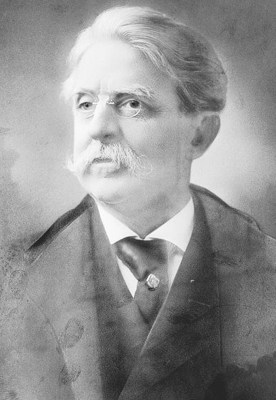
A dignified but slightly careworn John D. Rockefeller, probably then in his fifties. (Courtesy of the Rockefeller Archive Center)