
CHAPTER 17
By the late 1880s, it seemed as if half the country wanted to lynch John D. Rockefeller, while the other half only wanted to cadge a loan from him. He was assailed by journalists, reform politicians, and embittered rivals but also besieged by a growing legion of flatterers and schemers with designs on his fortune. This national ambivalence must have confirmed Rockefeller’s view that his critics were just envious hypocrites. The press fed this fascination with him. One 1889 newspaper article showcased Rockefeller as America’s richest man, with a net worth of $150 million—an estimate he regarded as much too high, pegging forty to sixty million as the correct range. (That would translate into between $635 and $950 million in contemporary money.) Another article clocked his income pouring in at $750 an hour. Whenever such articles appeared, hordes of supplicants emerged, making bad publicity in many ways less troublesome than favorable coverage. “I have been run down by adventurers during the last few days, owing to some foolish newspaper article,” Rockefeller complained after one flattering piece.1 He mused, “Great wealth is a great burden, a great responsibility. It invariably proves to be one of two things—either a great blessing or a great curse.” 2
Wherever he went, he was now trailed by a small army of petitioners. For someone of Rockefeller’s private nature, it was disconcerting to be approached in the street by strangers seeking money. “Mr. Rockefeller was constantly hunted, stalked and hounded almost like a wild animal,” said Frederick T. Gates, the Baptist minister who would soon help to alleviate the problem. “Neither in the privacy of his home nor at his table, nor in the aisles of his church, nor during his business hours, nor anywhere else, was Mr. Rockefeller secure from insistent appeal.”3 Supplicants breakfasted with him, rode to and from work with him, dined with him in the evening, then retired with him to the privacy of his study. “The good people who wanted me to help them with their good work seemed to come in crowds,” Rockefeller moaned. “They brought their trunks and lived with me.”4
Rockefeller had always required rest and solitude, but by the late 1880s these petitioners had stolen from his daily schedule those all-important intervals of relaxation:
At dinner they talked to me and, after dinner, when a little nap and a comfortable lounge, or a restful chair and a quiet family chat seemed about the most desirable occupations until bedtime, these good people would pull up their chairs and begin, “Now, Mr. Rockefeller—.” Then they would tell their story. . . . There was only one of me and they were a crowd—a crowd increasing in numbers every day. I wanted to retain personal supervision of what little I did in the way of giving, but I also wanted to avoid a breakdown.5
Mountains of mail tumbled in from around the globe, and by 1887 Rockefeller was so oppressed by appeals that he grumbled to brother Frank, “I have been overwhelmed with this sort of thing of late and want to shut down brakes a little until I can catch breath.”6The begging letters—many scarcely literate, often scrawled in pencil in foreign tongues—typically pleaded for money to relieve some personal misfortune. People wrote to Rockefeller the way small children pray to God for presents. In 1887, a distraught lady told him, “I wish I could see you and talk with you as I can with God but it seems harder,” while another woman confessed, “Last night as I lay thinking (for I could not sleep for the anxiety) asking the Lord for deliverance you came to me in a way that I could not banish it.”7
The volume of mail defied the imagination. One steamer alone brought five thousand begging letters from Europe. After the announcement of one large educational gift, Rockefeller received fifteen thousand letters during the first week and fifty thousand by the end of the month. He needed a staff just to sift through these appeals. His overtaxed subordinates opened each envelope and tried to identify genuine cases of need, but they could gratify only a tiny fraction of such hopefuls. Many requests were frankly selfish, as Rockefeller tartly noted. “Four-fifths of these letters are, however, requests of money for personal use, with no other title to consideration than that the writer would be gratified to have it.”8
Although Rockefeller didn’t recognize it at first, brewing here was a personal crisis more debilitating than anything he had encountered in business. As early as 1882, he lamented to the Reverend Edward Judson that he was swamped by charitable appeals, many from Baptist causes. “I am about leaving Cleveland and have a regular deluge of calls from every hand. . . . I was up until eleven o’clock last night and the night before on this general character of work trying to help to devise ways and means.” 9 Personal charity had long been his pleasure, his pride, his recreation, not something delegated to underlings, and he found it hard to break these honorable habits, especially in the midst of so much controversy about his business methods. As Gates noted of his early years, “He used to meet people, read letters, weigh appeals, send checks and receive grateful replies, all in his own person.”10 For such a perfectionist, giving money away was fraught with far more nervous tension than making it. He valued money too highly to dispense it lightly and wanted to investigate all requests before acting upon them. As the Lord’s fiduciary, he was responsible for seeing the money well invested. As he said in 1886, “I haven’t a farthing to give to this or any other interest unless I am perfectly satisfied it is the very best I can do with the money.”11
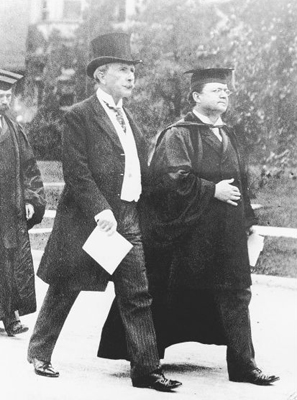
John D. Rockefeller striding briskly across the University of Chicago campus with William Rainey Harper. (Courtesy of the University of Chicago Library)
Now, as the sheer magnitude of his wealth rendered his accustomed approach obsolete, he was frustrated that he couldn’t give money away quickly enough to keep pace with his mounting income. It took several years before he learned to donate money in the systematic, scientific fashion that befit the scale of his fortune. He needed to forge a new set of working principles for his charity, and it was in his creation of the University of Chicago that he came to define his future style as a philanthropist.
Rockefeller’s involvement in the university started in a roundabout fashion through his friendship with the Reverend Augustus H. Strong, an eminent Baptist theologian and exponent of the social gospel. For seven years after the Civil War, Dr. Strong had served as pastor of the First Baptist Church of Cleveland, where he officiated at the funeral of Rockefeller’s second child, Alice, who died in infancy. In 1872, he headed east to assume the presidency of Rochester Theological Seminary, the citadel of Baptist orthodoxy. Awed by the erudite piety of this Yale graduate, Rockefeller supplemented his income, paid his vacation expenses, and, heeding his entreaties, gave $500,000 to his seminary over the years. A fine-looking man with a bushy mustache, Strong was grave, witty, and charming but tightly buttoned up and incapable of levity. An autocrat by nature, he didn’t become convinced by an idea so much as possessed by it to an extent that other people could find insufferable.
Starting in the early 1880s, Dr. Strong began to pitch to Rockefeller a grandiose scheme for an elite Baptist university in New York City over which he would himself preside. Convinced that the Baptists were lagging in the denominational race, he feared that many young Baptists were going by default to Harvard, Yale, or Princeton. His “university of the future,” as he dubbed it, would sit on Morningside Heights and cost Rockefeller a breathtaking $20 million. Since New York was becoming America’s foremost metropolis, Dr. Strong thought it a fitting home for this institution. Modeled after Johns Hopkins, it would accept only graduate students and research fellows, attracting the cream of Baptist undergraduates from around the country. Above all, the university would defend the faith against the encroaching forces of modernism, banning “infidel” teachers from the campus. This educational vision was Dr. Strong’s monomania throughout the 1880s—he contended that he had a “divine mission” to promote it—and he badgered Rockefeller about it at every turn.12 Strong knew how to couch his appeals in religious terminology and dress up self-interest as heaven-sent duty.
Hypersensitive to pressure, Rockefeller tended to stiffen up whenever he felt pushed. He feared the elaborate nature of Strong’s project and grew deaf to his entreaties. Several times, he asked Strong to table the subject and finally imposed a moratorium on all further discussion of it. Rockefeller was always quick to spy the worldly ambition when men of the cloth falsely claimed to pursue godly objectives. Ordinarily, he would have made quick work of such a pushy supplicant, but he tolerated Strong out of respect for his scholarship as well as because of growing ties between their two families.
Whenever Dr. Strong returned to Cleveland, his children were among the very few who frequented Forest Hill, and the Rockefeller children were especially fond of his brilliant eldest son, Charles. Tall and handsome, with curly black hair, Charles would sit in their favorite beech tree, reading ballads to them while perched on a bough. At first, Charles was attracted to Alta, then moved on to her older sister, Bessie. The striking compatibility of the Strong and Rockefeller children must have comforted John and Cettie, who worried that less-religious children might spoil their wholesome environment. For years, John Strong corresponded with Edith and might even have proposed to her, while Junior had a schoolboy crush on Mary Strong, ten years his senior. Later, he wrote affectionate, flirtatious letters to Kate Strong—addressing her as “My dear sister Kate”—even though she, too, was many years older.
Bessie and Charles became so wildly smitten with each other that friends said they were almost foolishly in love. They might have been secretly engaged as early as 1885, when Bessie was nineteen and Charles twenty-three. Charles was a prodigious young philosopher, a perfect reasoning machine, who inhabited a cold world of abstractions. He graduated summa cum laude from Harvard in 1885, where he was both a pupil and a friend of William James. As the two star philosophers among the Harvard undergraduates, Charles and George Santayana cofounded a philosophy club and were natural rivals for the Walker Travelling Fellowship, which paid for two years of study in Germany. Santayana was so daunted by Strong’s intellect that before the winner was announced, he prevailed upon Strong to split the prize. It was awarded to these two remarkable students with the understanding that they would divide the money.
In 1886, John and Cettie were searching for a suitable college for Bessie after she graduated from the Rye Female Seminary, and Dr. Strong accompanied them on a tour of Vassar, Smith, and Wellesley. That the Rockefellers finally opted for Vassar owed much to the fact that the strong-willed Dr. Strong chaired its board of trustees. Since Bessie had eye trouble and found it difficult to read, Dr. Strong made special arrangements that allowed her to skip the entrance exams and room with a friend who read aloud to her. When Kate Strong decided to share a suite of rooms with Bessie, it seemed to seal a sacred bond between the two families—surely what the Reverend Strong coveted. He accomplished another strategic objective when Rockefeller became a trustee of Vassar and erected buildings bearing the names Strong, Davison, and Rockefeller.
The only Rockefeller daughter to attend college, Bessie must have been smart and tenacious to overcome her eye troubles. Her few surviving letters evoke a lively, appealing young woman. She was perhaps the most eloquent Rockefeller child, very fond of music and charitable to the poor. As one friend said, “Bessie was a slender rosy-cheeked girl, vivacious, pretty and charming.”13 George Santayana, who met Bessie fresh from Vassar, fondly recalled her as “the image of vigorous health and good sense, nice-looking, frank, and with manlike college airs.” 14 Santayana always suspected that Reverend Strong conspired to marry off his eldest son to Bessie to snare the Rockefeller millions for his beloved university project. He also believed that Rockefeller had welcomed this match of his favorite daughter to a “good-looking, high-principled young man” who would “never separate her from her father, either in place or residence or in sound Christian sentiments.”15 If those were the hidden hopes superimposed upon this youthful romance, both fathers were cruelly disappointed.
During the interval between his graduation from Harvard and his two-year German sojourn with Santayana, Charles underwent a spiritual crisis that had profound repercussions for the Rockefeller family. For two months, he preached in Salem, Ohio, then entered the Rochester Theological Seminary, where he was to study for the Baptist ministry under his father’s vigilant supervision. For the first year, he faithfully attended prayer meetings and taught Sunday school, but his rational Harvard education now corroded the spiritual verities of his youth. Later on, Charles made the terrible confession that he had lost his faith while correcting proofs of one of his father’s theology books. A wholly cerebral man, fearless in exploring forbidden thoughts, Charles realized that he could no longer accept supernatural revelation. He went to his father and announced that he couldn’t stay at the seminary and would openly declare himself an agnostic.
For Reverend Strong, it was a shattering moment—one that he later characterized as his life’s most agonizing ordeal. As a distinguished Baptist theologian, he had groomed Charles as his successor and boasted of his intellectual prowess, confident it would be put to the service of the faith. “He depreciates insight,” he said of Charles, struggling to comprehend his apostasy. “He is critical rather than constructive.” 16 Once his son decided to leave the seminary, the unforgiving Dr. Strong even had him excommunicated, bidding the First Baptist Church of Rochester to withdraw the “hand of fellowship” from his son because he had “ceased to believe in the fundamentals of doctrine.”17 Only later did Dr. Strong realize that his own rigidly doctrinaire attitudes about religion had helped to drive Charles from the church.
Charles’s confidential admission must have stunned his father on several levels. If this loss of faith upset his marriage to Bessie, it might also derail Dr. Strong’s scheme to have Rockefeller finance a Baptist superuniversity in New York; it might even jeopardize Rockefeller’s future gifts to the Rochester seminary. It is not clear when Charles confided his spiritual turmoil to Bessie, or when Rockefeller became aware that his daughter’s suitor was a radical freethinker. Santayana’s comment clearly suggests that during Bessie’s courtship with Charles, Rockefeller was ignorant of Charles’s heretical tendencies and derived comfort from his sound views. This leads one to wonder whether Augustus and Charles—the one for money and the other love—tacitly decided to draw a discreet veil across Charles’s loss of faith.
The family association emboldened Dr. Strong to renew his pleas for a university in New York. While Bessie was still a freshman at Vassar, Dr. Strong dared to reopen the taboo subject. In a January 1887 letter, he began by telling Rockefeller that he had abided by his promise not to broach the forbidden subject, but time constraints now forced him to break long silence. “It has haunted me day and night for years,” Strong said of his proposal, “but I have had to keep my mouth shut. Meantime, years are passing and we are hurrying on to meet God.”18 Competing plans were now afoot for a Baptist university in Chicago, and Dr. Strong panicked at the thought of others gaining ground on him.
Rockefeller rebuffed this overture, then sweetened the pill by giving another $50,000 to the seminary. Since he admired Dr. Strong and didn’t wish to alienate him, he proposed that they travel through Europe that summer with Charles and Bessie. For Strong, this presented a miraculous chance to push his scheme in an intimate setting. “He accepted an invitation to tour Europe with Mr. Rockefeller for the reason chiefly, as he once told me, of using the opportunities daily association at leisure would give him of expounding his great theme and winning Mr. Rockefeller’s adherence,” said one theologian friendly with Strong.19 In their travels, Dr. Strong planned to acquaint Rockefeller with the great European universities to whet his interest in founding an American school.
On the other side of the Atlantic, George Santayana was sharing the Walker Travelling Fellowship with Charles Strong in Germany and noted his friend’s moody behavior. In January 1887, Santayana wrote to William James that Charles was “very reticent about all personal matters, so that I know less about what has been troubling him than you probably do.” 20 A month later, Santayana told James that he had “no idea what has been the matter with [Charles] this winter except that evidently he has not been at ease.”21Charles kept his engagement to Bessie so secret that when he went to Paris that spring he didn’t tell Santayana that he was meeting the Rockefellers. Santayana caught up with the party in London, where they were enjoying the festivities of Queen Victoria’s jubilee. Though Santayana met and liked Bessie, he was repelled by Rockefeller, who seemed devious and avaricious as he meditated ways to expand Standard Oil sales to Spain.
Encouraged by their travels together that summer, Dr. Strong increased the pressure on Rockefeller in the autumn. He completely misread Rockefeller’s psychology. Where Rockefeller preferred a modest approach, Dr. Strong was often overbearing, as if trying to bully him into endorsing the project. He committed an unforgivable sin by suggesting that Rockefeller could sanitize his reputation by funding the university. “You have the opportunity of turning the unfavorable judgments of the world at large into favorable judgments—and not only that—of going down to history as one of the world’s greatest benefactors.”22 This argument miscarried on several counts: Rockefeller resented any references to his infamy, felt no need to cleanse his reputation, and rebelled against any insinuation that his charity was selfishly motivated. Four days later, he decided to postpone consideration of Dr. Strong’s project.
Meanwhile, Charles Strong’s suit to win Bessie’s hand prospered, and sixteen months later, on March 22, 1889, Bessie Rockefeller, twenty-three, adorned with $8,000 in pearls, married Charles, twenty-seven, in the front drawing room of 4 West Fifty-fourth Street in a marriage performed by Reverend Augustus H. Strong. With 125 guests, it was as opulent an occasion as the Rockefellers had ever staged, and Bessie’s favorite teachers and classmates were brought down from Vassar in a private railroad car. The morning after the wedding, Charles and Bessie sailed for Germany so he could resume his philosophical studies, which explains why Bessie didn’t finish her final year at Vassar. She was also suffering from psychological problems, the first sign of nervous symptoms that made her adult life a huge mystery to posterity. In his letters, Rockefeller urged her to avoid all unnecessary excitement and strain, old-fashioned advice that would prove increasingly inadequate in coping with her deep-rooted troubles.
Having piqued Rockefeller’s interest in endowing a major Baptist university, the Reverend Augustus H. Strong had to ward off competing plans backed by no less spirited advocates. The most promising alternative, for a university in Chicago, had the advantage of building on preexisting foundations. In 1856, Stephen A. Douglas had contributed ten acres of land to start a small University of Chicago under Baptist auspices. It expired exactly thirty years later, the victim of debt and mismanagement. Many of its alumni considered this a disgrace to the Baptists and tried, at the last minute, to salvage the institution. Quite naturally, they turned to Rockefeller, who had aided the Baptist Union Theological Seminary in suburban Morgan Park, a sister institution. The seminary’s secretary, Thomas W. Goodspeed, unfortunately broached his rescue plan to Rockefeller at an inopportune moment, when the latter was being hounded mercilessly by Dr. Strong; the proposal was consequently rejected. In spring 1887, on the eve of Rockefeller’s European trip, Goodspeed again sounded out Rockefeller, but the titan cordially sent back fruit and flowers, not cash. Nevertheless, Goodspeed had drawn Rockefeller’s attention to Chicago’s merits as a home to a great Baptist university.
Goodspeed was a much better lobbyist than Dr. Strong, with a finer instinct for Rockefeller’s sensibility. With snow-white beard and blue eyes, he was a dignified man who knew how to lobby a rich donor with exquisite tact as opposed to Dr. Strong’s blunderbuss approach. He saw that Rockefeller flinched at anything that smacked of coercion and that patience was better than highpressure salesmanship. From the outset, Goodspeed made practical arguments, pointing out that construction costs were cheap in Chicago and that the Baptists lacked a first-rate midwestern college, forcing their children to study at eastern schools. Goodspeed was heartened by Rockefeller’s response when the most gifted member of the Morgan Park faculty, the thirty-year-old biblical scholar William Rainey Harper, was being wooed by Yale. Rockefeller knew Harper’s reputation as one of the foremost Baptist scholars of the Old Testament and urged Goodspeed to retain him at all costs. Though Harper was eventually spirited off to Yale, he stayed in close touch with Goodspeed and consistently supported a Chicago university project, though without committing himself to any role beyond a consulting one. As early as January 1887, he wrote to Rockefeller, “There is no greater work to be done on this continent than the work of establishing a University in or near Chicago.” 23
Rockefeller felt comfortable with worldly theologians, people determined to find an honored place in both this life and the next, and he was absolutely enthralled by Harper, the student of sacred literature who yearned to build an academic kingdom. Born in New Concord, Ohio, in 1856, Harper gave new meaning to the term wunderkind. He had entered college at ten, took a B.A. at fourteen, and completed his Ph.D. at eighteen. When this prodigy joined the Morgan Park faculty at twenty-two, he was younger than many of his seminary students. Many Baptist leaders recognized him as a man with a special future in the denomination, a dynamo bursting with energy and ideas. While still in his thirties, he opened Bible schools in five cities, founded a correspondence school, and coaxed seventy professors to join an American Institute of Hebrew that was assisted financially by Rockefeller.
While teaching at Yale, Harper often traveled to Vassar on Sundays to teach a Bible class and stayed with the college president, Dr. James M. Taylor. Since Rockefeller often visited Bessie for the weekend, Taylor brought the two together for breakfast, and the mutual attraction was instantaneous. Rockefeller later paid tribute to Harper as “a man of exquisite personal charm” and admitted that he had “caught in some degree the contagion of his enthusiasm. . . . As a friend and companion, in daily intercourse, no one could be more delightful than he.”24 Rockefeller didn’t issue such glowing testimonials lightly.
Harper was a pudgy man with a soft, jowly face behind round, thick spectacles. He exuded optimism and captivated people with his visionary ardor. As one newspaper noted, “Dr. Harper is a marvel of energy. His face shows as much eagerness and aggressiveness as that of Luther.” 25 Yet he had enough tact to steer clear of the pitfalls that tripped up the more egotistical Dr. Strong. In October 1887, fresh from his transatlantic voyage with Strong, Rockefeller invited Harper to lunch at 26 Broadway. The meeting went swimmingly, and a week later the impossibly busy and resolutely private Rockefeller cleared his schedule and spent an entire day with Harper—lunching with him at noon, then driving for a few hours in Central Park, then chatting again in the evening. For Rockefeller, this was an eternity of conversation. Equally unprecedented, he gave Harper a standing invitation to speak with him at any time. As he plumbed the plans for Baptist universities in different cities, Rockefeller always regarded Harper as an emissary for the Chicago group. After his heady day in Manhattan, Harper wrote excitedly to Goodspeed, “Again and again [Rockefeller] referred to you and to his thorough appreciation of your excellence and worth.”26 On future visits to Vassar, Rockefeller and Harper were often seen cycling around the campus together.
With all the hostile publicity directed against Standard Oil during the debate over the Interstate Commerce Act of 1887, it was certainly an auspicious time for Rockefeller to consider a major philanthropic bequest. The newspapers were now puffing him as one of America’s richest men, possibly the richest man, so he was under a certain pressure to show that he could discharge this large responsibility. Education was a safe, neutral area in which he had twenty years of experience, having contributed generously to Denison University in Granville, Ohio; Indian University in Muskogee, Oklahoma; Barnard College in New York, which appointed Cettie to its first board of trustees; and Cornell University, whose president, Andrew D. White, he had met on a European trip. Most notably, he was the godfather of Spelman Seminary in Atlanta. Yet Rockefeller was, in many ways, an improbable university founder, for he was not bookish, never attended college, and operated more in a world of facts than theories. Having skipped college, he never automatically recommended it to young people, telling one minister, “I should say in general the advantage of education is to better fit a man for life’s work. I would advise young men to take a college course, as a rule, but think some are just as well off with a thorough business training.” 27
Yet precisely because Rockefeller had missed college, no school could stake a claim on him. While he had the option of distributing his educational largesse widely, such dispersed giving didn’t jibe with his philosophy. In religion and education no less than in business, Rockefeller thought it a mistake to prop up weak entities that might otherwise perish in the evolutionary race. “I think mistakes are made by organizing too many feeble institutions—rather consolidate and have good, strong working church organizations,” he wrote in 1886—a remark that could have applied to his educational views. 28 In the long run, Rockefeller transposed to philanthropy the same principle of consolidation that had worked so well for him in business. Worn down by masses of people clamoring for his money, Rockefeller knew that he now needed a larger and more efficient method for disposing of his fortune. Without it, he would lapse into the slipshod amateurism that he detested. Dr. Strong and Dr. Harper had planted a vision of a large project in his mind, but it would require the careful tending of a lapsed Baptist minister named Frederick T. Gates to bring this seed to glorious life.
While Rockefeller was casting about for some means to spend money more liberally without compromising his scrupulous standards, a group of Baptist leaders met in Washington in May 1888 to form the American Baptist Education Society (ABES). The driving force behind this new association was Dr. Henry Morehouse, the executive officer of the American Baptist Home Mission Society who had advised Rockefeller on Spelman Seminary. Morehouse thought Baptist education was in a woeful state and urgently in need of reform. For Rockefeller, the new group was providential, promising to serve as a handy conduit for channeling large amounts of money to worthy, well-researched Baptist schools.
To serve as executive secretary of the new group, Morehouse drafted a fiery, articulate young Baptist minister, the thirty-five-year-old Frederick T. Gates, who had recently resigned a pastorate in Minnesota and now gravitated toward more worldly affairs. Soon after he assumed the post, Gates championed a Baptist university in Chicago to fill a glaring void. The eastern churches held more money, but the fastest-growing part of the membership resided in the Mississippi Valley and Great Lakes region. Before writing his report, he conducted an intensive study of Baptist education with prosecutorial zeal and ministerial fervor and he confirmed many of the arguments that Thomas W. Goodspeed had adduced. Because many Baptists schools were located in rural backwaters, midwestern congregants often attended schools of other denominations. Having tripled in size in two decades and ranking as America’s second largest metropolis with 1.7 million residents, Chicago seemed the optimal site for a major college.
Gates presented his findings in a richly detailed report that exhibited the exhaustive research that would endear him to Rockefeller. At the beginning, Gates, still unfamiliar with his patron, believed that Rockefeller would respond better to a bold plan than something tentative or equivocal. Hence, he portrayed this new Baptist university as the nucleus of a national educational network, confiding to Morehouse, “A scheme so vast, so continental, so orderly, so comprehensive, so detailed, will in my view capture a mind so constituted as Mr. Rockefeller’s is.”29 On October 15, 1888, he electrified a Baptist convention in Chicago with an impassioned paper entitled “The Need for a Baptist University in Chicago, as Illustrated by a Study of Baptist College Education in the West.”
The Gates report has often been credited with convincing Rockefeller to opt for Chicago, yet William Rainey Harper provided timely assistance. Two weeks after Gates made his sensational address, Dr. Harper spent ten hours at Vassar with Rockefeller and then joined him on the train to New York. During this momentous day, Rockefeller first declared his intention to found a Baptist university in Chicago. As Harper informed Goodspeed, “[Rockefeller] himself made out a list of reasons why it would be better to go to Chicago than to remain in New York.”30 Rockefeller leaned toward the Midwest for several reasons. He feared the complications that might result from the bullheaded Dr. Strong’s leadership of any New York school. He also worried that an eastern school might be encrusted with tradition, whereas a Chicago school could “strike out upon lines in full sympathy with the spirit of the age.”31 Then there was a political dimension that Rockefeller never dared to articulate openly. He had to convince the public that he would not meddle or convert the school into a mouthpiece for his corporate interests. As he put it three decades later, Chicago “was sufficiently removed from Wall Street to encourage the hope that it would escape suspicion of being dominated by the so-called interests.” 32
Twice during the next month, Rockefeller spent a day with Harper, first in Poughkeepsie, then in New Haven, for nonstop talks about the proposed university. Harper was astonished by his patron’s unreserved passion. “I have never known him to be so interested in anything,” Harper told Goodspeed, “and this promises much.”33 Growing more enthusiastic by the hour, Rockefeller advanced a three-pronged plan for a college and university in Chicago, a theological seminary in New York (doubtless to placate Dr. Strong), and an educational trust of western colleges. This last step, a brainchild of Harper, envisioned a string of colleges throughout the West sharing common management with the Chicago university. Warming to the project, Rockefeller planned to visit Cornell on an inspection tour and court three Baptist professors for Chicago. In eloquent testimony to his commitment, Rockefeller told Harper of his readiness to give three million of the first four million dollars needed by the Chicago school. On December 3, 1888, the ABES formally endorsed the plan to found a new school in Chicago; ABES would be the official channel for Rockefeller’s contributions.
Then suddenly, in early 1889, Rockefeller grew aloof toward William Rainey Harper, who had committed the classic error of promoting his cause too assertively. What especially distressed Rockefeller was that Harper wanted to start with a full-blown university, whereas he preferred to begin with a college and expand incrementally. To break this impasse, Harper tactfully bowed out and allowed Gates to take charge of the lobbying campaign. A master at reading the minds of potential donors, Gates intuited that Rockefeller felt put upon by Harper’s quixotic plans and, to lessen his anxieties, he sent Rockefeller a scaled-down plan for a plain Chicago college. Much relieved, Rockefeller invited Gates and Morehouse for lunch on January 21, 1889. When Gates first set eyes on the great sphinx, he found him polite and decorous, if cryptic. “In parting with me,” Gates reported to Harper, “he said that his mind worked slowly in these matters, but he was glad to have had this opportunity for extended conversation, and closed by saying, ‘I think we are in the way of progress.’ ”34
An important upshot of the lunch was that Rockefeller invited Gates to accompany him on a train trip to Cleveland. Gates saw that a low-key approach was the perfect antidote to Harper’s rousing oratory, and he decided to let Rockefeller initiate discussion about the Chicago school aboard the train. “I think this was soon perceived by Mr. Rockefeller,” Gates said in his memoirs, “that it surprised and pleased him, and that he amused himself by putting my sense of propriety to the test.” Though the train left New York at 6 P.M., the two men never referred to what was uppermost in their minds. When they were joined by a phalanx of Standard Oil men, Gates noted the magnetic power Rockefeller had over them. “I observed that he spoke very little indeed, and always in a low and quiet voice.”35 At one point, when the porter making up Rockefeller’s berth accidentally smacked him over the head, Rockefeller “uttered no word, made no exclamation, gave not one word of reproof to the careless porter, and reassured him when he offered profuse apologies,” recalled Gates.36
Having failed to broach the Chicago question with Rockefeller, Gates crept into his sleeping berth that night “a miserable, disappointed man.”37 As it turned out, Rockefeller was coyly enjoying a cat-and-mouse game, and as they neared Cleveland the next morning, he began to pummel Gates with questions about the ABES. Rockefeller wanted reassurance that the ABES board was truly disinterested and devoid of unstated agendas. He also wanted Gates to make on-site inspections of schools and not rely on secondhand reports. On the strength of these assurances, Rockefeller decided to make the Baptist society his preferred vehicle for denominational gifts, an important first step on the road to wholesale philanthropy. Clearly, Rockefeller was contemplating new ways of distributing money through central agencies that could offer expert advice and buffer him from applicants.
Gates often marveled at the inexplicable ways of his new patron, who enjoyed keeping everyone in suspense. As the ABES board meeting approached on February 20, 1889, Gates awaited word of a large contribution from Rockefeller. Only as the meeting was called to order did a messenger arrive with a $100,000 pledge to the organization. Later on, when Rockefeller asked him what the society did with the money, Gates said it went into a bank account that paid no interest. This so mortified Rockefeller’s sense of thrift that he borrowed back the $100,000 and paid the society 6 percent. “I can’t endure to see that money idle,” Rockefeller told Gates. “I feel about it as one does to come into a room, ill swept, with the corners full of cobwebs and dust. I want to clean up that room.”38
In the spring of 1889, Gates went through another baffling period of silence. He was hoping to announce Rockefeller’s decision to bankroll a Chicago university when the ABES held its general meeting in Boston on May 18. At the last minute, Rockefeller advised Gates to stop by his home en route to Boston and listened silently to the latter’s appeal for a large commitment to the Chicago project. Sticking with his habitual policy of creative procrastination, Rockefeller promised nothing and invited Gates for breakfast the next morning.
After all these excruciating dilatory tactics, the campaign for a Chicago college or university reached a surprisingly swift climax on a clear spring morning in May 1889. After breakfast, the two men strolled to and fro before the Rockefeller house on Fifty-fourth Street. After months of stalling, Rockefeller said he was ready to provide $400,000—considerably short of the figure he had quoted to Harper six months before. When Gates rejected this as insufficient, Rockefeller raised the ante to $500,000. Once again, Gates spurned the offer, citing the advantages of Rockefeller contributing the majority of the money. Gates held out for a stunning $600,000 contribution—equal to $9.5 million today—which was predicated upon another $400,000 being raised from other sources. Eager to commit this historic pledge to paper, they went down to Rockefeller’s office where he put his promise in writing.
The next day, clutching this paper, Gates rose before the Baptists in the Tremont Temple in Boston. Rumors had circulated about the gift, creating a tingling mood of expectation. “I hold in my hand,” Gates thundered, “a letter from our great patron of education, Mr. John D. Rockefeller.” A groundswell of cheers surged from the floor. “A letter in which, on the basis of the resolutions adopted by our board, he promises that he will give six hundred thousand dollars—” At this point, pandemonium erupted, with clergymen waving their handkerchiefs, whistling, and applauding. Driven to ecstasy by this earthly bounty, one minister on the podium flung his hat heavenward, while another theologian sprang to his feet and praised “the coming to the front of such a princely giver. . . . It is the Lord’s day. . . . As an American, a Baptist, and a Christian I rejoice in this consummation. God has kept Chicago for us; I wonder at his patience.”39 On this note, the ecstatic holy men rose up to offer a lusty rendition of “Praise God from Whom All Blessings Flow.”40 Overnight, for all his infamy in business, Rockefeller wore a golden nimbus in the eyes of many Baptists.
This was a bruising repudiation of Dr. Augustus H. Strong, who had ridden his hobbyhorse too hard and given the victory to his enemies. At first, it was exceedingly difficult for him to renounce his dream and concede defeat. Falling into deep dejection, he went on plying Gates with letters for Rockefeller until Gates had to inform him point-blank, “There is no hope. Mr. Rockefeller returned your letter to me with the request that the subject be dropped, and that I so write you as would leave no hope of any interest on his part.” 41 After a time, when Strong’s name surfaced in conversation, Rockefeller would drawl sarcastically, “Well, I hope Dr. Strong finds his man!” 42 It took Strong years to recuperate.
In June 1889, a few weeks after Rockefeller’s gift, Andrew Carnegie began to publish in the North American Review an influential essay entitled “Wealth.” Carnegie saw capitalism as threatened by the widening gulf between the swelling fortunes of the great industrialists and the meager wages of downtrodden workers. To defuse tensions and spread economic benefits more widely, he argued that the rich should donate large sums to worthy causes during their lifetimes, lest their money be frittered away by idle heirs. “The man who dies thus rich dies disgraced,” Carnegie declared bluntly.43 Rockefeller was greatly influenced by Carnegie and when the Carnegie Library opened in Pittsburgh in 1896 dashed off a congratulatory note. “I would that more men of wealth were doing as you are doing with your money; but, be assured, your example will bear fruits, and the time will come when men of wealth will more generally be willing to use it for the good of others.”44 Rockefeller was especially struck by the broadly systematic nature of Carnegie’s library program, which would bring some twenty-eight hundred public libraries into existence worldwide. When Rockefeller later addressed Marshall Field, Philip D. Armour, and other Chicago moguls about philanthropy, he echoed Carnegie’s plea to make bequests before they died.
In private, Rockefeller and Gates sometimes faulted Carnegie for letting his vanity peep out behind his benevolence. As Gates griped to Rockefeller, “Mr. Carnegie’s intimate friends tell me that it is no secret between them and him that he does these things for the sake of having his name written in stone all over the country. Have you observed that he always gives buildings while somebody else furnishes the money to keep them in repair?” 45 Rockefeller’s philanthropy was relatively discreet. Another tycoon might have been tempted to plaster his name on the Chicago college, especially during a contentious period that saw the passage of both antitrust and railroad-reform legislation. Yet this only hardened Rockefeller’s resolve to prove that he was not currying public favor. With the University of Chicago, his sole concession to vanity was to allow the trustees to affix his name to the school seal, official documents, and letter-heads. A proposal to place a lamp on the university seal was rejected, lest anyone mistake it for a vulgar allusion to oil. Even though Rockefeller was the Prospero who single-handedly conjured the University of Chicago into being, he didn’t allow any campus building to bear his name, and the Rockefeller Memorial Chapel was christened only after his death.
It was an auspicious time for such a venture. While enjoying the wealth of a nascent world power, America was still saddled with cultural institutions that seemed provincial beside their European counterparts, and many businessmen were eager to endow schools and museums. Rockefeller was not the only magnate to create a major university in the late nineteenth century: The railroad fortunes of both Johns Hopkins and Leland Stanford were similarly applied, while closer to home Rockefeller had the example of the Pratt Institute, set up by Charles Pratt in 1887. Instead of making isolated gifts, Rockefeller wanted to finance institutions whose research would have a pervasive influence. Of the University of Chicago, he later said, “Following the principle of trying to abolish evils by destroying them at the source, we felt that to aid colleges and universities, whose graduates would spread their culture far and wide, was the surest way to fight ignorance and promote the growth of useful knowledge. ”46 To Rockefeller, the least imaginative use of money was to give it to people outright instead of delving into the causes of human misery. “That has been our guiding principle, to benefit as many people as possible,” he affirmed. “Instead of giving alms to beggars, if anything can be done to remove the causes which lead to the existence of beggars, then something deeper and broader and more worthwhile will have been accomplished.”47
Businessmen such as Rockefeller and Carnegie saw themselves as applying their managerial wisdom to the charity world. As at Standard Oil, Rockefeller wanted to reduce waste and duplication in the charitable sphere and deplored the lack of study behind much giving. “Today the whole machinery of benevolence is conducted upon more or less haphazard principles,” he stated in his memoirs.48 The University of Chicago was Rockefeller’s signature project in which he clarified his approach and schooled Frederick T. Gates, his son, and other advisers as his future surrogates.
From the outset, Rockefeller swore that he would avoid the rich man’s trap of endowing institutions that would become dependent wards. His ideal was to create organizations that would take on independent lives and outgrow him. Having pledged $600,000 for the Chicago college, he gave the ABES one year from June 1, 1890, to drum up the other $400,000 from outside sources. To accomplish this, Gates moved temporarily to Chicago and joined forces with Goodspeed in a grueling fund-raising drive that nearly drove them to distraction. They were stymied by restrictions written into the school’s articles of incorporation, which stipulated that two-thirds of the trustees and the president be members of Baptist churches. If the enterprise’s spirit was ecumenical (several prominent Jews contributed), the institution’s charter was explicitly denominational. This confusion emanated from Rockefeller, who insisted that the new institution remain under Baptist auspices yet be “conducted in a spirit of the widest liberality,” with students drawn from every class of society.49 Unfortunately, Chicago numbered few Baptists among its high-spending citizens. Instead of being stimulated by Rockefeller’s involvement, many potential donors smugly assumed that the fledgling school would never want for money. Of their excruciating year of pleading, Gates later said it “cost more brain work, anxiety, anguish, tears, prayers and shoe leather than all the millions that have since gone into the university.” 50 A promising contribution came in January 1890 when Marshall Field donated a ten-acre parcel for the new school on the south side of Chicago, just north of the site of an upcoming fair that would attract worldwide attention: the World’s Columbian Exposition. Delighted by this act of faith, Rockefeller agreed that he and Field would jointly review the names of proposed trustees.
Having devoted his career to eliminating risk from the petroleum business, Rockefeller was unsettled by the uncertainties that dogged the Chicago project. For a long time, the question of who would lead the college was every bit as vexing as who—besides Rockefeller—would support it. William Rainey Harper seemed the natural candidate. As the star salesman who had converted Rockefeller to the cause, he enjoyed his special trust. Whatever his occasional qualms about Harper’s flamboyant rhetoric, Rockefeller was sure the young biblical scholar had unique credentials to run the school. Although Harper might not have known it, Rockefeller revealed his thoughts to him in an unprecedented fashion. Right after Christmas 1888, Harper had dropped by 26 Broadway. Since Rockefeller had been ailing, he asked after his health and Rockefeller replied:
I have made little progress, Doctor Harper. My wife has been sick and I have been anxious about her. My time has been taken up with the consideration of petitions from many sources—I have never known them so numerous. Montreal has come down upon me. Richmond, with a great reinforcement, has come down upon me. From every quarter the demands are growing more numerous, and more insistent. . . . I did not ask you to come and see me Sunday because I spent the day in bed; Christmas, too, I spent in bed—I was so tired. I have had some unusually worrying business matters in the last three weeks; still, the thing [the University of Chicago] is on my mind and I want to hear more about it.51
For a man who lived behind the heavy draperies of Victorian reticence, this was a remarkably candid response.
The intuitive Harper sensed that something else was preying on his mind, and Rockefeller confided that he had received a jarring letter from Dr. Strong. While masquerading as a family Christmas greeting—Charles’s marriage to Bessie lay just ahead—it was a transparent attempt to sabotage Harper and the Chicago project. A self-styled inquisitor, Dr. Strong had examined the class notes of his daughter Kate, who was taking a Bible course at Vassar with Harper, and written to Rockefeller that he had unearthed heretical tendencies in Harper’s teachings. Rockefeller was far more disturbed by Strong’s defamatory tactics than the specific charges leveled against Harper. When Harper was next in Poughkeepsie, he was greeted by a letter from Dr. Strong, who threatened, as a Vassar trustee, to lodge an official complaint if Harper continued to teach the Sunday Bible class there. When Goodspeed found out about this mean-spirited attack, he said to Harper, “The man seems mad, daft.”52
Harper was always Rockefeller’s choice for president, and at times the venture seemed to hinge upon his acceptance. In his grandiloquent visions of this new institution, Harper was not above gently flattering Rockefeller, making the new institution sound like the collegiate equivalent of Standard Oil. “And let it be a university made up of a score of colleges with a large degree of uniformity in their management; in other words, an educational trust,” Harper advised him.53 These sublime words both inspired and petrified Rockefeller. Hounded by requests for money, he didn’t know if he had the income to juggle so many commitments. In January 1889, he told Harper that they should start modestly with a college and defer the university till a later day. “So many claims have pressed upon me,” he explained, “I have not really needed a University to absorb my surplus.”54
Harper agonized over whether to take the presidential post at Chicago or stick with the biblical scholarship he loved. The question was a proxy for the larger issue of whether he sought power and status in life or the quieter rewards of scholarship. Harper was an original theorist and a charismatic teacher who hated to lose contact with his students, but he was also intensely ambitious. To pin him down, Yale offered him a generous, six-year compensation package that would allow him to hold two prestigious chairs at once. Learning of this, Rockefeller wrote Harper, “It would break my heart if I did not believe you would stay in the fold all right. For all the reasons I believe you will. Be sure you do.”55 When Harper conferred with him two weeks later, Rockefeller pleaded with him to avoid any permanent commitment to Yale.
When the University of Chicago charter was adopted in May 1890, the school still lacked a president. To force the issue, Rockefeller dispatched Gates to New Haven that July to notify Harper that he was the board’s unanimous choice to head the school. Far from settling things, this only sent Harper into fresh paroxysms of indecision. In spite of Rockefeller’s reiterated preference for a small college, Harper wanted nothing less than a full-fledged university and believed the one million dollars raised so far a mere pittance that fell short of his visions. As Harper wrestled with the dilemma, Rockefeller wrote to him in August, promising to add a premium to his salary. “I do not forget that the effort to establish the University grew out of your suggestion to me at Vassar and I regard you as the father of the institution, starting out under God with such great promise of future usefulness.” 56 Harper must have noted Rockefeller’s use of the hitherto taboo word university.
This letter alerted Harper to the fact that he now enjoyed considerable bargaining power in shaping the new institution, and his rhetoric only grew more sonorous. “The denomination and indeed the whole country are expecting the University of Chicago to be from the very beginning an institution of the highest rank and character,” he replied to Rockefeller. “Already it is talked of in connection with Yale, Harvard, Princeton, Johns Hopkins, the University of Michigan, and Cornell.”57 Harper characterized the money raised so far as insufficient to realize such lofty aims. Among other things, he envisaged a university where he could perpetuate his own scholarly interests and act as president and professor. When Rockefeller consented to his demand for an extra million dollars to transfer the Morgan Park Theological Seminary to the new Chicago campus, the thirty-four-year-old Harper capitulated and formally accepted the presidency in February 1891. It now seemed clear that his spacious dreams would carry him beyond the small, cloistered world of a biblical scholar.
Over time, the immoderate Harper gave liberal interpretations to Rockefeller’s vague promises of money, but he never misrepresented the scope of his plans. Even before accepting the presidency, he boasted to Rockefeller, “I believe that ten years will show an institution at Chicago which will amaze the multitudes.”58 Working sixteen-hour days, Harper now negotiated more than 120 faculty appointments in little more than a year. Rockefeller might think the university a plant of slow growth, but Harper wanted it to bloom overnight. The new president raided so many Ivy League faculties—the ranks of Yale and Cornell were especially depleted—that his ransacked rivals complained of foul play. Harper dangled sizable sums before reluctant prospects, enlarging the school’s future financial requirements. This nationwide talent search netted nine college presidents for the first faculty. Harper signed up John Dewey and George Herbert Mead for the philosophy department and enticed novelist Robert Herrick to join the English department, while Albion Small initiated America’s first graduate department in sociology. Another eminent recruit, economist Thorstein Veblen, came to regard Harper as the educational counterpart of capitalists such as Rockefeller and satirized him as a captain of erudition, one of a new species of empire builders in higher education.
However inspired he was by Harper, Rockefeller felt sorely beset by his extravagant spending, and their relations began to fray. With outside fund-raising stalled, it seemed that Rockefeller’s worst nightmare was coming true: He would end up sole benefactor of an institution that would bleed him dry for years. Whenever they met, they stayed away from money talk and spoke of educational policy. Financial matters were shunted off into increasingly testy private exchanges between Gates and Harper—exchanges that Rockefeller reviewed privately. By the spring of 1891, Rockefeller began to develop the queasy sense that Harper regarded his money as a blank check to cover annual deficits. To their surprise and disbelief, Rockefeller and Gates saw that the new president would not drop his busy lecture schedule (which netted him $4,000 a year) and contemplated a $3,000 offer to head the Chautauqua School of the English Bible, while also planning a fancy European trip—all the while banking a handsome $10,000 salary at the University of Chicago. As Rockefeller fumed in the summer of 1891, Gates met with Harper and urged him to shed his outside activities. “Of course he rejected these proposals,” Gates informed Rockefeller, “as well as the intimation contained in it that his motives are not without their mercenary side.”59 It was an odd situation: the world’s richest man chastising a biblical scholar for unseemly materialism.
To some extent, Rockefeller sent out conflicting messages and was partly to blame for Harper’s profligacy. It was Rockefeller, after all, who urged Harper to pay top dollar for America’s best academic minds. As Gates told Harper after one meeting with Rockefeller, “We talked at great lengthabout salaries of head professors pro and con and as a result he wished me to say to you positively that the best men must be had.” 60 Such talk could easily inspire a cavalier attitude toward money. Gates also had an ulterior motive for wishing Harper away from the lecture circuit. Though he was not the freethinker darkly portrayed by Dr. Strong, Harper did have heterodox religious views and brooded morbidly on his own heresy. Practicing the higher criticism, he had moved away from a stress on biblical inerrancy to a scholarly search for the authorship of sacred texts. Though becoming a modernist in his own right, Gates wanted Harper to muzzle his unorthodox views in public. Potential donors were already worried about the new university’s diluted Baptism and questioned Harper’s doctrinal purity. To one such critic, Gates insisted, “Dr. Harper is a man of evangelistic spirit and annually secures scores of conversions at Yale,” implying that he would continue this practice at Chicago. 61When Gates expressed concern to Harper about his views, the latter made a clean breast of his liberal religious views to Rockefeller so that he would never be shocked by his unorthodoxy.
The newspapers were not privy to these internal tensions and lampooned the implausible pairing of the trust king and the biblical scholar. Harper was irritated by cartoons that showed him sprinting after Rockefeller and his money bags. In one cartoon strip, Harper desperately pursued Rockefeller across a frozen Hudson River, hopping from one ice floe to the next until a weary Rockefeller dropped a thick wad of bills behind him to sate the university president. When Rockefeller later gave one million dollars to Yale, another cartoonist drew Harper astride a college building marked “University of Chicago,” glaring enviously at another college building marked “Yale.” Harper was often portrayed as a sycophant of the rich. In one cartoon, he was seen greeting fashionable ladies at the train station and carrying their luggage, which was marked “Proper Function of College Presidents.”
There must have been moments in 1891 when John D. Rockefeller wondered how he had gotten entangled in a project so vast and headed by such a brilliantly erratic man. Had he known what lay ahead, it seems doubtful that he would have persevered. But he had now publicly staked his reputation on this hugely expensive endeavor and, in the last analysis, wherever William Rainey Harper led, John D. Rockefeller would grudgingly follow. He was not a man to abandon a project that had received his blessing.
However mingled with joy, Rockefeller’s anguish over the University of Chicago came at a moment of physical vulnerability and tipped him over the edge toward a breakdown. Gates’s letters to Harper are laced with references to their patron’s sharply deteriorating health. In April 1891, Gates said after a tête-à-tête with Rockefeller: “He was kindness itself, but appeared very sad and depressed. . . . He even told me that anxiety and worry about the matter [i.e., university finances] had made him sick and it was this that took him from his business and drove him to Cleveland. We mustnot press him for money. Let us see to it and see if we can not cut down expenses and get through the first year with the smallest possible deficit.”62
This was more than mere bluff or tactical posturing on Gates’s part, though there was doubtless some of that. Starting in early 1889, Rockefeller had complained continually of fatigue and depression. For several decades, he had expended superhuman energy in the creation of Standard Oil, mastering myriad details; all the while, pressure had built steadily beneath the surface repose. One could now see in his face the subdued melancholy of a man who had sacrificed too much for work. In early 1890, Rockefeller stayed away from the office for several months due to an unspecified illness. Later in the year, he promised to stop working on Saturdays and take more vacations, but the symptoms harried him into the following spring.
By 1891, the top executive ranks were beginning to thin at Standard Oil. Charles Pratt died suddenly that year, and Henry Flagler was increasingly distracted by his Florida hotel and railway ventures. Having groomed John D. Archbold as his successor, Rockefeller began to shift day-to-day power to his feisty, bantam protégé. More reviled than honored for his triumphs, Rockefeller, fifty-two, felt embattled by endless subpoenas from court cases and congressional hearings. Though he brushed off his critics as minor irritants and professed faith in his own integrity, it could not have been easy to face such universal opprobrium. Keeping up the pose of indifference must have taken its own toll.
Nevertheless, Rockefeller had come through earlier assaults unscathed. What really disturbed him was not so much making money but spending it. One Cleveland society woman, a friend, told a story of sitting beside him on a streetcar when the conductor came to collect fares. When Rockefeller handed him a quarter, the conductor deducted two nickel fares, assuming he would pay for the lady, and gave him fifteen cents change. “My change is five cents short,” Rockefeller declared. “Why, no. I took out two fares and gave you back fifteen cents,” explained the conductor. “But I did not tell you to take out two fares,” Rockefeller retorted. “Let this be a lesson to you, and never assume that a passenger is paying for two people unless he says so.”63 Rockefeller reviewed every bill that arrived at home and often patrolled the hallways, turning off gaslights. Such habits were not simply reflexive stinginess but were rooted in bedrock beliefs about the value of money. When he discovered that one railroad overcharged him $117 for carrying his family and horses, he had the Standard Oil treasurer immediately retrieve the money. “I need the $117 to build mission churches in the West,” he explained, showing the association in his own mind between savings and charity.64
With such uncommon respect for the dollar, he couldn’t cope with the psychological demands of the University of Chicago and other philanthropic commitments. As Rockefeller said, “I investigated and worked myself almost to a nervous breakdown in groping my way, without sufficient guide or chart, through the ever-widening field of philanthropic endeavor. It was forced upon me to organize and plan this department upon as distinct lines of progress as our other business affairs.”65 The figures of Rockefeller’s contributions between 1889 and 1892 reflect the expanding nature of his giving. From $124,000 in 1889 (right before his big pledge to Gates), his donations soared to $304,000 in 1890, $510,000 in 1891, and then a spectacular $1.35 million in 1892 ($22 million today) as he opened the spigot for the University of Chicago. Clearly, he needed someone to help with the avalanche of appeals overwhelming him, and by late 1889 he began to forward begging letters to Frederick T. Gates. “I am disposed more and more to give only through organized agencies,” he told Gates.66 Finally, in March 1891, suffering from broken health and all too aware of his mortal limitations, Rockefeller summoned Gates for a confidential parley:
“I am in trouble, Mr. Gates. The pressure of these appeals for gifts has become too great for endurance. I haven’t the time or strength, with all my heavy business responsibilities, to deal with these demands properly. I am so constituted as to be unable to give away money with any satisfaction until I have made the most careful inquiry as to the worthiness of the cause. These investigations are now taking more of my time and energy than the Standard Oil itself. Either I must shift part of the burden, or stop giving entirely. And I cannot do the latter.”
“Indeed you cannot, Mr. Rockefeller,” Gates replied.
“Well, I must have a helper. I have been watching you. I think you are the man. I want you to come to New York and open an office here. You can aid me in my benefactions by taking interviews and inquiries, and reporting the results for action. What do you say?”67
Gates accepted and in March 1891 transplanted his family to Montclair, New Jersey, and took up offices in the Temple Court, near 26 Broadway. This action, which ended his ministerial career, made him an earthly potentate instead. At first, Gates retained his position as secretary of the ABES and funneled Rockefeller money around the country. By 1892, Gates joyously proclaimed to Rockefeller, “Our denomination has a larger, better distributed, better organized, and more efficient educational property than any other denomination in America.”68 Only after 1900 did the two men begin to branch out into the revolutionary schemes that transformed old-fashioned denominational charity into modern philanthropy. By that point, Gates had assembled a team of advisers tutored in Rockefeller’s principles, trained in his methods, and fired with his evangelical zeal.
For the remainder of his life, Rockefeller’s medical status provoked so much fantasy, gossip, and speculation that we should try to define it here with some precision. Rockefeller had been fit and youthful well into his fifties. He never adopted the sleek, portly look of his fellow plutocrats and seemed ten years younger than his age. What, then, ailed him in the early 1890s? Broadly speaking, the answer was overwork, brought on by the combined stress of work and charity. As his inseparable companion and homeopathic physician, Dr. Hamilton Biggar, said, “A little more of that would have killed him. Mr. Rockefeller was close to the edge of a breakdown . . . when he finally let himself be persuaded that he could no longer do the work of several men with the strength of one.”69But if overwork weakened his immune system, he also succumbed to opportunistic diseases. In 1891, a national grippe swept the nation, and Rockefeller was laid low. Dr. Biggar also diagnosed him as having a catarrh of the upper part of the bronchial tubes. For years, Rockefeller suffered from liver trouble—at one point he bought a “liver pad” from a local drugstore, wearing it with beneficial results—and in the early 1890s, Dr. Biggar plugged him full of an unnamed brew he had concocted for this trouble.
It was Rockefeller’s prolonged digestive troubles that most titillated the public, providing enduring satisfaction to moralists who believed that if Rockefeller could not be brought to justice, he could at least be tormented through his bodily afflictions. He had serious digestive problems in the early 1890s, perhaps even stress-related ulcers, and looked pale and haggard. For a time, to soothe his stomach, he lunched on milk and crackers at 26 Broadway, spartan fare that he enjoyed and sometimes even ordered by choice. He recovered from his digestive troubles, however, and they never recurred in any really threatening way. Yet he remained extremely fussy about his food, taking small, sparing bites in a manner that spawned a thousand myths about his ruined system. For years it was bruited that he had a standing million-dollar offer for any doctor who could repair his stomach.
Those who believed that Rockefeller was suffering divine retribution would have been interested to learn that in November 1888 Cettie was seriously injured in an alcohol-lamp explosion that badly burned both her hands and face. She had to be bedridden for several weeks. Only a few mystifying references to this ghastly accident appear in Rockefeller’s letters. One can’t help but wonder whether the lamp was actually burning Standard Oil kerosene and whether Rockefeller turned it into an alcohol lamp in his correspondence. Would the wife of John D. Rockefeller have used alcohol lamps? If Cettie was the casualty of impure Standard Oil kerosene, her husband might well have viewed her accident as celestial judgment upon him.
During 1891, under doctor’s orders, Rockefeller took time off from work and spent eight months at Forest Hill, the family’s sovereign cure for illness. His private secretary, George D. Rogers, was placed under strict instructions to spare him all but urgent business matters. For the first time in twenty-one years, his mind was cleansed of Standard Oil. To restore his health, he worked with his farm laborers in the field, rode his bike, ate simply, and jokingly claimed he was becoming a “great concert singer.” 70 These traditional remedies worked like a charm, for by June 1891 he wrote Archbold, “I am happy to state that my health is steadily improving. I can hardly tell you how different the world begins to look to me. Yesterday was the best day I have seen for three months.”71By the end of the summer, he had gained fifteen pounds, fresh color was restored to his face, and he resumed a more normal schedule. On February 23, 1892, he had Gates post a letter to the University of Chicago trustees, pledging another million dollars with these words: “I make this gift as a thank offering to Almighty God for returning health.” 72 In fact, the offering was as much a grudging response to Harper’s improvident spending as a token of Rockefeller’s gratitude to the Lord.
Having always enjoyed ruddy health, Rockefeller was evidently shaken by his lengthy illness, for he dreaded rushing back to work and precipitating a relapse. He now contemplated something inconceivable for most other restless tycoons of the period: retirement. He had no psychological need to spend his life amassing money and told Gates that he had all he wanted. As he later explained, “I felt that at fifty it was due me to have freedom from absorption in active business affairs and to devote myself to a variety of interests other than money making, which had claimed a portion of my time since the beginning of my business career.”73 Though he craved retirement, several crises tethered him to business for another three or four years until he stopped going to 26 Broadway altogether in 1897. In the meantime, he reported to the office less and less, as the focus of his life shifted slowly from earning money to dispensing it as intelligently as possible.
Although Harper had the founder’s promise that he would attend opening ceremonies, Rockefeller, eager to prove that he would not meddle with the school, later rejected the idea. One also suspects that he subtly wished to telegraph his displeasure to Harper over the handling of university finances. In early 1892, Gates visited Chicago and was “utterly appalled” at the yawning chasm between Harper’s extravagant schemes and the available money. Yet with all his openhanded spending, Harper had accomplished one of the great feats in education history. True to his wishes, he opened the school on October 1, 1892, without ceremony “as if it were the continuation of a work which has been conducted for a thousand years.”74 His hastily gathered faculty was so studded with renowned scholars that the university was catapulted instantly into the front ranks of higher education. On the first day of classes, the new school boasted 750 students, one-fourth of them women, with ten Jewish students, eight Catholics, and a handful of blacks.
Architect Henry Ives Cobb had little more than a year to summon a campus into being, and five major buildings were completed in 1892, another five in 1893. Built at a moment of civic pride, the new university sprang up beside the fabled White City of the 1893 Columbian Exposition. The fairgrounds featured a spectacular Standard Oil exhibit of a miniature refinery surrounded by a strange colonnade of Ionic columns with alternating oil-filled lamps and vases. From a Ferris wheel on the midway, visitors received a superb aerial view of the new school that Standard Oil profits had produced. Since Henry Ives Cobb also helped to plan the fairgrounds, the two projects appeared to blend into a seamless whole.
Once the university was inaugurated, President Harper did not stand still. Impulsive, never satisfied, he began to advance on a hundred fronts. Heedless of costs, he broached new initiatives to create a junior college, a night school, a correspondence school, extension courses for adults, a university press, a special division for laboratories, and museums. As leader of this educational trust, he wanted to dispatch scholars to teach at affiliated colleges in other states—an expensive initiative vetoed by Rockefeller. Harper also believed a university should benefit the surrounding city, and sociologists fanned out from the campus to undertake studies at Hull House and other settlement houses.
For all his pride in the university, Rockefeller dreaded this unbridled growth, which postponed the day when the new university might survive without him. Often, when Harper bagged another famous scholar, the university had to buy equipment for the newcomer—money Harper neglected to figure into his calculations. For all their mutual attraction, Rockefeller and Harper were destined to clash. As Gates framed the contrast:
Mr. Rockefeller, with a breadth of vision as great as Dr. Harper’s, was temperamentally cool, reserved, cautious, circumspect, deliberate, amazingly patient, but in the end, inflexible, adapting means to ends with long and accurate prevision. Dr. Harper was ardent, highly imaginative, with limitless capacity and insatiable eagerness for work, an undaunted optimist, minimizing difficulties, magnifying opportunities, rapid in conception, confiding, unsuspicious, bent on immediate results, willful, and impatient of opposition or delay. 75
As a businessman, Rockefeller believed in praying for good times while bracing for bad, and his recurring pleas for caution were vindicated in 1893 when panic seized the American economy and the university had to stall on paying salaries. To surmount the crisis, Rockefeller transferred another $500,000 to the university that October. He was now drawn in so deep that he couldn’t withdraw—and Harper knew it. Having sworn he would never cover operating deficits, Rockefeller had to renounce that policy and cover the budget shortfall for the next two years.
What made it so hard to enforce discipline in Chicago was that, after the obligatory protest, Rockefeller always came through with the money. In October 1895, Gates went to Chicago armed with a letter from Rockefeller pledging another three million dollars for the school’s endowment—possibly the largest such sum ever given at one time by one man for educational purposes and worth about $50 million today. Soon after, Harper and the university secretary, Thomas W. Goodspeed, attended a football game between Chicago and Wisconsin. During the first half, they told coach Amos Alonzo Stagg—who set up the first department of physical culture at an American university—about the gift. With Chicago trailing twelve to ten at halftime, Stagg suggested that the team be informed “because I felt that it would be a strong piece of psychology to do so,” as he said.76When told by Harper of the gift in the locker room, the team’s captain roared, “Three million dollars!” and gave another player a gleeful slap on the back. “Just watch us play football.”77 With that, the born-again squad streamed back onto the field and beat Wisconsin twenty-two to twelve. Later on, students lit a huge celebratory bonfire on campus and sang hymns to Rockefeller, including one that began, “There was a man sent from God whose name was John.”78
Despite a standing offer to tour his creation, Rockefeller declined to visit Chicago for several years, reluctant to have the university overly identified with his name. As Gates told Harper, “There are as you know advantages to the University (advantages in your canvass for funds) in the disinterested way in which Mr. Rockefeller has given his money.” 79 Beyond that, Rockefeller cherished his privacy and hated public occasions. When Harper finally persuaded John and Cettie to attend the first class quinquennial celebration in July 1897, he promised that Rockefeller would not need to speak. The patron’s ideal was to amble unseen through the campus for a couple of hours, an anonymous voyeur, relishing his creation.
As hundreds of students and professors, clad in caps and gowns, trooped into a huge tent in the central quadrangle on a sweltering July day, only one figure wore a plain frock coat and silk hat: the university founder, who marched, as he had since boyhood, with his eyes fixed on the ground. Far from being a fire-breathing mogul, he seemed quiet and faintly embarrassed by the fuss being made over him. When he got up on stage, three thousand people gazed in fascination at this reclusive American legend who had mesmerized the public as both a sinner and saint. It was so stifling inside the tent that hundreds of palm-leaf fans undulated in the audience. When Harper rose and reviewed the future needs of the university, he turned expectantly toward Rockefeller and referred to the pressing need for a hall to replace this temporary tent, eliciting an ambiguous smile from Rockefeller, who must have squirmed in his seat. Then the titan rose to address the crowd:
“I want to thank your Board of Trustees, your President and all who have shared in this most wonderful beginning. It is but a beginning”—he was interrupted by frenzied applause—“and you will do the rest.” The audience quieted down. “You have the privilege to complete it, you and your sons and your daughters. I believe in the work. It is the best investment I ever made in my life. Why shouldn’t people give to the University of Chicago money, time, their best efforts? Why not? It is the grandest opportunity ever presented. Where were gathered ever a better Board of Trustees, a better Faculty? I am profoundly, profoundly thankful that I had anything to do with this affair.” A roar of appreciative laughter. “The good Lord gave me the money, and how could I withhold it from Chicago?” 80
Whatever his own discomfort, Rockefeller made an excellent impression. Before the day was out, he had laid cornerstones, listened to sermons, and given two more short talks. He spent the night at Harper’s house and was so unnerved by the absence of clocks—the visit made him deviate from his usual daily schedule—that he gave Mrs. Harper a thousand-dollar check as a gift and suggested she buy clocks. The next morning, Rockefeller mounted a bike and set off on a campus tour with university administrators in tow. Attired in a bicycle suit, he set off at a brisk pace, waving at cheering students along the route. The entourage flew down the midway to Jackson Park, circled the ghostly remains of the Columbian Exposition, stopped for refreshments, then whirled back down the midway. Rockefeller was enormously gratified and touched by the warm, spontaneous enthusiasm of the students. Everywhere he went they chanted, “John D. Rockefeller, wonderful man is he / Gives all his spare change to the U. of C.” Another knot of students burst into a fight song: “Who’s the feller? Who’s the feller? Rah, Rah, Rah / Rockefeller, he’s the feller, Sis, Boom Bah!”81
As a philanthropist, Rockefeller chose to cultivate a wise detachment from his creations and told Harper that he saw himself as a silent partner in the operation. Despite intermittent accusations to the contrary, he did not interfere with academic appointments or free expression, though sometimes tempted to do so. When several Chicago students denounced his monopolistic practices, an enraged Rockefeller complained to Gates of “statements from the students, derogatory to the founder, careless and inexcusable; but whether the report is correct, I do not know. . . . It seemed to me if . . . [it was] correct the men should be expelled from the Chicago University.” 82 In this and other cases, as best as one can tell, Rockefeller then countermanded the order, fearing the threat to academic freedom or at least to his own reputation.
It took courage to start a university in the 1890s, when academe swarmed with vocal critics of big business, and many of Rockefeller’s industrialist friends saw universities as so many breeding grounds for subversion. William chided his brother for sponsoring the school: “You are getting together a lot of scribblers, a crowd of Socialists who won’t do any good.” 83 Rockefeller wrestled with the issue but believed, on balance, that “while scribblers of the worthless kind brought poison with their ink to the minds of the people, yet multitudes of others come out of these institutions of learning to strengthen the good among us. Let us so hope.”84 The University of Chicago was scarcely immune to the radical currents on campus. In 1899, while at Chicago, Thorstein Veblen published The Theory of the Leisure Class, which portrayed the new captains of industry as brutal troglodytes and exposed the primitive impulses lurking behind their gaudy consumption habits.
The best-publicized controversy about Rockefeller’s role at Chicago involved the dismissal in 1895 of a young political economist, Edward Bemis, who advocated municipal gas ownership and attacked the Standard Oil–controlled United Gas Improvement Company. The official explanation for the firing was that Bemis was more an activist than a scholar and did not measure up to the university’s high standards. Since Bemis had been hired by Harper himself and went on to a career of some distinction in utility regulation, one suspects a political motive behind his dismissal, yet there is no evidence that Rockefeller was the culprit. It seems more likely that Harper sacked him in anticipation of Rockefeller’s wrath. A year earlier, Harper had warned Bemis about his political activities after he made an inflammatory speech criticizing the railroads’ behavior during the Pullman strike. Such visible activism handicapped Harper in courting local business, as he made clear in a letter to Bemis in July 1894:
Your speech at the First Presbyterian Church has caused me a great deal of annoyance. It is hardly safe for me to venture into any of the Chicago clubs. I am pounced upon from all sides. I propose that during the remainder of your connection with the university you exercise great care in public utterances about questions that are agitating the minds of the people. 85
Rockefeller refrained from such pressure because he knew the political value of his nonpartisan patronage of a university at a time when he was being accused of subverting other institutions to advance his own interests.
Rockefeller did, however, request a voice in fiscal matters—the one thing that Harper denied him. Like many donors, Rockefeller wished to give freely, but Harper was constantly trying to speed up the process. In appointing Gates as his buffer with Harper, Rockefeller hoped to keep the university guessing about future gifts, but the tactic did not work. “Harper was insatiable in his appetite for money,” said one Standard Oil counsel. “Gates was the guardian of the treasurer.”86 As time passed, the strains between Gates and Harper grew intolerable. Both men were idealists steeped in religion, marred by a streak of worldly ambition, and each accused the other of hypocritically exploiting Rockefeller for personal gain.
At first, Gates admired Harper as an inspirational figure who overspent out of naive enthusiasm. He later modified this sanguine view when Harper stoutly denied that a first-rate university could be run as an efficient business and declared, “A university that is properly operated always has a deficit.” When this remark appeared in the press, it grated on Rockefeller and Gates as rank betrayal.
According to Gates, Harper flouted several clear understandings with Rockefeller: that the university would never be indebted; would never use endowment funds for university buildings; and would never form an alliance with any medical college in Chicago. When Gates put these points in writing and asked Harper to circulate them to board members, they mysteriously disappeared. When he remonstrated with Harper for hiring more expensive professors and launching new journals, the university president simply ignored him. Soon after Gates insisted that he forgo new buildings, Harper appealed to Chicago’s citizens to support a new building campaign. Just as Rockefeller feared, Harper had rashly leaped straight from a small college to a big university.
As Harper rolled up deficits, his patron kept adding millions to the endowment, but he could only be pushed so far. As legions of business rivals had learned, he sometimes groped toward a solution then acted in a swift, decisive manner. “I warned Dr. Harper,” Gates said. “I warned him many times. I warned him in words, in deed and in every possible way.”87 Sometimes, when Harper journeyed to New York, Gates thought the president had learned the error of his ways. Then Harper returned to Chicago and relapsed into free-spending habits.
After years of fruitless wrangling, the university was still struggling with a deficit of $200,000 in early 1897 when Rockefeller decided he had had enough. Bypassing Harper, he summoned two representatives from Chicago, Goodspeed and Henry Rust, to meet with Gates and Junior. Rockefeller himself did not attend these meetings, leaving these negotiations to his proxies. On this historic occasion, Gates expressed Rockefeller’s disappointment at Harper’s failure to raise money from outside sources to reduce the deficit. As Gates pointed out, Rockefeller believed that nonprofit institutions should be even more circumspect with money than business organizations:
[Rockefeller] feels that an institution of learning should be far more conservatively managed than, for instance, a bank, or even a savings bank or a trust company. These companies need only assure the depositor or investor that his funds will be duly cared for during the limited time in which they may be deposited. But a university invests the funds of those who are seeking to make an investment of money for the good of humanity, which shall last, if possible, as long as the world stands.88
Like Dr. Augustus H. Strong before him, Harper had fundamentally miscalculated in approaching Rockefeller for money. Gates noted that Rockefeller had long ago planned to found a great university and had ample resources to do so. It was the cavalier, high-handed way that Harper dunned him for money that rankled. “Mr. Rockefeller comes instinctively to feel that the methods of securing his assistance are too often methods of compulsion,” said Gates. “The appeals come to him in the shape almost of forced contributions.”89
Though the meeting ended with Gates acknowledging Harper’s accomplishments, he had delivered a humiliating rebuke to his leadership. After reading a stenographic transcript of the meeting, Rockefeller asked that every university board member read it and took the unusual step of having it deposited in his safe as a personal testament of his future wishes for the school. Two months later, the University of Chicago trustees instituted drastic changes. Henceforth, Rockefeller would be notified of new expenditures and given a chance to protest. Gates had joined the board the year before, and Junior followed a year later, giving John D. direct representation in the university’s management.
The breach that had opened up between the university’s patron saint and its charismatic president was distressing to both men, who had enjoyed an intimate, father-son relationship. Now proscribed from asking Rockefeller for more money, Harper forfeited the easy access he had long cherished. For the emotional Harper, prone to both wild elation and inconsolable gloom, it was hard to be muzzled in his patron’s presence. According to legend, when prohibited from talking about money directly to Rockefeller, Harper circumvented the ban by praying aloud for money in his presence. The story, if true, suggests that he still had not absorbed the lesson that Rockefeller had reluctantly and repeatedly tried to teach him.
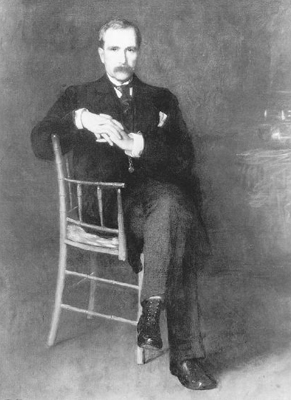
The powerful Eastman Johnson portrait of John D. Rockefeller, painted in 1895. (Courtesy of the Rockefeller Archive Center)