
CHAPTER 19
When he entered college in 1893, John D. Rockefeller, Jr., seemed like the prototype of the poor little rich boy, stuck with an overdeveloped conscience and the badge of being the son of one of the world’s wealthiest men. Having had a rather solitary childhood in mansions and on estates, he did not have the social ease of other young men of his age and class. Desperately eager to please his parents, he had exhausted himself in trying to scrub sin from his soul.
Much like his father, Junior couldn’t make decisions lightly and fretted over his choice of a college. Set to go to Yale, he passed its preliminary entrance exam and had even selected a room when reports reached him from one minister that a fast set dominated the Yale social scene. Others might have found this decidedly in Yale’s favor, but Junior decided to look elsewhere and finally selected Brown because three close friends had chosen to attend it. As he told Dr. William Rainey Harper, whom he consulted, in a tone of excruciating humility, about the choice of schools, “Being naturally somewhat retiring (I beg you to pardon personal references), I do not make friends readily, and some of those interested in my welfare fear if I go to Yale in a class wholly strange to me, I will be ‘lost in the crowd’ so to speak and remain much by myself, instead of getting the social contact I so greatly need.”1 Junior tended to discuss himself clinically, as if he were a laboratory specimen wriggling under glass, his parents, especially his mother, having taught him to probe his behavior with such antiseptic detachment.
Junior entered Brown in September 1893, just as the industrial slump worsened, and his college years unfolded against a turbulent backdrop of radical rhetoric and labor unrest, much of it directed against his father. Founded in the eighteenth century, Brown was the oldest and best-endowed Baptist college, and its president, E. Benjamin Andrews, was a Baptist clergyman– cum–political economist. In those days, college presidents were often ordained ministers who had a profound impact on the student body in classroom and chapel alike. During the Civil War, Andrews had lost an eye in the Petersburg siege, and his glass eye endowed him with a visionary gaze. Junior admired his spiritual zeal and keen intelligence and was especially struck one day when Andrews told him, “Rockefeller, never be afraid to stand up for a position when you know you are right.” 2
Six months before Junior arrived at Brown, Andrews had composed a flattering letter to Henry Demarest Lloyd about Wealth Against Commonwealth. “It is decidedly in my line,” he assured him, “although you are more radical than I am at some points.”3 Not averse to trusts, Andrews wanted to regulate them for the public good and distribute their benefits more equitably. When Junior took a course with him in practical ethics, Andrews gave him a finer appreciation for employer responsibility in big business. In one undergraduate essay, Junior already evinced the proclivity for corporate reform that would mark his adult life: “Who can look about upon the millions of laborers whose life is a treadmill, a continuous round of work to which they are driven by dire necessity . . . without being fired with a desire to revolutionize their condition by adopting the profit-sharing system?”4 However idolized by students, Andrews was roundly condemned by many alumni when he supported William Jennings Bryan’s presidential bid in 1896 and endorsed free coinage of silver, an episode that cost him his job. Henry Demarest Lloyd spied Rockefeller’s fine hand in the ouster, telling a friend, “One of the reasons which actuated the trustees in crowding [Andrews] out was the statement that as long as he remained, Mr. Rockefeller would never give the university any money.”5
The bashful young Rockefeller, quartered in Slater Hall, was much shorter than his father but broad chested and square shouldered. Both his mother and Grandma Spelman exhorted him to be vigilant against dormitory vice. In his first letter home, he reassured them by saying that he had already attended a prayer meeting, adding, “Grandmother will be interested to know that there are three colored men in the class.”6 He also had begun teaching a Sunday-school class at a Baptist church in Providence, and his relieved father wrote him that “the moral and religious tone seem of the best.”7 During his busy freshman year, Junior joined the glee club, the mandolin club, and a string quartet with some young ladies. As he ventured timidly beyond the self-contained world of his youth, he could not just enjoy spontaneous pleasure and had to justify it in terms of self-improvement. When he joined a college operetta, he wrote his mother, “Then too appearing on the platform before people as I would do and have done in the Glee Club gives me confidence in myself, and helps me to become easy in public which I always need.”8
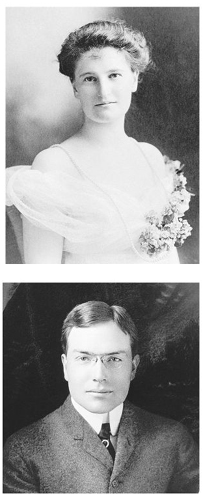
Abby Aldrich Rockefeller and John D. Rockefeller, Jr., around the time they were married. (Courtesy of the Rockefeller Archive Center)
Doggedly earnest, tenacious in his studies, Junior was a good enough student to make Phi Beta Kappa, and he especially enjoyed economics and sociology. Unlike his father, however, his self-confidence was a fragile bloom, easily crushed. “If a person scolded me,” he said, “I shut up like a clam. I wasn’t much of a scholar, but I always tried hard and I didn’t like to be reproached.”9 Everybody noticed his Baptist austerity: He did not drink, smoke, play cards, go to the theater, or even read Sunday papers. True to his temperance pledge, he plied students with crackers and hot chocolate when they came to his room, but he terribly upset Grandma Spelman when he let boys smoke there.
Junior’s frugality was the stuff of campus legend, and everybody had a favorite anecdote: how he soaked apart two two-cent stamps that got stuck together or how he pressed his own trousers, sewed his own buttons, and mended his own dish towels. Following his father’s example, he recorded every expense in his little book—sometimes to snickers from classmates—and even recorded bouquets of flowers bought for dates. Whether putting money in the plate at church or buying a pencil from a beggar, he jotted down everything to the last decimal. “He told me that his father allowed him all the money he wanted,” said a friend, “but insisted on an exact account of every penny.”10 Another classmate recalled, “It used to be a great joke, particularly among the girls in Providence, and they used to laugh a good deal about being treated to a soda by John D. Rockefeller, Jr., and having him enter it into his book as he sat at the soda fountain.” 11
Despite his shy formality, Junior was generally popular at Brown or, at least, highly respected. Some students were bound to see him as a hopeless prig, and one day as he was crossing the campus, one heckled him, “Here comes Johnny Rock, reeking with virtue and without one redeeming vice!” 12 For the most part, however, he became more sociable and self-assured and slowly weaned himself from the airless morality of his upbringing. He was tolerant by nature, telling Grandma Spelman in one letter, “One sees all sorts and conditions of men here viewing life, duty, pleasure and the hereafter, so differently. My ideas and opinions change I find in many ways. I would stickle less for the letter of the law, now, more for the spirit.” 13 Haltingly, he forged an identity separate from those of his forebears. He was more ecumenical, more open to the outside world, more considerate of alternate views. As president of his junior class, he got his classmates to desist from drinking alcohol at the class supper, which had traditionally been a drunken debauch. And when his class took its annual stag cruise to Newport, Junior agreed to keep kegs of beer on hand but tried to avert heavy indulgence. His parents were ecstatic. “Dear John,” his mother wrote, “you have been our pride and comfort from the day of your birth but at no time have we been more grateful for such a son as at the present moment—Tears of joy filled dear father’s eyes when your letter was read and he wants me to tell you how proud and happy it made him.” 14
At Brown, Junior learned to savor such illicit pleasures as theater and dancing, small triumphs for a Baptist boy bred with such unrelenting morality. After his sophomore year, he took a bicycle trip through England with Everett Colby, a classmate whose father was a railroad builder. (John D. had invested in his ventures.) In London, Junior saw his first plays: The Two Gentlemen of Verona, Charley’s Aunt, and A Midsummer Night’s Dream. As if admitting to a furtive visit to a brothel, he told his mother: “I shouldn’t have done it at home on account of the example but thought it not harmful in London, where I knew no one and had an opportunity of seeing several of Shakespeare’s plays.”15 Junior made it through his freshman year without dancing, then succumbed to this vice sophomore year by dancing all evening at a party thrown at the home of a university trustee. To practice for the event, he whirled his friend Lefferts Dashiell around his dormitory room. The whole evening, as he danced with a Miss Foster, he feared that he would crash to the floor. Holding on for dear life, he had the distinct impression that Miss Foster was propping him up. That evening, he met the vivacious Abby Aldrich, daughter of Rhode Island senator Nelson Aldrich, but could not muster the courage to dance with her. The love of dancing lasted, and by the time he graduated Junior indulged this sinful passion two or three times a week.
Cettie Rockefeller never entirely relaxed her militance about this pastime. During his senior year, Junior wanted to repay his classmates for their kindness to him and asked his parents to host a dance in Providence. Striking a compromise, John and Cettie agreed to have a musical evening of Mendelssohn, Bach, Chopin, and Liszt, followed by informal dancing. When they mailed out the invitations, the infernal word dancing appeared in small, almost apologetic lettering in the lower left-hand corner of the card. Yet when the evening arrived, Cettie developed a headache and took refuge in her hotel room. As a result, Senior, resplendent in tails and white gloves, stood alone on the receiving line, cordially greeting three hundred guests. Cettie’s behavior on this and other occasions supports the thesis that she retreated to her bed as an escape from threatening realities.
Before Brown, Junior had known little about sports: The Rockefellers were more interested in exercise, which stressed health, than in sports, which stressed pleasure. When he became a manager of the football team his senior year, Junior endured endless ribbing when he referred to the center as “the middle.” He was so much his thrifty father’s son that when one husky lineman asked for new shoestrings, Junior retorted, “What did you do with the pair I gave you last week?”16 Because of his son’s position, Senior, who had never been to a football game, attended one in New York between Brown and the Carlisle Indians. He started out in the stands, calmly surveying the spectacle, then grew so excited that he rushed down to the field in his tall silk hat and began to race up and down the sidelines with the coaches. The captain of the team assigned a lineman to explain the fine points of the game to him, and with his exceptional mind for tactical maneuvers John D. Rockefeller gave the impression that he had mastered the game, with all its subtleties, within five minutes.
Junior needed somebody who would release him from the suffocating prudery of his upbringing, and that liberating figure was Abby Aldrich. She was a confident girl who did not need his money and was not awed by his name. Something about the socially maladroit Junior appealed to the maternal instincts of this sophisticated young lady with the gracious manners and erect carriage of a senator’s daughter. One of eight children, she had often hosted her father’s Washington receptions and had met everyone from General Ambrose Burnside to William McKinley to Custer’s widow. Tall, voluptuous, and somewhat matronly in appearance, she was handsome rather than pretty. She liked to wear broad-brimmed, eccentric hats, a symbol of her outgoing personality. She seemed to give Junior the faith in himself that his parents couldn’t foster. As he said of their meeting sophomore year, “She treated me as if I had all the savoir faire in the world and her confidence did me a lot of good.”17 Through Abby, Junior made a startling discovery that had been artfully concealed from him: Life could be fun.
Abby came from old New England stock on her mother’s side and was descended from Elder William Brewster, a passenger on the Mayflower. Though the son of a mill hand, Senator Aldrich claimed Roger Williams, the founder of Rhode Island colony, as an ancestor. Tall and virile, with thick mustache and side-whiskers, the unflappable Senator Aldrich had escaped from poverty, but he never lost his dread of it. He was elected to the U.S. Senate in 1881 and held that seat for the next thirty years, winding up as chairman of the Senate Finance Committee. A confirmed protectionist and devoted servant of the trusts, he used public office to feather his own nest. Bolstered by a $5 million loan from the American Sugar Refining Company—the so-called sugar trust—he invested in four Providence street-railway companies while also representing the New Haven Railroad. Senator Aldrich turned public service into such a lucrative racket that he amassed $16 million by his death. As if he were a mogul, not a public servant, he built a 99-room château at Warwick Neck on Narragansett Bay and sailed a 200-foot yacht, equipped with 8 staterooms and a crew of 27. He bore a host of pejoratives, most notably those conferred by Lincoln Steffens, who referred to him in McClure’s Magazine as the “political boss of the United States, the power behind the throne, the general manager of the U.S.”18 Too entrenched to be ruffled by such journalistic pinpricks, Senator Aldrich stuck by his policy of “Deny nothing, explain nothing.”19
Abby grew up in a lively atmosphere of balls, parties, and plays. Opposed to religious severity, Aldrich spoiled his children with presents and seldom disciplined them. At the Aldrich mansion at 110 Benevolent Street in Providence, the senator liked to play bridge or even poker with Abby. (In later years, Junior would not join the game but sat quietly with a book, unable to break that taboo.) A self-taught aesthete with a highly cultivated taste for books and art, the senator had an excellent library of antique books, frequented auctions for furniture, rugs, and art, and so thoroughly schooled Abby in European museums that she knew their paintings by heart. As a teenager, she dipped into the novels of Dickens, Trollope, Hawthorne, Jane Austen, and George Eliot.
Junior’s romance with Abby played itself out amid a whirl of college dances, football games, tandem-bike rides, and canoe trips, as well as church services on Sundays. When they strolled along, Junior carried graham crackers in his pocket, and Abby freely reached in and helped herself. As Junior said, “She was so gay and young and so in love with everything.”20 By the spring of junior year, Junior was a regular visitor at Benevolent Street. One Sunday, he mentioned in passing to the senator his summer plans to cruise the Norwegian fjords with his sister Alta. The senator must have warmed to the idea of Abby marrying young Rockefeller, for a few weeks later he bought tickets for himself, his wife, and two daughters on the same ship, and they dined together during the cruise. Back in Providence in the fall, Junior saw Abby so frequently that people began to speculate when they would marry. But Junior approached the matter with the same soul-searching and nervous energy that he brought to every major decision, and he vacillated through four years of tortured introspection. It was perhaps apparent to everybody in Providence except him that he would someday marry Abby.
Certainly the size of his projected inheritance made the choice of wife a momentous decision. Junior idealized his father, and yet he had to deal with a mounting drumbeat of criticism against him. Abby seemed tailor-made to help him with this predicament, for they were both the children of public pariahs. Junior must have admired her ability to be the loyal daughter of a controversial senator while clinging to her own liberal beliefs. She lived in a way that betrayed neither her father nor herself and thereby pointed a path for Junior.
As he approached graduation, Junior still engaged in hero worship of Senior. His glorified image of his father was inextricably bound up with his lowly image of himself. On his son’s twenty-first birthday, Senior sent him twenty-one dollars, along with a tender note. “We are grateful beyond measure for your promise and for the confidence your life inspires in us, not only, but in all your friends and acquaintances and this is of more value than all earthly possessions.” To this, Junior replied, “People talk about sons being better than their fathers, but if I can be half as generous, half as unselfish, half as kindly affectionate to my fellow men as you have been, I shall not feel that my life has been in vain.”21 As Junior contemplated the duties that awaited him after college, the prospect only magnified his sense of inadequacy. Shortly before graduation, he was invited to join the board of the American Baptist Home Mission Society. When he asked his father’s advice, Junior made clear that “my first duty as well as my pleasure after this year would be to help you in whatever capacity or position you might see fit.” 22 He never wavered in this decision to subordinate his life to his father’s.
As graduation neared, Junior grew wistful about his years at Brown and the relaxed camaraderie it had allowed him. He would shortly emerge into the spotlight of public attention, which would burn brightly for the rest of his life. As he thought of following in his father’s footsteps, his courage failed him, and he told his mother soon after graduation, “I feel but little confidence in my ability to fill the position which is before me, but know that I am not afraid to work or do whatever is required of me, and with God’s help I will do my best.”23 “The future is glowing with possibilities of service for God and man,” Cettie wrote back. “May the Holy Spirit take possession of your entire being, and guide you into all truth.”24 By making him view life so loftily, by encouraging him to see himself as a valiant Christian soldier, she might have inadvertently exacerbated his anxieties. This transcendent perspective seemed to allow little room for normal human failure. Junior’s father, meanwhile, remained inscrutably silent about Junior’s forthcoming role at 26 Broadway, which could only have deepened his dread of the unknown.
When John D. Rockefeller, Jr., started work on October 1, 1897, he was entering 26 Broadway not long after Senior had left it. He was installed at an oak rolltop desk on the austere and slightly shabby ninth floor, in an office suite dedicated to his father’s outside investments and philanthropies. He worked cheek by jowl with Frederick T. Gates, George Rogers, and a telegrapher, Mrs. Tuttle, who had the dubious honor of opening Rockefeller’s crank mail—and “there was a great deal of it,” said Junior.25 Though he worked in the Standard Oil building, Junior was uninvolved in its management, and he belonged instead to the incipient Rockefeller family office. If his $6,000 annual salary, paid by father, seemed generous, it was a disguised allowance that kept Junior in a state of childlike dependence.
Junior turned aside suggestions that he go to law school or treat himself to an around-the-world trip. “I felt that I had no time for either, that if I was going to learn to help Father in the care of his affairs, the sooner my apprenticeship under his guidance began, the better.” 26 Junior was again living at 4 West Fifty-fourth Street and had ample opportunity to sound him out, yet the taciturn Senior provided no clues about what he expected of his son, leaving him in limbo. “Father never said a word to me about what I was to do in the office before I began work there, nor has he ever since. Moreover, he did not say anything on the subject to anyone else in the office, so far as I have ever learned. Apparently he intended that I should make my own way.”27 Junior never admitted to being bothered by this tight-lipped approach. Like God, father’s ways were mysterious but, it was always assumed, benevolent in the end. As a stout believer in self-reliance, Senior probably wanted to test his son’s aptitude for business and let him find his own way without coaching.
Rockefeller had numerous channels of intelligence, and Junior marveled at his knowledge of everything that went on at 26 Broadway. At a certain point during dinner, Rockefeller would apologize to guests for changing the subject and query Junior about his day’s work, displaying seeming omniscience about affairs downtown. Rockefeller’s gentle, probing questions were the closest Junior came to a business education from him. Father and son disagreed more than they publicly acknowledged, and Rockefeller was once heard to grumble, “You know, boys go to college and come back knowing everything about business and everything else.”28
At work, Junior had no formal place in the hierarchy and had to guess at his powers. He performed some menial tasks, such as filling inkwells. Never given his father’s power of attorney, he began to sign papers for him, unsure whether father would object; when he did not, Junior took this for a sign of approval and continued the practice. The first major task that Senior assigned his son was a ghoulish one: to supervise the design and transport of a soaring granite obelisk for the family burial plot in Cleveland, a shaft so huge it took up two freight cars. The young Brown graduate also picked out wallpaper for the family houses, sold worn-out buckboards and carriages, and managed Rockefeller real estate in Cleveland. One observer called it an “anxious and troubled” time for Junior, who felt that his performance was wanting, that he was not earning his keep, and that he was unequal to his appointed destiny.29
If Junior did not feel totally adrift in these years, the credit must go to Frederick T. Gates, who gave him the guidance he sorely missed from his father. Together, they toured iron ranges in Minnesota and timberlands in the Pacific Northwest, often playing violins together in their private railroad car. Gates invited Junior to audit business meetings, and he responded with everlasting gratitude. Under Gates’s tutelage, Junior began to assume his rightful place in the Rockefeller firmament and joined the University of Chicago board just three months after starting work. While still in his twenties, he became a director of U.S. Steel, National City Bank, the Delaware, Lackawanna and Western Railroad, and, of course, Standard Oil.
Bowed by a sense of premature failure, Junior was desperate to succeed at something and decided to try his hand at the stock market. Since his father had professed a puritan contempt for Wall Street, Junior was surprised to learn that he had played the market for years and traded actively. To teach them the art of investing, Rockefeller allowed Junior and his sister Alta to borrow from him at 6 percent and invest in equities. During his maiden year at 26 Broadway, Junior made several thousand dollars in the market and, like all giddy novices, began to take more risks and place ever-larger bets.
Meanwhile, a Wall Street operator named David Lamar—later styled the Wolf of Wall Street—began to cultivate George Rogers, Senior’s private secretary. In the fall of 1899, Rogers served as the gullible go-between for a scam. Transmitting information from Lamar, Rogers informed Junior that James R. Keene, a celebrated stock trader, had taken a big position in U.S. Leather and suggested that Junior join the buying. Led to believe that he was acting in concert with Keene, Junior took a gigantic stake in the stock. Upon learning that George Rogers was meeting secretly with Lamar at lunchtime, he had a queasy intuition of foul play. Junior summoned Lamar to his office, and he arrived with a flushed, agitated air. As Junior recalled, “One look at him was enough. I knew I had been sold out.”30 It turned out Keene knew nothing of the affair and that Lamar was liquidating leather stock as fast as Junior bid it up. The unthinkable had happened: The meek Junior had dropped nearly a million dollars—equal to more than $17 million today—of father’s money in the market. He knew the situation was unforgivable: He had never asked to meet Keene, had done no research, and had thrown away a fortune on a wild tip.
One can only guess Junior’s emotional turmoil when he broke this astonishing news to father, a harrowing meeting that was forever seared into his memory. “Never shall I forget my shame and humiliation as I went up to report the affair to Father. I hadn’t the money to meet the loss; there was nothing else to do.”31 Senior listened quietly and conducted a calm but thorough inquiry, investigating every detail of the transaction—all without a syllable of reproach. At the end, he simply said, “All right, I’ll take care of it, John.”32 Junior waited for some criticism, some outburst, some paternal homily about future behavior. But nothing further was said. It was a vintage Rockefeller performance: The true lesson lay in what he did not say and what he did not do. Rockefeller sensed that his insecure son had castigated himself so unmercifully that bitter reproaches were superfluous. By showing generosity, he enlisted his son’s loyalty forever. The incident must have reinforced Junior’s innate conservatism, for the one time he had entered into a rash, immoderate scheme he had been severely punished.
Working for months without a break, Junior began to carry a lot of pent-up tension. To purge this nervous energy, he went after work to the West Fifty-fifth Street stable, where his father’s horses exercised in bad weather, and furiously chopped firewood from twenty-foot logs. Over lunch one day with Henry E. Cooper, a former Brown classmate, Junior brooded about his own inadequacy. Startled by the personality change, Cooper followed up with a letter of friendly advice. “You are altogether too grumpy, too morose and gloomy, John. . . . I truly think it would do you good, for instance, to take up smoking an occasional cigarette, or something of that sort. I am not joking. Just try being a shade more reckless or careless as to whether or not you reach perfection within five years, and see if you don’t find more happiness.”33 Pathetically eager to please, Junior noted in his ledger a few days later, “pack of cigarettes— 10 cents.” It was the last time he ever smoked.
Trapped on a treadmill of work, duty, and prayer, Junior found it hard to squeeze in time for Abby Aldrich. Sometimes on weekends, he took the train to Providence after work, dined with her, then grabbed the midnight train back to New York. In Manhattan, Junior often attended dances and parties with Alta, who was also living at home. She developed such an excessive attachment to her brother that she treated Abby as a rival and tried to undermine her. Alta’s adamant opposition could only have prolonged Junior’s doubts about marrying Abby.
Senior saw that his son could not carry his load lightly and begged him to relax more. Cettie, however, insistently pushed him forward in his quest for moral perfection. Two days after he began at 26 Broadway, she prodded him to join the Bible class at the Fifth Avenue Baptist Church, telling him to be “mighty in the Scriptures. The most powerful Christians are Bible Christians.”34 Sometimes she made it seem that humanity’s salvation hinged upon his personal purity. In an astonishing letter of July 23, 1899, Cettie likened her husband to God and Junior to the Christ child. “You can never forget that you are a prince, the Son of the King of kings, and so you can never do what will dishonor your Father or be disloyal to the King.” 35 Cettie’s tone is especially revealing amid the rising attacks against Standard Oil. Much like her husband, she had fashioned an alternate reality in which, instead of being a corporate villain, he was converted into an American saint. There were no shades of gray permitted in the Rockefeller household.
Exhausted by work and beset by self-doubt, Junior pondered whether to marry Abby Aldrich and prayed daily for divine guidance for four years. “I always had a dread of marrying someone and finding out later that I loved someone else more. I knew a great many girls and I had so little confidence in my own judgment.”36 Things looked promising in April 1900, when Junior joined Senator Aldrich and Abby on a journey to Cuba aboard President McKinley’s yacht, the Dolphin, a senatorial trip to study conditions there following the Spanish-American War. Still, Junior hesitated, unable to suppress his doubts. In the stuffy Rockefeller household, both parents and son balked at bringing up the subject. Finally, his sister Edith, acting as intermediary, told her brother that their parents were worried about him and felt that they were being kept in the dark, at last opening the forbidden subject to discussion.
In February 1901, Junior and Abby submitted to a six-month separation as a trial of their affections. After the time had expired, Junior was strolling by the lake at Forest Hill with Cettie when he summoned up the strength to ask her opinion of Abby Aldrich. Her hearty, laughing response was categorical. “Of course you love Miss Aldrich. Why don’t you go at once and tell her so?”37 Junior needed that maternal validation, that direct push. Soon afterward at West Fifty-fourth Street, he heard God’s voice in the wee hours, blessing his choice of Abby. “After many years of doubt and uncertainty, great longing and hope, there came a supreme peace of calm.”38 Before dawn, he dashed off a letter to Abby, asking if he could visit her. Stopping off to see Senator Aldrich on his yacht in Newport, he asked for his daughter’s hand and began to lay out his salary and financial prospects. Doubtless with some amusement, the senator brushed aside all money concerns and delivered the predictable bromide, “I am only interested in what will make my daughter happy.”39 An ecstatic Junior went to the Aldrich summer estate at Narragansett Bay and proposed to Abby by moonlight. “I can’t believe that it is really true that all this sacred joy . . . is mine. . . . For so long, long a time it has been the one thing in life above all others that I have yearned for,” Junior wrote his mother.40 Abby then had six suitors, leading Junior to observe retrospectively, “I kept wondering why she ever consented to marry a man like me.”41 But she never regretted her decision. As she wrote to a cousin many years later, “Don’t you think him quite the dearest man that ever was?”42
When the engagement was announced in August 1901, the press had a field day. “Croesus Captured,” trumpeted one paper.43 Many articles commented upon the odd match of the fun-loving Aldriches and the dour Rockefellers. As one paper said, “Young Mr. Rockefeller . . . is a Sunday-school teacher, and doesn’t believe in cards, dancing or decollete gowns, and Miss Abbie [sic] has never been able to make up her mind that she can renounce these things.”44 Although Senator Aldrich and Senior came in for their usual rough treatment, Abby and Junior were applauded for their more progressive views.
The extravagant wedding at Warwick on October 9, 1901, reflected the cosmopolitan style of Senator Aldrich, who made scant concessions to his Baptist in-laws. By chartered steamer and private railway car, he transported a huge portion of the American plutocracy to the affair, which glittered with Goulds and Whitneys, McCormicks and Havemeyers. The marriage was a satirical bonanza for muckrakers. As David Graham Phillips darkly interpreted the union, “the chief exploiter of the American people is closely allied by marriage with the chief schemer in the service of their exploiters.”45
The affair began with a small private wedding, limited to thirty-five guests and presided over by the Reverend J. G. Colby, who had married John and Cettie thirty-seven years before. Then a thousand people trooped gaily through a vast reception in the ballroom. Senator Aldrich refused to truckle to the temperance views of his in-laws and personally selected an array of vintage wines. This was too much for Cettie, who developed chills, asthma, and diarrhea the night before the wedding and took to her bed for spiritual safety, skipping the ceremony the next day—an exact replica of her performance at Junior’s senior-year dance at Brown. Once the stylish guests had fled, Junior and Abby spent a glorious month in seclusion at the house Senior had purchased in the Pocantico Hills of Westchester.
For the first months of married life, the newlyweds lived with John and Cettie at 4 West Fifty-fourth Street then crossed the street to a rented four-story mansion at number 13. Junior tried, with some trepidation, to initiate his free-spirited wife into the cramped, clerical ways of the Rockefellers, suggesting she might like to keep a weekly expense account. “I won’t,” Abby said bluntly, ending the matter forever. To a family muzzled by taboos, she brought a refreshing candor. When a visitor asked her, “Whatever are you going to do with this great big empty house, Abby?” she looked at him in astonishment. “Why, we shall fill it up with children!” 46
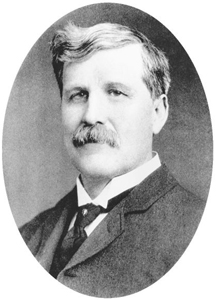
The young Frederick T. Gates. (Courtesy of the University of Chicago Library)