
CHAPTER 23
Had John D. Rockefeller died in 1902, at the outset of the Tarbell series, he would be known today almost exclusively as a narrow man of swashbuckling brilliance in business, a man who personified the acquisitive spirit of late-nineteenth-century American industry. But just as the muckrakers were teaching the public that Rockefeller was the devil incarnate, he was turning increasingly to philanthropy. What makes him so problematic—and why he continues to inspire such ambivalent reactions—is that his good side was every bit as good as his bad side was bad. Seldom has history produced such a contradictory figure. We are almost forced to posit, in helpless confusion, at least two Rockefellers: the good, religious man and the renegade businessman, driven by baser motives. Complicating this puzzle is the fact that Rockefeller experienced no sense of discontinuity as he passed from being the brains of Standard Oil to being the monarch of a charitable empire. He did not see himself in retirement as atoning for his sins, and he would have agreed emphatically with Winston Churchill’s later judgment: “The founder of the Standard Oil Company would not have felt the need of paying hush money to heaven.”1 He was also insistent that his massive philanthropy paled in importance beside the good he had done in creating jobs and furnishing affordable kerosene at Standard Oil.
As his fortune grew big enough to beggar the imagination, John D. retained his mystic faith that God had given him money for mankind’s benefit. Obviously, God disagreed with Miss Tarbell, or else why had He lavished such bounty on him? Rockefeller regarded his fortune as a public trust, not as a private indulgence, and the pressure to dispose of it grew imperative in the early 1900s as his Standard Oil stock and other investments appreciated fantastically. In the pre-Gates era, Rockefeller had found it difficult to expand his giving in proportion to his wealth—a strain that had pushed him steadily toward a psychic precipice. Tarbell stressed that Rockefeller had given away only a small fraction of his total wealth: between thirty-five and forty million dollars, or the equivalent of three years of Standard Oil dividends. (In fact, he had already given away several times that amount.) To parry the political attacks against him and mollify public opinion, he now had to disburse money on a much larger scale. For purely selfish reasons, he had to show that as a philanthropist he could act in a disinterested, public-spirited manner. Those commentators who see his charity as crudely furthering his economic interests miss a far more important goal: his need to prove that rich businessmen could honorably discharge the burden of wealth. The judicious disposal of his fortune might also blunt further inquiry into its origins.
It was thus from political necessity that Rockefeller distanced himself from his philanthropies, which would be marked by a low-profile style. The muckrakers had fostered such distrust of Rockefeller that he needed to counter suspicions that his charity was just another trick, a way to burnish his public image in the wake of investigations. The Rockefeller philanthropies would be constrained by a fundamental paradox: While extremely powerful, they were also inhibited in exercising that power. In explaining why members of the Rockefeller boards never gave interviews, Gates once said that if they extolled their benefactions, it would “inevitably lend color to the suspicion that [Rockefeller’s] gifts are not free from the taint of self-seeking.” 2
Gates helped Rockefeller to define his priorities so as to forestall political criticism. Rockefeller began to assign a lesser place to partisan or parochial concerns, such as the Anti-Saloon League or Anthony Comstock and his New York Society for the Suppression of Vice, in favor of programs with broad appeal and universal support—things unarguably good that helped all classes of people and lacked any tincture of self-interest. Groups that did not meet these criteria were either relegated to Rockefeller’s small, private gifts or discarded altogether. In his memoirs, Rockefeller said that he had sought progress in six areas of life, and the choices are notable for their general, noncontroversial nature: “(1) material comforts (2) government and law (3) language and literature (4) science and philosophy (5) art and refinement (6) morality and religion.”3 Who could protest such emphases?
The most perplexing issue for Rockefeller was how to square philanthropy with self-reliance. His constant nightmare was that he would promote dependence, sapping the Protestant work ethic. “It is a great problem,” he acknowledged, “to learn how to give without weakening the moral backbone of the beneficiary.”4 He dreaded the thought of armies of beggars addicted to his handouts. Back in the 1880s, when considering support for a veterans’ organization in Cleveland, he warned brother Frank that he did “not want to encourage a horde of irresponsible, adventuresome fellows to call on me at sight for money every time fancy seizes them.” 5 He constantly reminded his son that it was easier to launch a charitable commitment than to end it.
He was also wary of upsetting the existing social hierarchy. Staunchly convinced that society meted out just deserts, he believed that the rich had been recompensed for superior intelligence and enterprise. Conversely, the failures that a man makes in his life are due almost always to some defect in his personality, some weakness of body, mind or character, will or temperament. . . . It is my personal belief that the principal cause for the economic differences between people is their difference in personality, and that it is only as we can assist in the wider distribution of those qualities that go to make up a strong personality that we can assist in the wider distribution of wealth.6
He contributed to education and medical research, for they strengthened recipients and better prepared them for the evolutionary struggle—that is, he equipped them to compete but did not tamper with outcomes. For this reason, he never used his wealth to alleviate poverty directly and scorned any charity that smacked of social welfare. “Instead of giving alms to beggars,” Rockefeller said, “if anything can be done to remove the causes which lead to the existence of beggars, then something deeper and broader and more worthwhile will have been accomplished.” 7 Unlike Carnegie, he did not build libraries, athletic facilities, or music halls for the recreation of ordinary people but promoted pure research that would lead to more generalized benefits.
In focusing on prevention rather than relief, Rockefeller was influenced by two contemporary reform movements. By 1900, many progressives had tired of dealing with the symptoms of social ills and began to search for fundamental causes. Instead of falling back on isolated good deeds, they aspired to a systematic attack on the underpinnings of poverty. Backed by a new faith in scientific method, they drew on a burgeoning new middle class, educated by an expanding university system, and enlisted the knowledge of experts in business, labor, agriculture, and other areas. This new technical class provided a ready-made population to staff the Rockefeller philanthropies. Such “scientific reform” appealed to Rockefeller, who liked to analyze systems and probe underlying causes. After all, he himself had profited from scientific breakthroughs at Standard Oil, such as the Frasch process.
Rockefeller’s work was also buttressed by the social-gospel movement, which united social reform with moral uplift and religious renewal, reaching its high point between 1900 and 1920. For both Rockefeller senior and junior, this was a perfect synthesis, a way to be politically liberal and modern while clinging to an old-fashioned aversion to gambling, prostitution, alcohol, and other vices traditionally shunned by Baptists. It also guaranteed that reform took place under the safe aegis of religious authority. The social-gospel movement provided a way that the Rockefellers could make a smooth transition from narrow denominational giving to more secular, ecumenical causes.
Frederick T. Gates was the tutelary spirit of the Rockefeller philanthropies. Though nearly invisible to the public at the time, he advanced large claims for his contributions in his posthumously published memoirs. Yet Gates was groomed by Rockefeller, and if he was granted a large measure of freedom, it was partly because Rockefeller had trained him as his proxy. Since he held aloof from his charitable empire, Rockefeller’s role has almost invariably been underrated, but Gates allowed that it was Rockefeller himself who furnished the idea for founding a medical-research institute. Around 1894, when William Rainey Harper first proposed a medical school for the University of Chicago, Rockefeller countered with a novel proposal for a medical department devoted mainly or exclusively to research. Gates had the courtier’s knack for delivering on his sovereign’s wishes with unmatched energy and intelligence, so when he proposed a medical-research institute three years later, he knew his words would find a sympathetic echo in Rockefeller.
On summer vacation with his family in the Catskill Mountains in 1897, Gates tackled a book of door-stopping length: Principles and Practice of Medicine, a thousand-page tome by William Osler of the Johns Hopkins Medical School, the most renowned contemporary physician. (Whereas Rockefeller scarcely ever cracked a book, except for slim volumes of sermons, Gates read exhaustively and said he had scoured more than a thousand volumes in steering the Rockefeller philanthropies.) That spring, Gates had survived a serious illness, awakening his curiosity about American medicine. Osler’s magnum opus was not light summer fare, but with a medical dictionary at his side Gates waded through its pages with mounting amazement. He confided to William Rainey Harper that he had “scarcely ever read anything more intensely interesting.”8 Gates was appalled by the backward state of medicine unintentionally disclosed by Osler’s book: While the author delineated the symptoms of many diseases, he seldom identified the responsible germs and presented cures for only four or five diseases. How could one respect medicine that was so strong on anecdote and description but so weak on diagnosis and treatment? Gates had a sudden, vivid sense of what could be done by a medical-research institution devoted to infectious diseases. His timing was faultless, for major strides were being made in bacteriology. For the first time, specific microorganisms were being isolated as the causes of disease, removing medicine forever from the realm of patent-medicine vendors such as Doc Rockefeller.
With a rush of emotion, Gates drafted a strongly worded memo to Rockefeller, advocating the establishment of such an institute and citing European precedents, including the Pasteur Institute in Paris (founded in 1888) and the Koch Institute for Infectious Diseases in Berlin (1891), both of which greatly elevated the prestige of European medicine. At the time, the concept of a medical-research institute was still alien in America. The country’s medical schools were mostly commercial operations, taught by practicing doctors who picked up spare money by lecturing on the side. Standards were so abysmal that many schools did not even require a college degree for entry. Since these medical mills had no incentive to undertake serious research, medicine hovered in a twilight area between science and guesswork. Gates got Rockefeller to hire Starr Murphy to canvass medical opinion about setting up an institute. He found that many physicians were frankly skeptical that the country contained enough scientific talent to staff such an institution, and they recommended the distribution of small grants to individual labs instead.
Rockefeller responded to Gates’s memo with prolonged silence and let it marinate for a couple of years. But Rockefeller eventually realized that medical research ideally suited his needs. It would be safe, universally popular, and noncontroversial. While there was no guarantee that Rockefeller scientists would discover anything new, there was equally little chance that they would embarrass the founder. They would pick scientists associated with topflight universities and then set them to work with a free hand. Such an institution would also fill a void in the philanthropic universe. Gates told Osler, “This line of philanthropy, now almost wholly neglected in this country, is the most needed and the most promising of any field of philanthropic endeavor.”9 In fact, the promotion of medical science tallied so perfectly with Rockefeller’s needs that it would end up forming the common denominator of his foundations.
The proposal encountered skepticism in the medical community. It seemed quite rash, even quixotic, to pay grown men to daydream and come up with useful discoveries. At the time, institutionalized innovation was no less novel a notion in medicine than in industry. With other Rockefeller ventures, Gates had mostly responded to entreaties, whereas he now had to sell the idea in the teeth of widespread resistance.
Gates had hoped the institute would be associated with the University of Chicago, an opportunity lost when Dr. Harper consummated a merger with the Rush Medical College. Rush was exactly the sort of proprietary medical school that Gates wanted to see abolished. American medicine was then embroiled in open warfare between two schools: the allopaths, who used remedies that produced effects different from the disease in question, and homeopaths, who tried to induce in healthy persons prophylactic symptoms similar to the disease being fought. Rush was strongly biased toward allopathy, while Rockefeller favored homeopathy; Gates dismissed both allopathic and homeopathic medicine as scandalous pseudo-science. In 1898, he admonished the University of Chicago, “I have no doubt that Mr. Rockefeller would favor an institution that was neither allopath or homeopath but simply scientific in its investigation of medical science.”10 Nevertheless, Harper persisted in the Rush merger and forfeited any chance to have a Rockefeller medical-research institute in Chicago. After encountering allopathic sympathizers at Harvard and Columbia, Rockefeller’s advisers decided that it would be easier to set up an autonomous institution in New York.
Rockefeller was pleased by the decision to support a modest, freestanding research center. After all the bitter wrangling with Harper, he was doubtless sated with academic politics and administrative dreamers. An independent medical institute would be tightly controlled and minimize the chances of unpleasant fiscal surprises. In endowing the Rockefeller Institute for Medical Research (RIMR), he rigorously avoided the mistakes he had made with the University of Chicago, which became his cautionary tale of how not to build an institution. After the battle royal with Augustus Strong over the site for a Baptist university, Rockefeller must also have been glad to select his adopted town as the site of the research center.
If the University of Chicago seemed to emerge full-blown from the fertile brain of Dr. Harper, then the RIMR, founded in June 1901, was deliberately launched more modestly. It had no initial endowment and was lodged in temporary quarters in a Lexington Avenue loft building. This muted approach was designed to cool off any expectations that sudden miracles would emerge from this first American facility devoted solely to biomedical research. Deviating from custom, Rockefeller consented to the use of his name. The amount he pledged for this project—$200,000 over ten years—was considered spectacular at the time. To avoid a reprise of his Chicago problems, Rockefeller promised no additional gifts and deliberately kept administrators in the dark so that they would not feel overly confident of his support.
Rockefeller placed a premium on recruiting the best people for leading positions. “John, we have money,” he told his son, “but it will have value for mankind only as we can find able men with ideas, imagination and courage to put it into productive use.”11 That Rockefeller placed scientists, not lay trustees, in charge of expenditures was thought revolutionary. This was the institute’s secret formula: gather great minds, liberate them from petty cares, and let them chase intellectual chimeras without pressure or meddling. If the founders created an atmosphere conducive to creativity, things would, presumably, happen.
A stellar team was soon assembled. The chief adviser in this search was Dr. William H. Welch, professor of pathology and first dean of the Johns Hopkins Medical School. A bald, portly bachelor with a goatee, fondly called “Popsy” by his students, this sociable bear of a man liked everything from food to theater to Shakespeare’s sonnets. Trained in Germany, he had transplanted high German medical standards to America by opening the first pathology lab at Bellevue Hospital Medical College in 1878. When Hopkins inaugurated its medical school fifteen years later, Welch oversaw a faculty trained mostly in Germany and working as full-time teachers and researchers—a milestone in American medicine. Spurred by Rockefeller money, this model would later be copied across America. When in doubt, the Rockefeller lieutenants used the Johns Hopkins Medical School as the benchmark by which they judged progress in medical education.
As president of the RIMR board, Welch wooed as its first director his protégé Simon Flexner, whom he had considered his most gifted pupil and America’s best young pathologist. Of German-Jewish ancestry, raised in Louisville, Kentucky, Flexner neatly fitted into the Rockefeller mold of disciplined, self-made men.
Though highly respected in the medical world, Flexner was not a luminary when Welch approached him in early 1902. At thirty-nine, he faced an excruciating decision: whether to surrender a lifetime appointment as a pathology professor at the University of Pennsylvania to leap into the vortex of “an institution devoted exclusively to discovery of something new,” as he put it.12 When Flexner asked Gates why he was certain they would find something new, Gates smirked and replied that he had the faith of fools. The whole thing seemed so shadowy and insubstantial that Flexner hesitated for several months to accept the post. He bargained hard for the ability to offer high salaries to prospective researchers as well as for a promise that the institute would have a small, adjoining hospital in which diseases under study could be tracked in a clinical setting.
Flexner—spare, lean, ascetic, bespectacled—had features as sharp and precise as his mind. He was the sort of fair but tough-minded administrator who appealed to Rockefeller. Many people saw warmth beneath his businesslike exterior, but he was not a bluff clubman. “Flexner was competent,” said H. L. Mencken, “but he was a precise and somewhat pompous fellow.”13 More than one scientist quaked at his exacting expectations and incisive criticisms. Evidently heartened by this perfectionist director, Rockefeller pledged another one million dollars to the RIMR that June. Recalling how quickly Harper had burned up money, he stipulated that Flexner should receive the payments staggered over a ten-year period, slowing the pace of development.
Simon Flexner came to symbolize the institute, and his high-minded tone of scientific rigor established its enduring character. (Sinclair Lewis patterned the character of A. DeWitt Tubbs, the worldly director of the McGurk Institute of Biology in Arrowsmith,after him.) He exhibited a shrewd talent for exciting the public about the RIMR’s work. Soon after his appointment, a reporter tracked him down at his Philadelphia lab amid “the gruesome cans and jars of his work, busy as a hornet,” and he conveyed the audacious nature of the nascent institute, which he called “an extensive scheme, embracing the whole field of study of the cause and prevention of disease.”14 He had a missionary ardor for pure research, then rare in scientific circles. “There is no such thing as useless knowledge in medical research,” he said. “Ideas may come to us out of order in point of time. We may discover a detail of the facade before we know too much about the foundation. But in the end all knowledge has its place.”15
With Flexner signed up, a search committee surveyed Manhattan for a permanent home, and in 1903 bought thirteen acres of farmland on a stony bluff overlooking the East River between Sixty-fourth and Sixty-eighth Streets. When Junior first spotted this site, it was a bleak, treeless slope with cows browsing on the grass. The district was still so poor that the steam-heat company had not run lines there, and it attracted unsavory industries, such as breweries and slaughterhouses. For this so-called Schermerhorn tract, the Rockefellers paid $660,000. After an interim period of eighteen months spent in two brownstone houses at Lexington Avenue and Fiftieth Street, the RIMR moved into its new home on York Avenue in May 1906. Photos show a solid six-story brick building standing on a bare, windswept hill, flanked by a tiny copse of trees and a few sheds, with the Queensborough Bridge being constructed in the background. It is hard to match up this picture with today’s Rockefeller University, the pampered home of Nobel laureates, with its lushly landscaped grounds, screened from the city by magnificent gates and lofty trees.
As at Standard Oil, Rockefeller played the grand ventriloquist, operating at arm’s length. In pithy notes, he transmitted his wishes to subordinates, reserving the right to approve all major commitments of money. Having learned in business to rely on experts, he could seem remote from his own philanthropies. In 1910, Charles W. Eliot, the former Harvard president, lamented to Gates, “Mr. Rockefeller’s method of giving away money impersonally on the basis of investigation by others was careful and conscientious; but it must have cut him off almost completely from the real happiness which good deeds brought to the doer.”16
Rockefeller refrained from interfering with the medical institute’s autonomy and for a long time did not even visit it. While appreciating this restraint, Simon Flexner repeatedly invited him to tour the premises. “Very graciously he said that he could not take the valuable time of the workers,” said Flexner, “and when I said we had many visitors he remarked that made it more important that he should not consume my time.”17 Several years after the main building’s dedication, Rockefeller père and fils were in the vicinity one day when Junior suggested, “Father, you have never been at the Institute. Let us take a taxi up there and look at it.”18 Rockefeller agreed reluctantly. When they pulled up outside the institute, he just sat in the car and stared at it. “Father,” Junior gently prodded, “don’t you want to go in and look at it?” “No,” said Rockefeller, “I can see the outside.”19After more coaxing, he finally went inside. A staff member gave them a brief tour. Rockefeller expressed his gratitude then left, never to return. His craving for anonymity, such a controversial feature of his business career, seemed noble in his benefactions, and his respectful diffidence before scientific expertise won him praise as an exemplary donor.
However enlightened, Rockefeller’s detachment was also self-protective, for he feared that face-to-face encounters would generate fresh pleas for funds. One reason he did not visit the RIMR sooner was almost certainly that he wished to keep Flexner guessing about his intentions. As late as 1911, he advised his son, “I think it better that no intimation shall reach the Institute representatives of any purpose to increase the endowment in the near future. Let us hold the Institute to the strictest administration and observe for a further time how they get along and delay committal, as long as we can, to be confirmed as to the wisdom of such additional endowment.” 20 This slow development of the RIMR was a classic Rockefeller move.
In retirement, he devoted about one hour per day to philanthropy. Yet he managed to preside over this charitable universe in deed as well as name, demanding that his administrators have the exactitude of scientists, the sound economy of businessmen, and the passion of preachers. It was not the case, as Charles Eliot feared, that Rockefeller derived no pleasure from his good works, for he was engrossed in the RIMR. “If in all our giving, we had never done more than has been achieved by the fine, able, honest men of the Medical Institute,” he once remarked, “it would have justified all the money and all the effort we have spent.”21 Doc Rockefeller’s son took more pride in the RIMR than in any of his creations other than Standard Oil. In response to Eliot’s letter, Gates explained that Rockefeller stayed abreast of developments there:
I make it my business to keep Mr. Rockefeller personally informed of every important thing done and every promising line of inquiry at the Institute. He knows the lines of experiment trembling on the verge of success and their thrilling promise for humanity. I have seen the tears of joy course down his cheeks as he contemplated the past achievement and future possibilities of the Institute. He is a man of very quick and tender sympathies just as he is a man of a keen and lively sense of humor.22
Allowing for a certain hyperbole, the portrait is essentially just.
While Flexner paid social calls on Rockefeller and always found him cordial, he and Welch dealt mostly with the nonmedical trustees—Gates, Junior, and Starr Murphy—on policy matters. They made presentations that evoked the high drama of their medical sleuthing, holding their auditors rapt. As president of the trustees, Gates sat at the head of the table, his tie askew, shaggy hair falling over his forehead, flaming with enthusiasm at each new discovery, while the self-contained Junior posed well-chosen questions. Both Gates and Junior brought an almost mystical intensity to these meetings, as if their spirituality was finding a new home in scientific research. Gates likened the RIMR to a “theological seminary” and described Flexner’s work as a kind of prayer. He told Flexner, “To you He is whispering His secrets. To you He is opening up the mysterious depths of His Being. There have been times when, as I looked through your microscopes, I have been stricken with speechless awe. I felt that I was gazing with unhallowed eyes into the secret places of the Most High.” 23 For many of the men associated with the early Rockefeller philanthropies, science seemed to beckon as a new secular religion as the old spiritual verities waned.
Since cynics thought the RIMR would be relegated to ivory-tower irrelevance, Gates tried to shelter Flexner from any anxiety about immediate results. Then a sudden opportunity for heroism arose during the winter of 1904–1905, when three thousand New Yorkers died in a cerebrospinal meningitis epidemic. In response, Flexner developed a serum in horses to treat the disease. During monkey trials in 1907, he found that if injected at the proper spot in the spinal canal, the serum would treat the disease effectively. Rockefeller eagerly followed developments, telling a friend on January 17, 1908, “Only two days ago I was called on the telephone to speak with a German doctor, who had given it to a patient, and he reported that in four hours after the first application, the temperature became normal and so continued, and he was very hopeful at that time of the recovery of the patient.” 24 Until early 1911, when the New York City Board of Health took up the slack, the RIMR distributed the Flexner serum free as a public service. Later, the disease was treated with sulfa drugs and then antibiotics, but in the meantime Flexner’s serum mercifully spared hundreds, perhaps thousands, of lives. The press lionized him as a miracle worker, redounding to the lab’s benefit.
In a turbulent season of antitrust suits, Flexner’s triumph generated goodwill for Rockefeller, and this loosened the master’s purse strings. In early 1907, the institute directors asked Rockefeller for a $6 million endowment; eager to dampen starry-eyed hopes, he consented to $2.6 million, or less than half the desired amount. That same year, Junior advised him that the time was ripe to build the small adjoining hospital that had been promised to Flexner; the combined cost of endowment and hospital would be $8 million. As Rockefeller pondered this, the triumph of Flexner’s serum tipped the scales, and in May 1908 Junior notified the board that his father, in homage to this feat, would create a sixty-bed hospital and a nine-bed isolation pavilion. As blueprints were rolled out, Rockefeller tempered his generosity with his usual pinchpenny pleas for economy. “It is easy for these institutions to ask for money,” he told his son. “We have not one farthing to expend injudiciously.”25 When it opened in 1910, the hospital treated, free of charge, patients afflicted with any one of five priority diseases under study: polio, lobar pneumonia, syphilis, heart disease, and intestinal infantilism. Four rooms on the top floor were reserved for the Rockefeller family, but Senior never took advantage of this privilege, despite Gates’s constant urging: “The physicians are extremely polite, gentle, and courteous, and the nurses the very paragons of their tribe,” he assured him.26 But Rockefeller stubbornly preferred his osteopaths and homeopaths, whom he could also more easily control.
Now an independent foundation established in perpetuity, the RIMR adopted bylaws creating a board of scientific directors with unlimited control over research—a declaration of faith in science unprecedented in American philanthropic annals. (A separate board of trustees saw to fiscal matters.) In the estimation of one periodical, the RIMR was now “probably the best equipped institution for the study of the causes and cure of disease to be found anywhere in the world”—high tribute for an outfit less than ten years old.27 It was becoming the most richly endowed institute of its kind on earth, cranking out an enduring catalog of medical wonders.
More than a laboratory wizard, Flexner was a master talent scout. He collected brilliant strays, loners, and eccentrics who found the relaxed atmosphere of the institute congenial to their creative work. On his East River bluff, he marshaled an outstanding stable of scientific talent—he proudly dubbed them his prima donnas—including Paul Ehrlich and Jacques Loeb. Another inspired hire was a Japanese lab worker, Hideyo Noguchi, who would perform pathbreaking work in the study of syphilis. Flexner turned the institute into a series of autonomous departments, with each fiefdom shaped around a resident genius, while he kept close tabs on the central budget.
Flexner’s most prescient decision was to recruit the French-born surgeon Dr. Alexis Carrel from Chicago. Short and thickset, with an erect, military bearing, Carrel was a Catholic mystic and diehard royalist. His future medical agenda was defined in 1894 when President Sadi Carnot of France was stabbed by an assassin and died from the hemorrhaging of a severed blood vessel. Then only twenty-one, Carrel turned to the puzzle of rejoining severed vessels and devised solutions that would facilitate blood transfusions, organ transplants, and other advanced surgical procedures. Rockefeller frequently told dinner guests the dramatic tale of how Dr. Carrel, in 1909, saved the life of a premature infant who developed melena neonatorum, a condition in which blood oozes from the digestive tract. In a wondrous operation, Carrel resuscitated the pallid infant by attaching a vein in its leg to the artery of its father, a New York physician; within minutes, a rosy flush suffused the baby’s face. In 1912, Carrel won the Nobel Prize for medicine, the first ever awarded to a researcher in America.
Rockefeller was fortunate to have applied his money at the precise moment that medical research matured as a discipline and offered unbounded opportunities. None of the titan’s other philanthropies was perhaps such an unqualified success. Bowing to a serviceable division of labor, Andrew Carnegie ceded medicine to Rockefeller. Once approached about building medical facilities, he smiled shrewdly and said, “That is Mr. Rockefeller’s specialty. Go see him.”28
After decades spent warding off abuse, Rockefeller and his entourage were delighted, perhaps even mildly surprised, by the unalloyed praise heaped upon the RIMR. Gates fairly glowed with pleasure: “The nicest ear can scarcely detect a single discordant note.”29 In pleading for money for the RIMR, Junior observed to his father that “none of the Foundations which you have established are so popular with the public generally or so free from criticism as the Institute. I feel, therefore, that large sums of money are, in a sense, safer there than in other fields.” 30 Gates expanded on the theme that through medical research Rockefeller money touched everyone on earth and that “the values of medical research are the most universal values on earth, and they are the most intimate and important values to every human being that lives.”31 How could Rockefeller, long the target of almost universal obloquy, not embrace this new role of benefactor of all humanity? His gifts also reflected his own obsessive concern with longevity. When Carl Jung, the Swiss psychoanalyst, met Rockefeller in 1912, he recorded this impression: “He is almost exclusively preoccupied with his bodily health, thinking of different medicines, new diets and possibly new doctors!”32
In his inner circle, Rockefeller faced one boisterous critic of the RIMR: his golfing pal and crony Dr. Hamilton F. Biggar, a champion of homeopathy. A small-town doctor of the old school, Biggar was wont to pontificate: “We have too much laboratory and not enough bedside practice.”33 It was partly at Biggar’s behest that Rockefeller had balked at the merger of the University of Chicago with the allopathic Rush Medical College. Under Biggar’s influence, Rockefeller nearly refused to provide a $500,000 check to repair the Johns Hopkins Medical School after it was partially destroyed by fire in 1904—simply because the school refused to recognize homeopathy. Gates dismissed the work of Samuel Hahnemann, the German founder of homeopathy, as “the wild imaginings of a natural fool turned lunatic,” and found it hard to endure Rockefeller’s vestigial faith in what he saw as outdated medicine.34 Although he often muzzled his strong views on the subject, Gates’s real aim was to deliver a mortal blow to homeopaths—to shut their medical schools, expel them from medical societies, and strip them of hospital privileges—so as to clear the field for scientific medicine. Gates considered Biggar, if not a charlatan, at least a fossil and feared his rearguard attempts to undermine the RIMR.
At one point, antivivisection activists created an uproar about experiments at the RIMR, and Biggar leaped into the fray, complaining to Rockefeller about the cruelty inflicted on the lab animals. At this point, Gates decided to wipe out Biggar’s influence forever. In several caustic memos to Rockefeller, he lashed out at the homeopaths: “Neither Dr. Biggar nor any of his Homeopathic friends have told you, so I think it in hand to tell you, this fact—that Homeopathy is rapidly dying out in this country”—ditto for allopathy. “Both are fading away as schools of medicine with the dawn of scientific inquiry. Both were wrong. The theories of both have been completely exploded in the last twenty-five years.”35 In an early version of the letter, never sent, Gates was even more outspoken. “Dr. Biggar has not kept up with the progress of medicine and is still living in the twilight of two or three generations ago.”36 In deference to his golfing partner, Rockefeller did not acknowledge these memos.
It was deeply ironic that Rockefeller retained such residual faith in homeopathy even as he financed the world’s most sophisticated medical-research operation. Periodically, he had spasms of irritation, firing off letters on the need to save homeopathy, but these outbursts quickly passed. Through his philanthropies, Rockefeller did more than anyone else to destroy homeopathy in America, and in the end he seemed powerless to stop the scientific revolution that he himself had so largely set in motion.
In all, Rockefeller gave $61 million to the research institute. By the 1950s, it had bred so many imitators that it needed to change direction and was transformed from a research center into a specialized university offering only Ph.D.s and research fellowships. The name was officially changed to Rockefeller University in 1965. Its faculty roster became heavily laden with Nobel Prize winners, and by the 1970s it had housed sixteen of them. For the son of an itinerant vendor of dubious nostrums, this was a most implausible feat. The loftiest encomium to Rockefeller’s impact in this field came from Winston Churchill, who wrote shortly before Rockefeller’s death:
When history passes its final verdict on John D. Rockefeller, it may well be that his endowment of research will be recognized as a milestone in the progress of the race. For the first time, science was given its head; longer term experiment on a large scale has been made practicable, and those who undertake it are freed from the shadow of financial disaster. Science today owes as much to the rich men of generosity and discernment as the art of the Renaissance owes to the patronage of Popes and Princes. Of these rich men, John D. Rockefeller is the supreme type.37
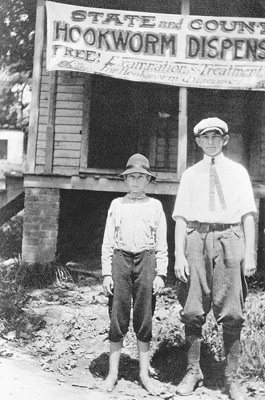
A documentary photo used by the Rockefeller Sanitary Commission in trying to stamp out hookworm in the South. The small boy on the left suffered from the disease, which had stunted his growth. (Courtesy of the Rockefeller Archive Center)