
CHAPTER 26
As they approached the 1904 presidential election, Standard Oil executives knew that Teddy Roosevelt was still miffed at their attempt to snuff out his new Bureau of Corporations and that the oil trust stood at the top of his list of evil trusts to be reined in by federal regulators. Since the idea of backing Roosevelt’s Democratic opponent, Alton B. Parker, was unthinkable to Archbold and his associates, they smothered the incumbent with money, especially a $100,000 contribution from Henry H. Rogers. Other businessmen who feared the lash of federal regulation—including Edward H. Harriman, Henry Clay Frick, and James Stillman— also paid tribute to Roosevelt, provoking Democratic charges that the president was being bribed by the very companies he vowed to control. Attorney General Philander Knox wandered into Roosevelt’s office one day in October 1904 and heard the president dictating a letter ordering the return of the Standard Oil funds. “Why, Mr. President, the money has been spent,” Knox objected. “They cannot pay it back—they haven’t got it.” “Well,” Roosevelt said, “the letter will look well on the record, anyhow.”1
When Roosevelt won by an impressive margin in November, Rockefeller sent a telegram to him: “I congratulate you most heartily on the grand result of yesterday’s election.”2 In the Standard boardroom, the contribution to Roosevelt’s campaign was soon acknowledged to be the worst investment they had ever made. As Archbold moaned, “Darkest Abyssinia never saw anything like the course of treatment we received at the hands of the administration following Mr. Roosevelt’s election in 1904.” 3 Or as Henry C. Frick phrased it more succinctly, “We bought the son of a bitch, but he wouldn’t stay bought.”4 Nevertheless, the Standard Oil hierarchs remained cocksure that, in any contest for supremacy with the federal government, they would inevitably prevail.
Before the election, the Bureau of Corporations, headed by James R. Garfield, had begun to gather data on Standard Oil. The son of the former president and active in Ohio Republican politics, Garfield was friendly with some Standard Oil lawyers, and the initial inquiry went amicably enough. Then, in February 1905, by a unanimous resolution, the House of Representatives urged an antitrust investigation of Standard Oil, a result of the oil boom in Kansas. Re-enacting a drama once played out in western Pennsylvania, independent oil producers and refiners protested that Standard Oil dominated the state’s pipelines, and they also accused it of conspiring with the railroads. Their passions were fanned both by Ida Tarbell’s articles and by a dramatic tour she made through the oil fields. Suddenly, Commissioner Garfield was summoning Archbold and Rogers to question them about Standard’s behavior in the state. When he broached the touchy subject of rebates—the flash point for so many battles in oil history—their relations deteriorated hastily. A new generation of independent oil producers in Kansas, Illinois, Oklahoma, Texas, and California would provide the motive force behind the antitrust drive against the Standard.
As the moribund Sherman Act quickened to sudden life under Teddy Roosevelt, the Tarbell series virtually guaranteed that Standard Oil would be the central target of any federal trustbusting probe. Tarbell thought it the optimal choice because it was “the mother trust and the most nearly monopolistic.”5 It furnished a well-known consumer article, affected nearly everyone, and had an abundant history of hearings and lawsuits to excavate. In the early 1900s, petroleum was being applied to an array of new uses and it no longer seemed tolerable for one organization to retain a stranglehold over it.
For years, Rockefeller and his colleagues had ignored public opinion, refusing to give interviews and behaving defiantly at hearings. In her McClure’s series, Tarbell had justly said, “If Mr. Rockefeller had been as great a psychologist as he is a business manipulator he would have realised that he was awakening a terrible popular dread.”6 In their hubris, the oil monopolists mocked the petty efforts of politicians to obstruct them. “We will see Standard Oil in hell before we will let any set of men tell us how to run our business,” an unreconstructed Henry Rogers swore.7 Unwilling to compromise, Standard officials dealt with government officials as roughly as they did with business competitors. At this precarious moment, the trust needed a master diplomat, not the hotheaded Archbold.
In 1906, Roosevelt signed a stack of bills to curb industrial abuses. Profiting from the outcry prompted by Upton Sinclair’s novel The Jungle, he signed the meat-inspection bill and the Pure Food and Drug Act. Identifying railroad discrimination as a major issue, he supported the Hepburn bill, which granted broader power to the Interstate Commerce Commission to set railroad rates and placed interstate pipelines under its domain. By bringing Standard Oil to heel, Roosevelt hoped to check two abuses at once: railroad collusion and industrial monopoly. When the Bureau of Corporations sent him its report on the oil trust, it highlighted Standard’s collusion, both in secret rates and open discrimination, with the railroads. Seizing upon this as a potent tool to push through the Hepburn bill, Roosevelt made the five-hundred-page report public on May 2, 1906. “The report shows that the Standard Oil Company has benefited enormously up almost to the present moment by secret rates,” the president declared.8
Seriously misreading the punitive public mood, Rockefeller remained silent. When Charles M. Pratt drafted a reply, Rockefeller objected in no uncertain terms: “Giving broadcast [to] this information at this date is unwise and is a headliner for more drastic treatment by the Fed. Govt.” 9Overriding Rockefeller’s dissent, Standard Oil released a statement denying that it had knowingly committed any unlawful actions.
In Standard Oil, Teddy Roosevelt found a trust tailor-made for his purposes: big, rich, brutal, unpopular, and totally unrepentant. He adored grandstanding and liked to use his bully pulpit to incite a popular furor. With an expugilist’s flair for feints and bluffs, he kept the combine thoroughly confused about his true sentiments. At moments, he issued strong public denunciations: “Every measure for honesty in business that has been passed in the last six years has been opposed by these men.”10 Even less temperate in private, he told his attorney general that the Standard Oil directors were “the biggest criminals in the country.”11 Then, in friendly private chats at the White House, he disarmed the very Standard directors he had reviled by seeming the soul of civility. In early March 1906, Archbold and Rogers were received cordially at the White House, as Junior reported to his father in confidence:
[The president] professed great ignorance of the affairs of the company, saying his knowledge of it was “nebulous.” As to the investigation on foot through Mr. Garfield’s department, he seemed to know little. . . . He exhibited no personal animosity or unkindly feeling, nor could they judge from anything said that he himself was at the bottom of this investigation.
While Archbold professed satisfaction, Junior, educated by his father-in-law in the president’s mutable ways, was more skeptical. “Senator Aldrich observed at my house the other night that while the President agreed with whoever talked last with him and seemed won over entirely to that view of the matter, the following day the next man who approached him with a different view gained an equally cordial hearing and relief.”12
Even as Roosevelt entertained the bosses of Standard Oil, he was about to unleash the government’s full fury against it. He was offended by its obstructive tactics with Garfield, its refusal to concede the legitimacy of his investigation. When he sent the Garfield Report to Congress, he warned that the Justice Department might prosecute Standard Oil for the abuses revealed. This linkage of Standard Oil with railroad rebates laid down the lines for future antitrust prosecution. Like Lloyd and Tarbell, Attorney General William H. Moody decided that the Standard monopoly had been based on a pattern of secret, illegal rebates. In late June 1906, Roosevelt summoned Moody and other cabinet members for an unusual nocturnal session at the White House to discuss possible prosecution. On June 22, Moody announced a preliminary investigation, headed by Frank B. Kellogg, of an antitrust suit against Standard Oil—a move that one newspaper reported under the stark headline, “Standard Oil Officials May Go to Prison.” 13
By this time, Standard officials knew that they had been grossly deceived by the president’s genial manner. “There is no doubt that the special Cabinet meeting, which the President called, and where the action was entirely dominated by him, led to the instituting of the proceedings,” Archbold told Rockefeller. Trying to strike a brave note, he added, “all well, feeling first rate, and ready for the fight.”14 As always, Standard Oil reacted with bravado, and Hell Hound Rogers sent these fighting words to Rockefeller: “It is my opinion that we are all right and going to win out sure, without doubt I do not think we have anything to fear.”15
In retrospect, it seems clear that the ambiguous signals from the White House reflected more than duplicity on Roosevelt’s part, for he was genuinely reluctant to wield the big stick against Standard Oil. He preferred compromise to antitrust cases, which were slow, time-consuming, and fiendishly difficult to win. He wanted to supervise trusts, not break them up and sacrifice their efficiency, and he was searching for some conciliatory overture from his adversaries, a suggestion that they would accept government oversight and voluntarily mend their ways. But compromise was so alien to Archbold that he did not see that he might have averted an antitrust suit with a little political flexibility.
By the time the Roosevelt administration formulated its suit, Rockefeller had not darkened the door of 26 Broadway for years. After 1905, he even stopped drawing a token salary. But Rockefeller was still held responsible for the sins of Standard Oil and most vilified when least involved in the business. Aware of the benefits of giving a human face to the trust, Roosevelt presented Rockefeller as the active genius of the cabal, and the press dramatized the antitrust case as a cockfight between Roosevelt and Rockefeller, the White House and 26 Broadway.
Even before the federal government filed formal charges against Standard Oil, a rash of state suits broke out, the most aggressive one being in Missouri, where Herbert S. Hadley was elected attorney general in 1905. As a reform-minded prosecuting attorney in Kansas City, he had developed a reputation for battling corruption. No sooner did he become attorney general than he set out to prove that both Waters-Pierce and Republic Oil were secret marketing subsidiaries of Standard Oil that had fixed prices and carved up the state into exclusive sales territories with Standard Oil of Indiana. In serving subpoenas upon Standard executives in Manhattan, Hadley’s men proved to be agile daredevils. “The gentlemen are following their daily avocation in town here but moving cautiously,” Junior reported to his father from 26 Broadway.16 One morning, Henry Rogers strode rapidly from his Manhattan town house to his chauffeured car. As it pulled away from the curb, a process server named M. E. Palemdo sprang from a hiding spot and landed on the running board. “Is this Mr. Henry H. Rogers?” he asked. While a speechless Rogers stared at this impudent interloper, Palemdo flung the subpoena at him, flashed his court order, then leaped from the speeding vehicle.
Even with such acrobatics, Hadley’s minions could not catch Rockefeller, and the press joined in the national manhunt. Tracing a welter of rumors, reporters erroneously placed the titan aboard Henry Rogers’s yacht, anchored off Puerto Rico, or in a hideaway with Flagler in Key West. As he decamped from one estate to the next, Rockefeller was reduced to the degrading life of a fugitive. Then his whereabouts were betrayed by the telltale cheese. Every day at Pocantico, Rockefeller received a shipment of his favorite cheese aboard the New York Central. One day, a local hack driver, Henry Cooge, informed the press that suspicious cheeses were again entering Pocantico. “Them cheeses,” he said, “I would recognize anywhere, no matter whether it is day or night. . . . Rockefeller, in my opinion, is somewhere on his estate.”17
Cooge’s nose was correct: Rockefeller had retreated to Pocantico, turning it into his fortress, flanked on every side by detectives. Waves of process servers flung themselves against the battlements to no effect. “Time and again,” said one newspaper, “process-servers in various disguises have succeeded in passing the pickets, but never have they penetrated beyond the inner guard of detectives. When discovered they have been handled roughly and promptly ejected by the oil king’s minions.”18 Afraid that his phone was being tapped, Rockefeller advised Cettie not to telephone him. He also advised his secretary at 26 Broadway to forward letters to him in plain envelopes without return addresses.
At a convenient moment, via a backdoor route, Rockefeller fled by boat from Tarrytown to Golf House in Lakewood, where he set up conditions worthy of a maximum-security prison. Floodlights were trained on people approaching the estate at night, and delivery wagons were searched thoroughly, lest they conceal crouching servants of the law. When Abby gave birth to John D. Rockefeller III in March 1906, the newspapers gloated that because of Hadley’s marauding agents Rockefeller could not visit his first male grandson bearing the Rockefeller name. The New YorkWorld taunted him with the headline, “Grandson Born to John D. Rockefeller And He, Mewed Up in His Lakewood Fort, Could Only Rejoice by Phone.”19 This artful dodger urged relatives to keep his location secret. He advised brother-in-law William Rudd: “Confidentially I prefer not to have it known where I am. It often saves me much annoyance. My correspondence has been cut down fifty or seventy-five per cent since the autumn. I say this because some curious people might be asking you if you heard from me or if you were writing me, etc. I do not wish to have it known now or at any time.” 20 During the first round of testimony in New York, Hadley failed to get Rockefeller on the stand, but the humiliating pursuit had made an impression on him. After Hadley returned to Missouri, Rockefeller inquired of Archbold, “Would it be well for us to see how we could settle the Missouri cases without further litigation or trouble? I am not prepared to say, but suggest that we give it careful thought.”21
No sooner had he finished evading Hadley’s men than Rockefeller’s testimony was sought in a Philadelphia suit against the Pennsylvania Railroad. Instructed by his lawyers not to venture within one hundred miles of the city, he had George Rogers draw a hundred-mile radius around Philadelphia on a map, and he did not penetrate that ring. Slowly, his life was being tied into knots by court cases. In March 1906, when Junior wanted him to attend his class reunion at Brown or at least to write a congratulatory note, Rockefeller declined, explaining that “if the location from which I wrote was not given it would cause comment. If the letter was dated from 26 Broadway, that would cause comment, especially in connection with the statement that I had not been in my office for many years. . . . Possibly if no reference was made to me on this occasion, it might be better.”22
As lawsuits kept appearing, Rockefeller reacted with the indignation of a man who felt wronged, and he cynically dismissed the politicians behind them as sensation-mongers. Nevertheless, he was being held hostage to Standard Oil’s legal travails and expressed frustration with his nominal title of honorary president, which made him a lightning rod for attacks against the trust. When he sounded out Gates and Junior about resigning, he recalled that when Standard Oil of New Jersey was formed, he had allowed his name to be used “at the solicitation of my associates, though I earnestly requested them to name my successor.”23 Both Gates and Junior pressed him to drop the unwanted title, which they thought a handicap to the conduct of his philanthropies.
In August 1906, amid great secrecy, Rockefeller quietly dictated a letter to George Rogers, resigning as president of Standard Oil and asking for speedy board approval—a request he renewed several times over the next few years. As he told Archbold, “I am placed in a false position and subjected to ridicule for not knowing about the affairs as one should know to be in the official relation; and I shall not be surprised to hear of stringent legislation to punish people for occupying positions in this way.”24 Every time that Rockefeller made this plea, Archbold resisted, afraid that his departure might appear to repudiate the organization at a vulnerable moment and undermine shareholder confidence. As far as Archbold was concerned, Rockefeller was now in too deep to back out. “We told him that he had to keep” the title of president, Henry Rogers had earlier told Ida Tarbell. “These cases against us were pending in the courts; and we told him that if any of us had to go to jail, he would have to go with us!”25
Rockefeller and his colleagues had been slow to grasp the power of the growing newspaper chains and mass-circulation magazines, which could now saturate the country with a story. Rockefeller’s image was suddenly everywhere. One cartoonist pictured him approaching a newsstand where his face was featured on the cover of every publication and dolefully asking the vendor: “Do you have any that aren’t about me?” In another cartoon, Rockefeller shoveled coins into one side of a scale, with a scrap of paper saying “A Few Kind Words” on the other side; the caption wondered: “What Would He Give for Them?” This most secretive of men saw his most obscure designs exposed everywhere. Wanting to forget the past, he now had to confront it at every turn.
In retrospect, it seems clear that Rockefeller’s press critics profited from a fleeting transitional moment when corporations had not adapted to the new media and lacked any public-relations apparatus. For nearly three years, Standard Oil was assailed by Ida Tarbell and made only halfhearted responses. When editorials appeared impugning the McClure’s series, for instance, Rockefeller had copies circulated widely. And for years, Standard Oil clandestinely paid $15,000 per annum to an English economist named George Gunton who edited a magazine that with telltale regularity disputed Lloyd and Tarbell. (For fear of the political consequences, Rockefeller and his descendants always balked at outright ownership of major news properties.) The trust also financed a sympathetic history, The Rise and Supremacy of the Standard Oil Company by Gilbert H. Montague, which began as his thesis as a Harvard undergraduate. Yet these were random efforts, not a coordinated counterattack.
The real publicity watershed for Standard Oil came after the tainted-money controversy. Feeling impotent in the face of misinformation, Gates badgered Rockefeller with plans for a literary bureau, and Rockefeller encouraged him to speak to Archbold. According to Gates, Archbold was “overjoyed” by Rockefeller’s change of heart, and the upshot was that the trust hired its first publicist, Joseph I. C. Clarke, an editor of the New York Herald. 26 Although Ivy Lee was already handling publicity for the Pennsylvania Railroad, such a step was still a novelty in corporate America. Most businesses did not concede the legitimacy of journalists poking into their affairs and consequently had no full-time publicist on the payroll. A jovial, outgoing poet and playwright, Clarke would greet reporters with a quip and a cigar to warm up the trust’s image. Before long, he was lining up reporters for breezy, lighthearted interviews with Rockefeller, featuring a game of golf with the mogul, who obligingly delivered pithy observations on topical subjects. Articles began to appear with titles like “The Human Side of John D. Rockefeller,” as if its existence wasn’t taken for granted.
At first, Junior doubted the efficacy of even favorable stories. But as early as 1903, he and Parmalee Prentice beseeched Senior to publish an authorized biography to rebut Tarbell’s work before it formed the basis of future histories. Sure that history would vindicate him, Rockefeller at first temporized, then compromised to appease his son—setting a pattern for the next three decades. In 1904, he began dictating answers to biographical questions posed by Starr Murphy, yet his heart was not in it, and the project soon expired. Work on an official Standard Oil history fared only marginally better. In 1906, a special executive committee of Standard Oil of New Jersey hired the Reverend Leonard Woolsey Bacon to write a history, and Rockefeller vetted his chapter on the South Improvement Company. Then Bacon got sick and only a pamphlet appeared.
Rockefeller imagined that the press’s muckraking ardor would cool shortly. He took comfort from the fact that the new mass media exemplified the big-business capitalism they deplored and so could not very well tolerate radical critiques for long. How could big newspaper barons such as Joseph Pulitzer crusade against their own interests? As Rockefeller assured Gates, “The owner of the World is also a large owner of property, and I presume that, in common with other newspaper owners who are possessed of wealth, his eyes are beginning to be opened to the fact that he is like Samson, taking the initiative to pull the building down upon his head.”27 By 1905, Rockefeller and his entourage were picking up hints that investigative zeal was ebbing among the editors at McClure’s,where, Starr Murphy reported, “the thing has now gone so far that they themselves are getting disgusted and heartily wish they were out of it.”28 In March 1906, Teddy Roosevelt delivered his famous speech at Washington’s Gridiron Club in which he borrowed a term from Pilgrim’s Progress and denounced the new investigative reporters as muckrakers who kept their eyes fixed on lowly matters instead of occasionally lifting them up to heaven. The muckrakers were now on the wane, but the trustbusters were not.
Hounded by government and the press, Rockefeller found little solace in family affairs. In May 1906, he provided one cousin with a somber litany of problems that had beset the family since the Tarbell series. Edith had returned from her therapeutic travels in Europe, which were supposed to alleviate her depression, but she was sick and recuperating only slowly; Junior was making progress after his breakdown but was still weak; Alta had been in bed for several weeks after surgery; and Cettie was laid low with pneumonia and grippe. “So I think we will agree,” Rockefeller summed up, “that no one family has a monopoly of the ills of life.”29 At sixty-six, he was the healthiest specimen in the family.
Of all the family medical problems, the most worrisome was that of Bessie. She and her husband, Charles Strong, had moved to Cannes in May 1904 to confer with neurological experts, especially a Dr. Bourcart. Now, two years later, she was also suffering from heart trouble and was too debilitated to return home. While Rockefeller applauded her for seeking rest in a warm, sunny climate, he was distressed by her two-year absence abroad. Sensitive to her delicate psychological state, he sent her gently whimsical letters. “I weigh nearly two hundred pounds, without my five wigs,” he wrote in December 1905. “You should see them! They are real works of art, and most satisfactory. I sleep in one, and do not know how I got along all these years without the hair.”30
In spring 1906, frustrated by Bessie’s absence, Rockefeller and Cettie decided to spend seven weeks with the Strongs in France—an eternity abroad for these two provincials—at their summer residence in Compiègne, northeast of Paris. That May, Charles had reported that Bessie “you will be glad to hear, is in better condition at the present than at any time since we came abroad, though we shall hardly be able to cross the ocean this summer.”31 Rockefeller might have seen a sudden chance to deliver a timely plea for Bessie’s return to America. In commenting on the trip, George Santayana said of the Rockefellers, “they are going to travel under an assumed name, to protect themselves from begging letters and indiscreet curiosity.”32 But Rockefeller might also have wanted to travel incognito to foil efforts to serve him with subpoenas.
In June 1906, the Rockefeller party—including Cettie, Lute, Alta, and Dr. Biggar—sailed for France aboard the Deutschland, with the Rockefeller name discreetly omitted from the passenger list. When it was learned that Rockefeller was aboard, the press busied itself with speculation about his motives. Some reporters stressed his desire to avoid testimony and others his supposedly broken health. Perhaps the most outrageous theory came from a New York American reporter, William Hoster, who conjectured luridly that Rockefeller’s stomach was ruined, that he was going to consult a renowed European specialist, and that he might never return alive. Hoping to observe Rockefeller at close range, Hoster purchased a ticket for the crossing, intending to file a series entitled “How the Richest Man in the World Plays.”
During the voyage, as he stalked his quarry, Hoster was amazed at how different Rockefeller was from the stereotype that he himself had foisted on readers. For one thing, Rockefeller had an excellent appetite and wolfed down three meals a day. “It was a distinct shock to me,” he later wrote, “when Mr. Rockefeller strolled up the plank to find him, instead of the hopeless dyspeptic that he had been painted, a tall, broad-shouldered, robust man, with ruddy complexion, clear eyes, alert step and altogether vigorous manner.”33Far from being aloof, Rockefeller fairly cavorted around the ship: bursting into a dance when he bested Dr. Biggar at shuffleboard; donning a harlequin’s costume the night of the captain’s dinner; and delighting small children with his antics. “One sturdy little fellow one afternoon produced two pennies, which he insisted upon sharing with his playmate Rockefeller,” Hoster later wrote. “The man of millions gravely accepted the copper and carefully placed it in his pocket, then, with his face turned seaward impulsively took up the child and folded his arms about it.”34 This warmhearted man was a revelation to Hoster.
One part of Hoster’s assignment was to land an exclusive interview with Rockefeller. When the boat docked at Cherbourg, he knew that the Rockefeller party would shortly roar off in a touring car and that he had to confront the mogul at once. While Rockefeller wandered in an arbor, Hoster accosted him and introduced himself. Though he pretended that he never read his critics, Rockefeller evidently knew Hoster’s byline and expressed bitterness at the absurd treatment of his health. Hoster meekly confessed his error. Then, with a reporter’s cheek, he asked, “Mr. Rockefeller, have you ever reflected that perhaps you yourself may be in a measure responsible for the way that you have been treated by the newspapers?” He recounted how, dozens of times, he had gone to Rockefeller’s homes to try to interview him but had never been admitted or even allowed a glimpse, which seemed to verify the reports of ill health. Turning to another canard that Hoster had swallowed, Rockefeller noted that he had not been involved in Standard Oil management for many years. “Is it possible that is not known?” he asked. “I have made no concealment of it. All my friends know it.”35 Yet Hoster insisted that he and other reporters were genuinely ignorant of that, and he implored him to make it public.
For a time, Rockefeller gazed stonily at Hoster and dug his walking stick into the gravel path. Then his face relaxed and a faint smile crossed his lips. “So it is all my fault,” Rockefeller said, with a touch of sarcasm. Then, after a pause, he added more seriously, “I suppose there may be something in what you say, though I had never thought of it in that way before.”36 Since Rockefeller had demonized reporters, much as they had demonized him, he was surprised to find that Hoster was sincere and invented stories for lack of accurate information.
Rockefeller’s attitude toward the press had already begun to evolve with Standard’s hiring of Joseph I. C. Clarke, which might have predisposed him to talk more freely with Hoster. When Hoster asked if he was worth a billion dollars, Rockefeller shot back, “Nothing like it—not by one-third of that amount. I want to make clear to you the injury that is done to me by these persistent stories that I am worth a billion dollars. They provoke in the minds of thousands thoughts which lead to great unhappiness.”37 Gradually opening up as they walked along, Rockefeller told Hoster how grieved he was to be transformed into a monster. “Is it not patent that I have been made into a sort of frightful ogre, to slay which has become a favorite resource of men seeking public favor?”38 As always, Rockefeller blamed business rivals and demagogic politicians for his troubles. Yet however self-serving his remarks, he was at least now talking to a reporter. Then, to Hoster’s extreme amazement, Rockefeller invited him to accompany the party to Compiègne. How could he possibly resist?
Charles and Bessie were renting the Château des Avenues at the edge of the forest of Compiègne for the summer. Once the summer home of Queen Isabella of Spain, it was now owned by the Duc de l’Aigle. Despite his wife’s illness, Charles was winding up a new book called The Origin of Consciousness. The Rockefellers were heartened to find the forty-year-old Bessie in improved health, though her mental faculties remained gravely impaired. When George Santayana visited during the Rockefellers’ stay, he wrote to a friend, apropos of Charles, “It is a terrible life he leads as his wife is like a child, hopelessly ill, yet apparently not going to die for the present.”39 Unlike Hoster, Santayana was shocked at how poorly Rockefeller looked, old and wrinkled and wearing a “pepper and salt wig decidedly too small for him.”40
After a lifetime spent escaping reporters, Rockefeller now converted William Hoster into his bosom companion. They rambled through the forest, golfed, and dined together in local hotels. After teaching Hoster how to ride a bike, he took him cycling down the main street of Compiègne, along with his adored nine-year-old granddaughter, Margaret. Hoster was struck by Rockefeller’s strong populist streak, how he was intrigued by common people but indifferent to the highborn. In discussing Napoleon, Rockefeller said, “He was a human being and virile because he came direct from the ranks of the people. There was none of the stagnant blood of nobility or royalty in his veins.”41 Rockefeller was entranced by Joan of Arc. “Where did she get her wisdom, if it was not inspired of Heaven?” he asked. 42 Sight-seeing with Hoster, Rockefeller might have begun to taste, for the first time, the pleasures of confession. “They will know me better when I am dead, Mr. Hoster,” Rockefeller said one day. “There has been nothing in my life that will not bear the utmost scrutiny.” 43
Rockefeller found it impossible during this European idyll to banish thoughts of his tribulations at home. Around the time of his departure from New York, Attorney General Moody had announced the preliminary antitrust investigation of Standard Oil. Then, in early July, Rockefeller received word that a probate court in Hancock County, Ohio, had brought an antitrust action against Standard Oil and issued a warrant for Rockefeller’s arrest. The local sheriff had bragged to reporters that he would be on the dock to greet Rockefeller when he sailed back from Europe. George Rogers relayed a message from Archbold, who called the Ohio suit frivolous but advised Rockefeller to extend his European stay. Rogers also reported a new suit in the works in Arkansas. “There seems to be a perfect wave of attacks all along the line,” he warned from New York.44 By late July, the Standard lawyers, reversing their earlier position, pressed Rockefeller to return, assuring him that the Ohio case was targeted against Standard Oil companies in the state, not individuals. As it turned out, Rockefeller was not arrested at the dock, since his lawyers had arranged for him to testify voluntarily in the Ohio case.
Having booked return passage on the Amerika for July 20, 1906, John and Cettie yearned to take Bessie with them. Rockefeller and Charles clashed repeatedly over this question. Charles later told William James, “I had an uphill fight to prevent Mr. Rockefeller from taking his daughter back with him in defiance of expert opinion.”45 Rockefeller refused to believe that Bessie was too frail to make the crossing. In the end, somewhat reluctantly, even resentfully, he acquiesced in Charles’s decision to keep her in France. Charles might have performed one signal service for him, however. One Sunday afternoon, he read aloud an essay that he had drafted on the duties of rich men, arguing that when people accumulated wealth on a colossal scale, they should then convert that wealth into public trusts, administered by trustees for the commonweal. This essay might have strengthened Rockefeller’s wish to create a huge philanthropic foundation.
Back in New York in August, Rockefeller tried to launch a new era in his relations with the press. In fact, reporters were so startled by his sudden, voluble friendliness that one headline declared, “Oil King Acts Like Political Candidate.”46 When Hoster published a long, flattering interview with Rockefeller, the latter applauded the “fair and square treatment” he had received.47 Deciding to combat ghoulish stories about his patient’s health, Dr. Biggar gathered reporters and said, “Mr. Rockefeller is in stronger physical health than he has been in the last fifteen years. He is as active and as light-hearted as a schoolboy. The trip has benefited him wonderfully.”48
Though sorry to return without Bessie, the Rockefellers had been encouraged by her progress, and Rockefeller, in thanksgiving, distributed shares of stock to family members. These hopes were cruelly dashed when word came from France on November 13 that Bessie had suffered a paralytic stroke. Rockefeller wired Charles, “Love Sympathy Hope. Leave nothing undone.” He took comfort in the thought that Bessie had a good doctor, an attentive husband, and a loving daughter. But the next day came the dreadful wire from Charles: “Bessie Passed Away at Two O’Clock This Morning Without Suffering.” 49 Deeply shaken, Rockefeller replied: “We all send love. All is well with dear Bessie. Command us for any service. Father.” 50 By a ghastly coincidence, this news arrived just as the government began to prosecute Standard Oil under the Sherman Antitrust Act.
When Bessie Strong died, so little was known about this reclusive heiress that the newspapers strained to pad out their obituaries, admitting that she was known only to a small circle of family intimates. In late November, Charles and Margaret brought the body back for burial in the Sleepy Hollow Cemetery in Tarrytown. Having lost Bessie, the Rockefellers wanted Charles to settle in America, but he was now a permanent expatriate. As he told William James, “I have never been especially proud of being an American.” 51Fluent in German, Hebrew, Latin, Greek, and French, he wanted to return to Europe, seeing it as the fountainhead of culture. For Rockefeller, American to the marrow, convinced that European society was decadent, such an attitude was incomprehensible. Around this time, when reporters asked whether he might ever retire to Europe, he replied, “The United States can’t develop enough drawbacks to make me lose the feeling that there is no place like home.”52
To Rockefeller’s immense chagrin, Charles took Margaret to England, where she went to school in Sussex and then to Newnham College, Cambridge. During the next thirty years, Charles took an apartment in Paris and a villa in Fiesole near Bernard Berenson’s I Tatti, living the life of a solitary, melancholy widower. Rockefeller kept renewing his earnest plea that Margaret be educated in New York City, and it became a sore point with him that Charles refused to oblige him. A year after Bessie’s death, Rockefeller discontinued all further gifts to his son-in-law, though not to Margaret. He feared that Margaret would become isolated from the rest of the family and was haunted by fears that she would be seduced by a continental fortune hunter. As he bemoaned to Edith, “[Margaret] is a dear girl. How much we wish she were at school in this country, where we could see her oftener; and when she gets all through with the English school, where are the American acquaintances to come from? I am talking this to her and Charles plainly, but without any encouraging response.”53
Rockefeller worried that Charles was exposing his granddaughter to too many radical, secular ideas. That Charles deplored capitalism, advocated trade unions, and favored taxes to rectify inequalities of income—these things Rockefeller could tolerate. But he could not condone that Charles led his daughter away from the church and deprived her of religious instruction. In 1908, Charles told Junior that he had dismissed Margaret’s beloved Irish governess, a Miss Lawrenson, for introducing religion into their household. “I find that, quite without her fault, Margaret was imbibing Catholic ideas, and there was nothing for it but to make a change, greatly as I regretted letting Miss L. go.”54 Every time that Charles and Margaret visited New York, the Rockefellers tried to lure them back to church—a strategy that probably backfired and fortified their resolve to stay away. During one such visit in 1909, Junior wrote to his mother, “Charles and Margaret took supper with us again last Sunday night and went with us to church as far as the corner of Fifth Avenue and Forty-Sixth Street. Whether we ever get any nearer or not time only will tell.” 55 More than a decade after Bessie’s death, Rockefeller was still jockeying to get Margaret back, asking his son-in-law Harold McCormick if he and Edith could use their “united influence to get Charles and Margaret to come over here when it is possible to do so. We want to have Margaret live with us.”56
Before considering the particulars of the antitrust case against Standard Oil, it is worth pursuing for a moment Rockefeller’s metamorphosis into a master of public relations. Back at Forest Hill that autumn, Rockefeller did something unexpected: He received—in a suitably jolly mood—a delegation from the American Press Humorists, who were so charmed by his wit that they elected him an honorary member and then cheerfully boasted that they now had the highest per-capita income of any such society in the world. For a long time, Starr Murphy and other aides had argued that if only reporters would meet Rockefeller and see him as a father, friend, and neighbor, he would not be so grotesquely misrepresented in the press. Joe Clarke invited more reporters to golf with the titan, and these festive outings, full of gags and banter, invariably produced favorable articles. “I have as my constant companions at golf, magazine writers and newspaper men,” Rockefeller wrote to Harold McCormick in September 1906. “They say they did not know me before, and seem entirely friendly and well disposed.” 57
As he abandoned his fearful attitude toward the press, he loosened up, as if liberated by the change. It formed part of a general development away from the more severe manner of his business years. Leslie’s Weekly reported the following year, “At the age of sixty-seven he is growing out of his chrysalis. For the first years of his life he is beginning to enjoy himself. Two years ago he dodged newspaper men. Now he courts them.” 58 Virtually every reporter who profiled Rockefeller was surprised to discover a courteous, lighthearted old gentleman. “Never have I known anyone who could approach Mr. Rockefeller in thoughtful little attentions,” one impressed reporter wrote. “This is the testimony of all his guests. His worst enemy would succumb to this treatment.”59 In response to this friendlier press treatment, Edith started giving her father giant scrapbooks, stuffed with the hundreds of articles about him that appeared around the world each year.
Though he had spurned many chances to respond to Ida Tarbell and declined offers to write his life, Rockefeller now decided to publish his memoirs in Tarbell-like monthly installments in The World’s Work. The magazine was an especially safe, attractive forum since its editor, Walter H. Page, was a member of the General Education Board. In February 1908, Rockefeller began to play golf daily in Augusta, Georgia, with the publisher, Frank N. Doubleday. Their talks resulted in a string of seven articles published under the title “Random Reminiscences of Men and Events” starting in October 1908. These quaint, superficial pieces were ghostwritten by Doubleday, assisted by Starr Murphy. After Doubleday, Page published them in book form in 1909, the volume was released simultaneously in England, Germany, France, and Italy. Rockefeller thought this due penance from publishers who were trying to undo past harm “when they supposed they were serving the cause of righteousness,” as he told Edith.60
For legal reasons, editing the series required great tact. Rockefeller knew that the attorney general would be scanning the series for his antitrust suit and Standard’s lawyers rigorously combed every word. At first, Rockefeller wanted to trim the Widow Backus section, citing the petty sums at stake, but Gates rejoined that it was precisely the minute sums that had given the story its hold over the popular imagination. “I doubt if any single libel against you or the company has done more harm,” Gates said bluntly. “If a man or a company could do such things to a poor and defenceless widow and for a small sum of money, how relentless must be its spirit and its methods!” 61 Bowing to Gates’s reasoning, the titan devoted more pages to Backus than to any of his mighty industrial ventures.
For the most part, Rockefeller eschewed controversy in his book. Doubleday wanted to replace the image of the forbidding Rockefeller with that of the easygoing man he had come to know. In the series, Rockefeller struck an avuncular note, presenting himself as an avid gardener and sportsman, telling the reader at the outset, “On a rainy morning like this, when golf is out of the question, I am tempted to become a garrulous old man.” 62 He was just plain John, the next-door neighbor. Of his current life, he said, “I live like a farmer away from active happenings in business, playing golf, planting trees; and yet I am so busy that no day is long enough.” 63 As always, he tried to seem a model of Christian forbearance, turning the other cheek to unfair attacks against him. “I have had at least my full share of adverse criticism, but I can truly say that it has not embittered me, nor left me with any harsh feeling against a living soul.” 64
In Random Reminiscences, Rockefeller described a fair world where strong, hardworking people were rewarded, and lazy folks punished; no admixture of tragedy clouded his vision. Despite the swelling tide of antitrust suits, Rockefeller reiterated his faith that cooperation, not competition, advanced the general welfare. “Probably the greatest single obstacle to the progress and happiness of the American people,” he intoned, “lies in the willingness of so many men to invest their time and money in multiplying competitive industries instead of opening up new fields, and putting their money into lines of industry and development that are needed.” 65
Though Rockefeller’s memoirs received mixed reviews, they helped to humanize his image. Everyone, of course, was eager for Ida Tarbell’s reaction, and she duly delivered a booming cannonade of criticism to a Chicago newspaper: Listen: There is the Mr. Rockefeller of his autobiography, for whom I have a real, a great admiration. He is admirable—there is no other word—in his quietly wise discussions of the proper setting out of Japanese quinces and blue firs, of the arrangements of geraniums and roses. . . . And then there is the other Mr. Rockefeller. . . . Utterly and almost as impersonally ruthless as a whirlwind or a torrent, he has swept through the country a conquering Hun, regardless of all save winning for himself. No, he’s not a Hun: the destructive force of him is too intelligent. He is more like Bernard Shaw’s Napoleon— great, because for himself he suspended the ordinary laws of conventionality and morality while keeping them in operation for other people. He is a mastodon of mental machinery. And would you ask a steam plow for pity? Would you look for scruples in an electric dynamo?66
Clearly, the lady had not mellowed.
Besides acting as midwife for Random Reminiscences, Doubleday made another valuable contribution to Rockefeller’s rehabilitation. As head of the Periodical Publishers’ Association, he dreamed up the idea of having Rockefeller address a luncheon of New York publishers; in a splendid coup de théâtre, the mogul would be introduced by Mark Twain, the chief satirist of the Gilded Age. As it turned out, Twain was ripe for this venture. In the summer of 1907, his dear friend Henry H. Rogers had suffered a stroke, and Twain had stayed with him in Bermuda from February 24 to April 11, 1908, easing his convalescence. Twain’s favorite daughter, Susy, had died of spinal meningitis a decade earlier at age twenty-four. When Frank Doubleday told Twain that Simon Flexner’s antimeningitis serum, developed at the Rockefeller Institute for Medical Research, had cut the death rate from the disease from 75 to 25 percent of those afflicted, Twain was all the more eager to help.
Always on good terms with Rockefeller, Twain thought he deserved a fair hearing from the press and was sure he would make a good impression on the publishers. Beyond his affection for Rogers, Twain recoiled at the sanctimonious tone the press often adopted in attacking the trusts. He knew all about Rockefeller’s business reputation, but some perverse, irreverent streak attracted him to anyone who was so deliciously notorious. For Twain, a man so universally hated by the American public had to have many redeeming features.
When Doubleday asked Rockefeller to meet with the magazine publishers, Rockefeller, now an old hand at press relations, replied, “Certainly. Why not? I am willing to meet and talk with any body of men, friends or enemies.” 67 On May 20, 1908, Doubleday sat at the head of the luncheon table at the Aldine Club, surrounded by forty or fifty magazine publishers, when the rear door flew open and Mark Twain, Henry Rogers, and the two Rockefellers, junior and senior, marched single file into the room. As Twain noted of those present, “there was probably not one whose magazine had not had the habit for the past few years of abusing the Rockefellers, Henry Rogers, and the other chiefs of the Standard Oil.” 68 Since Rockefeller had avoided contact with the literati, three-fourths of the publishers, by Twain’s estimate, had never before set eyes on him.
First Rogers and then Twain gave brief introductions before Rockefeller got up to speak. His talk, illustrated with moving anecdotes, described the work of the RIMR. Rockefeller was still a tall, imposing man, yet there was now a touch of melancholy in his eyes, and it was a sadder, more reflective face that stared out at the magazine publishers. The next morning, Twain, who had no equal himself on the lecture platform, jotted down this tribute:
Mr. Rockefeller got up and talked sweetly, sanely, simply, humanly, and with astonishing effectiveness, being interrupted by bursts of applause at the end of almost every sentence; and when he sat down all those men were his friends and he had achieved one of the completest victories I have ever had any knowledge of. Then the meeting broke up, and by a common impulse the crowd moved forward and each individual of it gave the victor a hearty handshake, and along with it some hearty compliments upon his performance as an orator.69
It was an unlikely triumph for a reclusive man who had refrained from public speaking and had fled from the press for so long. Unfortunately, he had turned this skill to advantage much too late, since the political assault against Standard Oil now headed inexorably toward its finale.
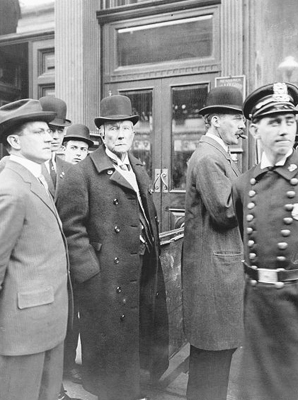
A grim John D. Rockefeller votes in November 1908, not long after the shocking disclosure of the Archbold bribery scandal. (Courtesy of the Rockefeller Archive Center)