
CHAPTER 30
The Ludlow saga was intertwined with the final, troubled phase of Cettie’s life. When demonstrators stormed the Pocantico gates, Rockefeller grew alarmed because, among other reasons, his wife lay terminally ill inside. Junior was about to make his trek of atonement to Colorado when his mother died on March 12, 1915, forcing him to postpone it until September. One of the first sympathy notes came from Mother Jones: “The sympathy of one whom thousands of men have called ‘Mother’ is with you at this time when your heart is filled with sorrow for her who called you ‘Son.’ ”1 A month later, Senator Aldrich, who had retired from the Senate in 1911, died of a stroke, steeping Junior and Abby in the thick gloom of double mourning.
Cettie had been withering away for many years. When she took up winter residence at 4 West Fifty-fourth Street in late 1909, she was already restricted to a wheelchair, so that Junior and Harold McCormick had to hoist her up the front steps. Largely bedridden, requiring round-the-clock nursing, she was inexplicably reluctant, like her husband, to consult the eminent physicians at the Rockefeller Institute. As her diaries show, she suffered from a gruesome host of afflictions, including pneumonia, shingles, pernicious anemia, and sciatica. She was pestered by so many ailments that it is impossible to come up with a single, clear diagnosis.
Senior’s response to her chronic troubles was ambivalent. He was often loving and infinitely patient. At dinner parties, he would pluck a flower, excuse himself, tiptoe up the stairs, and present it to her, along with some amusing tidbit of table talk. “He was the most affectionate and thoughtful man in illness and sorrow I have ever known,” said his son. “No woman could have been more tender.”2 During Cettie’s siege, they remained an old-fashioned couple, sweet and unfailingly courtly with each other.
Yet for all his devotion, Rockefeller was often away, refusing to modify his seasonal rotation of houses. During the winter of 1909–1910 at West Fifty-fourth Street, for instance, Cettie inscribed in her diary: “John Sr. is at Pocantico coming down Sundays.”3Though he stayed away for long patches— sometimes weeks at a stretch—Cettie expressed no bitterness.
During the summer of 1913 at Forest Hill, with Dr. Biggar in constant attendance, Cettie’s condition deteriorated as lumbago, pleurisy, congestive heart failure, and bladder and rectal problems were superadded to her already long list of maladies. In this cheerless season, sister Lute grew ill and took to a wheelchair, though she recovered by the spring. When doctors warned Rockefeller that Cettie was too frail to leave Cleveland, he was caught in an excruciating predicament, for his seasonal rotation demanded his presence at Pocantico in October. If he stayed through February, he could be listed as a Cleveland resident and face severe tax penalties. Nonetheless, he repeatedly postponed the trip due to Cettie’s frailty. Making the best of things, he drove Cettie around the grounds each day in an old-fashioned open phaeton or newfangled automobile. “John so very cheerful and comforting and glad I am slowly improving,” Cettie told her diary.4 During one visit to the Euclid Avenue Baptist Church, Rockefeller was addressing the congregation when his gaze alighted upon Cettie’s pale, upturned face, and he was moved to a personal utterance. “People tell me I have done much in my life,” he said. “I know I have worked hard. But the best thing I ever accomplished and the thing that has given me the greatest happiness was to win Cettie Spelman. I have had but one sweetheart and am thankful to say I still have her.”5
In February 1914, John preceded Cettie to Kykuit to ensure that the remodeled house would accommodate her comfortably. Perhaps with a premonition that she would never see Cleveland again, Cettie postponed her departure for New York. When one employee softly prodded her, she balked. “I don’t want to go yet,” she said. “This is where the children used to be, and Mr. John’s little rocking chair is upon the attic floor.” 6 The journey east in February proved an unspeakable ordeal. When the train stopped at Philipse Manor in North Tarrytown, Cettie, attended by doctors and nurses, was lifted to a waiting automobile. Once she was settled in at Pocantico, Senior promptly resumed his self-imposed routine and rushed off to his Lakewood haunt for his usual spring retreat. Without reproach, Junior wrote him, “Mother misses you, but is glad to feel that you are having a good rest, and while she will welcome you home, realizes that you should have this change.”7
Dismayed by his wife’s sickness and perhaps feeling faintly guilty, Rockefeller tried to offset his absences with extravagant romantic gestures. On their golden wedding anniversary in September 1914, he brought a brass band to Kykuit, placed them on the lawn, and had Cettie carried from the house to Mendelssohn’s “Wedding March.”

John D. Rockefeller attends the ailing Cettie, who was confined to a wheelchair in her final years. (Courtesy of the Rockefeller Archive Center)
During her last Pocantico winter, strengthened by a brew of barley, oatmeal, and milk, Cettie seemed to rally, so that Junior and Abby felt confident enough to join Senior at his new winter retreat in Ormond Beach, Florida. As workmen painted the master bedroom for John D.’s return, Cettie was in better spirits than she had been in for a long time. On March 11, 1915, she asked for a wheelchair, wanting to tour the garden and smell the flowers. During this fleeting reverie, she downed a glass of milk, pronounced it good, then wearily sank back on her pillow, feeling faint and weak. Lute and Dr. Paul Allen maintained an overnight vigil at her bedside, and the two sisters were clasping hands at 10:20 A.M. the next morning when Cettie expired. At Ormond Beach, Rockefeller received two telegrams in rapid succession: the first announcing that she was dying, the second her death. Though he had gotten accustomed, by degrees, to the possible imminence of her death, he was still stunned by the finality of the news. When he shuffled back to the breakfast table with the news, John and Abby saw something they had never seen before: Senior was openly weeping.
Returning by train from Florida with his son and daughter-in-law, Rockefeller was amazed by the many expressions of sympathy he received from railway officials and conductors along the route. As Abby said, “He was wonderfully calm and brave but it was a great shock to him.” 8 At Pocantico, Rockefeller found Cettie laid out peacefully where she had died and for a long time stared pensively at the woman who had shared the unprecedented achievements and tumult of his life. Alta came to Pocantico but not Edith, who was studying with Carl Jung in Switzerland. Seven years later, Rockefeller reconstructed for her his impressions of Cettie’s death, saying that “she triumphed gloriously when the end came, and to the last view we took of her, her face bore that angelic radiance.” 9
Rockefeller was always sentimental about his wife, and as he reminisced about their early married days on Cheshire Street in Cleveland, he would take out and lovingly handle the first dishes they had purchased. While grappling with both grief and wistful memory, he had to endure an infuriating tax battle with the city of Cleveland. He had been a legal resident of New York since the 1880s and paid all his taxes there. During the winter of 1913–1914, Cettie’s illness had forced him to prolong his stay at Forest Hill beyond February 3—the tax-listing day that determined taxable residence in Ohio. Rockefeller’s extended sojourn had been dictated solely by the medical emergency.
Nonetheless, his political enemies welcomed this chance to vex him. Declaring Rockefeller a legal resident for 1913, the Cuyahoga County tax office assessed him $1.5 million in taxes. Having already paid taxes in New York, he refused to submit to this extortion, even after Ohio governor James M. Cox threatened to subpoena him if he crossed the state line. While Rockefeller stalled, the Cuyahoga commissioners threatened to slap on a 50 percent penalty. Later on, the courts declared that Rockefeller had been assessed wrongfully, but meanwhile he had no choice but to boycott the state.
The way Cleveland dealt with him had long been a sore point with Rockefeller, who believed that no other town so regularly abused him. He thought the city ungrateful for Standard Oil’s economic contribution and railed against “low politicians” who tried to extract taxes from him. “Cleveland ought to be ashamed to look herself in the face when she thinks of how she treated us,” he stated.10 It irked him that local groups badgered him for money while he was being so mercilessly berated by local reporters and politicians. During his lifetime, he donated more than three million dollars to several local institutions— including the Euclid Avenue Baptist Church, Alta House, Western Reserve University, the Case School of Applied Sciences, and the Cleveland Orchestra— and gave the land for two spacious parks, Rockefeller Park and Forest Hill Park. Yet these gifts were extremely modest compared to what Cleveland would have received had it not antagonized him. Rankled, Rockefeller transferred his love and loyalty to his adopted town. “New York has always treated me more fairly than Cleveland, much more.”11 How many New York hospitals, museums, and churches would be enriched by Cleveland’s blunder!
Because of the virulent tax dispute, Rockefeller could not bury Cettie in the family plot in Cleveland without facing a subpoena and had to postpone the burial. To the press, he contrived a saccharine story that he could not bear to part with her remains. “I want to keep her with me as long as I can,” he told reporters.12 For four and a half months, he stored her casket in the green granite mausoleum of the Archbold family at Sleepy Hollow Cemetery in Tarrytown, which was patrolled at all hours by two armed guards.
The casket was finally moved to Cleveland under top secret conditions. During a pelting rain and hailstorm, two guards were sent down to the cemetery gate to pick up some decorative plants for the vault—a diversionary tactic that distracted them for twenty-five minutes. While they were away, a local undertaker named Vanderbilt drove up to the vault, peeled away the flower-covered pall, removed Cettie’s casket from its container, substituted a new empty casket, then replaced the pall and flowers. Once he had executed this switch, Vanderbilt drove out the front gate with Cettie’s coffin hidden inside a rough, plain, unmarked box. Driving to the Harmon station of the Lake Shore Railroad, the undertaker loaded the box into a baggage car amid the intermittent flashes of an electrical storm. Nobody associated with the railroad knew the identity of the cadaver, which was accompanied to Cleveland by Vanderbilt and two men from 26 Broadway. One conspirator recalled Rockefeller’s peculiarly boyish pleasure at this intrigue: “To plan and carry out the removal of the body without the papers and the public discovering a thing until all was over, was a source of satisfaction to him.” 13
Perpetuating this intrigue at Lake View cemetery, only Senior, Alta, Parmalee, and Aunt Lute stood by when Cettie’s coffin was lowered into the earth beside Eliza—with a gap left in between them so that Rockefeller could spend eternity flanked by his two favorite women. Rockefeller selected Christian verse to be read aloud at the gravesite, and this clandestine sunset burial filled him with emotion. “That was all so beautiful, so lovely,” he said. “It was just as mama would have wished.”14 It also ended Rockefeller’s association with Cleveland, since two years later the old Forest Hill house mysteriously burned down on a frosty December night. After a failed attempt to create a residential development with houses designed in Norman-château style, Junior transferred the remaining land to Cleveland for Forest Hill Park.
As part of the probate of her will, Cettie’s wardrobe was inventoried and revealed her nunlike simplicity. The most costly item of clothing was a seal coat and muff, appraised at $150. She had a dowdy collection of garments, with 15 suits valued at $300 and 10 hats at $50. Cettie had never replaced the thin gold wedding ring of 1864, which was now valued at $3. As one dumbfounded reporter commented: “Able to have a wardrobe as extensive as Queen Elizabeth’s, she was content with a supply which in quantity and quality could be duplicated by the wife of an ordinarily successful business man.” 15
Cettie’s death elicited Rockefeller’s last major philanthropic commitment: In 1918, he gave $74 million to endow the Laura Spelman Rockefeller Memorial. To commemorate his wife, he stipulated that this foundation should promote various causes that she had championed, such as Baptist missions, churches, and homes for the aged. But the Laura Spelman Rockefeller Memorial moved beyond the denominational giving she had favored. In 1922, under the direction of Beardsley Ruml, it began to pour nearly fifty million dollars into research in the social sciences. A husky, loquacious young man, always twinkling with ideas, the cigar-smoking Ruml stimulated the growth of many university research centers in social science and was a moving force behind the creation of the Social Science Research Council. By the time the memorial was folded into the Rockefeller Foundation in 1929, it had left an enduring imprint on the academic world in only a decade of existence. As Robert M. Hutchins of the University of Chicago said, “The Laura Spelman Rockefeller Memorial in its brief but brilliant career did more than any other agency to promote the social sciences in the United States.”16
By the time her mother died, Edith had already spent two years in self-imposed exile in Switzerland and was increasingly alienated from her father and siblings. Aside from a single meeting with Junior, she seemed to have no contact with the other Rockefellers during her years abroad. She kept up a sporadic, stilted correspondence with her father that was both warm and distant, loving and subtly hostile, as she tried to sort out her confused feelings toward him.
Edith and Harold McCormick had a close but tumultuous marriage. It was, in many ways, a classic mismatch: Harold was free and expansive, while Edith was aloof, imperious, and cerebral, very much the mistress of her emotions. Sometimes she found her husband too exuberant, while he criticized her for being standoffish. Their marital tensions were likely aggravated by the death of two of their children: four-year-old Jack in 1901 and one-year-old Editha in 1904, events that cast a shadow across Edith’s life. To worsen matters, between 1905 and 1907 she suffered from tuberculosis of the kidney, which fortunately went into remission. Edith became more rigid, a stickler for a frosty sort of protocol, even forcing her children to make appointments to see her. When she went out driving, she planned the exact itinerary for the coachman then refused to speak to him again during the drive. She and Harold constructed a forty-four-room mansion in Lake Forest, Illinois, called the Villa Turicum, which they never occupied, and the unpacked crates of china and chairs lingered dustily in the storerooms. Once a brilliant society hostess, Edith became increasingly immured in their mansion at 1000 Lake Shore Drive, incapacitated by a terrifying agoraphobia.
In 1910, to investigate new sites for an International Harvester factory, Harold spent two summer months motoring through Hungary with Edith, a trip that sorely debilitated her. The following year, at the last minute, she canceled a cotillion ball for two hundred people without any explanation, fostering rumors that she had had a nervous breakdown. Around this time, she also suffered a crisis of religious faith, producing a breach with her father. For a long time, she had suspected that preachers dressed up their personal beliefs as gospel truth. “I never heard a Baptist minister say anything from a pulpit that convinced me he was Divinely inspired,” she once remarked.17 The upshot, she recalled, was that “as the minister finished his sermon one Sunday I walked from my pew and out into the air vowing never to return and I kept that vow.”18 For Edith, it was a bracing moment that allowed her to map her own route to salvation, yet it also estranged her from a family spoon-fed on simple Baptist pieties.
During the summer of 1912, in a ten-week stay at a Catskill Mountains clinic run by a Dr. Foord, she rebelled against the conventional regimen of fresh air and exercise being prescribed for her depression. She was ripe for some daring approach—“My object in the world is to think new thoughts,” she once stated—ideally one with quasi-mystical ingredients that might substitute for her shattered religious faith.19 She was primed, in short, for her first encounter with Carl Jung, the Swiss clinical and experimental psychiatrist who had treated Harold several years earlier.
While Jung was in New York in September 1912, Harold’s cousin Medill McCormick—an editor and co-owner of the Chicago Tribune who had been treated by Jung for alcoholism—introduced Edith to him. As he began to analyze her, Jung liked her mental sparkle but thought her emotional state extremely precarious. Jung diagnosed Edith as suffering from “latent schizophrenia,” a hypothesis confirmed for him when she told him about a dream she had of a tree struck by lightning and split in two.20 Edith responded to analysis like a frustrated searcher who had at last found her destination. According to one version of the story, the bossy Edith urged Jung to move with his family to America, where she would buy him a house and help him to establish his practice. This grandiosity only strengthened Jung’s misgivings about Edith as a woman who thought “she could buy everything.”21 Regarding American life as sterile and deracinated, Jung recommended that Edith come to study with him in Zurich instead.
Since Edith spent years under Jung’s spell, it is worth noting his intense dislike of Rockefeller. On October 20, 1912, Jung spent the day with Edith at Kykuit, doubtless savoring the chance to study an archetypal figure such as Rockefeller up close. He glibly dismissed the titan as narrow, empty, and sanctimonious. “Rockefeller is really just a mountain of gold, and it has been dearly bought,” he said.22 He thought Rockefeller lonely, obsessed with his own health, and tortured by a bad conscience. At one point, Rockefeller told Jung that the Austrians were bad people. “You know, Doctor, perhaps, of my idea for a standardized price in favor of the Standard Oil Trust; you see what a great advantage it is to pay the same price for oil all over the world—it is for the good of the people—but the Austrians have made a separate contract with Rumania. Those people are very bad.”23 For Jung, who viewed Standard Oil as a monstrous operation, such talk corroborated his worst suspicions. As he later wrote, “We had three great organizations before the war, the famous trinity— the Germany army, the Standard Oil Company, and the Catholic Church. Each considers itself a perfectly moral institution . . . [yet] thousands of decent human beings have been destroyed by the Standard Oil Trust.”24
Having failed to woo Jung to American shores, Edith consented to sail with him to Switzerland in April 1913. For weeks before sailing, Jung met with her daily, and he continued the analytic sessions on board. Sigmund Freud, who had grown increasingly disenchanted with his onetime disciple, believed that Jung was scheming for the Rockefeller money and told Sándor Ferenczi that March that “Jung has gone to America again for five weeks, to see a Rockefeller woman, so they say.”25 For the crossing, the Rockefeller-McCormick retinue included Edith’s son Fowler and his tutor, daughter Muriel and her governess, plus a clutch of servants; Harold and their other daughter, Mathilde, stayed behind in Chicago. In Zurich, the group settled into a suite at the fancy Hotel Baur-au-Lac, where Edith spent the next eight years. At first, nobody, least of all Edith, thought in terms of such an extended stay. For Fowler, the Zurich summer proved intolerable. “This is a very queer place,” he wrote to Rockefeller. “It has rained here this summer almost incessantly and some very peculiar weather phenomenons happen.”26 When autumn came, he returned to America to attend Groton, but Edith tarried in Zurich, consulting Jung daily. In October, Harold and Mathilde went to Europe, hoping to bring Edith back in November, but given her growing attachment to analysis, Harold knew this was impossible. Hence, their two daughters stayed in Switzerland: Muriel was placed in a strict German school, while Mathilde, who suffered from weak health, stayed in a sanatorium.
By late December, lingering in Zurich with Edith, Harold saw the need to defend her protracted absence to her father. In a long letter to Rockefeller, he tried to explain some of Jung’s methods, though he was often reticent about the substance of Edith’s analysis. “Edith is becoming very real,and true to herself and is seeking and I am sure will succeed to find her path. . . . At any rate, she is in absolutely safe and trustworthy hands for no finer man ever breathed than Dr. Jung. He has an intense admiration for Edith and yet recognizes that she is the toughest problem he ever had to deal with.” To head off family criticism, Harold added, “It was a God-send that she met Dr. Jung and that her family stood back of her in her resolve and that she felt this assurance.” 27
Served with this warning to be tolerant, Rockefeller tried to be forbearing, but for a nineteenth-century man, Jung’s modern approach to nervous jitters sounded like so much mumbo jumbo. In detailed, informative letters, Harold gamely outlined Jung’s theory of the unconscious and how he investigated that realm through dreams, reveries, and free association. Rockefeller was diplomatic but obviously befuddled. “I have not been able up to date to get down satisfactorily to all the underlying principles,” he apologized to Harold. “But so long as they exercise a beautiful, helpful, continuing influence for good over the lives, that is the thing.”28
On December 20, Harold sailed back to America without Edith. Beyond her veneration of Jung, she was immobilized by a travel phobia that made even brief train trips unbearable torments. The severity of her fears can be gleaned from a gossipy account written by her Zurich chauffeur, Emile Ammann, who was driven to distraction by her antics. He portrayed Edith as a vain, haughty, narcissistic woman with a slender waist and bright, piercing eyes. He said she was known for her eccentric behavior, her furs and diamonds, and her beautiful fashions straight from Paris and Wiesbaden. According to Ammann, she was indifferent to her family, brutal with servants, and preoccupied with punctuality in a way that mirrored her father. On his first morning, she ordered him to pick her up at 9:14. After he arrived, she checked her diamond-studded wristwatch. “Ammann,” she said, “I ordered you to be here at 9:14. You were here at 9:13. Naturally, that’s not the same thing.”29
Ammann claimed that Edith had been able to sail to Switzerland because Jung had effectively sedated her by putting her in a hypnotic trance. The chauffeur played a pivotal role in the therapy to cure her travel phobia. Jung recommended that Edith board a train and travel as far as she could; sometimes, however, she sprang from the train in terror before it even left the station. But if she could stave off the terror and stay aboard, Ammann would speed ahead in the Rolls-Royce and meet her at the next station; if she felt secure enough to go on, she waved from the train window and he raced to the next station. Sometimes these grueling exercises lasted three hours, leaving both Edith and Ammann exhausted. Jung evidently thought Edith had to conquer her haughtiness as well, for he had her kneel down in her luxurious hotel suite and scrub the floors. Like some self-flagellating penitent, she also walked hatless and dripping through the rain while Ammann trailed alongside her in the car.
If Rockefeller had hoped that Harold would rescue Edith from this life, he was soon disabused as his son-in-law was sucked into the vortex of the Zurich group with its quasi-religious intensity. Returning to Switzerland in September 1914, Harold grew so entranced by Jung that he decided to stay and resigned as treasurer of International Harvester, ceding control to brother Cyrus while remaining a board member. He knew that such an abrupt change required some explaining. “I am trying to learn to think, for I have always had a superabundance of ‘feelings’—With Edith it’s just exactly the other way,” he reported to Rockefeller.30 Having grown up with both a mentally ill brother and sister, Harold was quick to brood about any deviant behavior in his children, especially the impetuous, twelve-year-old Muriel, who had started analysis with Jung that summer. The following year, Edith announced to her son, “Fowler, this question of analytical psychology is a very important one,” and he, too, was herded into analysis with a Jung associate.31
By October 1914, Edith had graduated from straight analysis with Jung and started a course of supplementary study. As Harold reported to his now-restive father-in-law, “She studies astronomy, biology and history, and music. She does not go to see Dr. Jung anymore.”32 Whatever patience Rockefeller had shown began to evaporate in early 1915 when Edith failed to attend the wedding of Harold’s brother Cyrus in February and did not come to Cettie’s funeral service in March—despite Harold’s talk about all the progress she had made. Rockefeller began to grumble that Edith and Harold were “banqueting” in Switzerland, forcing Harold into extended self-defense: “This is not a tabernacle of joy,” he told Rockefeller, “but a shrine to which seekers only address themselves, and it is in this spirit that I have postponed again my sailing and that Edith still finds herself held.”33 By this point, Harold had adopted Jung as his guru as well, accompanying him on mountain walks and idealizing him as being “as nearly perfect to my mind as a man can be.”34 This all sounds rather starry-eyed given Jung’s limited success with Edith. In a letter to his mother, Harold admitted that Edith was still prey to agoraphobia, had not left the hotel grounds for almost a year, and could not travel on a train for more than twenty minutes—hardly a glowing testimonial to Jung’s method.
What complicated relations between Rockefeller and Edith was that in working with Jung, she was trying to extirpate the cool, controlling nature she had internalized from her father. Jung classified Harold as too extroverted and Edith, like her father, as too introverted. As Harold told Rockefeller, “In Edith, Father, I see the near counterpart of your personality. I think she is more like you than any other of your children all attributes considered. . . . She has your purpose and tenacity without one little diminution.” 35Precisely for that reason, Edith knew the little devices by which her father cunningly walled himself off from people. As she wrote to her father after Cettie’s death, “There is warmth and love in your heart when we can get through all the outside barriers which you have thrown up to protect yourself—your own self—from the world.” 36 On another occasion, she repeated this leitmotif. “I wish sometimes that you would let me get near to you . . . so that your heart would feel the warmth of a simple human sort.”37
Such straight talk probably made Rockefeller squirm. The human psyche was a boggy, fetid terrain that he never cared to explore, and he had spent a lifetime trying to conceal his motives and emotions. He had been largely insulated from criticism within his own family, and Edith was the first child to press him, however gingerly, on taboo topics. It is testimony to his fatherly love that, despite his complete bafflement about her exile, he tried to respond to Edith with patient sympathy. To her plea for greater closeness, he replied, “I can think of nothing which I would more devoutly desire than that we should be constantly drawn closer and closer together, to the end that we may be of the greatest assistance to each other, not only, but to the dear ones so near and so dear to us.”38 For the most part, he was too shrewd to try to induce outright guilt in Edith about her stay overseas and simply said how much he missed her and that he knew her absence must be for the best.
In 1915, Jung recommended that his followers read Friedrich Nietzsche, especially The Will to Power, and Edith and Harold sent a copy to Rockefeller to promote self-awareness. “It cites the theory,” Harold explained excitedly, “you exemplify the practice.”39One can only picture Rockefeller’s puzzlement as he thumbed these pages. “I’m sure the book will prove very interesting reading, though it may be far beyond me,” Rockefeller replied. “I keep to a simple philosophy and almost primitive ideas of living.”40 In a later letter to Rockefeller— having clearly forgotten the earlier one—Harold explained that Nietzsche was attempting to show how some people need to impose their wills on others. Yet for all their efforts to enlighten him, Harold and Edith never made much progress with Rockefeller, who was comfortable with himself and lived quite nicely with his own repressions.
Increasingly, Edith saw in Jungian psychology a mystic path as well as a therapeutic method. “You on your path have your philosophy and your religion which guide you,” she wrote to Rockefeller in words that would have sounded blasphemous to him. “I on my path have my philosophy and my religion which guide me.”41 Edith wanted to use the Rockefeller fortune to proselytize for Jung, and she bristled that her father demoted her and Alta to a subordinate status behind Junior. With a protofeminist consciousness, she resented the flagrant inequality in the treatment of the son and daughters. In September 1915, she told Rockefeller of her wish to help with his philanthropies. “It is beautiful and enveloping work and John is privileged in a way which Alta and I as yet have not had the opportunity of being. I am sure that as women we are serious minded and earnest and deeply interested in mankind.”42 When this produced no effect, Edith upped the pressure in January 1916. “As a woman of forty-three I should like to have more money to help with. . . . I am worthy of more confidence on your part.”43 Rockefeller was not exactly punishing his daughter—he was sending her $2,500 monthly and had already given her and Harold more than $2 million in gifts—but his favoritism toward his son was clear.
What Edith could not admit was that she argued from a weak position. She had cut herself off from her family, skipped her mother’s funeral, often showed little interest in her children, had crippling phobias, and had no immediate plans to return to the United States. She was a spendthrift with a habit of running up debt, which would have only deepened her father’s doubts about her ability to manage money. As Rockefeller said, citing her stay abroad, he regretted that he could not be “more familiar with your benevolences as I have been with John and Alta in respect to their contributions to good causes. This contact and the more intimate knowledge of all that they are doing in this regard has afforded me much pleasure.”44 Eventually, he doubled Edith’s monthly allowance to $5,000 but went no further for the moment.
That Edith wanted additional money to advance the cause of Jungian analysis became clear in 1916 when she put up $120,000—$80,000 of it borrowed—to rent and renovate a posh Zurich mansion for a new Psychological Club, complete with a library, restaurant, recreation rooms, and guest rooms. The intention was to have a place where analysts and patients could socialize and listen to lectures. When the setting proved too costly, the club moved to more modest quarters on the Gemeindestrasse. Edith also sponsored translations of Jung’s work into English that significantly expanded his influence. Disturbed by this largesse, Rockefeller demanded that Edith send him a list of her chief charitable benefactions. In her reply, she showed that her gift to Jung far surpassed her donations to her two other main causes: the John McCormick Institution of Infectious Diseases and the Chicago Opera Company.
Upon learning of Edith’s contribution for the Psychological Club, Freud, who had since broken with his heretical disciple, greeted the news with a sneer. “So Swiss ethics have finally made their sought-after contact with American money.”45 It is easy to understand Freud’s cynicism. After her gift for the Psychological Club, Edith was suddenly allowed by Jung to graduate from an analysand with unusually intractable problems to the role of analyst. That Jung had allowed the phobic Edith to function as an analyst raises some profound questions about Jung’s judgment. By the following year, Edith wrote to her father, “I am teaching six hours a day besides my own studies.”46
Edith was also subsidizing writers and musicians. Her most important patronage was of James Joyce, who had found sanctuary in neutral Zurich during the war. In February 1918, Edith set up a bank account for the financially beleaguered Joyce that allowed him to withdraw a thousand francs monthly. Eager to thank his anonymous patron, Joyce managed to ascertain her identity. When Joyce met Edith, she said to him, “I know you are a great artist” then bubbled over with talk about Jungian analysis.47 In her typical domineering fashion, Edith decided that Joyce should undergo analysis with Jung and she would pay for it. Possibly because he spurned this offer, Joyce found his credit line abruptly terminated after eighteen months. The author did not welcome the volte-face. As Joyce’s biographer Richard Ellmann observed, “It is unlikely that Joyce would allow [Edith] to escape scot-free from artistic punishment; and in the Circe episode of Ulysses, Mrs. Mervyn Talboys, the society woman with a riding crop and a sadistic bent, may owe something to Edith Rockefeller McCormick, a noted horsewoman.” 48 Even Joyce’s wife, Nora, made Edith the butt of ribald jokes, wondering what kind of sumptuous underwear the rich American woman wore.
Edith certainly had her ridiculous aspects. She was an unlikely cross between the grande bourgeoise and the impractical bohemian, a dreamer caught up in the cultlike atmosphere of Jung’s practice. Yet in the Rockefeller family, she was a pioneer, the first to peer into the mysteries of human nature and confront social inhibitions and moral restraints that had long been held sacrosanct by the family.
It seemed at first that the mutual interest in psychoanalysis might bridge the temperamental divide between Edith and Harold. He was patient, compassionate, and eager to see his wife freed from the demons that beset her. “I must tell you in a word how lovely Edith is developing,” a rhapsodic Harold wrote to his mother in September 1917. “You would not know her.” 49 Indeed, Edith seemed to be thriving in Zurich, her caseload of patients growing. “New patients are coming to me all the time and I have had some fifty cases now,” she told her father in 1919. “I hear in a year twelve thousand dreams.”50 This pleasant interlude might have lasted forever if Harold had not been named president of International Harvester in 1918, pulling him back into the workaday world of Chicago.
Psychoanalysis had stimulated both Edith and Harold to experiment freely with their lives. Like other novices, Edith converted Jungian analysis into a license for wildly uninhibited behavior. Jung himself did not believe in or practice monogamy. “Ammann,” Edith told her chauffeur, “if your unconscious causes you to love several women, you need not feel any guilt. . . . Psychoanalysis will conquer all.”51 She posted Emma, her private secretary, at the threshold of her hotel suite to safeguard her trysts. One day, Harold showed up without warning and brushed past Emma before she could stop him. A startled Edith began to shout, “Harold, I . . . shan’t have it. You’re not to come to my rooms without first having Emma announce you.”52 Now that Harold and Edith lived far apart, each had numerous opportunities for escapades.
Edith’s liaisons managed to skirt scandal until a young Austrian named Edwin Krenn came onto the scene. A man of shadowy antecedents—Edith described him as the son of a famous European painter—he was short, blond, chubby, and always foppishly attired. When he arrived in Switzerland and entered analysis with Edith, he did not have any apparent means of support. Edith not only financed him but helped him to obtain Swiss citizenship. She was convinced that he was an architect of genius, and they became constant companions, driving together in the afternoons, attending theater in the evening, then retiring to her hotel suite for private dinners. According to Emile Ammann, Jung warned her of the scandal that might erupt from this love affair. “This is my problem,” Edith replied curtly, “and I can do what I please.”53
Alone in Chicago, Harold was highly susceptible to alluring women. Since he and Edith had recently made a five-year commitment to support the Chicago Opera Company, many pretty, aspiring singers passed his way. In September 1919, when the Chicago Opera performed in New York, a Polish singer named Ganna Walska tracked him down at the Plaza Hotel. Even though he was now balding and pudgy, Walska claimed that she swooned over his “wonderful boyish blue eyes.”54 A voluptuous woman with a hypnotic gaze, Walska wore ponderous jewelry and oversized hats and fancied herself a femme fatale; much like Edwin Krenn, she was a gold digger who wrapped herself in a cloud of exotic mystery.
In 1920, the two McCormick daughters, alarmed by their mother’s affair with Edwin Krenn, pleaded with Harold to come to Zurich at once. By this point, Harold was already smitten with Walska and had little incentive to terminate the match, but he perhaps went to Switzerland, in part, because of Rockefeller’s concern about the perilous state of Edith’s finances. Bent upon showing that she possessed her father’s business flair, she had blundered into one catastrophic deal after another. In late 1919, a German scientist had come to Switzerland peddling a secret process for hardening wood, which was supposed to make it usable for everything from railroad ties to telegraph poles. Even Jung initially encouraged Edith in the venture. She set up a company, appointed herself board chairman, and invested $100,000, promising to boost that amount to $1 million. Rockefeller pleaded with Harold to stop her. “I am opposed to Edith having anything to do with the project at all. I fear that it will result in great loss and trouble. I most earnestly entreat her to discontinue this not only but not to engage in any business schemes.”55 There was a touch of the willful adolescent about Edith, chafing at daddy’s authority, and Rockefeller’s intervention probably backfired. He quickly proved to be prescient: After the German scientist left Switzerland, Edith could not reproduce his results, and eventually she had to write off a $340,000 investment. Edith also piled up staggering debts to support the Chicago Opera and gave a $300,000 piece of property to Cook County for a zoo; Harold, Rockefeller, and Junior first learned of this last act of munificence in the morning papers. By early 1920, Edith’s debts had ballooned to $812,000, and her father was obliged to tide her over with a transfer of Standard Oil of New Jersey stock.
However sharp Rockefeller was in criticizing her finances, he was even more concerned about his daughter’s negligence as a mother, especially toward his favorite grandson, Fowler. As lovingly as he could, he prodded Edith to devote more time to her children. As he told her in April 1921:
Edith dear, the financial question, while important, is not important when compared to the other question—the great question of your being present with your children. And how sadly they need your presence, and how very solicitous we are all for them! In this connection I may add that you could have been a great comfort and help to your mother and me. But this sinks into insignificance also, when we consider the dear children. . . . I am not lecturing. I am not scolding. I love you, Edith dear; and I am still hoping.56
By late August 1921, Edith had sufficiently overcome her travel phobia that she was able to book passage for America, where she planned to visit her father upon arrival. She had not set eyes on him for eight years, yet when she docked in New York, she told him that she wanted to bring along two companions: Edwin Krenn and his old boarding-school chum, Edward Dato. Properly offended—and possibly privy to rumors about Edith’s affair—Rockefeller insisted upon seeing Edith alone. She grudgingly agreed to venture to Lakewood alone to see him. It took ten years for Edith to explain to her father why she never arrived on the agreed day. “When I got to the ferry, a terrific thunder storm broke the terrible heat and my nerves which had been sorely tried by the difficult divorce conditions of my arrival in New York added to the treatment of my children, broke down and I was forced to turn back instead of going to you.”57 This was as close as father and daughter came to seeing each other during the last nineteen years of Edith’s life. Despite eight years of intensive study with Jung, Edith still could not fully conquer her travel phobia, at least when it came to seeing her father.
A month after Edith returned to Chicago, Harold filed for divorce. Like her father, Edith harbored hopes for a reconciliation, but Harold had the stronger legal case: His lawyer, Paul Cravath, had brought over from Europe a witness who had apparently observed Edith’s infidelities. This unidentified witness was convincing enough that Alta suggested that her sister make an early settlement. By Christmas, Edith was forced to sign a harsh divorce settlement, stipulating that she would receive no alimony and would pay Harold $2.7 million for their homes, plunging her further into debt. (In 1922, Edith still owed $726,000 to the banks, despite having received more than $14 million from her father over the years.) As if to register sympathy for his son-in-law, Rockefeller sent Harold a $1,000 Christmas check even as his daughter was signing the punitive papers. Though Edith pressed him to cut off communications, Rockefeller stayed in touch with Harold, but they saw each other less frequently as time passed.
Upon returning to Chicago, Edith planned to establish a center for Jungian psychology, possibly housed in the Villa Turicum. Not particularly modest about her aspirations, she explained, “It was pointed out to me that, psychologically, Chicago will be the greatest center in the world. That is why I have come back to live.”58 Before long, Edith attracted one hundred patients to her private practice, many of them socialites enticed by the Rockefeller and McCormick names. Perpetuating her interests in astrology and the occult, she paid fantastic sums for horoscopes and hosted occasional séances; at one session, she swooned into a trance then announced that she was the reincarnated spirit of Tutankhamen’s child bride. Also feeding the curiosity of prospective patients was Edith’s rumored liaison with Krenn. As in Zurich, they made daily rounds together: They lunched together, then shared language tutors, followed by late-afternoon tea and evening movies. Some observers thought Krenn might be involved in a homosexual affair with Dato, although it is impossible to verify the truth of these assertions.
Still persuaded of her business acumen, Edith started a real-estate venture in late 1923, headed by her European companions and called Krenn and Dato. Once again, she proved as gullible and impulsive as Rockefeller had feared. To float the venture, Edith deposited $5.23 million ($45 million in today’s money) in an entity called the Edith Rockefeller McCormick Trust, naming Krenn and Dato as cotrustees. Seeing Edith about to step off another cliff, Rockefeller wrote to her, “I shall expect later on that you will have great disappointment in connection with these real estate transactions, and it would give us all great humiliation to find a duplication of the experience which you have already had in your business adventures with foreigners.” 59 The warning was not heeded. Though Edith planned to build affordable housing for the poor near Highland Park, Krenn and Dato’s flagship venture was to be a 1,500-acre haven for millionaires on Lake Michigan called Edithon, complete with a marina for owners’ yachts. For the town’s design, Krenn ransacked the styles of Atlantic City and Palm Beach. Trapped in Chicago by her travel phobia, Edith could not visit the building site or inspect the books or even stop by the Krenn and Dato offices. When Edith proudly mailed her father the firm’s prospectus, he must have groaned inwardly, and he issued yet another jeremiad. “While you are a brilliant and mature woman of great mental capacity, I cannot forget you are my own flesh and blood. Therefore, it seems my duty to warn you of the pitfalls and vagaries of life.”60Rockefeller had already heard reports that Edith was again borrowing heavily and that midwestern creditors were in New York, inquiring about her net worth. Yet Edith took umbrage at her father’s well-meant concern: “I cannot refrain from telling you that I have been pained by your expressions of doubt as to the way my business Trust is managed and as to my two partners. Both Mr. Krenn and Mr. Dato are men of the highest integrity.”61 By 1927, as they lurched toward disaster, Krenn and Dato waded deeper into debt. The firm was not strong enough to withstand the 1929 crash, which left Edith with piles of unsold real estate. She never recouped her huge losses.
Throughout the 1920s, Edith kept reassuring her father that she would visit him but never made the trip. One is finally left to wonder whether her travel phobia provided her with a handy excuse to avoid a problematic relationship. Father and daughter often exchanged brief, loving letters and never lost touch, but they continued to disappoint each other. Edith wanted a modern father, not the antique figure she got. She tended to approach him as an oracle but then was hurt and baffled by the advice she received. Edith never expressed any remorse for having deserted her father during the last twenty years of her life. She had long been liberated from such outmoded concepts.
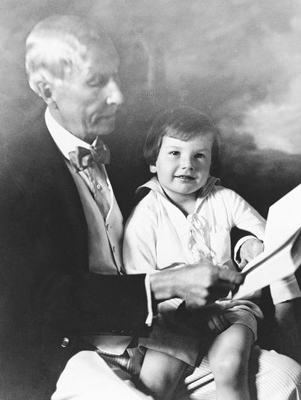
John D. Rockefeller with his adored grandson David in the 1910s. (Courtesy of the Rockefeller Archive Center)