
CHAPTER 6
The period after the Civil War was the most fertile in American history for schemers and dreamers, sharp-elbowed men and fast-talking hucksters, charlatans and swindlers. A perfect mania for patents and inventions swept America, as everybody tinkered with some new contrivance. It was a time of bombastic rhetoric and outsize dreams. As always during a protracted war, millions of people postponed their lives until the ghastly bloodshed was over, then they turned to private life with newfound zeal. The sudden wealth of young businessmen such as Rockefeller fed envy among returning soldiers, who wished to emulate their good fortune. The money fever was, in part, the reaction to a war that had appealed to both the worst and the best in the national character, for Lincoln’s high-minded crusade had often been debased by profiteering contractors operating behind patriotic façades. For many in the North, the high drama of preserving the union and emancipating the slaves had exhausted their capacity for altruism, leaving a residual contagion of greed.
As the banker Thomas Mellon observed of these years of unfettered growth,
It was such a period as seldom occurs, and hardly ever more than once in anyone’s lifetime. The period between 1863 and 1873 was one in which it was easy to grow rich. There was a steady increase in the value of property and commodities, and an active market all the time. One had only to buy anything and wait, to sell at a profit; sometimes, as in real estate for instance, at a very large profit in a short time.1
A new cult of opportunity sprang up, producing a generation of business leaders for whom work was the greatest adventure life afforded. As Mark Twain and Charles Dudley Warner wrote in The Gilded Age, “To the young American . . . the paths to fortune are innumerable and all open; there is invitation in the air and success in all his wide horizon.”2 Or as one character in William Dean Howells’s novel The Rise of Silas Lapham phrased it, “There’s no doubt but money is to the fore now. It is the romance, the poetry of our age.”3 Self-made businessmen were the new demigods, and a copious self-help literature sermonized that young men who worked hard and saved could enter the millionaires’ pantheon. This new industrial boom downgraded the power of the old gentry and rural elites, substituting a new species of self-made men: economic marauders too busy making money to be overly concerned with tradition. The era of the Great Barbecue—the felicitous name coined by literary historian Vernon Parrington—was dominated by arrogant, enterprising men in railroads, shipping, and stock manipulation: Jay Cooke, Commodore Vanderbilt, Jay Gould, Daniel Drew, Jim Fisk, and many others. The age was presided over by an inept president, General Ulysses S. Grant, a small-town businessman before the war, who was enamored of the rich, no matter how frequently they tried to fleece him.
The public was divided about these colossal developments. The appetite for gain fostered new fortunes and built up the industrial infrastructure, setting the stage for American industrial preeminence, but it also unsettled people with a sense of something frightening, gigantic, and poorly understood that was drastically transforming their innocent country. The Civil War invited people to repudiate their pasts as they staked out new lives. As Grant phrased it in his memoirs, “The war begot a spirit of independence and enterprise. The feeling now is, that a youth must cut loose from his old surroundings to enable him to get up in the world.”4 As people took unethical shortcuts to success, the universal race for riches threatened to overthrow existing moral systems and subvert the authority of church and state.
The triumph of the North meant the ascendancy of urbanization, immigration, industrial capitalism, and wage labor over an agrarian southern economy doomed to stagnate for decades. The war markedly accelerated the timetable of economic development, promoting the growth of factories, mills, and railroads. By stimulating technological innovation and standardized products, it ushered in a more regimented economy. The world of small farmers and businessmen began to fade, upstaged by a gargantuan new world of mass consumption and production. As railroad expansion gained momentum, populating the West and culminating in completion of the first transcontinental railroad in 1869, it spawned an accompanying mania in land deals, stock promotions, and mining developments. People rushed to exploit millions of acres of natural resources that could be economically brought to market for the first time.
In short, by the end of the Civil War, the preconditions existed for an industrial economy of spectacular new proportions. Before the war, the federal government had only twenty thousand employees and shied away from attempts to regulate business. Unlike Europe, America had no tradition of political absolutism or ecclesiastic privilege to quench entrepreneurial spirits, and the weak, fragmented political system gave businessmen room to flourish. At the same time, America had the legal and administrative apparatus necessary to support modern industry. There was respect for private property and contracts; people could get limited corporate charters or file for bankruptcy; and bank credit, while not yet plentiful, was everywhere available in a highly fragmented banking system. In time, the government redefined the rules of the capitalist game to tame trusts and preserve competition, but as John D. Rockefeller set about building his fortune, the absence of clear-cut rules probably aided, at first, the creative vigor of the new industrial economy.
Perhaps no industry so beguiled the Civil War veterans with promises of overnight wealth than the oil industry. In astonishing numbers, a ragtag group of demobilized soldiers, many still in uniform and carrying knapsacks and rifles, migrated to northwest Pennsylvania. The potential money to be made was irresistible, whether in drilling or in auxiliary services; people could charge two or three times as much as they dared to ask in the city. Ida Tarbell speculated that “this little corner of Pennsylvania absorbed a larger portion of men probably than any other spot in the United States. There were lieutenants and captains and majors—even generals—scattered all over the field.”5 They brought with them a military sense of organization and a bellicose competitive spirit, but they were eager for quick killings and betrayed little sense of how to fashion a stable, lasting business, providing an opening for the organization-minded Rockefeller.
The war had stimulated growth in the use of kerosene by cutting off the supply of southern turpentine, which had yielded a rival illuminant called camphene. The war had also disrupted the whaling industry and led to a doubling of whale-oil prices. Moving into the vacuum, kerosene emerged as an economic staple and was primed for a furious postwar boom. This burning fluid extended the day in cities and removed much of the lonely darkness from rural life. The petroleum industry also furnished lubricants to grease the wheels of heavy industry. Though the world oil industry was squeezed into western Pennsylvania, the repercussions were felt everywhere. In 1865, Congressman James Garfield alluded to the oil craze in a letter to a former staff officer: “I have conversed on the general question of oil with a number of members who are in the business, for you know the fever has assailed Congress in no mild form. . . . Oil, not cotton, is King now, in the world of commerce.”6 Soon, John D. Rockefeller would reign as the undisputed king of that world.
In many ways, Rockefeller seemed a finely tuned instrument of the zeitgeist, the purest embodiment of the dynamic, acquisitive spirit of the postwar era. Like other Gilded Age moguls, he was shaped by his faith in economic progress, the beneficial application of science to industry, and America’s destiny as an economic leader. He steeled himself to persevere, subordinating his every impulse to the profit motive, working to master unruly emotions and striving for an almost Buddhist detachment from his own appetites and passions. “I had a bad temper,” Rockefeller said. “I think it might be called an ugly temper when too far provoked.” 7 So he trained himself to control this temper and tried never to be guided by ego or pique.
By the end of the Civil War, the pale, trim twenty-six-year-old with the reddish gold hair and side-whiskers carried himself like a man of importance. No sooner had he formed a new firm with Sam Andrews than he was bent on expanding it. In December 1865, he and Andrews inaugurated a second refinery, the Standard Works, with brother William appointed its nominal head. The combined Excelsior and Standard Works confirmed Rockefeller as the leading Cleveland refiner at a time when the city ranked among the top refining centers. Photos of his first refineries show an unprepossessing cluster of buildings, scarcely bigger than sheds, spaced irregularly across a hillside. With hands clasped behind his back, Rockefeller paced these works, poking his head in everywhere, a perfectionist alert to the tiniest details. When he saw somebody attending to a neglected, unswept corner, he smiled and said, “That’s right, eternal vigilance!”8 For foreman, he recruited a man named Ambrose McGregor who was, in Rockefeller’s description, “a precise, exacting man, honest as the day but perhaps not given to cultivating people.”9 An imposing, bewhiskered figure, McGregor won Rockefeller’s absolute trust on all technical matters. Since the refineries stood some distance from downtown, Rockefeller and McGregor often lunched at the boardinghouse of a Mrs. Jones; the two men in their oil-soaked boots regularly offended the nostrils of other diners and were exiled to the porch.
As a self-made man in a new industry, Rockefeller wasn’t stultified by precedent or tradition, which made it easier for him to innovate. He continued to value autonomy from outside suppliers. At first, he had paid small coopers up to $2.50 for white oak barrels before he showed, in an early demonstration of economies of scale, that he could manufacture dry, tight casks more cheaply himself; soon his firm made thousands of blue-painted barrels daily for less than a dollar per barrel. Other Cleveland coopers bought and shipped green timber to their shops, whereas Rockefeller had the oak sawed in the woods then dried in kilns, reducing its weight and slicing transportation costs in half. And he continually extended the market for petroleum by-products, selling benzine, paraffin, and petroleum jelly in addition to kerosene.
In this early period, Rockefeller was a chronic worrier who labored under a great deal of self-imposed stress. Though not versed in the scientific side of refining, he often exercised a direct managerial role in the plant. With fluctuating market conditions, he sometimes needed to send shipments to New York with great dispatch and personally rushed down to the railroad tracks to motivate his freight handlers. “I shall never forget how hungry I was in those days. I stayed out of doors day and night; I ran up and down the tops of freight cars when necessary; I hurried up the boys.” 10
At the time, refiners were tormented by fears that the vapors might catch fire, sparking an uncontrollable conflagration. Fire had already taken many lives in the industry—Edwin Drake’s well, for example, was destroyed by fire in the autumn of 1859. During the Civil War, there were so many spectacularly destructive blazes along Oil Creek that producers posted signs warning, “Smokers Will Be Shot.”11 Mark Hanna, who later managed President McKinley’s campaign, recalled how one morning in 1867 he woke up and discovered that his Cleveland refinery had burned to the ground, wiping out his investment, and such fears kept refiners on tenterhooks around the clock. “I was always ready, night and day, for a fire alarm from the direction of our works,” said Rockefeller. “Then proceeded a dark cloud of smoke from the area, and then we dashed madly to the scene of the action. So we kept ourselves like the firemen, with their horses and hose carts always ready for immediate action.”12
Such was the perpetual fire menace posed by the new industry that refineries were soon banned within the Cleveland city limits, hastening the growth of Kingsbury Run. In those years, oil tanks weren’t hemmed in earthen banks as they later were, so if a fire started it quickly engulfed all neighboring tanks in a flaming inferno. Before the automobile, nobody knew what to do with the light fraction of crude oil known as gasoline, and many refiners, under cover of dark, let this waste product run into the river. “We used to burn it for fuel in distilling the oil,” said Rockefeller, “and thousands and hundreds of thousands of barrels of it floated down the creeks and rivers, and the ground was saturated with it, in the constant effort to get rid of it.”13 The noxious runoff made the Cuyahoga River so flammable that if steamboat captains shoveled glowing coals overboard, the water erupted in flames. Each time a black cloud billowed up in the sky, people assumed another refinery had exploded, and kerosene prices soared. At least in retrospect, Rockefeller sounded philosophic about this omnipresent danger. “In those days, when the fire bell rang, we would all go to the refinery and help put it out. When the fire was burning I would have my pencil out, making plans for the rebuilding of our works.” 14
Even the dread of fire paled beside recurrent worries that the Pennsylvania oil wells would dry up, with no substitute in sight. As Rockefeller noted, “It was here today and there tomorrow, and none of us knew with any certainty about the continuance of the supply, without which these investments were valueless. ”15 Already by the late 1860s, stern prophecies were issued about the industry’s impending demise. There were two types of oilmen: those who thought the sudden boom an insubstantial mirage and who cashed in their profits as soon as possible; and those, like Rockefeller, who saw petroleum as the basis of an enduring economic revolution. During the salutary nightly sermons he gave himself in bed, Rockefeller often meditated on the transience of earthly wealth, especially oil, and admonished himself, “You’ve got a fair fortune. You have a good property—now. But suppose the oil fields gave out!”16 Yet the future of the oil business became an article of religious faith for him, as did the feeling that the Lord had blessed him and his enterprise. In late 1867, several days before Christmas, he just missed a train that ended up in a terrible wreck, killing many passengers, and Rockefeller at once wrote to Cettie, “I do (and did when I learned that the first train left) regard the thing as theProvidence of God.”17
Not yet the bête noire of oil producers, Rockefeller frequently donned his shabby oil suit and traveled to Franklin, Pennsylvania, where he kept an office that purchased oil, saving on the cost of middlemen. The oil fever was so infectious in the Oil Regions that these trips always silenced any fugitive doubts he might have entertained about the industry’s survival. As one traveler reported after visiting Oil Creek in 1866, “Men think of oil, talk of oil, dream of oil, the smell and taste of oil predominate in all they eat and drink.”18 These trips energized Rockefeller, who returned to Cleveland with renewed faith. As a friend recalled, “When he came back he would always have great tales to tell, and his eyes would snap as he would speak of his desires to succeed.”19
In the 1860s, nobody knew if significant oil deposits existed outside the rugged terrain of northwest Pennsylvania, so the industry had immediately taken on global proportions. Within a year of Drake’s discovery, his backers were marketing oil in London and Paris, and Europe emerged rapidly as the foremost market for American kerosene, importing hundreds of thousands of barrels yearly during the Civil War. Perhaps no other American industry had such an export outlook from its inception. By 1866, fully two-thirds of Cleveland kerosene was flowing overseas, most of it routed through New York, which became the export entrepôt for oil. At once, Rockefeller saw that he had to look beyond American shores to soak up excess production: “It seemed absolutely necessary to extend the market for oil by exporting to foreign countries, which required a large and most difficult development.” 20 To accomplish this, he dispatched brother William to New York City in 1866 to launch the firm of Rockefeller and Company, which would oversee the exports of their Cleveland refineries.
If William wasn’t much younger than John—“My brother is one year, one month and eight days younger than I am,” John specified with comic exactitude—he certainly had a younger brother’s deference and mentality.21 Already settled by this time, William had gotten married in May 1864 to Almira (“Mira”) Geraldine Goodsell, who came from a well-heeled Cleveland family with Yankee antecedents. The photos of William in his early twenties reveal a young man with thick muttonchop whiskers, clear eyes, and a broad, smooth forehead who looks more placid and less driven than his elder brother. Throughout their lives, despite their antithetical temperaments—William was bluff and friendly and freer than John in morals and manners—the brothers remained warm companions and close colleagues. William was a natural salesman who easily charmed people. Even in Pennsylvania, he was a popular figure who swapped tales with oil producers while John held himself aloof. “William always judges everything by intuition and instinct,” said John, tacitly contrasting his brother with himself. “He doesn’t act on analysis.”22 But those instincts were sound, and, while William took things seriously, he didn’t puff them up into grand moral crusades the way his brother did.
As a novice businessman, William had been precocious like his brother. After joining John as a bookkeeper at Hewitt and Tuttle, he was spirited away by a local miller and ended up at a produce-commission house, making partner after just one year. By age twenty, he was already earning $1,000 a year— “much more than I got,” noted John wryly—and winning his older brother’s confidence.23 “My brother was a young, active and efficient, and successful, businessman.”24 The quality that most endeared William to John was sheer dependability. In later years, John repeated the anecdote of how his brother, as a young bookkeeper, awoke in the night and realized that he had made an error in a bill of lading. He was so disturbed that he couldn’t wait till morning to correct it and marched down to the lakefront warehouse during the night so that the ship could sail on time with proper paperwork. In September 1865, William left the produce house of Hughes, Davis and Rockefeller to join his brother’s oil-refining business, and, when the Standard Works was organized that December, it bore the name of William Rockefeller and Company.
Before long, John D. Rockefeller was cast by critics as the omnipotent wizard of the oil market, setting prices as the whim seized him, but by sending William to New York he acknowledged that the export market decisively influenced oil prices. Whenever news of a Pennsylvania gusher reached New York, the French and German buyers, anticipating lower prices, simply stopped buying, and this made them the ultimate arbiters of price. “They sat there like a lot of vultures,” said Rockefeller. “They wouldn’t buy until the price of refined had fallen very low on account of the flood of crude oil in the market.”25 One of William’s tasks in New York was to apprise the firm’s buyers in the Oil Regions of sudden drops in export prices so that they could temporarily curtail crude-oil purchases.
When William arrived in New York, he set up unadorned offices at 181 Pearl Street, and the proximity to Wall Street was critical. To implement their audacious schemes, the Rockefellers needed massive capital but encountered two problems that seemed insuperable. The elite Wall Street bankers preferred to finance railroads and government and regarded oil refining as a risky, untested business, nothing short of outright gambling. Mindful of the extreme fire hazards and the specter of the oil running dry, only a few intrepid souls dared to wager on it. At the same time, John D.’s insatiable need for money outstripped the meager resources of Cleveland banks, forcing him to widen his search to New York, where he could secure credit at more advantageous rates. “And my dear brother, William, being located in the metropolis, where the opportunities were better for securing money, had upon him this financial burden, and he showed marked ability in keeping a steady nerve and presenting our case very well to the bankers.” 26 As a result of John’s foresight in assigning him to New York, William’s career became closely intertwined with that of Wall Street—to an uncomfortable extent, from John’s later perspective.
As a gray eminence of the business world in his retirement, John D. betrayed a deep suspicion of financiers, boasted that he never borrowed, and was celebrated for his financial conservatism. Yet at this stage of his career, he turned inescapably to bankers. “One can hardly recognize how difficult it was to get capital for active business enterprises at that time,” he admitted.27 If Rockefeller ever came close to groveling, it was in his eternal appeals to bankers. “In the beginning we had to go to the banks—almost on our knees—to get money and credit.” 28 When dealing with the banks, he vacillated between caution and daring: He often went to bed worrying how he would repay his large volume of loans, then awoke in the morning, refreshed by a night’s sleep and determined to borrow even more.29
The Civil War introduced a new greenback currency and national banking system that generously stoked the postwar economy with credit. Many people grew rich with borrowed funds, creating a false flush of prosperity. Rockefeller was very much a product of this new credit-based society and owed a great deal to Truman Handy and other Cleveland bankers who identified him as a young businessman of exceptional promise. He cleverly projected the image of a rising star whom bankers spurned at their peril. One day, he ran into a banker, William Otis, who had allowed Rockefeller to borrow up to his credit limit; some directors were now expressing misgivings. Could Rockefeller stop by to discuss the loans? “I shall be very glad to demonstrate the strength of my credit at any time,” replied Rockefeller. “Next week I shall need more money. I would like to give my business to your bank. Soon I shall have a great deal of money to invest.”30
Obliging but never fawning, he knew how to soothe jittery creditors, and one of his cardinal rules was never to seem too eager to borrow. With amusement, he recalled how one day he was walking down the street, trying to figure out how to find an urgently needed $15,000 loan, when a local banker pulled up in a buggy and serendipitously asked, “Do you think you could use $50,000, Mr. Rockefeller?” Rockefeller, gifted with more than a touch of his father’s showmanship, studied the man’s face for a long time then drawled, “Well-l-l, can you give me twenty-four hours to think it over?” By stalling, Rockefeller believed, he pinned down the deal on the most favorable terms.31
Aside from his reputation for exemplary character, especially among Baptist business executives, Rockefeller had several other traits that inspired passionate allegiance from bankers. He was a stickler for the truth in presenting facts, never fudged or equivocated in discussing problems, and promptly repaid loans. At numerous points in his early career, he was rescued by bankers from crises that might have capsized his business. At one bank, the directors balked at extending him further credit after he suffered a refinery fire and hadn’t yet been compensated by insurers. Stepping into the breach, director Stillman Witt asked a clerk to fetch his own strongbox and announced with a flourish, “Here, gentlemen, these young men are all O.K., and if they want to borrow more money I want to see this bank advance it without hesitation, and if you want more security, here it is; take what you want.” 32
It is impossible to comprehend Rockefeller’s breathtaking ascent without realizing that he always moved into battle backed by abundant cash. Whether riding out downturns or coasting on booms, he kept plentiful reserves and won many bidding contests simply because his war chest was deeper. Rockefeller vividly described the way that he had hastily enlisted the aid of bankers to snap up one refinery:
It required many hundreds of thousands of dollars—and in cash; securities would not answer. I received the message at about noon, and had to get off on the 3 o’clock train. I drove from bank to bank, asking each president or cashier, whomever I could find first, to get ready for me all the funds he could possibly lay hands on. I told them I would be back to get the money later. I rounded up all of our banks in the city, and made a second journey to get the money, and kept going until I secured the necessary amount. With this I was off on the 3 o’clock train, and closed the transaction. 33
To have orchestrated such a rapid campaign required a long relationship of trust with the banks.
So adroitly did Rockefeller manage his unending quest for money that he became a director of a fire-insurance company in 1866 and a director of the Ohio National Bank in 1868. By that point, he must have felt very sure of himself, even cocky, because he didn’t bother to attend bank meetings and was ejected posthaste from one board. One is again impressed by the fantastic forward motion of his career, how quickly he evolved from humble supplicant to impatient businessman. Now in his late twenties, he had little time for fuddy-duddy directors and often dispensed with the niceties. As he said of the bank’s board meetings: “I used to go at first, and there were some nice old gentlemen sitting stolidly about a table discussing earnestly the problem offered by new departures in vault locks. It was all right in its way, but I was a busy man even then and I really didn’t have the time for it. So they got rid of me speedily.”
For all his self-assurance, Rockefeller needed one associate who would share his daydreams, endorse his plans, and stiffen his resolve, and that indispensable alter ego was Henry Morrison Flagler. Nine years older than Rockefeller, with roguish good looks, Flagler was a dashing figure with luminous blue eyes, smooth black hair, and a handlebar mustache. “His clothes were of the most recent cut,” an office messenger said admiringly. “He carried himself with a confidence that was regal. He had a heavy black moustache and the most beautiful hair I had ever seen.”34 Funny and voluble, brisk and energetic, Flagler was nevertheless reticent about his motives and background and in time surpassed his tight-lipped younger partner in fending off public inquiries.
Flagler’s upbringing had some noticeable parallels to Rockefeller’s. Born in Hopewell, New York, in 1830, the son of an impecunious Presbyterian pastor, he grew up in the Finger Lakes region of upstate New York before moving to Toledo, Ohio. In a previous marriage, his mother had been married to a Bellevue, Ohio, doctor named David Harkness, who already had a son, Stephen, from his first marriage. They had a second son, Dan, before David Harkness died. Flagler’s mother, Elizabeth, then married the Reverend Isaac Flagler. Evidently a man of courage and principle, Reverend Flagler created an uproar when he officiated over the marriage in Toledo of a young mulatto man to a white woman.
Dropping out of school at fourteen, Henry made his way to Republic, Ohio, and worked in the small country store of Lamon Harkness, Dr. Harkness’s younger brother. He later spun romantic tales of this first job, where he sold molasses and dry goods by day and slept in the drafty rear of the store at night. For special customers, Flagler would dip into a keg of brandy hidden upstairs. Becoming further entangled with his Harkness relatives, Henry married Lamon’s daughter, the dark-eyed, demure Mary, in 1853.
Before the Civil War, Henry earned good money in Lamon’s grain business in Bellevue, in the corn and wheat belt of Sandusky County, where he shipped much produce through Cleveland. “John D. Rockefeller was a commission merchant in Cleveland, and I sent him a good many carloads of wheat, which he sold as my agent,” he recalled.35 In a lucrative sideline, Flagler and his Harkness relatives took an interest in a whiskey distillery, which also provided an outlet for surplus grain. Like Rockefeller, Flagler was a prudish young man who never swore an oath stronger than “Thunder!” As a teetotaler, Sunday-school teacher, and minister’s son, Flagler’s liquor venture didn’t square with his principles—though the profits evidently provided balm to his conscience. “I had scruples about the business and gave it up,” he confided, “but not before I made $50,000 in Bellevue.”36 Awash with cash, he built a stately Victorian mansion, the Gingerbread House, that was brightly illuminated with coal-oil lamps. Among the visitors was John D. Rockefeller, then canvassing accounts for his partnership with Maurice Clark. “He was a bright and active young fellow full of vim and push,” said Rockefeller, as if Flagler were the younger of the two.37
During the Civil War, Flagler, like Rockefeller, hired a substitute. His firm was a major contractor for grain purchases by the Union army and in 1862, brimful of wartime profits, he cast about for a fresh opportunity. At this point, Flagler stumbled into the sole business blunder of his career when he took a sizable stake in a salt company in Saginaw, Michigan, and moved his family there. When the war ended, slashing demand for salt, his firm went bankrupt, the victim of a classic boom-and-bust cycle. Losing everything, he had to be bailed out by a giant loan from the Harkness family. “At the end of three years, I had lost my little fortune and owed $50,000 to about 50,000 Irishmen who had been working in the salt factory,” said Flagler.38 He had much occasion to ponder the contradictions of a market economy in which dynamic industries swiftly expand during prosperity only to find themselves overextended during downturns. To cope with excess production, many Saginaw salt companies opted for cooperation over competition and joined a cartel arrangement to try to prop up salt prices, providing a precedent for Standard Oil.
After his sobering reversal of fortune, Flagler entered a despondent period in which he sometimes skipped lunch to save money. Returning to Bellevue, he tried to market felt wool as well as a machine he had invented that would supposedly produce the perfect horseshoe. Deciding to try his luck in Cleveland (where Stephen V. Harkness had moved in 1866), he took a job selling grain with Rockefeller’s ex-partner, Maurice Clark, and by coincidence filled the post recently vacated by Rockefeller. Perhaps to tweak Clark, Rockefeller invited Flagler to rent desk space in his office suite in the Sexton Block. As Flagler prospered, he settled his debts, bought a fine house on Euclid Avenue, and joined the First Presbyterian Church.
As they strolled to and from work together, Flagler and Rockefeller must have soon discovered their remarkable affinity as businessmen. Chafing at his dependence on loans and wondering when he might deplete the capital of local banks, Rockefeller now scouted out large individual investors and was probably acutely aware of the wealth of Flagler’s relatives. Through Flagler’s introduction, Rockefeller solicited money from Stephen V. Harkness, by now one of Cleveland’s richest men. A bearish man with thick, slightly unkempt hair, fluffy sideburns, and a walrus mustache, Harkness had capitalized on inside political information to make a fortune during the war. As an ally of U.S. senator John Sherman of Ohio, he had received timely word in 1862 of an upcoming government move to levy a two-dollar tax on every gallon of malt and distilled liquor. Before the tax took effect, he busily stockpiled wine and whiskey and even raided the deposits of a local bank he owned to pour more money into this operation.39 When the tax was enacted in July 1862, he sold his enormous cache of spirits for a fast $300,000 profit. It is deeply ironic that Rockefeller, a staunch temperance advocate, got one of his most significant cash infusions from questionable gains in liquor.
While Rockefeller was negotiating a large loan from Stephen V. Harkness during an hour-long talk in 1867, the latter saw an excellent opportunity to set up Henry in business and instead of extending a loan asked for a large block of stock in the company. Investing $100,000—a third of the new firm’s capital—Harkness made it a precondition of his investment that Henry become treasurer and his personal deputy in the firm. As Harkness said to Rockefeller, “Young man, you can have all the money you want. You are on the right track and I am with you.” As to Henry’s part, he added, “I’ll make Henry my watchdog.”40 Since Harkness was also a director of banks, railroads, mining, real estate, and manufacturing companies, the tie ushered Rockefeller into a new universe of business connections.
On March 4, 1867, the Cleveland Leader announced the formation of a new partnership, Rockefeller, Andrews and Flagler, with offices in the Case Building, a solid masonry structure with rounded, Romanesque windows and a prestigious address on the Public Square. “This firm is one of the oldest in the refining business and their trade already a mammoth one. . . . Their establishment is one of the largest in the United States. Among the many oil refining enterprises, this seems to be one of the most successful; its heavy capital and consummate management having kept it clear of the many shoals upon which oil refining . . . houses have so often [been] stranded.” 41 From reading this description, one would have thought the firm was run by gray, reverend men, whereas Rockefeller, the boy wonder of Cleveland business, was just twenty-seven.
Starting with Flagler’s recruitment, Rockefeller began to assemble the team of capable, congenial executives who would transform the Cleveland refiner into the world’s strongest industrial company. Both Rockefeller and Flagler had nimble minds for numbers and infinite dexterity with balance sheets. Neither was interested in a modest success, and they were both prepared to go as far and as fast as the marketplace allowed. As Flagler boasted, “I have always been contented, but I have never been satisfied.” 42 Rockefeller found his partner’s enthusiasm a tonic, noting that Flagler “was always on the active side of every question, and to his wonderful energy is due much of the rapid progress of the company in the early days.”43 Given their exalted goals, it probably helped that Flagler had been chastened by failure and was acquainted with the perils of complacency.44
Rockefeller loved Flagler’s dictum that a friendship founded on business was superior to a business founded on friendship, and for several decades they worked together in an almost seamless fashion. In the early years, the two men were bound by a common dream, lived near each other, and seemed virtually inseparable. As Rockefeller said in his memoirs, “We met and walked to the office together, walked home to luncheon, back again after luncheon, and home again at night. On these walks, when we were away from the office interruptions, we did our thinking, talking, and planning together.” For a man as reserved as Rockefeller, this picture suggests an unbuttoned exchange of ideas of a sort he permitted with few people.
In the office, their intimacy was patent to visitors, for they had back-to-back desks and shared many duties. They even developed a collective letter-writing style, passing drafts back and forth with each making minor improvements until they expressed what was wanted but not one syllable more. At this point, the letters were ready to be vetted by the severest judge, Mrs. Rockefeller, who was, said one office worker, “known to be the most valued adviser.”45 Endowed with considerable verbal skill, Flagler had such a gift for drawing up legal documents or sniffing out hidden pitfalls in contracts that Rockefeller insisted he could have taught the fine points of contract law to lawyers—no small edge for a firm that would be engaged in running legal battles.
In his later years, Flagler developed into a grandee of such rich tastes that it is instructive to note his austere early style. Not only did he labor six days a week, but he shunned bars and theaters as the devil’s playgrounds and became superintendent of the First Presybterian Church. Like Rockefeller, he advocated self-discipline and deferred gratification. As he said of his first threadbare days in Cleveland: “I wore a thin overcoat and thought how comfortable I should be when I could afford a long, thick Ulster. I carried a lunch in my pocket until I was a rich man. I trained myself in the school of self-control and self-denial. It was hard on [me], but I would rather be my own tyrant than have some one else tyrannize me.” 46 After his wife, Mary, gave birth to a son, Henry Harkness Flagler, in 1870, she never regained her health and turned into an invalid. For the next seventeen years, Flagler stayed home at night so he could read to her for hours on end, with John and Laura Rockefeller often stopping by to mitigate the gloom.
That Flagler was his most valuable partner was always unquestioned dogma for Rockefeller, yet one wonders whether the influence was altogether benign. An ebullient man, Flagler wouldn’t stop to quibble over legal niceties when taken by a powerful idea, and even Rockefeller hinted obliquely at the dangers posed by Flagler’s headstrong nature. “He was a man of great force and determination,” said Rockefeller, “though perhaps he needed a restraining influence at times when his enthusiasm was roused.” 47 On his desk, Flagler kept a quote from a popular novel, David Harum, which said, “Do unto others as they would do unto you—and do it first.”48 What makes Flagler’s ethics consequential for Rockefeller’s career was that he was the mastermind of many negotiations with the railroads—the single most controversial aspect of Standard Oil history. It’s not clear that anyone could have tempered the fiercely irrepressible drive of John D. Rockefeller, but the swashbuckling Flagler had especially little interest in transposing the lessons of his Sunday-school classes to the profane, turbulent world of oil refining. As far as Rockefeller was concerned, however, Flagler’s arrival was providential, for the oil industry was about to be thrown into unprecedented turmoil, making relations with the railroads all-important.
Transportation assumed a pivotal place in the petroleum business for an elementary reason: Drake had discovered oil in a distant, inaccessible spot that was, at first, poorly served by the railroads. For several years, teamsters—the wagoners who hauled out the barrels—exercised a brutal tyranny and charged exorbitant sums. Since oil was a relatively cheap, standardized commodity, transportation costs inevitably figured as a critical factor in the competitive struggle. The logical and elegant solution—to construct a comprehensive pipeline network—encountered harsh resistance from the threatened teamsters. During the 1865 Pithole frenzy, Samuel Van Syckel laid a two-inch iron pipeline from Oil Creek to railroad tracks six miles away. Defying armed guards, roaming gangs of teamsters descended each night and tore up sections of the pipeline. When Henry Harley launched a second pipeline, they again dug up pipes and set storage tanks ablaze, forcing Harley to field a small army of Pinkerton detectives to squash the revolt. The teamsters must have known they were fighting a rearguard action, but for a time they managed to delay the installation of a pipeline system.
Between the benighted rule of the teamsters and the future domination by efficient pipelines, there arose an interregnum in which the railroads exercised pervasive influence over everything that happened in the industry. At first, they tried to ship barrels on open flatcars, but the swaying, jolting ride splintered the containers and spilled their contents. After the Civil War, this hazardous method was superseded by primitive tank cars—twin pine tubs mounted on flatcars—that were soon replaced, in turn, by single iron tanks that became the industry norm. Such technical advances allowed the railroads to speed oil across the continent and vastly expanded the market for petroleum products.
During the first few years, the oil business was so effortlessly profitable that refineries sprang up in six competing centers. The inland centers (the Oil Regions, Pittsburgh, and Cleveland) and the seaboard centers (New York, Philadelphia, and Baltimore) engaged in pitched battles to control the business. Favored by proximity to the wells, the western Pennsylvania refiners seemed to possess an incalculable edge, but they had to import chemicals, barrels, machinery, and labor and therefore labored under distinct handicaps. Nonetheless, these refiners saved so much on transportation that they fancied they would emerge supreme in the oil business. Later, Rockefeller admitted that he’d been tempted to switch operations to Pennsylvania, yet he and his partners didn’t wish to uproot their families or write off their considerable investment in Cleveland. They also feared that the glory of the Oil Regions might soon fade into history, as Rockefeller later noted in a statement reminiscent of Percy Bysshe Shelley’s poem “Ozymandias”:
You have seen Pithole and Petroleum Center—the places where once stood big, prosperous cities in which men made millions of dollars out of oil. Now they are bits of wilderness, overgrown with weeds, and with nothing left to tell of their greatness but a few scattered parts of old houses and the memory of a few aged men. Prudent men did not want to place all their capital into business in such places.49
Even late in life, Rockefeller was loath to confess, for political reasons, the overriding reason for his attachment to Cleveland: It was the hub of so many transportation networks that he had tremendous room to maneuver in freight negotiations. During the summer months, he could send oil by water, greatly enhancing his bargaining power with the railroads. His firm “could load their oil in the season of lake navigation and canal navigation, upon vessels at Cleveland and from Buffalo by the Erie Canal [and] could deliver the oil to their warehouses in New York at a cost lower than the current rates at which the railway companies had been seeking the business.” 50 Armed with this potent weapon, Rockefeller obtained such excellent railroad rates that it compensated for having to ship the crude oil to Cleveland before sending refined oil to the Atlantic coast—a far more circuitous route than shipping from Titusville straight to New York. Fed by rail links to Chicago, Saint Louis, and Cincinnati, Cleveland also served as a natural gateway to western markets. Other Cleveland refiners evidently made the same calculation, and by late 1866 the city supported fifty refineries, ranking second only to Pittsburgh. Cleveland’s refineries were so numerous that their foul, acrid atmosphere enveloped the outskirts, tainting the beer from local breweries and souring the milk.
Besides access to the Erie Canal and Lake Erie, Cleveland was serviced by three main railroad lines that gave its inland refineries direct access to eastern ports: the New York Central, which ran north from New York City to Albany and then west to Buffalo, where its Lake Shore line ran along Lake Erie to Cleveland; the Erie Railroad, which also sped across New York State to a point south of Buffalo, where its Atlantic and Great Western subsidiary headed down into Cleveland and the Oil Regions; and the august Pennsylvania Railroad, which went from New York and Philadelphia to Harrisburg and Pittsburgh. With virtuosic brilliance, Rockefeller and Flagler played these three railroads against each other in seemingly endless permutations. They even managed to manipulate such redoubtable figures as the notorious Jay Gould, who had wrested the Erie Railroad from Commodore Vanderbilt in 1868. Flagler singled out Gould as the fairest and squarest of the railroad chieftains in his dealings, and Rockefeller, when asked to name the greatest businessman he had ever met, instantly cited Gould.51 Gould himself later asserted that John D. Rockefeller had possessed “the highest genius for constructive organization” in American economic history.52
Before long, the various oil-refining centers were rushing to form tactical alliances with these railroad networks. As a natural outgrowth of their route structure, the New York Central and the Erie wanted to promote Cleveland as a refining center and regarded Rockefeller as a critical ally in efforts to boost their oil-freight business. With easy access to the oil fields via the Allegheny River, Pittsburgh might have seemed the optimal location, but its refiners were always held hostage to the freight monopoly of the Pennsylvania Railroad. Following a myopic and ultimately destructive policy toward Pittsburgh, the Pennsylvania Railroad decided it was more profitable to carry crude oil from Oil Creek all the way to Philadelphia or New York refineries rather than to have it refined in Pittsburgh. By penalizing Pittsburgh refiners with crushing rates, the railroad fattened its short-term profits but sacrificed the city’s future as a refining center and paved the way for the hegemony of the city the Pennsylvania wanted most to eradicate: Cleveland. As Rockefeller later said, the Pennsylvania Railroad’s attitude made it easy for him to find common cause with its archrivals, and he forged a cabal with the New York Central and the Erie that the Pennsylvania was hard-pressed to stop.
By the late 1860s, the press was rife with reports that the Pennsylvania Railroad had decreed that Cleveland would be “wiped out as a refining center as with a sponge”—a statement forever engraved on Rockefeller’s unforgiving memory. Taking this as a declaration of war, he was emboldened to respond with the most robust countermeasures at his command. He was a man who always acted on Flagler’s business motto of favoring “sharp, vigorous and decisive measures.”53 The Pennsylvania statement set off a panic-stricken reaction in Cleveland as local refiners prepared to transfer their operations to Oil Creek. Coolheaded in the face of such hysteria, Rockefeller saw that he could convert this chaos to advantage. By threatening to strip the others of their oil traffic, the Pennsylvania had placed the Erie and New York Central in a vulnerable position, and Rockefeller and Flagler decided to use this leverage to wring extreme concessions from them.
In the spring of 1868, Jay Gould hatched a secret deal with Rockefeller and Flagler that gave them shares in a subsidiary company called the Allegheny Transportation Company, which was the first major pipeline network serving Oil Creek. Through this deal, the Cleveland refiners received a staggering 75 percent rebate on oil shipped through the Erie system. As part of this extraordinary bonanza, Flagler also cut a deal with the Atlantic and Great Western, an Erie subsidiary, that gave Rockefeller, Andrews and Flagler highly advantageous rates on rail shipments between Cleveland and the Oil Regions.
In this season of bountiful concessions, Flagler also approached General J. H. Devereux, the newly installed vice president of the Lake Shore Railroad, which formed part of the New York Central system. Trained as a civil engineer, Devereux had revamped the railroad system in northern Virginia to assist the Union army and was commended by Lincoln for his work. In negotiating a new framework with him, Rockefeller and Flagler argued for preferential rates that would more than match discounts extended by the Pennsylvania Railroad to its customers in the Oil Regions. In other words, the young Cleveland refiners cannily converted their geographic disadvantage into a powerful bargaining tool and secured covert rates that allowed them to ship crude oil to Cleveland and then refined oil to New York for only $1.65 per barrel compared to an officially listed rate of $2.40.
In exchange for this extraordinary concession, Rockefeller and Flagler didn’t simply try to squeeze the railroads—they were much too shrewd and subtle for that—but offered compelling incentives. For instance, they agreed to assume legal liability for fire or other accidents and stop using water transport during the summer months. The biggest plum they dangled before Devereux was a promise to supply the Lake Shore with an astonishing sixty carloads of refined oil daily. Since Rockefeller lacked the refining capacity to fulfill this ambitious pledge, he was evidently prepared to coordinate shipments with other Cleveland refiners. For any railroad, the prospect of steady shipments was irresistible, for they could dispatch trains composed solely of oil-tank cars instead of a motley assortment of freight cars picking up different products at different places. By consolidating many small shippers into one big shipper making regular, uniform shipments in massive quantities, the railroads could reduce the average round-trip time of their trains to New York from thirty days to ten and operate a fleet of 600 cars instead of 1,800.
Never shy about his accomplishments, Rockefeller knew that he had broached a revolutionary deal: “It was a large, regular volume of business, such as had not hitherto been given to the roads in question.” 54 From that moment, the railroads acquired a vested interest in the creation of a gigantic oil monopoly that would lower their costs, boost their profits, and generally simplify their lives. As in other industries, the railroads developed a stake in the growth of big businesses whose economies of scale permitted them to operate more efficiently—an ominous fact for small, struggling refiners who were gradually weeded out in the savage competitive strife.
Without doubt, the Lake Shore deal marked a turning point for Rockefeller, the oil industry, and the entire American economy. Decades later, Ida Tarbell condemned it as Rockefeller’s original sin from which all others sprang. “Mr. Rockefeller certainly saw by 1868 that he had no legitimatesuperiority over those competing with him in Cleveland which would ever enable him to be anything more than one of the big men in his line.”55 Only Rockefeller’s willingness to cheat and cut corners, Tarbell contended, had enabled him to outdistance the pack. This claim, echoed by Rockefeller’s most virulent critics, overstates the case, for even before Rockefeller accepted his first rebate, he was the world’s largest refiner, equal in size to the next three largest Cleveland refineries combined. In fact, it was the unparalleled scope of his operation that had enabled him to cut this exceptional deal in the first place. Tarbell perceived correctly, however, that the principal advantage of Rockefeller’s commanding position was that it meant special power to compel railroad-freight concessions.
In closing their historic deal, Rockefeller and Flagler suffered no twinges of conscience and were frankly elated by their triumph. “I remember when the Standard received its first rebate,” said Flagler. “I went home in great delight. I had won a great victory, I thought.” 56 But they knew they had dabbled in a dark and controversial practice, for the rebates were predicated on great secrecy. Many years later, Rockefeller explained to one railroad negotiator that their dealings with the Lake Shore rested on oral agreements that were never committed to paper. “Our people do not think it would be best for the Lake Shore Road, or us, to have a contract, but with the good faith between us and desire to promote each other’s interest, we can serve each other better by being able to say we have no contracts.”57 Because many railroad deals ended with a handshake, not a signature, Rockefeller could breezily deny their existence without fear of embarrassing refutations later on.
As the chief transportation deal maker, Flagler had overseen the landmark pact, and Rockefeller always credited him for it. Some of this derived from Rockefeller’s humility, but it also betrayed a lifelong habit of covering his tracks and pretending to be elsewhere when critical decisions were made. Although Rockefeller didn’t lead the Lake Shore negotiations, he was smack in the thick of them. On August 19, 1868, he sent a fascinating letter to Cettie from New York that shows his toughness vis-à-vis the Vanderbilts, who controlled the New York Central, the Lake Shore’s parent. “We were sent for by Mr. Vanderbilt yesterday, at twelve o’c & did not go, he is anxious to get our business and said that he could meet us on the terms. We sent our card by the messenger, that Vanderbilt might know where to find our office later.”58 The point is worth underscoring: Twenty-nine-year-old John D. Rockefeller demanded that seventy-four-year-old Commodore Vanderbilt, the emperor of the railroad world, come to him. This refusal to truckle, bend, or bow to others, this insistence on dealing with other people on his own terms, time, and turf, distinguished Rockefeller throughout his career.
Bolstered by the Lake Shore deal, Cleveland soon surpassed Pittsburgh as the leading refining center, and for the first time journalists began to track Rockefeller’s ascendancy. In 1869, one writer marveled at the power that this laconic young man, in his understated manner, had already attained in Cleveland. “He occupies a position in our business circles second to but few. Close application to one kind of business, an avoidance of all positions of honorary character that cost time, keeping everything pertaining to his business in so methodical a manner that he knows every night how he stands with the world.”59
Today an arcane, forgotten subject, the issue of railroad rebates generated heated debate in post–Civil War America since they directly affected the shape of the economy and the distribution of wealth. Railroads had obtained the power to produce either a concentrated economy, with progressively larger business units, or to perpetuate the small-scale economy of antebellum America. The proliferation of rebates hastened the shift toward an integrated national economy, top-heavy with giant companies enjoying preferential freight rates.
Rockefeller justly argued that he hadn’t invented the rebate and that the Pennsylvania Railroad had granted thousands of them in the six years before his seminal Lake Shore deal. “It was a common practice in all descriptions of freighting, not peculiar to oil; in merchandise, grain, everything.”60 Rebates had inevitably accompanied railroad expansion. As the total railroad trackage doubled to 70,000 miles within eight years after the Civil War, the roads were saddled with high fixed costs and heavy bonded debt. This forced them to maintain a high, steady freight volume to stay alive and waylaid them into vicious rate wars. Rebates weren’t just solicited by shippers but were sedulously pushed by railway freight agents eager to win over new business. Rebates enabled them to maintain the fiction of listed rates while secretly giving discounts to favored shippers. Over time, relations grew ever closer and more incestuous between the railroads and large shippers. For decades, Rockefeller and his colleagues enjoyed free passes on all major railroads, which they regarded not as payoffs but as natural perquisites of their business.
Rockefeller never saw rebates as criminal or illegitimate or as favors secured only by bullying monopolies. He was correct in stating that listed rates were always a farce, a starting point for haggling. Many refiners received rebates, not just the leading firms, and some tiny rivals actually got superior discounts, especially from the Pennsylvania Railroad. Rockefeller’s business papers display much internal grumbling about this presumed inequity, for which he and his colleagues regularly chastised railroad officials at critical moments in negotiations. But in spite of numerous scattered cases of rival refiners getting comparable rebates, no other firm received so many rebates so consistently over so many years or on such a colossal scale as Rockefeller’s. It was therefore disingenuous of him to suggest that rebates played only an incidental role in his success.
So were Ida Tarbell and other detractors justified in tarring Rockefeller’s whole career based on railroad rebates? Unfortunately, the controversy was played out in a gray area of ethics and the law that makes a definitive answer impossible. From a strictly economic standpoint, Rockefeller rested on solid ground when he insisted that bulk shippers deserved a discount. “Who can buy beef the cheapest—the housewife for her family, the steward for a club or hotel, or the commissary for an army? Who is entitled to better rebates from a railroad, those who give it 5000 barrels a day, or those who give 500 barrels—or 50 barrels?”61 Besides providing a steady flow of oil shipments, Rockefeller’s firm invested heavily in warehouses, terminals, loading platforms, and other railroad facilities so that the roads probably derived more profit from his shipments than from those of rivals who paid higher rates. Small, irregular shippers were the bane of railroads for the simple, mechanical reason that they forced the trains to stop repeatedly to pick up single carloads of oil. To meet the terms of his deal with the Lake Shore, Rockefeller had to run his refineries at full capacity even when kerosene demand slackened. He therefore paid a price for his rebates and felt that equal rates for all shippers would have unfairly penalized his firm.
Perhaps because Ida Tarbell trained a glaring spotlight on the rebate issue, Rockefeller insisted vehemently in later interviews that the real profitability of his firm lay elsewhere. In an intriguing aside in later years, he even hinted that the clamor over rebates conveniently deflected public attention away from other, more profitable aspects of his operation: “Along this line much was said about rebates and drawbacks for long years, and the Standard Oil Company knew full well that the public were not on the right scent. They knew where their profits came from, but they did not deem it wise to inform the public, and especially their competitors, of the real secret sources of their strength.”62 Indeed, one can argue that the obsession among reformers with the rebate issue might have blinded them to a multitude of other sins.
Not until the Interstate Commerce Act in 1887 did it become an illegal, punishable offense for railroads to give rebates, and the practice didn’t cease entirely until the 1903 Elkins Act. Nevertheless, by the end of the Civil War, a widespread belief had begun to take hold that railroads were common carriers and should shun favoritism. Ida Tarbell cited provisions in the Pennsylvania state constitution that, as she interpreted them, compelled railroads to serve as common carriers and avoid discrimination. Yet in the last analysis, she based her withering critique of Rockefeller less on specific laws than on her belief that he had violated a sense of fair play. “That is,” she wrote in McClure’s Magazine in July 1905, “rebate giving then as now, was regarded as one of those lower business practices which characterizes commerce at all periods, and against which men of honor struggle, and of which men of greed take advantage.” 63 In the privacy of his study in 1917, an unrepentant Rockefeller disputed her view of the prevailing business ethics. “I deny that it was regarded as a dishonorable practice for a merchant or manufacturer to obtain the best rates possible for his goods.”64 As to Tarbell’s charge that the secrecy of rebates proved their immorality, Rockefeller countered that railroads didn’t wish to advertise discounts that might then be demanded by other shippers. “For these arrangements were not except by the academic expected to be published, any more than the general of an army’s plans are published to enable the enemy to defeat him.”65
The most compelling argument against rebates was that railroads received state charters and therefore had the right of eminent domain—that is, the right to claim private property in order to lay down tracks—investing their activities with a public character. In 1867, a committee of the Ohio senate declared that railroads, as common carriers, should charge equal rates, but a bill incorporating these ideas was defeated. The following year, just as Rockefeller implemented his Lake Shore deal, a Pennsylvania senate committee reported that railroads were common carriers and had “no right to show partiality among their customers”; but, again, no regulatory changes ensued.66 Almost twenty years passed before reformers succeeded in introducing public regulation that forced an end to the railroad favoritism that so incensed farmers and other small shippers across America. In the meantime, Rockefeller profited enormously from the failure of public authorities to rectify the inequities of the transportation system, and his firm understandably kept up vigorous lobbying efforts to perpetuate the status quo.
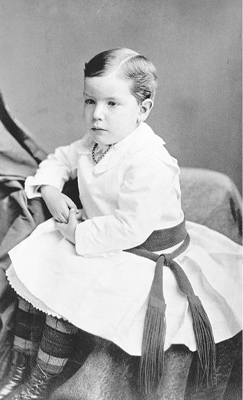
John D. Rockefeller, Jr., forced to wear his sisters’ hand-me-downs. (Courtesy of the Rockefeller Archive Center)