
PART SEVEN
‘The art of economics consists in looking not merely at the immediate but at the longer effects of any act or policy; it consists in tracing the consequences of that policy not merely for one group but for all groups.’
Henry Hazlitt
Economics studies how we distribute scarce resources to best satisfy our limitless list of wants and needs. As such, economics is also the study of human behaviour – what drives us to act as we do, how we organize as societies and how we seek to meet our present desires within a long-term strategy. Yet it is a discipline that can be enormously frustrating, its big ideas often seeming to contradict one another, or else proving highly fallible or inexact. US President Harry S. Truman once pleaded: ‘Give me a one-handed economist. All my economists say, on the one hand . . . on the other . . .’ But economics impacts on our lives in the most fundamental ways on a daily basis. In the words of John Maynard Keynes: ‘The ideas of economists and political philosophers, both when they are right and when they are wrong, are more powerful than is commonly understood. Indeed, the world is ruled by little else.’
Scarcity is the driving idea behind all economic thought. The more scarce a product in relation to the demand for it, the more it is likely to cost. The British economist Lionel Robbins defined economics as follows in 1932: ‘the science which studies human behaviour as a relationship between ends and scarce means which have alternative uses’.
Humanity has long understood that demand for scarce resources is a source of tension. Gautama Buddha went so far as to suggest that desire and greed (tanha) are the root of all suffering (dukkha), and that personal happiness is achieved by the limiting of our wants and needs. Come the early 19th century, the Scottish economist David Ricardo set out to explain how scarcity influences value. He observed: ‘Gold and silver, like other commodities, have an intrinsic value, which is not arbitrary, but is dependent on their scarcity, the quantity of labour bestowed in procuring them, and the value of the capital employed in the mines which produce them.’ Note that scarcity tops the list of determining factors.
In more recent times, the Indian-born economist Amartya Sen has suggested that the mechanisms of the market economy can actually aggravate problems of scarcity. In a 1981 analysis of several African and Asian famines (including the Bengal famine of the 1940s, in which some 3 million people died), he concluded that death was often not the result of non-availability of food but rather arose from inequalities in the food supply chain.
In Bengal, for example, he noted that food production had declined year on year leading up to the onset of famine in 1943, but was still higher than it had been in earlier, famine-free years. However, landless, rural farmworkers and the urban poor died in unprecedented numbers. With India assisting colonial British rule in its war effort, money directed from London gravitated towards India’s major cities – Calcutta (now Kolkata), in the case of Bengal. This drove up prices, leaving rural labourers and the urban poor unable to command high enough wages to enter the market. Although there was food to be had, they could not afford to buy it.
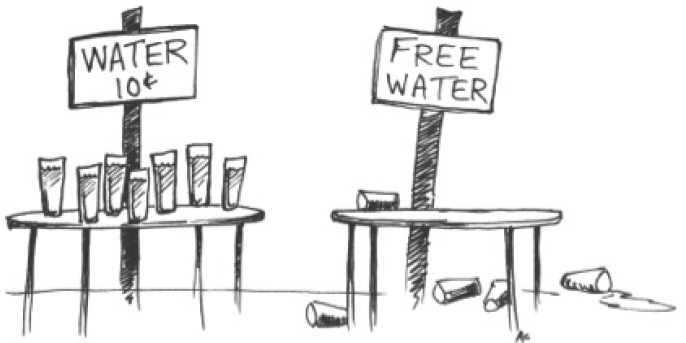
‘Living with Scarcity’
Scarcity, thus, is only half of the economist’s conundrum, with the question of how to secure fair allocation being the other half. Furthermore, scarcity is not limited to physical resources. Shortfalls in technology, for instance, can also skew our ability to make the best use of resources – think of the farmer in Africa who lacks access to the tools that would allow him to move beyond a subsistence existence.
And there are those who argue that time is our most significant ‘scarce resource’, forcing us to make economic decisions at every turn. As Nobel laureate Paul Samuelson (1915–2009) once put it: ‘Time is our ultimate scarcity… And so we’re constantly having to sacrifice alternate activities to get the one that pleases us most.’