
Space exploration is humanity’s ongoing investigation of the physical conditions of space. The ability to send humans into space, first achieved in the 20th century, is regarded as one of the crowning achievements of our species and has raised the possibility that we may eventually set up permanent homes elsewhere in the universe.
Exploring the cosmos was until recently only achievable from an earthly base, using technologies such as the telescope. Yet our desire to physically interpose ourselves in space is an old one, stemming directly from our desire to fly.
Back in 1640, the English clergyman and natural philosopher, John Wilkins, had ruminated:
I do seriously and on good grounds affirm it possible to make a flying chariot in which a man may sit and give such a motion unto it as shall convey him through the air . . . ’Tis likely enough that there may be means invented of journeying to the moon; and how happy they shall be that are first successful in this attempt.
Despite primitive rockets having been invented in China by at least the 13th century, it was only in 1903 that the Russian rocket scientist Konstantin Tsiolkovsky published an influential paper that laid the groundwork for the modern era of spacecraft engineering. ‘Earth is the cradle of humanity,’ he once said, ‘but one cannot remain in the cradle forever.’
He, along with Robert H. Goddard in the USA, Hermann Oberth in Germany and Robert Esnault-Pelterie in France, put space travel on a sound theoretical basis in the early decades of the 20th century. The development of new armaments during the Second World War – most notably Wernher von Braun’s V2 rocket – gave impetus to space programmes in the war’s aftermath. Then came the Cold War, which provided the political climate for a ‘space race’ between the USA and the USSR, with the respective governments willing to pump vast resources into the contest.
It was an age of landmark achievements. In 1957, the Soviet Union launched Sputnik 1, the first man-made satellite, and in the same year sent a live animal (Laika the dog) into orbit for the first time. In 1961, Yuri Gagarin became the first human in space, followed in 1963 by Valentina Tereshkova as the first woman in space. With the USSR seemingly in the ascendency, the USA struck back by landing the first man – Neil Armstrong – on the moon in 1969. As Armstrong famously said, it was one small step for a man but a giant leap for mankind.
Space exploration also poses ethical and philosophical questions. What rights do we have to other areas of space? And what sort of relations might we have with putative alien life? In 1960, Dwight Eisenhower asked this of the United Nations: ‘The emergence of this new world poses a vital issue: will outer space be preserved for peaceful use and developed for the benefit of all mankind?’
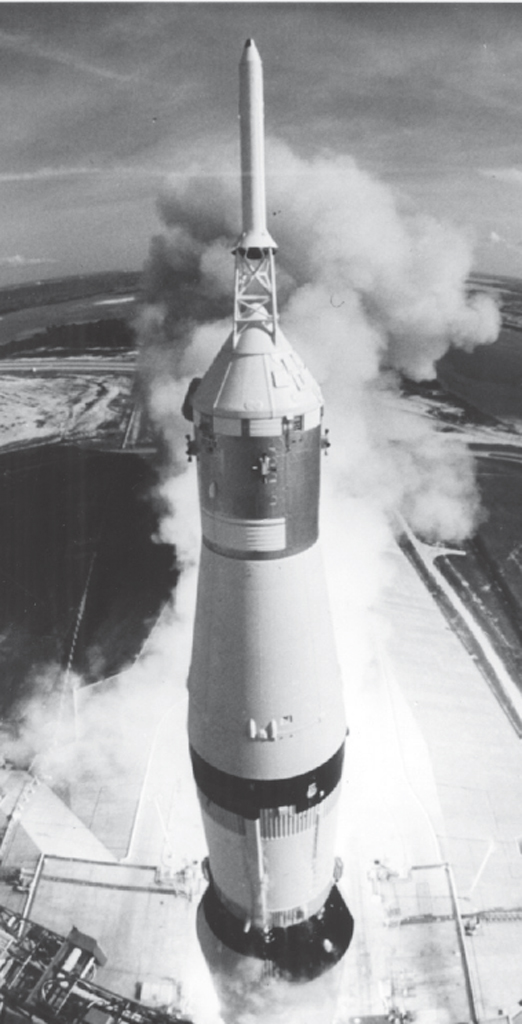
The Launch of Apollo 11 via the Saturn V Rocket
While there are genuine concerns, astronaut Alan G. Poindexter (1961–2012) succinctly put the positive case for our reaching out into the cosmos:
I’m really hopeful about the future of space exploration and human spaceflight. Civilization as we know it has been defined by exploration. You know, we need to go off and find out what’s around the next corner and what’s just beyond what we already know. It’s part of our being; it’s part of our moral fibre to go off and explore.