
All art forms – whether visual, literary, musical, cinematic or something else altogether – serve to communicate ideas, engage an audience and elicit an emotional and/or intellectual response. As such, the aims and motivations of individual artists and artworks are manifold. A 19th-century sonata by Brahms clearly draws a different reaction to, say, a song by the Sex Pistols. Equally, a love sonnet by Browning has different intentions to a political allegory such as George Orwell’s 1984.
Yet, there are those who argue that no artwork need have a ‘purpose’ beyond itself. Or, as this idea is commonly summarized, ‘art for art’s sake’. This became the slogan of the Aesthetic movement that grew up in the 19th century. Aesthetics may be considered that area of thought that seeks to examine the nature and appreciation of beauty. In the words of one of aestheticism’s chief spokespersons, Victor Cousin, ‘the beautiful cannot be the way to what is useful, or to what is good, or to what is holy; it leads only to itself.’
It was a philosophy that arguably reached its peak in the visual arts with the great Pre-Raphaelites such as Dante Gabriel Rossetti, the pioneering symbolist and Art Nouveau works of Aubrey Beardsley, and the paintings of James Abbott McNeill Whistler, that giant of the American Gilded Age. On the literary front, its most celebrated voice was Oscar Wilde. As he wrote in The Picture of Dorian Gray: ‘People say sometimes that Beauty is only superficial. That may be so. But at least it is not so superficial as Thought is. To me, Beauty is the wonder of wonders.’
Nonetheless, the very idea of what constitutes beauty changes and evolves over time and between cultures. The voluptuous beauty of a Rubens nude, for example, contrasts starkly with the ideal of feminine beauty found on your average contemporary Paris or Milan fashion-show catwalk.
So, can we reach any broad conclusions as to what constitutes beauty? Plenty have tried. Some evolutionists, for instance, argue that we tend to regard as beautiful that which signals the best chance of our key evolutionary goals – survival and reproduction. Therefore, it might be said, the curves of one of Ruben’s women appeal because they speak of a healthy, nourished body, well poised for the task of childbearing.
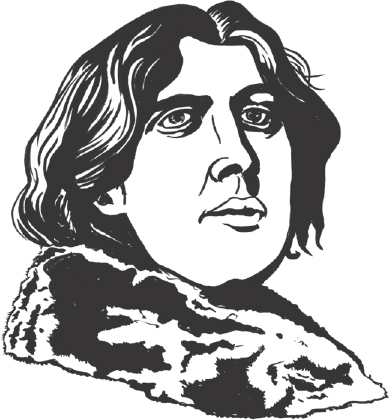
Oscar Wilde
The golden ratio
The ‘golden ratio’ – a common mathematical ratio that can be used to create pleasing, natural-looking compositions and also known as the ‘Golden Mean’ – was first described by Euclid in the 3rd century BCE. It has been used by artists and architects (often unconsciously) for millennia and may also be found in nature, with some claiming that it underpins universal ideals of beauty. Salvador Dalí, for example, consciously echoed the so-called golden ratio in several of his works.
Beauty, perhaps, is best thought of as something we may hope to recognize but not to understand. As Pablo Picasso once noted: ‘Beauty? To me it is a word without sense because I do not know where its meaning comes from nor where it leads to.’