
PART TWO
‘If in other sciences we should arrive at certainty without doubt and truth without error, it behooves us to place the foundations of knowledge in mathematics.’
Roger Bacon
Mathematics – the science of number, quantity and space – provides us with the intellectual tools and language that make possible all other scientific investigation. As Bertrand Russell put it in his Study of Mathematics (1902): ‘Mathematics takes us still further from what is human, into the region of absolute necessity, to which not only the world, but every possible world, must conform.’ Given its abstract nature, mathematics provides a uniquely pure and exacting framework upon which to base the exploration of other ideas. Furthermore, many great minds have detected a quasi-mystical relationship between mathematical laws and the nature of the world. As that pioneer of quantum mechanics, Paul Dirac, wrote in Scientific American in 1963:
One could perhaps describe the situation by saying that God is a mathematician of a very high order, and He used very advanced mathematics in constructing the universe. Our feeble attempts at mathematics enable us to understand a bit of the universe, and as we proceed to develop higher and higher mathematics we can hope to understand the universe better.
Current evidence suggests that mankind ‘invented’ numbers some 40,000-plus years ago. Even the most basic society needs some form of numeracy to operate – for instance, to keep track of the passage of days and nights, to record lunar cycles and to keep a tally of property. Yet, to imagine number in a world in which it does not conceptually exist ranks high among the great achievements of humanity; it may be regarded as one of those landmarks that helped secure our species’ pre-eminence on the planet.
Anthropologists believe that counting began by early humans developed a system of hand-to-eye number communication (e.g. holding up two fingers to indicate the two sheep you own or want to trade) as a precursor to written number systems. But as any school-age child can tell you, your fingers will only get you so far when it comes to numeracy. Next came the tally stick – typically made of wood, bone or stone – on which could be engraved marks to denote amounts. So instead of holding up two fingers, the shepherd could record ‘two sheep’ (or ‘twenty-seven sheep’) on his tally stick. One such tally stick found in the Lemombo Mountains in southern Africa has been dated to around 43,000 years ago and its notches are putatively said to correspond to lunar phases – possibly as a means for women to track their menstrual cycles.
For a more formal system of written numbers, we must fast-forward to Iran in about 4,000 BCE. A new method, seemingly to assist trade, emerged using clay tablets that corresponded to different numbers of a given commodity. There was, for instance, a symbol engraved into a tablet to denote one ox, another for one sheep, another for ten goats and so on. These tablets were then baked into a sort of clay envelope (as a means of preserving the record) upon which were engraved symbols summarizing the contents within. Over the next millennium, various societies developed systems in which numerals were written in abstract form, separate to the thing it was representing.
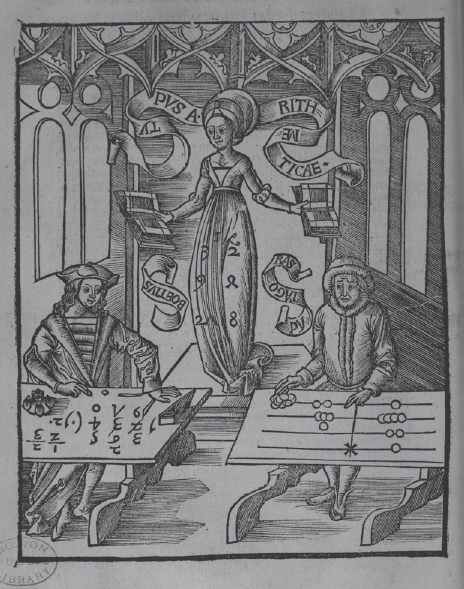
Early Number Systems
The history of numeral systems took distinctly different routes in different parts of the world. The ancient Egyptians had a hieroglyph system distinct from the letter-based system used by the Romans or the numeral/letter-based system adopted in China. The numbers with which we are familiar today (Hindu–Arabic numerals) originated in India from around the 5th century CE, before finding their way to Europe via Arab mathematicians only in the 12th century.