
Evolution describes the process by which different kinds of living organism are thought to have developed from earlier life forms over the passage of history. It is evolution, for example, that places modern humans in a complex lineage of species that connects us back to ancient apelike ancestors who walked the planet millions of years ago. Indeed, theoretically all extant species are traceable back to common biological ancestors.
Our understanding of how evolution happens is a work in progress and there are many conflicting opinions – both between evolutionists themselves and between evolutionists and those entirely opposed to the notion, such as believers in the literal truth of the Christian creation story. Underpinning all evolutionary theories is the notion that sometime after the Earth came into existence (about 4.5 billion years ago), life began with the emergence of basic self-replicating forms (e.g. simple molecular structures that could copy themselves in the manner of DNA). Over a process of millions of years, these life forms gradually grew more complex.
Those best equipped – or born with genes best suited – to adapt to a given set of circumstances (such as distinct climactic conditions, natural environments and food sources) survive and more effectively reproduce as a result of ‘natural selection’. Meanwhile, those creatures with characteristics ill-suited to their environment are more likely to die off and their genes less likely to be passed to a future generation. It is this lengthy process, so the theory goes, that causes some species to die out and others to thrive.
The giant intellectual figure in the development of the theory of evolution is the English naturalist, Charles Darwin (1809–82), who wrote his masterpiece, On the Origin of Species, in 1859. (Although it should be noted that his contemporary, Alfred Russel Wallace, arrived at similar conclusions around the same time as Darwin.) After travelling for several years to observe flora and fauna in disparate environments, Darwin came to realize that there is competition between and within species for vital limited resources, such as food, water and shelter. Those that win this competition are the ones who live to reproduce and so pass on their genes – a process commonly heralded as ‘the survival of the fittest’. In his own words:
Owing to this struggle for life, any variation, however slight and from whatever cause proceeding, if it be in any degree profitable to an individual of any species, in its infinitely complex relations to other organic beings and to external nature, will tend to the preservation of that individual, and will generally be inherited by its offspring.
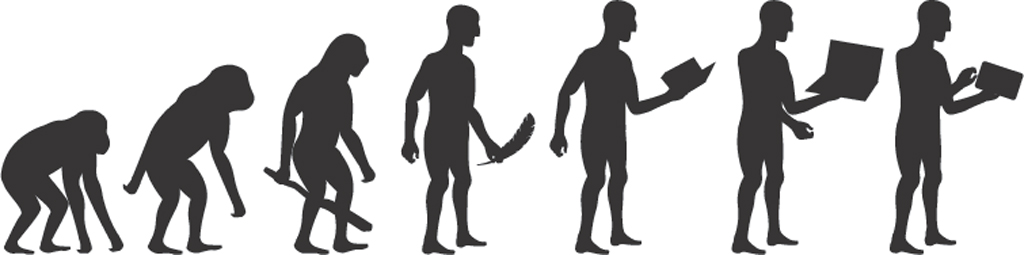
The Evolution of Humankind
The evolution of the giraffe
Darwin’s ideas were not without precedent. Several ancient philosophers had posited the notion that species emerge not fully formed but one from another. Meanwhile, in the early 19th century the French scientist Jean-Baptiste Lamarck had argued for a process of acquired characteristics. He suggested that any characteristic not used in a species eventually dies out, while those that are used become stronger and more established. For Lamarck, then, the giraffe developed a long neck to be able to feed better, and passed the characteristic on. For Darwin, by contrast, giraffes with long necks prospered because they were best suited to access high-level food. It is a subtle but significant difference in interpretation.
Darwin’s theory was supported by evidence, including fossil finds. While the fossil record is far from complete, clear patterns of evolutionary development may be traced. Furthermore, research into the genetic inheritance of plants conducted by Gregor Mendel during Darwin’s own lifetime further corroborated his thesis, and today, few serious scientists dare dispute the evolutionary nature of life.