
Anatomy is the branch of medicine concerned with the bodily structure of humans – both external and internal. Anatomical studies have been crucial to understanding how the body works and how to put things right when they go wrong. Yet cultural and religious sensitivities over much of human history ruled out human dissection as a means of increasing our anatomical knowledge. Only during the Renaissance did the idea of study through dissection receive widespread acceptance.
Anatomical knowledge among the ancient civilizations was severely limited, stemming primarily from the dissection of animals and, for example in Egypt, from the incidental study of human bodies as they were prepared for their putative afterlives. Around the 3rd century BCE Herophilus pioneered the idea of human dissection for medical research, usually using the bodies of condemned criminals. His career overlapped with that of Erasistratus, who made revolutionary new studies of the structure of the human brain.
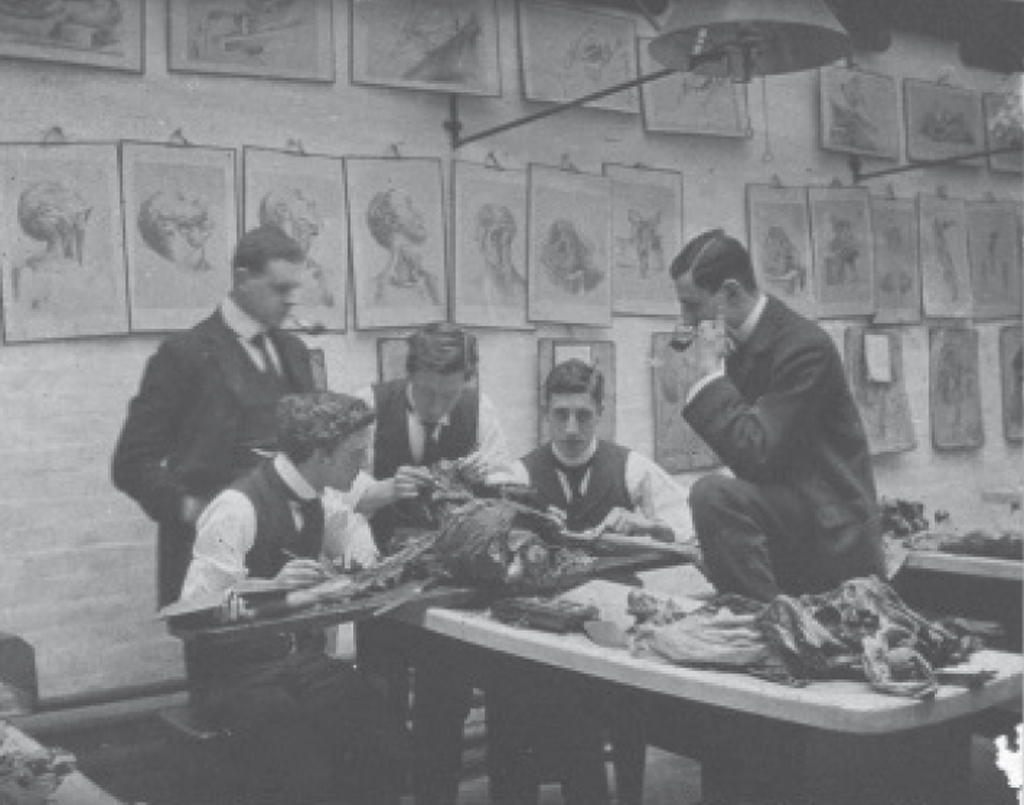
Students Dissecting a Cadaver, c. 1900
In the 2nd century BC, the Greek physician Galen significantly extended the pool of knowledge. Arguably Galen’s greatest contribution was to establish that the body and its functions are the result of design, and not mere chance. Through the Middle Ages, there was interest within both the Christian and Islamic worlds in learning more about the nature of the body, and by extension humanity’s place within the natural and spiritual order. Nonetheless, reluctance to ‘desecrate’ human bodies by dissecting them continued, so its practice was rare, with most physicians instead relying on the works of Galen.
It was not until the Renaissance in Europe that there was a marked shift in attitudes. Of particular importance was the publication in 1543 of Andreas Vesalius’s De humani corporis fabrica (On the Fabric of the Human Body), replete with illustrations based on observations from dissections. Vesalius, a professor at Padua, is regarded as the founding father of modern anatomy and gave the practice a new level of academic respectability – a status reinforced by the extraordinary collection of anatomical drawings made by Leonardo da Vinci (1452–1519).
Technical innovations such as improvements in the microscope propelled the discipline along still further and by the 19th century, human dissection was a required part of a medical student’s training across much of the world.