
Logic is the study of the principles of reasoning and the formal validity of argument. A logical argument is one in which a conclusion is drawn from premises (accepted or assumed propositions), so that to accept the premises but deny the conclusion is inconsistent and without merit. A logical argument, however, need not necessarily result in a ‘correct’ conclusion, merely an internally consistent one.
Aristotle is generally credited with creating the first formal logic system when he devised a method of deductive reasoning known as a syllogism. Within this scheme, a conclusion is inferred from two accepted premises – a major premise (the predicate of the conclusion) and a minor premise (the subject of the conclusion). For instance: all fish have gills. A salmon has gills. Therefore, a salmon must be a fish. This is an example of deductive logic, but the conclusion is not always factually correct. Consider the following: All birds have wings. An aeroplane has wings. An aeroplane is a bird. It is, nonetheless, a logically valid argument within the basic terms of the syllogism.
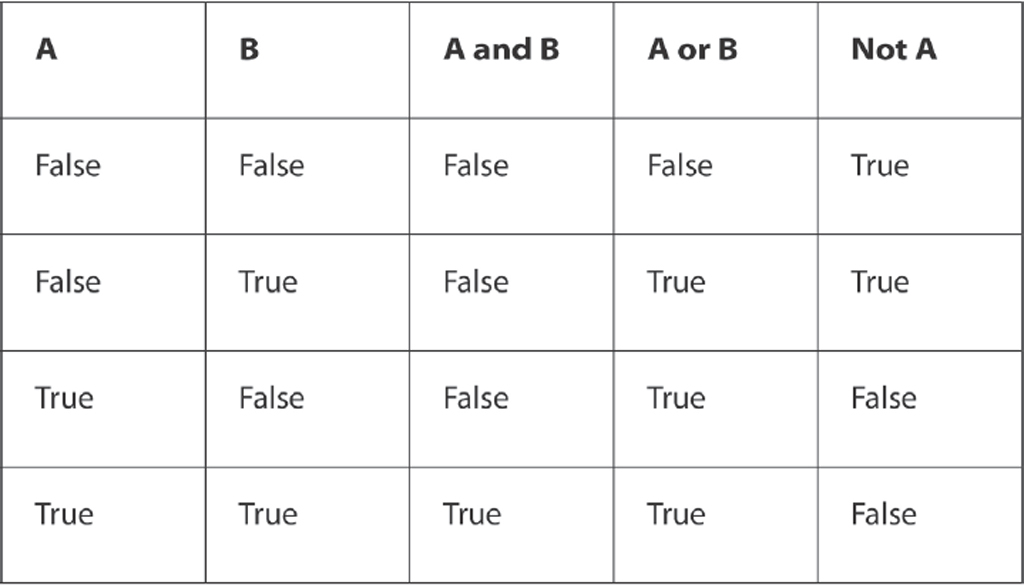
The Boolean Table
Aristotle’s groundbreaking work in logic analysis, along with that of the Stoic school of philosophy, laid the foundations of logic through to the 19th century. Nonetheless, there were some notable developments in between. For instance, modal logic was developed with a view to incorporating propositions of contingency, necessity and possibility into a logic framework, while Avicenna constructed a rival system of logic in the medieval Islamic world. A number of Christian scholars, meanwhile, attempted to reconcile scriptural teachings with logical argument. Yet Aristotle remained the unrivalled giant of logic until the 19th century when an Englishman, George Boole, introduced the idea of symbolic logic – a system using symbols to replace certain terms and propositions within a logical argument. Its near-relation, mathematical logic, followed fast behind. It is mathematical logic that underpins computer science and the technological revolution of the late 20th and early 21st centuries – evidence that logic is not merely an abstract intellectual plaything but a system of thought with deep practical applications.