
Rationalism is the philosophical outlook that reason – the power of the mind to think logically and to weigh up ideas – is the basis of true knowledge rather than supernatural force, emotional response or observation (see entry on Empiricism here). While rationalism classically allows that some knowledge may be known intuitively, it is generally assumed that a rational idea is the evident result of a series of logical steps.
The concept of rationalism is evident in the teachings of Plato, notably his argument that we inherently carry ‘true’ ideas within our minds (see Idealism here) and that these provide us with the pathway to knowledge. While many rationalist philosophers came to accept that empirical observation is a practical means of unlocking knowledge, Plato contended that we come pre-programmed with knowledge and famously illustrated his philosophy with the ‘Allegory of the Cave’, in which he described a group of people chained up in a cave for the entirety of their lives. They face a blank wall, their necks manacled so that they may not avert their gaze. A fire burns behind them while marionette players on a raised platform cast shadows onto the cave wall. Thus the shadows come to represent reality to the prisoners, just as we use observation of our ‘shadow world’ as the basis of our knowledge rather than seeking it exclusively through reason.
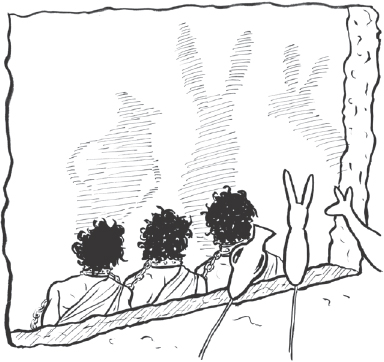
The Allegory of the Cave
Descartes and the wax argument
In the 17th century, René Descartes established himself as the most famous rationalist of the modern age. Among his many ideas, he set about showing how almost all apparent knowledge may be doubted, even if that doubt seems to run contrary to perceived reality. We may be being deceived by our senses, for instance, or else ‘reality’ may in fact be illusory, or God may be seeking to mislead us, or maybe there is no God and we are surrounded by cosmic ‘untruths’. He expounded his ‘Wax Argument’ to make his point. Take a piece of wax, he said, and your senses reveal its particular characteristics – shape, size, smell, texture, etc. However, melt the wax with a flame and it changes fundamentally. No longer is it the same shape or size, and it smells and feels different, Yet for all that, we comprehend that it is the same piece of wax, rendering our senses untrustworthy. Only logical reason is dependable: ‘And so something that I thought I was seeing with my eyes is in fact grasped solely by the faculty of judgement which is in my mind.’
Descartes came to the conclusion that there is but one statement of which we can be rationally sure: ‘I think, therefore I am.’ As he explained in Discourse on the Method:
And as I observed that this truth, I think, therefore I am, was so certain and of such evidence that no ground of doubt, however extravagant, could be alleged by the Sceptics capable of shaking it, I concluded that I might, without scruple, accept it as the first principle of the philosophy of which I was in search.
Descartes’ ideas were highly influential and were embraced, and adapted, by many of the greatest Enlightenment thinkers – among them Baruch Spinoza, Gottfried Leibniz, Voltaire, Jean-Jacques Rousseau, Baron de Montesquieu and Immanuel Kant (who commented that ‘There is nothing higher than reason’). While much modern thought (especially scientific thought) demands at least some form of empirical evidence, the human ability to rationally process and logically evaluate information is still understood as a defining feature that sets us apart from the beasts.