
Absurdism, most closely associated with the writings of Albert Camus, argues that we should accept the fundamental irrationality and meaningless of the world. Whereas existentialism – with which there are clear parallels – urges that the individual creates his own meaningful existence, absurdism suggests life may only be truly enjoyed once we cease searching for order and purpose.
Camus, born in Algeria in 1913, was a political activist who fought with the French resistance against the German occupying forces during the Second World War. A witness to regular atrocities in this period, his sense of the futility of life seems to have reached a peak around this time. In 1942 he wrote an essay, The Myth of Sisyphus, and a novel, The Stranger (also translated as The Outsider), that became the founding texts of absurdism.
Familiar from his days as a student in Algiers with the ideas of both existentialism and phenomenology (the study of consciousness and personal experience, as championed by Edmund Husserl), Camus evolved his own take on the inherent pointlessness of existence.
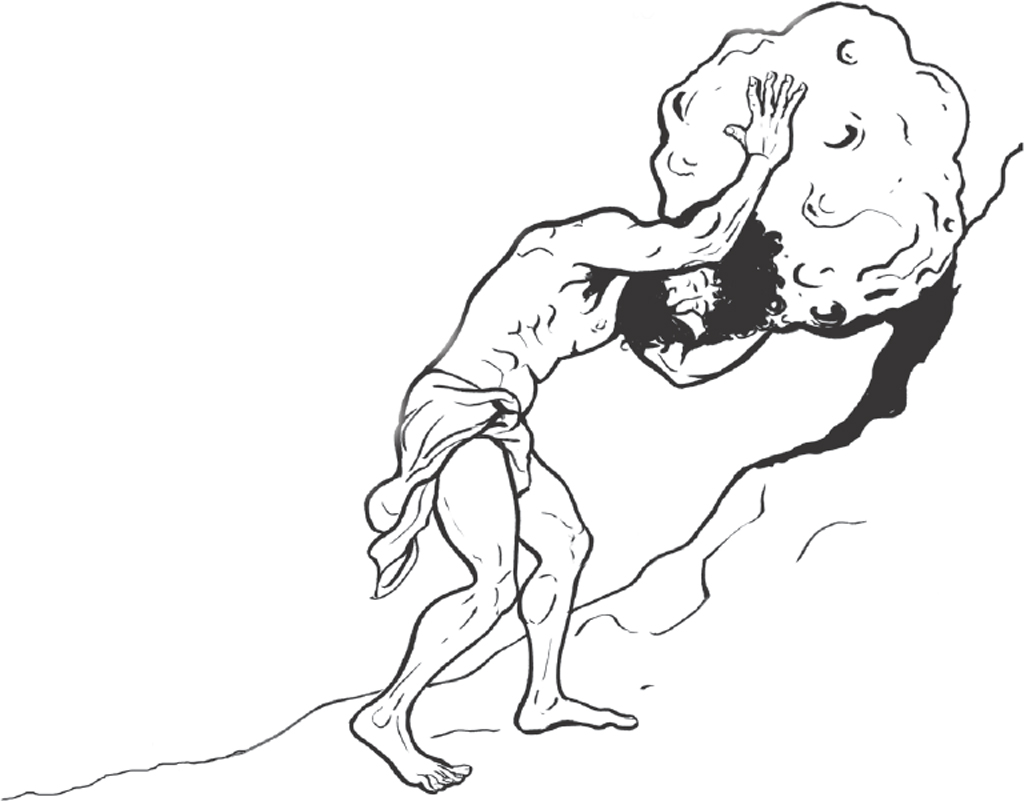
Sisyphus
In The Myth of Sisyphus, he depicted the Greek mythical figure of Sisyphus as the classic absurdist hero. Sisyphus, the story goes, had a particularly cruel punishment imposed on him by the gods – he was compelled to roll a boulder up a mountain, only to watch it roll back down again before beginning the process again in a cycle of eternal futility. It was only by undertaking the task without harbouring any hope of success, Camus said, that Sisyphus stood any chance of happiness. So too humans, who Camus suggested are faced with three choices – to believe in a divine presence who gives meaning to existence, to conclude that life is indeed meaningless and so not worth living, or to accept the absurdity of life and carry on regardless.
His own answer was to accept futility as a means of liberating the individual to live a full, passionate life as one sees fit. It was a philosophy he further expounded in what is widely regarded as his masterpiece, The Stranger, the tale of an emotionally vacant and amoral figure called Meursault, whose behaviour takes unexpected turns as he seeks to live a life of total honesty. The pivotal event in the story is his decision to kill a man for no apparent reason – a crime for which he subsequently goes on trial.
With Meursault convicted and sentenced to death, the latter stages of the book focus on his awaiting his ultimate fate. Rather than contest his sentence, he decides to accept it in the knowledge that the same fate – death – awaits him sooner or later anyway. Thus freed from the burdensome hope of extending his lifespan, he is able to seek out pleasure in the time left to him.
Absurdism thus presents a powerful vision of the world, at once dark and optimistic, that has found significant resonance in a society that has increasingly moved away from those traditional religious narratives which previously gave meaning to life. As the Nobel Prize committee put it, when awarding Camus the prize for literature in 1957, Camus – and by extension, absurdism – ‘with clear-sighted earnestness illuminates the problems of the human conscience in our times.’