
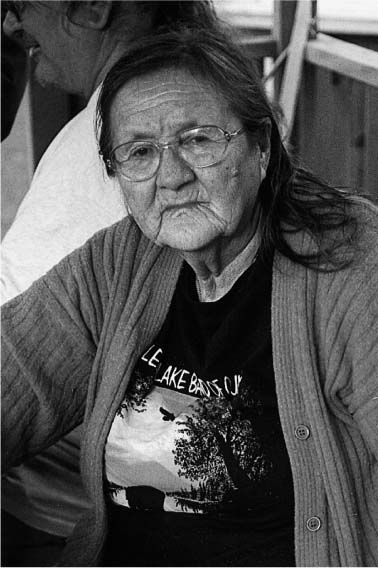
SUSAN JACKSON (b. 1925) is a perfect example of the positive effects of traditional Ojibwe living. “Niwajebaadiz,” she often says, in reference to this indisputable fact. Wajebaadizi means to be spry, peppy, and full of life. Most people don’t believe her when she tells them that she is well over seventy years old. Her body is strong, her wits are sharp, and she rarely complains of any physical condition.
Susan’s parents and grandparents taught her the value of hard work and a positive demeanor through their excellent examples of good character. As a small child, Susan chopped wood, hauled water, and shoveled snow. Even today she continues in these activities because, in her opinion, daily labors are good for the mind and body alike.
Susan grew up in and around the Leech Lake Reservation community of Chi-achaabaaning (Inger, Minnesota). Although there wasn’t much money in her early days, her father worked hard at several jobs and the whole family hunted ducks, snared rabbits, and harvested wild rice. The entire community was heavily involved in traditional Ojibwe religious ceremonies, and the culture united her family and community in many fundamental ways.
Chi-achaabaaning has been home to Susan for most of her life, from childhood to the present day. Currently she spends much of her time watching grandchildren and traveling to support her ever-growing extended family. Frequently, she is asked to lend her skills and knowledge of the Ojibwe language to assist in the instruction of reservation youth at language camps and in other forums. The second of her stories in this anthology is a recording of one of her sessions, designed to teach reservation youth about the art of snaring rabbits—from dressing for a walk in the woods to eating the victuals after harvest.
With an easy laugh and a positive outlook, Susan is great company. Wajebaadiziwin, however, is only one of her endearing qualities. Humble, reserved, honest, and wise, she manifests the fruits of traditional culture and lifeways. As her knowledge of Ojibwe language and culture and her example of traditional virtue are increasingly recognized, Susan has come to be highly valued as a cultural resource for her family, community, reservation, and people.
Chi-achaabaan Naanaagadawendamaan
[1] Inger ingii-tazhi-ondaadiz, Chi-achaabaaning ezhinikaadeg. Mii iwidi nimaamaa, miinawaa nimbaabaa gii-ayaawaad. Mii iwidi ondakaaneziwaad, gaa-onji-gikendamaan akina gegoo gii-pizindawagwaa nimaamaa miinawaa nookomis, gaye gegoo gii-kagwejimagwaa gegoo waa-izhi-gikendamaan gii-izhichigeyaan gii-ani-mindidoyaan. Miish onow namanj gii-kikendamaan gegoo i’iw.
[2] Miinawaa go ingii-kagiibaadiz gii-agaashiinyiyaan iidog. Gaawiin gegoo dibishkoo go ingii-pizikendanziin ji-wii-kikendamaan. Baamaash naagaj i’iwe maagizhaa gaye niizhwaasobiboonagiziyaan, miish o’ow dibishkoo gii-naanaagadawendamaan ji-bizindawagwaa gegoo ekidowaad miinawaa go gegoo gikinoo’amaagooyaan ji-ani-gikendamaan.
[3] Gaawiish wiin ingii-kikinoo’amaagoosii gegoo ji-gikendamaan gegoo, akina gegoo. Ingii-wiidookawaa gaa-maamaayaan aseked gaye. Mii imaa gii-kanawaabamag gii-wiidookawag. Mii imaa gaa-onji-gikendamaan i’iw waa-izhichigeyaan. Akina gegoo ingii-wiidookawaa nimaamaa. Gaawiin wiikaa gegoo gii-anokiisii nimaamaa. Mii eta go gii-chiibaakwed.
[4] Akina gegoo niinawind ingii-nisimin ingiw niiwiijaan, indinawemaag gayesh. Mii imaa ayaad bezhig nimisenh gaye niin dash mii gaa-nisayeyaan. Mii minik gaa-ishkonewaad, gaa-ishkoneyaang i’iw minik.
[5] Akinash gegoo ingii-wiidookawaanaan nimaamaa. Gaawiin gegoo gichi-anokiisii. Miinawaa akina gegoo ingii-izhichigemin. Imaa gaye nimbaabaa gii-anokiid, niinawind akina gegoo ingii-izhichigemin. Ingii-kiishkiboojigemin, biindigenising bigishkiga’iseyaang gaye, akina gegoo bi-naadiyaang gaye akina gegoo. Mii eta go gii-pagidinised a’aw nimaamaa jiibaakwed akina gegoo. Mii izhi-wiidookawag nimaamaayiban gii-pimaadizid. Akina gegoo, gaawiin ingii-pagidinaasiiwaanaan ge-gichi-anokiid gegoo.
[6] Mii eta go gii-anokiid nimbaabaam. Azhigwa nenitaawigid indinawemaa, mii ezhi-wiijiwaad onow nimbaabaayan gaa-anokiinid. Miish i’iw booch dagoshinowaad, mii booch, maagizhaa go onaagoshig, miish i’iw akina gegoo anokiiyaang. Mii gaa-izhi-wiidookawangid nimaamaa, miinawaa nimbaabaayinaan.
[7] Gayesh nimaamaa gii-ishkwaa-ayaad, mii dibishkoo gaawiin aapiji nimaanendanziin gii-wani’ag nimaamaa. Imaa sa akina gegoo ingii-wiidookawaa. Mii gaa-onji-maanendanziwaan aapiji gii-wani’agin nimaamaa. Mii go gaye nimbaabaa gii-ayaadog, noomag gii-ani-bimaadizi niizhwaasimidana ashi niizh ganabaj gii-wani’angid nimbaabaa, mii i’iw. Gaawiin igaye ingii-maanendanziin iye gii-ishkwaa-ayaad nimbaabaa. Akina gegoo ingii-wiidookawaa. Ingii-wiidookawaa gii-pimaadizid. Nizhawenimaa sa go nimbaabaa gii-ayaad.
[8] Mii go noongom bimaadiziwaad miinawaa, gaawiin niin indaa-asaasiig imaa endazhi-ganawenimindwaa gichi-aya’aag. Niin igo indaa-bami’aag. Mii i’iw akiwenzii gaa-ayaawangid, Bezhigoogaabaw gii-izhinikaazo. Niin ingii-kanawenimaa gii-ani-gichi-aya’aawid. Gaye dash gaawiin ingii-pi-maanendanziin apii ishkwaa-ayaad akiwenzii. Mii gii-shawenimag gii-omishoomisinaan akiwenzii. Ingodwaak awashiime gii-taso-biboonagizid gii-nibod. Mii gaa-izhi-zhawenimag; zhawenimag sa go gichi-aya’aa.
[9] Gaawiin gegoo booch igo maajaayaan igo gegoo wiidookawag. Onow gaye niin niizhwaasimidana indaso-biboonagiz. “Gaawiin,” indigoo dash wiin igo. Gaawiin indebwenimigoosii gaye. Niwiindamawaa endaso-biboonagiziyaan. Indaa-wiindamawaa, “Niwajebaadiz giiwenh o’owe.”
[10] Mii sa ganabaj i’iw.
Aabadak Waaboozoo-nagwaaganeyaab
[1] Mii o’owe ayi’ii wii-agoodooyan, miinawaa akina gegoo ge-aabajitooyan—babiinzikawaagan, gimakizinan, giminjikaawanag, miinawaa ginagwaaganeyaab, mashkimod miinawaa aagimag. Mii imaa onow gaye ge-ozhiitaayan wii-agoodooyan. Miish imaa akina onow gaa-aabajitooyan.
[2] Miinawaa imaa azhigwa maajaayan, noopiming ezhaayan, nandawaabandaman iniw waaboozoo-miikanan, mii imaa ji-agoodooyan miikaman i’iw waaboozoo-miikanens. Miish imaa azhigwa gii-maamawising ginagwaaganeyaab. Mii imaa mitigoons ezhi-atooyan miikanens ayaamagak. Mii imaa ge-izhi-agoodooyan ginagwaagan. Miinawaa gii-kiizhiikaman imaa iye ginagwaagan gii-agoodeman imaa, maajaayan miinawaa geyaabi indawaaj nandawaabandaman.
[3] Gaye a’aw gookooko’oo imaa nemadabid, mii a’aw waa-kimoodimik iniw giwaabooziman imaa nagwaanad. Waaboozoo-gimoodishki a’aw gookooko’oo.
[4] Miinawaa dash maajaayan imaa nawaj nandawaabandaman iniw miikanensan, iniw ajina waa-agoodooyan. Mii go minik ge-miikaman miikanensan.
[5] Mii miinawaa gii-nagwaanadwaa ingiw waaboozoog, mii ge-izhi-dazhiikawadwaa. Gii-kiizhiikawadwaa ingiw waaboozoog, miish imaa azhigwa ji-giizizwadwaa, da-atooyan nibi, imaa ji-atooyan miinawaa awegonen go imaa waa-tagonaman zhiiwitaagan, wiisagad igaye. Miish azhigwa ji-onji-giizizwad, mii imaa gii-kiizizwad dash a’aw waabooz miinawaa awegonen imaa waa-tagonaman, miinawaa go imaa ji-atooyan imaa nawaj wiisiniyeg imaa adoopowin. Onaaganan imaa atewan, emikwaanensan gaye badaka’igan. Mii imaa wii-wiisiniyeg. Mii azhigwa waabooz gii-amweg imaa awegonen imaa gaa-tagoziyeg, opiniig igaye.
[6] Mii dash gii-ishkwaa-wiisiniyan, mii i’iw ge-izhinaagwak o’ow gimisad onzaam niibowa wiisiniyan gaa-piikojiiyan. Mii i’iw ge-izhi-aanizhiitaman wii-wiisiniyan.
[7] Mii go gaye wii-kiiyoseyan gaye, mii go omaa gaye naasaab igo ge-biizikonayeyan gaa-piizikaman wii-kiiyoseyan wii-izhi-babaa-nandawaabamad a’aw waawaashkeshi. Mii mewinzha gaa-izhichiged anishinaabe gii-maajaad wii-wiisinid, giiyosed. Mii go gaye naasaab iniwe giigoonyan wii-amwaad; miish igo maajaad o-bagida’waad imaa, jiimaaning boozid. Mii imaa gaye gaa-ondinang mewinzha anishinaabe gii-wiisinid.
When I Think About Chi-achaabaan
[1] I was born in Inger, Chi-achaabaaning as it’s called. My mother and father were over there. That’s where they come from, where I got my knowledge of everything from, listening to my mother and grandmother and asking them what I wanted to know in what I did as I got bigger. That must be how I learned these things.
[2] And I must have been foolish when I was little. It was just like I didn’t pay attention to the things I wanted to know. Then maybe after I was seven years old, then I started to reflect on things like this to listen to them in the things they said and the things I was taught to know.
[3] I wasn’t just taught things to know them however, not everything. I helped my mother when she tanned hides. And there I would observe her as I helped her. That’s how I knew what I wanted to do. I helped my mother with everything. My mother never took any kind of job. She only cooked.
[4] It was always the three of us, my siblings, and my relatives. There was my one older sister and myself and my older brother. That was how many of them survived, just that many of us survived.
[5] And we helped my mother with everything. She didn’t work very hard. And we did everything. And my dad worked there, and we did everything [at home]. We sawed wood, chopping it into kindling as it was brought inside and everything; we hauled in everything. And my mother only hauled in wood and cooked everything. That’s how I helped my mom when she was alive. In all things, we never let her work too hard.
[6] My dad was the only one who worked. Now as my [older brother] grew up, then he accompanied my father when he worked. Then when they arrived, maybe sometime in the evening, then we did all the work. That’s how we helped my mother and my father.
[7] And then after my mother was gone, it was like I didn’t feel bad about having lost my mom. I had always helped her there with everything. That’s why I didn’t feel overly sorrowful when I lost my mother. And my father must have been, he must have lived just a little past seventy-two perhaps when we lost my dad. And I didn’t feel bad about it after my dad was gone either. I had helped him with everything. I had helped him while he was alive. I loved my dad while he was [here].
[8] And the ones still living today, I can’t put them in a nursing home. I can only take care of them myself. There was one old man, he was called Bezhigoogaabaw. I looked after him myself as he became an elder. Then too I didn’t feel bad about that old man’s passing. I loved that old man as he was like a grandfather to me. He was over one hundred years old when he died. That’s how much I loved him; I loved that old guy.
[9] And it’s not [time] for me to leave as I’m helping him. And I’m seventy years old too. But I’m told, “No.” And they don’t believe me. I tell them how old I am. I should tell them, “I’m [still] spry.”
[10] That must be it.
Using a Rabbit Snare Wire
[1] When you want to go snaring, this here is everything you will need to use—a coat, your moccasins, your mittens, and your snare wire, a rucksack, and snowshoes. And you have to get these things ready when you want to go snaring. That’s everything you use.
[2] And there now when you leave, you go into the deep forest, looking for rabbit trails, and where you find that rabbit path, that’s where you set your snare wire. And there you put your snare wire together. And you place sticks where the trail is. Then you hang your snare there. And when you’ve finished hanging your snare there, you leave again looking for more.
[3] And [maybe] that owl’s sitting there, wanting to steal the rabbits you snare. That owl is a chronic rabbit thief.
[4] And again you leave, looking for more of those rabbit trails, as that’s where you want to set snares. Then that’s as many trails as you’ll find.
[5] And those rabbits you snared, they must be dressed out. When you finish those rabbits, now then you cook them, putting in water, and you put in there whatever you want to mix in there, salt and pepper. Now that’s how you cook him, and you cook that rabbit there and whatever you want to add in with it, and you put it there on the table so you all can eat well. Plates are put there, spoons and a fork. That’s where you all will eat. And now you all eat that rabbit there and whatever you all added in, potatoes too.
[6] Then after you eat, this is how that belly of yours will look, from overeating; you got a potbelly. That’s how you finish your meal when you’re going to eat.
[7] And when you want to go hunting too, here it’s the same thing too, as you shall get dressed [and,] having donned what you’ll go hunting with, you’ll go around searching for that deer. That’s how the Indian did things when he left for what he wanted to eat, hunting. And it’s the same if he wanted to eat fish; then he left, going over and setting net there, embarking in a canoe. Long ago the Indian got what he ate from there too.