
CHAPTER 1

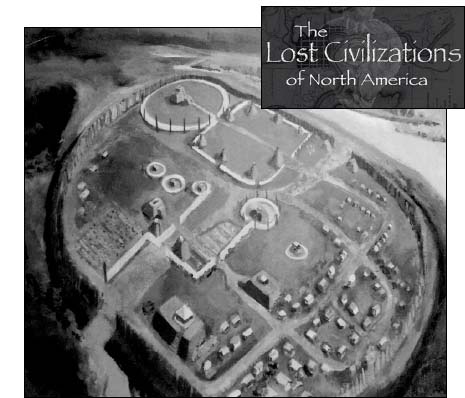
Several years ago while producing the documentary “Lost Civilizations of North America,” I accompanied our research and production team through the Ohio and Mississippi river valleys as we visited sites of the ancient mound-building cultures. Notwithstanding our prior research, the abundant artifacts and seemingly endless burial mounds and earthwork structures, many of them massive, fascinated us. We began to ask each other why we hadn’t heard more about these remarkable American civilizations that predated Columbus. Why didn’t our school textbooks say more about these ancient Mound Builders? Why weren’t they discussed in any of our American history classes? Most importantly, what might these bygone civilizations, whose lands we now inhabit, teach us?
I discovered that others had asked similar questions, including no less an authority than Roger G. Kennedy, former director of the Smithsonian’s American History Museum. In his landmark book Hidden Cities: The Discovery and Loss of Ancient North American Civilization published in 1994, Dr. Kennedy recounts the startling personal event that led to its writing. Exploring a labyrinth of subterranean caves beneath Indiana, he entertained “the proud thought” that he was the first human to tread those passageways. “Then my head lamp showed on the floor the twisted fibers of the butt end of a torch, and there were sandal-marks on the floor. I was late by a millennium and a half.”1
The discovery should have come as no surprise, said Kennedy, since he had been writing about American history for five decades. But it jolted him, and as he began to share with others his experience and its implications, he made a second discovery: “I found that I was not alone in my ignorance of America’s ancient past.”2 Spurred by the things he found in the cave, Kennedy was determined to learn more.
They led me to learn as much as I could about the people who left them in that cave, and also about why only a few specialists seemed to be informed about them. What did the first European explorers and settlers know about ancient America? Why was that knowledge not passed on, expanded, revised, and made a necessary prelude to American history? The antiquities of Mexico or of Egypt are far better known than those of Indiana, Illinois, or Ohio, and not because they are larger or more ambitious intellectually.3
As I began to search for my own answers to Kennedy’s questions, a remarkable story began to unfold. The story is larger than the loss of our knowledge of America’s ancient civilizations. It is a story of how our recovery of that knowledge has been hampered, hidden, and manipulated. It is a story not just of the ancient antiquities and monuments of North America, but of the men who explored them and their motives and the ideologies that drove them. Such provocations were motivated by Manifest Destiny, which encompasses such thorny issues as evolution, land rights and the proper role of government.
This book examines the research of many scholars and shows how the exploration of America’s ancient civilizations was suppressed, and how social engineering ideas that took hold in the 1800s have altered the course of human history. It shows how early men of American science, who were exploring the origin of the ancient Mound Builders, advanced foundational theories that would have a profound influence on the advancement of evolutionary thought, Communist theory and Social Darwinism around the world. It pulls the curtain back on the remarkable effect that powerful and conspiring men exercised on America. It is a story not just of past events, but of issues and ideas that are laden with implications for our day.
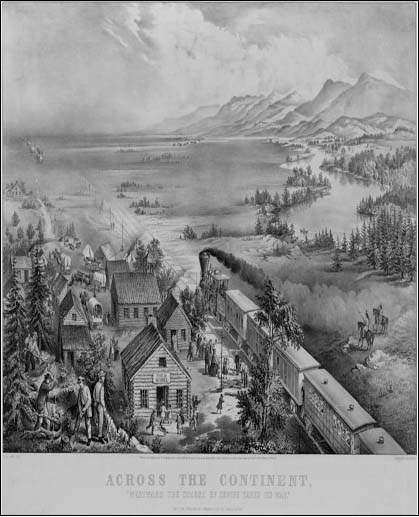
Manifest Destiny
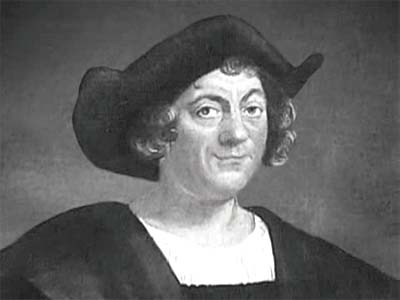
Christopher Columbus
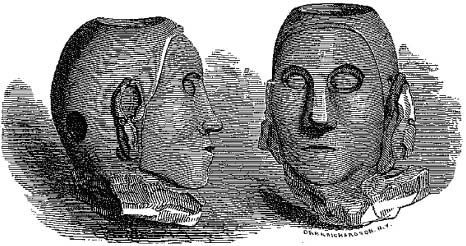
Hopewell Artifacts
Ancient Monuments, Squier and Davis: 1848, Fig. 144
_______________________
1 Roger G. Kennedy, Hidden Cities: The Discovery and Loss of Ancient North American Civilization (New York: The Free Press, 1994) 2.
2 Ibid.
3 Ibid.