
CHAPTER 44

Powell’s life is also the story of the rising influence of the natural sciences, of rationalism contesting the faith of traditional religion, and of a new nationalism and secularism taking its place. As he was coming of age, science was rising to influence the study of nature and culture and even the making of laws. In his day science meant, above all geology, evolution, and Darwinism. The contest of those ideas with what is now called religious fundamentalism for supremacy in American mind is mirrored in Powell as nowhere else. 362
Powell already had in hand another bureau that might have been considered sufficient occupation. Though its 1881 budget was only $25,000, it took for its province the whole Science of Man as it was revealed among the North American Indians. Four years before, Henry Adams had urged such an organized study of history, and Morgan’s preface to his monumental, Ancient Society in 1877 had echoed Adams’ conviction that American ethnology was destined to make over the fashionable theories of history.363
Powell saw the brilliance of Morgan’s thinking and research into the stages of human evolution, looking at the origin of man, which would serve to address a myriad of political and social issues being debated, swaying how society would view the origin of America’s ancient cultures.
Morgan died in December 1881, leaving Powell devastated. “As consolation, he held on to a letter from Morgan in May, congratulating him on [his] promotion to the National Chair in Geology. It is higher pay and honor than Ethnology” the older man had written, “but not as important a field just now.”… “Powell was bound to agree and he determined to carry on his Indian studies as Morgan’s anointed successor.”364
Upon Morgan’s death, Powell and the early men of science in which he surrounded himself, became the piston and the driving force in advancing the new evolutionary agenda forward, “though he adopted Morgan’s savage-barbarous-civilized stages of society and accepted without revision Morgan’s theory of the kinship basis for savage institutions, social evolution was not quite the even stairway that Morgan and some European anthropologists would have it. The diversity of culture among the American Indians made ridged systematization difficult.”365 But to advance these evolutionary theories, which were rich in consequences would alter many fashionable and traditional religious beliefs.
In the Foreword to his book Powell of the Colorado, William T. Pecora (1913-1972) a Princeton University graduate who was a successor to Powell as the United States Chief Director of U.S. Geological Survey (1964) shared his insight of his predecessor by stating:
John Wesley Powell was years ahead of his time. He was in fact one of those rare people, a man for all times. He had been honored in recent decades for his insight into the problems of the arid western lands and for his efforts to bring about the development of their full potential. Principles that he laid down have been adapted to widely different areas in addition to our own west. But he may be read with profit equally well by those who are concerned today with the action and reaction of man and his environment and with the special responsibilities that devolve upon government because of the pressing social questions [of] this interaction.366
Powell’s ethnological tentacles reached well beyond the silencing of Indian and Mormon land claims. “What Powell aimed to do, it now became clear, would take years, and while he carried out his plans he had despotic powers over the public domain. His enemies had always said he drew his considerable authority from peculiar and irregular acts of legislation.” When it came to the west, “He could practically distribute the nation’s remaining resources of soil and water according to his own plan and philosophy. He could all but command the sun to stand still in the West until he told it to go on.”367
“Until the Attorney General’s ruling in April, 1890, it is doubtful that Major Powell suspected the full power he possessed. At least he had taken the trouble on November 9, 1889, to request the segregation of 8,000,000 acres in the Snake River drainage basin in Wyoming and Idaho.” And the “whole public domain was automatically withdrawn. By the spring of 1890 he knew his strength, and he had begun to understand the violence of his opposition.”… “Yet he seems not to have feared it as much as he might have. Pushed by a combination of accident and public urgency into a control of land policies more complete than he could have ever dreamed of having… He not only pursued his general plan, but he practically incorporated himself in it.”368 As “the key ideas [of that plan] were hammered at over and over in an attempt to breakdown tradition.”369
Today, there remain divided opinions as to the degree of benefit derived to society by the many progressive and restrictive conservation efforts implemented by Powell and the early men of science. Their influence on land and on race policy and how history has been handed down to our day extends well beyond their ventures into the Wild West. Their social engineering efforts and insights into the earliest beginnings of man have altered the course of human history. And it has influenced a whole new way of viewing the origin of man, America’s antiquities, the mound building cultures, American Indian history, property rights, America’s founding documents, sustainable development, marriage, family and even the value placed on children.
Some would see that Powell’s imposed government controls over the exploration of the mound sites found in America’s heartland, his efforts to curtail the amount of western lands open for settlements, and his effective efforts in taking control over the irrigational waters found in the West as a good conservationist move. But others would see that what he undertook has debauched what could have been, affecting greatly the development and economic growth of the west, as well as depriving society and the American Indians of their history. This raises the question as to how much control over historical sites and the lands of the west should the federal government have?
Environmentalist and social engineers would argue that placing the lands of the west and the ancient mound sites under the protection and restrictive controls of the federal government is the best way of bringing the land and society to its fullest potential. But many in government have determined that its fullest potential is having preserved the land in it’s pristine state, making it off-limits to any future development, causing a growing number to argue, that the pendulum has swung too far in favor of greater governmental controls.
As Powell’s successor, William Pecora would see Powell’s leadership as a “true conservationist.” Today, Powell has been referred to by some as the “Father of Conservation in America.” His philosophies that were advanced in the sciences in the form of policies, programs and curriculums, were used in future administrations of archeology, anthropology, and ethnology and in creating research guide lines and establishing academic norms within the science community. Besides being one of America’s first true conservationists, Powell extended his influence into many areas of social and government interaction.
One of the weightiest areas of Powell’s social and government interaction has been his efforts to curtail and restrict investigations into the history of pre-Columbian cultures of North America, for he would see it as an undesirable investment of government resources.
This determination to halt exploration was, made in part based on Morgan’s sketchy scholarly research, along with the lack of rigorously established investigative processes. It included assumptions and interpretations about ancient American populations, which have been found in some cases to be incorrect. Yet with these findings it is still professionally taboo for scholars to raise questions or to pursue new research, which may raise questions as to the customary history that has been handed down to our day. If this is not the case then why do establishment-sponsored scientists, protest so loudly and work so hard when any question of insight is raised that is contrary to the established position? Could it be that they know that it has bearing on established agendas and future policies, along with what has been shared in past histories?
In the pursuit of truth, why would science ever close the debate on anything? Everything should always remain open for research and debate. With today’s ever advancing discoveries and technologies, could archaeologists, anthropologists and other scientists use these advances to give society greater understanding of these once epic people which were found in America’s heartland?
Some defenders of the sciences would say that the research on the Mound Builders has been done. If that is so, then publish the reports on all recent explorations completed over the last hundred years and make them available for public inspection and exhibit along with the thousands of artifacts that have been accumulated and recovered from these historical sites. Also allow all findings to be published and vetted by a larger scientific community, rather than just by a selected Washington committee.
The greatness of America was founded in its ability to explore and to ask questions on everything or anything. Has American society lost what made it a great nation, where everything is open for questioning, where questions are not in a spirit of malice, but in the honest hope that these North American civilizations will be given the same respect and effort as those of South and Central America, Asia, Europe and the Middle-East. The Mound Builders are certainly no less important than other civilizations, and for us who live here, perhaps more important. And if, as stated, that all the Mound Building cultures are the direct antecedents of the American Indian, shouldn’t the existing native tribes of America be given more control in pursuing the knowledge of their ancestors, which knowledge is still in need of being un-earthed?
As one delves into the salient issues of the research surrounding these Mound Building cultures, an understanding of a larger history emerges, a historical understanding of the actions of these early men of science. Morgan, Powell and Ward, and their associates have promulgated within the sciences, “the science of man” which would go on to create a new foundational base, upon which they were able to address a larger agenda, which has altered the course of human history. These foundational views, based on the origin of man, have been expanded into areas of great interest, which they may never have envisioned. Whether intentional or not, the consequences they have brought about are not viewed favorably by all, for many would see that the outcomes have not been for the ultimate benefit of society. The remainder of this discussion takes a closer and more critical look at this larger history.
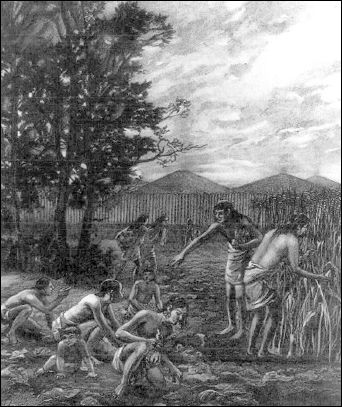
This early depiction gives indication of a more domestic life than often presented, as it shows a palisade timber fence enclosure and what appear to be the women of the village working in their gardens harvesting their crops.
_______________________
362 See: Ibid. A River Running West the life of John Wesley Powell: Prologue XIII
363 Stegner, 248.
364 Worster 444, 604: Morgan to John Wesley Powell letter. May 11, 1881, Morgan Rochester, box 10
365 Stegner, 252
366 Darrah, William Culp: Powell of the Colorado, (Princeton University Press) Forward ix.
367 Stegner, 319
368 Ibid. 320
369 Ibid. 321