
APPENDIX C

There has been many times in history that those in science and politics have sought to use their position or some interpretation of science to validate their opinion. As this example shows, just because it is valid, doesn’t mean it is correct. Valid and correct are terms that are often used interchangeably, believing that if something is valid, it is necessarily correct. This is not, in fact, the case. Something is valid, if it logically follows from something else. Something is correct, if it is, well, correct. That is, it stands on its own, is objectively true, or based on verifiable assumptions. An associate, Paul Legler, had a high school experience that illustrates this point.
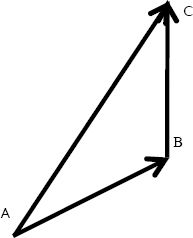
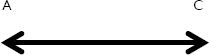
In his senior year, he was taking a class in mathematics in preparation for studying engineering in college. In the first part of the semester, the course focused on vector arithmetic, which states that given two vectors, AB and BC, their sum is the vector AC Vectors can be added, subtracted, multiplied, and divided, and form the basis for the area of mathematics known as Linear Algebra. In study hall one day, he and a friend were discussing what they had been studying in class, and hit upon an idea. What if you took two vectors of equal length and overlaid them on one another, but in opposite directions. One would get this:
They reasoned that length cannot be negative (length cannot be less than zero), the resulting equation would be: 1 + 1 = 0 – if the length of each vector was 1.
This didn’t seem sound, but they ran with the idea. By the end of that study hall they had shown that:
2 = 1
Pi and e are rational (can be expressed as a non-decimal fraction)
i, the imaginary number is real, anything is equal to anything else.
Every result they derived was arrived at through a logical process. That is, they all flowed directly from the original premise, using established mathematical axioms and processes. None of them, of course, were correct. They had made two assumptions one explicit, one implicit. The explicit assumption was that a vector’s magnitude (length) could not be negative, which is true. The implicit assumption was that a vector only has one property-magnitude. Herein lay the flaw in their reasoning, as vectors have two properties- magnitude and direction. The original equation should have been: 1 + (-1) = 0.
Thus, anyone – scientist, layman, religionist, or scholar – can draw logically deduced, but incorrect conclusions, if the underlying assumptions are faulty. We must consistently assess our own, and others’, assumptions to come to both a valid and correct conclusion.