
When art forgers are caught, a defense they often present is that their intention was not to deceive. They say they only intended to copy an image or a style, and not to commit fraud. Copying is a time-honored tradition, and if copies are claimed to be just that, rather than originals, no wrong has been done. Even though this defense may be hard to believe, it is also hard to disprove. The creators of false artworks hope they can duck out by putting the onus on dealers they sold to, saying the dealers knew they were getting copies, or should have, and passed those works on as originals. By the same token, the people who buy works from self-described copyists and resell them may claim they thought they were dealing in the real thing. When a piece is resold more than once and a chain of buyers and sellers is created, it becomes increasingly difficult to identify the culpable party or parties. Maybe all of them knew what they were buying and selling was phony, or maybe just one or some of them did, but it is likely that none will admit it. So, although a work of art may be a fake, pointing to the person who made it as culpable rather than a legitimate copyist, or to a person who sold it as being a fraudster rather than an innocent believer, may be an exercise in futility.
Tony Tetro’s defense is a classic demonstration of a plea from intention. When he was put on trial for faking several dozen paintings and lithographs by Dalí, Miró, Norman Rockwell, and Hiromichi Yamagata, and suspected of at least hundreds more by those artists and others, he held steadfastly that he was a copyist who never sold his works as originals. They were merely “reproductions” (direct copies) or “emulations” (in the style) of the work of famous artists: “Forgery indicates intent to defraud . . . and I never sold anything as real.” He claimed his intention was public knowledge: “Every one of my friends knew what I did. You know: What do you do for a living? I copy masters. I even had business cards which said: Anthony Tetro, Art Reproductions.”21
Prosecutors presented evidence that Tetro was in business with art dealer Mark Sawicki, who had been arrested and offered leniency (he ended up with no jail time) in return for his testimony. In a meeting with Tetro he wore a concealed recorder that picked up the statement, “I did a Chagall,” and a response of “Yeah” when asked if he had other fakes in progress. Sawicki also said he witnessed Tetro practicing signatures of the artists he was copying, and that he did between $75,000 and $100,000 of business with him each year from 1984 to 1989.22 In response, Tetro testified that he was unaware his works were being sold as authentic. It was established that Sawicki had paid him amounts in the hundreds of dollars per artwork, while price tags in galleries were many times that: The Yamagata works ranged from $3,000 to $16,000.23 While this price disparity could lend credence to Tetro’s claim that his intention was not to be a forger but merely a copyist, Yamagata revealed that he was paid only $1,000 for similar works.24 The upshot of the case was a mistrial, with jurors unable to decide on guilt. Having spent all of his money on attorney’s fees, Tetro avoided a retrial by serving a nine-month jail sentence and community service.25
Well aware that intention is the key to a guilty verdict before the law, forgers sometimes go to greater lengths to forestall trouble than Tetro did in printing business cards advertising his copying services. Because false signatures are another legal impediment, forgeries may be left unsigned, and even with signatures, they may be presented to potential buyers with an air of innocence in not claiming their authenticity and perhaps not knowing their potential value. The detection of a phony work, then, would not point definitively toward the intention of fraud. Eric Hebborn, in making a thousand fake Old Master drawings, capitalized on the fact that the artists he faked seldom signed their works on paper. He was known in London and Rome to be knowledgeable about art and active in searching out old works, and often approached potential buyers with his “finds” while leaving the determination of authorship up to them. (In other situations, he appeared as a dealer and expert.) He asserted that he believed the reason he continually evaded the law, along with the art establishment’s fear of a loss of public confidence in the market from the bad publicity that would be generated if he was exposed, was his cautious approach to the way he presented his phony productions depending on the party with whom he was dealing.26 Ken Perenyi’s memoir makes the same point. He speaks of approaching Phillips Auction House in London with a Martin Johnson Heade fake (eventually sold for $94,000) that he “found in a boot sale” and that looked like something he once saw in a magazine ad.27 Later, he says, when the FBI was closing in, his lawyers sent a letter claiming their client “has been creating high quality reproductions for years and never misrepresents them.”28 Perenyi avoided arrest, probably from a combination of the art market’s not wanting the public relations debacle that would ensue and his willingness to play dumb about the authenticity of what he offered for sale. Here are two bold but shrewd operators who managed to be thought of as too big and too complicated to be prosecuted, whereas other prominent forgers were unable to escape the legal system.
While Perenyi, Hebborn, and Tetro worked in the late twentieth century as they strategized over how to evade the law, a century earlier Giovanni Bastianini presented himself willingly to the public as the artist behind a major fraud. Described sometimes as the nineteenth century’s most prominent forger, he was never subject to legal action since he died at the age of thirty-seven while trying to prove his claim to have created a sculpture depicting the Renaissance poet Girolamo Benivieni that was on display in the Louvre as a Renaissance original (see Figure 2.1). The artist wanted the world to know of his talent, and declared he did not intend his works to be received as genuine products of the Renaissance. Public opinion about his honesty wavered, and with time, especially as more of his sculptures thought to be Renaissance-period originals were discovered, the label of forger won out, although it was not universally endorsed.29 In recent years, a reassessment has been underway that questions Bastianini’s culpability. He did not claim that any of his sculptures were the products of other artists, or sign with false names: some works were undesignated, and others were put forward under his own name. A series of Renaissance figures, including the disputed Benivieni piece, are among the items that provoke controversy,30 although there seems to have been no attempt by the artist to misrepresent them. Also key are that he did not apply artificial aging and offered no false provenance. He was typically paid between 200 and 500 lire for the works in question, while they were then sold for 9,000 to 10,000 lire, and the amount of 13,600 francs for the Louvre’s acquisition.31
The evidence against Bastianini is largely circumstantial and based on his association with art dealer Giovanni Freppa, who determined how much he was paid, although there is a letter by a third party describing a transaction between the artist and a buyer of one of his works for 1,000 francs along with the artist’s agreement to remain quiet about the deal. What is unclear is whether Bastianini was agreeing to sell an intentional fake for that amount or he wanted the amount to be secret for another reason.32 What is certain is that the artist perfected his talent for sculpting in the Renaissance manner, and that in designating some of the works he produced to be his own emulations of that period, he worked as a legitimate copyist. This status does not preclude his also being a forger, and because a number of his works have turned up in the guise of originals, it is not difficult to believe that sometimes he acted with the intention to deceive.
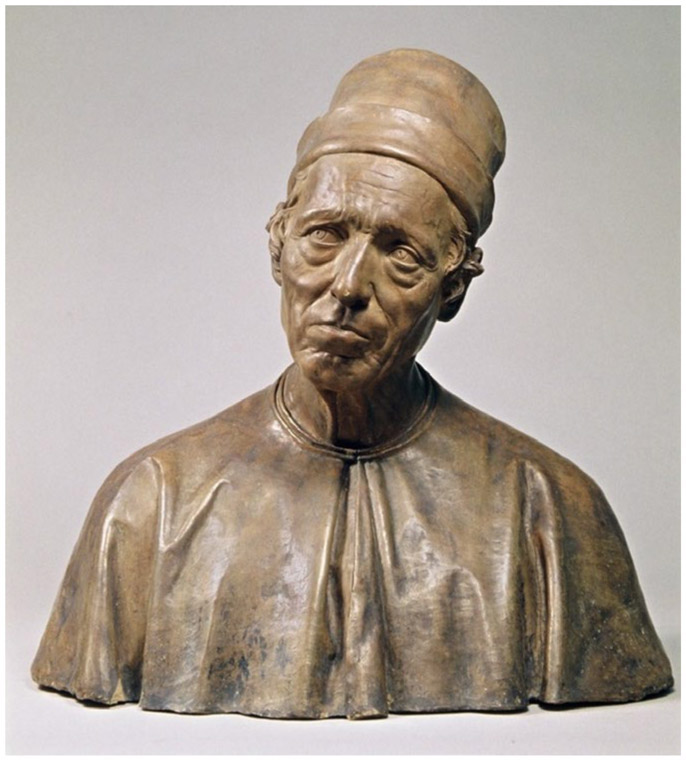
Figure 2.1. Bust of Girolamo Benivieni by Giovanni Bastianini, terracotta, 54 × 54 × 33 cm. Purchased by the Louvre as an unattributed Renaissance masterpiece. Art Resource/Courtesy of the Louvre
In the legal realm as well as in common understanding, determining an artwork to be a fake rather than authentic, or an artist to be fraudulent rather than a legitimate imitator, lies in finding an intention to deceive. However, in the realm of aesthetics, a variety of views can be found that range from endorsing the importance of intention to downplaying and even denying it. From the latter perspective, the difference between forgery and authenticity in art becomes clouded. And as the gap between forgery and authenticity closes, forgery gains in its perceived aesthetic value and finds proponents to speak for its worth.
Among philosophers, the conventional view is that a forgery—taken to be the antithesis of “authentic”—is what dictionary definitions say but with a more precise or deeper explanation. Denis Dutton states, “A forgery is normally defined as a work of art presented to a buyer or audience with the intention to deceive. Fraudulent intention is necessary for a work to be a forgery; this distinguishes forgeries from honest copies and merely mistaken attributions.”33 Taking a different tack, Sándor Radnóti, borrowing from and amending a definition by Nelson Goodman, asserts that “a forgery of a work of art is an object falsely purporting to have both the history of production as well as the entire subsequent general historical fate requisite for the original work.”34 A forgery, then, is designed to look its age, beyond demonstrating the handiwork typical of the artist being copied. And still another formulation, from Michael Wreen, stipulates that
A forgery is to be understood as a forged XY. . . . a forged XY is not a genuine XY, but is represented as a genuine XY, and is so represented with the intention to deceive. . . . A forged Picasso painting is not a genuine Picasso painting, but is represented as a genuine Picasso painting, and is so represented with the intention to deceive.35
The Picasso painting is an XY, with the class X being the “source of issue” and class Y the type of object being forged. Wreen says he prefers his definition because it applies successfully when dealing with several complications beyond simply stating the nature of an art forgery, such as allowing for the possibility of a forgery of a forgery, a forgery with a genuine signature, self-forgery, and the work of a nonexistent artist to be classified as a forgery.
Willful deception is front and center in all of these definitions. Its presence is a given and is necessary for forgery to occur. This point can be highlighted by asking whether an example can be cited in which forgery occurred without the intention to deceive. An attempt might be some version of the following: a copyist makes a copy of an artwork and sells it as a copy to a purchaser who displays it as a copy. After the copy leaves the purchaser’s possession still designated as a copy (as a gift or through an auction or other sale), it passes through a succession of owners and eventually is displayed innocently as an original, although it is not known at what point it acquired that designation. In its latest resting place, the artwork is assessed by an expert and labeled as a forgery. The artwork is not an original, and no one is known to have intentionally misrepresented it. Is this a case of forgery without the intent to deceive? The answer is no. Two mistakes have occurred, the first of which was to assess the artwork to be an original, and this was done without a wrongful intention. The other mistake was to apply the label of forgery. The misrepresented artwork can be called just that, a misrepresentation, or, to use another term common in the practice of authenticating art that is suggested in the quote from Dutton, it is a “misattribution.” The lack of willful deception is the telling factor. There was or was not an intention to deceive; this factor is binary—either-or. When situations arise, as with Tetro, in which it is difficult to determine if intention implies forgery, the problem lies with gaining the necessary evidence to determine the contents of the suspected forger’s mind. There is not a problem concerning the nature of forgery itself: there is no question that the intention to deceive is present with a forgery and not with an authentic work.
The idea that the separation between forgery and authentic art lies with intention as described so far has been challenged by postmodern theorists. From the perspective of “anti-intentionalism,” it is futile to look to the mind of the creator of a work of art to find its meaning. This view has been a staple in aesthetic theory for literature and the visual arts during the last half of the twentieth century to the present, and although endorsed in one version or another by many scholars, it has its detractors as well.36 In its moderate version, the assertion is that readers or viewers are incapable of determining with certainty what, for instance, a novelist’s or a painter’s intention was in creating a particular work: while meaning does exist, access to it is mediated rather than direct, and various interpretations will result. The aim of criticism is to proceed from the various interpretations to come to the best possible understanding of a work. A strong version of anti-intentionalism rejects the notion of searching for an overall meaning and holds that all that is available are multiple interpreters with their own interpretations. Figuring out the contents of an artist’s mind, then, cannot be done even collaboratively. An essay by Rosalind Krauss explains this view particularly in light of what the creators of modern art have done in conjunction with the thinking of twentieth-century philosophers such as Ludwig Wittgenstein and Maurice Merleau-Ponty, who have displaced a Cartesian notion of mental events—intentions—that exist in an artist’s mind and then become externalized in objects outside of the mind to be discovered. Regarding Wittgenstein, “his work became an attempt to confound our picture of the necessity that there be a private mental space (a space only available to the single self) in which meanings and intentions have to exist before they could issue into the space of the world.”37 As an example of specific artworks Krauss cites paintings by Frank Stella, saying that “the real achievement of these paintings is to have fully immersed themselves in meaning, but to have made meaning itself a function of surface—of the external, the public, or a space that is in no way a signifier of the apriori, or the privacy of intention.”38 Meaning, then, is established outside of what may be in an artist’s mind. It is born only when an artwork comes into contact with viewers who offer their particular perspectives on it.
With the meaning in artworks cut off from the minds of their creators, and established only when outside parties have conferred their own thoughts about the works themselves, artists become expendable in the process of coming to understand those works. A continuation of anti-intentionalism declares that the creator of a work is effectively a nonentity for the purpose of establishing meaning. This is the message from Roland Barthes in his famous pronouncement of “the death of the author,”39 and from Michel Foucault in his preference for referring to an “author-function” rather than a person.
We can easily imagine a culture where discourse would circulate without any need for an author. Discourses where whatever their status, form, or value, and regardless of our manner of handling them, would unfold in a pervasive anonymity. No longer the tiresome repetitions:
“Who is the real author?”
“Have we proof of his authenticity and originality?”
“What has he revealed of his most profound self in language?”40
How the relationship between strong anti-intentionalism and forgery works requires further explanation. Krauss and Foucault are not denying that artists have intentions, but saying that their intentions do not count beyond their own minds. What do count are the various meanings found in viewing the surface of an artwork that each person sees differently. Questions about the status of a particular painting as an original or a legitimate copy or a forgery lose out to an all-consuming focus on interpreting the intellectual and emotional impact that comes from viewing it. How the artwork speaks to the viewer is the key, and not what the artist who made it was thinking. Herein lies a problem. Focusing merely on the form an art object presents—“formalism” in aesthetic terms—hits a philosophical snag that will be discussed in part III with the topic of the “perfect fake.” In short, it is that leaving out the contents of artists’ minds oversimplifies the process of criticism by leaving out key factors that many viewers find important.
Anti-intentionalism faces another philosophical roadblock over the demand that multiple and competing interpretations of artworks be recognized. Its moderate version melds with moderate intentionalism, which also recognizes multiple interpretations, to form a continuum that accommodates various theoretical perspectives between the poles of strong intentionalism and strong anti-intentionalism.41 It is anti-intentionalism in its strong sense of discarding authorial intent and nullifying concerns about authenticity that becomes problematic. With no author, and confronted with a multiplicity of meanings, interpretation becomes unsupportable. If meaning—what is in an artist’s (author’s) mind—is only a construction by interpreters and unavailable to be discovered, the meanings the interpreters come up with are also created in a way that makes them unavailable to be discovered and not able to be understood for their intention. Interpretation is trapped in subjectivism. As explained by philosopher Paisley Livingston,
If the minds of readers are the constructed products of a theoretician’s interpretative operation, who constructs what may be called the theoretician-function? Either there are “spontaneous” cognitive processes—perhaps even genuinely rational ones—that are not the product of someone else’s projection, or there is an endless regress of projections.42
The upshot is that interpretation needs to recognize genuine contents in genuine minds. The psychological makeup of both interpreters and the artists whose works they interpret must be recognized after all. And this allows back into the equation an interest in what Foucault has said is irrelevant: a concern about authenticity when engaging in the analysis of artworks. Rather than being put aside, the question of whether an artist intends to make an illegitimate work belongs within the range of art criticism.
The strain between intentionalism and anti-intentionalism in interpreting art extends beyond art criticism per se and into an important consideration in law. The significance of interpreting the meaning in an artist’s mind when creating an artwork versus the meaning decided by viewers of that work has relevance in copyright law in regard to appropriation art. This topic will be discussed later in part II in the section on appropriation.