
The second half of the twentieth century onward saw the appearance of an abundance of forgers. The most notable among them have been the subject of not only many news articles but also interviews, television and film documentaries, book-length portrayals in memoirs and biographies, special exhibitions, and promotional campaigns through their own websites. Like Van Meegeren and Malskat before them, these forgers have reached celebrity status. Each has drawn attention for one or a combination of factors including the importance of the artists they faked, the volume of their output, the monetary value they accounted for, their artistic skill and ingenious methods, and the effect of their fraud on the historical record. Oil paintings and works on paper are their most popular mediums. The focus for some of these forgers is pre-twentieth century, but many have concentrated on the latter nineteenth and twentieth centuries. As Impressionism, Post-Impressionism, and subsequent movements came into vogue among museums and private collectors, and their commercial value increased, they became natural targets for forgery. Modern and contemporary works also carry the advantage for forgers of requiring materials that are less difficult to obtain or fabricate than those for faking earlier artists, although failing to be careful in this regard has sometimes been their undoing.
One of the most celebrated forgers is Elmyr de Hory, whose story is told in his biography Fake: The Story of Elmyr de Hory, the Greatest Art Forger of Our Time; his personal assistant’s book, The Forger’s Apprentice: Life with the World’s Most Notorious Artist; and two documentary films.201 During three decades after World War II, De Hory produced an estimated one thousand fake drawings and paintings202 imitating Monet, Van Gogh, Picasso, Dufy, Bonnard, Vlaminck, Van Dongen, Matisse, Chagall, and others.203 For the first half of his career he was his own salesman, using many aliases as he lived and traveled in Europe, the United States, Canada, Brazil, and Australia, always eluding authorities. Later, he sold through the agent team of Fernand Legros and Réal Lessard, who employed a sophisticated scheme of bribing experts for authentication and well-known collectors for fake bills of sale. They acquired engraving stamps that would duplicate the impressions of experts who could not be bribed, and a set of French and Swiss customs stamps that allowed for international transport of what appeared to be high-value works under export restriction (indicating authenticity). Still another trick was to locate out-of-print art books that held detachable reproductions and replace them with reproductions of De Hory’s fakes.
De Hory was never prosecuted for art fraud (although he was incarcerated briefly for other offenses), and he spent his last years living on the Spanish island of Ibiza while painting under the signature “Elmyr.” His death in 1976 was a suicide when he feared that Spain would extradite him to France to stand trial.204 His fame drew attention from other forgers, and several hundred works appeared on the art market bearing the false signature “Elmyr,” creating a phenomenon of faking the fakes.205 Legros and Lessard served prison time for art fraud, and each published a book claiming his own version of events in contradiction to De Hory’s account: Lessard declared himself to be the painting forger (with De Hory doing the signatures), and Legros presented De Hory as an art critic.206
During the 1960s, David Stein experienced meteoric success at forging drawings, watercolors, and pastels of Matisse, Picasso, Chagall, Van Dongen, Derain, Dufy, Braque, Laurencin, and Cocteau. His wife, Anne-Marie Stein’s, book, Three Picassos Before Breakfast, calculates his output as “thousands of forgeries” over a four-year period beginning in 1964.207 She describes him as working so rapidly as to complete a Picasso drawing in fifteen minutes, forty Cocteau drawings in one evening, and a Chagall watercolor in forty-five minutes.208 He avoided painting in oil because of the longer drying time as well as the smaller clientele for sales and greater attention those works would attract from experts.209
A native of France, Stein moved to New York and established a gallery where he mixed his forgeries with legitimate artworks. He was caught when three of his Chagalls were labeled false by Chagall himself, pleaded guilty and served eighteen months of a three-year prison sentence, and then was extradited to France, where he served a sentence of two years and was released in 1972.210 Capitalizing on the media attention he received, Stein painted successfully under his own name and had a role in a Hollywood movie about an art forger where he was also a technical advisor and provided a number of artworks. He is said to have continued forging by making fake collages of Superman signed “Andy Warhol 1960,” which were discovered in New York and France.211
Another forger who targeted Post-Impressionist masters is Geert Jan Jansen, a gallery owner in the Netherlands who turned to fraud by signing Karel Appel posters and selling them as original lithographs, then moved on to making paintings and works on paper. A 1981 brush with the law turned up a cache of Appel lithographs, but no charges were brought. When the art market was saturated with Appel prints in 1998, and Jansen was again suspected, he moved to France and continued his operation using several aliases to sell regularly through the Drouot auction house in Paris. A few years later, sixteen hundred works were seized from his residence, including forgeries of Dufy, Picasso, Miró, Matisse, Cocteau, and several Dutch artists, including Appel, along with a few originals.212
The legal case against him withered away when victims who purchased the forgeries were reluctant to press charges. The confiscated works were designated to be destroyed, but Jansen’s attorney argued successfully against it because experts were uncertain as to which works were originals mixed in among the forgeries.213 Jansen was sentenced to one year in prison with four years’ suspended sentence and exile from France for three years.214 Today, he lives in an elegantly restored thirteenth-century Dutch castle that also houses his studio and exhibition space. His website sells his autobiography, Magenta: Adventures of a Master Forger (printed in Dutch)215 and presents a list of his interviews along with recent and upcoming exhibitions of his works, some of which are simulations of well-known artists while others are done in his own abstract style.216
In France, Guy Ribes forged paintings of modern masters for three decades until his arrest in 2005. He targeted Renoir, Picasso, Braque, Dalí, Modigliani, Bonnard, Matisse, and Chagall, and has claimed that forty of his fakes are pictured as originals in three authoritative books on Dufy, and ten are included in the catalogue raisonné of Tsuguharu Foujita. Expert opinion estimates there are one to two thousand Ribes forgeries in circulation.217
Ribes’s life and career are presented in his autobiography, Self-Portrait of a Forger (printed in French), and a film documentary, A Genuine Forger: Portrait of an Art Forger (in French with English subtitles).218 There he speaks of his painting techniques, fraudulent art dealers, and millions of dollars of lavish spending, and claims that a number of dealers and police were aware of his identity as a forger. At his trial in 2010, he admitted to his activities, including the three hundred fakes submitted in evidence by the prosecutor. His sentence was three years in prison. He was released after one year, and hired on the set of the French film Renoir, where he created seventy-three artworks for the production, instructed the actor portraying Renoir on the proper posture with a brush, and in close-up scenes did the brushwork himself.219 He has brazenly suggested he will continue with forgery, telling an interviewer that if a new fake is uncovered he will attribute it to being made prior to his conviction: “Yes, I made that. That’s a fake, yes. They just sold that one? That’s not me. Because the trial had limits, I could bring out 50 new fakes. I made them ten years ago, but I was sentenced for that.”220
American forger Tony Tetro’s career lasted for two decades beginning in the early 1970s. Self-taught in art as a copyist, he found inspiration in reading Elmyr de Hory’s biography221 and went on to fake oil paintings, watercolors, drawings, and lithographs, particularly Chagall, Dalí, Picasso, Miró, and Rockwell. When a gallery owner he had done business with was arrested for selling fakes in 1989, he named Tetro as the forger and provided evidence and court testimony in return for a sentence of probation. Tetro’s trial stretched over four and a half years, costing $500,000 and forcing the sale of his possessions. It ended in a hung jury due to his persistence in maintaining that he was a legitimate copyist who sold his works without fraudulent intent. Rather than undergo a second trial, he pleaded “no contest” and served nine months in a work-release program teaching art to high school students and making paintings for a traffic safety program.222
Today, Tetro speaks openly to interviewers about the illegal activities in his past, no longer maintaining his claim to innocence.223 His website bills him as “The World’s Greatest Art Forger,” and includes details about how he forged Dalí along with a listing of interviews, articles, and images of paintings he has done as commissions.224 After a period of years to promote himself as a legitimate copyist, he became successful selling replicas and stylistic “emulations” (often large-scale) of masters from the Renaissance through the twentieth century (see Figure 1.6) to private collectors and museums. In 2019 Tetro identified publicly three works he painted on commission as emulations in the styles of Monet, Dalí, and Picasso for a collector who claimed them to be originals valued at $136 million and loaned them to Prince Charles of England for display.225
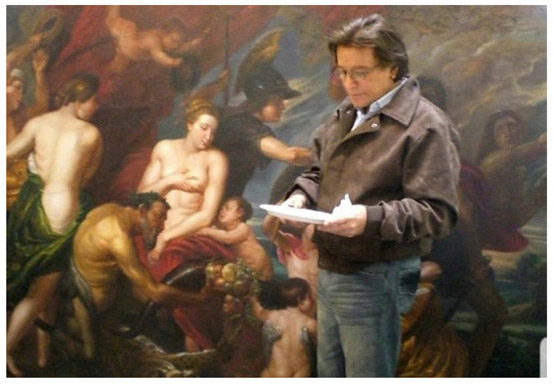
Figure 1.6. Tony Tetro with his rendition of Rubens’s Peace and War, oil painting, 213 × 396 cm. Courtesy of Tony Tetro
From 1986 to 1994, the team of John Myatt and John Drewe in England created and sold about 250 fake paintings bearing the signatures of Chagall, Matisse, Dubuffet, Le Corbusier, Giacometti, and other modern masters.226 Myatt was the painter, while Drewe forged the provenance and arranged to sell the works to collectors and galleries and through Sotheby’s and Christie’s auction houses at prices ranging from the tens of thousands to the low hundreds of thousands of dollars. In a hurry to turn out completed works to market, Myatt avoided the drying time of oil paint and instead used common house paint, with lubricant jelly added to make it more pliant and a finishing coat of varnish for sheen. Many of the paintings also lacked the technical quality expected of the masters they imitated, but with the impeccable documentation created by Drewe, they passed through the authentication process, without careful physical inspection, as inferior works by famous names. Posing as a physicist and wealthy art collector, he donated money and fake paintings to the Tate and Victoria and Albert Museums, and gained access to their archives. Over a period of years, he removed briefcases full of materials he used as models and for information to create false documentation for Myatt’s paintings: certificates of authenticity, bills of sale, personal letters, and catalogs he took apart and reassembled with replacement pages showing Myatt’s forgeries as originals. He then returned the original documents along with newly created fakes.
The scheme unraveled when several of Myatt’s paintings were examined closely enough to question their authenticity on qualitative and technical grounds, and Drewe made small mistakes on the accompanying documents. At their trial, nine fraudulent works were presented in evidence from the eighty that had been recovered from various collectors, auction houses, and dealers. Police estimated that Drewe had earned $2 million from the partnership and Myatt less than $200,000,227 but the greater significance of their activity lies in the extensive corruption to the art-historical record. Myatt admitted his guilt and professed repentance for his crimes, and served four months of a one-year prison sentence. Then he capitalized on his fame through two television series in which he demonstrated how to paint in the styles of great artists, and through exhibitions and gallery representation selling his works for prices in the tens of thousands of dollars.228 Drewe declared his innocence and wove a bizarre tale of government-sponsored arms trafficking funded through the sale of fake artworks. He served four years of his six-year prison sentence.229 In 2012, he was sentenced to eight years in prison for defrauding an elderly woman of her savings of $1 million.230
Two of the highest monetary-value forgery operations in history played out simultaneously during the 1990s and early 2000s, focused on abstract paintings. Wolfgang Beltracchi, first in Germany and later in France, forged stylistic imitations of Van Dongen, Léger, Braque, Campendonk, Molzahn, and other notable Cubists and Expressionists that his wife, Helene Beltracchi, and two associates sold to dealers and through Sotheby’s, Christie’s, and other auction houses. In New York, Pei-Shen Qian simulated paintings by Pollock, Rothko, De Kooning, and other Abstract Expressionists. He was employed by a three-person team that sold his paintings primarily through the Knoedler Gallery.
Beltracchi’s paintings were claimed to have come from an art collection inherited from his wife’s grandfather that lacked documentation because it was purchased from a Jew who fled Germany under the Nazis and was forced to sell.231 After nearly being caught in 1995 for three suspicious pieces that were beyond the law’s statute of limitations, in 2010 the group was arrested when a forensic analysis of a Beltracchi painting revealed an anachronistic paint pigment. At trial in 2011, fourteen criminal counts were submitted for forged works valued at more than $40 million and which the accused had sold for $21 million. Authorities later reported that fifty-three forgeries had been discovered that were attributable to Beltracchi, with twenty more likely to be designated as his.232 Beltracchi himself has estimated that over the course of his career, he created “hundreds” of forgeries by fifty artists.233
The trial ended with a plea agreement when prosecutors became concerned about potential complications in proving their case. Wolfgang and Helene Beltracchi received terms of six years and four years of incarceration, to be served in “open prison” with confinement at night and release during the day for employment. One of the confederates was sentenced to five years, and the other to twenty-one months’ suspension.234 The Beltracchis commenced work on a documentary film and two autobiographical books, and Wolfgang began painting under his own name.235 He was released from prison in 2015 and Helene in 2013, facing more than $20 million in lawsuits by parties they swindled.236 Beltracchi’s legitimate paintings have sold in various gallery exhibitions and through his website at prices in the tens of thousands of dollars.
As the Beltracchis were netting tens of millions of dollars in Europe, Pei-Shen Qian’s forgeries in New York sold for a total of $80 million. Qian was a successful artist in China who emigrated to the United States, and in the early 1990s, was recruited by José Carlos Bergantiños Diaz to create stylistic imitations of Abstract Expressionists including Rothko, Pollock, and Motherwell, among others. His partner, Glafira Rosales, presented them to the Knoedler Gallery, which paid over $20 million for approximately forty works between 1994 and 2009, and sold them for a profit of more than $40 million. Twenty-three more paintings went to Julian Weissman Fine Art for $12.5 million and were sold for $17 million. Rosales claimed provenance for most of the paintings to be a Swiss client who wished to remain anonymous, and the rest from a Spanish collector.237
Rumblings about the questionable authenticity of some of the works prompted scientific examination that revealed paint pigments that were not in existence during the artists’ lifetimes, along with evidence of the removal of old paint from canvases before the fake works were painted on them. The signatures on some works were questioned, and one was spelled “Pollok” rather than “Pollock.”238 Rosales pleaded guilty in 2013 to charges of fraud, money laundering, and tax evasion. She was sentenced in 2017 to jail time already served (three months) and nine months of home detention, along with financial restitution of $81 million. The judge’s decision for the unusually brief incarceration was due to intimidation and abuse Rosales had been subjected to by Bergantiños Diaz. The prosecutor did not object, saying the defendant had provided “instrumental” evidence in the case.239
In 2014 charges were brought against Qian, Bergantiños Diaz, and his brother Jesus Angel Bergantiños Diaz, who was named as a co-conspirator. Qian left the United States for China, with which there is no extradition treaty. In interviews he claimed his paintings were made as legitimate copies and that he was paid no more than $8,000 for each.240 In 2014, the Bergantiños Diaz brothers were arrested in Spain, where they hold citizenship, and avoided extradition to the United States. In a 2020 interview in Spain, José Bergantiños Diaz declared that Rosales was “the ambitious one” who masterminded the scheme and that he had not mistreated her.241 The Knoedler and Julian Weissman Galleries were not indicted in the conspiracy, but both, along with Knoedler’s director, faced lawsuits from defrauded collectors (see Figure 1.7). Knoedler closed in 2011 under the weight of scandal and financial ruin.242
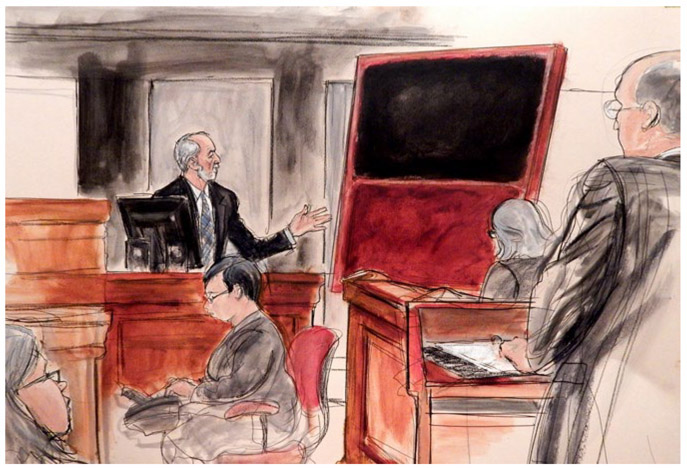
Figure 1.7. Trial testimony against the Knoedler Gallery, 2016. Courtroom sketch. The Mark Rothko fake pictured here was sold by Knoedler for $8.3 million. Courtesy of Elizabeth Williams
Among the most notable forgers of recent decades are several whose range was broad and can be described as eclectic, spanning various time periods, movements, and, in some cases, mediums stretching from works on paper to sculpture. Each of these forgers was active for a number of years before being exposed. Over three decades beginning in the 1950s, British art restorer Tom Keating made at least two thousand fake paintings and drawings in the names of more than one hundred artists, from the seventeenth through the twentieth centuries, who are listed in an appendix to his book The Fake’s Progress (authored with the journalist who exposed him). His most frequent targets include Samuel Palmer, Cornelius Krieghoff, Degas, Renoir, Sisley, Rembrandt, Turner, Goya, Modigliani, and Expressionists such as Feininger, Nolde, and Munch.243
For a period of ten years, Keating partnered with Jane Kelly, who created a provenance for his numerous Palmer fakes as coming from her family collection, which was recently returned to England from Ceylon. After Keating admitted his forgery activities to the press in 1976 and his book appeared the following year, he and Kelly were charged in 1979 with fraud for false Palmer paintings totaling $30,000, with Kelly pleading guilty and agreeing to testify against her accomplice. She received an eighteen-month suspended sentence. His charges were dropped because of his serious physical condition.244 He recovered and hosted a popular television series in which he demonstrated how to mimic the styles of famous artists.245 Keating also was notorious for the unusual practices that he included in creating his fakes. Although typically careful to use appropriate materials and apply artificial aging, he often placed “time bombs” under the surface of paintings that would reveal their falsity in the future. In some cases an underlayer of glycerin was applied so that the paint would disintegrate during the process of cleaning. In other cases he wrote a message in white lead paint—a swear word or an expression such as “This is a fake”—that could be discovered by X-ray.246 Since his death, paintings known to have been done by Keating have acquired market value extending into the tens of thousands of dollars.
Keating’s successor as a celebrity forger in Britain was Eric Hebborn. Known for making one thousand fake Old Master drawings (van Dyck, Poussin, Tiepolo, Rubens, Piranesi, Boucher, and others), he also faked oil paintings and sculptures. His memoir, Drawn to Trouble: Confessions of Master Forger, describes incidents from his career as a forger interwoven with a philosophy aimed at justifying it. A second book, The Art Forger’s Handbook, provides details about how to work as a forger in several mediums.247 In other projects, he translated and illustrated poetry by Michelangelo, Giuseppi Belli, and Federico García Lorca, and occasionally exhibited artworks done in his own name.
Hebborn made his living as an art dealer, although he looked disdainfully on dealers in general for accepting works of questionable authenticity and for taking advantage of forgers by paying them small sums for fakes that produced large profits. In 1964, he moved permanently to Rome and opened a gallery where he mixed his fakes with legitimate works. For a decade and a half beginning in 1963, he created his first five hundred Old Master drawings, selling many of them in London through Sotheby’s and Christie’s along with the Colnaghi gallery. In 1978, Colnaghi made a public statement that they had unknowingly sold a number of forged drawings, all from one source. Hebborn was not named, but his identity became known among insiders in the trade. At that point he vowed to do five hundred more drawings of even better quality than the previous ones and later claimed to have accomplished his goal.248 Hebborn was never arrested, although during the 1980s he spoke publicly about his deeds as a forger. His death in 1996 at age sixty-one came from a blow to his skull on a street in Rome, with conflicting stories citing a fall during a state of drunkenness and murder at the hands of the Mafia.249
Another forger who evaded arrest during a decades-long career was Ken Perenyi, an American who as a teenager was inspired by reading a book about Van Meegeren.250 He learned about old paintings by working for a painting restorer, began faking unsigned sixteenth-century Dutch paintings, and then opened his own art restoration business and expanded his range of fakes to nineteenth-century American artists such as John Peto, William Aiken Walker, Charles Bird King, Martin Johnson Heade, James Buttersworth, and Antonio Jacobsen. When the FBI began tracing Perenyi, he operated for two years in England, where he faked eighteenth- and nineteenth-century British sporting art (John Herring Sr., James Seymour) and marine scenes (Charles Brooking, Thomas Buttersworth). After returning to the United States, he continued selling through auctions in New York and London, mostly works in the tens of thousands of dollars, although one Heade painting netted more than $700,000. By the 1990s, the FBI was on his trail for several Buttersworth forgeries, and he turned to selling his works as reproductions.
With his forgery career over and hundreds of fakes in circulation,251 Perenyi waited until the statute of limitations for prosecution had passed before writing his memoir, Caveat Emptor: The Secret Life of an American Art Forger. There, he speculates on why he remained free from legal action. Proof was lacking that he had sold his fakes as originals because he was careful to leave attribution up to dealers and auction houses rather than assert it himself. And the number of fakes he produced would have been embarrassing to the people who sold them, leaving them hesitant to support a case against him.252
The most versatile of forgers for the range of mediums he attempted, as well as genres and styles, is Shaun Greenhalgh. From the 1970s until the early 2000s, he created oil paintings (from Rembrandt to Impressionism to Remington), eighteenth- and nineteenth-century watercolors, fresco fragments, drawings (Old Master, possibly hundreds in pastel of L. S. Lowry), ceramics (Pre-Columbian, Ming dynasty, Gauguin), sculptures in stone, terra-cotta, bronze, and ivory (ancient Roman, Mayan, African, a Buddha head, portraits of Thomas Jefferson and John Adams), Lalique glass, gold and other metal works (Bronze Age, Japanese, Islamic, ancient Roman silver plates, Gothic crucifixes), and nineteenth-century majolica.253 He sold many of his forgeries for small amounts of money, although a few fetched large prices, including more than $700,000 for the Amarna Princess (see Figure 1.8), an ancient Egyptian sculpture. In the postscript to his book, A Forger’s Tale: Confessions of the Bolton Forger, he claims to be the creator of the much-discussed portrait La Bella Principessa, attributed by some experts to Leonardo da Vinci and with a potential value as an original of $200 million.254
Early in his career, Greenhalgh sold often to an antique dealer and later worked with his parents, dubbed the “Artful Codgers” by the press. His mother made phone contacts, and his father (presenting a sympathetic figure of an elderly man in a wheelchair) met with potential buyers to sell artworks claimed to be from an inherited collection. The scheme unraveled in 2005 when Bonhams auction house examined three ancient alabaster relief tablets and found an oddly rendered horse’s harness along with a misspelled cuneiform inscription.255 Scotland Yard confiscated many artworks from the family’s home and the crude garden shed that functioned as the forger’s studio, finding that despite the $1 million to $3 million the operation is said to have earned, they lived together in public housing without a computer and maintained a frugal lifestyle.256 Court proceedings revealed 120 fakes known to have been placed on the market. With his mother and father given suspended sentences, Greenhalgh was sentenced in 2007 to four years and eight months in prison, and since his release in 2010, he has sold his works as reproductions.257
Perhaps the most unusual among the high-profile forgers of recent decades is Mark Landis, who from the mid-1980s until 2010 donated his fake artworks to fifty museums throughout the United States (mostly local and regional institutions including universities). He used several aliases, sometimes showing up in person dressed as a Jesuit priest, and talked of family wealth that included an art collection. The FBI investigated Landis but determined that since he never sold his forgeries and never claimed their donation for a tax advantage, his activities were not subject to prosecution. The artists he faked span the range of Impressionism, American Western art, Ashcan School, Surrealism, Expressionism, Fauvism, Rococo, and cartoon art: Mary Cassatt, Charles Courtney Curran, Maynard Dixon, René Magritte, Everett Shinn, Louis Valtat, Antoine Watteau, Charles M. Schulz, and others.
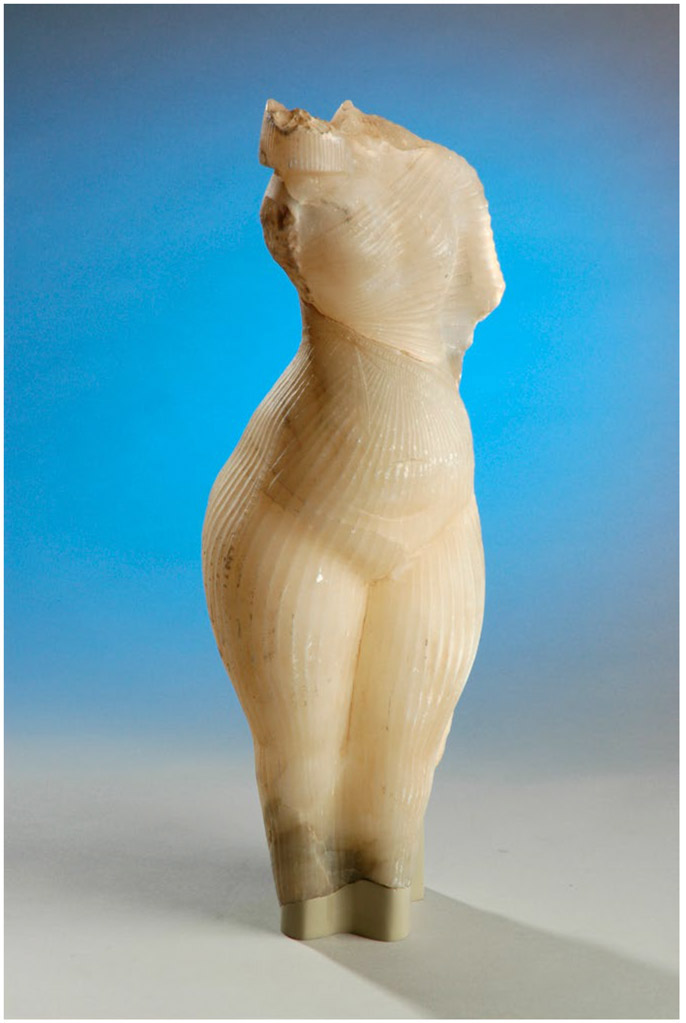
Figure 1.8. Amarna Princess by Shaun Greenhalgh, style of Egyptian Amarna period, c. 1350 BC, alabaster, 51 cm high. Courtesy of the Bolton Museum
Landis’s income is from an inheritance. He suffers from mental illness (diagnosed schizophrenia) and says that due to attention deficit disorder he prefers to complete an artwork within an hour.258 Although some works are done freehand, many consist of photographic images or tracings that are simply painted over or drawn over. They would not fool experts under close examination, but as gifts they faced less scrutiny than if they were offered for purchase. In 2008, the Oklahoma City Museum of Art noticed that two works donated by Landis were identical to those at other institutions, and when his modus operandi was uncovered, other museums were alerted. His story made headlines, and in 2012 the University of Cincinnati held a one-man show of Landis’s forgeries, many of them provided by the forger himself, who also loaned his priest’s outfit and appeared in person at the opening.259 A documentary film about him, Art and Craft, was released in 2014.260 Landis today makes commissioned pieces from photographs, with a portion of the proceeds donated to mental health awareness.261