
The extensive presence of fakes in the art world has drawn an increasing level of response during the twentieth and twenty-first centuries. Several trends have emerged, one of which is organization among professional specialists with various forms of expertise to confront forgery. Targeted law enforcement units, information-sharing organizations, comprehensive and online catalogues raisonnés, and permanent authentication boards developed from earlier precedents to greater levels of sophistication. A second trend is for museums and, occasionally, commercial galleries to mount special exhibitions of counterfeit art. These forums offer education on a provocative subject that attracts not only dedicated aficionados but also visitors less inclined to attend art exhibitions. Masses of people have had the opportunity to learn about art forgery by viewing its products firsthand. A third trend embraces new technologies in art authentication. Laboratory science offers a number of possible tests for discovering false artworks that were not previously available in history. This approach is often successful, but it is subject to limitations that prevent it from being a comprehensive answer to counteracting art forgery.
Many countries and a few major cities, as well as Interpol, established specialized law enforcement units during the latter 1900s and 2000s to combat art crimes consisting of theft, illicit trafficking in cultural goods, and fraud.315 Italy’s Carabinieri T.P.C. is often held up as a model. Founded in 1969, it is the oldest and by far the largest of these units, consisting of nearly three hundred officers located in thirteen regional offices. By comparison, the FBI’s Art Crime Team, existing since 2004, has twenty special agents.316 Counterparts at New Scotland Yard and the Netherlands’ KLPD were created several decades ago, but like units in other countries, they have faced uncertain budgets and downsizing when law enforcement’s tightening finances are devoted to violent crimes.317 Although typically these specialized forces are small, and forgery is only one of their responsibilities, the training and grouping of specialists represents a step beyond an ad hoc approach in law enforcement’s pursuit of forgers.
Besides law enforcement, other organizations have been formed as watchdogs to disseminate information about art crime. The Museum Security Network, online since 1996, allows museum officials to learn about specific incidents and best practices, and is also consulted by attorneys, academics, insurance companies, journalists, auction houses, and police. The Association for Research into Crimes Against Art (ARCA), established in 2007, concentrates on educational programming. It approaches art crime as an interdisciplinary field of study, sponsoring symposia and a postgraduate certificate program as well as publishing a journal. While these organizations, like the targeted law enforcement units, deal with art crime in its several facets, and attention often goes to theft and cultural preservation, the International Foundation for Art Research (IFAR), also multifaceted, places a greater emphasis on forgery-related activities. Founded in 1969, IFAR holds extensive information for provenance research and an online database of legal cases, publishes a journal, and provides an authentication service that has been directly involved in uncovering numerous fakes. Among them are more than one hundred forged Jackson Pollock paintings linked to three important cases, including the Knoedler affair, which involved cooperation with the FBI.318
IFAR maintains an online database of catalogues raisonnés with a listing of twenty-five hundred entries. A similar database devoted to prints is held by the Print Council of America. Having developed historically from the business practice of artists and dealers maintaining inventory lists, the catalogues are an asset in authentication, especially as they have come to be illustrated through photography. In the 2010s, some were digitized and put online, making continuous revision possible, while giving immediate access for viewing collections of images that have been verified by experts and that can train the eye in connoisseurship as well as identify newly found works that are duplicates.
A further attempt at organizing expertise for counteracting forgery was the establishment in the late twentieth century of authentication boards for prominent artists commanding especially high prices. Experts from academia, the commercial side of the art world, and artists’ families converge (under the banner of a foundation, estate, museum, or research project) to form an ongoing panel whose declarations regarding the authenticity of works submitted to it are considered to carry greater weight than the determinations of other parties. Although their purpose is to give stability in the difficult process of deciding which artworks are genuine, the boards are subject to criticism for conflict of interest since many of their sponsoring organizations hold collections of works by the artists they authenticate. Another difficulty has been the finality of the pronouncements issued, such as the Warhol Board’s indelible red-ink stamp “DENIED” placed on rejections. Due to the cost of lawsuits against them by dissatisfied authentication seekers, a number of boards disbanded after a decade or two of operation, including Pollock, Warhol, Lichtenstein, Rauschenberg, Rembrandt, Basquiat, Haring, and Noguchi.319 The Warhol Foundation issued the statement that “We won every single one of those lawsuits, but the process was extraordinarily expensive, costing us at least $10 million defending ourselves. . . . we wanted our money to go to artists and not to lawyers.”320
While the Museum Security Network, ARCA, IFAR, and catalogues raisonnés are consulted by specialists in the art world, a movement toward mounting special exhibitions of fake art has targeted a broad population of collectors and the general public. This approach diverged from what had been typical policy among museums to remain silent about forgeries so as to avoid embarrassment about their collections and prevent fear about fraud. The new posture was to educate people about forgery. Exhibitions of fakes have been sponsored by public and private museums, universities, law enforcement agencies, and commercial galleries.
Three museums in Europe today are dedicated to the permanent display of art fakes: the Fälschermuseum in Vienna (which includes works by Edgar Mrugalla, Tom Keating, Elmyr de Hory, and other noted art forgers), the Museum Valse Kunst in Vledder, Netherlands (which includes works by Geert Jan Jansen among others), and the Museo d’Arte e Scienza (which features scientific instruments used in determining authenticity) in Milan. All stipulate that their purpose is to educate and warn the public about the presence and danger of fake art.321 Beyond these permanent displays are numerous temporary exhibitions, with a few precedents in the early 1900s and a proliferation since midcentury and especially the last several decades. The international library catalog WorldCat lists more than 150 catalogs of special exhibitions on art forgery, with the likelihood that there were other exhibitions for which catalogs were not available to be recorded or were not produced.
Among notable examples is a 1952 exhibition titled False or True, which began in Amsterdam and continued on to Switzerland, Germany, and the United States. Originals and forgeries were displayed side by side to promote the idea that false works are different and inferior and can be spotted. A key display lined up several sculptures by Giovanni Bastianini to demonstrate how they are similar to one another and unlike the works of Renaissance masters he was accused of copying.322 The Salon of Fakes exhibition in Paris in 1954 similarly used prominent names to attract public interest and emphasize the criminality of the forger’s enterprise. Eight fake Mona Lisa paintings were featured.323 False Rodin drawings were the subject of an exhibition that began at the National Gallery in Washington, D.C., in 1971 and continued the following year to the Guggenheim Museum in New York. Genuine drawings were intermingled with fakes, and museumgoers were given scorecards to mark T or F as they tried to determine authenticity. The purpose of the exhibit was to promote connoisseurship, both a desire to learn more about it and an appreciation for the difficulty in detecting forgeries.324
In 1990, the British Museum held a blockbuster exhibition of six hundred fake items, mainly artworks but also extending to coins, perfume, and athletic shoes. Beyond the catalog, a three-hundred-page book, Fake? The Art of Deception, was issued to provide much historical material about forgery. The items on display were borrowed from various sources and included many from the museum’s own collection that were acquired as originals and only later found to be fakes. This exhibition signaled a leading institution’s willingness to display its vulnerability in an effort to inform the public that forgeries not only lie hidden in the art world but often fool experts.325 In the following decades, other institutions made similar admissions on a smaller scale, such as the Brooklyn Museum’s exhibition in 2009 that revealed that a third of its thirty-one Coptic sculptures were false,326 and the Detroit Institute of Arts’ 2011 display of fifty inauthentic or questionable objects from its holdings, including, among other items, an ancient Egyptian sculpture, a Botticelli painting, and a Ralph Blakelock painting.327 The show’s curator offered a confident statement about the museum’s reputation after admitting it unknowingly harbored forgeries:
As one of my colleagues emailed me recently, “Times have changed, and we are all more enlightened about these things now” . . . after 125 years of acquiring art extremely well we transparently acknowledge that we have made some mistakes and that this is part of the process of the DIA’s successful collecting history.328
Some exhibitions have delved into the scientific aspects of detecting forgeries. The National Gallery in London in Close Examination: Fakes, Mistakes, and Discoveries (2010), presented forty-one paintings drawn from the institution’s Old Master collection. Viewers saw (and later could access online) numerous photos showing paint layers close-up from a side view, cracking patterns, underdrawings, and the difference before and after cleaning.329 An exhibition at the Winterthur Museum in Delaware in 2018 presented artworks and various other objects to show how they were created as well as how they were detected as fakes. One room was devoted to scientific evidence, while the overall message was that science works in conjunction with provenance and connoisseurship in investigating authenticity.330
Another strategy for drawing visitors to exhibitions of fakes has been to focus on celebrity forgers. One-man shows have featured Elmyr de Hory (Gustavus Adolphus College, 2010),331 Mark Landis (University of Cincinnati, 2010),332 and John Myatt (various galleries in the 2010s),333 while on a larger scale, Myatt and Shaun Greenhalgh were highlighted in Fakes and Forgeries, which appeared at the Victoria and Albert Museum in London in 2010 and the Bolton Museum in 2011. Works by both forgers were displayed along with documents of false provenance created by Myatt’s partner, John Drewe, and a life-size replica of Greenhalgh’s garden-shed studio.334 Intent to Deceive, which displayed works by De Hory, Landis, Myatt, Van Meegeren, and Heb-born, began in Springfield, Massachusett, in 2013 and traveled to several other midsize museums in the United States. The stated purpose of the show was to contradict the sympathetic images forgers sometimes are afforded in the media, and present a “cautionary tale for any serious collector” as well as a “wake-up call to those interested in preserving the cultural heritage.”335 Exhibitions such as these that feature individual forgers humanize those figures and afford viewers insights into their minds and personalities. At the same time, despite an intention to ward off a sympathetic attitude toward forgery, the effort toward personalization may lead to a mitigated outlook on their criminality.
Other exhibitions have advanced a perspective that purposely counters conventional thinking about art forgery by questioning the meaning and worth of the concepts of uniqueness and authenticity. In a nod to postmodern thinking, the Musée d’Art Moderne de Paris in 2010 presented Second Hand, which employed the method of hanging fakes beside originals that has often been used to point out their differences. In this case, nonoriginals were labeled as “look-alikes” or “avatars” and presented in favorable comparison to what they were copying. Regarding the objective of the exhibition, the museum director declared that if it “raises questions about the notions of originality and masterpiece, then the museum will have fulfilled one of its missions: to foster critical thinking.”336 In a similar vein of breaking down traditional views, the SAW Gallery’s exhibition F is for Fake (Ottawa, 2014) showed an assortment of authentic and fake works of Picasso, Modigliani, Chagall, and others. The curator’s stated goal was to call attention to “all these ideas around originality and authenticity in an art world that seems more and more confused by artifice. I think the show makes a very contemporary statement about the art world today.” A highlight among the items displayed was a counterfeit ten-pound note made by underground graffiti artist Banksy (replacing the Queen’s head with the head of Princess Diana, and the words “Bank of England” with “Banksy of England”) that, it was pointed out, is worth more than a real ten-pound note.337
As exhibitions of fake artworks became usual fare, with some of them moving in the direction of postmodern aesthetics, others have continued to present a traditional message about the wrongdoing of forgery. Law enforcement agencies have been willing contributors and sponsors. Police in Aarhaus, Denmark, in 2007, having completed the investigation of a decades-old case of a forger who had since left the country and avoided arrest, warned the public about her fakes by collaborating with the Bornholm Art Museum to put them on display.338 In 2013, Fordham University in New York hosted Caveat Emptor, sponsored by the FBI, which supplied a carefully selected group of forgeries from the many discovered during the bureau’s investigations. Among the items included were fakes of Rembrandt, Chagall, and Warhol, as well as a James Buttersworth painting made by Ken Perenyi and a Renoir fake involved in the undoing of Eli Sakhai’s long-running scheme of making direct copies.339 Interpol, too, has engaged in exhibitions, supplying forty fake paintings that were shown at the Argentine Finance Ministry in 2016. The artworks were made in the styles of noted South American artists, drawn from 240 pieces seized in a recent raid and designated for use in court proceedings before being destroyed.340
As some of the special exhibitions cited here have demonstrated, scientists in the twentieth and twenty-first centuries have employed various means for exposing art forgeries. The field of materials science in particular, as it is applied in art conservation, lends itself to determining attribution and authenticity. Many large museums today house laboratories for conservation, as do certain universities and independent commercial enterprises. Scientists working at these institutions engage in forensic analysis as one of their functions and sometimes as their main or only function. In an action demonstrating concern about dealing with forgeries in the auction market, in 2016 Sotheby’s acquired leading forensics firm Orion Analytical.341 The capability of science to uncover falsity in artworks continues to expand with the development of new technologies, although some of the mainstays have been in use for many decades and undergone refinements.342
X-rays were used to examine paintings as early as 1896, shortly after their discovery. In the high-profile trial of art dealer Otto Wacker in 1932 in Germany, X-rays demonstrated the difference between the fake Van Gogh paintings he was selling and the artist’s authentic works.343 Additionally, chemical analysis of the paints revealed a resin that was foreign to Van Gogh’s materials.344 In the Van Meegeren case in the 1940s, an analysis of the paints he used to make his false Vermeers revealed the presence of cobalt blue, a pigment not found in seventeenth-century paints, as a contaminant in the natural ultramarine pigment he had made a special effort to obtain.345 In 1992, pigment analysis combined with X-rays, high-intensity microscopy, and dendrochronology (which dated the wood to the late fifteenth century) solved the mystery of The Man of Sorrows panel painting in the Metropolitan Museum of Art’s collection that was thought to be an outright fake, suggesting it is one of Jef Van der Veken’s clever hyperrestorations.346 More recently, pigment analysis was the factor that revealed a Pollock painting sold by the Knoedler Gallery for $17 million to be a forgery, with the gallery announcing its closing in 2011 the day after the buyer presented the forensics report.347 Wolfgang Beltracchi, too, was tripped up by an anachronistic pigment, as well as a dendrochronology report that the wooden stretchers for four of his canvases, each faking a different artist, originated from the same tree (although this finding was disputed later).348
For mediums other than paintings, various tests are available. Chemical analysis has been employed with works on paper. When Tom Keating was under scrutiny before being exposed, one of his Palmer drawings was submitted for examination that revealed the paper was made later than the artist’s lifetime.349 Similarly, in a key legal case in the United States when a number of fake photographs claimed to be by photographer Lewis Hine were discovered on the market in the 1980s and 1990s, forensic tests were done that dated the paper to show the works could not be vintage.350 With ceramic artworks, thermoluminescence can be applied as a way to determine age by measuring the amount of radioactivity absorbed since they were fired. The process has been used since the mid-twentieth century, with a notable finding in 1968 that a prized Etruscan terracotta figure of Diana displayed at the Saint Louis Art Museum, and praised by many experts, was only forty years old. Its creator was Alceo Dossena, who had photographed the completed sculpture in his studio.351 Also based on measuring radioactivity to determine age (loss over time in objects containing organic material), carbon dating has been a staple procedure for anthropologists since midcentury. With later advances in the process, it can be applied to a sample size small enough to be removed from many artworks without appreciable damage. In 1991, the Louvre announced that a wooden Egyptian head of a harp, displayed for several decades until the 1980s as one of its main exhibits, had been determined by carbon dating to be a product of modern craftsmanship rather than ancient.352
These examples describe only a few of a great many instances where science has uncovered forgery in artworks. And the tests noted are not all of the laboratory means available, which also include infrared imaging, X-ray fluorescence, stable isotope analysis, and more, with some coming in several variations (such as types of mass spectrometry for analyzing pigments).353 In their collective effort to look closely at and beneath the surface of objects, such tests point in two directions: determining what materials were used to make an artwork and what the artist’s process entailed in creating with those materials. Materials analysis may discover anachronisms such as a pigment not yet in use when a painting was claimed to have been made, or anomalies such as (using stable isotope analysis) that the marble in a supposedly ancient Greek sculpture was quarried in a location that is a giveaway. Detecting the creative process may reveal features such as the number of paint layers or the presence of an underdrawing in a painting. Beyond the tests mentioned so far lies a different scientific approach gaining ground in the twenty-first century—pattern analysis—which uses digital photography and computer recognition to find statistically consistent patterns in artists’ styles that can be applied to distinguish fake artworks from authentic ones. Variations on this approach, which is still experimental, concentrate on brushstrokes (“wavelet decomposition”), curves in paintings where brushstrokes are not visible (“curve elegance”), and a combination of several features (“sparse coding”). Each has been demonstrated to be successful in limited trials at an accuracy rate of roughly 80 percent or higher.354 A related project was the analysis of Pollock drip paintings by looking for geometric patterns (fractals, based on chaos theory in mathematics), with one researcher declaring success, and others claiming the method is flawed.355
Scientific testing provides an impressive vehicle for detecting art forgery, but it also faces limitations. The expense and inconvenience of hiring technical expertise means that most artworks are not subjected to analysis. A simple study can easily run to several thousand dollars, as paint analysis alone may cost several hundred dollars per pigment. A more thorough study runs to tens of thousands of dollars.356 Beyond the analysis itself is the cost (including insurance) of sending an artwork to a laboratory or for an expert to travel to examine an artwork on-site with portable equipment or to take a sample. The time frame for scheduling an examination to receiving a completed report can range from weeks to months. To subject works other than high-priced ones to testing would add a significant layer of cost for dealers, which would be passed on in purchase prices to buyers and slow commerce in art considerably.
Another factor that limits the effectiveness of science in examining artworks for authenticity is the type of knowledge it provides. Materials analysis has the capability to falsify an artwork’s claim to be authentic, but not to verify it. Finding a pigment invented in the twentieth century on a painting purported to be three hundred years old can label it a forgery, and likewise with determining the wood panel an artist supposedly painted on was cut after the artist’s lifetime. But if the pigments are the same ones used three hundred years ago by the artist in question, and if the wood is of the right age and the variety the artist favored, that evidence does not determine the artwork to be genuine. Expert forgers are careful about the materials they use and sometimes go to great lengths to obtain them. Analyzing materials in art authentication can detect anachronisms and anomalies and definitively say “no,” but it cannot say “yes.” As for determining the particular way an artist used materials, again, science can point in the direction of authenticity but not establish it with certainty. Knowing the technique of how a finished product was put together may show that the creator followed habits like those of a famous artist, thus confirming something beyond the materials being appropriate, but assessing the image that was created is still crucial. That assessment is the domain of connoisseurship, although the science of pattern analysis follows a similar principle by applying artificial intelligence and aims to provide a conclusive decision about authenticity.
It is often the case that scientific assessment is sought only after an artwork has been judged to be authentic by connoisseurship. When science then runs its course, a collective decision is made that is stronger because it brings together two distinct ways of knowledge. Still, the thoroughly informed result sometimes is not decisive but inconclusive. A well-known example is the dispute over the Getty Kouros (see Figure 1.10), a larger-than-life-size ancient Greek marble sculpture purchased by the Getty Museum in 1985 for $9 million and put on exhibition the next year as one of its most important holdings. The Kouros was examined many times by the museum’s staff, guest specialists, and at a 1992 special conference in Greece where it was shipped for the occasion. Over time, the provenance documents were found to include forgeries, although they may have been created for the purpose of smuggling an original artifact. Scientific analysis employed microscopy, spectrometry, and X-ray analysis to examine the surface, and isotope analysis located the quarry for the stone to be on the northeast coast of Thasos. It was at first determined that the marble had undergone the process of dedolomitization (the conversion of dolomite to calcium), occurring over thousands of years. A later finding was that dedolomitization could be simulated over months in laboratory conditions, although the likelihood that a forger would know this, and, even further, be able to carry it out successfully, is remote.357 Connoisseurship, which initially was ambivalent, swayed against authenticity, with the general opinion that the style lacks the uniformity seen in other kouroi. It is seen as a pastiche in which the feet are anomalous with the hair and the shoulders and waist are
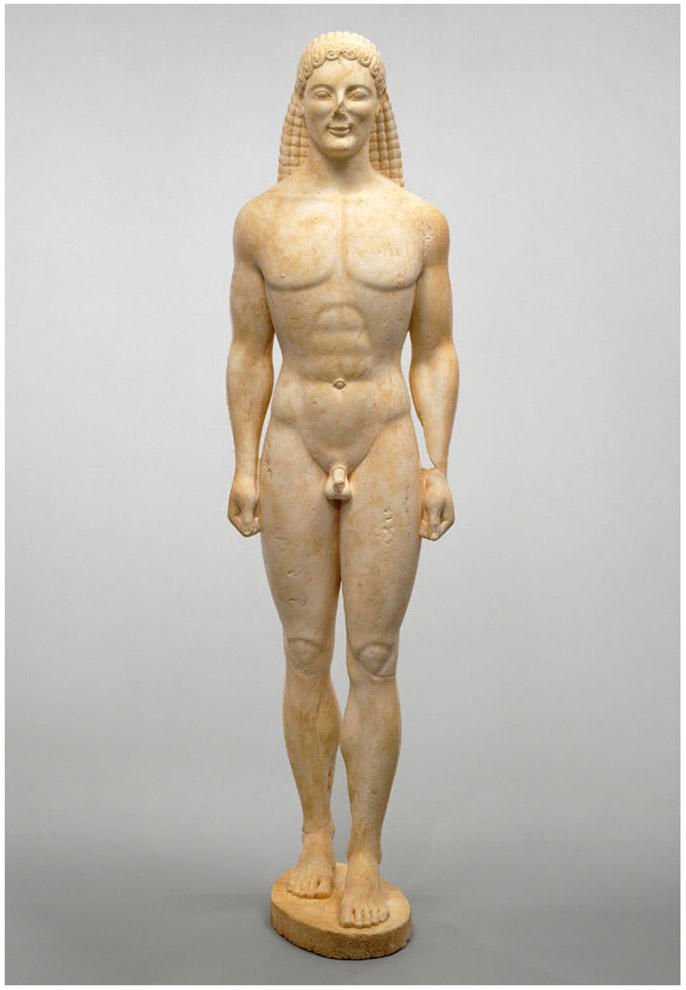
Figure 1.10. Getty Kouros, Archaic Greek style, c. 530 BC, dolomitic marble, 206 cm high. Taken off view in 2018 as opinion mounted that it is a forgery. Courtesy of the J. Paul Getty Museum
uncharacteristically narrow, among other questionable features.358 With scientific evidence pointing to an ancient origin and connoisseurship seeing a fake, the Kouros remained on display at the Getty, with the attribution of “Greek about 500 B.C., or modern forgery,”359 until it was put into storage in 2018.
Science and connoisseurship came to disagreement over the status of the Getty Kouros. On other occasions, the disparity may lie within the realm of science itself, pitting one laboratory against another. In 2006, Christie’s sold a Boris Kustodiev painting for $3 million to a buyer who later declared it to be a fake. A legal case was brought in London, with a decision in 2012. The buyer submitted a scientific report from a Moscow firm stating that the paint in the signature was faulty because under microscopic examination it could be seen as having seeped into underlying craquelure (implying the signature was added later than when the painting was made), and it contained an anachronistic thickening agent. The scientific analysis commissioned by Christie’s asserted that no paint could be detected in the cracking, and there was no evidence of an anachronistic substance. Further analysis by Christie’s compared the painting with two other works by Kustodiev, finding strong material and technical similarities including the presence of brushwork sketches and use of the same pigments. The buyer’s counterargument was that Christie’s sampled only two other paintings, while their own testing of ten more showed less consistency with pigments, and in both of Christie’s other works but not in the painting in question there were underdrawings and thin, translucent paint layers. The arbiter in this high-stakes face-off over art authenticity was a single justice, who accepted Christie’s finding on the signature and the buyer’s view that Christie’s comparison using two paintings was based on too small a sample and failed to account for significant differences found in the larger sample. With inconclusive scientific analysis, and a lack of provenance that is common with Russian art, connoisseurship was the key in a decision favoring the plaintiff.360
Beyond occasions where science is in dispute with connoisseurship or with itself, other factors may be problematic in the authentication process. When establishing that a pigment is anachronistic, confusion can arise over when it was first available. Was it the date when it was patented or when it was invented and might have been in limited use, or when it was first put into commercial use?361 With a pigment that clearly does postdate a painting, its presence may be the result of a restoration. The dendrochronology test is not viable with poplar wood, a favorite of Italian Renaissance artists. Thermoluminescence can sometimes be beaten by seeding the object with radioactive material in locations likely to be tested.362 And more important on a broad scale, searching for anomalies to rule out an artist as the creator of a work, or for similarities that strengthen a case for authentication, requires a database of practices for each artist under scrutiny. To know that someone typically applied a certain number of paint layers, was fond of certain paints or pigments and never used others, or worked with a regularity that pattern analysis could search for, requires that a number of works have been studied and data made available. For most artists who are not renowned, that data does not exist and would be complicated and costly to create. And when the data is available, the habits that have been detected may be subject to exceptions. Knowing, for instance, that an artist was particular about using a certain brand of paper does not exclude the possibility of an authentic set of drawings made on another type of paper when the regular stock was unavailable.
Notwithstanding the various limitations science faces in detecting forgeries, it is often successful. Artists who create high-value fakes confront an array of tests that can be used against them. On the other hand, it is possible that those tests may be employed in the service of forgery. Nothing prevents the maker or holder of fake artworks from submitting them, with an air of innocence and perhaps through an intermediary, for testing that would reveal just what improvements need to be made to pass for authentic. When those improvements are accounted for, the same works can be submitted to a different laboratory for analysis. And new works can be made that avoid the hurdles from the start. Even with works that still fail examination, there will be other laboratories to try in the hope of finding one that is less diligent and identifies no disqualifying features.
Another direction in which science has moved in recent years goes beyond the detection of forgery and points toward prevention, with artists taking strategic measures as they create new works. One developing technology is to mark each artwork with synthetic DNA, with a unique version designed for each artist and available in small stickers with material that will seep into an artwork permanently when attached to it. The material is said to be unreplicable, and tampering to remove it will leave microscopic forensic evidence. Artist’s DNA markers are stored in a dedicated database, which can be consulted by art professionals after they use a scanner to read the sticker on an artwork.363 This database dovetails with another technology for collecting and storing information, which is valuable in provenance searches. Blockchain data storage creates comprehensive records, made available to any interested parties, by chaining together all entries in a given file in a way that prevents alteration and can show possession of a work from the artist through successive owners. This method has been promoted as inexpensive, secure, and transparent,364 but it shares with DNA markers the limitation that it applies only to creations by current and future artists, and not to the vetting of earlier works. Both methods also rely on conscientious artists, dealers, and collectors who will participate and carry through with them routinely, a prospect that even proponents find doubtful.
Forensic analysis of artworks will continue to evolve given the nature of science to undergo constant change, resulting in improved knowledge. Perhaps in the future, less expensive and less time-consuming means of materials analysis will make it feasible for a greater portion of works to be examined. Pattern analysis may advance. And perhaps synthetic DNA or other systems of markers will be perfected and popularized. These possibilities add to other measures in an overall effort to counteract the activity of forgers. The popular trend of presenting special exhibitions of fakes will continue to educate the public about them. And organizations and databases can be expected to increase their role in a watchdog effort to expose inauthenticity. It is reasonable to assume that all of these means will advance to provide more scrutiny in separating authentic artworks from fakes. The potential of science combined with the dissemination of information offers optimism in confronting the significant presence of forgeries in the art world. But it can be expected, too, that forgers will keep up with measures that are used against them. History says as much through the expansive forgery industry that exists today in the art world. Practitioners of fraud will look for ways to steal or duplicate sophisticated identification markers, pattern analysis may be used to understand what patterns need to be duplicated in making convincing fakes, and a single laboratory could serve multiple forgers looking for methods to improve their fakes against the latest means of detection. Added to all of this, hackers may find ways to insert false information into digital files. In sum, the presence of forgeries can be expected to remain in spite of improved vigilance. The struggle between the forces of false art and those of authentic art will be ongoing.