
Rendered in Gustav Klimt’s distinctive decorative style, The Kiss (1907–8) portrays an embracing couple, enveloped in golden robes, who kneel on a bed of blossoms. A dark-haired man, adorned with a crown of vine leaves and a geometrically patterned gown, leans in to kiss the ivory-pale face of a woman. Wearing a crown of flowers in her auburn hair and a dress patterned in soft ornamental shapes, she closes her eyes in complete bliss.
Today, Klimt’s most popular painting has been reproduced countless times – on Valentine’s Day cards, cushion covers, mugs and posters hung on bedroom walls. Evoking tenderness, intimacy and unity, the image is held up in celebration of an idealised romance between a man and woman. But could there be more to this glittering masterpiece than an allegory of love? Who are the couple, and what is the significance of their shimmering, mosaic-like robes?
Klimt painted The Kiss from his studio in Vienna at a pivotal moment in the city’s history. At the turn of the twentieth century, the Austrian capital was a vibrant epicentre for artists, designers and intellectuals. Among them was the pioneering psychologist Sigmund Freud who, in 1905, and just two years before Klimt painted The Kiss, published Three Essays on the Theory of Sexuality. With this founding text of psychoanalysis – which framed sexuality as a normal part of development – Freud profoundly challenged attitudes to sex.
While Freud’s theories shocked and disgusted many, they influenced a number of contemporary artists, including Oskar Kokoschka, Egon Schiele and Klimt, who began to interrogate sexuality through their visual art. Kokoschka painted darkly expressive couples, reflecting on his troubled relationship with Alma Mahler, the lover and muse who abandoned him; Schiele, meanwhile, used twisting lines to infuse male and female nudes, whom he posed spreadeagled, with an electrifying eroticism.
Klimt, too, depicted nude female figures, undressing biblical and fictional characters including Judith holding the severed head of Holofernes, Eve found in the Garden of Eden, and a sleeping Danaë, the young woman who Zeus seduced in Greek myth. In works such as these, the artist treated his subjects in sensual terms, describing the feminine form with sweeping, unbroken curves. However, breaking away from his fellow contemporaries’ focus on stripped-down figures, from around 1900 Klimt also clothed many of his women in ornate outfits, such as that seen in The Kiss. What, then, had sparked his focus on fashion?
From the start of his career, Klimt had an interest in the decorative arts. Instead of studying at Vienna’s famed Academy of Fine Arts, he trained at the more practical School of Applied Arts between 1876 and 1883, where the influence of the English Arts and Crafts Movement had taken hold. Klimt admired its leader William Morris, who wanted to raise the status of the design – including jewellery and textiles – to that of painting or sculpture. Morris believed that art should be for everyone and infuse domestic life; he famously filled Victorians’ homes with his pattern designs featuring leaves, flowers and strawberry-thieving birds.
Like Morris, Klimt took the idea of decoration seriously; he led a group of young rebel artists called the secessionists away from Austria’s academic art history and towards a more modern aesthetic: ‘To every age its art, to every art its freedom’ was their motto. Although Vienna’s secession did not promote a particular style, artists including Klimt borrowed an ornamental approach to painting from art nouveau with its emphasis on swirling natural forms and rhythmically repeated patterns. However, the importance of fashion in Klimt’s work must likewise be attributed to one particular woman, who also rejected artistic traditions and rebelled against society’s norms, but who has been overlooked in many of art history’s narratives: Emilie Flöge.
Flöge appears in an early pastel portrait by Klimt, titled simply Emilie Flöge, Aged 17, from 1891. Drawn in soft tones, it pictures Flöge from head to waist, wearing a pretty but traditional white gown and delicate tiara in her pinned-back hair; with her face in profile, she stares away from the artist, who seems to be keeping a respectful, although admiring, distance from his new muse, whom he had recently met. Earlier that year Klimt’s younger brother, Ernst, had married a young middle-class woman called Helene Flöge. Following the wedding, the artist became a frequent guest at the Flöges’ family home, where he met Helene’s three siblings, including her youngest sister, Emilie.
But it wasn’t just family ties which drew Klimt to Flöge: aged seventeen, she was already a talented seamstress and aspiring fashion designer who was equally interested in and committed to the ideas of the Vienna Secession. When in 1903 the Wiener Werkstätte – and an alliance of artists and designers – was founded, both Klimt and Flöge became significant members. Inspired by the Arts and Crafts Movement, they wanted contemporary art to infiltrate every area of life, from furniture to fashion, and promoted the concept of the Gesamtkunstwerk or total work of art – Klimt through his paintings and Flöge in her progressive dress designs.
Flöge took a leading role in rethinking women’s dress for the modern age, designing garments in the style of the new ‘reform dress’. With wide sleeves and an empire waist, it was intended to free women’s bodies from the traditionally restrictive corset and impractical garments which physically prevented them from fully participating in society. Instead, this easy-to-wear, flowing robe both allowed for, and celebrated, the bodily liberation of women, promoting comfort, practicality and engagement with everyday life. This fashion reform reflected and symbolised wider feminine emancipation across Europe, where the idea of an educated, independent ‘New Woman’ was taking hold.
Although at the turn of the century in Vienna unmarried middle-class women could forge their own careers, Flöge embarked on what would have been an unusual venture at this time. In 1904, with her two sisters, she opened a fashion house and shop called Schwestern Flöge, located on Vienna’s bustling Mariahilfer Strasse. A former apprentice of the three sisters, Herta Wanke, recalled that ‘it was Emilie Flöge in particular who kept the salon. It was only due to her initiative that the firm reached such a height.’ The youngest sister was the one who not only sewed and designed garments but, as Wanke accounted, ‘directed the whole fashion house’, which became particularly well-known for its range of non-conforming reform dresses and one of the city’s top fashion salons.
Welcoming the women of Viennese high society into Schwestern Flöge, Flöge dressed them in her haute-couture designs for which she took inspiration from an extensive personal collection of folk art and festival dress which she owned and exhibited in the store. As her apprentice recalled, there were ‘glass display cases with beautiful embroideries, Hungarian national costumes, Slovakian needlework, which were something quite exquisite’. The bold colours, symbolic shapes and intricate geometric patterns of these pieces not only informed her own flamboyant creations, but also appear in the paintings of Klimt.
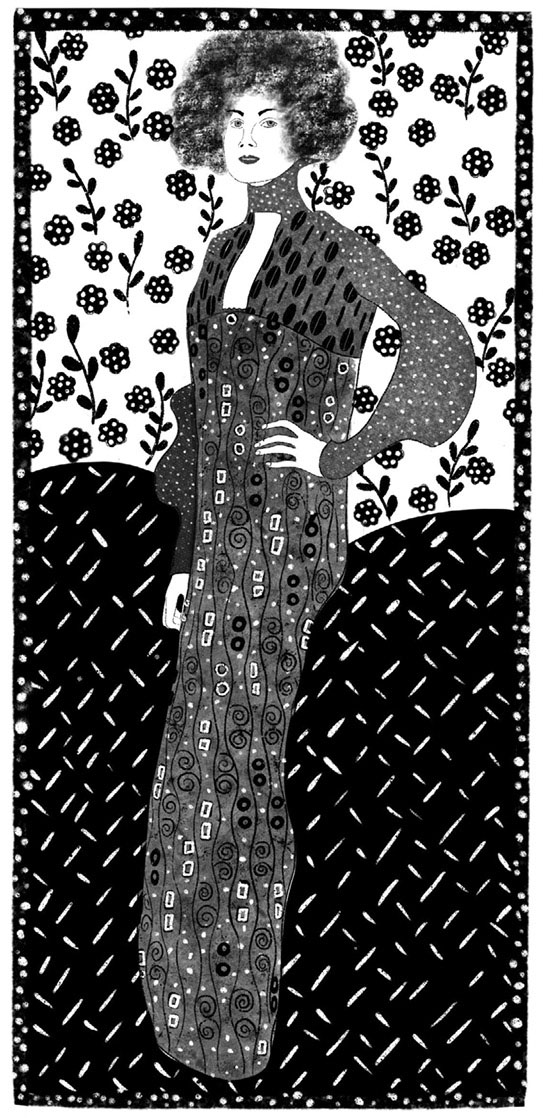
In marked contrast to her first formal portrait by Klimt, in Emilie Flöge (1902) the designer, now aged twenty-eight, models one of her own creations – the long blue-mottled robe, embellished with purple spirals, white dots and gold squares, falls to her feet. Exuding confidence, she holds one hand defiantly on her hip, while staring straight at the artist. Although she is naturally tall and slim, Klimt has emphasised her stature to present her as a towering and proud figure.
From this point onwards, it can clearly be observed that Klimt’s relationship with fashion begins to dominate his paintings. ‘Every aspect of this portrait acclaims the artistic vision of Gustav Klimt and the period,’ writes curator Frances Lindsay. However, she may be missing a key point: he is also paying tribute to Flöge as an artist. As well as showing off her own radical and revolutionary reform dress, Klimt brings the focus onto Flöge’s strong, slender hands – emerging prominently from her billowing sleeves, they point to the maker behind the dress.
Flöge opened up the world of fashion for Klimt, and they soon began to collaborate on a range of dresses: taking inspiration from her collection of folk art, as well as stage costumes, kimonos and kaftans, Klimt created designs which Flöge then sewed in the Schwestern Flöge workshop. As curator Jane Alison writes in the catalogue for the Barbican’s 2018 exhibition Modern Couples: Art, Intimacy and the Avant-Garde, ‘Klimt and Flöge, in a process of co-creation, became standard-bearers of the new liberated man and woman, the alternative king and queen of fashionable Viennese society.’
Numerous photographs show the pair sailing together on a boat on Lake Attersee, where they spent many summers together between 1900 and 1916, along with the wider Flöge family. In these images, they are both dressed in long reform robes embroidered in their designs; mirroring one another, Klimt and Flöge appear as equal and artistic companions. Klimt also photographed Flöge alone in the gardens surrounding and beside the edge of the lake, modelling their co-created long flowing dresses. While she poses seriously for the majority of these shots, in several of them Flöge laughs out loud, as if in on a secret joke with him.
Back in Vienna, Flöge was not the only subject whom Klimt portrayed wearing her dresses. At the Schwestern Flöge store, the designer introduced Klimt to wealthy heiress clients who were all keen to have their portraits painted by him: Sonja Knips, Szeréna Lederer, Friederike Maria Beer and Adele Bloch-Bauer, adorned in Flöge’s ornate dresses, were among those who posed for the artist. It is Bloch-Bauer who sat for the iconic painting The Woman in Gold (1907), in which she appears empowered, in a wondrous flowing dress embellished with swirling, golden patterns, upon a stylised throne.
While Flöge provided Klimt with a network of female models, Klimt promoted Flöge’s salon to his circle of collectors and patrons; his paintings of high-society women, whom he elevated to the status of icons adored in Flöge’s innovative designs, were surely the best advertisements she could have wished for. Moreover, Klimt’s paintings validated her avant-garde creations as furthering the freedoms of women: by rendering his female sitters confidently garbed in the new reform dress, rather than restrictive traditional garments, Klimt embraced the iconography of women’s liberation, showing his full support and solidarity with Flöge’s rebellious feminist fashions.
The same year that Klimt painted Bloch-Bauer as The Woman in Gold, he created his most celebrated canvas of all, The Kiss, which many believe to represent the artist and his main muse, Flöge, who were inseparable. Given the pose of the embracing couple, the painting invites questions about the exact nature of the pair’s relationship – we know that they were close friends, artistic allies and creative collaborators for twenty-six years. But did Klimt and his muse also enter into a romantic partnership?
Between 1897 and 1913 Klimt wrote around four hundred letters and postcards to Flöge, including eight on the very same day, on 10 July 1909. Often hastily scribbled, without proper punctuation, they reveal a closeness between the pair who were in constant correspondence, even while both in Vienna. In short notes, Klimt invites Flöge to attend plays, operas and concerts with him: ‘Ballet Russe extended – so we could go to it together,’ he writes in typically brief fashion on 24 February 1912. This archive of letters demonstrates the couple’s status as close companions who enjoyed the city’s rich cultural life together.
Klimt also wrote to his muse while he was travelling in Europe. In his correspondence, he covers a wide range of subjects, including art history, his own painting, his health and often, in what seems to be a favourite subject, the weather! He includes details about trips to museums, galleries and cultural sites, which sparked his imagination, and in 1903 he wrote about the ‘unbelievably wonderful’ golden mosaics he had seen in Ravenna, which were to partly inspire shimmering paintings such as The Woman in Gold and The Kiss.
Held up as an allegory of love, some critics perceive The Kiss to be a double portrait of the couple and an illustration of their romantic relationship. Wrapped in gleaming golden robes, they evoke the artists, who certainly dressed in such flowing patterned garments. However, in none of his letters does Klimt address Emilie in romantic terms or write with the tone or terminology you might expect of a lover; rather, he uses surprisingly formal salutations and sign-offs: ‘Sincerely Gustav’, ‘Sincerest greetings’ and ‘Sincere best wishes’.
Moreover, if you look closely at The Kiss, the woman turns away slightly from the man’s embrace, offering only her cheek up for his lips. Klimt, who shared a flat with his mother and two sisters, never married, although it is widely believed that he was the father of many illegitimate children with various women. Flöge has been presented by numerous critics and academics as a victim of Klimt, whom art historian Jill Lloyd rightfully refers to as a ‘serial philanderer’. But perhaps the painting also shows us that it was Flöge who wanted to keep her independence.
While Klimt travelled for his career, so too did Flöge, who managed her business and decided on its direction. She would visit London and Paris several times each year in order to attend trade shows, source fabrics and accessories, and to keep up to date with new fashion trends. Marriage would undoubtedly have compromised her profession and restricted her business activities, since most married women at this time were expected to prioritise home life and husbands over work.
It is impossible to know the exact nature of the relationship between Klimt and Flöge, and The Kiss cannot be used as evidence for their romance. Perhaps there had been a spark and they ignored it, feeling that their connection as professional partners and close friends was more important. What is clear, however, is the respect, mutual admiration and commitment which they felt towards one another, which is surely indicated in Klimt’s masterpiece. So often we hold romantic love up as the ultimate aim, and overlook the importance of platonic friendships; dressed in Flöge’s revolutionary designs, the two appear bound together, oblivious to all else.
Following the Nazi invasion of Austria, in the lead-up to the Second World War, Flöge was forced to close her salon in 1938. Nevertheless, she maintained behind its bolted doors a ‘Klimt room’, in which she kept the artist’s easel, his painter’s overalls, drawings and a collection of his own ornamental gowns, protecting the treasured memories of her time together with him. By this time the older artist had died, suffering a stroke on 11 January 1918; Klimt’s last words reportedly were ‘Get Flöge.’
Just as Flöge inspired Klimt, today her art-oriented aesthetic continues to make its mark on others. In 2015, Maria Grazia Chiuri and Pierpaolo Piccioli based their Fall/Winter collection for Valentino on her designs: models took to the catwalk in boldly geometric black-and-white gowns and embroidered floor-length robes in the style of the reform dress. In an interview for Women’s Wear Daily, sometimes referred to as ‘the bible of fashion’, Chiuri divulged the inspiration behind their designs: ‘Women can be multifaceted. They can be muses, they can be artists. And our collections speak about this in a simple way.’
Klimt’s sumptuous golden goddess, Flöge, should be seen as far more than a passive princess waiting to be kissed. She was a hugely talented designer, who had a profound influence on the artist and his work; the dresses she designed and co-created with Klimt contributed significantly to his trademark decadent aesthetic. It’s no wonder that this avant-garde couple find themselves in each other’s arms in The Kiss. As if cloaked in their collaboration, the painting acts as a manifestation of the transformational impact they had on one another as equal and mutual muses who, side by side, rejected tradition and embraced the uniting worlds of art and fashion.