

Oldenburg mare and foal. Inherited excellence is promoted through inspections. Daniel Johnson
Oldenburg Horse Breeders’ Society
150 Hammocks Drive
West Palm Beach, Florida 33413
www.oldenburghorse.com
The Oldenburg horse belongs to one of Europe’s oldest warmblood breeds. It is bred in the far northern part of Germany in the relatively small breeding area of the former kingdom of Oldenburg. An important aspect for Oldenburg’s success is its horse breeding philosophy—take the best stallions and mares that can be found and include them into the breed.
Oldenburg never had a state stud or stallions owned by the association. Everything was always based on private stallion owners and the competition among them is probably one secret of the great success of the Oldenburg breed. Unlike other registries in Germany where the breeding programs were completely under government direction, Oldenburg breeding has been in the hands of private breeders and stallions owners since the 1600s. The success of the Oldenburg horse can be attributed to this fact of open competition between stock produced by private studs.
The result is that the Oldenburg sport horse is now one of the most modern and popular riding horses of the world. It is adept in jumping as well as in dressage and seen everywhere in sport horse arenas.
History
The Oldenburg breed began with Graf Johann XVI von Oldenburg (1573–1603) who founded many small breeding farms within the Oldenburg region for the purpose of producing war horses. These horses were given to important rulers and those who had distinguished themselves in battle. Graf Johann used Turkish, Neopolitan, Andalusian, and Danish stallions to improve his Friesian horses, described as being large and strong.
Further development of the Oldenburg breed was attributed to the work of Graf Johann’s successor, Herzog Anton Gunther von Oldenburg, in the sixteenth century. He traveled even more extensively, bringing back stallions from Naples, Spain, Poland, England, Tartary, and Barbary (North Africa). He was also well known for his traditional dressage riding, most notably on his Oldenburg stallion, Kranich, which is portrayed with him in a well-known painting. He permitted his tenants and other commoners to use his stallions and soon the seventeenth-century Oldenburgs were in great demand throughout Europe, serving as elegant riding and carriage horses.
From the sixteenth through the eighteenth centuries, Oldenburg horses were mainly bred on private sovereign stud farms and owned by Europe’s nobility. One such instance was when Leopold I, King of the Holy Roman Empire, rode through Vienna on his wedding day astride a black Oldenburg stallion. He was followed by his wife who sat in a splendid carriage pulled by eight dark bay Oldenburgs.
The period following was shaped by several important events: an Oldenburg State-appointed licensing committee was conceived and the first stallion approval was decreed by the state in 1820. This committee decided whether or not the stallions presented each year would be allowed to breed for the new society (this was after the Napoleonic wars and restructuring of the land). There was also the introduction of a register of origins in 1861, and the establishment of a foundation for two horse breeding societies by the Horse Breeding Act of April 9, 1897. These two societies merged in 1923 to form today’s Verband der Züchter des Oldenburger Pferdes. Further progress in the breed occurred when the first measures towards refinement were introduced in 1935 with the addition of the Thoroughbred horse, Adonis.
Due to the introduction of modern transportation in the twentieth century, the demand for carriage horses dropped. In the early 1960s, the German Oldenburg breeding associations made the decision to produce a modern riding horse and embarked on an extensive cross-breeding program. The purpose of the program and the new breeding goal was to produce an outstanding sport horse.
More Thoroughbred stallions were approved and the turnaround in breeding towards the modern sport horse was underway. Oldenburg mares bred to top European Thoroughbred stallions produced more refinement. The resulting mares were bred to Europe’s finest riding horse bloodlines, such as Trakehner, Anglo-Normans, and Anglo-Arabs. But also Hanoverians, Holsteiner, Westphalian, and Dutch stallions were used.
In 2002, it was decided that a separate breeding society dedicated to the pursuit of breeding top jumper horses would be created. It is called the Springpferdezuchtverband Oldenburg International e.V., or OS for short. It is still related to the main Oldenburg breeding society, but it has a separate breeding commission that concentrates on the jumping bloodlines and abilities of the stallions and mares.
Each November, approximately eighty young stallions are presented to the German Oldenburger Verband for three days. They are preselected from more than five hundred and are presented to the commission for stallion licensing. This process has produced the superbly athletic Oldenburg horse that is a successful sport horse in the dressage and jumping arenas around the world.
Today, the German Oldenburger Verband registration commissio) has nearly eight thousand registered mares and is one of the largest breeding associations in Germany (Hanover has approximately fifteen thousand mares, Westphalia has approximately ten thousand). Half of the Oldenburg registered mares live in the Oldenburg area in the northwest of Lower Saxony.
Distinctive Oldenburgs
Towards the end of the 1960s the French stallion, Condor, was proving to be very successful, so Oldenburg stallion owners turned to France to improve their lines. Practically no other breeding area was able to achieve the success Oldenburg reached with stallions of French origin.
Furioso II was the first Anglo-Norman of modern breeding times. Horse breeders the world over still have the highest regard for this sire. French Anglo-Arabians such as Inschallah AA were also used in Oldenburg in small doses with great success. By combining the various bloodlines on the base of Oldenburg mares, breeders were able to produce a horse in a relatively short period of time that now is in the top group of modern sport horse breeds.
In 1986, a privately owned Oldenburg stallion, Donnerhall, became the Deutsche Landwirtschafts-Gesellschaft (German Agricultural Society) Champion for the first time. Donnerhall, born in 1981, was one of the most successful sires of his generation in Germany. As no other, he combined success in breeding and sport—in 1994 in The Hague, the Netherlands, he was a member of the German gold medal winning dressage team at the World Championships and won the individual bronze medal. He was also a member of the German European Championship team and won the individual bronze medal there as well.
The next legend in the making in the world of sport horse breeding is the Oldenburg bred, licensed, and approved stallion, Sandro Hit. He not only won the World Championships for the six-year-old dressage horses in 1999, but his offspring have dominated the young horse championships and are emerging with great success at Grand Prix in international competition. His daughter, Poetin, won both the German National Championships and the World Championships for five-year-old dressage horses in 2003 before selling for the record price of 2.5 million euros at the PSI auction the same year.
The success of Sandro Hit’s daughters continues through the two time German Champion, Silberaster, and Samira, who also broke records winning the German National Championships in 2007 for the six-year-old dressage horses. Judge Christoph Hess commented about Samira, “We’ve never seen anything like this in this arena!” before awarding her two perfect scores of 10 resulting in an overall score of 9.7.
Sandro Hit’s licensed and approved sons are also becoming dominant in the sport horse world. Sir Donnerhall, who combines the lines of Sandro Hit and Donnerhall, was the Reserve Champion of the five-year-old dressage horses at the 2006 World Championships and was the 2006 German National Champion for the same division. He has also proved himself as a sire, having produced the Reserve Champion of the 2007 Oldenburg stallion licensing, Sir Rubin, and the Champion of the 2008 Southern German stallion licensing, Sir Nymphenburg.
Oldenburgs are also well known in the jumper arenas around the world. In the past there have been jumper stars such as the mare, Weihaiwej, who incredibly accomplished the nearly impossible feat of winning double gold at the World Championships in 1994, and Sandro Boy who won the 2006 World Cup by putting in an amazing four clear rounds. More recently Air Jordan Z and Leena successfully competed in the 2007 World Cup in Las Vegas, and after winning individual gold at the Pan American Games, the incredible gelding, Special Ed, brought home the 2008 Olympic Team silver for Canada.
An outstanding stallion, Le Champ Ask, was the champion of the 2008 stallion licensing, and his talent was so clear, his character so assured, that he broke the German breeding society auction record, selling to Denmark for the sum of 1.1 million euros.
Around the globe today, Oldenburg jumpers and dressage horses, such as Salieri, Don Schufro, Silberaster, Deveroux, Don Angelo, Dolomit, and Ringo Starr, put fear into the hearts of competitors. Outstanding athletes such as these and Bonfire, who was ridden to unprecedented wins of five World Cup titles and an individual dressage gold medal in the Olympic Games in Sydney, Australia, are excellent examples of the high standards of breeding from the Oldenburg Verband that will surely continue into the future.
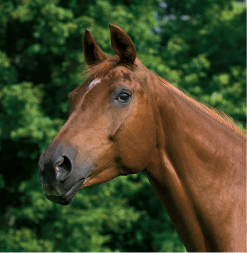
The noble Oldenburg, a historic horse with modern athletic talent. Daniel Johnson
American Registry
In the United States, the Oldenburg breeding philosophy of using the best possible mares and stallions has also become successful. In 1982, the Verband der Zuecnter des Oldenburger Pferdes e.V. (direct English translation is “Oldenburg Horse Breeders Society”) registered its first horses in North America. The Oldenburg Horse Breeders’ Society (OHBS), using the successful breeding philosophy and breeding goals of the Oldenburger Verband in Germany, have been a strong force in producing top riding horses for the North American market.
The Oldenburg breed is an important part of the sport horse breeding in the United States. Since the Oldenburg breeding philosophy has limited restrictions against good mares or stallions from other Oldenburg accepted breeds, the registry is in the comfortable position of picking the best from what’s available.
With the breeding of modern sport horses in North America and with the cross breeding with American Thoroughbreds, it became increasingly important to establish a uniform standard of evaluation and measurement to ensure the highest standards of breeding and consequently, of offspring. Based on this need, the OHBS provides uniform methods and means to evaluate, test, register and measure performance of sport horses participating in jumping, dressage, and eventing using the strict German standards as dictated by the Department of Agriculture. The approach, methods of evaluation, and overall objectives are developed from the many years of successful experiences in Europe.
The OHBS is supported 100 percent by the German Verband breeding director, Dr Wolfgang Schulze-Schleppinghof, as well as experienced breeders in North America. Its standards of measurement and registration are also regulated by the registry systems of the European horse-producing countries.
Only horses that are the sport horse type are eligible for entry into the OHBS. The principal goal of the registry is to assist in the development of top performance horses in North America using the established and effective criteria used in Europe. Horses are presented at specific sites and dates for inspection tests prior to approval of their registration.
Breeding of selected horses is aimed at producing a noble, large-framed and correct horse with dynamic, spacious, and elastic movements. It is well suited for dressage, hunter classes, show jumping, or eventing because of its temperament, character, and rideability.
Criteria for Scoring Mares
Mares need at least a four-generation pedigree of approved bloodlines. They must be three years old or older and may be eligible for one of four mare books: the Main Mare Book is for registered mares with a full pedigree and very good type; the Mare Book is for registered mares with perhaps one score that is lower or an incomplete pedigree; the Pre Mare Book I and Pre Mare Book II are for mares that are not eligible due to reasons of pedigree alone, but their quality must be of very good type. Mares are scored on: head, neck, saddle position, frame, forelegs, hindlegs, breed (sex type), walk in-hand, swing/elasticity, correctness of gaits, and overall impression and development.
Since 2008, the Registry offers mare performance tests for mares at a limited number of locations. All three-year-old or older mares that are registered with OHBS can participate in the Mare Performance Test, which is a one-day event. Basic gaits and free jumping are scored by three judges and rideability is evaluated by a test rider. Eligible mares are presented loose as well as under saddle.
Usually the test starts with the free jumping. Three judges evaluate the jumping ability, style, and technique. This is followed by the under saddle presentation of basic gaits. Mares should be able to lengthen strides in each gait and perform simple dressage movements, such as a three loop serpentine and free walk on a loose rein. The under saddle test is not a dressage test. However the mare should be able to walk, trot, and canter from 10 to 15 minutes. The mare should be presented well balanced and ridden forward in the three basic gaits. During the third and final part of the test, the mare is ridden by the registry’s test rider for approximately 5 to 10 minutes.
Criteria for Scoring Foals
Foals are judged on conformation, type, and correctness, as well as swing, elasticity, and athletic ability of movement. Overall impression and development is evaluated as related to age.
Eligibility and Selection of Breeding Stallions
Stallions are eligible for presentation at one of the OHBS stallion inspections if they have a regular registration of a registry that is approved by the German Oldenburg Verband with at least a four-generation pedigree. The selection of breeding stallions is undertaken through a series of steps based upon the age, performance, and breeding results of the horse.
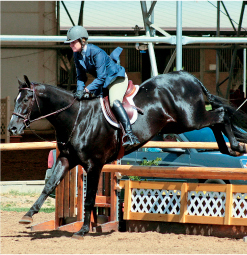
Oldenburg five-year-old stallion. Jane Sommers
The initial inspection (Koerung) of two-and-a-half- and three-year-old stallions is done in-hand, with free jumping and lunging, which began in 2008. The Koerung for older stallions also includes an inspection under saddle. The next step on the way to a lifetime breeding license is passing a thirty-day test for three- and four-year-olds, followed by qualification for the National Championship with a specific high score, or passing a seventy-days test, or alternatively competing at the highest level of sport, finishing within the first three placings. In Dressage, it is also required that the scores must be of a specific high level. These are the three alternative possibilities at the final selection step for breeding stallions, the most sure being the seventy-days test, at this time.
It must be pointed out that although the criteria is tough, this is the only way to ensure that the sport has an influx of high quality horses being produced.
Credit: Oldenburg Horse Breeders’ Society