

The barring on this Sulphur Springs stallion is unmistakable, including the rump and possible shadowing on the neck. Ken Benefril
SulphurSprings Horse Registry, Inc.
1245 South 6300 West
Cedar City, Utah 84720
www.sulphurspringshorseregistry.com
In the southwest corner of Utah lies a mountain range that is home to a special wild horse. Descended from ancient Iberian horses brought from Spain, they have remained in the Mountain Home Range area, where they managed to survive for two centuries. While the large herds of wild horses in the valleys and lower foothills were caught or killed off, the wild horses of the Mountain Home Range remained isolated and free. They apparently did not mix extensively with the domestic horses in the valleys and managed to escape all attempts to capture them. Mustangers were not able to catch them because of the rocky terrain and heavy stands of pinyon-juniper woodlands on the range.
The Bureau of Land Management (BLM) recognized the special characteristics of the wild horses and named them after the Sulphur Springs area from which they came, located in the Mountain Home Range, the north half of the Herd Management Area (HMA), where it regulates the herd.
Sulphurs are a small population of horses, the last remnant group of Southern California Spanish horses. Spanish horses were considered to be the finest horses in the world at the time of the conquest, and they left a living legacy in these tough, hardy, extremely beautiful horses of the Sulphur Spring herd.
As noted equine expert Dr. Gus Cothran states, “What I can tell you is that the Sulphur horses have the highest similarity to Spanish-type horses of any wild horse population in the U.S. that I have tested. There is more to learn, but they definitely have Spanish ancestry and possibly are primarily derived from Spanish horses.”
History
Archaeological evidence in the Iberian Peninsula of modern-day Spain and Portugal indicates that the origin of the Spanish horse dates back to at least 25,000 BC in the form of its primitive ancestor, the Sorraia breed. The oldest reference to the horse in Portugal is its portrayal in the cave paintings and engravings of Escorial, in the Alentejo area. These show the convex head and arched neck of the true Iberian horse, rather than the pony-like sketches of the Lascaux cave paintings in France.
The Sorraia remained isolated for several millennia in the southern part of Iberia in the Alentejo and Andalusian regions, where modern Portugal and Spain are now. Around 3000 BC, Iberian tribes from North Africa invaded the peninsula, which would later be named after them, and there was an influx of oriental horse breeds from Libya, Egypt, and Syria.
The warriors of the Iberian Peninsula were superior horsemen. In historic times, it is well documented that the Iberian cavalry had achieved fame as an effective and fearless foe, with much of its success due to its fine mounts. The cavalry’s warfare consisted of individual horse charges with fast starts, stops, and pirouettes, followed by retreats and renewed attacks. It was a form of riding made possible by the use of stirrups, curb bits, and incredibly agile horses. In further invasions, the Carthaginians and Romans recognized the superiority of the Iberian horses and horsemanship. This acknowledgment led the Romans to adopt the Iberian equestrian style of warfare and set up stud farms in the conquered Iberian territories. Most of the horses for these studs came from the present-day Andalusian region.
In 711 AD, Moorish Muslims invaded the Iberian Peninsula, at the time being ruled by Visigoths. In varying degrees, the Muslims occupied the peninsula until the end of the fifteenth century. These people brought some of their native Berber (or Barb) horses with them, which were interbred with the Iberian horses. The exchange of Barb and Iberian blood was mutually beneficial and produced many similarities between the two breeds.
During the almost eight hundred years for which Spain and Portugal were in constant war with the Moors, horses and horsemanship had become finely attuned to the war exercises. By the seventeenth century, the Iberian warhorse—or Jennet, as it was beginning to be called—had become important not only in the battlefield, but also in the riding academies founded in France, Germany, Italy, and Austria. The turbulent history of the Iberian Peninsula and the later explorations of the seagoing Spaniards had much to do with the distribution of the Spanish horse to all parts of the then-known world.
No breed has had more influence on the modern horse than the Iberian horse. Welsh Mountain Ponies, Lipizzaner, German, Danish, and Dutch Warmbloods, Irish Connemara Ponies, Hackney, Cleveland Bay, Kladruber, Peruvian Paso, and even the American Quarter Horse—all find their roots in the Iberian horse. Certainly, that Iberian blood lives on today in the Sulphurs.
Columbus brought Iberian-type horses on his voyages, and their hardiness helped them withstand the rigors and poor conditions of the journey better than others. Every ship arriving to the New World carried some of Spain’s choice breeding stock, including their superb Iberian warhorses. The conquistadors introduced and dispersed them throughout the New World. Herman Cortes proclaimed, “After God, we owed our victory to the horses.” Spanish horses were eventually used in almost every facet of progress in North America.
Trade caravans were established along the Old Spanish Trail that linked Los Angeles, California, to Santa Fe, New Mexico. From 1830 to 1855, these routes became the most notorious for horse thievery in the history of the Southwest. Virtually thousands of Spanish horses were driven across the Old Spanish Trail into Utah, where they escaped or were purchased or stolen during numerous raids by Ute Chief Walkara. Many of these horses escaped into the mountains of southwestern Utah, where they survived on their own.
BLM and the Sulphur Herd
Many of the wild horses in the western states were killed or captured before the U. S. Congress passed legislation in 1971 to protect, manage, and control wild horses and burros on public lands. The Wild Free-Roaming Horse and Burro Act declared these animals to be “living symbols of the historic and pioneer spirit of the West.” Congress further declared that “wild free-roaming horses and burros shall be protected from capture, branding, harassment, or death” and that they were “an integral part of the natural system of the public lands.” BLM regulations now required that wild horses and burros be considered along with other resource values within the area.
The BLM now maintains and manages wild horses and burros in HMAs. In the ten states in which the BLM manages horses, there are 270 herd areas. In Utah, about 3,600 horses are found among twenty-three different herds scattered across the state.
The Sulphur herd roams a vast, unpopulated region of alternating high desert basins and expansive mountain ranges. In some spots, the range rises to nearly ten thousand feet in elevation. Their home, the Needle Range, is a starkly beautiful mountain block that lies about forty-five miles west of Milford, Utah, along the Nevada state line.
Sulphur horses are rounded up every few years, depending on the number of horses on the HMA. The BLM likes to maintain a population of around two hundred to three hundred head. They turn back horses that exhibit Iberian traits and markings, attempting to preserve the bloodline.
None of the other herds are as distinctive as those in the Sulphur HMA. It is evident the Sulphurs have an influence from the ancient Iberian horse in their genetic makeup. This is expressed by the prominence of their primitive dun factor coloration, their ability to survive in a harsh environment, and their willingness to inhabit such a rocky, mountainous area as the Mountain Home Range.
Over the years, the Sulphur herds bred with escaped ranch livestock, but most still retain many of the Spanish Barb traits. Like the original Colonial Spanish horse of America, which had displayed some characteristics of the extinct wild Tarpan horse, the Sulphur horses exhibit many of those ancient traits. Dominant colors include dun, buckskin, and grullo. Physical characteristics include ears that curve in like a bird beak, dorsal stripe, bi-colored mane and tail, tiger-striped legs, and occasional chest barring. Sulphurs are deep-bodied, but narrow-chested, and have Iberian-type heads.
Remoteness and seclusion preserved this large herd of Spanish-type horses on the Mountain Home Range. There is historical importance for these Spanish horses, which have become increasingly rare, and they are subsequently in need of conservation. The horse currently in Spain, through centuries of divergent selection, is distinct from America’s Colonial Spanish horse, which is more old-type Iberian. The result is that these New World remnants are important to overall conservation since their varieties are closer in type to the historic horse of the Spanish Golden Age than are the current horses in the Iberia Peninsula.
“Colonial Spanish horses are of great historic importance in the New World,” states Dr. Phillip Sponenberg, DVM, PhD. “These horses are a direct remnant of the horses of the Golden Age of Spain, which type is now mostly or wholly extinct in Spain. The Colonial Spanish horses are therefore a treasure chest of genetic wealth from a time long gone. In addition, they are capable and durable mounts for a wide variety of equine pursuits, and their abilities [had] been vastly undervalued for most of the 1900s.”
The Portuguese are interested in doing more genetic testing, and local genetic testing is also in progress. Sulphurs are genetically almost identical to the Chilean Criollo, the oldest and purest of the Criollo breeds. Their highest individual similarity values also include the Paso Fino. Genetic studies done on the Sulphur mitochondrial DNA (mtDNA) pattern has shown that they may in fact be an ancestral horse breed.
Genetically, Sulphurs are completely different from any other herd in the United States. Their DNA blood markers show that not only do they cluster within the Iberian breeds, but also their mtDNA shows the Sulphur Iberian pattern is carried in every horse tested in the Sulphur herd. This is sufficient evidence of their Spanish roots. They all seem to carry that one pattern, with no other outside pattern having been found yet, which is extremely significant, once again pointing to their primitiveness. They may prove to be an intact herd of ancestral horses, a genetic type that represents the ancestral wild populations.
These horses may be the last true wild Spanish Mustangs left, and their future should be protected. If they are not protected, they could become extinct and the bloodline could be lost forever.
Registry
In 1998, the Sulphur Horse Registry (now the SulphurSprings Horse Registry) began to keep track of Sulphur horses in private hands. All Sulphur horses either captured in the Sulphur HMA or descended from those horses are eligible for registration regardless of sex, color, markings, or type. Adopted wild horses from the BLM must have documentation stating that they were from the Sulphur range. The registry works with the BLM at adoptions to support the horses and answer questions that potential owners may have. Roundups occur whenever herd numbers exceed the allotted herd size of two hundred to three hundred head on the HMA. The ones that exhibit Iberian traits, markings, and color are turned back to the range.
There also is an Appendix division for Sulphur crosses. Horses registered must have a direct connection with the Sulphur horses—either they were born on the HMA or they are the offspring of horses from there. As of 2008, there were 241 registered horses, but the registry is growing. People from all around the world are starting to recognize the breed.
Characteristics
While it is the SulphurSprings Horse Registry’s stance not to tell breeders how they should breed, there is a need to breed for the Colonial Spanish type found in the Sulphur herd, which is vitally important as there are differences in type.
These horses are of an ancient breed that does not conform to many of the standards used by registries preserving western horse breeds based on short sprinter-type conformation. Bred for beauty and endurance, they are a much more physically variable breed than the more homozygous modern western horse breeds. Yet the distinctive type of these horses sets them apart from other breeds and other origins.
Size and Weight: Generally, it is a mediumsized horse, although size is increasing with improved nutrition and some selection among breeders. The usual height is 14.2 to 15.2 hands. Some exceptional horses are up to 16 hands high or slightly more. Weight varies with height, but most are around 800 to 900 pounds.
Head: The head is of medium length, with a tendency to be long and fairly narrow with a convex profile. Forehead is broad, but face and muzzle are narrow from a frontal view.
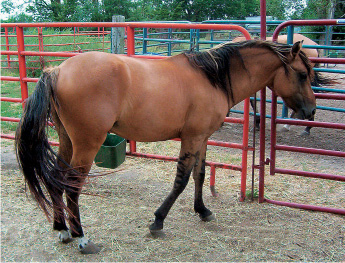
Young, nice-looking stallion with leg barring and bi-colored mane and tail. Some Sulphurs have long, dense manes and tails. Ken Benefril
Ears: Fairly long and of medium shape, the ears tend to hook toward each other at the tip.
Eyes: The eyes are elliptic and almond-shaped.
Muzzle: The muzzle is refined and small. The mouth is shallow and the lips firm. From the side, the upper lip is usually longer than the lower one, although the teeth meet evenly. Nostrils are usually small and crescent shaped when the horse is resting and can close tightly, but do flare with alertness or exertion. Many horses wear a 4-inch-wide bit, and some have “mustaches.” Many of the most primitively marked horses will show a lighter muzzle or “mealy nose.” Parrot mouth is rarely seen in the Sulphur, but since it may cause grazing problems and inefficient chewing and is highly inheritable, such animals should be seriously penalized at halter, especially if they are breeding stock.
An unusual note is that the Sulphur horse produces a strange, rattling type of snort when the animal confronts a questionable situation or object. This sound has been referred to as having “rollers in the nose,” and is unlike the snort of most other types of horses. This sound is part of the horse’s herd behavior and is used to alert other herd members to possible danger. Since this is a more natural breed than the “manmade” ones, its herd behaviors, such as this one, are often more pronounced.
Neck: The neck is comparatively long and flexible.
Mane and Tail: Both may be long and often quite dense; some have distinct bi-coloring. Tails typically are not raised when animated, as with Arabians, but are low set.
Shoulder: The long, well angulated shoulders have smooth muscling. The forward point of the shoulder is prominent. The horse is often heavier on the forequarters than the hindquarters.
Chest: The chest is narrow, but deep, with the front legs leaving the body fairly close together. There is a well-defined inverted “V” shape between the front legs. The chest is well muscled, but not bulgy, and never broad and flat. It is deeper from the side view and usually accounts for about half of the height of the horse from the ground to the withers.
Barrel: The barrel is slightly tapering with well-sprung ribs. When looking at the horse from the front, the barrel should be plainly visible on both sides. The heart girth is deep (as opposed to wide) with good heart and lung space in front of a full abdomen. The horse is short coupled, and the underline is longer than the topline. The flank space behind the ribs is short.
Legs: They are rather long with long cannon bones, but strong and of medium-dense bone. Smooth muscling carries down well into the knees and hocks. They are uniquely flexible with stretchy but strong tendons, which are well defined from the bone. The joints also allow great flexibility of motion and are rather large. The rear legs may be set slightly under the body, allowing the forward reach of the hind stride to land just beneath the rider’s stirrup. The hind legs are straight to slightly turned out. The pasterns are of medium length and sloping under a strong fetlock. The hind pasterns may be somewhat shorter and straighter than the front, but all are long and angular enough to give a springy, smooth ride. The angle should be approximately the same as the shoulder and hoof wall.
The chestnuts (especially rear ones) and ergots are small or missing altogether.
Hooves: They are small and upright rather than flat, but adequate for the horse’s size and body weight. Most wear 00 or 0 shoes. They are generally more egg-shaped than round with a distinct point at the toe, especially on the hind feet. The hooves are hard and dense, with many never requiring shoeing. Their circumference is smaller at the coronary band than at the ground surface. Hoof color may be black, gray, white, or striped (laminated).
Back: Prominent withers and a medium-long, straight back are present in this breed.
Hindquarters: The horse has sloping, rafter-shaped hips that do not drop steeply. The muscling is characteristically long and tapering, even in the heavily muscled individuals, rather than the short and bunchy muscling characteristic of bulldog-like stock and draft breeds.
Gait: Long, fluent strides mark the breed’s gait, which has considerable knee action due to the longer cannon bones. The horse flexes easily at the poll and has a natural ability to collect itself. Many of the horses have gaits other than the usual trot of most breeds, which can include a running walk, single foot, amble, pace, and the paso gaits of other more southerly Spanish strains, such as the Peruvian Paso and Paso Fino. It is important to note that these gaits refer to the pattern of the footfall and not to any sideward, or lateral, tendency of the path of the foot. While both are typical of some of the Paso breeds, only the pattern of footfalls is the actual gait.
Color and Coat Type: Dorsal stripe, tiger-striped legs, and occasional chest barring are desirable markings for the horse to have. There are minimal variations for color, and this restricted variation should be maintained. Dominant colors include dun, buckskin, and grullo. Other colors found throughout the region include bay, black, sorrel, palomino, and various roans, including blue, red, strawberry, etc. Occasionally some can be found with curly coats, manes, and tails.
Temperament: Mellow and dependable, they settle in nicely after adoption once they learn to trust their new owners. Trust is everything to them. Once that is established, they give their all.
They are quite hardy. Heat and humidity do not seem to bother them too much. They are easy keepers, for the most part. Their hooves are hard and do not have to be shod for normal riding.
Says Naylene Nield, president of the Sulphur Spring Horse Registry, “I find them to be very smart and easy to teach, as they are very eager to learn and willing to please. They are very mellow and affectionate toward people as well as each other. They are constantly grooming each other and playing together to keep themselves occupied in between feedings. You would think they were all very young when you watch them as they enjoy teasing and romping and jumping around [like] young foals.”

Sulphurs have longer cannon bones; withers are typically prominent. Ken Benefril
Nield observes that Suphurs, as well as most mustangs, are a hearty animal. They have a wonderfully pleasant disposition and temperament and are generally loving and passionate toward their owners. Once someone has earned their trust, they are loyal and affectionate, usually much more so than other horses. They are surefooted and strong, and they love riding in the mountains and on trails. As such, they would make great prospects for endurance horses.
“I have watched other owners with their Sulphur Springs horses in various shows and competitions and I am not surprised when I see them take home first- and second-place ribbons regularly,” Nield says. “I have seen these horses perform very well in just about every area of show and competition.” The accomplishments they have achieved are impressive. They also make good trail-riding mounts due to their surefootedness. “They constantly remind me as to the reasons that I chose to have these wonderful horses as my loyal companions and friends.” For an all-around good horse, they are the best.
Ken Benefiel, vice president of the registry, says, “I have been astounded by how smart they are and how fast they learn. They are not aggressive towards people or other horses, for the most part. . . . I learn something new from them every day . . . they like as much attention as I can give. We show one of our mares at the Kansas Equifest every year, and people really make a fuss over her and cannot believe that she is a wild mustang. [Sulphurs] can hold up to weather, disease, terrain, and they are capable of traveling long distances with little effect on their well being.”
Suphur Spring horses are a great genetic resource from a time long ago and need to be preserved for the future. Once they are gone, there is no replacement.
Credit: SulphurSprings Horse Registry; Ron Roubidoux, Mantua, Utah; Vickie Ives, Karma Farms, Marshall, Texas; Dr. Gus Cothran; Dr. D. Phillip Sponenberg; and Ken Benefiel, Burrton, Kansas