

A beautiful Arabian stallion frolicking in the snow. Pru Critchley
Arabian Horse Association
10805 E. Bethany Drive
Aurora, Colorado 80014
www.arabianhorses.org
Romance, antiquity, and tradition are integral elements of the Arabian breed’s legacy. The Arabian possesses unique qualities that distinguish it from other breeds of horses—their incredible beauty, endurance, and intense affection and loyalty to their owners. Historical figures, such as Napoleon and George Washington, rode Arabians.
The breed is distinctive with their dished head profile; large, lustrous, wide-set eyes on a broad forehead; small, curved ears; and large, efficient nostrils. Known for their deep chest, strong joints, and powerful lungs, Arabians are all-around athletes who can do many things well and love challenges.
History
Authorities are at odds about where the Arabian horse originated. There are certain theories that propose the ancestral Arabian was a wild horse in northern Syria or southern Turkey.
About 3,500 years ago, however, in an area including the valley of the Nile and beyond, the forerunner of the Arabian breed was first noticed when it attained a role alongside kings. Its image appeared on seal rings, stone pillars, and various monuments with regularity after the sixteenth century BC. This ancient horse was observed for many centuries before the term “Arab” was ever used for a race of people or species of horse.
The origin of the word “Arab” is still obscure. Arab is a Semitic word meaning “desert,” or the inhabitant thereof, with no reference to nationality. In the Koran, “a’rab” is used for Bedouins (nomadic desert dwellers). Throughout the centuries, the Bedouin tribes that roamed the northern desert in what is now Syria became the most esteemed horse breeders. Their horses reached a zenith of fame as the horse of the “Arabas.” The harsh desert environment ensured that only the strongest and keenest horses survived, which passed down many of their resilient physical characteristics that distinguish Arabians to this day.
The Bedouin people bred their horses as war mounts capable of quick forays into enemy camps. The severe desert climate required these nomads to share their food, water, and sometimes even their tents with their horses. Over the millennia, Arabian horses developed a close affinity with humans, as well as a high level of intelligence.
Bedouins zealously maintained the purity of the breed. Even today, the purebred Arabian is virtually the same as the one ridden in ancient Arabia. Due in part to the religious significance attached to this desert horse, as well as its contribution toward the wealth and security of the tribe, the breed flourished in near isolation from other breeds. Traditions of breeding for purity were established so that any mixture of foreign blood from the mountains or the cities surrounding the desert was strictly forbidden. While other desert type breeds developed in North Africa and the periphery of the Great Desert, they were definitely not of the same blood as the Arabian breed and were disdained by the proud Bedouins.
Desert Strains
Arabian mares evolved as the most treasured possession to the Bedouins, who thought no greater gift could be given than an Arabian mare. The value placed upon mares by the Bedouins inevitably led to the practice of tracing of any family of the Arabian horse through the dam. The only requirement of the sire was that he had to be pure. If a dam was a “celebrated” mare of a great mare family, so much the better. Mare families or strains were often named according to the sheik or tribe that bred them.
Bedouins valued purity in a strain of horses above all else, and many tribes owned only one main strain of horse. The five basic families of the breed include Kehilan, Seglawi, Abeyan, Hamdani, and Hadban. Other less choice strains include Managhi (also spelled Muniqi), Jilfan, Shuwayman, and Dahman. Sub-strains developed within each main strain and were named after a celebrated mare or sheik that formed a substantial branch.
A great story of courage, endurance, or speed always accompanied the recitation of the genealogy of the sub-strain, such as the great Kehilet al Krush, the Kehilet Jellabiyat and the Seglawi of Ibn Jedran. Each of these mares carried with it stories of great battles and intrigue. Their daughters were sought after by the most powerful kings, but often remained unattainable. Daughters and granddaughters of these fabled mares changed hands through theft, bribery, and deceit. If any of their descendants were sold, the prices were legendary.
Each strain, when bred pure, developed characteristics that can be recognized and identified. The Kehilan (also spelled Kuhailan) strain is noted for depth of chest and masculine power and size. The average pure Kehilan can stand up to 15 hands. Its head is short with a broad forehead and great width in the jowls. Most common colors are gray and chestnut.
The Seglawi (also spelled Saqlawi) is known for refinement and almost feminine elegance. This strain is more likely to be fast rather than having great endurance. Seglawi horses display fine bone and longer faces and necks than the Kehilan. The average height is 14.2 hands, and the most common color is bay.
The Abeyan (also spelled Abayyan) strain is very similar to the Seglawi. They tend to be refined, and pure Abeyans often have a longer back than that of a typical Arabian. They are small horses, seldom above 14.2 hands, and commonly gray, but carry more white markings than other strains.
Hamdani horses are often considered plain with an athletic, if somewhat masculine, large-boned build. Their heads are more often straight in profile, lacking an extreme jibbah (bulging forehead). The Hamdani is one of the largest, standing as tall as 15.2 hands. Common colors are gray and bay.
The Hadban strain is a smaller version of the Hamdani, sharing several traits, including a muscular, big-boned build. They are also known for possessing an extremely gentle nature. The average height of a Hadban is 14.3 hands, and the primary color is brown or bay with few, if any, white markings.
Bred in the desert, the Bedouins’ remarkable horses evolved like finely tempered steel into the swift, elegant, graceful, and magnificent warhorse with which the Arabs shook the civilized world. Over the centuries, Bedouins zealously maintained the purity of the breed. Due to limited resources, their breeding practices were extremely selective, which eventually established the Arabian as a prized possession throughout the world.
Early Breed Expansion
Europeans had developed bigger horses through the Dark Ages to carry a knight in armor, and their lighter horses were from the pony breeds. Thus, they had nothing with which to compare the smaller, faster horses of the invading Turks. Though very few Arabians accompanied these invaders, an interest in “eastern” horses grew in Europe. To own such a horse would not only allow for the improvement of local stock, but would also endow the fortunate owner with incredible prestige. Such a horse residing in the stable would compare in value to owning a great artistic painting. Europeans of means, primarily aristocracy, went to great lengths to acquire the fabled eastern horses.
Eventually, Europeans began looking to the people of the East for Arabian stock. Soon, European horses had an infusion of Arabian blood, especially as a result of the Christian Crusaders returning from the East between 1099 AD and 1249 AD. With the invention of firearms, heavily armored knights lost their importance, and during the sixteenth century, the handy, light, and speedy horses became more in demand.
As the world slowly shrank due to increasing global travel, the Turkish rulers of the Ottoman Empire began to send gifts of Arabian horses to European heads of state. Thus a revolution in horse breeding occurred when three Arabian stallions were imported to England: the Godolphin Arabian (sometimes called “Barb”) imported in 1730, the Byerly Turk (1683), and the Darley Arabian (1703). These three eastern stallions formed the foundation upon which a new breed, the Thoroughbred, was to be built. Today, 93 percent of all modern Thoroughbreds can be traced to these three sires. By direct infusion and through the blood of the Thoroughbred, the Arabian breed has contributed in some degree to all light horse breeds.
The Arabian horse also made inroads into other parts of Europe and even farther east. In France, the Arabian helped to make the famous Percheron and the Limousin (today known as the French Anglo-Arab). Two Arabians were used as foundation sires of the Lipizzaner. In East Prussia, the Arabian was used to create the Trakehner, and in Russia, it contributed extensively to the development of many breeds, including the Orlov Trotter.
In the 1800s, travelers of the Victorian era became enamored with the horse of the desert, and significant Arabian stud farms were founded throughout Europe. The royal families of Poland established notable Arabian studs, as did the kings of Germany and other European nations.
As a result of Lady Anne and Wilfred Blunt’s historical sojourns to obtain Egyptian and desert Arabian stock, the world-famous Crabbet Arabian Stud was founded in England. This stud farm eventually provided foundation horses for many countries, including Russia, Poland, Australia, Egypt, and countries across North and South America.
In the United States
The United States was built by utilizing horsepower, and the colonists were quick to realize the value of Arabians. Nathan Harrison of Virginia imported the first Arabian stallion in 1725. This horse reportedly sired three hundred foals from grade mares.
In 1877, President Ulysses S. Grant visited Abdul Hamid II, His Imperial Majesty the Sultan of the Ottoman Empire. There, he was presented with two stallions from the sultan’s stable, Leopard and Linden Tree. Leopard was later given to Randolph Huntington, who subsequently imported two mares and two stallions in 1888 from England. This program, limited as it was, is considered as the first purebred Arabian breeding program in the United States.

The chiseled head of the Arabian: dished profile, large eyes, and teacup muzzle. Bridget Lockridge
The Chicago World’s Fair (also known as the World’s Columbian Exposition) held in 1893 drew widespread public attention and had an important influence on the Arabian horse’s foundations in America. While every country in the world was invited to participate, Turkey chose to bring forty-five Arabian horses for a “wild eastern” exhibition. Among the imported Arabians were the mare Nejdme and the stallion Obeyran, which became foundation horses number one and number two in the Arabian Stud Book of America. Several years later, two mares and one stallion were also registered. Many breeding farms today have horses whose pedigrees can be traced to these nineteenth century Arabians.
One of the most significant imports occurred in 1906, when Homer Davenport received permission from the sultan of Turkey to export Arabian horses. Davenport, with the backing of then President Theodore Roosevelt, imported twenty-seven horses that became the foundation of the famous Davenport Arabians.
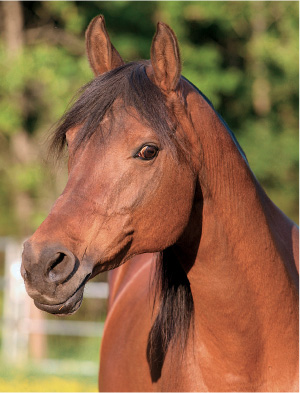
These wide-set eyes reflect the Arabian’s intelligence and eloquence. Pru Critchley
In 1908, the Arabian Horse Club of America (now known as the Arabian Horse Registry of America) was formed and the first studbook was published. Recognition of the Arabian Stud Book by the U.S. Department of Agriculture established the organization as a national registry and the only one for the purebred Arabian breed. Seventy-one purebred Arabians were registered at that point.
Today, the Arabian horse exists in far greater numbers outside of its land of origin than it ever did in the Great Desert. There can be no dispute, however, that the Arabian horse has proven throughout recorded history to be an original breed, of which it remains to this very day. There are now approximately 637,000 purebred Arabians, 340,000 Half Arabians, and 10,000 Anglo-Arabians registered with the Arabian Horse Association.
Egyptian, Polish, and Russian Lines
All Arabians originally came from the Arabian Peninsula, but different countries imported them and set up their own breeding programs. Egyptian, Polish, and Russian Arabians are all examples of different strains of the purebred Arabian that were developed from these early breeding programs.
The Egyptian program focused on hardiness and Arabian type, preserving many of the older desert strains. Many of the homozygous black Arabians, as well as the flaxen-maned chestnut ones, are Egyptian. The term “straight Egyptian” refers to a purebred Arabian’s complete sire line, including its sire or grandsires, that goes back to pure Egyptian breeding.
Polish and Russian Arabian breeding programs were very similar, as their horses were traded, sold, or stolen from each other during wars and invasions. These two programs focused on traits such as stamina and speed; many racing Arabians are products of Russian and Polish breeding.
All these programs have produced National Champion halter and performance horses. There are many breeders in the United States who follow one of these programs and are often referred to as preservationist breeders. Still other breeders concentrate on performance or halter characteristics rather than Arabian strains.
Crabbet Arabians
A Crabbet Arabian is an Arabian whose bloodlines trace back to horses from the once famous Crabbet Park Stud (breeding farm) in England, or the Sheykh Obeyd Stud in Egypt (owned by the same family). These studs were owned by Lady Anne Blunt and her husband, Wilfred Blunt, in the latter half of the nineteenth century. Their purebred Arabian horses were purchased either in Egypt or imported from the Arabian Peninsula.
Crabbet Arabians became world renowned when the Blunts sold their best quality stallions and mares to England and the United States. Most horses that are Crabbet in breeding have lines to the stallions Mesaoud or Raffles. Arabians that trace their heritage in all lines back to horses used in this breeding program are said to be 100 percent Crabbet.
Another term associated with Crabbet Arabians is “CMK” Arabian. CMK breeding stands for Crabbet Maynesboro Kellogg, the names of three Arabian stud farms that used Arabians from desert sources and Crabbet Park in England. All Crabbet Arabians are CMK, but not all CMK Arabians are 100 percent Crabbet.
Arabian Excellence
Given that the Arabian is the original source of quality and speed and remains foremost in the field of endurance and soundness, it has contributed either directly or indirectly to the formation of virtually all the modern breeds of horses. As the oldest of all the light breeds and the foundation stock of most, it is unique in that it does not exist as a result of selective breeding, like other modern light breeds whose breeders found it necessary to establish a registry prior to development. The Arabian is a breed that has been recognized for thousands of years and has been maintained and cherished in its purity as much as is humanly possible. Its influence is commanding to a remarkable degree and invariably dominates all the breeds to which it is introduced, as it contributes superior qualities.
Since the Arabian has been bred and reared in close contact with man from the earliest records and has existed in mutual interdependence, it developed an unequaled ability to bond with humans. It is gentle, affectionate, and familiar, almost to the point of being troublesome. Foals, for example, have no fear of man and are usually indifferent to sudden noises. The Arabian gentleness and tractability, while originally the effect of education, are now inherited, as foals bred in a foreign environment are demonstrating these traits.
Today’s purebred Arabian is virtually the same as that ridden in ancient Arabia. Its ancient traits enable it to excel at a variety of activities, displaying athletic talents in disciplines from English to western riding.
Its stamina is legendary as an endurance horse. It is considered the best horse for covering long distances that would exhaust other breeds, and it still has energy for more. Consistently winning competitive trail and endurance rides, the top prizes at endurance events almost always go to riders of Arabians. As an endurance horse, the Arabian has no equal and is the undisputed champion.
The loyal, willing nature of the Arabian makes it the perfect family horse for recreational riding. Its easygoing temperament and smooth gaits are terrific for beginning riders, and its affectionate personality also makes it a great horse for children. Growing up around Arabian horses is an experience that lasts a lifetime.
In the show ring, the Arabian is exceptional, well known for balance and agility. Combined with high intelligence and skillful footwork, it is more than capable in driving and reining events. The Arabian competes in more than four hundred all-Arabian shows, as well as in numerous open shows around the United States and Canada. For speed, agility, and gracefulness, there is nothing like an Arabian.
As the original racehorse, the Arabian is becoming increasingly more popular competing at racetracks throughout the country. Arabians race distances similar to Thoroughbreds, and more than seven hundred all-Arabian races are held throughout the United States annually.
Today’s Arabian prices are comparable with other popular breeds; excellent Arabian horses are now accessible to a broad base of horse enthusiasts. With more living Arabian horses in the United States than in all the other countries in the world combined, America has some of the best horses and breeding farms from which to choose.
Standards
The Arabian is a purebred based on pedigree. Horses that only look like Arabians cannot be introduced into the breed. All registered Arabians are validated via DNA to both parents that must be registered as purebred Arabians. A horse conceived and born in the United States or Mexico and whose parents are an eligible stallion and an eligible mare can be registered with the Arabian Horse Association.
Overall appearance: The Arabian can most readily be identified by its dished face, long arching neck, and high tail carriage. When the horse is aroused, it is extremely attentive, and its entire appearance exudes energy, intelligence, courage, and nobility.
Head: The Arabian is especially noted for its delicate head, which has a triangular shape that diminishes rapidly to the small, fine muzzle. Its skull is characterized by its relative shortness, slenderness of the lower jaw, and a larger size brain case.
It features small, tipped-in ears, a tiny teacup muzzle, fine, thin lips, and large, expressive, dark eyes. The nostrils are long, thin, and delicately curled, running upward and outward; their large size assures easy breathing in a hot, dry climate. The eyes are set far apart, nearly at the middle of the head, and are large and lustrous. Long eyelashes were designed to protect the eyes from sand.
The head is frequently enhanced by a slight protrusion over the forehead that extends to just below the eyes. This protrusion, called the jibbah, contributes to the Arabian’s distinct appearance. The cheek bones are spread wide apart at the throat, enabling the muzzle to be drawn in without compressing the windpipe and permitting the horse to breathe easily when running.
This eloquent, finely chiseled Arabian head has been represented artistically for literally thousands of years. Defined, described, and judged for centuries, the shape and beauty of the Arabian head remains its most unique and sought after quality.
Body: The Arabian’s long, arched neck is set high and runs well back into the withers. The withers should be prominent and set well back over a long, sloping shoulder, equal in height with the croup, which has a high tail set.
Many of the Arabian’s distinct characteristics proclaim its desert heritage, such as the deep chest, strong joints, and good lungs, which guaranteed its ability to carry riders across large stretches of desert.
In general, Arabians have a short, straight back, a deep chest, well-sprung ribs, deep girth and strong legs of thick density. They have perfect balance and symmetry.
The skeleton is characterized by a relative shortness of skull, a slenderness of the lower jaw and a larger size of brain case. It has fewer vertebrae in the back (usually twenty-three vertebrae as compared to twenty-four in most other equine breeds), as well as in the tail. One of the most distinguishing Arabian characteristics is its naturally high tail carriage sustained by the fewer vertebrae. The pelvic bone has a more horizontal position.
Movement: The Arabian is known for a well coordinated, easy stride with stylish, natural, balanced action. Every time an Arabian moves in its famous floating trot, it announces its proud, graceful nature to the world.
Height: The Arabian horse generally measures 14.1 to 15.1 hands at the withers, although some are above or below this height.

Arched neck, high tail carriage, and alert exuberance are Arabian traits. Sharon Morris/Shutterstock
Color: Arabians are bay, gray, chestnut, and black, with an occasional roan. Common markings are stars, strips, snips, or blaze faces, and white feet or white stockings. There are no restrictions about the amount of white on a purebred Arabian.
Today’s Arabians are also recognized for their extraordinary intelligence, stamina, and trainability. Although it is the most beautiful of all riding breeds, the Arabian is not just a pretty horse; it is an all-around family horse, competitive sport horse, and work horse. Trail riding, endurance riding, showing, cutting, reining, dressage, jumping, racing, and even ranch work—if a rider is up to it, so is the Arabian.
Credit: Arabian Horse Association