
Kentucky Mountain Saddle Horse Association
P.O. Box 1405, 102 Finley Drive, Suite 108
Georgetown, Kentucky 40324
www.kmsha.com
For over two hundred years, the Kentucky Mountain Saddle Horse has lived and flourished in the mountains and valleys of eastern Kentucky. Originally bred for a variety of uses on the family farm, the Kentucky Mountain Saddle Horse quickly became known for more than its versatility and heartiness. Its intelligence, willingness, and, perhaps most notably its smooth, natural four-beat gait drew attention and much appreciation.
How the Kentucky Mountain Saddle Horse got its start is still a great mystery, but it is well known that for centuries, the mountain people of Kentucky bred horses for a smooth, even gait, good temperament, and self sufficiency. These horses were never deemed special by their original owners, who bred them for practical reasons only. Life in the mountains was hard and families were large. Saddle horses were used for a variety of tasks and given little attention for their care. They had to adapt to the environment and be easy keepers. Only the strongest and fittest survived, and this served to make the breed healthy, strong, and highly intelligent.
The breed’s other distinguishing feature—its natural four-beat gait—was an easy riding, gentle movement that could be maintained over rough terrain. It had the same footfall pattern as a walk, only quicker, called an amble or rack. The result was that the rider could sit almost motionless while carried at speeds almost as fast as the canter of other horses.
Characteristics
The Kentucky Mountain Saddle Horse is popular as the breed for all reasons. Along with its willing nature and exceptional beauty, the Kentucky Mountain Saddle Horse is admired for its comfortable ride produced by its natural four-beat gait. It frequently sports a dark coat with lighter mane and tail, which is proving to be desirable.
There are no limits with Kentucky Mountain Saddle Horses. They are quiet, forgiving, people-oriented horses. Their willingness and gentleness make them easy to work with and teach almost anything. They love to be with people and constantly want to be part of everything that is happening. Stallions as well as mares will walk up to people in a large pasture, seeking affection and attention.
Many of the soft-gaited horse breeds have so many gaits that a novice can become confused. With Kentucky Mountain Saddle Horses, there are only three gaits to enjoy: the trail walk, the canter, and the saddle gait (known also as a single-foot or amble). These demonstrate several speeds, going from very slow to extremely fast. Some horses are known to rack at over 18 miles per hour. Once the feeling of comfort and exhilaration is achieved, there is less danger that the rider will allow the horse to slip into the bad habit of a pace or trot. Best of all, after a thirty-mile ride, a rider can still walk!
Kentucky Mountain Saddle Horses are impressing crowds at horse events from one end of the United States to the other. This is the experience breeders Mike and Toni Rohm had when they exhibited their stallion. “Folks were just amazed at how calm and quiet he was,” says Toni. “I understand that. I’ve been around horses for a long time, but I’d never seen anything like the Mountain Horses before. It’s their disposition that convinced Mike and I to get involved with this wonderful breed. We love the smooth gait and their beauty, but it’s the disposition that is really amazing. It’s impossible not to love this breed. These guys are just too good to keep a secret.”
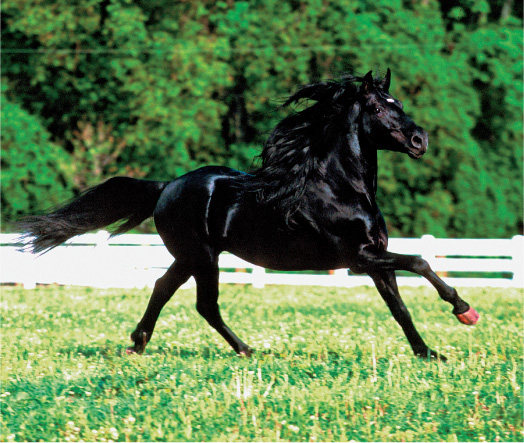
The Kentucky Mountain Saddle Horse is athletic, compact, and close coupled.
Whether trail or endurance riding, showing, working cattle, or pulling a cart, the Kentucky Mountain Saddle Horse offers its rider intelligence, willingness, versatility, and a smooth natural gait. It’s truly a horse for “any reason in any season.”
Registry
Although Kentucky’s easy-riding saddle horse was well known among the mountain residents of eastern Kentucky, it remained an obscure breed beyond that region until the late 1980s. It was then when a Kentucky resident, Robert Robinson Jr., envisioned broader recognition for this unique horse. Robinson was raised with mountain horses and found them to be a most unusual breed. “I’ve been with these horses all my life. They were primarily a workhorse. My father and I worked and used them for all purposes. We pleasure rode them [as well as] worked them; back then we rode a lot.”
Robinson had participated in the formation of the other mountain horse registries. There was, however, an area of disagreement that he wished to address: “In the other registries, the smallest horse they would register was 14.2 hands. But we had many good four-beat gaited horses that came in under that size.”
Many of the shorter horses seemed to be the most talented in gaiting, such as the horse named Kentucky Goldrush. He stood 14 hands tall and weighed about 1,100 pounds. His neck was set high on his shoulder and his terrific animation and brio (stylish boldness) gave the appearance of a very large horse. A 5-foot 10-inch rider mounted on him still looked good and fit him nicely.
Robinson’s decision to embark on the enormous responsibility of forming a registry was sealed when he bred a horse named General Jackson. This gorgeous, strong gaited, flashy stallion stood a sturdy 13 hands tall. Robinson was quick to point out that Jackson was a short horse, not a small horse. This was a horse solid in the tradition of the Narragansett Pacer breed.
In 1989 Robinson founded a registry, the Kentucky Mountain Saddle Horse Association (KMSHA). Careful selection and breeding by the members brought about a rapid base growth, which created a gene pool large enough to accommodate the original breed characteristics without compromising them. Robinson said, “We tried to breed for gentle horses, for good temperament, and a good smooth four-beat gait. If you don’t register a good product you’re defeating your purpose. We wanted the horse to be the winner.”
After Robinson and his volunteers registered the local native mountain horses as foundation stock, the registry was then opened to receive other horses possessing the same traits. By grouping horses with like characteristics, a gene pool formed from which owners of mares and stallions could review and select compatible breed lines for their horses.
Through this selective breeding of foundation horses with similar approved stock, the smooth gait and gentle disposition was ensured among the horses of the association for generations to come. This approach to breed development has been followed by other important registries. Some of those registries kept their books open (to outside breeds) for more than thirty years to complement the genetics and growth of each breed. Welcoming outside blood that is consistent with the registry usually limits the chance of abnormalities due to lack of variety in breeding options.
Since the KMSHA registry began, the reputation and demand for Kentucky’s pleasure riding horses has extended well beyond its mountain area. Today there are over twenty-one thousand registered Kentucky Mountain Saddle Horses throughout the United States, Canada, Germany, France, Switzerland, and Holland. The Kentucky Mountain Saddle Horse is enjoying success as the largest and fastest growing mountain horse breed. Several other breeds of horses also make their claim of establishing their foundation by breeding to the Kentucky Mountain Saddle Horse.
Registration
The KMSHA has now closed its registration books and is working with the University of Kentucky to identify new genetic markers that will further individualize the breed.
All foals are issued temporary papers. Once a horse is under saddle and before it is either bred or reaches the age of four, it must be designated as Certified to Breed (mares or stallions). Before a horse can be certified, its DNA or blood analysis must be on file with the University of Kentucky to establish identity. Temporary registration papers expire on all horses that are not certified by their fourth birth date. Upon satisfactory examination of a horse for conformation and certification of gait under saddle by two examiners or a video of the horse moving, the horse is entered into the permanent registry books. As part of the certification process, a horse must display the following characteristics:
1. Show a gentle, alert, and willing attitude; have a calm, kind demeanor: The evidence of a gentle temperament and willing disposition must be observed by two examiners or shown on a videotape. Any horse that displays temperament that is unruly or unmanageable will not be eligible for certification.
2. Give evidence of a natural, smooth, even, four-beat gait under saddle: The saddle gait is recognized and defined as innate, with four distinct hoof beats. Head bobbing or nodding are not desirable, nor is a stride of more than 24 inches. An 18- to 24-inch stride is acceptable. The horse can lift its front end up and have its back end follow in very quick timing or cadence without jogging its rider in the seat, and the rider experiences little to no vertical motion while in the saddle.
3. Qualify within two class categories: (a) Class A is for horses standing at 14 hands or above at maturity; and (b) Class B is for horses standing from 11 hands to 13.3 hands at maturity. Measurements are to be taken when the head and neck are raised at the throatlatch, pushing toward the back of the body to produce a tuck in the neck, and should not be taken in a relaxed position. No horse can be registered if it stands less than 11 hands (44 inches) at maturity. There is no upper height limit. Most registered horses average between 13 and 16 hands.
4. Show an above average degree of beauty and refinement: The horse must be of medium bone and substance, reflecting its heritage as an all-around utility breed. It should present an appearance of athleticism and the ability to perform useful work, having a compact, well muscled, and close coupled frame. Principles of sound conformation relevant to all breeds are applicable; the horse should be well proportioned in the body, neck, hindquarters, and legs.
Registry Limitations
The KMSHA breed registry foundation books are closed for mares and stallions (with some exceptions that include other gaited breed registries). There are, however, still several horses known to exist in the hills of the Appalachians with the exact characteristics that meet the registry requirements and appear from time to time with their owner’s intention of getting them registered. Therefore, the KMSHA mare books open for short periods of time to evaluate horses left out of the registry that could enhance the breed “type” for continued genetic improvement. The overall breed numbers are still limited and must be managed wisely in order to preserve the breed’s innate qualities.
The Mare Appendix of the KMSHA registry is still open, and consideration is given to outside mares for registry that meet the standard of the breed. These mares are not restricted from showing, but are required to have all male offspring gelded, while female offspring derived from a registered KMSHA stallion may receive full registration.
Foals can be registered with the KMSHA provided that both parents are KMSHA horses. A filly can be registered as an Appendix Mare if she has one parent that is registered KMSHA.
The KMSHA gelding books are still open for registration of geldings that meet the standards of the breed.
Standards
The Kentucky Mountain Saddle Horse is an all-around farm horse, but its primary purpose is for riding. It is valued for its easygoing temperament, intelligence, versatility, and willingness, but especially for its smooth, natural gait.
The head is attractive, cob-sized, not too long or wide in appearance, and proportional, with a broad flat forehead, well defined jaw, and a profile that is neither severely Roman nor dished. Looking straight at the front of the head, the distance from the middle point between the eyes to the middle point between the nostrils is of medium length. The facial composure overall is pleasing to the observer.
Neck is of medium length and thickness, with the topline of the neck longer than the underline, and meets the back behind the shoulder. The neck should show an ability to flex at the poll and not be tied into the body too low in the chest. Flat, little, or no wither is desirable.
Planes of the legs, when viewed from the front and the rear, should be straight and aligned. Severe cases of sickle hocks, cow hocks, hooves turned in or out, or any other variance from correct structure of the major joints are not desirable.
When viewed from the side, horses should have near equal proportions of the forequarter, body, and hindquarter with proper angulations of the shoulder and humerus. An upright humerus and front legs that are not set too far underneath the body allow for good stride and reach. The horse should have a strong topline, short in the coupling, with a rounded croup. The tailset should be natural.
The horse can be of any solid body color, with white markings accepted only on the face (no bald faces), legs (no excessive amount of white above the knees or hocks), and the area on the belly that is behind the breast bone and under the ends of the ribcage, which should not exceed 36 square inches, or 6 by 6 inches (no bigger than an average sized hand). Otherwise no spots are allowed. Manes and tails can be white. Colors include buckskin, bay, roan, or any combination of solid color with flaxen mane and tail.
Any horse that does not meet the limited amount of white requirement with the KMSHA, but carries significant white markings known as tobiano, overo, and sabino, may be registered with the Spotted Mountain Horse Association (SMHA), a subsidiary of the KMSHA. Although crossbreeding to a Kentucky Mountain Saddle Horse is permissible, the resulting foal is registered with the SMHA only. A foal of either sex with a solid body color and foaled by one or both parents that are Spotted Mountain Horses must be registered with the SMHA. (There is no foolproof genetic test that can determine if a solid colored offspring will throw spots or not.) A solid colored gelding with either one or both parents that are Spotted Mountain Saddle Horses may be registered with either SMHA or KMSHA, but not both.
Credit: Kentucky Mountain Saddle Horse Association