
Paso Fino Horse Association, Inc.
101 North Collins
Plant City, Florida 33563
www.pfha.org
The Paso Fino is a graceful, agile, and supple athlete, with an incredibly smooth gait. It has captured the hearts of horse lovers everywhere with its proud carriage and elegance that reflects its Spanish heritage. It is the oldest true native breed of horse in the Western Hemisphere, having ties to a glorious past. Spanish conquistadors proudly rode this magnificent horse when they set out to conquer the New World.
Its gait is one of its most outstanding attributes. Paso Fino means “fine step.” The Paso Fino’s inherently smooth gait utilizes all four legs with precision and harmony. It is born with this gait that is unique to the breed and normally exhibits it from birth. After newborn Paso Fino foals struggle to their feet, they take their first faltering steps in gait.
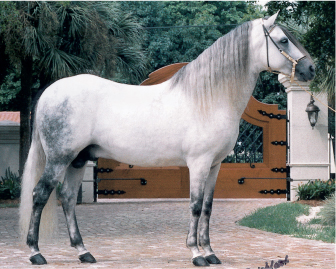
A beautiful gray stallion depicts the perfect conformation for the Paso Fino. Paso Fino Horse Association
The Paso’s gait allows riders to enjoy long hours in the saddle without tiring, thus opening up a whole new world for horse lovers. When it comes to comfort, performance, and elegance, the Paso Fino horse is the natural choice. It does it all with a ride that provides unparalleled comfort. With its lively but controlled spirit, natural gait, presence, and responsive attitude, the Paso Fino is indeed a rare and treasured equine partner.
Some people have the mistaken notion that Paso Finos are like little wind-up toys that just go round and round a show arena. That myth, however, is being dispelled every day as more discriminating equestrians get on a Paso Fino and discover that it has something special to offer—its remarkably smooth ride and versatility. It is growing in popularity, and the ancient history of the Paso Fino is fast-becoming the future for show and pleasure horses in the United States and beyond.
History
Over five hundred years ago, on his second voyage from Spain, Christopher Columbus brought a select group of mares and stallions from the provinces of Andalusia and Cordela to Santa Domingo. These horses were a mixture of Spanish Barb from North Africa, Andalusian, and the smooth gaited Spanish Jennet (which is now extinct as a breed). Spanish conquistadors continued the importation of these breeds, which served as the foundation stock for remount stations for them.
With additional Spanish settlers bringing more horses to the New World, Spanish horses were called upon to perform a diverse role, first in the conquest, and then in the exploration and development of the Americas. Descendents of these horses are believed to have spread into North America after the Spanish soldiers forayed for a brief time into that territory. Modern-day mustangs still have traces of these Spanish forbears.
As Paso Finos drifted into the hands of the Native Americans, their gait became highly prized. An example of this is the Nez Perce Indian tribe, renowned for its expert horsemanship and sophisticated knowledge of breeding spotted horses. The tribe may have mixed some Spanish stock into its famous Appaloosas in their tribal land in the Pacific Northwest. Chief Joseph of the Nez Perce tribe had a favorite horse that was gaited and was envied by all his warriors.
For nearly five hundred years Paso Fino horses were selectively bred in the Western Hemisphere. With the more perfected breeding done by those who colonized the Caribbean area and Latin America, variations in types of Spanish horses were produced. Among them was a special horse that flourished initially in Puerto Rico and Colombia, and later in many other Latin American countries (primarily Cuba, the Dominican Republic, Aruba, and Venezuela). Bred for its stamina, smooth gait, and beauty, it eventually came to be known as los Caballos de Paso Fino—the horse with the fine walk.
Coming primarily from Latin America, the Paso Fino as we know it today did not spread beyond those countries until after World War II. U.S. servicemen came into contact with stunning Paso Fino horses while stationed in Puerto Rico and began importing them from there in the mid 1940s. Two decades later, many Paso Fino horses began to be imported from Colombia as well.
For a while, there was some contention as to which country produced the “true” Paso Fino. Though there are still some self-professed purists who advocate for one country or another, the American Paso Fino is often a blend of the best of Puerto Rican and Colombian bloodlines.
Registry
The Paso Fino Horse Association was founded in 1972 and has continued to grow at an astonishing rate of 5 percent per year for the last five years. There are twenty-four regions within the association, twenty-one in the continental United States and one each in Europe, Canada, and Columbia. Currently, there are in excess of 52,500 registered Paso Finos.
There are more than two hundred thousand Paso Fino horses throughout Central and South America. La Confederación Internacional de Caballos de Paso (Confepaso), a confederation of ten countries (Germany, Switzerland, United States, Puerto Rico, Colombia, Venezuela, Dominican Republic, Panama, Aruba, and Ecuador), was established in 1990 for the purpose of international competition. There have been seven Mundial (World Cups) since 1993.
From the Florida Keys to the Pacific Northwest, from southern California to New England, and from eastern Canada to Puerto Rico and Colombia, the Paso Fino is now expanding in popularity as the horse for all seasons, climates, and purposes. Its remarkable versatility is not just for the show ring, but also has been demonstrated in competitive trail and endurance rides, dressage, rodeo performances, and ranch work.
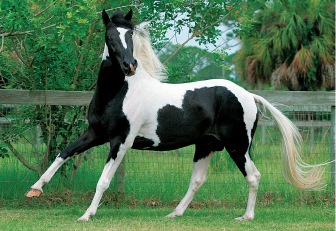
This Paso Fino Pinto stallion is colorful as well as graceful and agile. Darlene Wohlart/equinephotography.com
Standards
The Paso Fino has a noble appearance. Modern care and selective breeding have enhanced its beauty, refinement, and well-proportioned conformation conveying strength and power without extreme muscling. It is bred for good physical balance and is extremely quick, surefooted, and athletic. It is a willing and spirited horse, yet very gentle at hand and easily managed. It is people-oriented, enjoying its human companion and always striving to please.
One feature that is always noticed is its long, beautifully flowing, luxurious mane, tail, and forelock. No artificial additions are allowed. The tail is carried gracefully when the horse is in motion.
The head is refined and in good proportion to the body of the horse, neither extremely large nor small, with a preferred straight profile. The neck has a graceful arch, and the shoulders slop into the withers with great depth through the heart. While the chest is moderate in width, the midsection is moderate in length with a well-sprung ribcage. The Paso Fino horse’s legs show well defined tendons and refined bones with longer forearms and shorter cannons. The hooves are durable and are seldom shod unless traveling on rocky surfaces.
Size will vary between 13.2 and 15.2 hands in height, with the average being slightly over 14 hands. The normal weight will range from 700 to 1,100 pounds. Full size may not be attained until the fifth year.
The breed can be found in every equine color, with or without white markings, including bay, black, buckskin, palomino, chestnut, gray, roan, and even pinto.
Gait
The breed’s attitude seems to transmit to the observer that it knows its gait is a very special gift that must be executed with style and pride. Sometimes it is said the Paso Fino is a horse with brio, which is the inner spirit it has and is evident when observing its proud nobility. These horses walk freely, and many of them can perform a collected canter, or a relaxed lope, and can gallop like other horses, but their preferred way of going is their own natural four-beat lateral gait.
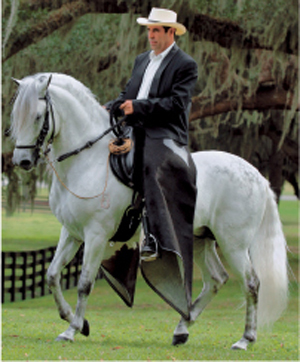
A regal Paso Fino stallion and rider in traditional Colombian tack. Darlene Wohlart/equinephotography.com
The Paso Fino executes a gait that is smooth, rhythmic, purposeful, straight, and balanced in flexion and synchronization from front to rear, resulting in unequalled comfort and smoothness for the rider. The cadence of the one-two-three-four beat is rhythmic, with equal time intervals between hoof beats. There is very little up and down movement in either the croup or the shoulder of the horse. It is an evenly spaced, four-beat lateral gait, with each foot contacting the ground independently in a regular sequence at precise intervals, creating a rapid, unbroken rhythm. Executed perfectly, the four hoof beats are absolutely even in both cadence and impact, resulting in extreme smoothness and comfort for the rider.
The Paso Fino gait is performed at three forward speeds and with varying degrees of collection that decreases as speed increases. In all speeds of the gait, the rider should appear virtually motionless in the saddle, and there should be no perceptible up and down motion of the horse’s croup.
The first of the three speeds is Classic Fino. During this step, the horse holds itself fully collected and balanced, with very slow forward speed. The footfall is extremely rapid, while the steps and extensions are exceedingly short. Leg motion is smooth and extravagant, with each hoof hitting the ground in rapid succession. This gait is used for show purposes only and is performed with the same forward impulsion as a slow walk, yet with a rapid footfall that is calculated, crisp, and precise.
The Paso Corto is comparable in speed to the trot, but is the average trail gait. Forward speed is moderate, unhurried, and executed with medium extension and stride. A well-conditioned horse may travel at the Paso Corto for hours without tiring, and due to the smooth gait, so can the rider.
The Paso Largo is the fastest speed of the three gaits and is executed with a longer extension and stride, with varying degrees of collection. Forward speed varies with the individual horse, since each one should attain its top speed in harmony with its own natural stride and cadence.
No matter if the horse is executing the highly collected Classic Fino or the fully extended Largo, the Paso Fino’s performance is a pleasure for both the rider and performer. The breed is born with this completely natural gait, thus there are no external aids that help promote it, or are involved in the training for it. The only training that is used is to help with the collection of the gait and other requirements of the particular class in which the horse is to be shown.
The Paso Fino is capable of executing other gaits that are natural to horses, including the relaxed walk and lope or canter. It competes in western classes such as Trail and Versatility, as well as Costume and Pleasure Driving. Known for their diverse abilities, Paso Finos are also being seen in cow penning, trail riding, and endurance competitions and are winning ribbons in these events.
Credit: Paso Fino Horse Association, Inc.