
American Haflinger Registry
1686 East Waterloo Road
Akron, Ohio 44306
www.haflingerhorse.com
The specialness of the Haflinger lies, of course, in its unique golden chestnut coloring with the long, flowing, white mane and tail, the coloring all Haflingers have. More unique than its coloring is its people-loving, willing, and forgiving temperament that was established over centuries of living alongside and working with mountain peasants. The Haflinger served in every capacity possible for all family members and very simply became part of the family.
This beautiful and versatile horse is now one of North America’s fastest growing horse breeds. It is being discovered by the horse-loving public who want an equine companion that is safe, loveable, and dependable. Intelligence, character, grace, stamina, athleticism, and long life are qualities of the Haflinger. It continues to capture hearts and enrich lives, as it has for centuries. Its beauty and charm steals hearts forever.

This Haflinger stallion shows harmony of conformation and elegance. American Haflinger Registry
History
The history of the Haflinger Horse can be traced to medieval times, when writings told of an Oriental race of horse found in the Southern Tyrolean Mountains of present-day Austria and northern Italy. Many of the villages and farms in the Tyrol were accessible only by narrow paths requiring agile and surefooted horses for transporting and packing. Artwork in the early 1800s from the region depicted a small, noble, chestnut horse with packs and riders traversing steep mountain trails.
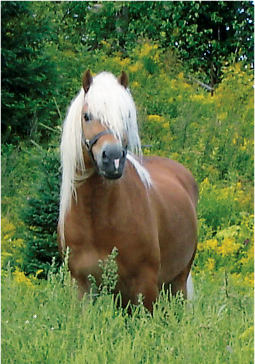
A noble Haflinger stallion. American Haflinger Registry
The first official documentation of the present-day Haflinger (named for the Tyrolean village of Hafling) was in 1874, when the foundation stallion, 249 Folie, was born by the Half Arabian stallion, 133 El’ Bedavi XXII, that was crossed with a refined native Tyrolean mare. All modern purebred Haflingers trace their ancestry directly to Folie through seven different stallion lines: A, B, N, S, ST, and W. With documentation of pure lines, this makes the Haflinger breed much older than one century.
During the years of World War II, there was a significant shift in breeding practices, as pack horses were needed by the military, thus a shorter, draftier Haflinger was produced. Postwar, the breeding practices were modified again in order to restore the height and refinement of the breed, still with an emphasis on a small, yet solid constitution. A horse versatile enough for both riding and driving was developed with substantial bone and an uncomplicated personality.
Haflinger Horses were first introduced into the United States in 1958. The first importation was acquired by Tempel Smith of Chicago, Illinois, who sent his farm manager to Europe to find a unique breed of horse that could be brought to the United States. In 1958, thirteen Haflingers—one two-year-old stallion, nine broodmares, and three foals—left Hamburg, Germany, tucked away in stalls built on the deck of a steel-hauling ship, which arrived in New York nine days later. Haflingers have proceeded to become more popular in North America ever since.
The modern Haflinger is now found all over the world, active in such varied uses as draft work, packing, light harness and combined driving, western and trail riding, endurance riding, dressage, jumping, vaulting, and therapeutic riding programs. Haflingers hold their own in competition with other breeds, often showing surprising athleticism and strength for their size.
In the United States
The American Haflinger Registry was formed in 1998 from the combined memberships of the Haflinger Association of America and the Haflinger Registry of North America. It represents approximately nine thousand North American Haflinger owners with over thirty thousand Haflingers now recorded in the studbook.
The World Haflinger Federation sets the standards, and the American Haflinger Registry follows that standard today. A Haflinger must have a purebred, registered sire and dam to be registered. The American Haflinger Registry conducts a voluntary Inspection and Classification Program open to both mares and stallions. Breeding animals are presented before a panel of judges who evaluate the horse against the accepted breed standard using a ten-point system with written scorecard. The following is examined:
• Character and temperament as observed by the judges during the inspection and measurement process
• Conformation, shown standing in-hand
• Basic gaits (walk and trot) shown on the triangle
• Free schooling, including canter or gallop
The classification of Breeding Horses aged six and over are final decisions; the judgments are not revised up or down afterwards. An owner is entitled to one appeal, however, and may be given the opportunity to re-present the horse one time only at a later inspection under different judges. The decision and score at the second inspection is final and overrides the original score.
Standards
The standards apply to both inspections and judging at halter.
Color: Color may range from light chestnut to dark liver chestnut with white or flaxen mane and tail. Color impurities in the base color, such as roaning, black spots, or others, are undesirable; excessive deviations will be judged as negative, and using such animals for breeding purposes is strongly discouraged. Color impurities in the mane and tail are undesirable; excessive deviation from white or flaxen will also be judged as negative, and using such animals for breeding purposes is strongly discouraged.
Markings: Head markings are desirable, but not a prerequisite. Too many markings are undesirable and can go as far as being strongly discouraged. Leg markings are not desirable: One white leg (which is a white sock that extends above the fetlock joint) will not be penalized; two white legs will result in a one-point deduction; three white legs will result in a two-point deduction; and horses with four white legs or white above the knees or hocks will be strongly discouraged from breeding. White markings are signified by a change in skin pigment.
Size: The desired size is from 54 to 60 inches. Horses not reaching the minimum size should result in them being strongly discouraged from breeding. Horses outside this parameter may still be used for breeding in the case of an excellent or outstanding evaluation of all other characteristics.
Type: A desirable appearance of the horse is one of elegance and harmony. To this belong a lean and expressive head with large eyes, well formed neck, and supple mid-section. The croup should be neither too divided nor too short, and the horse should have a distinct musculature as well as correct, defined limbs with good joints.
Stallions and mares for breeding should have clearly defined masculine or feminine features.
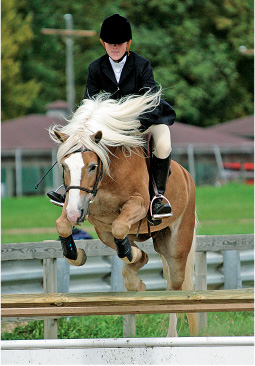
Haflinger clearing a jump. Haflingers are graceful and athletic. American Haflinger Registry
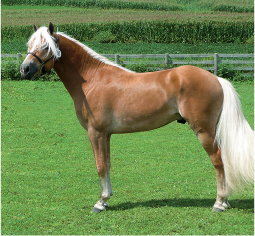
The Halflinger is an elegant chestnut horse with a long, white mane and tail. American Haflinger Registry
Body structure: The body structure should be harmonious and suitable for an all-around pleasure horse.
The head should be noble and lean, and the size in harmony with the horse, with large forward-pointing eyes and wide nostrils. It should have enough poll freedom to allow for correct flexion, a clean connection of the head to neck through the jowl area, and correct positioning of the ears.
The neck should be medium long and slimmer toward the head, with no bulky lower line. It should not be too wide and should demonstrate good freedom of the lower jaw muscles.
A pronounced withers reaching well into the back, large diagonally lying shoulders, and sufficient depth of chest are the most striking features of the forehand. The back should be medium long and muscular, as well as display swinging, load-bearing capacity and balance in its movement. The hindquarters should be long and slightly sloping, but not too steep, with a not too obviously divided, yet well-muscled croup. The tail should not be set too low. All in all, a harmonious distribution of the forehand, mid-section, and hindquarters is the goal.
Front and hind limbs are extremely important. They should have correct conformation and clearly pronounced joints, with a broad and flat knee joint and a broad strong hock. A full range of bone measurements proportionate to height shall be considered, with special attention to the quality of the cannon bone, as indicated by an oval shape, clean connection to both the fetlock and pastern joints, and clear definition of the tendons and ligaments. Seen from the front and behind, limbs should show straight conformation; seen from the side, a straight standing foreleg and hind leg angled at approximately 150 degrees at the hock are desirable, as is a hoof angle of approximately 45 to 5 degrees to the ground. The pasterns should be moderately long and well developed. The hooves should be round, distinct, and hard.
Movements for basic gaits: The stride should be correct, supple, and of a pure rhythm without serious faults. The horse should have a good, long-reaching, swinging stride at its disposal, with an elastic and not too flat gait, showing good impulsion from behind.
Desirable are hardworking rhythmic and swinging basic gaits: walk, four-time; trot, two-time; and canter, three-time. The movements at a walk should be relaxed, energetic, and elevated. The movements at the trot and gallop should be supple, swinging, and light on the feet, with a noticeable swinging phase and a natural suspension. The clear thrust of the foot from an active working hindquarter should be transferred over a loosely swinging back to the anticipating forehand that is moving freely from the shoulder. Some knee action is desirable. In particular, the canter should demonstrate a clear forward- and upward-springing sequence.
Internal characteristics and health: Desirable is a horse with an even temperament and a strong, excellent character without vices. It should be an all around horse, good natured, strong, eager, and able to perform, easy feeder, resistant to disease, and easy to adapt to be useful for all purposes. In particular, this is valid for riding, driving, and vaulting in the pleasure and sport sector, but also as a working horse for pulling and carrying.
Credit: American Haflinger Registry