
Newfoundland Pony Society
P.O. Box 8132
St. John’s, Newfoundland and Labrador
A1B 3M9
Canada
www.newfoundlandpony.com
The Newfoundland Pony is a special and historic pony, used for riding, driving, and light draft work. It makes an excellent mount for children and adults, and excels under saddle and in harness. It is a multi-talented, enduring, hardy, dedicated worker and easy keeper.
This is a rare breed, unique in its history and capabilities. For four hundred years, the Newfoundland survived in the harshest of conditions that only the hardiest creatures could endure. At the same time, it never lost its affinity for working side by side with people. It is a strong, adaptable, and congenial pony, but most of all, it is a survivor.
The Newfoundland Pony of today has all of the assets of its ancestors, and probably a few more. It is a sturdy mount that is hardworking, eager to please, and learns quickly. Since these features are combined with good feet, robust good health, and a pleasing temperament, it is a pony that is hard to match. It is an all-purpose pony with many desirable characteristics: strength, stamina, courage, intelligence, obedience, willingness, and common sense.
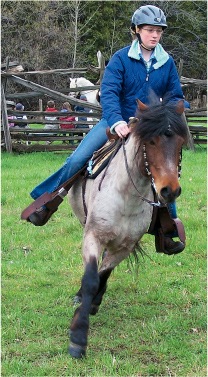
The Newfoundland Pony is excellent for riding. Greg Oakes
History
The arrival of Moorland breeds in New Founde Land, as it was called when first discovered, began in the 1600s when Lord Falkland attempted a settlement there. Those were tough times for both human and beast, with conditions on the island being extremely harsh, indicating a need for horses of the hardy type. Falkland sent an order to Bristol, England, requesting livestock that “can live in hard ground and in the wood without fodder in the winter.” These were the expectations of imported ponies and conditions that they would need to have for survival.
When early English fishermen became involved in the rich fishing grounds of Newfoundland and settled there in the seventeenth and eighteenth centuries, the robust native ponies they brought from the British Isles possessed the type of resilient attributes Falkland described. These breeds became ancestors to the Newfoundland Pony and were primarily Exmoor, Dartmoor, and New Forest Ponies from England, and to a lesser extent, Welsh Mountain Ponies from Wales, Galloway (now extinct) and Highland Ponies from Scotland, and Connemara Ponies from Ireland. These were sturdy creatures, already well adapted to the harsh climate of the islands of the North Atlantic and were used for work side by side with the moorland and highland crofters. They were perfect helpmates to “live in the hard ground and wood” in Newfoundland’s harsh climate and rocky terrain. They were fully accustomed to the plough, harrow, back pack, cart, and heavy work.
In time, the resident pony population of Newfoundland increased to the point where local supply could satisfy demand and further British imports were no longer necessary. Isolated on the island, these various British native breeds interbred, and over three centuries and with little outside influence, the hardiest of them eventually evolved into one common pony type perfectly suited to the rough Newfoundland environment. That pony is now recognized as the Newfoundland Pony.
The Newfoundland Pony was primarily a work pony used in the field and on the fishing wharf. It hauled firewood, timber, kelp, the fish catch, and rocks and pulled the plow. It transported its owners by back, cart, and wagon in times before the car. This remarkable little pony was an integral part of Newfoundland life right up to the late 1940s and 1950s, and in some remote villages up to the late 1960s and early 1970s.
By 1935 the population of ponies on the island was recorded as 9,025, while the horse population was recorded at 5,658. The pony had greater and wider use and therefore outnumbered the larger equines. Healthy numbers of Newfoundland Ponies existed into the 1970s and 1980s.
After that, the population dropped rapidly due to a number of factors. While once a necessity for rural and city life, increased modernization made the pony’s traditional role obsolete. This occurred with the replacement of horse power by mechanical power, so working ponies were no longer needed. The Newfoundland Pony had been used to plow gardens, haul fishing nets or kelp and wood, gather hay, and provide families with transportation around the island. When these functions were replaced and the pony population plummeted, there was the possibility of its extinction. Also anti-roaming legislation was passed in many communities, thus limiting the pony’s food supply and curtailing the traditional method of breeding during the summer pasture months. Owners were being encouraged to geld their stallions. Due to the decreased need for the pony, thousands were exported for meat to processing plants in Quebec, which then sold the meat to Belgium and France for human consumption.
This exceptional animal that for over four hundred years had helped Newfoundlanders secure a place in the New World almost disappeared completely. Had it not been for a number of dedicated individual breeders and pony protection groups, the Newfoundland Pony would have become extinct.
From an estimated population of twelve thousand in the 1970s, pony numbers dropped to fewer than one hundred in the 1980s. By the early 1990s, the population was thought to still be under two hundred, with many of these not being used for breeding purposes.
Preservation Measures
The Newfoundland Pony Society was founded in 1979 and incorporated in 1981. It proceeded to lobby the government of Newfoundland and Labrador to have the Newfoundland Pony recognized as a living part of the province’s cultural history and have it protected from extinction.
In 1997, the provincial government of Newfoundland passed the Heritage Animals Act, which gave both the Newfoundland Pony and the Newfoundland Pony Society official designation. It provided legal protection for Newfoundland Ponies, with the assistance of the Newfoundland Pony Society, by making it illegal to transport the ponies off the island without export permits. This ensured that ponies leaving the island were headed only to breeders and pony lovers—not meatpacking plants. The act also designated the Newfoundland Pony Society as the public group responsible for registering, promoting, and protecting the Newfoundland Pony. The society identifies and maintains a listing of Newfoundland Ponies, as well as doing inspections where necessary and promoting the Newfoundland Pony in Newfoundland.
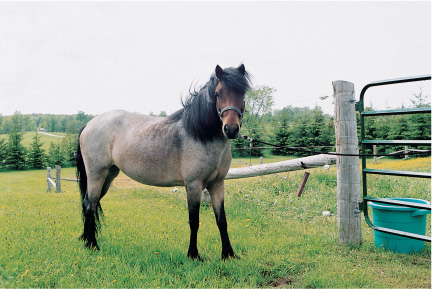
The Newfoundland is a hardy breed that often has fine legs. Diana Wright
Additionally, an ongoing effort on the part of concerned individuals stabilized the Newfoundland Pony population, but the Newfoundland Pony has continued to be classified as critically endangered by Rare Breeds Canada. The current Newfoundland Pony population totals less than four hundred animals, but many of them are geldings and aged mares. The number of ponies able to carry on the breed is relatively small—approximately 250. The Newfoundland population is spread across Canada, with the majority of the ponies located in Newfoundland, Nova Scotia, and Ontario.
The Future
There are many dedicated Newfoundland Pony owners and breeders located across Canada, as well as a few in the United States, producing Newfoundland Ponies that are listed and recognized by the Newfoundland Pony Society. The Newfoundland Pony is not an officially recognized “breed,” however. Although it has been purebred for centuries, it is considered a pony “type” by the government. Pedigrees were not formally recorded for the pony until the 1980s.
Breeders and owners of Newfoundland Ponies are seeking to have the Newfoundland Pony recognized as a national breed in Canada under the Animal Pedigree Act (APA). The act makes no consideration for any historical significance of the pony, so it is within this context that the Newfoundland Pony must make a place for itself in today’s equine world. The Newfoundland Pony Society is cooperating with breeders and owners in this effort.
Rare Breeds Canada is supporting a blood-typing project for two ponies, the Newfoundland Pony and the Lac La Croix Indian Pony. The Newfoundland Pony has a diverse ancestry in its background, but the isolation of the various lines in the Newfoundland community is unique. In recent years, the breeding pool has been significantly reduced. The presence of radical changers, the incidence of cryptorchism, and the variation in size are all subject to speculation. Knowledge of the genetic diversity will be key to understanding the level of risk to the pony.
Foundation breeds of the Newfoundland Pony are:
Connemara
Dartmoor
Exmoor
Fell
Galloway
Highland
New Forest
Section A: Welsh Mountain Pony
Section B: Welsh Pony
Section C: Welsh Pony of Cob Type
Section D: Welsh Cob
With continued support from concerned individuals, groups, and corporations in Newfoundland, across Canada, and beyond, the prospect for the survival of the Newfoundland Pony, while not yet assured, is improving annually. With the dedication of countless volunteers, it is hoped the Newfoundland Pony known and loved across North America will eventually be recognized as one of the most historically significant pony breeds in the world.
Standards
For listing with the Newfoundland Pony Society as a Heritage Newfoundland Pony, DNA parental verification is required. The standards may vary in the event that a more detailed survey of the breed carried out at a later date shows evidence of any discrepancy. The applicant pony must conform to the following standards in order to be registered as a Newfoundland Pony in the Newfoundland Pony Society:
• Demonstrates and/or documents ancestry to the Newfoundland Pony acceptable to the society
• Has a good temperament and is docile and easy to work with
• Is a good winter animal, being all-around hardy
• Is surefooted
• Has a structure that can vary from fine boned types to larger stocky types
• Has a height that can vary from 11 to 14.2 hands
• Has a coat color of bay, black, brown, chestnut, dun, gray, roan, and white (with pink skin), but no piebalds and skewbalds (pintos) are acceptable
• Has a heavy coat, which sometimes changes color and character seasonally
• Has a thick mane and tail
• Has a low-set tail
• Has feathered fetlocks with hair extending below fetlock points
• Has flint hard hooves
• Has, typically, dark limb points, though white or light color on limbs is acceptable
• Is free of defects that might endanger the ability to live a normal, healthy life
Credit: Newfoundland Pony Society