
Horse of the Americas, Inc.
202 Forest Trail Road
Marshall, Texas 75670
www.horseoftheamericas.com
The broad list of Colonial Spanish horses includes a tiny Havapai Pony from a small genetic base of less than forty horses; a Sulphur Springs or Pryor Mustang, which is occasionally offered for adoption by the Bureau of Land Management (BLM); or a tribal original like a Cherokee or Choctaw horse. All of these horses descended from ancient Spanish stock first brought to America around the time of its colonization. The registry for them is Horse of the Americas (HOA), which is open to all Colonial Spanish horses.
These historical horses are America’s first horses and should be preserved for future generations. Each one carries its own bit of history. Some have been selectively bred for certain uses. Others were selected naturally for certain traits, like hooves that could handle the hardest terrain or for being easy keepers for survival in severe northern winters. These strengths make each subgroup unique and worthy of preservation in their own right. They have come a long way via diverse routes to reach the twenty-first century.
Colonial Spanish horses stand as a unique collection among horse breeds. Their history and breeding make them a genetic resource of great value. They are also distinct from most other breeds and ancestral to many, but their uniqueness is one of the major impediments to conservation. As the general horse-owning public has gone to the Arabian, Thoroughbred, warmblood, and stock horse types, the other less popular types have become rarer. International horse breeding is now very homogeneous, and the more unique types are clearly being left behind.

Bob Brislawn stands on his Cayuse Ranch with a Colonial Spanish 100 percent Brislawn Foundation grulla stallion. Courtesy Gretchen L. Patterson
The current Colonial Spanish horse comes to us because previous generations of breeders cared enough to assure its survival. As with any conservation effort, each breeder had slightly different ideas and goals. Past breeding has resulted in a variety of strains and subgroups, each of which being slightly different by ancestry and type. These differences are in some cases minor, in others distinctive. The differences have been a source of disagreements as to what is pure and what is not within the Colonial Spanish horse spectrum and has been one cause of the multiple registries. Each registry designates a slightly different group of horses as pure. This can contribute to conservation, but likewise can contribute to divisions, which defeats the purpose of their continued existence. The Colonials deserve better. They are indeed important, because they possess most of the basic components of the present breed.

Colonial Spanish 100 percent Wilbur–Cruce horse with an overo pattern. Courtesy Gretchen L. Patterson
Horse of the Americas Registry is a unified registry for America’s first horse, the Colonial Spanish, a historic horse group that contains, among others, the Spanish Mustang, Barb, Original Indian Horse, and Cayuse. Horse of the Americas has registered more than seven hundred horses to date, and the number of applications increases almost daily. Approved strains include:
• Brislawn foundation
• Original Horse of the Americas foundation
• Book Cliffs
• Tribal
• Havapai Pony
• Belsky
• Romero/McKinley
• Romero/Gonzalez/Marques
• Gilbert Jones foundation
• Wilbur-Cruce
• Yates
Other Colonial Spanish strains registered with Horse of the Americas—such as the Abaco Barb, Banker Horse, Carolina Marsh Tacky, Cerbat, Florida Cracker, Kiger, Nokota, Pryor Mountain Mustang, Spanish Barb, and Sulphur Springs Horse—have their own registries as well. (They are presented elsewhere in this book.)
The value of the various strains is that each one is a survivor from a earlier time when the Colonial Spanish horse was the horse in North America. Each has a portion of the overall genetic mix that was brought here during Spanish exploration. Each has a role to play toward the conservation of the Colonial Spanish horse.
History
The original horses brought to America from Spain were relatively unselected. They first came to the Caribbean islands where their populations were increased before being exported either north or south to the mainland continents. In the case of North America, most went to Mexico first, thereby populating the southeastern United States through Mexico, rather than more directly from the Caribbean. The North American horses ultimately came from this somewhat indiscriminate and early imported base.
South American horses, in contrast, originally tended to derive about half their genetics from the Caribbean horses and half from direct imports of highly selected horses from Spain. These later imports changed the average type of horses in South America.
This difference in foundation blood is one reason for the current dissimilarity between the North American and South American horses today. Other disparities were fostered by the diverse selection goals in South America. Both factors resulted in related, but different, types of horses. In addition, the South American horses have become popular and common in several countries within the continent, with some becoming the national horse, such as the Puerto Rican Paso Fino and Peruvian Paso.
The lack of popularity of the Colonial Spanish horse subtypes in North America has been a mixed blessing, as their breeders have tended to be loyal to them, yet have tended to work very much outside the mainstream of horse breeders and users in North America. This has kept Colonials obscure from general horse circles longer than intended. Their isolation has resulted in constant pressure to increase their size and harmonize their conformation to more popular North American breeds. The danger of this trend is that it could result in homogenizing out what traits are left of the Colonial Spanish horse, which was a purebred longer than some of today’s popular breeds.
In the early 1700s, the purely Spanish horse could be found in an arc from the Carolinas to Florida, west through Tennessee, and then throughout all of the western mountains and the Great Plains. In the Northeast and Central East, the colonists were from northwestern Europe and the horses they brought were more draft or Thoroughbred types, rather than the Colonial Spanish type. Even in these non-Spanish areas, the Colonial Spanish horse was highly valued and still contributed to the overall mix of American horses. Due to their wide geographic distribution of pure populations, as well as their contribution to other crossbred types, Colonial Spanish horses were the most common of all horses throughout North America at that time and were widely used for riding as well as draft. In addition to being the common mount of Native American tribes and white colonists, there were also immense herds of feral animals that were descended from escaped or strayed animals from the owned herds.
Colonial Spanish horses came to be considered to be too small for cavalry use by the colonists and were slowly supplanted by taller and heavier types from the Northeast as integral parts of colonial expansion in North America. In the final stages, this process was fairly rapid, expedited by the extermination of the horse herds of Native Americans during the latter’s subjection in the late 1800s.
The close association of the Spanish horse with both Native American and Mexican cultures also caused the popularity of these horses to diminish, in contrast to the highly favored, larger horses of the dominant Anglo-American culture, whose horses tended to be more northern European types. The end result was that by the twentieth century, only a handful of Colonial Spanish horses were left of the once-vast herds.

Colonial Spanish silver dun Choctaw mare. Courtesy Gretchen L. Patterson
Brislawn and the Original Horse of the Americas Foundation
Many of the pure Spanish horses in North America remained in isolated feral herds and became rare fairly early in the twentieth century due to the practice of shooting the Spanish stallions and replacing them with draft, or blooded, stallions (generally Thoroughbred or coach) in an attempt to “improve,” or breed up, the feral herds as sources of draft or remount stock.
The relatively small handful of western Colonial Spanish horses that survived through these lean years founded the present Brislawn strain, and so is the horse of interest when considering the history of the current breed. These Colonial Spanish horses that persisted through that period of low herd numbers will forever stamp the resulting breed in more important ways than the millions of horses that once roamed the continent but failed to survive.
Bob Brislawn, who founded the Spanish Mustang Registry in 1957, used many feral horses in his herd. He obtained several of his foundation horses from an Apache named Monty Holbrook, who lived in Utah and was an excellent mustanger (capturer of feral horses). Thus most of the feral components of the Brislawn horses originated from Utah horses, although isolated horses from other herds contributed as well.
Brislawn also selected some of the ranch’s finest Colonial Spanish horses to begin the Horse of the Americas herd, bringing the first “stud bunch” to the Wild Horse Research Farm in California in 1971. Jeff Edwards, the other original Horse of the Americas founder, later wrote, “In 1972 the Department of Agriculture recognized Bob Brislawn as the founder of the Spanish Barb Mustang horse. Now with the horses on the Research Farm being personally selected by Bob Brislawn they are ‘authenticated.’” Thus, the Brislawn horses contributed widely to the present breed.
Book Cliffs
A later major source of feral Colonial Spanish type horses were the herds in the Book Cliffs of Utah. This area has an interesting geological formation that looks like sheer walls of rock. The valleys in between are where Monty Holbrook captured wild horses for the Brislawns. These horses figured prominently in the Brislawn herds as well as others. In some herds, Book Cliffs horses are still present and unique, but their main impact has been their use for other horse breeds. While today’s Book Cliff horses are generally no longer considered pure, the neighboring Sand Wash area is reputed to still be home to some typical Spanish Colonial horses.
Tribal
Feral horses were not the only group to contribute to the Colonial Spanish horse of today. Many foundation horses came from the horse herds of Native Americans. The original Spanish horses were obtained at first from a chain of missions across the south in early Spanish colonial days, and their breed continued on in the tribes.
The Native herds were especially important in the early twentieth century. Most of these tribal horses have only influenced the present breed through individual horses and not through groups that continue to be bred pure within the strain. Tribes contributing to the continuation of tribal horses include Cheyenne, Lakota, Paiute, Navajo, and a few others. Horses from the northern tribes contributed heavily to the Brislawn herd along with the feral stock they used. The search is always on for breeders or families that have kept the original type pure, but these have become increasingly rare as the years go by.
A few tribal types have continued to be bred as distinct strains. The Choctaw and Cherokee horses are among these. Both of these tribes, in addition to the Chickasaw and Creek, were avid horse breeders in their original homes in the southeast. The quality of their horses was specifically mentioned as being excellent in various travel journals from the late 1700s and early 1800s. Some of these horses have unique Iberian blood types, which provide evidence of the accuracy of the oral history about isolation surrounding the herds.
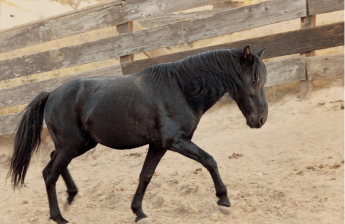
Colonial Spanish 50 percent Havapai Pony black stallion. Courtesy Gretchen L. Patterson
These horses were brought from the Southeast to what is now Oklahoma on the Trail of Tears. This was a forced relocation by the U.S. government in the 1830s of seventy thousand Native Americas from eastern tribes that were moved westward across the Mississippi River to areas that the white European settlers did not want. These tribes became important mediators between several of the western tribes and the government, and it is likely that exchanges of horses between tribes occurred during the many meetings that were held. No doubt some western horses were added to the eastern tribal herds in this way.
Some individual families were important in preserving the tribal horses. The Whitmire line, which also includes horses from the Corntassle family, is a Cherokee line that can be traced back to the American Indian removal from Etocha, Georgia, in 1835. It probably goes back even further, as court records from 1775 indicate that these families had herds of horses at that time. A few Mexican stallions, which had leopard-type color patterns, were also used in the Whitmire line of Cherokee horses, but the exact source of the stallions is unknown.
The Whitmire horses were always kept within the line of the female side, although outside stallions were occasionally introduced. The stallions were of Mexican, Choctaw, or Comanche breeding, and were therefore also Colonial Spanish. Some of the Comanche stallions came from the Black Moon Comanche of Oklahoma and bore leopard color patterns; at least one Mexican stallion was a buckskin leopard. The outside stallions were carefully and specifically selected to be as similar to the Cherokee strain as possible and to be Colonial Spanish in type. Many of the Cherokee horses that remain today are gaited, and many have unusual color patterns including several Medicine Hat Paint horses.
The major families that preserved the Choctaw horses until recently were the Brame, Crisp, Locke, Self, Helms, Thurman, and Carter families. Horses were run on the open range in areas where other types of horses were not kept. These families had hundreds of horses of consistent Spanish type and widely varying colors, including the “Spanish roan” sabino type, leopard and blanketed, and others such as overo paints.
The Choctaw horses are occasionally gaited. They are also quick. Hal Brame was noted for taking his little Paint horse to parties and dances, and wagering on races of more than fifty yards. He took a lot of money from cowboys with Quarter Horses and Thoroughbreds who went away with increased respect for small Paint Indian horses.
From the hundreds of Choctaw and Cherokee horses that were available as recently as 1975, there are now only a few survivors. This is due to the dispersal of many large herds following the deaths of some of the elder breeders. Probably only fifty-nine pure Choctaw and Cherokee horses could be assembled in 1988, but a few breeders are trying to assure that this type continues into the future as a part of the overall breeding of Spanish horses. Most of the present Choctaw and Cherokee horses are in the herds of Bryant and Darlene Rickman. Many horses in the various registries are of partial Choctaw breeding, confirming that the Choctaw horses have made a wide impact on the general Colonial Spanish horse breed of today. The stallions Choctaw, Choctaw Sundance, and Chief Pushmataha had an especially great influence on the horse of the Spanish Mustang Registry, the Society for the Preservation of the Barb Horse (SPBH), and the Southwest Spanish Mustang Association.
Havapai Pony
These ponies once lived in the Havapai region of the Grand Canyon. Their history is still being explored. The first mention of them occurred at the beginning of the twentieth century and ran through the late 1960s. There are accounts and lore that were circulated about sightings of small Grand Canyon horses, and many early twentieth century photographs exist of these tiny Colonial Spanish type horses in the Grand Canyon. They lived both as wild herds and as a part of Havasupai Indian life. The Havasupai were the native residents of the Grand Canyon who rode and used the small horses for generations.
The National Park Service was given a mandate to remove non-native species from National Parks, which may have been the main factor in the loss of the wild Havapai Pony bands. Also, there was uncertainty concerning the impact on the Grand Canyon with construction of the 1960 dam on the Colorado River that created Lake Powell. There was growing public criticism regarding the forty-year practice of killing wild burros and horses. Perhaps due to this criticism, removal of wild horses for preservation became a greater concern for the National Park Service.
Regardless of how it was accomplished and whatever the chain of events that followed, the accepted conclusion is that there was an authentic Havapai Pony mare, Grand Canyon I. She and her daughter made their way into Colonial Spanish breeding programs in the 1970s. Their history begins with their owner, Robert Brislawn, who took Grand Canyon I to the Wild Horse Research Farm (later called the Horse of the Americas Research Farm) in Porterville, California, where she produced three foals. They all were later transported to Texas when the largest breeding group of the remaining herd was purchased in 1988. Another small group was moved to California.
Grand Canyon I was a Havapai Pony of typical size. She was originally selected by Brislawn for a study on genetic size. Once at the Wild Horse Research Farm, she produced several foals by Snipper, a small, black Book Cliffs stallion.
During the mid to late 1980s, breeders of the existing Horse of the Americas stock incorporated some of their finest Colonial Spanish stallions into the Havapai Pony program. The strain was expanded, adding both paint and appaloosa color patterns and occasional lateral gaits, while preserving the small size characteristic. Other breeders have now joined that effort.
The Havapai Ponies are a re-creation of the horses of the Havasupai Indians. Using the blood of the little mare, Grand Canyon I, and stallions of recorded Colonial Spanish ancestry, the Havapai Pony breeders are attempting to preserve a smaller Colonial Spanish horse.
Havapai Ponies generally stand 13.2 hands or under, which is called Classic size. Those standing over or under 13.2 hands are termed Standard size. Even Standard Havapai Ponies rarely stand over 14 hands. They are a Colonial Spanish pony that utilizes the flexion, endurance, and trainability of the Colonial Spanish horse, yet sized for those who have use for a smaller mount of Barb type. They are naturally sound and amicable, which makes them well suited as mounts for children.
Belsky
Other important subtypes of Colonial Spanish horses are the rancher strains. Some of these, such as breeder Tom Waggoner’s horses, figure not only in the background of the Colonial Spanish horses, but also in the makeup of the American Quarter Horse. Most of the old ranch strains were Spanish in the 1800s, with the later addition of horses from the Northeast. One rancher who kept the original Spanish type was Ilo Belsky. He ranched in Nebraska, and his herd began from horses that accompanied cattle driven from Texas in the late 1800s. He kept the best horses, and then selectively bred them back mostly to those in his own herd.
Early in the history of their conservation, Belsky popularized his horses as good for ranching. They tended, on average, to be heavier and more thickly made than some of the other strains, although some were the lighter type. His horses were commonly roan, gray, dun, or dark colors.
Belsky horses are now rare, considered a unique western group of Spanish horse, and figure in the background of many Spanish Barbs. They are especially prominent in Spanish Barb Breeders Association (SBBA) horses and, to a lesser degree, in Spanish Mustang Registry and Southwest Spanish Mustang Association horses.
Romero/McKinley and Romero/Gonzalez/Marques
Another important rancher strain is the Romero strain. Horses of this strain are from a ranch near Cebolla, New Mexico, where Spanish horses were raised for generations. The Romero ranch passed to the McKinley family, which still maintains a few horses of the original strain. These horses figure heavily in some lines of Spanish Barb horses.
Another independent New Mexico line confusingly also involves a family named Romero, but is also associated with the Gonzalez and Marques families in Rio Arriba County, New Mexico. They were all involved in the active trade that New Mexicans had with the Comanche tribe for a period covering several centuries, but most were active in the 1800s. Some of these Romero/Gonzalez/Marques horses were gaited and also had flashy calico/paint patterns. This influence persists in some horses raised by Bob Ele and Gilbert Jones, who preserved another rancher strain of the Colonial Spanish breed.
Gilbert Jones
Gilbert Jones of Finley, Oklahoma, was also crucial in maintaining Spanish horses of rancher strains. Due to his moving from Texas to New Mexico and then to Oklahoma, his herd had influences from a wide variety of sources. Many early horses that he included in his breeding program were those from Kiowa, Comanche, and Chickasaw tribes, as well as some from Anglo ranchers such as Tom Waggoner. Some of the tribal horses were from strains of buffalo runners once frequently used on the Llano Estacado, a geographical region in West Texas and eastern New Mexico where many wild mustangs once roamed and lived. Many of the Waggoner horses came from the Llano Estacado, as did some of Gilbert Jones’s stock.
These horses were all blended into a single strain. When Brislawn spent a few years in Oklahoma, there was an exchange of Brislawn and Jones horses. Later in the development of the strain, many Choctaw and Cherokee horses were included and now represent a high proportion of the breeding of several Jones horses today. His herd is one of the few sources of Waggoner, Tom East, Kiowa, and Comanche breeding left today.
Other individual Mexican horses that came into the Jones and Choctaw lines were horses from the Huasteca tribe. Two Huasteca horses were imported from Yucatan in southeast Mexico and are responsible for many of the leopard-type markings in some strains today.
Wilbur-Cruce
Father Eusebio Kino was one of the Catholic priests who established missions in Mexico during the sixteenth and seventeenth centuries. Reputed to be an excellent horseman and breeder of horses, Kino ran a breeding operation for original Spanish horses and other livestock. His little horses carried missionaries, native people, and settlers for thousands of miles through the rugged West with comparatively little feed, water, or care.
Some of his horses ended up in Arizona, where they were bred and used as working horses on Dr. Reuben Wilbur’s ranch beginning in 1885. Wilbur kept his horses intact and untouched from other outcrosses. His horses were highly praised and treasured for their quickness, surefootedness, hard feet, intelligence, and courage.
The horses ran free on the ranch, fending for themselves. The rugged environment influenced the selection process; only horses used for work were rounded up and trained. Their strength was amazing: an 800-pound Wilbur horse could hold a 1,000-pound bull while carrying a 200-pound man and an enormous saddle.
Wilbur’s family name became the Wilbur-Cruce family through marriage. Their herd lived in isolation on the ranch for more than one hundred years until 1989, when Miss Eva Cruce dispersed the livestock due to her old age. Some eighty horses were sold, and from these horses came the Wilbur-Cruce strain of horses. They came to the attention of the Spanish Barb Breeders Association, Spanish Mustang Registry, and Gilbert Jones. A few breeders continue the line of horses, both purebred and outcrosses.
Yates
In addition to the feral, tribal, and rancher horses, there were some Spanish Colonial horses from Mexico. These Mexican horses usually were single horses and not a strain. One exception was a group assembled by Ira Yates, who also figures prominently in the history of the Texas Longhorn. The Yates horses are small, of dun, or grulla color, and still exist in the care of Tally Johnson in Oklahoma. Originally from 150 miles southwest of Mexico City, the first group was assembled in 1950 and the line still continues today.

Brislawn Foundation and Book Cliffs dun overo mare. Courtesy Gretchen L. Patterson
Registries
Most of the Colonial Spanish horses today can be traced to the previously mentioned sources and came either as individual horses, or as contributions of distinct strains. These distinct strains include feral (Brislawn/Holbrook, Cerbat, Pryor Mountain, and Kiger), native tribe (Choctaw and Cherokee), rancher (Belsky, Romero, Jones, and Wilber-Cruce), and Mexican (Yates and Huasteca) horses. These are all generally western or southwestern subgroups. A few other sources have contributed strains from the southeast United States that are of special interest due to their location and history.
The situation with the numerous registries for the Colonial Spanish horse can be confusing. Each registry is slightly different in history and outlook from the others. The Horse of the Americas Registry acts as umbrella for all of the other groups in the sense that it will accept horses that are accepted by other registries, as well as horses submitted for inspection and possible inclusion in its own.
Foundation horses for breeds such as the Brislawn foundation, Book Cliffs foundation, Belsky, and Havapai Pony lines may be named with some accuracy today. Establishing foundation lines for some breeds, such as the accepted feral lines, is an ongoing process and many overlap. Good examples are the many breeds that primarily owe their original conservation to Robert Brislawn, such as the Book Cliffs foundation, the Horse of the Americas foundation, and the Havapai Ponies. Others originally preserved by Gilbert Jones and Jewel Whitmire make up both the Jones foundation and the Tribal foundation horses.
The breeds are preserved in several groups for a reason. For example, the Jones foundation horses are not all tribal horses and not all Brislawn foundation horses are Book Cliffs, but all Book Cliffs seem to owe their preservation to the Brislawns.
Characteristics
Today’s average Colonial Spanish Horse stands between 13.1 and 14.2 hands and weighs between 750 and 1,000 pounds, although the tiny Havapai Ponies from the Grand Canyon can be much smaller. With modern feeding methods and good care, some of these horses can reach up to nearly 16 hands and may weigh up to some 1,100 pounds.
Horses from lines that have been allowed to run on open ranges for generations often grow larger than their ancestors, if acquired when young and put on feed with a good parasite-control program. The next generation born from such horses may be larger yet, as the horses are simply being allowed to reach their genetic potential. (After all, the conquistadors did not come to America dragging their stirrups on the ground!) As they are descended from Spanish horses brought to the New World during the colonization of the Americas, they do not conform to many of the standards used later by western horse registries that promoted sprinter-type conformation.
Bred for beauty and endurance, the Colonial Spanish horse quickly adapted to the challenging environments of the American frontier—the heat of the Southwest, the wetlands of the Southeast, and the near-arctic winters of the High Plains and Northwest. These radically different climatic conditions forged their different physical adaptations, which must be taken into consideration in judging Colonial Spanish horses. It is a much more physically variable breed than the more homozygous modern western horse breeds.
Three distinct Colonial Spanish horse types, with intermediate types that fall somewhere between, are the following:
• Southwestern type: The lighter-bodied and leggy Spanish Mustang is called the light, or Southwestern, type.
• Northern type: The heavy, or Northern, type is a more blocky horse, like the Spanish Ginete.
• Andalusian type: The third resembles the Andalusian, the classic Spanish horse seen in Renaissance art. This third type is the only one included in certain other Colonial Spanish registries. Some consider it a fusion of heavy and light, a median type. However, it may be the true prototype.
Extremes of climate shaped the lighter and heavier horses in North America—or at least selected the survival of certain types in demanding geographical areas. Even though these three types, and the combinations resulting from crossing them, may appear quite different from one another, they have many physical characteristics in common.
A physical description of the Colonial Spanish Horse, including similarities and differences in the types, follows:
Head: There are three possible head profiles: concave, straight, and convex. In general, the Northerns have a broader jaw and blunter muzzle than the Southwesterns. The head of the Southwestern types is often narrow and more triangular shaped when viewed from the front.
Ears: The ears are medium to short, alert, often deeply hooked, and also called “fox ears.” Many have a darker coat color on the rims of the ears than the horse’s base coat; this is termed “rimmed.” The inner ear hair has natural protection in the form of thick, wooly hair, usually lighter in color than the base coat.
Southwesterns have much less inner ear hair than Northerns. Neither inner nor outer ear hair is trimmed in the Colonial Spanish horse. However, horses with ears trimmed for other equine events that may require it are not to be penalized.
Eyes: Colonial Spanish horses include those with the most unique eye colorations of any breed in the world. Their eyes may be dark, tan, golden, gray, hazel, green, navy, blue, and parti-colored; any of these may also include the sclera. Some of the purest have blue, “glass,” or parti-colored eyes; these unique colors are not penalized at halter or in judged performance classes. The Colonial Spanish horse has a medium to large, wide-set eye with a prominent arch. The eyes are alert, and the horse shows interest in all activity around it. Some have heavy bone protruding over the eyes.
Muzzle: The muzzle is refined and small, the mouth is shallow, and the lips are firm. Many wear a four-inch-wide bit, and some have moustaches. The most primitively marked horses will usually show a lighter-colored muzzle, or “mealy nose.” Parrot mouth is rarely seen in the Colonial Spanish horse, but since it may cause grazing problems and inefficient chewing and is highly inheritable, such animals should be seriously penalized at halter, especially if they are breeding stock. The nostril is crescent shaped and will close tightly.
An unusual trait is that the Colonial Spanish horse produces a strange, rattling type of snort when it confronts a questionable situation or object. This sound has been referred to as the horse having “rollers in the nose,” and is unlike the snort of most other types of horses. It is part of herd behavior and is used to alert other herd members to possible danger. Since the Spanish Mustang is a more natural breed than the human-made ones, its herd behaviors, such as this one, are often more pronounced.
Neck: The neck is strong and moderate in length—about the same length as from the withers to the croup—and not heavily muscled. The throatlatch is deep with a strong, gracefully curved bottom line. The hollow between the jaws is well defined. The Northern type carries more crest than the Southwestern, with the Andalusian type generally having the most graceful necks of the three physiological types. All show shorter and more powerful necks in proportion to the rest of their body than modern breeds of Thoroughbred descent. While excessive crest is not desired, a strong crest is often noted and not to be penalized.
Mane and Tail: The forelock and mane are not to be trimmed, pulled, or clipped in any way, unless the exhibitor is required to trim them for other equine events (such as open shows or drill team competitions). The mane and tail may be very long and is often quite dense, especially in the Andalusian and Northern types.
A double mane, or a mane parting to fall on alternate sides of the neck, is common, and exhibitors are not required to train a mane to fall on one side for showing at halter. Some Colonial Spanish horses have a scanty mane and tail, especially some appaloosas and duns. Although the long mane is generally considered desirable in the Colonial Spanish horse, the thin mane and “rat tail” are not to be penalized at halter.
Shoulder: The shoulder is long, sloping, and laid back with smooth muscling. The forward point of the shoulder is prominent. The horse is often heavier on the forequarters than the hindquarters.
Chest: The chest is medium to narrow. The Southwestern type is narrower than the other types, but in all types there is a well-defined inverted “V” between the front legs. The chest is well muscled, but not bulgy and never broad or flat.
Barrel: The barrel is slightly tapering. It has well-sprung ribs; in all types, when looking at the horse from the front, the barrel should be plainly visible on both sides. The heart girth is deep (as opposed to wide) with good heart and lung space in front of a full abdomen. It should be short-coupled. The underline is longer than the topline, with a more rounded underline on the Andalusian and Northern types. The flank space behind the ribs is short.
Legs: The legs are strong and of medium bone with long, smooth muscling that carries down well into the knees and hocks. They are uniquely flexible with stretchy but strong tendons that are well defined from the bone. The joints also allow great flexibility of motion and are rather large. The length of the cannon is short to medium with round and dense bone, but never heavy in appearance.
An outward rotation of the fetlock joint may look similar to, but less obvious than, the termino of the Paso Fino and Peruvian Paso. This is seen most often at the trot or in the movements of the gaited variety. Called “winging” or “paddling” in breeds in which it is undesirable, such action is not a fault in the Colonial Spanish horse, unless it interferes with movement and/or clips opposing hooves. Otherwise, this action can add to the smoothness of the gait.

Colonial Spanish champagne overo stallion. Courtesy Gretchen L. Patterson
The hind legs should be strong with hocks well defined, but without excessive flesh. Tendons and suspensor ligaments are well defined. The rear legs may also be set slightly under the body, allowing the forward reach of the hind stride to land just beneath the rider’s stirrup. The hind legs are straight to slightly turned out. Any leg deviation that causes interference is to be heavily penalized.
The pasterns are of medium length and sloping under a strong fetlock. In most horses, the hind pasterns may be somewhat shorter and straighter than the front, but all are long and angular enough to give a springy, smooth ride. The angle should be approximately the same as the shoulder and hoof wall.
Hoof: The hooves are small, but adequate for the horse’s size and body weight. Most wear 00 or 0 shoes, if they are shod at all. The hoof is hard and dense, so many never require shoeing. The hooves are generally more egg-shaped than round with a distinct point at the toe, especially on the hind feet. The circumference is smaller at the coronary band than at the ground surface. Hoof color may be black, gray, white, or striped (laminated).
Back: The back is well-defined, and withers are not too pronounced, but blend nicely into the neck and back. The back is short, strong, and well proportioned, stout but never flat. The withers should be higher than the top of the hip.
Hindquarters: The croup is short and sloping with a slightly low tailset; the hips are well rounded. The Southwesterns have narrower hips than the Andalusian or Northern types, but none have bulgy, excessively heavy hip muscling or much width between the hip bones. The tail is set medium low to low. The tail is usually long and may be heavy.
Gait: The heritage of the Colonial Spanish horse includes virtually all so-called saddle gaits, including varieties of the pace and broken pace, the trot and the broken trot, the running walk and the fox trot. Since most gaited Colonial Spanish horses have some of the outward rotation of the fetlock joint called termino, they are often referred to as having Paso gaits, similar to, but not as animated as, the gaits of the Peruvian Paso and Paso Fino. Colonial Spanish horses do not show excessive termino; it is certainly not as pronounced as in Pasos.
All gaits are acceptable in this breed, and no particular gait is preferred over another, so long as they do not interfere with sound movement and show good endurance. The gaits are not choppy, but have a good degree of smoothness and are comfortable for the rider, even on those horses that are not gaited, performing only at the walk, trot, and canter.
Ground-covering ability is an important characteristic and extreme collection is not desired; the horse should have ability to cover ground well and have smoothness of gait.
Temperament: The Colonial Spanish horse is bold, yet calm, alert, curious, proud, and trainable. The horse is expected to perform with energy, but without foolishness.
General Comments: Emphasis in judging at halter should first be on soundness and stamina, then on ground-covering ability. The judge should place horses according to how he or she believes they would perform on a full day’s ride over challenging terrain, and then consider their potential readiness to do the same day after day. Modern breed conformation criteria that may potentially cause soundness problems in long-distance riding—such as feet too small for the horse’s body weight, heavy, bunchy muscling, or excessive fat—should be penalized. Endurance qualities are more important to Colonial Spanish horses than sprinting ability, but many are reasonably fast over short distances and still have good stamina.
What a Colonial Spanish horse is supposed to look like has been the subject of many debates. One of the purposes of the Horse of the Americas Registry is to advocate a certain heterozygous nature inherent to the various subgroups of these horses.
All Colonial Spanish horses have these characteristics (among others) in common:
• Neck, back, shoulder, heart girth, and hip are approximately the same length.
• Bone over the eye is heavier and more protruding than in modern horses.
• Back often has one less lumbar vertebra. If the sixth is present, the fifth and sixth lumbar vertebrae are usually fused. Often the shorter-backed horse will have one less pair of ribs.
• Tailset will be low and hip more deeply angled than most modern horses. This “Spanish hip” allows for more flexion and extension so that at the trot, the horse’s rear foot will land just below, or only slightly behind, a line drawn from the back of the stirrup to the ground.
• Gaits will be smooth and comfortable, whether lateral or diagonal. The Colonial Spanish usually has an overstride, with the hind foot landing in front of the front hoof.
• Structurally, bone will be dense, hoof wall thick, and cannon bone round rather than oval.
• Chestnuts will be small or often missing entirely, especially on the hind legs.
• Nostrils will be strongly crescent shaped and able to close up tightly.
• Shoulders will be strongly angled and well laid back.
• Ears are fine and narrow. They range from the short fox ear to the longer narrow ear of the Southwestern, but are not blunt or wide. A pronounced hook inward at the tips is noted in many Colonials.
• Necks have a strong crest when the horse is in good condition. The head is attached to the neck with a cleanly arched throatlatch.
Horses can be registered if already recorded as Spanish Mustangs, original Indian Horses, and Barbs, and the Horse of the Americas Registry will inspect Colonial Spanish type feral horses for possible inclusion.
Credit: Horse of the Americas, Inc.
Wilbur-Cruce credit: Silke Schneider and Gretchen Patterson

Colonial Spanish horse. Ears are hooked in slightly and the muzzle is refined with tight lips. Courtesy Gretchen L. Patterson