
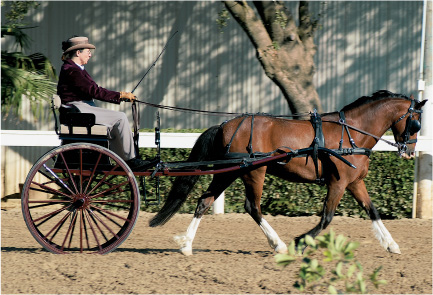
A Welsh Cob (Section D) mare turning heads in a Pleasure Driving class. Courtesy of Davidson Dales Farm
Welsh Pony and Cob Society of America
720 Green Street
Stephens City, Virginia 22655
www.welshpony.org
Undoubtedly the most popular of the nine Mountain and Moorland Pony breeds native to the British Isles is the strikingly attractive Welsh. It is the epitome of elegance and athleticism, and many experts consider it “the most beautiful pony in the world.” Writing in The Horse in 1859, Youatt stated, “The Welsh Pony is one of the most beautiful little animals that can be imagined. He has a small head, high withers, deep, yet round barrel, short joints, flat legs and good round feet. He will live on any fare and never tire.”
The Welsh Mountain Pony is renowned in the horse world for its gorgeous head and breathtaking movement, making it perhaps the most charismatic and eye-catching of all British native pony breeds. Like the other Mountain and Moorland breeds, the native Welsh Mountain Pony owes its sound constitution, iron-hard limbs, and great intelligence to a harsh and unforgiving environment that demanded much of the individuals who survived there. It was once written that they were “little animals who can survive where sheep and cattle die.”
Today the breed is divided into four sections or types, all developed from the Welsh Mountain Pony. The four sections include:
• Section A: Welsh Mountain Pony
• Section B: Welsh Pony or Welsh Riding Pony
• Section C: Welsh Pony of Cob Type
• Section D: Welsh Cob
Many light horse breeders have utilized the characteristics of the Welsh Pony or Cob and the Half-Welsh can now also be registered.
In the United States and Canada, the four sections of Welsh Pony and Cob can be found successfully competing in a wide variety of disciplines including: hunter/jumpers, eventing, English and western pleasure, competitive trail and endurance, dressage, and combined driving events, among many others. Due to its popularity and great versatility, the breed is a fantastic introduction to the Mountain and Moorland breeds for families and other pony lovers. Its distinctive characteristics generate tremendous enthusiasm among breeders and pony lovers all over the world. Many of its most devoted admirers believe the companionship of a Welsh Pony or Cob is a delight and privilege that must be experienced to be truly understood.
History
The original Welsh Mountain Pony is thought to have evolved from the prehistoric Celtic pony and developed in Wales prior to the arrival of the Romans. Though its inhospitable habitat was daunting and harsh, the ponies managed not only to survive but ultimately flourish. The necessity of the “survival of the fittest” insured perpetuation of the breed through only the hardiest of stock.
The traits of hardiness, beauty, and intelligence, combined with the legendary Welsh temperament, reportedly caught the attention of Julius Caesar during his British campaign in 55 BC. It is believed that the Roman leader was so taken with the beautiful ponies that he kept a stud of native ponies on the shores of Lake Bala in Wales.
During the Roman occupation of Britain, Roman horses bred with the native ponies, producing hardy offspring with both substance and beauty. The characteristics of the Welsh breed as it is known today were likely established by the late fifteenth century, when the Crusaders returned to England with Arabian stallions obtained from the Middle East.
Even when Henry VIII (1509–1547) decreed that “nags of small stature” be destroyed (all stallions under 15 hands and all mares under 13 hands), enough of the small Welsh ponies resided in remote and desolate areas to avoid the onslaught. Like other surviving English pony breeds, such as the Dartmoor and Exmoor, the Welsh Mountain Pony’s isolation from human scrutiny ensured a less than diligent execution of the monarch’s edict, preserving it for future generations.
In past centuries the ponies were commonly bay, brown, dun, or black. One brilliant pony changed this: a gray stallion named Dyoll Starlight foaled in 1894 and considered by many to be the foundation stallion for the modern Welsh Mountain Pony. Starlight’s lineage goes back to an Arabian horse, known as the Crawshay Baily Arab, who was turned out with a herd of Welsh Mountain Ponies in 1850. The Crawshay Baily Arab is believed to have also produced Starlight’s dam, Dyoll Moonlight. Many Welsh experts believe that Dyoll Moonlight’s Arabian blood is responsible for introducing the gray gene into the Welsh breed.
Though clearly developed from the smaller Welsh Mountain Pony, the history of the Welsh Cob is shrouded in mystery. In the twelfth century in the area of Powys in Wales, it was noted that Spanish stallions were bred with native pony mares producing the “Powis Horse” or what we now call the Welsh Cob. The Powis horse, also known as a Rouncy, was the most sought after of all mounts in Western Britain. An archbishop of Brecon recorded that the brave Welsh princes rode “swift and generous steeds” into battle. Descriptions of these preferred mounts of the time relate characteristics of the Welsh Cob that are still the ideal for the type today. In the nineteenth century a writer stated that the Welsh Cob was “strong enough for the farm, swift enough to fetch the doctor in an emergency, handy enough to put to the cannon, and good enough for the cavalry to ride.” It’s a very apt description of today’s Welsh Cob.
Registries
The Welsh Pony and Cob Society, founded in Wales in 1901, published the first Welsh Stud Book in 1902. The original classification for Welsh Ponies was Section A: The Welsh Mountain Pony. Due to the demand for children’s riding ponies, Section B: The Welsh Pony, was added in 1931.
In the United States, Welsh Ponies were imported by breeders as early as the 1880s. George E. Brown of Illinois appears to have been one of the first real Welsh enthusiasts in America, importing a large number of ponies between 1884 and 1910. He called the Welsh “the grandest little horse yet produced!”
Principally through the efforts of Brown and John Alexander, the Welsh Pony and Cob Society of America (WPCSA) was formed and certification for the establishment of a breed registry was issued by the U.S. Department of Agriculture in 1907. It was the concern of early importers and breeders that breed purity be maintained and this subject was regularly discussed with breeders in the United Kingdom. Brown summarized this in a report to the members of the WPCSA: “With a correct standard fixed and uniformly adhered to, nothing can block the advancement of Welsh to front rank in their classes.” Interest in the Welsh Pony took a drop during the Depression years, but through the combined efforts of breeders, particularly those in the East, participation in shows and fairs continued.
The 1950s brought increased interest in the breed and WPCSA membership rose significantly. By 1957, a total of 2,881 Welsh had been registered in the United States and interest demanded annual publication of the Stud Book, demonstrating that the Welsh was becoming the fastest growing pony breed in the States.
With 2007 now marking the 100th anniversary of the Society, more than 48,000 Welsh Ponies have been registered since the WPCSA’s inception. All Welsh Ponies and Cobs are descended directly and entirely from stock registered with the Welsh Pony and Cob Society in the United Kingdom.
Welsh Mountain Pony (Section A)
The diminutive Welsh Mountain Pony still roams in semi-feral herds in its native land. An animal of great beauty and refinement, it has the substance, stamina and soundness of his ancestors. With its friendly personality and even temperament, it is extremely intelligent and easily trained.
Well built and kind in nature, the Welsh Mountain Pony makes the ideal children’s pony and can be used for small children for first riding lessons. In the show ring these ponies are extremely competitive in lead-line and first ridden classes. With older children they are very successful in breed competitions and in mixed Mountain and Moorland classes where available. The Welsh Mountain Pony is a willing and safe jumper for Pony Club and junior one-day events.
With its Mountain and Moorland heritage, these ponies are hardy and strong and live well on meager rations. It often puts weight on easily and can become fat if overfed and under-worked, so care in its management is advised.
Its general description includes a small head with neat, pony-like ears with a wide forehead. The eyes are big, bold and expressive. A clean-cut jaw tapers to a small muzzle which should be dished in profile and never straight or convex. The neck is of good length, well carried and set strongly into sloping shoulders and a well-defined withers. Limbs are set square with strong forearms, short cannon bones and good round hooves. The tail is set high and well carried. The action is spectacular, demonstrating power from the hind quarters and good free use of the shoulders. The movement must be straight in front and behind, quick and rhythmical. Well known for its friendly personality and even temperament, the Mountain Pony is extremely intelligent and easily trained.
The Welsh Mountain Pony (Section A) may not exceed 12.2 hands in the United Sates (12 hands in the United Kingdom). The Welsh Mountain Pony faces ever increasing threats to survival on its native land and needs support if it is to continue to survive in its semi-wild state. Widely acknowledged as the world’s most beautiful pony, it is essential that the traditional hill breeding of these Mountain Ponies continue.
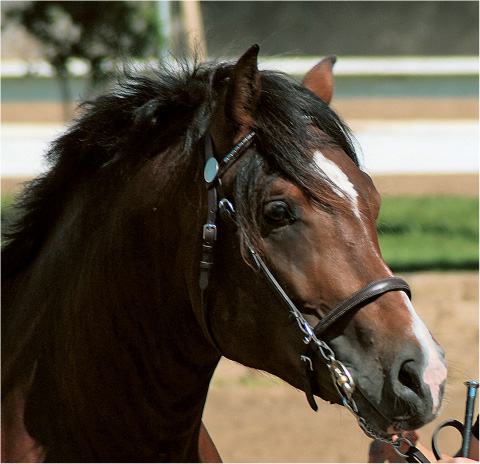
Welsh Cob (Section D) gelding exhibits the tapered head and small ears. Courtesy of Davidson Dales Farm
Welsh (Riding) Pony (Section B)
The Welsh Pony has all the physical and personality characteristics of the Section A Mountain Pony, but was originally added to meet the demand for a larger riding type pony. The same general description of the Welsh Mountain Pony can be applied to the Welsh Pony, with greater emphasis being placed on riding pony qualities while still retaining the true Welsh quality with substance. For generations these ponies were the hill farmers’ main means of transport, herding sheep and wild ponies over rough and mountainous country. They had to be hardy, balanced, and fast in order to survive, which ensured that only the best were bred from. These qualities, combined with a natural jumping ability and the temperament of their Welsh Mountain Pony forebears, make the Welsh Pony second to none in whatever field its rider may choose.
Today they hold their own among first class riding ponies, both in performance competitions and in the show ring. With the Welsh Mountain Pony as its foundation, the breed standard for Section B is the same as for Section A, but “more particularly the Section B pony shall be described as a riding pony, with quality, riding action, adequate bone and substance, hardiness and constitution and with pony character.” The Welsh Pony is well known for its beautiful trotting action and athletic ability but still retains the substance and hardiness of its Welsh Mountain Pony lineage.
Section B ponies do not exceed 14.2 hands in the United States (13.2 hands in the United Kingdom), but have no lower height limit.
Welsh Pony of Cob Type (Section C)
The Welsh Pony of Cob Type first resulted by crossing the Welsh mountain pony (Section A) and the Welsh Cob (Section D). Today, some Section C ponies are still produced from this cross. Other breeds also influenced the Section C, including the Norfolk Trotter, the Hackney, and Yorkshire Coach Horse.
Welsh Ponies of Cob Type are strong, hardy and active with pony character and as much substance as possible. They have bold eyes, strong laid back shoulders, dense hooves, a moderate quantity of silky feather, lengthy hindquarters and powerful hocks.
Cob Type Ponies differ from the Section A and B ponies in that they demonstrate a heavier or “cob-like” build, tend to have less dishing of the face in profile, and have clean limbs with silky feathering at the heels. Their movement is high stepping, but with good reach in the shoulder and impulsion from the hindquarters. They have a round barrel and compact back with good muscling.
The Welsh Ponies of Cob Type is considered to have a more independent character than the Section A or B, yet they are known for their gentle nature. They are easy keepers and have excellent endurance.
Today, this type is used mainly in harness for competitive driving, yet many are beautiful jumpers and can make wonderful children’s ponies. Their true worth has been more fully realized in the United States in recent years and their numbers have increased accordingly. Active, surefooted, hardy, and attractive, they are ideal for many purposes both for adults and children.
The Welsh Pony of Cob Type must not exceed 13.2 hands.
Welsh Cob (Section D)
Used as mounts for the British knights during the fifteenth century, the Welsh Cob was used to lead the mighty fighting horses, known as destriers. As the destrier’s natural gait was the trot, Welsh Cobs had to cover great distances matching the much taller warhorses stride for stride at the trot. To this day, their forceful, ground-covering trot is legendary.
On the upland farms of Wales, Welsh Cobs would often have to do everything from plowing a field to carrying a farmer to market or driving a family to church on Sunday. Up until the mid twentieth century, its substance made it a popular mount in the British Army and for pulling heavy guns and equipment through rugged terrain. Prior to the automobile, the Welsh Cob was the quickest and most reliable transport for doctors and businessmen.
Aptly described as “the best ride and drive animal in the world,” the Welsh Cob is well respected for its flashy trot, athletic prowess, and great endurance. Though they are the tallest and stockiest of the Welsh sections, the head remains full of pony character, with large eyes, and neat pony-like ears. Mature stallions have well formed necks with substantial crests giving the appearance of a strong and charismatic animal.
The legs should be relatively short, as it is still considered a pony type. Welsh Cob action must be straight, free, and forceful. The knees should be bent with the whole foreleg extended from the shoulders as far as possible with the hocks well flexed, producing powerful leverage.
Gray coloring is less common in both the Section C and D, but bold white markings are common.
The Welsh Cob is earning a sound reputation in both the hunter/jumper and dressage spheres, and many have had great success in the international driving scene. A strong and powerful animal, both Section C and D ponies have gentle natures and are extremely hardy. From backyard pony to internationally known sport horse, the Cob suits all needs. In the field of competition, the Welsh Cob is a tremendously competent athlete and is difficult to beat.
It should stand above 13.2 hands, and unlike any other Mountain and Moorland pony, there is no upper height limit.
Essential Points of Conformation For All Sections
• General character: Hardy, spirited and pony like
• Color: Any color except piebald and skewbald (pinto type spotting)
• Head: Small, clean-cut, well set on, and tapering to the muzzle
• Eyes: Bold, intelligent and expressive
• Nostrils: Prominent and open
• Jaw and throat: Clean and finely cut, with ample room at the angle of the jaw
• Neck: Lengthy, well carried, and moderately lean in the case of mares, but inclined to be “cresty” in the case of mature stallions
• Shoulders: Long and sloping well back. Withers moderately fine but not “knifey.” The humerus is upright so that the foreleg is not set in under the body.
• Forelegs: Set square and true and not tied in at the elbows. Long strong forearm, well developed knee, short flat bone below the knee, pasterns of proportionate slope and length, feet well shaped and round, and hooves dense.
• Back and loins: Muscular, strong and well coupled
• Girth: Deep and well formed
• Ribs: Well sprung
• Hind quarters: Lengthy and fine. Not cobby, ragged or goose-rumped. Tail well set on and carried gaily.
• Hind legs: Hocks to be large, flat and clean with points prominent to turn neither inwards nor outwards. The hind leg not to be too bent. The hock not to be set behind a line from the point of the quarter to the fetlock joint. Pasterns of proportionate slope and length. Feet well shaped, hooves dense.
• Action: Quick, free and straight from the shoulder, well away in front. Hocks well flexed with straight and powerful leverage and well under the body.
• Height: Section A not exceeding 12.2 hands; 12 hands in the UK
Section B not exceeding 14.2 hands; 13.2 hands in the UK
Section C not exceeding 13.2 hands
Section D exceeding 13.2 hands with no upper height restriction
Mares and foals must be DNA typed and stallions must have a standard Stallion Service Report.
Half-Welsh
The breeders of both fine light horses and smaller ponies have successfully crossed with Welsh Ponies and Cobs. With an unusually high capacity for transmitting their best qualities through carefully selected crosses, Welsh have been found to improve many performance lines. Registered Half-Welsh horses/ponies must have either a purebred Welsh sire or dam registered with the Welsh Pony and Cob Society of America.
Credit: Kelly Davidson Chow and Welsh Pony and Cob Society of America, Inc.